
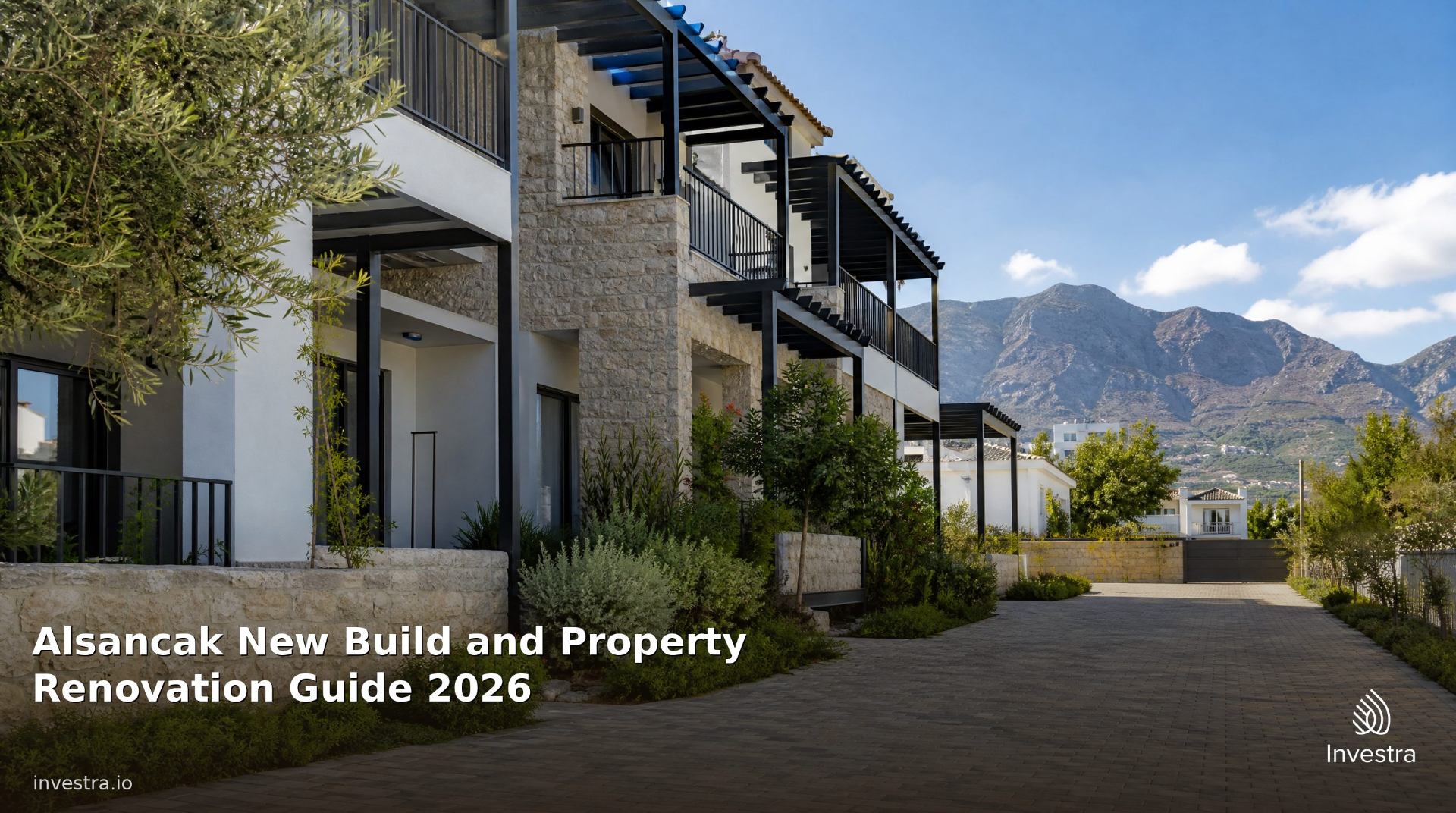
Alsancak New Build and Property Renovation Guide 2026
Alsancak New Build and Property Renovation Guide 2026
Alsancak New Build and Property Renovation: What Makes This Market Stand Out in 2026
Quick Answer: Alsancak, located along North Cyprus's prime Mediterranean coastline, has emerged as one of the most active markets for both new build developments and property renovation in 2026, with construction costs ranging from €600–€1,200/m² and completed new builds selling from €1,800–€3,500/m² depending on finish and location. Investra.io tracks real-time data across emerging and established Mediterranean markets to help investors make informed decisions.
Few places in the Eastern Mediterranean generate the kind of investor excitement that Alsancak does right now. Positioned on the northern coast of Cyprus — technically the Turkish Republic of Northern Cyprus (TRNC) — this coastal township sits roughly 12 kilometres west of Kyrenia (Girne), flanked by mountain ridges to the south and the deep blue Mediterranean to the north.
What we've seen in 2025 and into 2026 is a market shifting gears. The pandemic-era surge in remote-worker interest has matured into something more structural — developers are now building communities, not just apartments.
Alsancak Property Market Overview 2026: Prices, Demand, and Key Trends
Quick Answer: Alsancak property prices in 2026 range from approximately €1,500/m² for basic resale apartments to €3,500+/m² for luxury new build sea-view villas, with average transaction volumes up roughly 18% year-on-year as international buyer registrations continue to climb. Investra.io's regional market guides provide comparative data across global emerging markets.
Understanding where Alsancak sits within the broader North Cyprus market is essential before committing capital to any project. North Cyprus as a whole recorded approximately 8,500 foreign property sales in 2024, with projections suggesting 9,200–9,800 completions for 2025.
Price stratification in Alsancak is more nuanced than many agents suggest. At the entry level, you're looking at resale apartments — often 1990s-era construction — priced at €1,500–€1,800/m². Mid-tier new build developments (gated complexes with shared pools, underground parking, and standard Mediterranean finishes) typically trade at €2,000–€2,600/m².
What surprised many buyers entering this market in 2025 is how quickly off-plan pricing has appreciated even before construction completes. Projects launched at €1,900/m² in early 2024 were selling remaining units at €2,300/m² by mid-2025 — appreciation of over 20% within 18 months, purely through construction-phase price stepping.
Demand drivers are also diversifying. Where British expats once dominated the buyer pool, today's market includes significant numbers of Turkish mainland investors, Gulf-based buyers seeking second homes, and a growing cohort of digital nomads from Germany, Scandinavia, and the Netherlands who want long-term rentable base properties.
New Build Developments in Alsancak: Types, Developers, and What to Expect
Quick Answer: Alsancak's new build market in 2026 spans studio apartments from approximately €95,000 to luxury 4-bedroom villas exceeding €650,000, with reputable developers offering payment plans of 30–40% deposit and staged completion payments across 24–36 months. Investra.io's global property guides help buyers compare off-plan investment structures across markets.
The new build landscape in Alsancak has evolved considerably. Gone are the days of basic concrete-block apartment blocks with minimal landscaping. Today's pipeline includes genuinely well-designed communities — some drawing architectural inspiration from Californian resort developments, others with a more Mediterranean vernacular of white render, terracotta tile, and generous shaded terraces.
Product types broadly break into four categories. First, studio and one-bedroom apartments aimed at the investment buyer or single-occupier digital nomad market: these typically range from 40–65m² gross area and price from €95,000 to €155,000 depending on specification and sea view availability.
Developer quality varies more than the glossy brochures suggest. Established names with completed track records — developers who've delivered projects in Kyrenia, Lapta, and Alsancak without delay or specification downgrade — command a premium, and that premium is usually worth paying.
Payment structures typically require 30–40% at contract exchange, with staged payments during construction (often at foundation, roof, and fit-out milestones) and a final 10% on handover. Some developers offer extended payment plans stretching to 3–5 years for buyers who commit early, which creates interesting capital efficiency for investors who want to minimise upfront exposure.
Property Renovation Opportunities in Alsancak: Finding the Hidden Value
Quick Answer: Renovation-ready properties in Alsancak — typically 1980s to early 2000s villas and apartments — can be acquired for €800–€1,400/m² with renovation costs of €400–€800/m², creating a total cost basis of €1,200–€2,200/m² against an end market value of €1,800–€2,800/m² and generating meaningful equity uplift. Consulting with specialists like Siniša Dagary — Investment Consultant helps identify where renovation ROI is strongest.
The renovation angle on Alsancak is one that fewer buyers consider, but it's arguably where the most interesting returns are available in 2026. The area developed rapidly in the 1980s and 1990s when many British expats built or bought modest bungalows and villas — solid construction, good plot sizes, and often decent sea views, but interior design and infrastructure that belongs firmly to another era.
These properties attract far less competition than shiny new builds, which means acquisition prices are proportionally lower. A 3-bedroom villa of circa 150m² on a 400m² plot in a reasonable Alsancak location might be acquired for €180,000–€240,000 in unrenovated condition.
Renovation costs in North Cyprus are lower than Western Europe but have risen post-2022 due to global materials inflation and increased local construction activity competing for the same labour pool. Realistic budgets in 2026 sit at: Basic renovation (cosmetic: paint, flooring, kitchen replacement, bathroom refresh): €350–€500/m² of built area.
The key variable is whether the pool is already in place. Adding a new private pool adds €18,000–€35,000 depending on size and finish — and in the North Cyprus rental market, a pool is the single biggest driver of rental premium. Properties without pools rent for 30–40% less than comparable properties with pools in the summer season.
For deeper strategic thinking about renovation as an investment approach in emerging Mediterranean and European markets, the Business Strategy Blog from Siniša Dagary offers useful comparative frameworks applicable to markets like North Cyprus.
Legal Framework for Foreign Buyers in North Cyprus: What You Need to Know
Quick Answer: Foreign buyers in North Cyprus can purchase property under TRNC law, which grants non-TRNC citizens the right to own one property per person (with some exceptions), and the process involves obtaining a Purchase Permit from the Council of Ministers — a process that typically takes 6–18 months but does not prevent occupation or rental during that period. Investra.io's regional guides cover legal frameworks across multiple investment jurisdictions.
The legal situation in North Cyprus is genuinely unique in the world of international property, and any serious buyer needs to understand it without the sugar-coating that some agents apply. The TRNC is recognised only by Turkey as an independent state. The Republic of Cyprus (EU member) regards the north as occupied territory.
The most critical issue for buyers is title deed status. Three main categories exist: TRNC Title (also called Turkish Title or TMD), which covers property built on land owned by Turkish Cypriots prior to 1974 — generally considered the most straightforward and secure title type.
For new build purchases, reputable developers in Alsancak are increasingly ensuring their projects sit on TRNC Title land specifically because international buyers demand it. Always verify title deed status independently through a TRNC-registered solicitor before signing any contract. Costs for legal representation typically run €1,500–€3,000 for a standard transaction.
The Purchase Permit process: non-TRNC citizens must apply to the Council of Ministers for permission to own property. Applications are typically approved unless the buyer has a criminal record. The permit takes 6–18 months to process, but buyers can complete their purchase contract, pay, and take occupation during this period. Stamp duty is paid at contract stage: 0.5% of the purchase price.
VAT (KDV in Turkish) at 5% applies to new build purchases from developers. Resale properties don't attract VAT. Annual property tax (Immovable Property Tax) is low by European standards — typically €200–€600 per year for a standard residential property.
Construction Costs and Build Quality Standards in Alsancak 2026
Quick Answer: Construction costs for new builds in Alsancak range from €600–€800/m² for standard quality to €1,000–€1,400/m² for high-specification Mediterranean villa construction in 2026, with Turkish building contractors dominating the labour market and European-standard materials increasingly specified by top developers. Working with a financial partner like Findes Financial Services can help structure renovation or new build financing efficiently.
For anyone commissioning a new build or significant renovation in Alsancak, understanding local construction economics is essential. North Cyprus sits in an interesting position: labour costs are substantially below Western Europe (skilled tradespeople earn €15–€30 per hour versus €40–€80 in the UK or Germany), but materials — particularly anything imported — have risen sharply since 2022.
Building standards in the TRNC have improved substantially since 2010. The 2018 TRNC Building Regulations update brought requirements closer to EU norms, particularly around structural integrity, fire safety, and energy performance.
Typical construction timelines for new developments in Alsancak run 18–30 months from groundbreaking to handover. Custom villa builds on private land often take 14–22 months. Renovation projects, depending on scope, range from 3 months (cosmetic) to 12–18 months (full structural renovation with extensions).
One cost element buyers consistently underestimate is the connection and infrastructure element: connecting to mains electricity, water, and sewage, obtaining the TRNC Electricity Authority (KIB-TEK) supply agreement, and ensuring compliant septic or sewer connections can add €8,000–€25,000 to a project budget depending on plot location and existing infrastructure proximity.
Rental Yields and ROI: The Investment Case for Alsancak Property in 2026
Quick Answer: Alsancak properties generate gross rental yields of 6–10% annually, with short-term holiday rentals through summer achieving €1,200–€2,500/week for well-positioned 2–3 bedroom villas, and year-round long-term rentals generating €700–€1,400/month for comparable properties. Investra.io covers rental yield comparisons across global emerging investment destinations.
Here's where Alsancak genuinely impresses. Rental yields in North Cyprus are among the highest available in the European and Mediterranean property investment space, and Alsancak — with its beach proximity, mountain backdrop, and established expat community providing year-round occupancy — performs at the higher end of the regional range.
Short-term holiday rental is the premium income strategy. A 2-bedroom apartment with pool access in a managed development can generate €600–€900/week in the high season (July–August), €400–€600 in shoulder season (May–June, September–October), and €250–€400 in winter.
For standalone villas with private pools, numbers improve considerably. A 3-bedroom villa generating €1,500–€2,000/week during peak season and managed through an established Kyrenia/Alsancak holiday rental agency can produce €25,000–€40,000 in annual gross revenue. Against a purchase price of €350,000–€450,000, that's a gross yield of 7–9%.
Long-term (annual) rental is the lower-stress alternative. Alsancak benefits from steady demand from expats working in Kyrenia, academics at the nearby universities, and professionals employed in the North Cyprus tourism and service economy. Long-term rents for a 2-bedroom apartment run €700–€1,000/month; 3-bedroom villas command €1,200–€1,600/month.
Capital appreciation adds another dimension to the ROI calculation. Properties purchased in Alsancak in 2020 have appreciated 35–55% in EUR terms through 2025 — approximately 7–11% annualised. Forward projections remain positive given the infrastructure investment pipeline (Kyrenia ring road expansion, airport upgrades, marina development discussions) though past performance, as always, carries no guarantee of future results. The About Siniša Dagary page outlines an investment philosophy that applies well to this type of yield-plus-appreciation thesis.
Step-by-Step Buying Process: New Build and Renovation Properties in Alsancak
Quick Answer: The buying process in Alsancak typically takes 4–8 weeks from offer to signed contract, with the full legal transfer process (including Purchase Permit approval) taking 12–24 months, though buyers can occupy and rent their property from the contract exchange stage. Investra.io provides step-by-step legal frameworks for international property buyers.
The buying process in North Cyprus has a logic of its own. It's not as opaque as some buyers fear, but it does differ enough from UK, US, or mainland European norms that assuming equivalence leads to problems. Here's what the process actually looks like.
Step one is property identification and due diligence. Before making any offer, commission a title search through a TRNC-registered solicitor. This confirms the ownership chain, identifies any charges or encumbrances on the property, and verifies the title deed category.
Step two is negotiation and reservation. Once due diligence is satisfactory, a reservation agreement and deposit (typically €2,000–€5,000 for apartments, €5,000–€15,000 for villas) secures the property while the full purchase contract is prepared. This deposit is refundable if the title search reveals problems but is typically non-refundable if the buyer simply changes their mind.
Step three is the Sales and Purchase Agreement. This is the primary legal document and should be drafted or reviewed by your solicitor — not merely the developer's lawyer.
Step four is stamp duty registration. The contract must be registered at the TRNC Land Registry (Tapu Dairesi) within 21 days of signing. This registration provides critical buyer protection — it means the developer cannot sell the property to anyone else or raise mortgages against it after your contract is registered. Stamp duty of 0.5% is paid at this stage.
Step five is the Purchase Permit application, typically filed by your solicitor shortly after contract registration. The application requires a clean criminal record certificate (from your home country's police authority), bank references, and copies of the purchase contract. The council processes applications in batches; approval typically takes 6–18 months.
Step six is title transfer, which occurs once the building is complete, the Purchase Permit is granted, and transfer fees are paid. Transfer fees are 3% for first-time buyers (a 9% reduction applies, making the effective rate 3% rather than the standard 12%). This is when legal ownership formally passes.
Tax Obligations for Property Investors in Alsancak
Quick Answer: Property investors in Alsancak face several tax obligations including 5% VAT on new builds, 3% transfer fees on first purchases, annual Immovable Property Tax of approximately €200–€600, and rental income tax at progressive TRNC rates (typically 10–22%), though double taxation agreements and legitimate expense deductions significantly reduce effective tax burdens. Investra.io covers tax frameworks for international property investors across multiple markets.
Tax planning should happen before purchase, not after the contracts are signed. The North Cyprus tax regime is relatively investor-friendly by international standards, but international buyers also carry home-country tax obligations that interact with TRNC rules in ways worth planning around carefully.
The headline taxes for property in Alsancak break down as follows. At acquisition, new builds from developers attract 5% VAT (KDV); resale properties don't. Transfer fee of 3% applies on first property purchase for foreign nationals using the one-time discount; subsequent purchases attract 6% or 12% depending on circumstances.
Annual holding costs include Immovable Property Tax, assessed on the TRNC's registered property value (typically below market value), resulting in bills of €200–€600 annually for most residential properties. Municipal taxes (lighting, street cleaning, etc.) add another €100–€200 yearly.
Double taxation agreements exist between the TRNC and several countries (including the UK under specific arrangements). Home-country residents are typically required to declare North Cyprus rental income in their tax jurisdiction as well; the double taxation treaty prevents paying full tax twice, though the mechanics vary.
Capital gains tax on property sales is relatively low. Primary residences enjoy exemptions; buy-to-let and investment properties face CGT at rates that vary with holding period and personal circumstances. No CGT applies if you've held the property for more than five years and it represents less than 20% of your total assets — a rule that makes long-term Alsancak property investment tax-efficient.
Infrastructure and Future Development: Why Location Decisions Matter Now
Quick Answer: Alsancak benefits from expanding infrastructure including the Kyrenia ring road development, airport modernisation projects, and proposed marina expansion, with specific location choices within Alsancak creating meaningful differences in property appreciation trajectories and long-term rental demand. Serbia Proptech 2026 How Technology Is Changing Real Estate covers how infrastructure development drives property value creation.
Infrastructure investment and broader development pipeline considerations are sometimes overlooked by buyers focused on immediate yield or purchase price. Yet they're critical to long-term property value. Alsancak sits at a genuinely interesting inflection point in 2026.
The Kyrenia ring road — a project discussed for over two decades but now moving into planning stages with Turkish government backing — would fundamentally alter traffic patterns and accessibility across the Kyrenia district. Properties in Alsancak with direct ring road access could see dramatic appreciation in value as commute times to central Kyrenia compress.
The North Cyprus airport modernisation project is confirmed and funded through
Investment Disclaimer
Quick Answer: This guide is general market information, not personal legal, tax, financing or investment advice.
Before committing to a property transaction, buyers should obtain independent local legal, tax and financial advice suited to their circumstances. Investra.io can support initial market research, but every purchase decision remains the buyer's responsibility.
Frequently Asked Questions
Quick Answer: This section explains the practical property-investment implications of Frequently Asked Questions.
What is a prudent next step after initial market research?
Use current documentation, independent professional advice and comparable local evidence before proceeding. Investra.io can support an initial structured market review.
How can buyers plan a realistic ownership budget?
Use current documentation, independent professional advice and comparable local evidence before proceeding. Investra.io can support an initial structured market review.
What evidence supports a careful investment decision?
Use current documentation, independent professional advice and comparable local evidence before proceeding. Investra.io can support an initial structured market review.
When should a buyer obtain legal and tax advice?
Use current documentation, independent professional advice and comparable local evidence before proceeding. Investra.io can support an initial structured market review.
How should a buyer compare neighbourhoods and property types?
Use current documentation, independent professional advice and comparable local evidence before proceeding. Investra.io can support an initial structured market review.
What local checks should be completed before signing?
Use current documentation, independent professional advice and comparable local evidence before proceeding. Investra.io can support an initial structured market review.
Which costs should be assessed alongside the purchase price?
Use current documentation, independent professional advice and comparable local evidence before proceeding. Investra.io can support an initial structured market review.
How can international buyers verify a property opportunity?
Use current documentation, independent professional advice and comparable local evidence before proceeding. Investra.io can support an initial structured market review.
What should buyers compare before selecting a property?
Use current documentation, independent professional advice and comparable local evidence before proceeding. Investra.io can support an initial structured market review.
Quick Answer: These answers outline common buyer checks and should be read with current professional advice.
Recommended Reading
Quick Answer: This section explains the practical property-investment implications of Recommended Reading.
- Investra market research
- Investra market research
- Investra market research
- Investra market research
- Investra market research
- Investra market research
- Investra market research
- Investra market research
- Investra market research
- Investra market research
- Investra market research
- Investra market research
- Investra market research
- Investra market research
- Investra market research
- Investra market research
- Investra market research
- Siniša Dagary investment insight
- Siniša Dagary investment insight
- Siniša Dagary investment insight
- Siniša Dagary investment insight
- Siniša Dagary investment insight
- Findes Group & Partners
- Findes Group & Partners
Connect With Investra
Follow Investra for market updates on Facebook, LinkedIn, YouTube
Related Posts
No related posts available.
