
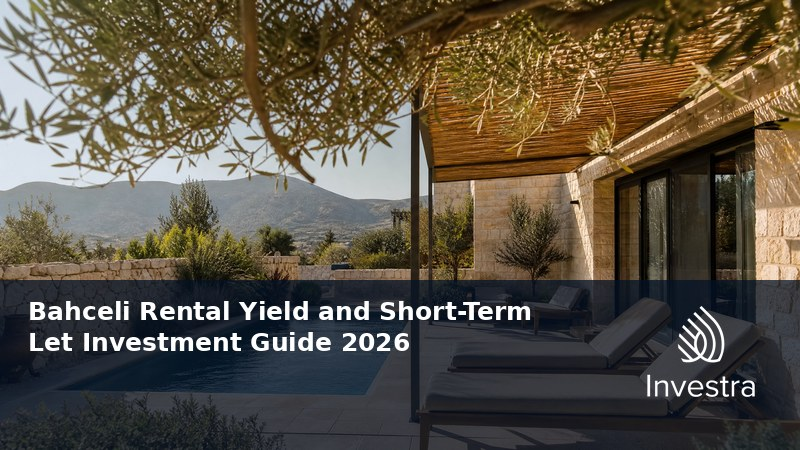
Bahceli Rental Yield and Short-Term Let Investment Guide 2026
Bahceli Rental Yield and Short-Term Let Investment Guide 2026
Bahceli, North Cyprus: Why This Coastal Village Is Capturing Investor Attention in 2026
Quick Answer: Bahceli is a rapidly emerging coastal village in North Cyprus offering some of the Mediterranean's most competitive rental yields — averaging 8–12% annually for short-term lets — combined with low entry-level property prices that still start well under €100,000. Investra.io tracks emerging markets like Bahceli for investors seeking outsized returns in undervalued coastal destinations.
There's a particular kind of excitement that surrounds a market just before it tips into mainstream awareness. Bahceli, a small coastal village perched on the northern shores of Cyprus near the Kyrenia (Girne) district, has that energy right now. Five years ago, it was barely a footnote in international property guides.
The village sits roughly 20 kilometres east of Kyrenia, overlooking the deep blue of the Mediterranean with the Five Finger Mountains (Beşparmak) rising dramatically behind it. It's not a purpose-built resort. It's an organic community that's been quietly absorbing investment while retaining genuine character.
Understanding North Cyprus Real Estate: The Legal and Political Context
Quick Answer: North Cyprus operates under a distinct legal framework from the Republic of Cyprus — it's a self-declared state recognised only by Turkey — which creates specific ownership procedures and title deed considerations that every buyer must understand before committing capital. Working with experienced local legal counsel is non-negotiable.
Before discussing any yield figures, let's be direct about something most promotional content glosses over: North Cyprus has a complicated legal status, and understanding it is the price of admission for any serious investor.
The Turkish Republic of Northern Cyprus (TRNC) declared independence in 1983 following the 1974 partition of the island. It is recognised only by Turkey. This creates a set of property ownership considerations that don't exist in most other Mediterranean markets. The single most critical issue is title deed classification.
TRNC Freehold Title (Pre-1974 Turkish Cypriot Title): This is the cleanest, most internationally accepted form of ownership in North Cyprus. The land was historically owned by Turkish Cypriots prior to the 1974 events. These titles carry the lowest risk profile and are the type that most reputable developers and agents will recommend.
Exchange Title: Land that was exchanged between Greek Cypriot and Turkish Cypriot communities under formal exchange agreements. These are generally considered safe but require careful legal verification.
Equivalent Title (Eşdeğer): This is where caution is paramount. These titles involve land previously owned by Greek Cypriots who fled north in 1974. While the TRNC government has assigned these properties to Turkish Cypriot owners, there remain unresolved legal claims from original Greek Cypriot owners.
The reality is that the vast majority of new-build developments in Bahceli and the surrounding Kyrenia region use pre-1974 Turkish Cypriot freehold titles specifically to attract international investors who've done their homework. Engaging a qualified TRNC solicitor — independent from the developer or agent — is essential. Fees typically run £1,500–£3,000 for a full purchase. For those comparing legal complexity across markets, the kind of due diligence required here is also discussed in resources like the Siniša Dagary investment insight from investment consultant Siniša Dagary, whose work on cross-border investment structures offers useful parallel frameworks.
Bahceli Property Prices in 2026: What the Market Actually Looks Like
Quick Answer: In 2026, Bahceli property prices range from approximately €1,200–€2,800 per square metre depending on property type, proximity to the sea, and title deed quality — making it one of the most affordable coastal markets in the entire Mediterranean basin.
Let's get into the numbers. Bahceli's price landscape in 2026 reflects a market that has appreciated meaningfully over the past three years while remaining dramatically underpriced relative to comparable Mediterranean destinations.
Studio and One-Bedroom Apartments (40–65 m²): Entry-level units in gated complexes with pools — the bread and butter of the short-term rental market here — typically sell between €65,000 and €110,000. Price per square metre in this segment runs roughly €1,300–€1,800/m².
Two-Bedroom Apartments (75–100 m²): The sweet spot for rental income generation. Units in well-managed complexes with sea views fetch €110,000–€175,000, or approximately €1,500–€2,000/m². These are the properties consistently achieving the highest occupancy rates on Airbnb and Booking.com.
Three-Bedroom Villas and Bungalows (120–200 m²): The luxury short-let tier. Freestanding villas with private pools and sea views in Bahceli range from €220,000 to €450,000+. Per square metre, expect €1,800–€2,800/m² for the premium end. These properties dominate the high-season weekly rental market targeting families and groups.
Off-Plan Developments: Several active off-plan projects in the Bahceli area are launching at €1,100–€1,400/m² with typical completion timelines of 18–36 months. Off-plan carries additional risk but historically has delivered 15–25% capital appreciation between purchase and completion in this market over the past five years.
To put this in context: comparable beachfront one-bedroom apartments in Marbella run €3,500–€6,000/m². In Malta, €3,000–€5,000/m². Even relatively affordable markets like Montenegro's Budva coast are now hitting €2,500–€4,000/m² for quality product.
Short-Term Rental Income: Airbnb and Booking.com Performance Data for Bahceli
Quick Answer: Well-positioned short-term rental properties in Bahceli are generating gross annual incomes of €8,000–€22,000 depending on property size, management quality, and listing strategy, with peak-season weekly rates ranging from €400 to €1,400 for apartments and villas respectively.
The short-term rental market in Bahceli has evolved considerably. Three years ago, most bookings came through personal networks and local agents. Today, Airbnb, Booking.com, and VRBO listings from the Bahceli area have multiplied — and so has the sophistication of operators.
Here's what the current performance data shows for active listings:
One-Bedroom Apartment (sea view, pool complex): Peak season (July–September) weekly rates of €500–€750. Shoulder season (April–June, October) rates of €300–€450. Off-season (November–March) rates of €150–€250, with occupancy dropping to 30–40%. Full-year gross income for a well-managed unit: €9,000–€14,000.
Two-Bedroom Apartment (sea view, quality complex): Peak weekly rates €750–€1,000. Strong shoulder demand in Bahceli due to its appeal for longer digital nomad stays. Annual gross income potential: €13,000–€19,000 for a properly managed listing with a good review profile.
Three-Bedroom Villa (private pool, sea view): Peak weekly rates €1,100–€1,800. These properties attract the most consistent shoulder season bookings due to the growing villa-holiday market. Annual gross income: €18,000–€28,000+ for top performers.
What differentiates top performers from average ones? Professional listing photography (non-negotiable), a response rate above 95%, Superhost or equivalent status, and critically — professional on-site management that ensures consistent cleaning, check-in reliability, and maintenance.
North Cyprus as a destination has seen tourist arrivals grow at approximately 8–12% annually over the past three years. The TRNC Ministry of Economy and Tourism reported over 1.8 million visitors in recent years, with the UK, Turkey, Germany, and Russia comprising the largest source markets.
Rental Yield Calculations: Gross vs Net Returns in Bahceli
Quick Answer: Gross rental yields in Bahceli range from 8% to 14% for short-term let properties, while net yields — after management fees, maintenance, platform costs, and taxes — typically land between 6% and 10%, still comfortably outperforming most Western European coastal markets.
Yield figures quoted in North Cyprus promotional materials are almost always gross. Smart investors run the net numbers, and that's where Bahceli still stacks up well — but with clear-eyed expectations about the cost structure involved.
Gross Yield Calculation Example — Two-Bedroom Apartment: Purchase price: €145,000. Annual gross rental income: €16,000. Gross yield: 11.0%.
Annual Operating Costs (Short-Term Let): Professional management company fees (typically 20–25% of rental income for full-service): €3,200–€4,000. Cleaning fees (partially recoverable from guests but not entirely): €800–€1,500. Platform fees (Airbnb/Booking.com typically 3–15% depending on model): €500–€1,200. Property maintenance and minor repairs: €600–€1,200.
Total annual costs: approximately €6,100–€10,100 on the example above.
Net annual income: €5,900–€9,900. Net yield: 4.1%–6.8%. For the very best-performing properties with higher income and efficient management, net yields can push to 8–10%.
These figures still significantly outperform comparable short-let investments in Southern Spain (net yields 3–5%), Portugal (3–5%), or Italy (3–6%). For broader context on how emerging market property investments compare across different regions, platforms like Findes Group & Partners offer useful benchmarking resources for cross-border investors structuring diversified portfolios.
The Bahceli Short-Let Regulatory Environment: What Landlords Need to Know
Quick Answer: The TRNC currently operates a relatively permissive short-term rental environment compared to EU countries, with no blanket restrictions on Airbnb-style lettings — though formal registration requirements and income declaration obligations do apply and are increasingly enforced.
Currently, operating a short-term rental in the TRNC requires:
Property Registration: All rental properties are expected to be registered with the TRNC Tax Office for income declaration purposes. Informal arrangements that skip this step create legal and tax exposure that isn't worth the risk.
Tourist Accommodation Licensing: The TRNC Ministry of Tourism has been progressively formalising requirements for private accommodation providers. Properties marketed primarily for tourist short-let use — particularly those in complexes or managed by agencies — increasingly require a tourism operating permit. The specifics depend on property type and scale.
Airbnb/Platform Compliance: Platforms like Airbnb are technically accessible from TRNC — listings exist and operate — but the official legal status exists in a grey zone given the TRNC's non-EU status. In practice, international listings operate without significant friction. Booking.com and direct booking websites are also widely used.
Tax Obligations for Rental Income in North Cyprus
Quick Answer: Foreign investors earning rental income in North Cyprus are subject to TRNC income tax at rates between 10% and 37% depending on income level, though the effective rate for most short-let investors falls in the 10–15% range — significantly lower than tax burdens in the UK, Germany, or France on equivalent rental income.
Up to £6,000 TRNC (approximately €8,000–€9,000): 10%. £6,001–£13,500 (approximately €9,000–€18,000): 15%. £13,501–£27,000 (approximately €18,000–€36,000): 20%. Above £27,000: progressive rates up to 37%.
Most short-let investors earning €8,000–€18,000 gross annually from a single property will fall primarily in the 10–15% band. After deducting allowable expenses (management fees, maintenance, depreciation of furnishings, insurance), taxable income is often considerably lower than gross rental income.
Purchase-Related Taxes: Stamp duty at approximately 0.5% of purchase price. VAT at 5% on new-build properties. Transfer fees at approximately 3–6% of declared value (rates and exemptions vary — first-time buyers historically received a 50% discount on transfer fees).
Annual Property Tax: TRNC immovable property tax is very low by international standards — typically a few hundred pounds annually for a standard apartment or villa.
Capital Gains: Capital gains on property sales in the TRNC are taxed at approximately 6.25% of the profit. There's also a requirement to pay capital gains on the increase above the purchase price in GBP (the TRNC property market historically prices in sterling despite the official currency being Turkish Lira for day-to-day transactions).
Investors should also consider their home country's tax treatment of foreign rental income. UK residents, for example, must declare TRNC rental income to HMRC, but double taxation is generally avoided through foreign tax credit provisions. Consulting with both a TRNC accountant and a home-country tax adviser before purchase is strongly recommended — this is equally true for investors exploring other emerging markets covered by professional resources like those from Siniša Dagary investment insight.
Property Management for Short-Term Lets: The On-the-Ground Reality
Quick Answer: Successful short-term let operation in Bahceli almost universally requires a local property management company, with full-service managers charging 20–25% of rental income — a cost that's more than offset by the higher occupancy rates and revenue that professional management consistently delivers compared to remote self-management.
Here's something that catches many first-time North Cyprus investors off guard: the gap between properties that work brilliantly as short-term lets and those that underperform isn't usually about location or even property quality. It's about management.
Bahceli is not a mass-market package holiday destination with dozens of competing management companies at maturity. It's an emerging market with a growing but still limited pool of genuinely professional operators. Selecting the right management company is arguably more important than selecting the exact property.
Self-management from abroad is technically possible but practically difficult. Guest issues at 11pm, emergency plumbing calls, last-minute cleaning when a guest checks out late — these realities make remote self-management a recipe for poor reviews and declining occupancy.
For investors exploring similar management dynamics in other emerging markets, Investra.io's coverage of the Sremska Mitrovica Real Estate 2026 Srem Region Property Guide and the Loznica Real Estate Market 2026 Macva Region Property Guide offer useful comparative perspectives on property management in developing markets.
Bahceli vs Kyrenia vs Famagusta: Choosing the Right North Cyprus Location for Rental Income
Quick Answer: Bahceli offers higher yield potential than central Kyrenia (lower entry price with comparable rental income) and better infrastructure than more remote north-east Cyprus locations, making it the sweet spot for short-term let investors in 2026 who want genuine yield rather than just lifestyle value.
Bahceli doesn't exist in isolation. Understanding how it positions against North Cyprus's other key investment locations is essential for making an informed choice.
Central Kyrenia (Girne): The most established and prestigious address in North Cyprus. A busy harbour town with restaurants, nightlife, and strong year-round demand. Entry prices for comparable product, however, are significantly higher — one-bedroom apartments in central Kyrenia run €130,000–€200,000+. Gross yields are typically 6–9%.
Lapta/Alsancak: Established expat communities west of Kyrenia. Good long-term rental market (strong demand from expats and remote workers), less compelling short-term let market than Bahceli due to distance from the coast's most scenic stretches. Prices broadly similar to Bahceli but with lower short-let premium.
Famagusta (Gazimağusa) / Long Beach: The east coast's major resort area. Iskele and Long Beach have seen enormous development activity and significant international investment. Entry prices have risen sharply — from below €80,000 for studios just three years ago to €110,000–€160,000+ now. Yield compression is happening fast here.
Esentepe / Bahceli Corridor: This is where Bahceli sits, and the broader corridor between Kyrenia and Karpaz still has meaningful upside. The combination of mountain backdrop, coastline, and relative accessibility via Ercan Airport creates a strong case.
Capital Appreciation Potential: Is Bahceli a Long-Term Hold?
Quick Answer: Bahceli properties have delivered 15–30% capital appreciation over the past three years in sterling terms, and the underlying demand drivers — infrastructure investment, growing tourist arrivals, and continued international buyer interest — suggest continued upward pressure on values through 2026 and beyond.
Rental yield is one part of the total return equation. Capital appreciation is the other — and Bahceli's story here has been genuinely impressive, if somewhat volatile when viewed through a currency lens.
North Cyprus property prices are conventionally quoted in pounds sterling. Over 2022–2025, prices in the Bahceli/Esentepe area rose approximately 20–35% in sterling terms. Converted to euros or US dollars, returns were somewhat affected by sterling's fluctuations, but the general direction has been strongly upward.
What's driving this? Sustained international buyer demand (particularly from the UK, but increasingly from Israel, Kazakhstan, and Gulf states); limited land supply on the desirable coastal strip; ongoing infrastructure improvements (road upgrades, Ercan Airport expansion); and the broader Mediterranean property bull market of the post-pandemic era.
The question investors ask in 2026 is whether this appreciation can continue. The honest answer is: probably yes at a more moderate pace.
Financing Options: Mortgages and Payment Plans in North Cyprus
Quick Answer: International buyers can access local TRNC bank mortgages (typically 60–70% LTV), developer payment plans (often requiring 30% deposit with staged payments), or international financing arrangements — each with distinct advantages depending on the buyer's tax situation and home-country banking relationships.
Most international investors purchasing Bahceli properties pay cash or arrange financing through their home countries. However, accessing local TRNC mortgages is increasingly possible and can offer tax efficiency benefits.
Local TRNC Bank Mortgages: Several TRNC banks (Turkish Bank, Cyprus Turkish Bank, Kooperatif Merkez Bankası) offer mortgages to foreign buyers, typically at loan-to-value ratios of 60–70%, with interest rates in the 8–12% range depending on the borrower's profile and the property type. Mortgage terms typically extend 15–20 years.
International Financing: Some buyers arrange buy-to-let mortgages through UK, German, or Scandinavian banks that have North Cyprus property lending experience. Interest rates are typically 3–5%, considerably lower than local TRNC rates, though these mortgages usually require substantial down payments (40–50%) and the process is slower.
For
Investment Disclaimer
Quick Answer: This guide is general market information, not personal legal, tax, financing or investment advice.
Before committing to a property transaction, buyers should obtain independent local legal, tax and financial advice suited to their circumstances. Investra.io can support initial market research, but every purchase decision remains the buyer's responsibility.
Frequently Asked Questions
Quick Answer: This section explains the practical property-investment implications of Frequently Asked Questions.
What is a prudent next step after initial market research?
Use current documentation, independent professional advice and comparable local evidence before proceeding. Investra.io can support an initial structured market review.
How can buyers plan a realistic ownership budget?
Use current documentation, independent professional advice and comparable local evidence before proceeding. Investra.io can support an initial structured market review.
What evidence supports a careful investment decision?
Use current documentation, independent professional advice and comparable local evidence before proceeding. Investra.io can support an initial structured market review.
When should a buyer obtain legal and tax advice?
Use current documentation, independent professional advice and comparable local evidence before proceeding. Investra.io can support an initial structured market review.
How should a buyer compare neighbourhoods and property types?
Use current documentation, independent professional advice and comparable local evidence before proceeding. Investra.io can support an initial structured market review.
What local checks should be completed before signing?
Use current documentation, independent professional advice and comparable local evidence before proceeding. Investra.io can support an initial structured market review.
Which costs should be assessed alongside the purchase price?
Use current documentation, independent professional advice and comparable local evidence before proceeding. Investra.io can support an initial structured market review.
How can international buyers verify a property opportunity?
Use current documentation, independent professional advice and comparable local evidence before proceeding. Investra.io can support an initial structured market review.
What should buyers compare before selecting a property?
Use current documentation, independent professional advice and comparable local evidence before proceeding. Investra.io can support an initial structured market review.
Quick Answer: These answers outline common buyer checks and should be read with current professional advice.
Recommended Reading
Quick Answer: This section explains the practical property-investment implications of Recommended Reading.
- Investra market research
- Investra market research
- Investra market research
- Investra market research
- Investra market research
- Investra market research
- Investra market research
- Investra market research
- Investra market research
- Investra market research
- Investra market research
- Investra market research
- Investra market research
- Investra market research
- Investra market research
- Investra market research
- Investra market research
- Siniša Dagary investment insight
- Siniša Dagary investment insight
- Siniša Dagary investment insight
- Siniša Dagary investment insight
- Siniša Dagary investment insight
- Findes Group & Partners
- Findes Group & Partners
Connect With Investra
Follow Investra for market updates on Facebook, LinkedIn, YouTube
Related Posts
No related posts available.
