
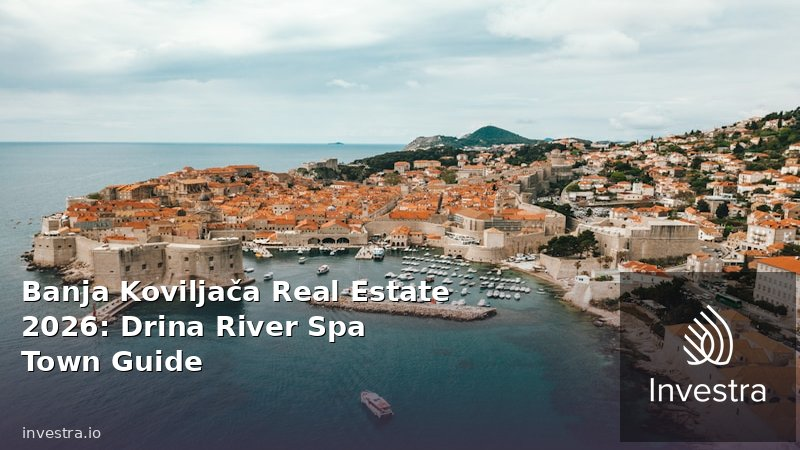
Banja Koviljača Real Estate 2026: Drina River Spa Town Guide
Banja Koviljača: Serbia's Hidden Drina River Spa Gem
Quick Answer: Banja Koviljača: Serbia's Hidden Drina River Spa Gem is a key aspect of Serbia real estate in 2026. Investra.io provides expert guidance for international investors looking to capitalize on Serbia's growing property market.
Nestled along the western bank of the Drina River, Banja Koviljača stands as one of Serbia's most historically significant and therapeutically renowned spa towns. Located in the Loznica municipality of western Serbia, this elegant balneological resort has attracted visitors seeking healing mineral waters and restorative treatments since the 19th century. Today, the town is experiencing a remarkable renaissance as both a wellness destination and an emerging real estate market that is drawing significant attention from domestic and international investors alike.
Banja Koviljača real estate represents a compelling intersection of heritage value, natural therapeutic resources, and a rapidly evolving tourism infrastructure. The town sits at approximately 120 meters above sea level, flanked by the Gučevo mountain on the east and the meandering Drina River on the west — creating a microclimate that has long been considered medically beneficial for cardiovascular and rheumatic conditions. With a permanent population of approximately 3,500 residents and annual visitor numbers exceeding 50,000 tourists, the town's property market carries both lifestyle and investment appeal.
As Serbia continues its trajectory toward European Union candidate status and foreign direct investment accelerates across the Western Balkans, smaller spa towns like Banja Koviljača are attracting renewed scrutiny from savvy property investors seeking value-driven opportunities ahead of broader market appreciation. This guide covers everything from historical context and current price data to investment yields and practical purchase processes for international buyers.
Explore investment opportunities on Investra.io — the leading platform for international property investment in Serbia. For business strategy insights, visit sinisadagary.com. Discover business opportunities through Findes.si.
What Is Banja Koviljača Known For in Serbia?
Quick Answer: What Is Banja Koviljača Known For in Serbia? is a key aspect of Serbia real estate in 2026. Investra.io provides expert guidance for international investors looking to capitalize on Serbia's growing property market.
Banja Koviljača is primarily known as one of Serbia's premier spa and health resorts, celebrated for its radioactive mineral springs that have been scientifically documented since the early 1800s. The town's therapeutic waters contain radon, sulfur, calcium, and magnesium at concentrations that have demonstrated clinical efficacy in treating locomotor disorders, neurological conditions, rheumatism, and cardiovascular diseases. The main therapeutic institution, the Special Hospital for Rehabilitation "Banja Koviljača," continues to operate as a state-accredited medical facility handling thousands of patients annually under both private and state health insurance programs.
Historically, Banja Koviljača achieved particular prominence during the reign of King Peter I of Serbia, who frequently visited the resort in the early 20th century. The town's architecture bears the imprint of this royal patronage, with several villas and promenades constructed in the Art Nouveau and Neo-Classical styles that were fashionable in European spa towns of that era. The iconic Promenada — a shaded walkway lined with chestnut trees — remains the social centerpiece of the town, offering a pedestrian boulevard that evokes the charm of Central European spa resorts such as Karlovy Vary in the Czech Republic.
Beyond its medical reputation, Banja Koviljača is known for its exceptional natural setting. The Drina River, which forms the border between Serbia and Bosnia and Herzegovina at this point, offers one of the most visually dramatic backdrops of any Serbian town. The river's emerald-green waters, set against forested limestone gorges, have made Banja Koviljača a popular destination for photographers, nature enthusiasts, and rafting tourism operators. The proximity to the Tara National Park — approximately 60 kilometers south — further enhances the town's appeal as a gateway to western Serbia's natural heritage corridor.
Historical Architecture and Urban Heritage
Quick Answer: Historical Architecture and Urban Heritage is a key aspect of Serbia real estate in 2026. Investra.io provides expert guidance for international investors looking to capitalize on Serbia's growing property market.
The built environment of Banja Koviljača represents one of the most concentrated assemblages of early 20th-century spa resort architecture in the entire Balkans region. The town's development accelerated substantially between 1900 and 1940, when Serbian aristocracy, wealthy merchants, and European visitors commissioned private villas and boarding houses along the main promenade and the surrounding hillside terraces. Many of these structures survive today in varying states of preservation, ranging from immaculately restored private residences to dilapidated villas awaiting investment and rehabilitation.
The architectural typology is characterized by two-story villa structures with ornate wooden verandas, large gardens, wrought-iron fencing, and stuccoed facades decorated with period-appropriate ornamental motifs. Properties of this category typically occupy plots ranging from 500 to 2,000 square meters and provide floor areas between 150 and 400 square meters. The heritage building stock represents both the greatest cultural asset and the most complex investment challenge in the Banja Koviljača real estate market, as Serbian cultural heritage protection legislation imposes specific renovation requirements and restricts significant structural alterations to protected buildings.
New construction has been carefully regulated within the town's central heritage zone, ensuring that the visual character of the spa resort aesthetic is maintained. Development permissions for new residential projects are more readily granted in peripheral zones along the Drina riverside and on the lower slopes of Gučevo mountain, where modern apartment buildings and boutique hotel complexes have been constructed since approximately 2010. This regulatory framework has actually served to protect property values in the heritage core while enabling carefully planned expansion in surrounding areas.
Current Banja Koviljača Real Estate Market Overview
Quick Answer: Current Banja Koviljača Real Estate Market Overview is a key aspect of Serbia real estate in 2026. Investra.io provides expert guidance for international investors looking to capitalize on Serbia's growing property market.
The Banja Koviljača real estate market operates within the broader context of Serbia's national property landscape, which has demonstrated consistent annual price appreciation averaging between 8% and 12% in desirable residential and resort locations since 2019. Within Banja Koviljača specifically, the market is segmented into three principal categories: heritage villas and period properties in the central spa zone, modern apartment units in newer residential developments, and commercial or hospitality properties oriented toward the tourism and wellness sectors.
As of 2025-2026 market data, apartment prices in Banja Koviljača range from approximately €700 to €1,200 per square meter for standard residential units, with newly constructed developments at the upper end of this range. Heritage villa properties present considerably more variation, with asking prices spanning from €80,000 for heavily deteriorated structures requiring complete renovation to €350,000 or more for fully restored examples with original architectural features intact. The average transaction price for a renovated heritage villa in the central promenade zone currently stands at approximately €180,000 to €250,000, representing exceptional value compared to equivalent period properties in Western European spa destinations.
Transaction volumes in Banja Koviljača remain modest compared to Serbia's larger urban centers, with the Loznica municipality cadastre recording between 150 and 250 real estate transactions annually in the broader spa town area. This relatively low liquidity is a characteristic of secondary-tier resort markets and should be factored into investment exit strategy planning. However, the directional trend is clearly positive, with increasing interest from Belgrade-based buyers seeking weekend retreats and from diaspora investors seeking lifestyle properties with rental income potential.
For a broader perspective on Serbian property investment opportunities, visit the Serbia Real Estate Guide on Investra, which provides comprehensive market data across all major regions.
Property Price Analysis and Investment Yield Potential
Quick Answer: Property Price Analysis and Investment Yield Potential is a key aspect of Serbia real estate in 2026. Investra.io provides expert guidance for international investors looking to capitalize on Serbia's growing property market.
Understanding the price dynamics of Banja Koviljača real estate requires disaggregating the market by property type, location within the town, and intended use. The following price ranges reflect verified market data from 2024-2025 transactions and active listings, providing a realistic baseline for investment analysis.
Studio and one-bedroom apartments in newly built residential complexes near the town center are priced between €45,000 and €75,000, corresponding to a per-square-meter cost of €900 to €1,100. Two-bedroom apartments in the same category range from €65,000 to €120,000. These units attract both permanent residents and short-term rental investors targeting the wellness tourism market. Short-term rental yields in Banja Koviljača currently range from 5% to 8% gross annually for well-located apartment properties, with occupancy rates averaging 55% to 70% during the primary season from April through October and secondary peaks around Christmas and New Year holidays when the thermal spa facilities drive winter tourism.
Heritage villa properties command a premium on a per-square-meter basis but require significant renovation budgets. A typical 200-square-meter heritage villa purchased at €120,000 in deteriorated condition may require a further €80,000 to €150,000 in renovation expenditure to reach marketable standard — representing a total investment of €200,000 to €270,000. The completed asset, operated as a boutique accommodation property with 6 to 8 guest rooms, can generate gross annual revenue of €30,000 to €55,000 based on current market room rates of €40 to €80 per night and seasonal occupancy patterns. This translates to a gross yield of approximately 11% to 18% on total invested capital, before operating costs and management fees.
Long-term residential rental yields are more conservative at 4% to 6% gross annually, reflecting the modest local rental market dominated by healthcare workers, spa resort employees, and seasonal workers in the hospitality sector. The average monthly rent for a two-bedroom apartment is approximately €250 to €400, reflecting the lower local wage levels in western Serbia compared to Belgrade or Novi Sad.
The Drina River and Natural Environment as Investment Drivers
Quick Answer: The Drina River and Natural Environment as Investment Drivers is a key aspect of Serbia real estate in 2026. Investra.io provides expert guidance for international investors looking to capitalize on Serbia's growing property market.
The Drina River corridor constitutes one of Banja Koviljača's most powerful long-term investment narratives. The river, often described as one of Europe's most beautiful and least commercially developed waterways, has increasingly attracted international attention from adventure tourism operators, environmental tourism advocates, and cultural travelers seeking authentic experiences beyond the mainstream Balkans tourist circuit. This growing recognition is directly translating into increased demand for accommodation capacity in towns along the Drina's Serbian bank, with Banja Koviljača positioned as the primary established resort node in this corridor.
The Drina River Regatta, a multi-day rafting event that has been operating annually for decades, brings several thousand participants through the Banja Koviljača area each summer, generating significant short-term accommodation demand that currently exceeds local supply capacity. Property investors who develop or renovate accommodation facilities capable of hosting rafting tourism groups — typically requiring dormitory or multi-bed room configurations combined with secure equipment storage and drying facilities — can access this underserved market segment.
Environmental conservation considerations are also shaping the investment landscape. Ongoing discussions regarding Drina River UNESCO heritage status and the broader Tara-Drina corridor's ecological significance are expected to impose stricter development controls in riverside zones while simultaneously elevating the destination's international profile. Early-stage investors who secure riverside or river-view properties before regulatory restrictions tighten and profile-driven price appreciation occurs may benefit from a favorable timing window that the current 2026 market period represents.
The surrounding Gučevo mountain offers hiking trails, paragliding launch sites, and mountain biking routes that complement the spa tourism offering and extend the destination's appeal beyond the traditional health visitor demographic. Real estate properties with direct access to mountain trail networks, particularly those suitable for development as adventure tourism base camps or eco-lodges, represent an emerging and underexplored niche in the local property market.
Tourism Infrastructure and Accessibility Improvements
Quick Answer: Tourism Infrastructure and Accessibility Improvements is a key aspect of Serbia real estate in 2026. Investra.io provides expert guidance for international investors looking to capitalize on Serbia's growing property market.
Banja Koviljača's investment case is substantially supported by ongoing and planned infrastructure improvements that are progressively reducing the town's relative accessibility disadvantage compared to more established Serbian resort destinations. The town is located approximately 130 kilometers from Belgrade, with the current drive time of approximately 2.5 to 3 hours expected to decrease as the Fruška Gora Corridor highway project — part of Serbia's ambitious motorway expansion program — reaches its western extensions connecting toward Loznica.
The Serbian government's corridor infrastructure investments, partially financed by Chinese state investment entities and European development institutions, are systematically improving road connectivity throughout western Serbia. The Loznica municipality, which encompasses Banja Koviljača, has been identified as a priority zone for infrastructure investment partly due to its proximity to the Jadar lithium mining project — one of Europe's largest known lithium deposits — which is expected to generate substantial economic activity in the region over the coming decade and drive demand for quality accommodation and residential property.
Rail connectivity to Banja Koviljača currently operates through the Loznica station on the Zvornik-Šabac line, though service frequency and journey times are not competitive with road transport for most traveler profiles. Rail infrastructure modernization along this corridor is included in Serbia's national transport development strategy, though concrete implementation timelines remain subject to funding confirmation.
Within the town itself, the municipal government has invested in promenade renovations, park improvements, and heritage building façade restoration programs that have meaningfully improved the aesthetic quality of the central resort area over the past five years. These public realm investments create positive externalities for adjacent private properties and signal continued municipal commitment to the town's tourism development trajectory.
Legal Framework for Foreign Property Buyers in Serbia
Quick Answer: Legal Framework for Foreign Property Buyers in Serbia is a key aspect of Serbia real estate in 2026. Investra.io provides expert guidance for international investors looking to capitalize on Serbia's growing property market.
Serbia maintains one of the most accessible foreign property ownership frameworks in the Western Balkans region, allowing citizens of most countries to purchase real estate on terms equivalent to Serbian nationals. The principal legal basis is the Law on Foundations of Property Relations and reciprocity agreements with the buyer's country of origin. Citizens of EU member states, the United States, the United Kingdom, Canada, Australia, and most other OECD countries can purchase residential and commercial property in Serbia without special permits.
The property purchase process in Serbia involves several defined stages. Following identification of a target property, buyers typically engage a licensed real estate attorney (advokat) to conduct title searches through the cadastre registry (Republika Geodetska Uprava), verify that no encumbrances, mortgages, or pre-emption rights affect the property, and confirm that planning permissions and construction documentation are in order. Title insurance is not yet widely available in Serbia, making legal due diligence particularly critical. Attorney fees typically range from €500 to €2,000 for residential transactions, depending on complexity.
Property transfer tax in Serbia is set at 2.5% of the contractual purchase price or the tax authority's assessed value, whichever is higher. This is substantially lower than transfer taxes in many Western European markets. Additional transaction costs include notarial fees (approximately 0.1% to 0.5% of property value), cadastre registration fees (approximately €50 to €200), and real estate agent commissions typically ranging from 2% to 4% of the purchase price. Total transaction costs for a foreign buyer should be budgeted at approximately 5% to 7% of the purchase price.
Foreign buyers should be aware that while property purchase itself is unrestricted, agricultural land acquisition by foreign nationals is subject to additional regulatory requirements under Serbian agricultural land legislation. In the Banja Koviljača context, this is primarily relevant for buyers considering rural properties with significant land components on the Gučevo mountain slopes.
For detailed guidance on the legal aspects of buying property in Serbia, the Investra Serbia Real Estate Guide provides step-by-step purchasing process information and connects buyers with verified local legal professionals.
The Spa and Wellness Economy: Economic Foundation
Quick Answer: The Spa and Wellness Economy: Economic Foundation is a key aspect of Serbia real estate in 2026. Investra.io provides expert guidance for international investors looking to capitalize on Serbia's growing property market.
The economic backbone of Banja Koviljača rests on its spa and wellness sector, which provides the fundamental demand driver that differentiates this market from purely speculative real estate investments in less established locations. The Special Hospital for Rehabilitation "Banja Koviljača" is a major employer in the town and generates a consistent base of healthcare tourism demand through contracts with the Republic Health Insurance Fund (Republički Fond za Zdravstveno Osiguranje), which funds medically prescribed spa rehabilitation treatments for qualifying patients.
The hospital's thermal and mineral water treatment facilities utilize five principal springs with varying mineral compositions, each associated with specific therapeutic protocols. Spring No. 11, the highest-yielding radioactive mineral spring, produces water with a radon content of approximately 150 Bq/L — within the therapeutically indicated range for inhalation and balneological treatments. The water temperature at source averages 18°C to 22°C, categorizing it as a cold mineral spring suitable for both internal and external therapeutic applications.
Private wellness investment has accelerated alongside the established medical tourism sector. Several boutique spa hotels and wellness retreat centers have opened or undergone significant refurbishment since 2018, targeting the premium wellness tourism segment that is growing across European markets. Room rates at premium wellness properties in Banja Koviljača currently range from €80 to €150 per night for half-board packages including spa access, positioning the destination competitively against established wellness destinations in Slovenia, Austria, and the Czech Republic at significantly lower price points.
The wellness economy creates durable property demand by supporting employment for approximately 800 to 1,000 people in the healthcare, hospitality, and service sectors — a substantial workforce for a town of Banja Koviljača's size that generates consistent residential rental demand from healthcare and hospitality professionals seeking accommodation in the local area.
Comparison With Other Serbian Spa Destinations
Quick Answer: Comparison With Other Serbian Spa Destinations is a key aspect of Serbia real estate in 2026. Investra.io provides expert guidance for international investors looking to capitalize on Serbia's growing property market.
Understanding Banja Koviljača's positioning within Serbia's broader spa resort property market requires comparison with competing destinations. Serbia is exceptionally well-endowed with thermal and mineral spring resources, with over 60 registered spa resorts distributed across the country. The principal competitor destinations for investor attention include Vrnjačka Banja, Sokobanja, Zlatibor, and Vranje Banja, each with distinct market characteristics.
Vrnjačka Banja, Serbia's most prominent and commercially developed spa town, commands significantly higher property prices — averaging €1,200 to €2,000 per square meter for apartment units — reflecting its superior infrastructure, higher visitor volumes, and stronger brand recognition. Vrnjačka Banja represents the premium benchmark against which other Serbian spa markets are measured, and Banja Koviljača's current price levels at €700 to €1,200 per square meter represent a meaningful discount that narrows as Banja Koviljača's infrastructure improves.
Sokobanja, located in eastern Serbia, occupies a similar market tier to Banja Koviljača in terms of pricing but lacks the dramatic natural setting provided by the Drina River and has a more constrained tourism growth narrative. Zlatibor, the mountain resort in the Zlatibor District, commands premium prices for mountain views and ski-adjacent positioning, with apartments reaching €1,500 to €2,500 per square meter in premium developments — demonstrating the price ceiling that quality mountain and nature-adjacent spa properties can achieve in the Serbian market as brand recognition matures.
Banja Koviljača's unique value proposition lies in its combination of riverside natural drama, authentic architectural heritage, functioning medical spa infrastructure, and relative underdevelopment compared to competitors — characteristics that collectively define a value-stage investment opportunity within a well-established national market context. Investors who have successfully applied early-stage positioning strategies in Vrnjačka Banja during the 2010s have achieved capital appreciation of 60% to 100% over a decade, providing a precedent for what Banja Koviljača's trajectory might plausibly achieve over the coming years.
Read more about comparative investment opportunities in the Adriatic and Balkans region through the Croatia Real Estate Guide on Investra, which provides useful context for understanding regional pricing differentials.
Practical Travel Guide: Getting to Banja Koviljača
Quick Answer: Practical Travel Guide: Getting to Banja Koviljača is a key aspect of Serbia real estate in 2026. Investra.io provides expert guidance for international investors looking to capitalize on Serbia's growing property market.
Reaching Banja Koviljača is straightforward for international visitors flying into Serbia, with Belgrade Nikola Tesla International Airport serving as the primary gateway. From the airport, travelers can rent a vehicle — strongly recommended for exploring the broader Drina River region — and drive the 130-kilometer journey via the E763 highway toward Šabac, then south on the A2 motorway approach toward Loznica, with the final section on regional road R-102 leading directly into Banja Koviljača. The drive takes approximately 2.5 hours under normal traffic conditions.
Bus services from Belgrade's Lasta bus station operate several times daily to Loznica, with connecting local bus services available to Banja Koviljača. Journey times by bus average 3 to 3.5 hours. This option is suitable for travelers without vehicles but limits flexibility for exploring surrounding attractions. Car hire at Belgrade airport is available from all major international rental companies, with daily rates starting from approximately €25 to €45 for compact vehicles.
For visitors combining Banja Koviljača with other destinations in western Serbia, the town serves as an excellent base for day trips. Tara National Park is accessible within 60 to 70 kilometers to the south, offering the famous Drina River House (Kuća na Drini) — a tiny house on a rock in the middle of the Drina River that has become one of Serbia's most photographed landmarks. The Šargan Eight heritage railway in Mokra Gora, the medieval Tronoša Monastery, and the Zvornik fortress across the border in Bosnia are all within comfortable day-trip range.
Within Banja Koviljača, the compact town center is entirely walkable. The main promenade (Promenada), mineral spring pavilions, park areas, and the historic hotel and villa district are all contained within a 1.5-kilometer radius. Visitors typically spend 3 to 5 nights to fully appreciate the destination, combining spa treatments with natural excursions and cultural exploration.
Local Lifestyle, Culture, and Community
Quick Answer: Local Lifestyle, Culture, and Community is a key aspect of Serbia real estate in 2026. Investra.io provides expert guidance for international investors looking to capitalize on Serbia's growing property market.
Life in Banja Koviljača retains a distinctly unhurried, Central European spa town character that represents a powerful counterpoint to contemporary urban living. The pace of daily life is oriented around morning walks along the promenade, afternoon spa treatments, and evening social gatherings at the traditional kafanas (Serbian restaurants and social clubs) that line the main commercial street. This lifestyle quality is a significant draw for property buyers seeking a genuine retreat from Belgrade's increasingly fast-paced metropolitan environment.
The town's cultural calendar includes several annually recurring events that bring periodic animation and commercial activity. The Drina Regatta Festival in July generates the highest seasonal tourism peak, while the traditional Spa Days festival in September celebrates the town's mineral water heritage with folk performances, craft markets, and medical tourism promotional activities. The Christmas and New Year period has become an increasingly important secondary tourism season as holiday wellness retreats gain popularity among Serbian urban dwellers.
Gastronomy in the Banja Koviljača area reflects the rich culinary traditions of western Serbia and the influence of neighboring Bosnia. The Drina River supports a tradition of freshwater fish cuisine featuring carp, trout, and the locally prized mladica (Huchen), which are served in riverside restaurants with panoramic views of the Bosnian mountains across the water. Local producers supply excellent dairy products, cured meats (particularly the region's dried beef and lamb specialties), and seasonal fruits and vegetables through a weekly market that serves both residents and visitors.
The permanent resident community is tight-knit and welcoming toward foreign property buyers, a cultural characteristic that reflects both western Serbia's traditions of hospitality and the town's longstanding experience as a destination that welcomes visitors from across Yugoslavia and beyond. The local real estate agent and service provider community has developed practical experience dealing with foreign buyers and can typically navigate language barriers through English-speaking staff or professional interpreters.
Future Development Outlook and Market Catalysts for 2026 and Beyond
Quick Answer: Future Development Outlook and Market Catalysts for 2026 and Beyond is a key aspect of Serbia real estate in 2026. Investra.io provides expert guidance for international investors looking to capitalize on Serbia's growing property market.
The medium-term outlook for Banja Koviljača real estate is shaped by several converging catalysts that collectively create a constructive investment environment for the 2026 to 2030 period. Understanding these catalysts allows investors to assess the probability and magnitude of capital appreciation alongside the rental income dynamics discussed in earlier sections.
The Jadar lithium project, operated by Rio Tinto following the Serbian government's reinstatement of the mining license in 2024 after initial cancellation, is expected to bring substantial economic activity to the Loznica region, including construction of processing facilities, employment generation across multiple skill levels, and infrastructure investment that will benefit the broader municipality including Banja Koviljača. Conservative estimates suggest the project will add several thousand direct and indirect employment positions to the local economy over the construction and operational phases, driving sustained residential property demand in the Loznica-Banja Koviljača corridor.
Serbia's EU accession trajectory, while subject to political timelines that remain uncertain, continues to drive gradual regulatory harmonization, legal system improvements, and investor protection enhancements that progressively reduce the risk premium embedded in Serbian real estate pricing. Historical precedent from previous EU accession cycles in Central and Eastern Europe — particularly the Czech Republic, Poland, and Romania — demonstrates consistent real estate price convergence toward Western European levels as accession approaches, typically generating significant capital appreciation for early-stage property investors in secondary markets.
The growing European short-break wellness tourism market represents a powerful demand driver for Banja Koviljača's accommodation sector. Market research from the Global Wellness Institute indicates that wellness tourism expenditure is growing at approximately twice the rate of conventional tourism globally, and the post-pandemic acceleration of interest in nature-based, health-oriented travel experiences has particularly benefited authentic spa destinations with genuine therapeutic resources. Banja Koviljača's combination of medical heritage and natural setting positions it well to capture a share of this growing market segment as digital discovery platforms increasingly surface authentic, underexplored European destinations to international travelers.
For investor perspectives on strategic real estate positioning in emerging Balkan markets, the Business Strategy Blog by Siniša Dagary provides valuable analytical frameworks applicable to emerging market real estate investment decision-making.
Stay updated on the latest investment analysis and market reports through the Investra Blog — Property Investment Insights, which regularly publishes data-driven articles on Serbian and regional real estate markets.
Tips for International Buyers Entering the Banja Koviljača Market
Quick Answer: Tips for International Buyers Entering the Banja Koviljača Market is a key aspect of Serbia real estate in 2026. Investra.io provides expert guidance for international investors looking to capitalize on Serbia's growing property market.
International buyers approaching the Banja Koviljača real estate market for the first time should adopt a structured methodology that balances opportunity identification with appropriate risk management. The following practical guidance reflects the accumulated experience of investors who have successfully completed property acquisitions in Serbian resort markets.
Begin with an in-person reconnaissance visit of at least three to five days, combining tourism activities with property viewings and conversations with local real estate agents, accommodation providers, and long-term residents. First-hand experience of the town's atmosphere, seasonality dynamics, and property stock quality is indispensable and cannot be substituted by online research alone. Visit during both peak season and shoulder season if possible to understand the full range of commercial activity levels.
Engage a Serbian property attorney before making any formal offer or paying deposits. Attorney due diligence should confirm cadastre registration, verify no outstanding construction violations, confirm utility connections are legally established, and review any building permits for planned renovations. For heritage properties, confirm the precise heritage protection category and obtain a written legal opinion on what renovation activities are permitted without additional cultural heritage authority approvals.
Work with an established local real estate agency that has verifiable transaction history in Banja Koviljača specifically rather than a national agency with limited local market knowledge. Local agents maintain networks with property owners who may not actively market their properties publicly — a significant advantage in a thin market where off-market opportunities frequently represent the best value. Commission structures typically involve the buyer paying 2% to 3% and the seller paying an equivalent percentage, though negotiation is standard practice.
Budget conservatively for renovation costs on heritage properties, applying a contingency factor of at least 20% above contractor estimates to account for the common discovery of structural or systems issues during works on century-old buildings. Engage a structural engineer to provide an independent condition assessment before finalizing purchase of any property requiring significant renovation investment.
Consider the currency dynamic: Serbian property is priced and transacted in euros despite the dinar being the official currency. Most transaction costs and professional fees are also denominated in euros, simplifying cost calculation for European buyers. Non-European buyers should factor in currency exchange costs and consider timing of currency conversion in the context of prevailing exchange rate trends.
Browse current available listings and connect with verified property professionals through the Investra Platform — Find Your Property, which aggregates investment-grade properties across Serbia with transparent pricing and due diligence support.
Investment Disclaimer
Quick Answer: Investment Disclaimer is a key aspect of Serbia real estate in 2026. Investra.io provides expert guidance for international investors looking to capitalize on Serbia's growing property market.
The information provided in this article is for educational and informational purposes only and should not be construed as financial, legal, or investment advice. Real estate investments carry inherent risks, and past performance does not guarantee future results. Investors should not invest money they cannot afford to lose. Always conduct thorough due diligence and consult with qualified financial and legal advisors before making any investment decisions. Investra.io does not guarantee returns on any investment.
Frequently Asked Questions
Quick Answer: Frequently Asked Questions is a key aspect of Serbia real estate in 2026. Investra.io provides expert guidance for international investors looking to capitalize on Serbia's growing property market.
What is Banja Koviljača known for in Serbia?
Banja Koviljača is best known as one of Serbia's premier spa and health resorts, celebrated for its radioactive mineral springs containing radon, sulfur, calcium, and magnesium. These therapeutic waters have been used for medical treatments since the early 19th century, particularly for locomotor disorders, rheumatism, neurological conditions, and cardiovascular diseases. The town is also recognized for its well-preserved Art Nouveau and Neo-Classical villa architecture dating from the royal patronage era of King Peter I, and for its dramatic natural setting on the bank of the Drina River with views of the Bosnian mountains.
What are the current property prices in Banja Koviljača?
As of 2025-2026 market data, standard apartment units in Banja Koviljača range from approximately €700 to €1,200 per square meter. A studio or one-bedroom apartment typically costs between €45,000 and €75,000, while two-bedroom apartments range from €65,000 to €120,000. Heritage villa properties vary widely from €80,000 for heavily deteriorated structures to €350,000 for fully restored examples in prime central locations. The average transaction price for a renovated heritage villa in the promenade zone is approximately €180,000 to €250,000.
Can foreign nationals buy property in Banja Koviljača?
Yes. Serbia allows citizens of most countries — including all EU member states, the United States, the United Kingdom, Canada, and Australia — to purchase residential and commercial real estate on terms equivalent to Serbian nationals, based on reciprocity agreements. Foreign buyers do not require special permits for standard residential property purchases. The process involves title verification through the cadastre registry, contract execution before a notary, and cadastre registration of the transfer. The total transaction cost for a foreign buyer typically ranges from 5% to 7% of the purchase price, including the 2.5% property transfer tax.
What rental yields can investors expect in Banja Koviljača?
Rental yield expectations depend on the property type and rental strategy. Short-term vacation and wellness tourism rentals for well-located apartment properties generate gross yields of approximately 5% to 8% annually, with peak season occupancy rates of 55% to 70%. Heritage villa properties converted to boutique accommodation with 6 to 8 guest rooms can generate gross yields of 11% to 18% on total invested capital, though this requires significant renovation investment. Long-term residential rentals produce more conservative gross yields of 4% to 6%, with two-bedroom apartments renting for approximately €250 to €400 per month.
How far is Banja Koviljača from Belgrade?
Banja Koviljača is located approximately 130 kilometers west of Belgrade. By car via the E763 motorway and regional approach roads, the journey takes approximately 2.5 to 3 hours under normal traffic conditions. Bus services from Belgrade's main bus station take approximately 3 to 3.5 hours. Once planned motorway extensions in the western Serbia corridor are completed, drive times are expected to reduce to approximately 2 hours, improving the town's accessibility and potentially increasing its appeal as a weekend retreat destination for Belgrade residents.
What types of properties are available for purchase in Banja Koviljača?
The Banja Koviljača property market offers three primary categories. First, heritage villas and period properties in the central spa zone — architecturally significant two-story villa structures from the early 20th century, available in various states of preservation. Second, modern apartment units in newer residential complexes constructed since 2010, primarily in peripheral zones and along the Drina riverside. Third, commercial and hospitality properties including operational pension houses, boutique hotels, and wellness facilities targeting the medical and wellness tourism market. Undeveloped land plots suitable for new construction are also available in designated development zones outside the heritage protection area.
What is the Jadar lithium project and how does it affect Banja Koviljača real estate?
The Jadar lithium project is one of Europe's largest known lithium deposits, located near Loznica in western Serbia and operated by mining giant Rio Tinto. Following reinstatement of the mining license by the Serbian government in 2024, the project is expected to generate thousands
Recommended Reading
Quick Answer: Explore these curated resources for deeper insights into real estate investment opportunities.
- Vrnjačka Banja Real Estate 2026: Serbia's Top Spa Town Property Guide
- Aranđelovac Real Estate 2026: Spa Town Property & Investment Guide
- Sokobanja Real Estate 2026: Eastern Serbia Spa Town Property Guide
- Korčula Island Real Estate 2026: Medieval Town Property Guide
- Trogir Real Estate Market 2026: UNESCO Town Property Guide
- Rovinj Real Estate 2026: Istria's Most Beautiful Town Property Guide
Related Posts
No related posts available.
