
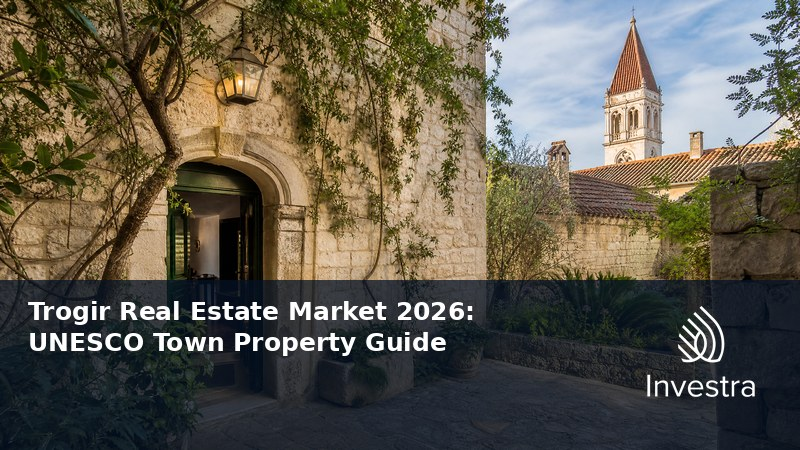
Trogir Real Estate Market 2026: UNESCO Town Property Guide
Trogir Real Estate Market 2026: An Overview of Croatia's UNESCO Gem
Quick Answer: Trogir's real estate market in 2026 offers property prices ranging from €2,500/m² for standard apartments to over €6,000/m² for premium waterfront and historic old town properties, making it one of Dalmatia's most compelling investment destinations. Croatia Real Estate Investment Guide 2026 provides the latest market data for serious investors.
Trogir stands as one of the Adriatic coast's most extraordinary real estate markets — a UNESCO World Heritage City where medieval stone architecture meets modern investment opportunity. Located just 27 kilometres west of Split, this compact island city has attracted international property buyers for decades, and 2026 represents a particularly significant moment in its market trajectory. The city's unique combination of cultural heritage protection, coastal tourism, EU membership benefits, and proximity to Split Airport positions Trogir as a rare asset in the European property landscape.
The Trogir real estate market 2026 is characterised by constrained supply — there are only so many historic stone buildings within the fortified old town — combined with consistently rising international demand. This supply-demand imbalance has produced annual price appreciation of 6–9% across key property categories over the past three years, a trend that shows no signs of reversing. Tourism statistics reinforce this outlook: Trogir and its surrounding municipalities recorded over 1.2 million overnight tourist stays in 2024, a figure that continues to grow year-on-year as Dalmatia expands its appeal beyond its traditional summer peak season.
For international investors, Croatia's 2023 adoption of the euro as its official currency eliminated foreign exchange risk entirely, while EU membership since 2013 ensures property rights protections consistent with Western European standards. Whether the goal is short-term rental income, long-term capital appreciation, or a personal holiday home in one of Europe's most beautiful settings, Trogir delivers a compelling case across all three dimensions.
What Are Property Prices in Trogir Croatia in 2026?
Quick Answer: Property prices in Trogir Croatia range from approximately €2,500/m² for standard mainland apartments to €6,500/m² or more for premium seafront and historic old town properties in 2026, with the market showing consistent year-on-year growth. Explore current listings through Investra's Croatia Real Estate Investment Guide 2026.
Understanding Trogir's property pricing structure requires examining the market across several distinct micro-locations, each commanding a different price premium based on heritage status, sea views, accessibility, and property condition.
Trogir Old Town (UNESCO Core Zone): The historic island centre represents the most prestigious — and most regulated — segment of the market. Renovated stone apartments and palazzos within the old town walls trade between €4,500/m² and €6,500/m², with exceptional canal-facing or loggia properties occasionally exceeding €7,000/m². The supply here is genuinely limited: the old town island measures just 0.6 square kilometres, and heritage regulations restrict new construction entirely. A 60m² renovated apartment within the old town walls might list at €300,000–€390,000.
Čiovo Island (Residential Growth Zone): Connected to Trogir's old town by a short bridge, Čiovo island has emerged as the primary residential growth area. New-build apartments here trade between €2,800/m² and €4,200/m², with sea-view properties at the upper end of that range. A modern 70m² two-bedroom apartment with a terrace and sea view might be priced at €240,000–€295,000. The ongoing development of marina infrastructure and coastal promenades continues to push values upward.
Trogir Riviera (Seget, Marina, Okrug Gornji): The surrounding coastal municipalities offer more accessible entry points. Seget Donji and Seget Vranjica, immediately adjacent to Trogir, show prices of €2,500–€3,500/m² for standard apartments, rising to €4,500/m² for direct waterfront positions. Okrug Gornji on Čiovo, known for the famous Blue Flag Medena beach, has seen strong price growth and now averages €3,000–€4,000/m² for quality new builds.
Year-on-Year Price Growth: Across all categories, Trogir's property market recorded an average price increase of approximately 7.8% in 2024, broadly consistent with the wider Dalmatian coastal market. Since Croatia's euro adoption in January 2023, foreign buyer confidence has strengthened noticeably, contributing to heightened demand in the €200,000–€500,000 price bracket.
Why Trogir Attracts International Property Investors
Quick Answer: Trogir attracts international investors due to its UNESCO World Heritage status, proximity to Split Airport, strong short-term rental yields of 5–8%, consistent capital appreciation, and the security of EU property ownership rights following Croatia's euro adoption in 2023.
Trogir's appeal to international property buyers operates on multiple levels simultaneously, and understanding each driver helps investors calibrate their expectations and strategy appropriately.
UNESCO World Heritage Status: Trogir's inscription on the UNESCO World Heritage List since 1997 is not merely a cultural distinction — it is a powerful market moat. Heritage protection means the supply of authentic stone properties within the old town can never meaningfully increase, creating structural scarcity that underpins long-term price appreciation. Buyers understand that what they are purchasing cannot be replicated or substituted.
Split Airport Proximity: Trogir sits just 6 kilometres from Split's Resnik International Airport, one of Croatia's fastest-growing air hubs. Split Airport handled over 4 million passengers in 2024, with direct routes from across the UK, Germany, Scandinavia, the Netherlands, Ireland, and Central Europe. This connectivity translates directly into a larger pool of short-term rental guests, longer booking seasons, and stronger rental income potential.
Euro Currency Stability: The 2023 eurozone entry eliminated the exchange rate risk that previously complicated investment calculations for buyers earning in euros. All property transactions, rental income, and resale proceeds are now denominated in euros, simplifying financial planning for German, Dutch, Austrian, and other eurozone-based investors in particular.
EU Legal Framework: As a full EU member state since 2013, Croatia offers property investors the protections of European law, including transparent land registry systems, enforceable contracts, and non-discriminatory property rights for all EU citizens. Non-EU buyers, including citizens of the UK, USA, Australia, and Canada, can also purchase property in Croatia with minimal additional restrictions, subject to reciprocity agreements.
Lifestyle Premium: Trogir consistently ranks among Dalmatia's most photogenic and liveable destinations. The combination of a functioning medieval old town, crystalline Adriatic waters, excellent gastronomy, a warm Mediterranean climate with 2,700 annual sunshine hours, and the cultural richness of the Dalmatian hinterland creates a lifestyle proposition that commands sustained international demand. For the sophisticated investment consultant, this qualitative premium translates into measurable financial outperformance compared to less distinctive coastal locations.
Rental Yields and Short-Term Rental Income Potential in Trogir
Quick Answer: Short-term rental yields in Trogir range from 5% to 8% gross annually, with premium old town and seafront properties generating the highest returns during an extended season that runs from April through October. Consult the Split Real Estate Guide for comparative regional yield data.
Rental income potential represents one of Trogir's strongest investment arguments. The city's combination of UNESCO tourism appeal, coastal leisure, and Split Airport proximity creates a robust demand profile for short-term accommodation across a longer-than-average season.
Seasonal Pattern and Booking Duration: Trogir's rental season effectively runs from mid-April through late October — approximately 28 weeks — with peak demand concentrated in July and August. Unlike purely beach-focused resorts, Trogir's cultural tourism element sustains meaningful occupancy in shoulder months. A well-positioned old town apartment can achieve occupancy rates of 85–95% in peak months and 50–70% in April, May, June, September, and October.
Nightly Rate Benchmarks (2025–2026): A well-presented 2-bedroom apartment in the old town or Čiovo commands €120–€200 per night in peak season and €70–€110 in shoulder season. Larger 3-bedroom canal-view properties in the historic centre can achieve €200–€350 per night in July and August. Budget-oriented apartments in Seget or mainland Trogir start at €60–€90 per night in peak season.
Annual Revenue Estimates: A quality 2-bedroom apartment purchased for €280,000 might generate gross annual rental income of €18,000–€24,000 based on realistic occupancy projections, representing a gross yield of 6.4–8.6%. After management fees (typically 15–25% of revenue), cleaning costs, utility contributions, and Croatian tourist tax, net yields of 4.5–6.5% are achievable for professionally managed properties.
Airbnb and Platform Performance: Trogir ranks consistently as one of Croatia's top-performing Airbnb locations on a per-listing basis. The combination of high average nightly rates and strong search volume from UK, German, and Scandinavian travellers drives platform visibility. Properties with outdoor space — terraces, courtyards, or roof access — command a significant premium over comparable enclosed apartments, often 20–35% higher nightly rates.
Long-Term Rental Market: Long-term residential rental demand in Trogir is primarily driven by local professionals, expats associated with Split's expanding business community, and seasonal tourism workers. Long-term yields are lower, typically 3–4.5% gross, but offer more predictable income and lower management intensity. For investors seeking passive income, a hybrid strategy — short-term rental in peak season, long-term lease from November to March — can optimise overall yield.
Best Neighbourhoods to Buy Property in Trogir 2026
Quick Answer: The best neighbourhoods to buy property in Trogir in 2026 are the UNESCO Old Town for maximum prestige and rental premium, Čiovo island for value-growth potential, and Okrug Gornji for beach-proximity appeal with more accessible entry price points. Browse available properties through Find Your Property on Investra.
Each of Trogir's distinct micro-markets offers a different investment profile, and selecting the right neighbourhood depends on investment objectives, budget, and risk appetite.
Trogir Old Town (Stari Grad): The fortified island centre is the jewel of the market. Properties here are almost exclusively stone-built historic structures — palazzos, converted merchant houses, and traditional Dalmatian apartments — that carry maximum heritage prestige. Investment logic here is primarily capital preservation and premium rental income. The scarcity of available properties means that when quality old town assets do come to market, they sell quickly, often to repeat buyers or investors already familiar with the market. Expect to pay €4,500–€6,500/m² for renovated properties. Unrenovated properties requiring full restoration can occasionally be found at €2,500–€3,500/m², representing significant upside but requiring substantial renovation investment and heritage approval processes.
Čiovo Island: The fastest-growing residential zone in the Trogir municipality, Čiovo offers a compelling mix of new-build quality, sea views, and proximity to the old town. The island's northern shoreline, facing the Trogir channel, is particularly desirable, with projects offering marina views and easy cycling access to the old town. Čiovo's southern coast faces open sea and is popular with families and active tourists. New developments here represent the sweet spot for investors seeking modern apartments with strong rental appeal and 3–4% annual capital appreciation potential on top of rental income.
Okrug Gornji and Okrug Donji: Located on Čiovo's western tip, the Okrug settlements are known for Medena beach, one of Dalmatia's most popular Blue Flag beaches. This area has strong family tourism appeal and solid rental fundamentals. Prices are generally more accessible than the old town, averaging €3,000–€4,000/m² for quality new builds, and the rental season is particularly robust due to beach-focused demand.
Seget Donji and Seget Vranjica: These mainland coastal villages immediately west of Trogir offer some of the most attractive waterfront properties in the greater Trogir area. Seafront houses and apartments with direct water access and boat mooring capability are highly sought after by affluent buyers seeking private coastal living. Prices range from €3,000/m² for standard apartments to €6,000+/m² for exceptional seafront villas. The area also benefits from quieter, more residential character compared to the old town's tourist intensity.
Marina Town: Located approximately 12 kilometres north of Trogir, Marina is a smaller coastal town with a growing real estate profile. Entry prices are more accessible at €2,200–€3,000/m², attracting buyers who want Dalmatian coastal living at a more relaxed pace. The existing ACI marina attracts yachting tourism and supports a genuine short-term rental market.
Legal Process for Buying Property in Trogir as a Foreign Buyer
Quick Answer: EU citizens can purchase property in Trogir under the same conditions as Croatian nationals, while non-EU buyers require a reciprocity agreement, which exists for most major nationalities including UK, US, Australian, and Canadian citizens. The full purchase process typically takes 30–90 days to complete.
Croatia's property purchase process is well-structured and transparent for foreign buyers, particularly following significant legal reforms implemented since EU accession. Understanding each step prevents delays and protects the buyer's interests.
Step 1 — OIB Number Registration: All foreign buyers must obtain a Croatian Personal Identification Number (OIB — Osobni Identifikacijski Broj) before any property transaction can proceed. This is obtained from the local tax authority (Porezna uprava) and is a straightforward administrative process taking 1–3 days. Non-residents can obtain an OIB through a Croatian notary or authorised legal representative.
Step 2 — Property Due Diligence: Before signing any agreement, buyers must commission a thorough title search through the Croatian Land Registry (Zemljišna Knjiga). This verifies the seller's ownership, checks for mortgages, liens, rights of way, or any other encumbrances. In Trogir's old town, it is particularly important to verify that all renovation permits were obtained and that the property has no unresolved heritage status issues. Engaging a local lawyer specialising in real estate is strongly recommended.
Step 3 — Preliminary Purchase Agreement (Predugovor): The buyer and seller typically sign a preliminary agreement defining price, payment terms, and completion timeline. A deposit of 10% is standard at this stage. If the buyer withdraws without cause, the deposit is forfeited; if the seller withdraws, they must return double the deposit.
Step 4 — Notarisation and Final Contract: The final purchase contract (Kupoprodajni Ugovor) must be notarised by a certified Croatian notary (Javni Bilježnik). The notary verifies both parties' identities, confirms the contract's legality, and oversees the official transfer documentation.
Step 5 — Land Registry Transfer: Following notarisation and full payment, the ownership transfer must be registered with the Municipal Court's Land Registry. This process typically takes 2–8 weeks, after which the buyer is the officially registered owner. The Contact Investra Experts team can connect buyers with verified local legal professionals throughout this process.
Non-EU Buyer Specific Requirements: Citizens of countries outside the EU must confirm reciprocity agreements exist between Croatia and their home country. The Croatian Ministry of Justice maintains a current list of eligible countries. UK citizens retain purchase rights following Brexit through bilateral agreements. US, Canadian, and Australian buyers can generally proceed without restrictions.
Taxes and Purchase Costs for Trogir Property Buyers
Quick Answer: The primary purchase tax in Croatia is a 3% real estate transfer tax (RETT) on the assessed property value, with total transaction costs including legal fees and notary charges typically running 5–7% above the purchase price. For new-build purchases, VAT of 25% is included in the developer's price rather than RETT.
Accurate budgeting for a Trogir property purchase requires understanding all applicable taxes and transaction costs, not just the headline purchase price.
Real Estate Transfer Tax (Porez na promet nekretnina): For resale (second-hand) properties, Croatian law applies a 3% real estate transfer tax calculated on the property's assessed market value. This tax is paid by the buyer within 30 days of the signed and notarised purchase contract. It is important to note that the Croatian Tax Administration may assess the property independently if they believe the declared purchase price is below market value — another reason to transact at genuine market rates.
New Build VAT: Purchases of newly built properties from developers are subject to Croatian VAT at 25%, but this is incorporated within the developer's advertised selling price. Buyers of new builds do not pay the 3% RETT, as VAT replaces it. This distinction is important when comparing new and resale property prices.
Notary Fees: Croatian notary fees are regulated by a government tariff system and are calculated on a sliding scale based on the transaction value. For a €300,000 property, notary fees typically amount to approximately €500–€800.
Legal Fees: Engaging a qualified Croatian real estate lawyer is strongly recommended and typically costs €1,000–€2,500 depending on transaction complexity, or alternatively 0.5–1% of the purchase price. Old town properties with heritage complications may attract higher fees.
Land Registry Fee: Registration of the ownership transfer with the Land Registry incurs a court fee of approximately €40–€250 depending on the value, plus a state administrative fee.
Real Estate Agency Commission: Croatian agency commission is typically 2–3% of the purchase price, payable by the buyer, though in some markets sellers cover part or all of the commission. Buyers should clarify commission arrangements before signing any agency agreement.
Annual Property Taxes: Croatia does not currently impose a recurring annual property tax on residential properties, though a communal utility contribution (komunalna naknada) based on the property's location and size is payable. This is typically modest — €200–€600 per year for a standard apartment.
Rental Income Taxation: Rental income earned in Croatia by non-residents is subject to a flat 12% Croatian income tax on net rental income (after allowable deductions). There is also a tourist tax component of €0.53–€1.33 per guest per night, which is collected by the landlord and remitted to the municipality. For comprehensive tax planning support, resources like Findes Financial Services can assist international investors with cross-border financial structuring.
New Build vs. Historic Stone Properties: Which Is the Better Investment?
Quick Answer: Historic stone properties in Trogir's old town offer superior capital appreciation and premium rental rates due to absolute supply scarcity, while new-build apartments on Čiovo provide modern amenities, lower maintenance costs, and more accessible price points — the optimal choice depends on investment horizon and risk tolerance.
One of the most important decisions Trogir property investors face is choosing between the character and prestige of a historic stone property and the practicality and modernity of a new-build apartment. Both have genuine investment merit, but they serve different strategies.
The Case for Historic Stone Properties: Trogir's old town properties are genuinely irreplaceable assets. The combination of UNESCO protection, architectural authenticity, and absolute supply constraints creates a market dynamic where quality historic properties consistently outperform the broader market in both capital appreciation and rental premium. Guests and buyers are drawn to the experience of living within medieval walls, walking on Roman-era streets, and occupying spaces with centuries of history. This premium translates into consistently higher nightly rental rates — often 30–50% above comparable modern apartments on Čiovo. From a capital growth perspective, old town properties in Trogir have appreciated by an estimated 40–55% over the past decade in euro terms.
The challenges are equally real: renovation costs in the old town can be substantial, ranging from €800–€1,500/m² for quality restoration work. Heritage approval processes add time and complexity. Some buildings lack natural light or outdoor space. Infrastructure (parking, loading access) can be challenging. Despite these factors, for investors with sufficient capital, the long-term case for quality old town properties is compelling.
The Case for New-Build Apartments: Modern developments on Čiovo and in surrounding municipalities offer significant practical advantages. Buying off-plan or newly completed removes renovation risk entirely. Modern construction methods deliver thermal insulation, energy efficiency (increasingly important for the EU's building standards), contemporary kitchen and bathroom specifications, underground parking, and building management structures. Maintenance costs are predictably lower in the first decade of ownership.
New builds also offer buyers more flexibility — larger floor plans, open-plan layouts, and terraces that historic structures cannot always provide. For buyers prioritising rental income over heritage premium, a well-specified new-build apartment can achieve comparable occupancy rates to an old town property at a lower entry cost, potentially producing a higher yield percentage even if absolute nightly rates are somewhat lower.
The Split Real Estate Guide provides additional comparative analysis of new-build versus heritage property investment across the Dalmatian coast for investors seeking wider context.
Trogir Marina and Nautical Tourism: Impact on Property Values
Quick Answer: Trogir's nautical tourism infrastructure, including the ACI Marina with 160 berths and planned expansion projects, directly elevates property values in marina-adjacent locations by 15–25% compared to equivalent non-marina positions, and extends the rental season into early spring and late autumn.
Croatia holds the position of Europe's premier nautical tourism destination, with over 17,000 berths across its coastline and approximately 100,000 charter boat movements annually. Trogir sits at the heart of this industry, and its nautical credentials have a measurable impact on real estate values and rental demand.
The ACI Marina Trogir, located on the eastern tip of Čiovo island directly opposite the old town, accommodates approximately 160 vessels and represents a year-round anchor of marine tourism activity. Plans for a significant expansion of Trogir's marina capacity have been under discussion within the municipal planning framework, and any approved expansion would have a substantially positive impact on surrounding property values.
Beyond the ACI Marina, the entire Trogir Channel — the waterway between the old town island and Čiovo — serves as a spectacular natural marina, with dozens of charter yachts mooring along the old town's waterfront promenade during peak season. This creates a uniquely vibrant atmosphere that enhances the tourism appeal and, by extension, the short-term rental market.
Properties with direct marina views or water access, whether on the old town's Riva promenade or along Čiovo's northern coast, consistently command values 15–25% above comparable properties without these attributes. Boating enthusiasts purchasing property in Trogir also value the proximity to the Split archipelago — the Dalmatian islands of Šolta, Brač, Hvar, and Vis are all within comfortable day-sail range, making Trogir an ideal home base for sailing-oriented lifestyle buyers.
The nautical tourism connection also means that Trogir's rental market attracts a particularly affluent demographic — charter boat crews and passengers frequently need accommodation before and after charter periods, creating consistent demand for well-positioned short-term rental properties at premium rates.
Trogir vs. Split vs. Dubrovnik vs. Hvar: Comparative Investment Analysis
Quick Answer: Trogir offers the best balance of UNESCO prestige, accessible pricing, and rental yield among Dalmatia's key markets, sitting below Dubrovnik's premium price level but above purely residential markets, with stronger cultural tourism appeal than most beach resorts. Compare markets using Dubrovnik Luxury Property Guide and Hvar Island Real Estate for a complete picture.
Positioning Trogir within Dalmatia's broader property investment landscape helps investors understand its relative value proposition and competitive advantages.
Trogir vs. Dubrovnik: Dubrovnik remains Croatia's most prestigious coastal real estate market, with old town apartment prices regularly exceeding €8,000–€12,000/m² for premium properties. The city's global brand recognition is unmatched, but entry costs are substantially higher, and rental regulations in Dubrovnik's historic core have been progressively tightened due to overtourism concerns. Trogir offers comparable UNESCO heritage credentials and Adriatic beauty at 40–60% of Dubrovnik's price point, with fewer regulatory constraints on short-term rental activity. See the Dubrovnik Luxury Property Guide for a full comparison.
Trogir vs. Split: Split is Croatia's second-largest city and offers the widest range of property types and price points, from affordable suburban apartments at €1,800/m² to Diocletian's Palace luxury units at €5,000–€8,000/m². Split's advantage is year-round population and rental demand, but competition in the rental market is intense and the city lacks Trogir's intimate, car-free old town character. For capital city investment logic, the Zagreb Property Market Analysis provides the continental Croatia perspective.
Trogir vs. Hvar: Hvar Island is Croatia's glamour destination, attracting celebrity visitors and superyacht tourism, with prices on the island's main town reflecting this premium positioning at €5,000–€9,000/m² for quality properties. However, Hvar requires ferry access, which creates a logistical barrier for repeat rental guests and year-round residents. Trogir's road connectivity to Split Airport gives it a meaningful practical advantage for rental market depth and occupancy consistency. Review the Hvar Island Real Estate guide for detailed island-specific analysis.
The Trogir Value Proposition: For investors seeking a combination of authentic heritage, strong rental fundamentals, accessible entry pricing, and excellent infrastructure connectivity, Trogir occupies a distinctly advantageous position in the Dalmatian market hierarchy. It is the market most likely to deliver consistent 6–9% total annual returns (combining yield and appreciation) across a range of investment scenarios.
ROI Analysis: Projected Returns for Trogir Property Investments
Quick Answer: Well-selected Trogir properties have delivered total annual ROI of 8–13% in recent years when combining net rental yields of 4.5–6.5% with capital appreciation of 6–8%, though past performance cannot guarantee future results and individual outcomes vary significantly by property type and management quality.
Constructing a realistic ROI analysis for a Trogir property investment requires integrating several components: rental income, capital appreciation, transaction costs, operational costs, and tax obligations.
Sample Investment Scenario — Čiovo Sea-View Apartment:
- Purchase price: €290,000 (70m² new-build, 2-bedroom, sea view)
- Transaction costs (3% RETT, legal, notary, agency): approx. €17,400 (6%)
- Furnishing and setup: €15,000
- Total investment: €322,400
- Gross rental income (28-week season, 75% occupancy, €130 avg nightly rate): €20,475
- Management fees (20%): -€4,095
- Utilities, cleaning, maintenance: -€3,000
- Croatian rental income tax (12% net): -€1,600 (approx.)
- Net rental income: approx. €11,780
- Net rental yield on total investment: 3.65%
- Estimated annual capital appreciation (7%): +€20,300 on property value
- Combined total annual return: approx. €32,080 (9.95% on total investment)
This illustrative scenario demonstrates that Trogir's investment case rests significantly on capital appreciation, not purely on rental yield. Investors who hold for 5–7 years in the current market environment are positioned to benefit from both income generation and meaningful asset value growth.
Long-Term Appreciation Context: Croatian coastal property in premium locations has appreciated by an average of 6.5–9% annually in euro terms over the 2019–2024 period, despite the COVID-19 disruption of 2020. The structural factors driving this appreciation — limited supply, growing international demand, EU membership security, and infrastructure investment in Croatian tourism — remain intact through the foreseeable investment horizon. For deeper strategic analysis, the Business Strategy Blog by Siniša Dagary offers insights on real estate investment planning frameworks applicable to markets like Trogir.
Renovation and Heritage Regulations in Trogir's Old Town
Quick Answer: Renovating property within Trogir's UNESCO-protected old town requires approval from the Croatian Ministry of Culture's Conservation Department, with restrictions on facade alterations, material choices, and structural modifications — renovation projects require specialist contractors and typically add 12–24 months to project timelines compared to standard construction.
Buyers considering unrenovated or partially renovated properties within Trogir's UNESCO core must develop a thorough understanding of the heritage conservation regulatory framework before committing to a purchase. The conservation obligations are genuine and can significantly affect both renovation costs and timelines.
Conservation Authority Oversight: All works on buildings within the UNESCO protection zone fall under the jurisdiction of the Regional Conservation Department (Konzervatorski odjel) of the Croatian Ministry of Culture. This body must approve any planned interventions, from minor interior alterations to full structural restoration. Approval processes typically take 3–9 months depending on the scope of works and the cultural sensitivity of the specific building.
Permitted and Restricted Works: Interior works that do not affect original structural elements or historically significant features typically receive approval more readily. Exterior interventions — facade treatments, window replacements, roof modifications — are subject to strict material and design standards. Traditional stone masonry, lime mortar, and period-appropriate window profiles are mandated; modern materials like uPVC windows or cement render finishes are not permitted. Roof replacement must use traditional Dalmatian roof tiles matching the existing character.
Cost Implications: Renovation costs within the old town's heritage framework typically run 30–50% higher than equivalent non-heritage renovations due to specialist labour requirements, mandated material specifications, and the logistical challenges of working within the narrow streets and passages of a car-free medieval environment. Budget €1,000–€1,500/m² for thorough heritage renovation to a rental-quality standard, and €1,500–€2,500/m² for luxury-grade restoration of a palazzo or historic merchant house.
Upside of Heritage Renovation: Despite the complexity, successful heritage renovation in Trogir's old town can generate exceptional value. Properties purchased unrenovated at €2,500–€3,000/m² and restored to high standards can achieve post-renovation valuations of €5,000–€7,000/m², representing 60–100% uplift on the combined purchase and renovation cost in strong market conditions. This "renovation premium" strategy requires patience, expertise, and capital, but has delivered outstanding returns for experienced investors who have navigated it successfully.
Infrastructure Developments Impacting Trogir Real Estate Values
Quick Answer: Key infrastructure developments affecting Trogir's real estate values include the expansion of Split Airport capacity, planned motorway improvements reducing Zagreb-Split travel time, marina expansion projects, and EU-funded coastal tourism infrastructure investment, all of which support continued property price appreciation through the mid-2020s.
Infrastructure investment is one of the most reliable drivers of regional property value appreciation, and Trogir is well-positioned to benefit from several significant development programmes underway across Dalmatia.
Split Airport Expansion: Split International Airport has committed to a capacity expansion programme aimed at accommodating up to 8 million passengers annually by 2028, up from current capacity of approximately 5 million. New terminal capacity, expanded gate infrastructure, and increased parking are components of this programme. For Trogir — just 6 kilometres from the airport — this expansion represents a direct positive for rental market depth and accessibility for international buyers.
Road and Transport Improvements: The A1 motorway connecting Zagreb to Split continues to receive investment, and improvements to the D8 coastal road between Split and Trogir improve accessibility for domestic visitors. The broader Pelješac Bridge, operational since 2022, has enhanced road connectivity along the entire Dalmatian coast, removing the historical inconvenience of crossing Bosnia-Herzegovina to reach southern Dalmatia.
EU Cohesion Fund Investment: Croatia remains a significant recipient of EU Cohesion and Regional Development Funds, with projects across water management, coastal tourism infrastructure, cycling and walking routes, and heritage conservation all receiving EU co-funding. Trogir's municipality has successfully attracted EU funding for waterfront promenade improvements, cycling connectivity between the old town and Čiovo, and heritage building stabilisation projects — all of which enhance the destination's quality and attractiveness.
Digital Nomad and Remote Work Infrastructure: Croatia introduced a Digital Nomad Visa in 2021, and the trend of remote workers choosing coastal Croatian cities as bases continues to grow. Trogir's improving broadband infrastructure, pleasant climate, and quality of life make it increasingly competitive as a semi-permanent relocation destination, adding a new demand segment to both the rental and purchase markets beyond traditional holiday buyers.
Financing Options for Trogir Property Purchases
Quick Answer: Non-resident buyers can access Croatian bank mortgages, though typically with stricter LTV ratios of 50–70% and higher interest rates than domestic buyers experience, while many international investors use financing from their home country or developer payment plan structures to fund Trogir property purchases.
Understanding the available financing mechanisms is essential for buyers who intend to use debt to optimise their investment returns or preserve liquidity for other purposes.
Croatian Bank Mortgages for Non-Residents: Several Croatian banks, including Erste Bank, Raiffeisenbank, and OTP Bank, offer mortgage products to non-resident foreign nationals. Typical terms for non-residents include loan-to-value ratios of 50–70% (meaning deposits of 30–50% are required), repayment periods of 15–25 years, and interest rates currently ranging from 3.5–5.5% depending on the borrower's credit profile, employment status, and the specific bank's criteria. All mortgage documentation requires Croatian translation, and the process can take 4–8 weeks from application to approval. Income documentation requirements are rigorous and vary by nationality.
Home Country Financing: Many experienced property investors choose to refinance or draw equity from existing property in their home country to fund Croatian purchases. This approach often provides access to lower interest rates and more familiar administrative processes, while allowing the Croatian property to be acquired as an unencumbered asset. This strategy is particularly common among UK, Dutch, German, and Austrian buyers who have significant equity in their domestic properties.
Developer Payment Plans: For new-build purchases, Trogir's developers typically offer structured payment plans tied to construction milestones. A common structure requires 30% on contract signing, 30% at roofing stage, 30% at completion, and 10% on handover. These staggered payment structures allow buyers to manage cash flow effectively and reduce the need for immediate full financing.
Professional Financial Guidance: Given the complexity of cross-border property financing, engaging specialists with experience in international real estate transactions is strongly recommended. Platforms like Siniša Dagary — Investment Consultant provide strategic guidance on structuring property investments for optimal financial efficiency, particularly for investors managing portfolios across multiple European markets.
Practical Guide for International Buyers: Steps to Purchasing in Trogir
Quick Answer: International buyers can successfully purchase property in Trogir by following a structured process: market research and property search, legal due diligence, OIB registration, preliminary contract and deposit, notarised final contract, and land registry transfer — the process typically takes 30–90 days from offer acceptance to registration. Start your property search at Find Your Property on Investra.
For first-time buyers in the Croatian market, a clear practical roadmap reduces uncertainty and ensures no critical steps are overlooked.
Research and Market Familiarisation: Before visiting properties in person, develop a thorough understanding of Trogir's micro-markets, price benchmarks, and investment fundamentals through authoritative resources like the Croatia Real Estate Investment Guide 2026 and comparable market reports. Establish clear investment criteria: budget, property type, location preference, primary purpose (rental income, capital growth, personal use, or combination), and preferred financing approach.
Site Visits and Property Inspections: Physical visits to Trogir are invaluable and cannot be fully substituted by virtual tours. The character differences between the old town, Čiovo, and
Investment Disclaimer
The information provided in this article is for educational and informational purposes only and should not be construed as financial, legal, or investment advice. Real estate investments carry inherent risks, and past performance does not guarantee future results. Investors should not invest money they cannot afford to lose. Always conduct thorough due diligence and consult with qualified financial and legal advisors before making any investment decisions. Investra.io does not guarantee returns on any investment.
Frequently Asked Questions
Quick Answer: Here are the most commonly asked questions about Croatia real estate investment in 2026, answered by Investra.io experts.
Is Croatia a good country for real estate investment in 2026?
Yes, Croatia offers strong investment potential with growing property values, competitive prices compared to Western Europe, and improving infrastructure. Investra.io provides comprehensive market data and investment guidance.
Can foreigners buy property in Croatia?
EU citizens can buy property freely in Croatia. Non-EU citizens may need to meet specific requirements. Investra.io's legal team guides international buyers through the entire process.
What is the average property price in Trogir?
Property prices in Trogir vary significantly by location and property type. Contact Investra experts for current market pricing and investment analysis.
What rental yields can I expect?
Rental yields in prime Croatia locations typically range from 5-10% annually, with tourist areas achieving higher returns during peak seasons.
What taxes apply to property purchases?
Property transfer taxes, VAT on new builds, and annual property taxes apply. Rates vary by property type and location. Consult Siniša Dagary for tax optimization strategies.
How long does the purchase process take?
Typically 30-60 days from offer to completion. Working with Investra.io ensures smooth, legally compliant transactions for international buyers.
What financing options are available?
Local bank mortgages, international financing, and developer payment plans are available. Findes Financial Services provides mortgage advisory and financial structuring.
Is property management available for rental properties?
Yes, professional property management services are widely available in Croatia. Investra.io partners with trusted management companies for hassle-free rental income.
What are the best areas to invest in Trogir?
Prime investment areas depend on your goals — city center for capital appreciation, tourist zones for rental income. Investra.io's market analysis identifies the best opportunities.
Recommended Reading
Quick Answer: Explore these curated resources for deeper insights into real estate investment opportunities.
- Šibenik Real Estate Market 2026: UNESCO City Property Guide
- Kragujevac Real Estate Market 2026: Industrial City Property Guide
- Aranđelovac Real Estate 2026: Spa Town Property & Investment Guide
- Čačak Real Estate Market 2026: Western Serbia Property Guide
- Pančevo Real Estate Market 2026: Belgrade Suburb Property Guide
- Smederevo Real Estate Market 2026: Danube City Property Guide
Related Posts
No related posts available.
