
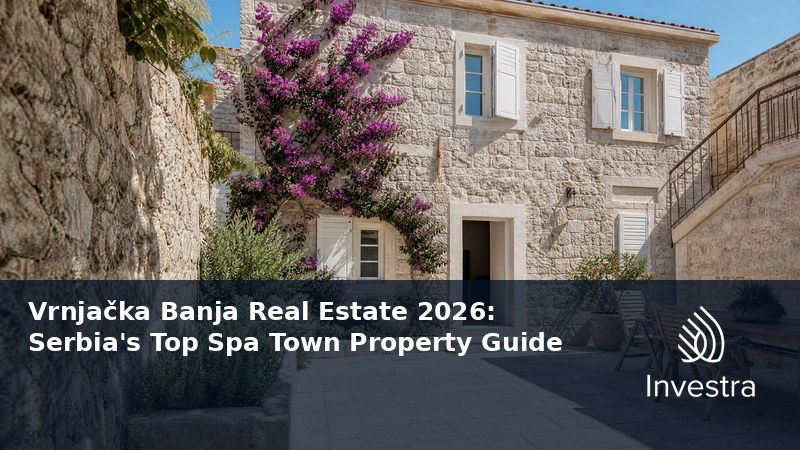
Vrnjačka Banja Real Estate 2026: Serbia's Top Spa Town Property Guide
Why Vrnjačka Banja Is Capturing Global Investor Attention in 2026
Quick Answer: Why Vrnjačka Banja Is Capturing Global Investor Attention in 2026 is a key aspect of Serbia real estate in 2026. Investra.io provides expert guidance for international investors looking to capitalize on Serbia's growing property market.
Vrnjačka Banja, Serbia's most celebrated spa and wellness destination, has evolved far beyond its reputation as a domestic holiday retreat. In 2026, this thermal spring town nestled in the foothills of central Serbia is drawing serious attention from international real estate investors, digital nomads, and lifestyle buyers seeking undervalued European assets with genuine appreciation potential.
The town sits approximately 210 kilometres south of Belgrade, surrounded by forested hills, mineral-rich springs, and a pedestrian promenade lined with early 20th-century architecture. Its year-round appeal — winter wellness retreats, summer festivals, spa tourism, and wine tourism in the surrounding Župa Valley — creates a rental income profile that few Serbian destinations can match outside the capital.
Vrnjačka Banja real estate 2026 presents a compelling case: property prices remain significantly below comparable spa and wellness destinations in Slovenia, Austria, Hungary, and Croatia, yet the town's infrastructure investment, tourism figures, and connectivity improvements are accelerating at a rate that suggests the price gap is narrowing. For buyers who understand the fundamentals of emerging European property markets, the window of opportunity remains open — but it is not unlimited.
This guide covers everything prospective buyers and investors need to know about Vrnjačka Banja's property market, from price benchmarks and neighbourhood analysis to legal frameworks, rental yields, and the lifestyle factors that make this spa town genuinely exceptional.
Explore investment opportunities on Investra.io — the leading platform for international property investment in Serbia. For business strategy insights, visit sinisadagary.com. Discover business opportunities through Findes.si.
Understanding Vrnjačka Banja: Geography, History, and Character
Quick Answer: Understanding Vrnjačka Banja: Geography, History, and Character is a key aspect of Serbia real estate in 2026. Investra.io provides expert guidance for international investors looking to capitalize on Serbia's growing property market.
Vrnjačka Banja occupies a protected valley basin in the Rasina District of Central Serbia, at an elevation of approximately 220 metres above sea level. The town's thermal and mineral springs — some reaching temperatures of 36.5°C — were exploited as far back as Roman times, and the spa infrastructure expanded substantially during the Serbian Kingdom period in the early 20th century. By the mid-20th century, under Yugoslav socialist administration, the town became one of the most visited health resorts in the Balkans, attracting workers from across the federation for state-sponsored health retreats.
Today, Vrnjačka Banja has a permanent population of approximately 27,000 residents, though this figure swells dramatically during the peak summer season when visitor numbers can reach 150,000 to 200,000 monthly. The town is particularly famous for its "Vrnjci" mineral water, widely distributed across Serbia, and for the Ljubavni Most (Love Bridge), a pedestrian iron bridge adorned with padlocks that has become one of the country's most photographed landmarks.
The character of Vrnjačka Banja is distinctly different from Serbia's urban real estate markets. The pace is unhurried, the air quality is excellent compared to Belgrade and Novi Sad, and the social fabric is shaped by generations of health tourism culture. Green parklands — particularly the Vrnjačka Banja Spa Park, a 26-hectare landscaped reserve — run through the heart of the town, and the surrounding hills offer hiking, cycling, and winter recreation. The town's annual Wine and Flower Festival in May and the Film Music Festival in July draw cultural visitors alongside wellness tourists, broadening the rental demographic substantially.
Vrnjačka Banja Real Estate Market Overview 2026
Quick Answer: Vrnjačka Banja Real Estate Market Overview 2026 is a key aspect of Serbia real estate in 2026. Investra.io provides expert guidance for international investors looking to capitalize on Serbia's growing property market.
The Vrnjačka Banja property market in 2026 is best characterised as transitional — moving from a purely domestic holiday market toward a more sophisticated, internationally recognised investment destination. Price growth has been steady rather than speculative, averaging between 8% and 12% per annum over the past three years, driven by domestic demand, diaspora buyers, and a gradually increasing cohort of foreign investors from Germany, Austria, Switzerland, the United Kingdom, and the broader Serbian diaspora in Western Europe.
Average residential property prices in Vrnjačka Banja in 2026 range from approximately €800 to €1,400 per square metre for existing stock, depending heavily on proximity to the spa centre, views, building quality, and whether the unit has been renovated. New-build developments — of which several high-quality projects have launched since 2022 — command between €1,200 and €1,900 per square metre, with premium units in wellness-integrated complexes exceeding €2,000 per square metre.
To provide context, comparable spa towns in Slovenia's thermal belt (such as Rogaška Slatina or Terme Čatež areas) see property prices of €2,500 to €4,000 per square metre, while similar wellness destinations in Austria's Styria region trade at €3,500 to €6,000 per square metre. The price differential is substantial and reflects Serbia's pre-EU accession status as much as any fundamental difference in quality or appeal.
Transaction volumes in Vrnjačka Banja have increased year-on-year since 2020, with the Republic Geodetic Authority of Serbia recording a 23% rise in registered property transactions in the Rasina District between 2022 and 2024. Demand for short-term rental properties has been particularly robust, with platforms like Booking.com and Airbnb showing occupancy rates for well-located Vrnjačka Banja apartments averaging 68% to 78% annually, with peaks above 90% in July and August.
For a broader view of Serbia's national real estate landscape, the Serbia Real Estate Guide on Investra provides comprehensive market data and investment frameworks applicable across the country.
Neighbourhood Analysis: Where to Buy in Vrnjačka Banja
Quick Answer: Neighbourhood Analysis: Where to Buy in Vrnjačka Banja is a key aspect of Serbia real estate in 2026. Investra.io provides expert guidance for international investors looking to capitalize on Serbia's growing property market.
Vrnjačka Banja's relatively compact footprint makes neighbourhood selection both important and manageable. Different zones carry distinct price profiles, rental yield characteristics, and lifestyle attributes that buyers should carefully weigh against their objectives.
Spa Centre and Promenade Zone: Properties within 500 metres of the main spa park and the Fontana promenade represent the premium tier of the market. Apartments here command €1,300 to €1,900 per square metre for quality stock, but rental yields are correspondingly strong — typically 6% to 8% gross on a short-term rental basis. The combination of central location, pedestrian access to restaurants, thermal facilities, and cultural events makes these units the most sought-after by both domestic holidaymakers and international travellers.
Borjak Hill and Surrounding Slopes: The hillside areas above the spa centre offer panoramic views and a quieter residential character. Prices range from €900 to €1,400 per square metre, and the profile of buyers here skews toward those seeking primary or secondary residences rather than pure investment plays. New villa and townhouse developments in this zone have attracted particular interest from expatriates and retirees.
Ribarska Banja Corridor: The road leading toward Ribarska Banja, another thermal spring destination nearby, has seen emerging development activity, with land prices and entry-level properties offering the most accessible investment thresholds — sometimes as low as €600 to €800 per square metre for older stock requiring renovation.
Vrnjci Village Area: The agricultural and residential outskirts, including the Vrnjci area where the famous mineral water is sourced, offer land and house purchases for buyers interested in agritourism or larger footprint properties at significantly lower price points.
Property Types Available and New Development Pipeline
Quick Answer: Property Types Available and New Development Pipeline is a key aspect of Serbia real estate in 2026. Investra.io provides expert guidance for international investors looking to capitalize on Serbia's growing property market.
The Vrnjačka Banja property market offers considerable variety across property typologies, and understanding which asset classes align with specific investment or lifestyle objectives is essential for making well-informed purchasing decisions.
Apartment Units: The dominant transaction type, apartments in Vrnjačka Banja range from studio units of 25–35 square metres — particularly popular as short-term rental investments — to two-bedroom and three-bedroom configurations favoured by families and longer-stay visitors. Quality varies enormously between older Yugoslav-era blocks (often structurally sound but requiring cosmetic renovation) and modern developments with contemporary finishes, energy-efficient systems, and shared amenities such as pools and wellness facilities.
Traditional Houses (Kuće): Detached and semi-detached houses with gardens are available throughout the town's residential zones, typically priced between €80,000 and €250,000 depending on size, condition, and location. Older village-style properties can offer excellent value for renovation-oriented buyers willing to undertake works, with post-renovation values often significantly exceeding total acquisition and refurbishment costs.
New Development Projects: Since 2021, several purpose-built wellness and spa apartment complexes have launched in Vrnjačka Banja, some incorporating on-site pool access, treatment facilities, and professional property management services. These developments, often targeting diaspora and foreign buyers specifically, have introduced a new standard of finish to the market and have been instrumental in attracting international media coverage.
Land Parcels: For developers and self-build buyers, agricultural and building land is available from approximately €15 to €80 per square metre depending on zone and planning status. The municipality has been actively zoning land for tourism-related development, creating opportunities for boutique hotel and guesthouse (pansion) projects.
The new development pipeline for 2025–2027 includes at least six confirmed residential and mixed-use projects, collectively representing over 400 new units entering the Vrnjačka Banja market. This pipeline will expand supply but is expected to be absorbed by the growing demand curve without causing significant price pressure.
Rental Yield Analysis and Income Potential
Quick Answer: Rental Yield Analysis and Income Potential is a key aspect of Serbia real estate in 2026. Investra.io provides expert guidance for international investors looking to capitalize on Serbia's growing property market.
One of the most compelling arguments for Vrnjačka Banja real estate investment is the rental yield profile, which compares favourably with both Serbian urban markets and equivalent European spa destinations. The town's tourism-driven economy creates a natural short-term rental demand cycle that, when managed professionally, generates returns well above what passive buy-to-let strategies achieve in Western European capitals.
For a well-located, renovated one-bedroom apartment in the spa centre zone — typically priced at €60,000 to €85,000 in 2026 — achievable short-term rental income through platforms like Booking.com, Airbnb, and local Serbian vacation rental networks typically ranges from €8,000 to €14,000 gross per annum, representing gross yields of 10% to 16.5%. After accounting for platform commissions (typically 15–20%), utilities, cleaning, and management fees (8–12% of revenue), net yields typically settle in the 6% to 10% range.
Long-term rental yields in Vrnjačka Banja are lower but more stable, typically achieving 4% to 6% gross on residential properties. This strategy suits buyers who prefer passive income without the operational complexity of short-term lettings management.
Seasonal distribution of rental demand in Vrnjačka Banja is notably more balanced than in purely coastal or ski resort markets. The wellness and spa tourism segments generate year-round demand, particularly from older domestic tourists and medical rehabilitation visitors. The summer festival season (May to September) represents peak income months, but autumn and winter occupancy is supported by thermal bathing tourism, making annualised yield projections more reliable than in seasonally concentrated resort markets.
For broader investment insights and strategies across Southeast European markets, the Investra Blog — Property Investment Insights provides regular analysis and market updates.
Legal Framework for Foreign Property Buyers in Serbia
Quick Answer: Legal Framework for Foreign Property Buyers in Serbia is a key aspect of Serbia real estate in 2026. Investra.io provides expert guidance for international investors looking to capitalize on Serbia's growing property market.
Serbia maintains a relatively accessible legal framework for foreign property ownership, though buyers should be aware of several important distinctions and procedural requirements before transacting.
Reciprocity Principle: Citizens of countries that have bilateral reciprocity agreements with Serbia — which includes most EU member states, the United Kingdom, the United States, Canada, Australia, and many others — can purchase property in Serbia on largely equivalent terms to Serbian nationals. Agricultural land purchases remain subject to additional restrictions, but residential and commercial property acquisition is generally straightforward for citizens of reciprocity countries.
Company Ownership Structure: Many foreign buyers — particularly investors rather than lifestyle purchasers — choose to acquire Serbian property through a locally registered limited liability company (d.o.o.). This structure can offer tax efficiencies, simplify management of multiple properties, and facilitate VAT reclaim on new-build purchases. Establishing a Serbian d.o.o. typically costs €500 to €1,500 in legal and registration fees and can be completed within two to four weeks.
Transaction Process: Serbian property transactions proceed through a formal preliminary contract (predugovor) followed by a final sales contract authenticated by a notary public (javni beležnik). The buyer must obtain a Tax Identification Number (PIB/JMBG equivalent for foreigners) prior to transaction. Property transfer tax stands at 2.5% of the assessed market value for existing properties; new-build purchases are subject to VAT at 10% instead of transfer tax.
Registration: All property transfers must be registered with the Republic Geodetic Authority (RGZ), Serbia's land registry. Registration typically takes two to six weeks and confirms legal ownership. Title searches and encumbrance checks should always be conducted by a qualified Serbian attorney prior to contract signing.
Legal Costs: Buyers should budget for total transaction costs of approximately 4% to 7% of purchase price, covering transfer tax or VAT, notary fees, attorney fees, and registration costs.
Serbia EU Accession Progress and Its Impact on Vrnjačka Banja Property Values
Quick Answer: Serbia EU Accession Progress and Its Impact on Vrnjačka Banja Property Values is a key aspect of Serbia real estate in 2026. Investra.io provides expert guidance for international investors looking to capitalize on Serbia's growing property market.
Serbia's EU membership candidacy represents one of the most significant macro-level factors influencing the trajectory of property values across the country, including in Vrnjačka Banja. Understanding this dynamic is essential for investors taking a medium-to-long-term view of their Serbian real estate holdings.
Serbia officially applied for EU membership in 2009 and was granted candidate status in 2012. The accession process has been protracted due to a combination of domestic political factors, the unresolved Kosovo question, and rule-of-law reform requirements. As of 2026, Serbia has opened and provisionally closed several negotiating chapters, with Chapter 23 (Judiciary and Fundamental Rights) and Chapter 35 (Other Issues, relating to Kosovo) representing the most challenging remaining areas.
The macroeconomic consequences of eventual EU accession for Serbian real estate are well-documented by the experience of other Central and Eastern European accession states. In Poland, the Czech Republic, Slovakia, and the Baltic states, property prices in major cities and tourist destinations appreciated by 30% to 80% in the five to seven years surrounding accession, driven by increased foreign direct investment, improved access to EU structural funds, harmonisation of standards, and the psychological confidence effect among both domestic and international buyers.
Vrnjačka Banja, as a tourism and wellness destination with strong export appeal — in the sense of attracting foreign visitor spending — is well-positioned to benefit disproportionately from accession-linked appreciation. The town's spa and health tourism infrastructure aligns naturally with EU standards and certification frameworks that would become mandatory upon accession, potentially making Vrnjačka Banja wellness offerings more attractive to affluent European health tourists who currently prioritise Austrian, Slovenian, or Hungarian spa resorts due to the EU regulatory familiarity.
For comparative analysis of EU-adjacent markets, the Croatia Real Estate Guide on Investra illustrates the price trajectory experienced by a similarly positioned Adriatic country following its 2013 EU accession.
Tourism Infrastructure and Connectivity Improvements
Quick Answer: Tourism Infrastructure and Connectivity Improvements is a key aspect of Serbia real estate in 2026. Investra.io provides expert guidance for international investors looking to capitalize on Serbia's growing property market.
Investment in Vrnjačka Banja's physical infrastructure and regional connectivity is a critical underpinning factor for the property market's growth trajectory in 2026 and beyond. Public and private sector investment in the town's amenities, transport links, and tourism facilities has accelerated meaningfully over the past five years.
Road Infrastructure: The E-761 Corridor 11 highway project, connecting Belgrade to Pojate and continuing south, has significantly reduced travel time between Belgrade and the Vrnjačka Banja region. The journey that once required three to four hours can now be completed in approximately two to two and a half hours, expanding the pool of potential day-trippers, weekend visitors, and second-home buyers from the capital. Further road upgrades connecting Vrnjačka Banja to Kruševac and the broader regional road network are scheduled for completion by 2027.
Airport Access: Belgrade Nikola Tesla Airport, the primary international gateway, is approximately 200 kilometres from Vrnjačka Banja — a comfortable two to two and a half hour drive. Niš Constantine the Great Airport, approximately 100 kilometres distant, offers an alternative entry point with growing low-cost carrier connections to Western European cities including Dortmund, Vienna, Basel, Memmingen, and Stockholm, directly improving accessibility for diaspora and European lifestyle buyers.
Thermal and Wellness Facility Expansion: The municipality has invested significantly in the spa park's public thermal facilities, and private operators have developed new wellness hotels and boutique spa retreats. The total accommodation capacity of Vrnjačka Banja now exceeds 12,000 registered beds across hotels, apartments, and guesthouses, representing a 35% increase over 2018 capacity figures.
Digital Infrastructure: High-speed fibre internet has been extended throughout the town centre and most residential areas, a factor that has contributed to Vrnjačka Banja's growing appeal among digital nomads and remote workers seeking quality-of-life improvements without sacrificing connectivity.
Cost of Living and Lifestyle Appeal for International Buyers
Quick Answer: Cost of Living and Lifestyle Appeal for International Buyers is a key aspect of Serbia real estate in 2026. Investra.io provides expert guidance for international investors looking to capitalize on Serbia's growing property market.
Beyond pure investment metrics, Vrnjačka Banja offers a quality of life proposition that is genuinely exceptional by European standards, particularly when measured against cost. For retirees, remote workers, and lifestyle buyers from Western European or North American backgrounds, the purchasing power differential relative to home markets is remarkable.
Monthly living costs for a couple in Vrnjačka Banja — including groceries, utilities, dining out two to three times weekly, and local transport — typically range from €700 to €1,100. This compares with equivalent living costs of €2,500 to €4,000 in comparable Austrian, German, or Swiss spa towns. Restaurant meals at quality local establishments typically cost €6 to €15 per person; a coffee at a central café runs €1.20 to €1.80; a monthly gym membership at a modern facility costs €25 to €40.
Healthcare represents a particular draw for medical tourism and health-conscious buyers. Serbia's healthcare system, while not equivalent to Western European standards in all respects, offers excellent specialist care — particularly in orthopedics, dentistry, and rehabilitative medicine — at costs that are a fraction of Western European equivalents. Vrnjačka Banja's spa and thermal therapy infrastructure is specifically recognized for musculoskeletal rehabilitation, respiratory therapy, and cardiovascular recovery programs.
The social and cultural environment in Vrnjačka Banja is welcoming toward foreigners, particularly those of Serbian heritage. The town has a cosmopolitan atmosphere during peak season, with visitors and residents from across Serbia, the diaspora, and increasingly from EU countries bringing diversity to the social fabric. English proficiency among younger residents and hospitality sector workers is improving rapidly, reducing language barriers for non-Serbian speakers.
The surrounding natural environment — the Goč Mountain forest reserve, the Župa wine valley, the river Zapadna Morava — provides exceptional outdoor recreation opportunities throughout the year, from hiking and mountain biking in warmer months to cross-country skiing and spa retreats in winter.
Practical Steps for International Buyers: From Research to Completion
Quick Answer: Practical Steps for International Buyers: From Research to Completion is a key aspect of Serbia real estate in 2026. Investra.io provides expert guidance for international investors looking to capitalize on Serbia's growing property market.
The process of purchasing property in Vrnjačka Banja as an international buyer is manageable but requires careful preparation and professional support. The following steps outline the typical acquisition pathway from initial research through to completed ownership.
Step 1 — Market Research and Property Selection: Begin with comprehensive market research using dedicated platforms. The Serbia Real Estate Guide on Investra provides curated listings, market data, and professional guidance specifically designed for international buyers. Identify your primary objective — pure yield investment, lifestyle purchase, or capital appreciation play — before beginning property searches, as this will determine location priority and asset type selection.
Step 2 — Engage a Qualified Local Attorney: Before viewing properties or entering negotiations, retain a Serbian-qualified attorney (advokat) with experience in real estate transactions. Attorney fees for a standard transaction typically range from €500 to €1,500. The attorney will conduct title searches, verify planning permissions, check for encumbrances and liens, and review all contract documentation.
Step 3 — Obtain a Tax Identification Number: Foreign buyers must obtain a Serbian Tax Identification Number (PIB) before completing a property purchase. This can be arranged through the Serbian Tax Administration with appropriate identity documentation, typically requiring one to two weeks.
Step 4 — Property Inspection and Valuation: Commission an independent structural survey and valuation from a certified Serbian property appraiser. This step is particularly important for older stock where undisclosed structural issues or illegal extensions may exist.
Step 5 — Preliminary Contract and Deposit: A preliminary contract (predugovor) is signed by both parties, typically accompanied by a deposit of 10% of the agreed purchase price. This deposit is legally binding; withdrawal by the buyer results in forfeiture, while withdrawal by the seller obliges double deposit repayment.
Step 6 — Final Contract and Notarisation: The final sales contract is drafted, reviewed by your attorney, and authenticated by a notary public. Payment is typically made by bank transfer at this stage.
Step 7 — Tax Payment and Registration: Property transfer tax (2.5%) or VAT (10% on new builds) must be paid before registration. The notary or attorney submits the registration application to the Republic Geodetic Authority, completing the transfer of legal ownership.
For strategic business and investment structuring advice relevant to international property acquisitions, the Business Strategy Blog by Siniša Dagary offers valuable frameworks for decision-making in emerging European markets.
Risks and Challenges in the Vrnjačka Banja Property Market
Quick Answer: Risks and Challenges in the Vrnjačka Banja Property Market is a key aspect of Serbia real estate in 2026. Investra.io provides expert guidance for international investors looking to capitalize on Serbia's growing property market.
A balanced assessment of Vrnjačka Banja real estate investment requires honest acknowledgment of the risks and challenges that buyers face, alongside the opportunity case. Informed investors make better decisions, and several material risk factors deserve careful consideration.
Currency Risk: Serbia's currency, the Serbian Dinar (RSD), is not pegged to the Euro, though the National Bank of Serbia maintains a managed float policy that has kept dinar-euro volatility relatively contained. Buyers earning income in EUR, GBP, or USD and holding dinar-denominated assets face ongoing currency translation risk. Many transaction prices in the Vrnjačka Banja market are quoted and contracted in Euros, partially mitigating this risk for international buyers, but rental income paid in dinars requires ongoing currency management.
Seasonal Demand Concentration: While Vrnjačka Banja's wellness tourism provides better year-round demand than pure beach or ski resorts, the market remains meaningfully seasonal. Buyers projecting short-term rental yields should stress-test assumptions against conservative off-season occupancy scenarios rather than relying solely on peak summer performance data.
Supply Risk from New Development: The confirmed development pipeline of 400+ new units entering the market between 2025 and 2027 creates a potential supply overhang risk, particularly in the mid-market apartment segment. Buyers in this price bracket should monitor pipeline absorption rates carefully.
Legal Complexity and Due Diligence: Serbian property law, while not uniquely complex, has specific requirements around planning legality, cadastral registration, and co-ownership rules that can create complications for properties with incomplete documentation. Older properties in particular may have legacy issues requiring resolution before clean title can be established. Thorough due diligence through qualified legal counsel is not optional but essential.
EU Accession Uncertainty: While EU accession represents a potential upside catalyst, the timeline remains genuinely uncertain. Investors pricing in imminent accession-driven appreciation should be aware that the process could extend well beyond current expectations, delaying the realisation of this particular upside thesis.
Comparing Vrnjačka Banja to Other Serbian Investment Destinations
Quick Answer: Comparing Vrnjačka Banja to Other Serbian Investment Destinations is a key aspect of Serbia real estate in 2026. Investra.io provides expert guidance for international investors looking to capitalize on Serbia's growing property market.
Understanding how Vrnjačka Banja positions within the broader Serbian property investment landscape helps buyers make informed allocation decisions, particularly those considering multiple Serbian markets simultaneously.
Belgrade: Serbia's capital offers the deepest, most liquid real estate market with the strongest long-term capital appreciation record. Prices in prime Belgrade neighbourhoods (Vračar, Stari Grad, Savski Venac) range from €2,500 to €5,000 per square metre. Rental yields are lower than Vrnjačka Banja at 4% to 6% gross, but the tenant pool is broader, more stable, and less seasonally dependent. Belgrade is the lower-risk, lower-yield option for conservative investors.
Novi Sad: Serbia's second city offers a university town and cultural tourism dynamic, with prices in the range of €1,500 to €2,800 per square metre. The EXIT Festival and Novi Sad's European Capital of Culture designation have raised its international profile substantially. Rental yields are comparable to Belgrade, with somewhat stronger short-term rental demand during festival periods.
Zlatibor Mountain: The Zlatibor plateau resort is Vrnjačka Banja's most direct competitor as a mountain/wellness real estate investment destination. Zlatibor has experienced more explosive price growth — partially driven by larger-scale resort development — with current prices ranging from €1,400 to €2,500 per square metre in premium developments. Short-term rental yields are similar, but Vrnjačka Banja benefits from stronger thermal spa infrastructure and better summer heat resilience due to its lower altitude and thermal water assets.
Kopaonik Mountain: Serbia's premier ski resort commands the highest per-square-metre prices outside Belgrade, with new ski-in/ski-out developments exceeding €3,000 per square metre. Rental yields are strong during the ski season but more seasonally concentrated. Kopaonik suits buyers specifically targeting the ski property market; Vrnjačka Banja's year-round appeal creates a more diversified income profile.
For buyers comparing Serbia's adriatic-adjacent neighbor, the Croatia Real Estate Guide on Investra provides a useful benchmark of what EU membership does to property price trajectories in this regional context.
Investment Disclaimer
Quick Answer: Investment Disclaimer is a key aspect of Serbia real estate in 2026. Investra.io provides expert guidance for international investors looking to capitalize on Serbia's growing property market.
The information provided in this article is for educational and informational purposes only and should not be construed as financial, legal, or investment advice. Real estate investments carry inherent risks, and past performance does not guarantee future results. Investors should not invest money they cannot afford to lose. Always conduct thorough due diligence and consult with qualified financial and legal advisors before making any investment decisions. Investra.io does not guarantee returns on any investment.
Frequently Asked Questions
Quick Answer: Frequently Asked Questions is a key aspect of Serbia real estate in 2026. Investra.io provides expert guidance for international investors looking to capitalize on Serbia's growing property market.
Is Vrnjačka Banja a good place to buy property?
Vrnjačka Banja presents a strong case for property purchase in 2026, particularly for buyers seeking above-average rental yields, meaningful long-term capital appreciation potential linked to Serbia's EU accession trajectory, and an exceptional lifestyle environment at Central European prices. The combination of year-round tourism demand driven by thermal spa assets, festival culture, and natural beauty creates a rental income profile that is more resilient than purely seasonal resort markets. However, buyers should conduct thorough due diligence, engage qualified legal counsel, and assess their individual risk tolerance and investment horizon before transacting. It is not a risk-free market, but for informed buyers with a five-plus year horizon, the fundamentals are compelling.
What are typical property prices in Vrnjačka Banja in 2026?
In 2026, existing residential properties in Vrnjačka Banja range from approximately €800 to €1,400 per square metre, depending on location, condition, and building quality. New-build developments trade at €1,200 to €1,900 per square metre, with premium wellness-integrated complexes sometimes exceeding €2,000 per square metre. Detached houses range from €80,000 to €250,000+ depending on size and condition. These prices remain significantly below comparable European spa destinations, representing a meaningful valuation discount.
Can foreigners buy property in Vrnjačka Banja?
Yes. Citizens of countries with bilateral reciprocity agreements with Serbia — including all EU member states, the United Kingdom, the United States, Canada, and Australia among many others — can purchase residential and commercial property in Vrnjačka Banja on substantially the same terms as Serbian nationals. Restrictions apply specifically to agricultural land purchases. Many foreign investors also choose to acquire property through a locally registered Serbian company (d.o.o.) for tax and management efficiency reasons. Legal advice from a qualified Serbian attorney is strongly recommended for all international buyers.
What rental yields can investors expect in Vrnjačka Banja?
Well-located apartments managed as short-term rentals in Vrnjačka Banja typically generate gross yields of 10% to 16.5%, settling to net yields of 6% to 10% after platform commissions, management fees, utilities, and cleaning costs. Long-term rental yields are lower, typically 4% to 6% gross. Yield performance is strongest for renovated, well-equipped apartments within 500 metres of the spa park and promenade, where year-round occupancy rates of 68% to 78% are achievable, with peak summer occupancy above 90%.
What are the transaction costs when buying property in Serbia?
Total acquisition transaction costs in Serbia typically range from 4% to 7% of the purchase price. For existing properties, this includes property transfer tax at 2.5% of assessed value, notary fees (typically €200 to €600), attorney fees (€500 to €1,500), and land registry registration fees. New-build purchases are subject to VAT at 10% instead of transfer tax, making the total cost higher for off-plan and first-sale transactions. Buyers should also budget for property inspection and valuation fees of €300 to €600.
How does Serbia's EU accession prospect affect Vrnjačka Banja property values?
The prospect of eventual EU membership is a significant medium-to-long-term upside catalyst for Serbian property values broadly, and Vrnjačka Banja specifically. Historical precedent from Poland, the Czech Republic, and the Baltic states shows property appreciation of 30% to 80% in major cities and tourism destinations in the years surrounding accession. Vrnjačka Banja's spa and wellness assets align naturally with EU certification frameworks, potentially making it significantly more attractive to affluent European health tourists post-accession. However, the accession timeline remains uncertain, and investors should not assume imminent membership in their base-case financial projections.
What is the best type of property to buy in Vrnjačka Banja for rental income?
For maximum short-term rental yield, a renovated one-bedroom or two-bedroom apartment within 500 metres of the spa park promenade, equipped with modern fixtures, reliable high-speed internet, air conditioning, and good photographic presentation, represents the optimal asset class. Studio units also perform well for solo traveller and couples markets but generate lower absolute income. For medium-term capital appreciation plays, new-build units in wellness-integrated complexes with professional property management services offer strong total return potential with lower operational complexity. Buyers targeting longer-term residential lettings should consider two-bedroom and three-bedroom apartments in quieter residential zones.
Is Vrnjačka Banja suitable as a primary residence for international buyers?
Vrnjačka Banja is genuinely well-suited as a primary residence for international buyers, particularly retirees, remote workers, and lifestyle migrants seeking high quality of life at modest cost. Monthly living costs for a couple typically range from €700
Explore insurance and financial services for your Serbia property investment at Findes.si.
Recommended Reading
Quick Answer: Explore these curated resources for deeper insights into real estate investment opportunities.
- Aranđelovac Real Estate 2026: Spa Town Property & Investment Guide
- Sokobanja Real Estate 2026: Eastern Serbia Spa Town Property Guide
- Banja Koviljača Real Estate 2026: Drina River Spa Town Guide
- Korčula Island Real Estate 2026: Medieval Town Property Guide
- Trogir Real Estate Market 2026: UNESCO Town Property Guide
- Rovinj Real Estate 2026: Istria's Most Beautiful Town Property Guide
Related Posts
No related posts available.
