
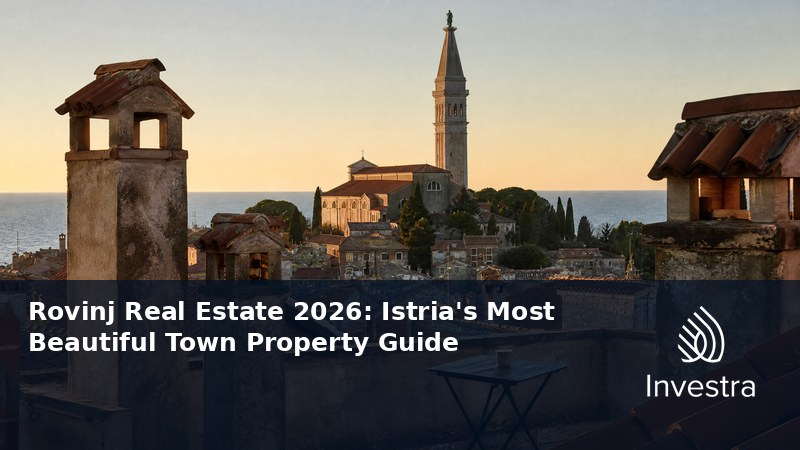
Rovinj Real Estate 2026: Istria's Most Beautiful Town Property Guide
Why Rovinj Is Capturing the Attention of Global Property Investors in 2026
Quick Answer: Rovinj has emerged as one of Croatia's most compelling real estate markets in 2026, combining UNESCO-adjacent cultural heritage, strong short-term rental demand, and property values that still trail comparable Mediterranean destinations — making it a genuinely attractive investment proposition. Croatia Real Estate Investment Guide 2026 covers the broader national context in detail.
There are towns along the Adriatic that tourists visit, and then there are towns that tourists fall in love with and never quite leave behind. Rovinj is firmly in the second category. Perched on a peninsula jutting into the Adriatic on the western coast of Istria, this former Venetian fishing settlement has managed something genuinely rare — it kept its soul while becoming internationally desirable.
The cobblestone alleys, the pastel-colored houses stacked improbably on top of each other, the Baroque church of St. Euphemia crowning the skyline — these aren't marketing props. They're the authentic fabric of a working town that also happens to be one of the most photographed places in Croatia. And for property investors paying attention to the European coastal real estate scene, that authenticity translates directly into value.
What we've seen in the Rovinj market over the past three years is a fundamental shift. The buyer profile has changed. Where once the market was dominated by German and Austrian buyers seeking summer retreats, the current wave includes British buyers post-Brexit exploring EU residency pathways, American and Canadian investors attracted by the euro-denominated pricing, and high-net-worth individuals from across the EU diversifying into tangible assets. The result is a market that feels more liquid, more professionally structured, and considerably more competitive than it was even in 2022.
The town's population sits around 15,000 permanent residents — small enough to feel intimate, large enough to sustain year-round amenities. Tourism numbers tell a different story entirely: Rovinj consistently records over one million overnight stays per year, with the tourist season extending beyond the traditional July-August peak into late September and increasingly into October. That extended seasonality is one of the factors that makes the short-term rental case here particularly strong.
Croatia's EU membership (since 2013) and eurozone accession (January 2023) removed two major friction points for international buyers. No more currency conversion risk on a Croatian kuna-denominated purchase, and the legal framework for foreign ownership is now fully aligned with EU standards. For anyone who was watching but waiting, those developments removed the last significant structural hesitations.
Rovinj Real Estate Market Overview 2026: What the Numbers Actually Tell Us
Quick Answer: In 2026, Rovinj property prices range from approximately €3,500/m² for standard apartments on the outskirts to €8,000–€12,000/m² for premium old-town properties with sea views, reflecting consistent annual appreciation of 6–10% over the past four years.
Let's talk numbers, because the narrative around Rovinj real estate is sometimes more romantic than precise — and investors deserve precision.
The Rovinj property market divides reasonably cleanly into three distinct price tiers, each driven by different buyer motivations and delivering different investment profiles.
At the premium end, old-town properties — meaning the historic peninsula, the streets immediately surrounding St. Euphemia's Church, and any address with direct or near-direct Adriatic views — command €7,000–€12,000 per square meter for renovated or new-build quality. These properties are scarce by definition. The old town is geographically constrained, historically protected, and the supply of genuinely premium units that come to market in any given year can be counted on two hands. What surprised many buyers entering this segment for the first time is just how few transactions actually occur — which is, of course, precisely what sustains the pricing.
The mid-market segment — newer apartment developments within 500–1,500 meters of the waterfront, areas like Valdibora, Monte Mulini surrounds, and the neighborhoods between the old town and the main marina — sits in the €3,500–€6,500/m² range. This is where the most transaction volume occurs, and where the investment calculus tends to be most favorable for buyers seeking a blend of capital appreciation and rental yield.
The outer residential areas and inland villages within the broader Rovinj municipality offer entry points from €1,800–€3,000/m², attracting buyers prioritizing value over immediate coastal access. These properties tend to underperform on short-term rental yield but can deliver solid long-term appreciation as infrastructure and transport links improve.
Year-on-year appreciation across the Rovinj market has averaged 7–9% in euro terms since Croatia's eurozone entry in 2023 — a figure that compares favorably with comparable Adriatic destinations like Montenegro's Bay of Kotor (5–7%), Slovenia's coastal strip (4–6%), and Italian Adriatic resorts (3–5%). The Croatian market, and Istria specifically, is still in a price-discovery phase relative to its Western Mediterranean equivalents.
Transaction volumes recovered strongly after a brief pandemic-era softening and have remained elevated. The Croatia Real Estate Investment Guide 2026 documents that foreign buyer participation in the broader Istrian market now accounts for approximately 35–40% of total transactions — a figure that underscores just how internationalized this market has become.
The Old Town Peninsula: Rovinj's Most Coveted — and Most Complex — Real Estate
Quick Answer: Old-town Rovinj properties offer the highest prestige and strongest long-term value retention, but come with strict heritage renovation constraints, limited availability, and prices of €7,000–€12,000/m² that demand careful due diligence on structural condition and legal title.
The old town is what people mean when they picture Rovinj. The narrow streets that aren't wide enough for a car, the arched doorways, the Venetian Gothic windows, the smell of salt air mixed with stone and fishing nets — this is the Rovinj that ends up on screensavers and travel magazine covers. And yes, you can buy property here. But you should understand exactly what you're buying.
The buildings in the historic nucleus are predominantly 17th and 18th century Venetian construction — solid stone structures that have survived remarkably well, but that carry the idiosyncrasies of their era. Irregular floor plans, low ceiling heights in some sections, stairways that would terrify a modern building inspector, and plumbing systems that have been retrofitted rather than designed. None of this is insurmountable, but renovation budgets need to be realistic.
Heritage protection rules administered by the Croatian Ministry of Culture and the local Konzervatorski odjel (Conservation Department) govern what can and cannot be changed. External facade alterations require approval. Window replacements must use period-appropriate materials. Structural changes require archaeological surveys in some areas. The process is manageable but adds time — typically 12–18 months for a full renovation project requiring multiple permits — and cost, with quality renovation work running €800–€1,500/m² depending on the complexity.
The legal title situation in old-town properties deserves specific attention. Many of these buildings passed through complex ownership arrangements during the Yugoslav period, and the land registry (Zemljišna knjiga) records may contain historical encumbrances, co-ownership complications, or incomplete documentation. Hiring an experienced local notary and an independent property lawyer — not the seller's agent's recommended lawyer — is non-negotiable here. Budget €2,000–€5,000 for proper legal due diligence on an old-town purchase.
Despite these complexities, the investment case is compelling for the right buyer. A renovated old-town apartment of 60–80m² with sea views can generate €1,500–€2,500 per week in peak season short-term rental income. With a purchase price of €500,000–€700,000 all-in, and 16–20 weeks of viable rental income per year, gross rental yields of 7–10% are achievable for well-positioned properties under professional management.
Rovinj Property Prices by Neighborhood: A Detailed Geographic Breakdown
Quick Answer: Rovinj property prices vary significantly by location, ranging from €1,800/m² in outer residential areas to €12,000/m² in the historic peninsula core — understanding each neighborhood's characteristics is essential for matching investment goals to the right location.
Beyond the old town, Rovinj's real estate geography is worth mapping carefully because "near Rovinj" and "in Rovinj" are doing a lot of different work in property listings.
Valdibora is the neighborhood immediately north of the old town, separated from the historic peninsula by the main harbor. It's predominantly residential with a mix of older Yugoslav-era apartment blocks and newer developments. Prices here run €3,500–€5,500/m² for newer quality, with older stock available from €2,500/m². Walking distance to the old town (10–15 minutes), reasonable infrastructure, popular with longer-term renters and families. Rental yields in the 5–7% range are realistic.
Monte Mulini / Lone Bay Area sits south of the old town along the wooded Zlatni Rt (Golden Cape) nature park coastline. This is Rovinj's luxury hotel corridor — home to the five-star Monte Mulini Hotel and the design hotel Lone — and the residential development that's followed reflects that premium positioning. New-build and recently completed apartments here command €5,000–€8,000/m². Views are excellent, the pine-forested setting is genuinely beautiful, and the proximity to the nature park makes it attractive for buyers who want resort quality without the old-town complexity. Strong short-term rental performance due to the setting.
Cuvi / Balota is the southern residential expansion zone, with a mix of villas, semi-detached houses, and modern apartment complexes. More suburban in character, prices range €2,800–€4,500/m². Good for buyers seeking larger footprints — 3-4 bedroom houses are more available here than in the dense old town.
Veštar / Monsena Bay extends further south and includes some of the peninsula's most picturesque small bays. Properties here are predominantly villas and detached houses, often with private sea access. Premium coastal villas can reach €1.5–€3 million total, with per-square-meter values for the construction itself around €3,500–€5,500 plus significant land premiums.
Inland villages in the Rovinj municipality — Kanfanar, Bale, Rovinjsko Selo — offer traditional Istrian stone houses from €150,000–€400,000 for renovation projects. These represent a different investment thesis: agrotourism, longer-stay vacation rentals, or lifestyle purchases with strong cultural appeal. For a deeper look at how Rovinj fits within the broader Croatian coastal investment landscape, the Split Real Estate Guide offers useful comparative perspective on Croatia's other major coastal markets.
How to Buy Property in Rovinj Croatia: The Complete Legal Process
Quick Answer: EU citizens can purchase property in Rovinj Croatia with near-identical rights to Croatian nationals; non-EU buyers face additional reciprocity requirements but the process remains accessible. The purchase typically takes 2–4 months from offer to completion and involves a notarized purchase agreement, land registry registration, and 3% real estate transfer tax.
The question "how to buy property in Rovinj Croatia?" sits at the center of what most international buyers want to know, so let's walk through the process in the kind of practical detail that actually helps.
Step 1 — Establish Buyer Eligibility. EU and EEA citizens have full purchasing rights under Croatian law, which aligns with EU property ownership directives. Non-EU nationals (including Americans, Canadians, Australians, and others) can purchase subject to bilateral reciprocity agreements — Croatia has such agreements with numerous non-EU countries, and your lawyer can confirm eligibility for your specific nationality. Swiss nationals have specific treaty provisions. If direct purchase isn't available for your nationality, purchasing through a Croatian-registered company (d.o.o.) is a standard alternative route.
Step 2 — Engage a Property Lawyer. This isn't optional. A Croatian property attorney (odvjetnik) should review the land registry extract (ZK izvadak), check for any encumbrances, verify building permits and usage permits, confirm the property's legal status, and identify any issues with the cadastral records. Legal fees typically run 1–2% of purchase price, minimum €1,500–€3,000.
Step 3 — Pre-Contract (Predugovor). Once due diligence is satisfactory, a preliminary contract is signed, typically with a 10% deposit. This commits both parties — the seller faces double-deposit return if they withdraw; the buyer forfeits the deposit if they pull out. Getting this document right matters.
Step 4 — Main Purchase Agreement. The solemnized purchase contract (Kupoprodajni ugovor) is executed before a Croatian notary public (javni bilježnik). The notary authenticates signatures and confirms the legal validity of the transaction. Notary fees are regulated by law and typically range €300–€800.
Step 5 — Land Registry Registration. The notarized agreement is filed with the Municipal Court land registry. Registration takes 1–3 months currently, though the process has been streamlining progressively. Full ownership is legally effective from registration.
Step 6 — Tax Payment. Croatia applies a 3% Real Estate Transfer Tax (Porez na promet nekretnina) on the purchase price for resale properties. New-build properties where the seller is a VAT-registered developer are subject to 25% VAT instead (typically included in the listed price). The tax must be paid within 30 days of signing.
For the complete national framework that gives context to this process, Investra's Croatia Real Estate Investment Guide 2026 covers the regulatory environment in comprehensive detail. You can also contact Investra's experts directly for guidance specific to your situation.
Taxes, Costs, and True Purchase Price: What Buyers Need to Budget For
Quick Answer: Beyond the headline purchase price, buyers in Rovinj should budget an additional 5–8% for transaction costs including 3% transfer tax, legal fees, notary costs, and agent commission — bringing total acquisition cost to approximately 105–108% of the agreed purchase price.
One of the most consistent surprises for first-time buyers in Croatia is the gap between the listed price and the true total acquisition cost. It's not dramatic by Mediterranean standards — Italy, France, and Spain all have higher total transaction cost burdens — but it's worth modeling accurately from the outset.
Here's a realistic cost breakdown for a €400,000 Rovinj apartment purchase:
The Real Estate Transfer Tax at 3% adds €12,000. This applies to resale properties; for new developments from developers, you're instead paying 25% VAT which is usually incorporated in the listed price. Your property lawyer will charge 1–1.5% for a standard transaction, here approximately €4,000–€6,000 — spend this money, it protects your entire investment. Notary fees are regulated and modest: €300–€600 for a standard residential transaction. Agent commission in Croatia is typically 2–4% split between buyer and seller, so a buyer's agent fee of 1.5–2% is common — around €6,000–€8,000 on this transaction. Land registry fees and court costs run €200–€400. Translation costs for any foreign-language documentation add €200–€500.
Total additional costs: approximately €23,000–€27,000 on a €400,000 purchase, or 5.75–6.75%.
For new-build purchases where VAT is embedded in the price, the incremental costs reduce to approximately 3–4% (legal, notary, agent, registration) since the transfer tax doesn't apply.
Annual ongoing costs are also worth factoring: Croatian property owners pay Communal Fee (komunalna naknada), which varies by municipality and property size but typically runs €500–€2,000 per year for a mid-size apartment. Building maintenance charges (pričuva) apply to apartments in managed buildings, typically €0.80–€2.00/m²/month. Property insurance for a Rovinj apartment runs €300–€800 annually. There is currently no annual property tax in Croatia beyond the communal fee, though discussions about introducing one have circulated for years without materializing.
For investors utilizing financing, Croatian banks offer mortgages to EU nationals at rates currently in the 4–5.5% range (variable), with loan-to-value ratios up to 70–80% for primary residences and 60–70% for investment properties. Non-EU nationals typically need to explore international or home-country financing or purchase cash.
Short-Term Rental Income and Yields in Rovinj: The Investment Reality
Quick Answer: Well-positioned Rovinj properties can achieve gross short-term rental yields of 6–10% annually, with premium old-town and sea-view apartments reaching the higher end of that range — though net yields after management fees, maintenance, and vacancy typically land between 4–7%.
Croatia's short-term rental market is mature, regulated, and genuinely lucrative in the right locations. Rovinj sits in the top tier of Croatian short-term rental markets, consistently ranked alongside Dubrovnik and Hvar in terms of achievable nightly rates and occupancy.
The rental season in Rovinj has extended meaningfully. While July and August remain the absolute peak — with a 2-bedroom apartment of quality achieving €200–€450 per night — the shoulder seasons of May, June, September, and October now contribute substantially to annual income. A well-managed property in Rovinj can realistically achieve 100–130 booked nights per year, concentrated in April–October.
Let's model a specific scenario: a 2-bedroom apartment in the Lone Bay area, 65m², fully renovated to high standard, purchased for €380,000 all-in including acquisition costs. Nightly rates of €280 in peak (8 weeks), €180 in high shoulder (6 weeks), and €120 in mid-shoulder (6 weeks), with full platform fees and a professional management company taking 20–25%, deliver gross rental income of approximately €28,000–€34,000 per year. After management fees, cleaning costs, platform commissions, maintenance reserve, and insurance, net operating income lands around €18,000–€22,000. That's a net yield of 4.7–5.8% on the total investment — genuinely competitive with comparable Mediterranean markets.
Old-town premium properties can exceed these figures. A 50m² studio apartment in the historic peninsula with views, purchased for €420,000, can command €350–€600 per night at peak and achieve net yields approaching 6–8% given the premium nightly rates — provided the property is managed and marketed professionally.
Croatia requires short-term rental registration with the local tourist board (Turistička zajednica), annual category classification (1–5 stars), and the collection and remittance of tourist tax (sobodar tax). These administrative requirements are straightforward but must be properly maintained. Rental income is subject to Croatian income tax, with a flat rate option of 12% plus surtax on categorized rental income being the most commonly used structure for foreign investors.
For investors comparing yield profiles across Croatian coastal markets, the Hvar Island Real Estate guide offers a useful benchmark — Hvar commands higher peak nightly rates but has a shorter effective season, creating a different yield profile than Rovinj's more extended tourism calendar.
Long-Term Capital Appreciation: Is Rovinj Real Estate a Good Investment?
Quick Answer: Rovinj real estate has delivered consistent capital appreciation of 6–10% annually in euro terms over 2020–2025, supported by constrained supply, rising international demand, and Croatia's eurozone integration — the fundamentals suggest this trajectory will continue, though at a potentially moderating pace as prices mature.
Capital appreciation is where Rovinj's investment story becomes particularly interesting when viewed against the broader European coastal property landscape.
For context: comparable Venetian-influenced coastal towns in northern Italy — Portofino, Positano, Ravello — have property values 3–5x higher than Rovinj on a per-square-meter basis. The Croatian Adriatic, and Istria specifically, remains materially underpriced relative to its Italian, French, and Spanish equivalents when adjusted for quality of setting, cultural heritage, climate, and water quality. The gap has been closing, but it hasn't closed yet.
The supply constraint is structural and permanent. Rovinj's historic center is legally protected. New development within the town is tightly regulated by the physical plan (prostorni plan) and cannot expand onto the peninsula. Even outside the old town, development is constrained by the Zlatni Rt nature park to the south and agricultural protection zones elsewhere. The result is a market where supply is fundamentally inelastic — new supply cannot meaningfully expand to meet demand, which is a powerful support for values.
Demand-side factors are equally compelling. Tourism to Istria has grown at 4–6% per year on average over the past decade. New direct air connections to Pula Airport (40 minutes from Rovinj) from across Europe and increasingly from North America and the Middle East bring a continuously expanding buyer pool within range. The work-from-anywhere trend has extended buyer interest beyond pure holiday-home purchasers to include buyers seeking semi-permanent European bases.
The risk side deserves honest treatment. Climate change poses real questions for Adriatic coastal tourism over a 20–30 year horizon — rising sea temperatures, potential jellyfish proliferation, and increasingly hot summers may gradually shift preferences toward higher-altitude destinations. The Croatian institutional and regulatory environment, while much improved, still carries higher administrative friction than Northern European markets. And any significant European economic downturn would likely soften discretionary second-home demand.
On balance, the medium-term capital appreciation case — 5 to 10-year horizon — looks robust. The long-term case depends on factors that are genuinely uncertain. For investment strategy guidance that goes beyond a single market, Siniša Dagary's investment consulting practice provides portfolio-level thinking about how Croatian real estate fits within a diversified international real estate strategy.
Rovinj vs. Other Croatian Coastal Markets: How Does It Stack Up?
Quick Answer: Rovinj offers a compelling middle ground between Dubrovnik's extreme luxury pricing and Split's higher-volume mass tourism market — lower entry prices than Dubrovnik with stronger cultural cachet and more discerning tourist demographics than Split's city-break crowd.
Every investor comparing Croatian coastal options eventually asks the same question: why Rovinj over Dubrovnik, Split, Hvar, or the other Istrian towns like Poreč or Pula? The honest answer is that there isn't a single correct choice — but the differences matter enormously for investment strategy.
Dubrovnik is Croatia's most globally recognized destination and commands the country's highest property prices: €6,000–€15,000/m² in the Old City area, with premium apartments exceeding €20,000/m² in the most sought-after locations. The brand is unassailable, but the price of entry is high, the old town is genuinely overcrowded (which Croatia's tourism authorities are actively trying to address), and rental yields have actually compressed as prices have risen faster than rental rates. Dubrovnik is a prestige hold — capital preservation and modest appreciation — rather than a yield play.
Split is Croatia's second-largest city and offers a very different proposition: year-round urban demand, a university population creating permanent rental demand, cruise tourism (8–10 cruise ships per day in peak season creating problematic crowds), and property prices of €3,000–€7,000/m² in the desirable areas. Split is more of a balanced urban investment than a pure lifestyle play.
Hvar has become Croatia's celebrity and nightlife island, commanding extraordinary nightly rates in peak season but with a party-island reputation that doesn't appeal to all investors' target rental demographics. Entry prices in Hvar Town are €5,000–€10,000/m² for quality properties.
Rovinj's distinctive position: it attracts a higher-spending, culturally motivated tourist demographic than Split or Poreč; it's less overtly touristy and crowded than Dubrovnik; it's more sophisticated and architecturally coherent than Pula; and its prices remain below peak Croatian market levels. The Zagreb Property Market Analysis offers useful comparison data for investors also considering Croatia's capital as part of a multi-property Croatian strategy.
New Development Projects in Rovinj 2025–2026: What's Coming to Market
Quick Answer: The Rovinj new-build market is limited by planning constraints but includes several boutique residential developments offering 15–25 units near the waterfront, plus villa projects in the Veštar Bay and Cuvi areas, with off-plan pricing typically 10–15% below completed comparable values.
New development in Rovinj is deliberately constrained — which is one of the things that makes the market interesting from a supply-demand perspective, but means that investors seeking off-plan opportunities need to look carefully.
The planning framework for Rovinj's municipality (Grad Rovinj-Rovigno) prioritizes heritage protection and sustainable tourism development, which in practice means the dramatic mixed-use mega-developments that have reshaped some Croatian coastal areas are simply not happening here. What comes to market instead is typically smaller-scale: boutique developments of 8–25 units, converted stone buildings in semi-urban settings, and individual villa projects on larger plots.
The Lone Bay corridor has seen the most coherent new development activity, with several projects of 15–25 apartments in the €5,500–€7,500/m² range completing or near-completing in 2025–2026. These properties are designed to premium international standards — German kitchens, Porcelanosa bathrooms, smart home integration, private parking — and are specifically marketed to short-term rental investors and lifestyle buyers from the EU and beyond.
Off-plan purchasing in Croatia carries standard pre-construction risks: developer financial stability, construction timeline delays, specification changes, and market value fluctuations between purchase and completion. Croatian consumer protection law requires developers to provide bank guarantees for off-plan deposits from 2023 onwards, which addressed one of the most significant pre-existing risks. Still, independent legal review of the developer's building permits, zoning approvals, and financial structure is essential before committing to off-plan.
For investors interested in exploring current development opportunities across the Rovinj and broader Istrian market, Find Your Property on Investra aggregates new-build and resale listings with current market data. The Investra Blog also tracks new development announcements as they emerge.
The Rovinj Rental Market: Long-Term vs. Short-Term Strategy
Quick Answer: Short-term vacation rental consistently outperforms long-term letting in Rovinj on a yield basis — often by a factor of 2–3x — but requires active management, seasonal administration, and regulatory compliance; long-term rental suits investors prioritizing passive income with lower management intensity.
The choice between short-term and long-term rental strategy in Rovinj is more consequential than in many markets, because the gap in returns is substantial and the management requirements differ dramatically.
Long-term rental in Rovinj — meaning a 12-month unfurnished residential lease to a local or relocating tenant — reflects a relatively modest local rental market. Rovinj's permanent population is around 15,000, the local economy is dominated by tourism, hospitality, and small-scale fishing and agriculture, and wage levels don't support the kind of rental rates that generate strong yields on premium property values. A 2-bedroom apartment purchased for €380,000 might achieve €800–€1,200/month in long-term rent, delivering a gross yield of 2.5–3.8% before costs. That's below what a comparable Slovenian or Czech city apartment would deliver, and far below short-term potential.
Short-term vacation rental, as outlined in the yield section above, consistently delivers 6–10% gross yield for well-managed properties. The tradeoffs are real: you're operating what is effectively a micro-hospitality business, with cleaning scheduling, guest communication, key exchange logistics, platform management, and seasonal fluctuation. Professional management companies operating in Rovinj (and there are several well-established operators) typically charge 20–30% of gross rental income, which is high but justified by the operational complexity and the direct correlation between professional management quality and achieved nightly rates and review scores.
A hybrid strategy — short-term rental April–October, potentially a medium-term let to a digital nomad or professional November–March — is increasingly common and can optimize utilization while preserving the personal use periods that many lifestyle buyers want. Croatian law is relatively flexible on this, provided the rental categorization is properly maintained.
One important regulatory consideration: Croatia introduced tighter rules on tourist accommodation from 2024, requiring new registrations to demonstrate minimum facility standards and imposing stricter limits on the number of guests per registered unit. Properties registered under the previous regime maintain their status, but new investors entering the short-term rental market should confirm current registration requirements with a local lawyer or through the relevant tourist board.
Financing Your Rovinj Property Purchase: Mortgage, Cash, and Hybrid Options
Quick Answer: Most international buyers purchase Rovinj property in cash, but Croatian bank mortgages are available to EU residents at 4–5.5% (2026 rates), and home-country equity release or international mortgage structures can also provide financing — each approach has distinct cost and risk profiles worth comparing.
The financing landscape for Rovinj property purchases is more nuanced than many first-time Croatian buyers expect. The default assumption that all foreign buyers pay cash is outdated — the market has matured significantly, and financing options are real.
Croatian banks — the major ones being Erste Bank, Raiffeisen Bank Croatia, PBZ (Privredna Banka Zagreb), and OTP Bank Croatia — offer residential mortgages to EU nationals with Croatian income or demonstrable income in their home country. The current variable rate environment has pushed rates to 4.0–5.5% for investment properties, with fixed-rate products (typically 3–5 year fixed) available at 4.5–5.8%. Loan-to-value for foreign investment buyers typically maxes out at 60–70% of assessed value. Croatian bank assessments (procjena) often come in below market value, which can reduce effective LTV — factor this into your financing calculations.
Home-country equity release — borrowing against existing property equity in Germany, Austria, the UK, or elsewhere — is increasingly popular for Rovinj purchases. Interest rates in these markets may be comparable or lower than Croatian bank rates, and the administrative process is often simpler for the buyer. The risk is home-country property exposure backing a Croatian asset.
Developer payment plans on off-plan properties occasionally offer 20–30% payment deferral until completion, which provides a form of implicit financing on new-build purchases. These aren't mortgages, but they reduce the immediate capital outlay.
For buyers considering financial structuring advice as part of a broader wealth management approach, Findes Financial Services provides professional financial planning support relevant to cross-border property investment structures. For investment consulting at the strategic portfolio level, Siniša Dagary's practice works with investors on structuring Croatian real estate alongside broader international investment portfolios.
Practical Guide for International Buyers: Opening Bank Accounts, OIB Numbers, and Residency
Quick Answer: International buyers in Croatia need an OIB tax identification number (obtainable within days) and a Croatian bank account to complete property purchase — both are straightforward to obtain, and property ownership does not automatically confer residency rights, though ownership supports certain visa applications.
The practical mechanics of buying property as a foreigner in Croatia involve several administrative steps that are genuinely manageable once you know what they are.
The OIB (Osobni Identifikacijski Broj) — Croatia's personal tax identification number — is required for any property transaction. EU nationals can apply at any Croatian Tax Authority (Porezna uprava) office with a passport; the OIB is typically issued within 1–3 business days. Non-EU nationals follow the same process. This is not the obstacle it might seem — it's a straightforward administrative step.
A Croatian bank account is technically required for the money transfer associated with the purchase, though in practice many transactions are structured to use the notary's escrow account. That said, having a Croatian account simplifies ongoing property management, utility payments, rental income collection, and tax remittances. Erste, Raiffeisen, and OTP are the banks most accessible to non-resident foreigners; the documentation requirements have simplified significantly since EU accession.
On residency: Croatian property ownership does not automatically grant residency rights. EU citizens have the right of free movement and can register residency without property ownership. Non-EU nationals seeking residency would typically apply through the standard work permit or self-employment routes, or through the Croatian Digital Nomad Visa — a temporary residence permit introduced in 2021 and now well-established, available to non-EU nationals with demonstrable remote income above a threshold (currently approximately €2,300/month). Property ownership strengthens but doesn't automatically qualify a non-EU application.
The Golden Visa route that exists in some EU countries (Portugal, Greece, Spain, Malta) does not have a direct equivalent in Croatia. However, significant investment through business formation can support residency applications. This area is evolving as Croatia continues adapting its immigration framework.
Day-to-day living considerations for buyers considering personal use or semi-permanent residence in Rovinj: the town functions as a proper year-round community with a hospital, quality international schools accessible in Pula (40 minutes), a well-developed restaurant and café culture that extends beyond summer, and genuinely good infrastructure by Croatian standards. The Istrian peninsula has the highest per-capita income in Croatia and a notably higher quality of civic infrastructure than many other Croatian regions.
Property Management and Rental Operations in Rovinj: Choosing the Right Partner
Quick Answer: Professional property management in Rovinj costs 20–30% of gross rental income but is essential for maximizing yield and handling the operational complexity of short-term letting — selecting an established local management company with demonstrable Airbnb and Booking.com track records is one of the most important decisions a rental investor makes.
Here's a truth that Rovinj rental investors learn quickly: the property is only part of the investment. The other part is the management operation behind it. Two identical apartments, five doors apart on the same street, managed by different operators, can produce yields that differ by 30–40% due to differences in photography, platform optimization, pricing algorithms, review management, and operational reliability.
The Rovinj short-term rental management landscape has professionalized significantly. Several established operators — including both locally-based Croatian companies and the Croatian arms of European platforms — now manage hundreds of properties across Istria with genuinely sophisticated systems. The best of them combine dynamic pricing software (that adjusts nightly rates daily based on demand signals), professional photography, multi-platform distribution (Airbnb, Booking.com, Vrbo, direct booking sites), and reliable local cleaning and maintenance teams.
When evaluating a management company, ask for: verified performance data across their current portfolio (not cherry-picked examples), their average occupancy rate across the full season, their approach to dynamic pricing, their guest communication response time guarantees, their maintenance cost management structure, and references from non-local owners who can't easily monitor performance themselves.
Management fees structure matters too. Full-service companies typically charge 20–25% of gross revenue. Some charge a base fee plus variable components. Watch for structures that charge full fees during calendar blocks where the owner takes personal use — that misaligns incentives significantly.
Self-management from abroad is genuinely possible for some investors, particularly those with significant prior Airbnb experience, local language ability, and a reliable local cleaner/handyman network. But for most international buyers purchasing in Rovinj without an existing local network, professional management more than pays for itself in achieved nightly rates and avoided operational headaches.
The Investra Property Investment Articles section regularly covers property management best practices and operator reviews for the Croatian market.
Sustainability, Tourism Regulation, and the Future of Rovinj's Property Market
Quick Answer: Rovinj and Istrian authorities are increasingly implementing sustainable tourism measures — including caps on new tourism accommodation, heritage protection enforcement, and environmental preservation — which while constraining supply further, strengthen long-term value for existing property holders.
The regulatory environment around Croatian coastal tourism is evolving, and serious investors need to understand the direction of travel — because it has direct implications for property values and rental operations.
Croatia's tourism authorities have been under sustained pressure to address overtourism in key destinations. The most dramatic responses have been in Dubrovnik, where visitor caps and cruise ship restrictions were implemented in the early 2020s. Rovinj hasn't faced the same intensity of overtourism pressure, but the town has been deliberate about positioning itself in the upper tier of the market rather than chasing volume — a strategy that reflects both cultural preference and hard-headed economic sense.
The Istrian County physical plan and Rovinj's own prostorni plan have been updated to restrict new tourist accommodation construction in environmentally sensitive zones, including the Zlatni Rt nature park area. The effect is a gradual tightening of supply in the most desirable locations. For existing property holders, this is unambiguously positive news — it means your asset is becoming structurally scarcer.
Climate and environmental considerations are taken seriously in Istria. The region has invested substantially in water quality (Blue Flag beach designation is consistently
Investment Disclaimer
The information provided in this article is for educational and informational purposes only and should not be construed as financial, legal, or investment advice. Real estate investments carry inherent risks, and past performance does not guarantee future results. Investors should not invest money they cannot afford to lose. Always conduct thorough due diligence and consult with qualified financial and legal advisors before making any investment decisions. Investra.io does not guarantee returns on any investment.
Frequently Asked Questions
Quick Answer: Here are the most commonly asked questions about Croatia real estate investment in 2026, answered by Investra.io experts.
Is Croatia a good country for real estate investment in 2026?
Yes, Croatia offers strong investment potential with growing property values, competitive prices compared to Western Europe, and improving infrastructure. Investra.io provides comprehensive market data and investment guidance.
Can foreigners buy property in Croatia?
EU citizens can buy property freely in Croatia. Non-EU citizens may need to meet specific requirements. Investra.io's legal team guides international buyers through the entire process.
What is the average property price in Rovinj?
Property prices in Rovinj vary significantly by location and property type. Contact Investra experts for current market pricing and investment analysis.
What rental yields can I expect?
Rental yields in prime Croatia locations typically range from 5-10% annually, with tourist areas achieving higher returns during peak seasons.
What taxes apply to property purchases?
Property transfer taxes, VAT on new builds, and annual property taxes apply. Rates vary by property type and location. Consult Siniša Dagary for tax optimization strategies.
How long does the purchase process take?
Typically 30-60 days from offer to completion. Working with Investra.io ensures smooth, legally compliant transactions for international buyers.
What financing options are available?
Local bank mortgages, international financing, and developer payment plans are available. Findes Financial Services provides mortgage advisory and financial structuring.
Is property management available for rental properties?
Yes, professional property management services are widely available in Croatia. Investra.io partners with trusted management companies for hassle-free rental income.
What are the best areas to invest in Rovinj?
Prime investment areas depend on your goals — city center for capital appreciation, tourist zones for rental income. Investra.io's market analysis identifies the best opportunities.
Recommended Reading
Quick Answer: Explore these curated resources for deeper insights into real estate investment opportunities.
- Aranđelovac Real Estate 2026: Spa Town Property & Investment Guide
- Vrnjačka Banja Real Estate 2026: Serbia's Top Spa Town Property Guide
- Sokobanja Real Estate 2026: Eastern Serbia Spa Town Property Guide
- Korčula Island Real Estate 2026: Medieval Town Property Guide
- Trogir Real Estate Market 2026: UNESCO Town Property Guide
- Pula Real Estate 2026: Istria's Capital City Property Investment Guide
Related Posts
No related posts available.
