
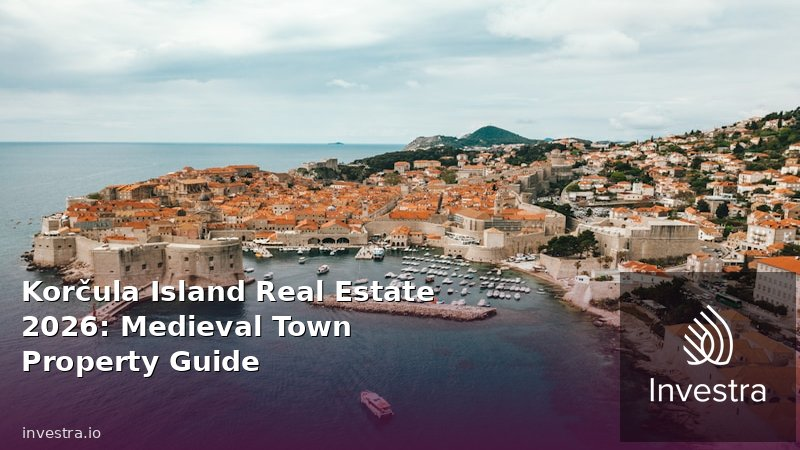
Korčula Island Real Estate 2026: Medieval Town Property Guide
Korčula Island Real Estate 2026: Why This Medieval Adriatic Gem Is Attracting Global Investors
Quick Answer: Korčula island real estate in 2026 offers international buyers a rare combination of medieval heritage, pristine Adriatic coastline, and strong short-term rental yields averaging 6–9%, making it one of Croatia's most compelling island investment destinations. Croatia Real Estate Investment Guide 2026 on Investra.io provides comprehensive market intelligence for buyers entering this market.
Nestled in the southern Dalmatian archipelago, Korčula island has long captivated visitors with its fortress walls, cypress-lined shores, and the legendary birthplace claim of Marco Polo. In 2026, however, the island is drawing a new breed of admirer — the international property investor. With Croatia's eurozone membership now fully embedded into market pricing, a thriving short-term rental economy, and a UNESCO-adjacent cultural profile that commands premium holiday rates, Korčula has emerged as one of the Adriatic's most strategically attractive real estate markets.
The island stretches approximately 47 kilometres in length and covers roughly 276 square kilometres, making it one of the largest Adriatic islands. Yet despite its size, total available inventory remains deliberately constrained by heritage preservation regulations and strict coastal building codes. This supply limitation, combined with surging international demand, has created a market dynamic that consistently rewards early investors and well-positioned buyers.
Property prices on Korčula have risen approximately 28–34% over the past five years, outperforming many mainland Croatian cities and keeping pace with the premium island markets of Hvar and Brač. In 2026, the island is not a secret — but neither has it been fully priced out of reach. For investors who understand its micro-market dynamics, timing, and legal structure, Korčula still represents exceptional value relative to comparable Mediterranean destinations in Italy, France, or Greece.
Korčula Property Market Overview 2026
Quick Answer: The Korčula property market in 2026 is characterised by limited supply, rising demand from EU and non-EU buyers, and average prices ranging from €2,800 to €7,500 per square metre depending on location and property type. Investra.io tracks live listings and market trends across the entire island.
The Korčula property market operates across several distinct micro-zones, each with its own pricing dynamics, buyer profiles, and investment potential. Korčula Town — the fortified medieval settlement on the island's eastern tip — anchors the luxury end of the market, where stone townhouses within or immediately adjacent to the old town walls command between €4,500 and €7,500 per square metre. These properties attract heritage buyers, boutique hotel developers, and high-net-worth individuals seeking a trophy asset with a cultural narrative.
Moving along the northern coastline toward Vela Luka on the western end of the island, prices moderate considerably. In Vela Luka, a working town with a strong local residential character, properties range from €2,800 to €4,200 per square metre. Lumbarda, a village known for its sandy beaches — rare on the Dalmatian coast — sits southeast of Korčula Town and attracts family-oriented buyers willing to pay €3,500–€5,500 per square metre for seafront or near-seafront villas.
The island's southern coastline, with its quieter coves, olive groves, and emerging rural tourism infrastructure, offers the most affordable entry points at €2,200–€3,500 per square metre, primarily for land and renovation-ready stone houses. This segment appeals to buyers with a longer investment horizon who recognise that coastal access, build quality, and location will drive appreciation as the island's infrastructure continues to improve.
Transaction volume on Korčula has increased by approximately 18% year-on-year since Croatia joined the eurozone in 2023, with foreign buyers — predominantly from Germany, Austria, the Netherlands, the United Kingdom, and Scandinavia — accounting for an estimated 45–55% of all sales in tourist-facing zones. The elimination of currency risk has been a particularly significant catalyst, as European investors no longer face kuna conversion exposure when acquiring or monetising assets.
For a detailed breakdown of current listings and investment-grade properties across the island, Find Your Property on Investra and explore the full Korčula inventory with real-time data filters.
Property Prices in Korčula 2026: Zone-by-Zone Breakdown
Quick Answer: Property prices in Korčula range from €2,200 to €7,500 per square metre in 2026, with Korčula Town old city properties at the top of the range and inland or western island properties at the lower end. Investra.io provides real-time market data for informed investment decisions.
Understanding Korčula's pricing geography is essential for any serious buyer. The island's real estate market is not homogeneous — a 200-metre difference in proximity to the seafront, or a placement inside versus outside old town walls, can represent a €2,000+ per square metre price differential. The following zone-by-zone guide reflects 2026 market conditions based on current transaction data and active listings.
Korčula Town Old Town (Stari Grad): The historic walled city is the island's most prestigious address. Stone houses within the medieval fortifications sell for €5,500–€7,500/m², with the finest restored properties exceeding €8,000/m² when they include sea views, roof terraces, or boutique conversion potential. Supply is extremely limited — fewer than 15–25 properties come to market annually within the walls. Demand consistently exceeds supply, and properties rarely require price negotiation.
Korčula Town Surrounding Areas: Properties in the immediate periphery of the old town — within 500 metres of the walls — range from €3,800–€5,500/m². These include modern apartments, semi-detached houses, and larger villas with gardens. Access to the old town's restaurants, beaches, and ferry connections makes this zone highly attractive for short-term rental operators.
Lumbarda: Approximately 6 kilometres southeast, Lumbarda's sandy beaches (Pržina and Bilin Žal) create premium demand. Waterfront villas command €4,500–€6,500/m², while properties set back 200–400 metres from the beach range from €3,200–€4,800/m². Lumbarda attracts a strong family-oriented rental market, with weekly villa rentals in peak season reaching €3,000–€8,000 per week.
Vela Luka: The island's second-largest settlement offers the best value proposition for investors seeking yield over capital appreciation. Properties range from €2,500–€4,000/m², with modern apartments in the town centre at the lower end of the premium range. Proximity to ferry connections to Split and proximity to Lastovo island make Vela Luka an emerging hub for sailing tourism infrastructure investment.
Blato and Central Island: Blato, the largest inland settlement, offers the most affordable properties at €1,800–€2,800/m². Stone houses requiring renovation can be acquired for significantly less, sometimes €1,200–€1,800/m², but conversion costs and permitting complexity must be factored into total investment calculations. This zone suits patient investors comfortable with development risk.
Coastal Villages (Račišće, Žrnovo, Cara, Smokvica): These smaller settlements along the northern and southern coastlines vary considerably. Seafront properties in Račišće have been clocking €4,000–€5,500/m², while inland village houses in Žrnovo or Cara range from €1,500–€2,500/m², with excellent renovation opportunities for rural agritourism concepts.
How to Buy Property on Korčula Island Croatia: The Legal Process Explained
Quick Answer: EU citizens can buy property on Korčula with the same rights as Croatian nationals, while non-EU buyers require reciprocity agreements or must purchase through a Croatian-registered company. The purchase process typically takes 2–4 months and involves a notary, land registry, and a real estate transfer tax of 3%. Contact Investra Experts for personalised legal guidance.
Buying property on Korčula island follows Croatia's national real estate acquisition framework, which has been significantly streamlined since EU accession. The legal process, while straightforward relative to many Eastern European markets, requires careful attention to due diligence steps that are particularly relevant for island properties, where land registry records, coastal zone designations, and heritage protection classifications can materially affect usability and value.
Step 1 — Eligibility Check: EU/EEA citizens enjoy full property ownership rights identical to Croatian nationals. Citizens of countries with bilateral reciprocity agreements (including the United States, United Kingdom post-Brexit under existing treaty provisions, and Switzerland) can also purchase directly. Non-EU citizens from countries without reciprocity agreements must establish a Croatian-registered limited liability company (d.o.o.) to hold property. Company formation costs approximately €800–€1,500 and takes 1–3 weeks.
Step 2 — Property Search and Offer: Once a suitable property is identified, a Letter of Intent or preliminary offer is submitted. In Korčula's competitive old town market, serious buyers often make formal offers backed by proof of funds to differentiate from speculative enquiries. Engaging a bilingual real estate agent with specific Korčula market expertise is strongly recommended at this stage.
Step 3 — Due Diligence: This is the most critical phase for island properties. A Croatian real estate attorney (odvjetnik) must verify the land registry extract (Zemljišna knjiga) to confirm clear title, check for mortgages or liens, verify that the property is not in a protected coastal or heritage zone that restricts renovation, confirm building permits for all structures, review utility connections, and check for any agricultural land designation (which carries different ownership rules for foreigners).
Step 4 — Pre-Contract (Predugovor): A preliminary contract is signed, and a deposit of typically 10% of the purchase price is paid. This deposit is legally protected — if the buyer withdraws, the deposit is forfeited; if the seller withdraws, double the deposit is returned. This stage requires notarisation.
Step 5 — Final Contract and Land Registry: The final purchase agreement (Kupoprodajni ugovor) is executed before a Croatian notary. Following payment of the balance, the property is registered in the buyer's name at the Municipal Land Registry Court (Općinski sud). Full registration typically takes 4–8 weeks after contract execution.
Step 6 — Real Estate Transfer Tax: Croatia levies a 3% real estate transfer tax (porez na promet nekretnina) on the purchase price. This is paid within 30 days of the transaction. New-build properties purchased from a developer are subject to VAT (PDV) at 25% rather than the transfer tax — a significant cost difference buyers must account for when comparing new versus resale properties.
For expert guidance on the entire acquisition process, Siniša Dagary — Investment Consultant provides specialist advisory services for international investors entering the Croatian market.
Rental Yields and Short-Term Rental Income on Korčula
Quick Answer: Short-term rental yields on Korčula average 6–9% gross annually, with premium seafront villas and old town apartments achieving 8–11% gross yield during peak season. Strategic properties listed on Airbnb, Booking.com, and specialist villa rental platforms generate the highest returns.
Korčula's tourism economy is the engine that makes its real estate investment case compelling. The island receives approximately 150,000–180,000 tourist overnight stays annually in peak season (June–September), with significant shoulder season activity in May and October driven by sailing tourism, cycling tourism, and cultural visitors. This creates a robust short-term rental market that is the primary return driver for property investors.
In Korčula Town, a well-positioned 60m² apartment with sea views and authentic stone character can generate €1,800–€3,200 per week in peak season. With an average occupancy rate of 70–85% across June, July, and August, and 40–60% occupancy in shoulder seasons, annual gross rental income for such a property might reach €35,000–€55,000. Against a purchase price of €350,000–€450,000, this represents a gross yield of approximately 8–12%.
Villa properties in Lumbarda with private pools and beach access occupy the top tier of the rental market. A 4-bedroom, 200m² villa with pool can command €5,000–€12,000 per week in peak season. At 70% peak occupancy and 40% shoulder occupancy, annual gross income may reach €80,000–€140,000. Against acquisition costs of €900,000–€1,500,000, gross yields sit at 7–10%, with net yields (after platform fees, management, utilities, and maintenance) typically 4–6%.
More accessible entry points in Vela Luka — 2-bedroom apartments at €180,000–€250,000 — generate €800–€1,400 per week in peak season. With a shorter high-demand window than the eastern part of the island, annual gross income might reach €18,000–€28,000, implying yields of 8–11% gross. These properties appeal to investors seeking lower capital outlay with strong yield metrics.
It is critical to understand Croatian short-term rental regulations. All rental properties must be registered with the local tourism board, obtain a category rating (1–5 stars for apartments and villas), and comply with occupancy registration requirements (eVisitor system). Rental income is subject to Croatian income tax at a flat rate of 10% (with standard deductions for maintenance costs), plus a tourist residence tax contribution. Compliance costs add approximately 15–20% to gross income calculations when estimating net returns.
For the most current rental yield data and investment-grade listings on Korčula, explore the full selection on Split Real Estate Guide and related Dalmatian coast markets to compare yield profiles across the region.
Capital Appreciation Potential: Korčula's Long-Term Investment Case
Quick Answer: Korčula properties have appreciated approximately 28–34% over the past five years, and supply constraints combined with growing EU buyer demand position the island for continued 5–9% annual appreciation through 2028, making it a strong long-term capital growth play alongside rental income.
Beyond rental yields, Korčula's capital appreciation story is driven by several structural factors that distinguish it from more speculative coastal markets. Supply is fundamentally constrained by the island's geography, heritage protection laws, and strict coastal construction regulations under Croatia's Physical Planning Act. New build supply within desirable zones is minimal — the old town cannot expand, seafront zones are largely built out, and development approvals are increasingly difficult to obtain for new coastal villas.
Demand, conversely, has been growing consistently. Croatia's full eurozone integration in January 2023 removed the single largest barrier to European institutional and private investment — currency risk. The number of property transactions involving non-resident EU buyers has grown by an estimated 22% since eurozone entry, and Korčula, with its relatively accessible price points compared to Hvar or Dubrovnik, has attracted strong interest from first-time Adriatic island buyers.
Infrastructure improvements are also a significant appreciation catalyst. The ongoing expansion of Split Airport and the introduction of new international routes has improved year-round accessibility to the Dalmatian coast. Faster ferry services and discussions about a potential fixed link between the island and the Pelješac peninsula — already connected to the mainland via the Pelješac Bridge (opened 2022) — would materially transform accessibility and, by extension, property values.
Comparative benchmarking supports the appreciation case. Comparable heritage island markets in Croatia — most notably Hvar — have seen sustained 10–15% annual price appreciation over the past decade, driven by the same supply/demand dynamics now playing out on Korčula. Korčula currently trades at a 25–40% discount to equivalent Hvar properties, a gap that market analysts expect to narrow progressively as international buyer awareness of the island increases.
The ROI calculation for a typical Korčula investment — combining a conservative 5% annual capital appreciation with a 6–8% net rental yield — implies a total annual return of 11–13%, before leverage effects. This positions Korčula among the higher-performing residential real estate markets in the Mediterranean basin. For strategic perspective from experienced advisors, About Siniša Dagary details the investment philosophy underpinning successful Croatian real estate portfolio construction.
Korčula Town Old Town: Heritage Property Investment Opportunities
Quick Answer: Stone properties within Korčula Town's medieval old town represent the island's most prestigious and scarcest investment class, with prices between €5,500–€7,500/m² and potential for boutique hospitality conversion offering exceptional long-term returns. Supply within the walls is under 25 transactions per year.
Korčula Town's old town is architecturally among the most intact medieval settlements on the Adriatic coast. Constructed primarily between the 13th and 16th centuries, the town's characteristic herringbone street pattern (designed to channel sea breezes while blocking wind), Venetian Gothic facades, stone campaniles, and fortified town gates create an aesthetic and experiential quality that is virtually impossible to replicate. This irreplaceable character is precisely what commands premium pricing and drives exceptional rental income from discerning travellers willing to pay top rates for authentic immersion.
Properties within the old town walls are classified under Croatian heritage protection, which means any renovation requires approval from the conservation authority (Konzervatorski odjel). This adds complexity and lead time to renovation projects but simultaneously acts as a protective moat against overdevelopment and value dilution. Buyers who navigate the heritage approval process successfully emerge with assets that appreciate consistently and command rental premiums of 25–40% over comparable non-heritage properties.
The most viable investment strategies within the old town include: premium short-term vacation rentals (5–15 person capacity with authentic stone interior design commanding €4,000–€10,000 peak week rates); boutique accommodation conversion (6–12 room heritage hotels or guesthouses that can operate under Croatia's growing 'small hotel' licensing framework); and long-term hold as a trophy asset with moderate rental activity to offset carrying costs.
Current availability within the old town includes a small number of properties ranging from 80m² single-floor stone apartments to 300–400m² multi-storey houses suitable for boutique hospitality conversion. Asking prices range from €450,000 for compact apartments requiring renovation to €2,500,000+ for fully restored multi-floor properties with sea views and terraces. Renovation costs in heritage zones average €1,500–€2,500/m² depending on scope and specification.
Buyers interested in Korčula's heritage property segment should also review the broader Dalmatian luxury market context available through the Dubrovnik Luxury Property Guide, which provides comparative analysis of premium heritage asset performance across the southern Dalmatian coast.
Lumbarda: The Sandy Beach Premium and Family Villa Market
Quick Answer: Lumbarda is Korčula's premium family villa destination, priced at €3,200–€6,500/m² for properties ranging from modest holiday homes to large seafront villas. Its rare sandy beaches generate some of the island's highest weekly villa rental rates and strongest short-term rental occupancy.
Lumbarda occupies a unique position in the Korčula real estate market. On a coastline dominated by pebble and rock beaches, Lumbarda's Pržina and Bilin Žal sandy beaches are a genuine rarity — and they are the primary driver of the village's outsized rental demand and premium property prices. Families with young children are prepared to pay significant rental premiums for sandy beach access on the Dalmatian coast, and Lumbarda's beaches deliver exactly that in a quieter, more intimate setting than Split or Dubrovnik.
The property stock in Lumbarda ranges from compact 1-2 bedroom apartments above family-run wine estates (the village is renowned for Grk white wine from indigenous sandy-soil vineyards) to substantial 4-6 bedroom villas with private pools. The village has a gentle, authentic character that contrasts with the more tourist-saturated atmosphere of Korčula Town in peak season, attracting buyers seeking a genuine community connection alongside investment returns.
Investment performance data from Lumbarda supports strong yield and appreciation metrics. A 4-bedroom villa with pool (approximately 180m², 800m² garden, pool) purchased in the €750,000–€950,000 range can generate €6,000–€10,000 per week in July and August, with shoulder season rates of €3,000–€5,000 per week in June and September. At 65–75% peak season occupancy, annual gross rental income of €70,000–€110,000 implies gross yields of 8–12%.
The wine tourism angle adds a distinctive marketing dimension. Properties adjacent to or incorporating working vineyards can command a significant narrative premium on premium booking platforms, attracting agritourism-oriented guests willing to pay above-market rates for an authentic Dalmatian wine estate experience. Several Lumbarda properties have successfully repositioned as wine-and-wellness retreat venues, generating year-round revenue rather than the purely seasonal income of standard holiday rentals.
Land acquisition in Lumbarda for new villa development is increasingly constrained by planning restrictions, making existing built properties the primary market. Plots suitable for residential construction within beach proximity are extremely rare and, when available, command €300–€600 per square metre for land alone.
Vela Luka: The Undervalued Opportunity for Yield-Focused Investors
Quick Answer: Vela Luka offers Korčula's best value proposition for yield-focused investors at €2,500–€4,000/m², with excellent ferry connectivity, a genuine local town atmosphere, and growing tourism interest in the western end of the island generating strong short-term rental returns relative to acquisition cost.
Vela Luka consistently flies under the radar of international buyers who focus their attention on Korčula Town and Lumbarda, but for investors prioritising rental yield over trophy appeal, this western harbour town offers a compelling case. With a permanent population of approximately 4,500 — the island's largest individual settlement — Vela Luka has the infrastructure, services, and community character of a genuine town rather than a seasonal tourist resort. This creates year-round rental demand from workers, sailing charters, and cultural tourists that smooths the extreme seasonality of purely tourist-oriented properties.
The ferry connection from Vela Luka to Split (2 hours) operates year-round, providing reliable accessibility that supports shoulder and off-season rental activity. The town also serves as a gateway to Lastovo Nature Park, positioned as Croatia's next emerging sustainable tourism destination, and hosts the Vela Luka Cultural Arts Centre — one of Croatia's most significant ethnographic museums — which generates cultural tourism interest beyond the beach season.
Property prices in Vela Luka range from €2,500–€4,000/m² for well-maintained apartments and townhouses, with seafront and harbour-view premiums pushing quality properties to €3,500–€4,500/m². New-build apartments in smaller developments near the harbour are available at €3,200–€4,000/m² and represent a clean-title, low-maintenance entry point for investors who prefer to avoid the renovation complexity of older stone properties.
Rental income potential in Vela Luka, while lower in absolute terms than Korčula Town or Lumbarda, compares favourably on a yield basis. A 60m² two-bedroom apartment priced at €180,000–€220,000 can generate €800–€1,400 per week in peak season and €400–€700 per week in shoulder months, producing annual gross income of €20,000–€32,000 and implied gross yields of 10–14% — among the highest on the island.
New Developments vs. Resale Properties on Korčula: Pros, Cons, and Tax Implications
Quick Answer: Resale stone properties dominate Korčula's investment-grade market and attract only 3% transfer tax, while new-build properties are subject to 25% VAT. New builds offer modern standards and clean titles but are rare on the island; resale properties require due diligence but offer heritage premium and lower tax burden at acquisition.
One of the most practically significant decisions for Korčula property buyers is whether to acquire a resale property or a new-build unit. The tax treatment alone makes this a meaningful financial consideration: new-build properties purchased directly from a developer are subject to Croatian VAT (PDV) at 25% of the purchase price, which is typically included in the advertised price but must be clearly understood in the total cost calculation. Resale properties, by contrast, attract only the 3% real estate transfer tax.
On a €500,000 property, this difference amounts to approximately €110,000 in additional tax burden for new builds versus resale. Buyers pursuing new-build properties must ensure this cost is factored into yield calculations and ROI projections. The higher acquisition cost means new builds generally need higher rental rates or longer hold periods to achieve equivalent total returns.
That said, new-build properties on Korčula offer meaningful advantages. They arrive with fully compliant building documentation, modern energy efficiency standards, contemporary infrastructure (underfloor heating, air conditioning, solar panels), and clean land registry records with no legacy title issues. For buyers without the time or expertise to manage complex due diligence on older properties, new builds provide certainty and predictability.
New supply on Korčula is limited by design. Strict Physical Planning Act restrictions prevent large-scale development in coastal zones, and the few new projects that do receive approval tend to be small-scale (4–12 units) and in strong demand from the moment permits are granted. Developers occasionally offer pre-launch pricing at 10–15% below completed project value, which can offset the VAT disadvantage for early buyers.
Resale stone houses and apartments, especially in Korčula Town and coastal villages, represent the vast majority of available investment stock. The due diligence requirements are more intensive — historical building permits may be incomplete, land registry entries may require regularisation, and renovation scope may be uncertain — but the acquisition cost advantage, heritage appeal, and rental premium potential make them the preferred vehicle for experienced investors.
For financial structuring advice on Croatian property acquisitions, Findes Financial Services offers specialist cross-border financing and investment structure advisory for international buyers.
Financing Property on Korčula: Mortgage Options for Foreign Buyers
Quick Answer: Foreign buyers can access Croatian mortgage financing at 2.5–5% interest rates through local banks, typically covering 60–70% of property value, while EU buyers from eurozone countries may benefit from competitive home-country financing. Cash purchases remain the most common approach among international buyers on Korčula.
Financing property on Korčula as a foreign buyer requires understanding a mortgage landscape that has evolved considerably since Croatia's eurozone entry. Croatian banks — including Erste Bank, Privredna banka Zagreb (PBZ), Raiffeisen, and OTP banka — offer mortgage products to non-resident foreign buyers, though the terms are typically less favourable than those available to Croatian residents.
For non-resident buyers, Croatian banks generally offer loan-to-value (LTV) ratios of 60–70% of the assessed property value (which may differ from the purchase price). Interest rates for foreign buyers range from 3.5–5.5% depending on the borrower's financial profile, nationality, and the specific bank's risk appetite. Loan terms typically range from 15–25 years, with repayments in euros eliminating historical currency mismatch risk that existed prior to 2023.
The mortgage approval process for foreign buyers requires documentation including: proof of income (2–3 years of tax returns or salary documentation), bank statements, property valuation by a certified Croatian appraiser, clean credit history documentation, and in some cases, life insurance assignment. Processing times range from 4–8 weeks, which buyers must factor into transaction timeline planning.
EU buyers — particularly from Germany, Austria, and the Netherlands where domestic mortgage rates are competitive — often find it advantageous to leverage equity in their home country properties rather than entering the Croatian mortgage market. Home equity release or refinancing of existing property allows these buyers to fund Croatian acquisitions as cash buyers, potentially strengthening their negotiating position and simplifying the transaction.
Alternative financing routes include developer payment plans on new-build properties (typically 30% on contract, 30% on structural completion, 40% on handover), personal loans from home-country banks against existing assets, and private lending arrangements. Each carries different risk and cost profiles that require careful evaluation with qualified financial advisors.
Taxes, Costs, and Ongoing Fees for Korčula Property Owners
Quick Answer: Total acquisition costs for Korčula property typically reach 5–8% above the purchase price, including 3% transfer tax, notary fees, legal fees, and agency commissions. Annual ownership costs include communal fees, property management, rental income tax at 10%, and utility costs.
A comprehensive understanding of taxes and ongoing costs is essential for accurate return modelling on any Korčula investment. Beyond the purchase price itself, buyers should budget for the following acquisition costs:
Real Estate Transfer Tax (Porez na promet nekretnina): 3% of purchase price, paid to the Croatian Tax Administration within 30 days of transaction registration. For new builds, 25% VAT replaces this tax.
Notary Fees: Regulated by Croatian law at approximately 0.1–0.5% of transaction value (decreasing percentage for higher values), typically €500–€2,500 for most Korčula transactions.
Legal/Attorney Fees: Croatian real estate attorneys typically charge 0.5–1.5% of purchase price or a fixed fee of €1,500–€5,000 for standard transactions. Heritage property or complex title situations may command higher fees.
Real Estate Agency Commission: Standard agency commission in Croatia is 3–5% of purchase price (often split between buyer and seller), though this is negotiable on higher-value transactions.
Land Registry Registration Fee: Approximately €200–€500 depending on property value.
Annual ownership costs include: communal maintenance fees (naknada za uređenje) typically €500–€2,000/year for apartments; property management fees for rental properties (typically 15–25% of rental revenue for full management); utility costs (water, electricity) averaging €1,500–€4,000/year for active rental properties; property insurance at approximately €500–€1,500/year; and tourism board registration and category maintenance costs of €200–€500/year.
Income from short-term rentals in Croatia is taxed at a flat rate of 10% on gross income minus a standard lump-sum deduction (currently 30% of gross revenue as a cost allowance), resulting in an effective tax rate of approximately 7% of gross rental income. Rental income earned through a Croatian company is taxed at 18% corporate tax rate, which may be advantageous for higher-income properties when combined with full expense deduction rights.
For strategic tax planning advice specific to your nationality and investment structure, consulting with Business Strategy Blog resources provides valuable context on cross-border investment structuring approaches.
Tourism Infrastructure and Accessibility: Korčula's Connectivity Advantage
Quick Answer: Korčula is accessible via ferry from Split (2.75 hours to Vela Luka or 50 minutes by catamaran to Korčula Town), from Dubrovnik (3 hours), and via the Pelješac peninsula bridge connection, making it one of Croatia's most accessible islands and supporting strong tourism demand year-round.
Accessibility is a fundamental value driver for island property, and Korčula's connectivity story has improved materially in recent years. The opening of the Pelješac Bridge in July 2022 — a €550 million EU-funded infrastructure project that connects the Pelješac peninsula to the mainland without passing through Bosnia and Herzegovina — reduced drive times from Zagreb and northern Europe to the Dubrovnik-Neretva County by approximately 45 minutes, with flow-on benefits for Korčula as a proximate island destination.
Ferry connections are the island's primary transport arteries. Jadrolinija operates year-round car ferry services between Split and Vela Luka (approximately 2 hours 45 minutes), and between Orebić on the Pelješac peninsula and Korčula Town (approximately 15 minutes — one of Croatia's shortest and most convenient island ferry links). In summer, Krilo Jet catamarans connect Korčula Town directly to Split in approximately 2 hours and to Dubrovnik in approximately 3 hours, significantly expanding the catchment of one-day and weekend visitors who convert to repeat long-stay guests.
Split Airport, approximately 85 kilometres from the Orebić ferry terminal, serves as the primary air gateway. The airport handles over 4 million passengers annually with direct connections to most major European cities. Dubrovnik Airport, approximately 90 kilometres from Korčula Town via ferry and road, provides an alternative gateway particularly strong for UK, German, and Scandinavian direct routes. Charter flights to Dubrovnik from Northern Europe and North America support the premium villa rental market significantly.
The tourism infrastructure on the island itself has also expanded. New boutique hotels, restaurant concepts, diving centres, cycling routes, and wine tourism experiences have elevated Korčula's profile beyond a day-trip destination for Dubrovnik cruises. The island now ranks among the top Adriatic island destinations in major international travel media, generating organic demand for authentic accommodation that property investors can capitalise upon.
For a broader perspective on Dalmatian real estate infrastructure and market conditions, the Split Real Estate Guide provides complementary analysis of the regional market ecosystem.
Comparing Korčula to Hvar Island: Which Offers Better Investment Value in 2026?
Quick Answer: Korčula trades at a 25–40% discount to comparable Hvar properties while offering similar rental yield potential, stronger heritage character, and less tourist saturation — making it the superior value proposition for investors entering the premium Adriatic island market in 2026. Hvar Island Real Estate data from Investra.io enables direct property-by-property comparison.
The Korčula versus Hvar comparison is perhaps the most frequent analytical exercise for buyers considering premium Dalmatian island investment. Both islands offer medieval old towns, crystal Adriatic waters, luxury villa markets, and strong short-term rental economies. Yet they occupy different market positions and offer distinctly different investor value propositions in 2026.
Hvar commands Croatia's highest island property prices outside Dubrovnik, with old town Hvar Town properties reaching €8,000–€12,000/m² and luxury seafront villas on the Pakleni islands selling for €15,000–€20,000/m² at the extreme top of the market. Hvar's profile as an international luxury party destination (the Hvar cocktail bar strip is globally famous) drives premium pricing but also introduces significant reputational and regulatory risk as Croatian authorities have introduced noise restrictions, tourist cap discussions, and alcohol service regulations in response to overtourism concerns.
Korčula, by contrast, maintains a more culturally refined, family-oriented destination character. It does not attract the same level of youth-market package tourism, which preserves the premium feel of its rental market, reduces wear on properties, and supports the sustainable appreciation of property values without the volatility associated with nightlife-dependent destinations. Korčula Town's comparison to a miniature Dubrovnik — without Dubrovnik's cruise ship crowds — is frequently cited by buyers who have specifically chosen Korčula over Hvar for its quieter, more sustainable tourism dynamic.
On a pure yield basis, Korčula's lower acquisition prices relative to Hvar tend to produce higher yield percentages even when rental income is somewhat lower in absolute terms. A comparable villa on Korčula at €800,000 generating €70,000/year gross rental income produces an 8.75% gross yield versus the same villa on Hvar at €1,200,000 generating €90,000/year, which produces only 7.5% gross yield. The capital required is also significantly lower, allowing for diversified portfolio construction across multiple properties.
For comprehensive comparison data across both island markets, Hvar Island Real Estate listings on Investra.io provide direct comparable analysis alongside Korčula options.
Practical Guide for International Buyers: Due Diligence Checklist for Korčula
Quick Answer: International buyers should complete a minimum 10-point due diligence checklist before purchasing on Korčula, covering land registry verification, building permit status, heritage zone classification, coastal protection status, utility connections, rental licence requirements, and seller identity verification. Engaging a specialist Croatian real estate attorney is non-negotiable.
Due diligence for Korčula island property carries specific requirements that differ from mainland Croatian acquisitions in important ways. Island properties frequently have legacy issues related to decades of incomplete building permit documentation, informal extensions and renovations, agricultural land reclassification, and coastal zone boundary ambiguities. A rigorous due diligence process protects buyers from expensive surprises that can materialise after purchase.
1. Land Registry (Zemljišna knjiga) Search: Confirm registered ownership matches the seller's identity. Check for mortgages, liens, easements, or third-party rights. Verify that all built structures on the property are registered. Discrepancies between physical reality and registry records must be resolved before purchase.
2. Cadastral Records (Katastar) Verification: Cross-reference land registry with cadastral records for plot boundaries and usage classification. Agricultural land designations may restrict foreign ownership or permitted use.
3. Building Permits (Građevinska dozvola): Verify that all structures on the property have valid building permits and use permits (Rješenje o izvedenom stanju may be required for older buildings that were built without proper documentation under a Croatian regularisation programme). Properties without use permits cannot legally be rented short-term.
4. Heritage and Conservation Status: For Korčula Town properties, confirm the exact heritage protection classification and permitted renovation scope. The conservation authority's pre-approval process for planned works should be initiated before purchase if significant renovation is planned.
Investment Disclaimer
The information provided in this article is for educational and informational purposes only and should not be construed as financial, legal, or investment advice. Real estate investments carry inherent risks, and past performance does not guarantee future results. Investors should not invest money they cannot afford to lose. Always conduct thorough due diligence and consult with qualified financial and legal advisors before making any investment decisions. Investra.io does not guarantee returns on any investment.
Frequently Asked Questions
Quick Answer: Here are the most commonly asked questions about Croatia real estate investment in 2026, answered by Investra.io experts.
Is Croatia a good country for real estate investment in 2026?
Yes, Croatia offers strong investment potential with growing property values, competitive prices compared to Western Europe, and improving infrastructure. Investra.io provides comprehensive market data and investment guidance.
Can foreigners buy property in Croatia?
EU citizens can buy property freely in Croatia. Non-EU citizens may need to meet specific requirements. Investra.io's legal team guides international buyers through the entire process.
What is the average property price in Korčula?
Property prices in Korčula vary significantly by location and property type. Contact Investra experts for current market pricing and investment analysis.
What rental yields can I expect?
Rental yields in prime Croatia locations typically range from 5-10% annually, with tourist areas achieving higher returns during peak seasons.
What taxes apply to property purchases?
Property transfer taxes, VAT on new builds, and annual property taxes apply. Rates vary by property type and location. Consult Siniša Dagary for tax optimization strategies.
How long does the purchase process take?
Typically 30-60 days from offer to completion. Working with Investra.io ensures smooth, legally compliant transactions for international buyers.
What financing options are available?
Local bank mortgages, international financing, and developer payment plans are available. Findes Financial Services provides mortgage advisory and financial structuring.
Is property management available for rental properties?
Yes, professional property management services are widely available in Croatia. Investra.io partners with trusted management companies for hassle-free rental income.
What are the best areas to invest in Korčula?
Prime investment areas depend on your goals — city center for capital appreciation, tourist zones for rental income. Investra.io's market analysis identifies the best opportunities.
Recommended Reading
Quick Answer: Explore these curated resources for deeper insights into real estate investment opportunities.
- Aranđelovac Real Estate 2026: Spa Town Property & Investment Guide
- Vrnjačka Banja Real Estate 2026: Serbia's Top Spa Town Property Guide
- Sokobanja Real Estate 2026: Eastern Serbia Spa Town Property Guide
- Hvar Island Real Estate 2026: Luxury Property & Investment Guide
- Brač Island Real Estate 2026: Bol & Supetar Property Guide
- Trogir Real Estate Market 2026: UNESCO Town Property Guide
Related Posts
No related posts available.
