
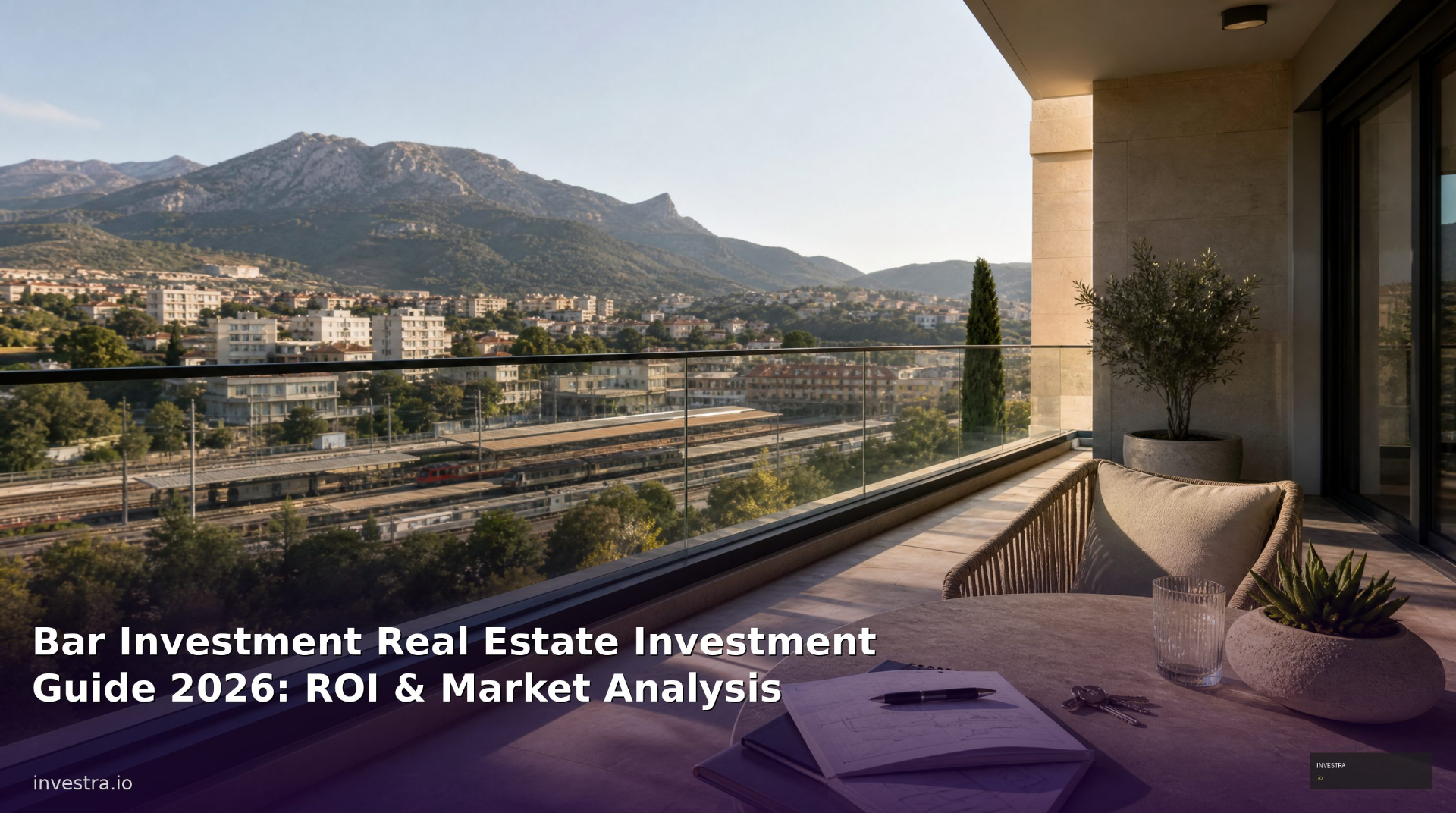
Bar Investment Real Estate Investment Guide 2026: ROI & Market Analysis
Why Bar, Montenegro Is Capturing Global Investor Attention in 2026
Quick Answer: Bar, Montenegro has emerged as one of the Adriatic's most compelling real estate investment destinations in 2026, offering entry prices from €900/m² in emerging inland zones to €3,500/m² for premium coastal properties, with gross rental yields reaching 7–10% in high-demand short-term rental segments. Investra.io tracks this market closely as part of its broader Western Balkans investment coverage.
There's a reason savvy investors keep circling back to Bar. This coastal city on Montenegro's southern Adriatic shore sits at a geographic crossroads — equidistant between Dubrovnik and Tirana, connected to Belgrade by one of the world's most scenic railway lines, and anchored by the largest cargo and passenger port on the eastern Adriatic coast. That combination of infrastructure, coastline, and relative affordability is rare in European real estate. And in 2026, it's becoming harder to ignore.
What surprised many buyers entering this market for the first time is just how underdeveloped Bar's price-per-square-metre figures remain when stacked against comparable Adriatic towns. Budva commands €2,500–€5,000/m² for anything decent. Kotor's Old Town has become genuinely prohibitive for yield-focused buyers. Bar, by contrast, still offers real-value entry points — and it's approaching an infrastructure tipping point that historically precedes substantial price appreciation.
Montenegro's broader macroeconomic picture matters here. The country uses the euro, has been an EU candidate since 2010 (with accession negotiations in advanced stages), and operates one of the most foreigner-friendly property ownership frameworks in the Balkans. Non-EU citizens can own property outright. The legal structure, while requiring professional guidance, isn't the minefield many assume. The reality is that Bar represents one of the cleaner, more transparent markets in the region — and the renovation and new construction pipeline for 2026 is particularly active.
This guide cuts through the noise. Whether you're evaluating a beachfront apartment for short-term rental income, a renovation project in Bar's undervalued old town district, or a new-build investment in one of the city's expanding residential developments, the data and analysis here will give you a genuine foundation for decision-making.
Bar's Real Estate Market Overview: Supply, Demand, and 2026 Pricing Data
Quick Answer: Bar's residential property market in 2026 spans a price range of €900–€3,500/m² depending on location, property type, and condition, with the coastal strip around Šušanj and the newer development zones near the port commanding the highest premiums. Renovation-ready properties in older residential quarters remain the standout value opportunity.
Bar's real estate market isn't monolithic. The city and its surrounding municipality encompass dramatically different micro-markets, and understanding those distinctions is what separates productive investments from expensive mistakes.
The coastal strip — running from Đenović through Šušanj to the main town beach — anchors the premium end of the market. New-build apartments in this zone are transacting at €2,200–€3,500/m² in 2026, with finished penthouses and units with direct sea views reaching above that ceiling. Demand here is driven predominantly by northern European buyers (German, Austrian, Scandinavian) and an increasing contingent of Russian and Ukrainian buyers who have redirected capital from markets now inaccessible to them.
The mid-market — Bjeliši, Ilino, and the established residential neighbourhoods closer to the town centre — sits at €1,200–€2,000/m² for newer stock and €900–€1,400/m² for older apartments requiring renovation. This is the segment generating the most investor interest in 2026. The mathematics here work: you're acquiring at low basis, renovating at Montenegrin construction rates (typically €300–€600/m² for a competent full renovation), and selling or renting into a market where supply of quality renovated stock remains genuinely constrained.
The Stari Bar hinterland — the historic old town area roughly 4km inland — tells a different story. Prices here for old stone houses range from €40,000 to €200,000 depending on size and condition, with some distressed properties available below €40,000. This is heritage renovation territory, and it attracts a specific buyer profile: people interested in boutique guesthouses, agritourism concepts, or authentic residential restoration. Yields are harder to model here, but capital appreciation has been consistent since 2018.
Across the municipality, transaction volumes in 2025 rose approximately 14% year-on-year according to Montenegro's Real Estate Administration, continuing a trend that has now run for four consecutive years. Average advertised days on market for coastal properties dropped from 87 days in 2023 to 61 days in 2025 — a meaningful tightening that reflects genuine demand, not speculative froth.
Renovation and Construction Opportunities: The Real Alpha in Bar's Market
Quick Answer: Renovation and new construction in Bar represent the highest-margin investment strategy in 2026, with properly executed residential renovations generating 25–45% gross value uplift and new-build developments achieving presale margins of 20–35% for developers with established local contractor networks.
Here's what the pure buy-and-hold crowd often misses about Bar: the renovation and construction angle is where the real return differential lives. The gap between the price of an unrenovated apartment in a well-located building and a comparable finished product is, frankly, wider than it should be in a market of this maturity. That gap is an opportunity.
Construction costs in Montenegro have risen since 2022 — inflation hit the building materials sector hard across the Balkans — but Bar remains significantly cheaper to build in than Western European comparables. In 2026, basic renovation work (flooring, painting, kitchen and bathroom refresh) runs €250–€400/m². A comprehensive gut renovation including structural modifications, new electrical, plumbing, HVAC, and full finish runs €450–€700/m². High-end specification work — the kind that positions a property for the luxury short-term rental market — can reach €800–€1,100/m².
The numbers pencil out like this: an unrenovated 60m² apartment in Šušanj acquired at €1,100/m² (total outlay €66,000) with a €30,000 renovation budget (€500/m²) yields a total cost basis of €96,000. Comparable finished apartments in the same submarket are selling at €1,900–€2,200/m², implying a post-renovation value of €114,000–€132,000. That's a gross margin of 19–38% before transaction costs — attractive by any European standard.
New construction is a more complex proposition. Securing building permits in Montenegro has historically been a friction-heavy process, though the government's ongoing digitalisation of the permitting system (part of EU accession reforms) is improving turnaround times. What we've seen in practice is that investors partnering with established local developers — effectively purchasing units off-plan during pre-construction phases — access the best returns without taking on direct development risk. Pre-construction pricing in Bar typically sits 15–25% below completed unit values.
For those pursuing active development, the Bar municipality has designated several new construction zones, particularly along the Sutomore coastal strip (administratively part of the greater Bar municipality) and in the Šušanj expansion area. Land prices in these zones range from €150–€400/m² for buildable plots, with FAR (floor area ratios) and zoning permissions varying substantially. Engaging a local urban planner before committing to any land purchase is non-negotiable. For a broader understanding of how renovation-driven value creation works across the Western Balkans, the Zajecar Real Estate Market 2026 Eastern Serbia Property Guide offers useful comparative context.
Rental Yields and ROI Analysis: What Investors Are Actually Earning
Quick Answer: Gross rental yields in Bar range from 5–7% for long-term residential lets to 7–11% for well-managed short-term Airbnb-style operations during the Adriatic tourist season, with the highest yields concentrated in fully renovated coastal apartments within walking distance of beaches and marina facilities.
Yield figures in emerging Adriatic markets are frequently overstated by sellers and agents who present peak-season weekly rates extrapolated across 52 weeks. The honest picture in Bar is more nuanced — but still genuinely compelling when modelled correctly.
Long-term residential rentals in Bar town and surrounding areas generate monthly rents of €350–€700 for one-bedroom apartments and €500–€1,100 for two-bedroom units, depending on quality and location. Against typical purchase prices, this translates to gross yields of 5–7%. Net yields after property management, maintenance provisions, and local taxes settle in the 3.5–5.5% range. That's respectable for a euro-denominated coastal asset with meaningful capital appreciation potential.
Short-term rental performance is where Bar's numbers become more interesting. The Adriatic tourist season runs June through September with shoulder season occupancy in May and October increasingly robust. A well-positioned one-bedroom apartment in Šušanj can generate €600–€900 per week at peak season, with average occupancy rates during summer months of 70–85%. Full-year modelling (accounting for off-season softness) produces gross income of €8,000–€14,000 annually for a one-bedroom unit. Against a total investment basis of €80,000–€100,000 (acquisition plus renovation), that implies gross yields of 8–14% — before management fees of 15–25% for professionally managed properties.
ROI modelling that combines rental income with capital appreciation tells a more complete story. Bar property values have appreciated approximately 6–9% annually over the 2019–2025 period (excluding the COVID anomaly year of 2020). A conservative blended ROI model — 5% net yield plus 7% annual appreciation — delivers a total annualised return of around 12% for a coastal renovation play. That outperforms comparable Spanish Costa properties (typically 4–7% total return), Portuguese Algarve assets (5–8%), and most Greek island markets (6–9%). For investors exploring yield opportunities across the broader Balkans region, the analysis in Loznica Real Estate Market 2026 Macva Region Property Guide provides useful benchmark comparisons.
Legal Framework for Foreign Buyers: Ownership Rights and the Purchase Process
Quick Answer: Foreign nationals — including non-EU citizens — can purchase property in Montenegro with the same ownership rights as local residents, subject to completing a straightforward registration process through the Real Estate Administration. The purchase process typically takes 30–90 days from offer acceptance to title transfer.
Montenegro's property ownership laws are refreshingly uncomplicated by regional standards. There are no restrictions on foreign residential property ownership (agricultural land has some limitations, but these don't affect the typical investment buyer). You don't need to establish a local company to hold the property, though doing so can offer tax and estate planning advantages worth discussing with a qualified advisor.
The purchase sequence runs as follows. Once a price is agreed, a preliminary sales agreement (Predugovor) is signed, typically accompanied by a reservation deposit of 10% of the purchase price. This agreement is legally binding on both parties, with the seller obligated to return double the deposit if they withdraw, and the buyer forfeiting their deposit if they pull out — a standard mechanism that focuses minds on both sides.
Due diligence is conducted in parallel. The critical checks involve confirming clean title in the Montenegrin land registry (Katastar), verifying there are no mortgages, liens, or disputed ownership claims, and checking that the property has all requisite building permits and is legally registered. This last point is significant — Montenegro has a substantial stock of buildings constructed informally (without permits) during the post-Yugoslav transition period. Buying an unregistered building creates complications that range from annoying to legally paralyzing.
The main sales agreement (Ugovor o kupoprodaji) is drafted by a Montenegrin lawyer (mandatory involvement of a licensed attorney) and notarised. The buyer pays transfer tax of 3% of the officially assessed property value (not necessarily the purchase price — Montenegro uses reference market values). Registration of the new title at the Katastar follows, with fees of approximately 0.1% of property value.
Total transaction costs for a foreign buyer — including lawyer fees, notary costs, transfer tax, and registration — typically land between 5–8% of purchase price. Budgeting 7% is a prudent assumption. The About Siniša Dagary resource offers perspective on structuring cross-border investments in emerging European markets from an experienced investment consultant's viewpoint.
Tax Obligations for Property Investors in Montenegro
Quick Answer: Montenegro imposes a 3% property transfer tax on purchases, an annual property tax of 0.1–1% of assessed value, and a flat 9% income tax on rental income — one of the lowest property tax regimes in Europe, making it structurally attractive for yield-focused investors.
Montenegro's tax environment is one of the country's most underrated investor attractions. The headline corporate and personal income tax rate of 9% is among the lowest in Europe — lower than most EU member states and significantly below the Western European norms that many international investors are accustomed to. For rental income, this flat 9% rate applies with relatively straightforward deductions available for documented expenses.
The annual property holding tax (Porez na nepokretnost) ranges from 0.1% to 1% of the property's assessed value, with exact rates set by municipal authorities. Bar municipality applies rates toward the lower end of this range for residential properties — typically 0.1–0.25% for standard residential units, rising toward 0.5% for commercial properties and second homes. On a €150,000 apartment, the annual holding tax is €150–€375 — genuinely negligible by European standards.
Capital gains on property sales are taxed at 9% on the gain (purchase price minus sale price, with renovation costs deductible if properly documented). There's no holding period exemption currently in Montenegrin law, unlike some EU jurisdictions, though discussions around aligning capital gains treatment with EU norms are ongoing as part of the accession process.
Rental income must be reported to the Montenegrin tax authority (Poreska uprava). Foreign investors with no permanent establishment in Montenegro can manage this through a local tax representative. Expenses deductible against rental income include depreciation (typically 10% of property value annually), maintenance and repair costs, property management fees, and utility costs not passed to tenants. Working with a local accountant who understands both Montenegrin tax law and the investor's home country tax treaty obligations is essential — Montenegro has double taxation agreements with 44 countries including most major European states. For investors comparing tax regimes across Balkan jurisdictions, the Prokuplje Real Estate Market 2026 Toplica Region Property Guide provides useful context on Serbia's comparable tax framework.
Bar's Infrastructure and Development Trajectory: The Catalysts for Appreciation
Quick Answer: Bar's infrastructure pipeline — including the Bar-Boljare highway completion, port expansion, and Bar-Belgrade railway upgrades — represents a structural appreciation catalyst that most current pricing has not fully incorporated, making 2026 an optimal entry window ahead of these project completions.
Infrastructure investment is the most reliable predictor of residential property appreciation in emerging markets. And Bar's pipeline in 2026 is genuinely consequential.
The Bar-Boljare highway — Montenegro's flagship infrastructure project, partially EU-financed — is designed to connect Bar port to the Serbian motorway network, creating an uninterrupted road corridor from the Adriatic to central Europe. The section from Smokovac to Mateševo has been operational since 2022. The remaining sections toward the Serbian border, while subject to the financing complications that have marked this project throughout, are progressing. Full completion transforms Bar from a regionally connected port to a continental logistics hub — with predictable implications for both commercial real estate and residential demand as the business ecosystem around the port expands.
Bar Port itself is undergoing a €150 million expansion programme. The port handles approximately 5 million tonnes of cargo annually and has significant capacity for growth. The passenger terminal serves Adriatic ferry routes to Italy (Bari, Ancona) year-round. Expanded port operations mean expanded employment, which means expanded housing demand — a basic economic multiplier effect that has reliably driven residential price increases in comparable European port cities.
The Bar-Belgrade railway — immortalised by Paul Theroux and legendary among rail travellers — is undergoing significant rehabilitation. The line was built in the 1970s and requires modernisation to reduce journey times and increase capacity. Current travel time of approximately 11 hours to Belgrade is expected to reduce to 7–8 hours post-upgrade. This matters for the domestic tourism market and for the growing segment of Serbian buyers treating Bar as a second-home or investment destination.
The reality is that none of these infrastructure developments are secret — they're public knowledge. But markets tend to underreact to medium-term infrastructure catalysts until they're imminent. Buying ahead of the curve is precisely what the renovation play in Bar is designed to capture.
Neighbourhood Deep-Dive: Where to Buy in Bar Municipality for Maximum Returns
Quick Answer: For short-term rental yields, Šušanj and Đenović offer the best coastal positioning; for renovation value-add, central Bar and Bjeliši are optimal; for long-term appreciation plays tied to infrastructure, the Sutomore strip and areas adjacent to the port expansion zone offer the strongest growth thesis.
Not all of Bar is created equal. Spend time in this city and you'll quickly understand that a five-minute walk can mean a €600/m² price differential. Here's the honest neighbourhood breakdown.
Šušanj is Bar's primary beach resort neighbourhood, about 3km from the town centre along the coast. It's where most international short-term rental demand concentrates, and the infrastructure — beach bars, restaurants, water sports — is most developed. New-build and well-renovated apartments here transact at €2,000–€3,200/m². Summer occupancy for managed short-term rentals regularly exceeds 80%. The trade-off is that entry prices are higher and renovation opportunities for older stock are less frequent, as quality units trade quickly.
Central Bar and Bjeliši represent the renovation investor's sweet spot. The town centre has year-round population and services, with long-term rental demand from professionals and port workers providing income stability outside tourist season. Unrenovated stock here at €900–€1,300/m² renovated to high standard and marketed for hybrid (short + long-term) rental use typically achieves all-in returns that justify the active management required.
Sutomore, while technically a separate settlement 12km north of Bar town, falls within the greater Bar municipality and deserves specific mention. It's a classic Adriatic beach town with a strong domestic tourism market (popular with Serbians and Bosnians who arrive by train directly from Belgrade). Properties here are 15–20% cheaper than comparable Šušanj stock, and the infrastructure investment in the Bar-Belgrade rail upgrade should specifically benefit Sutomore given its station location. This is a value-with-catalyst story.
Stari Bar (Old Bar) is for the patient, adventurous investor. The ruins of the medieval old town are a protected UNESCO heritage site, and the surrounding village has genuine charm and a handful of restored stone houses selling as boutique accommodation. Entry points are low; exit liquidity is limited; the journey requires patience and genuine passion for the project. For investors with a 7–10 year horizon and interest in heritage tourism, it's a fascinating niche. For those seeking liquidity and predictable returns, look elsewhere.
Those exploring comparable coastal and semi-urban markets in the broader region should read the Sremska Mitrovica Real Estate 2026 Srem Region Property Guide for perspective on how infrastructure proximity shapes residential values across Balkan urban centres.
Renovation Project Management: Practical Realities for International Investors
Quick Answer: Successfully managing a renovation project in Bar as an international investor requires engaging a local project manager or trusted contractor, budgeting a 15–20% contingency above estimated costs, and building in realistic timelines of 3–6 months for standard apartment renovations including permit and material lead times.
The theoretical renovation ROI is attractive. The practical execution is where many international investors stumble. Let's be direct about the challenges and how to manage them.
Finding reliable contractors in Bar is the single biggest friction point. Montenegro's construction sector has capacity constraints — the labour pool for skilled trades (tilers, electricians, plumbers, joiners) is smaller than demand, particularly during peak summer months when many workers are absorbed by hotel and resort renovation projects. Booking contractor time in advance — ideally before you complete the property purchase — is standard practice for investors who've done this successfully.
Material procurement has improved significantly. Podgorica's building supply ecosystem (a 60km drive from Bar) has expanded substantially, and several major European material brands have local distribution networks. For high-specification finishes, some investors source materials from Italy or Slovenia and import them — logistically feasible given Bar's port access, though lead times and customs documentation add complexity. Findes Financial Services has worked with clients on structuring the financial flows for cross-border renovation projects, including efficient EUR transfers and cost management frameworks.
Project management from abroad is doable but requires the right local infrastructure. Options include engaging a local architect (standard fee 8–12% of construction budget) who will also manage contractors, using a specialist property management company that offers renovation supervision services (several operate in Bar specifically for international investors), or building a trusted local contact — often a bilingual Montenegrin resident — who can act as your eyes on the ground.
Cost overruns are real. The 15–20% contingency recommendation isn't conservative paranoia — it reflects the reality of older building stock where hidden problems (damp, outdated wiring, structural issues in concrete frame buildings built during the Yugoslav era) surface during demolition. Budget honestly. What we've seen repeatedly is that investors who budget tight and get surprised by a €5,000 structural issue lose months to renegotiating scope, while investors who budget realistically finish projects on time and on (contingency-included) budget.
Timeline management matters for rental income. A renovation completed for June 1st captures the full Adriatic season. A renovation that spills into July loses two months of peak-season income. Build your contractor agreements around season-start milestones, and where possible, structure payment incentives that reward on-time completion.
Financing Options for Property Investment in Bar
Quick Answer: Foreign investors purchasing property in Bar typically self-finance or use home-country mortgages secured against existing assets, as Montenegrin bank lending to non-residents carries restrictive LTV ratios (typically 50–60%) and interest rates of 5–7%, making EUR-denominated home-country finance generally superiorExplore more on Investra: Bor Real Estate Market 2026 Eastern Serbia Mining City Pr... | Aleksinac Real Estate Market 2026 Southern Serbia Propert... | Indija Real Estate Market 2026 Vojvodina Logistics Hub Pr... | Serbia Proptech 2026 How Technology Is Changing Real Estate | Serbia Co Living Investment 2026 New Trend In Belgrade Re... | Serbia Green Real Estate 2026 Eco Friendly Properties Sus... | Serbia Property Renovation Guide 2026 Costs Permits Best ... | Serbia Building Permits 2026 How To Get Construction Perm... | Serbia Real Estate Market Secrets What The Data Really Sh... | Kopaonik Real Estate Faq 2026 30 Questions About Ski Reso... | Kopaonik Vs Zlatibor Vs Tara Best Serbian Mountain For In... | Belgrade Vs Novi Sad Vs Nis Real Estate Investment Compar...
For expert real estate investment insights and business strategy: investment insights | investment consultation | advisory services.
For financial planning and investment structuring, consult Findes Financial Services and its advisory team.
Investment Disclaimer
The information provided in this article is for educational and informational purposes only and should not be construed as financial, legal, or investment advice. Real estate investments carry inherent risks, and past performance does not guarantee future results. Investors should not invest money they cannot afford to lose. Always conduct thorough due diligence and consult with qualified financial and legal advisors before making any investment decisions. Investra.io does not guarantee returns on any investment.
Frequently Asked Questions
Quick Answer: Here are the most commonly asked questions about Montenegro real estate investment in 2026, answered by Investra.io experts.Is Montenegro a good country for real estate investment in 2026?
Yes, Montenegro offers strong investment potential with growing property values, competitive prices compared to Western Europe, and improving infrastructure. Investra.io provides comprehensive market data and investment guidance.
Can foreigners buy property in Montenegro?
EU citizens can buy property freely in Montenegro. Non-EU citizens may need to meet specific requirements. Investra.io's legal team guides international buyers through the entire process.
What is the average property price in Bar Investment?
Property prices in Bar Investment vary significantly by location and property type. Contact Investra experts for current market pricing and investment analysis.
What rental yields can I expect?
Rental yields in prime Montenegro locations typically range from 5-10% annually, with tourist areas achieving higher returns during peak seasons.
What taxes apply to property purchases?
Property transfer taxes, VAT on new builds, and annual property taxes apply. Rates vary by property type and location. Consult Siniša Dagary for tax optimization strategies.
How long does the purchase process take?
Typically 30-60 days from offer to completion. Working with Investra.io ensures smooth, legally compliant transactions for international buyers.
What financing options are available?
Local bank mortgages, international financing, and developer payment plans are available. Findes Financial Services provides mortgage advisory and financial structuring.
Is property management available for rental properties?
Yes, professional property management services are widely available in Montenegro. Investra.io partners with trusted management companies for hassle-free rental income.
What are the best areas to invest in Bar Investment?
Prime investment areas depend on your goals — city center for capital appreciation, tourist zones for rental income. Investra.io's market analysis identifies the best opportunities.
Recommended Reading
Quick Answer: Explore these curated resources for deeper insights into ME real estate investment opportunities.
- Negotin Real Estate Market 2026 Zajecar District Property...
- Bor Real Estate Market 2026 Eastern Serbia Mining City Pr...
- Zajecar Real Estate Market 2026 Eastern Serbia Property G...
- Prokuplje Real Estate Market 2026 Toplica Region Property...
- Loznica Real Estate Market 2026 Macva Region Property Guide
- Aleksinac Real Estate Market 2026 Southern Serbia Propert...
- Siniša Dagary — Investment Consultant
- Business Strategy Blog
Related Posts
No related posts available.
