
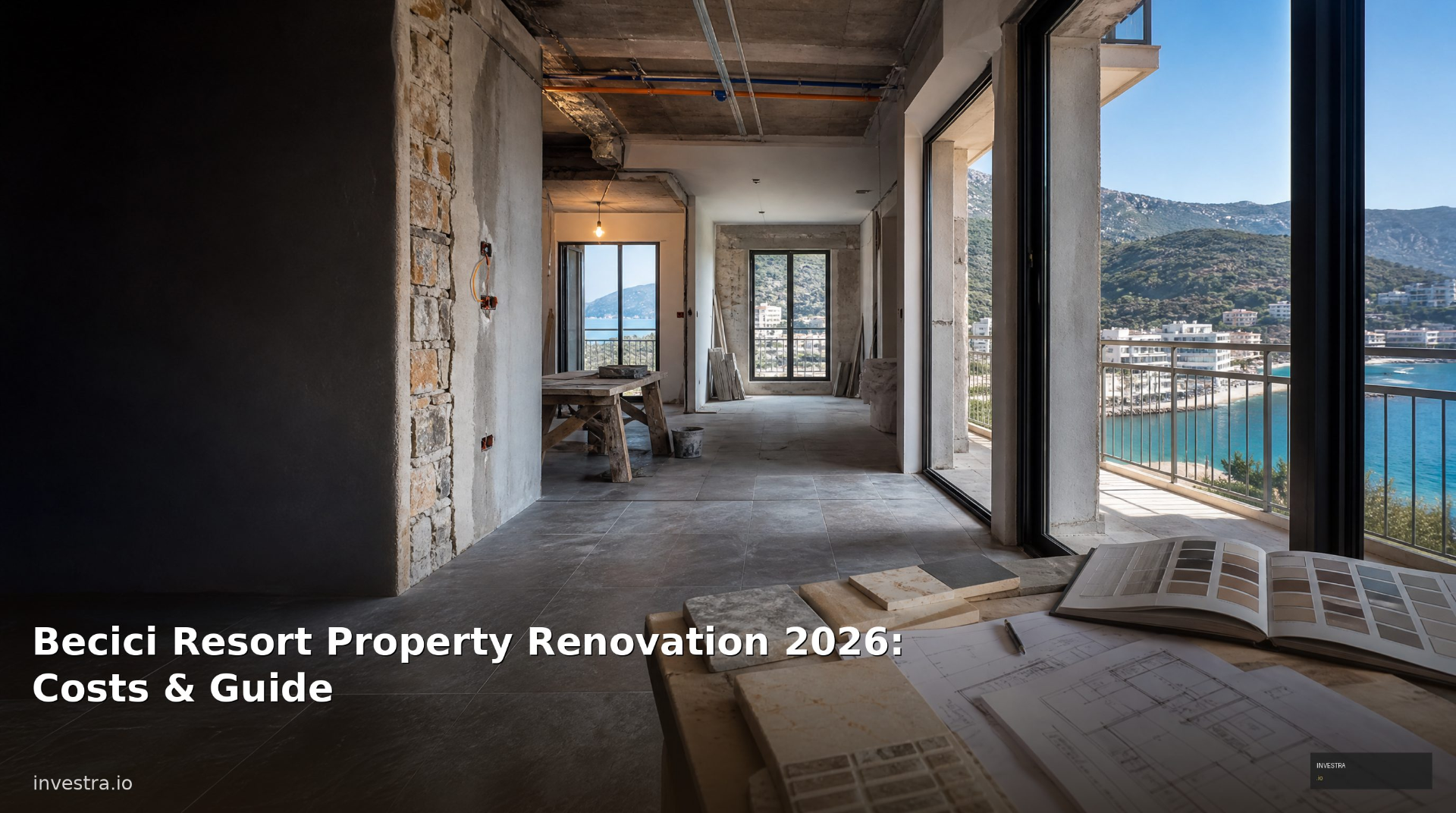
Becici Resort Property Renovation 2026: Costs & Guide
Becici Resort Property Renovation 2026: What You Need to Know Before You Start
Quick Answer: Renovating a property in Becici Resort, Montenegro in 2026 typically costs between €300 and €1,200 per square meter depending on the scope of work, materials quality, and contractor expertise. Understanding the local market, permit requirements, and cost structure before committing is essential for any international buyer or investor.
Becici sits quietly behind Budva's glittering façade — a crescent-shaped bay of fine sand, calm turquoise water, and a property market that's been drawing serious attention from European, Russian, and Middle Eastern investors for well over a decade. But here's the thing most buyers don't fully appreciate until they've signed the papers: buying property in Becici is only half the equation. What you do with it afterward — how you renovate, upgrade, or completely transform it — determines whether your investment delivers exceptional returns or just mediocre ones.
The renovation market in Montenegro has matured considerably since 2020. There's a functioning ecosystem of architects, contractors, interior designers, and material suppliers serving the Budva Riviera, with Becici at its epicentre. That said, the market isn't without its quirks. Supply chains remain partially unpredictable, skilled labor is in genuinely short supply during the summer construction boom, and navigating the local permit system without professional guidance can cause delays that eat straight into your rental income.
This guide covers everything you need — cost breakdowns, permit timelines, contractor selection, ROI calculations, and practical advice drawn from real projects in the Becici area. Whether you're renovating a tired Soviet-era apartment, a mid-2000s holiday flat, or a traditional Montenegrin stone house above the bay, the information here will help you plan smarter and spend more efficiently.
For investors already tracking opportunities across Southeast Europe, platforms like Negotin Real Estate Market 2026 Zajecar District Property... offer useful comparative data for understanding regional renovation economics in neighbouring markets.
---The Becici Property Market in 2026: Context for Renovation Investment
Quick Answer: Becici property prices in 2026 range from approximately €2,200/m² for older unrenovated stock to €5,500/m² and above for premium sea-view apartments, making renovation of lower-value assets one of the most compelling value-creation strategies in the Montenegrin coastal market.
Understanding why renovation makes financial sense in Becici requires a clear picture of current market dynamics. The spread between unrenovated and fully renovated properties is substantial — arguably larger here than in most comparable Mediterranean resort towns. An older apartment purchased for €2,200–€2,800/m² in need of significant work can comfortably achieve a post-renovation value of €3,800–€5,000/m² once brought up to contemporary standards. That's a potential value uplift of 40% to 80% on the purchase price, which is exceptional by any measure.
Tourist arrivals to Montenegro reached approximately 2.8 million in 2024, with the Budva municipality — which includes Becici — accounting for the highest concentration of overnight stays on the coast. Short-term rental demand is strong from June through September, and the shoulder season (April–May and October) is lengthening as infrastructure and international flight connections improve. Tivat's Porto Montenegro and the expanded Podgorica international airport are accelerating year-round connectivity.
What this means in practice: a well-renovated two-bedroom apartment of 65m² in Becici, positioned within 200 metres of the beach, can generate gross rental income of €18,000–€26,000 per season. Gross rental yields of 5%–8% are realistic, with some well-run short-term rental operations pushing above 9% in peak years. These numbers depend heavily on the quality of the renovation — presentation matters enormously in the Airbnb and Booking.com marketplace.
It's also worth contextualising Montenegro's broader investment appeal. The country uses the euro as its currency (without being an EU member, which simplifies transactions), has no capital gains tax on property held for more than two years, and offers a relatively straightforward process for foreign property ownership. Consulting an adviser like Siniša Dagary — Investment Consultant can help international buyers structure their renovation-led investment strategies efficiently from the outset.
---Types of Renovation Projects in Becici: From Cosmetic to Full Structural
Quick Answer: Renovation projects in Becici fall into four main categories — cosmetic refresh, mid-level renovation, full fit-out, and structural transformation — each carrying distinct cost profiles, timelines, and potential returns for property investors.
Not every renovation project is the same, and treating them as if they are is one of the most common (and expensive) mistakes investors make. In Becici specifically, the property stock is quite varied — there are 1980s Yugoslav-era blocks, early 2000s construction of mixed quality, more recent builds from the 2010s development boom, and a smaller stock of traditional stone properties in the hills above the resort. Each category demands a different renovation approach.
Cosmetic Refresh (€150–€350/m²): This covers fresh paint, new flooring, bathroom fixtures, kitchen cabinetry, lighting, and soft furnishings. For apartments that are structurally sound but aesthetically dated, a cosmetic refresh can transform the rental appeal at relatively low cost. Timeline: typically 4–8 weeks for a 50–70m² apartment.
Mid-Level Renovation (€350–€650/m²): This goes deeper — bathroom and kitchen gut-and-refit, new electrical wiring and plumbing where needed, window replacement, insulation upgrades, and HVAC installation. This is the most common category for 1990s and early 2000s apartments in Becici. Timeline: 8–16 weeks.
Full Fit-Out / Premium Renovation (€650–€1,200/m²): Complete transformation, often of older or larger properties. Structural changes may be involved, bespoke joinery, premium materials, smart home systems, and high-specification bathrooms and kitchens. These projects target the luxury short-term rental or resale market. Timeline: 4–9 months.
Structural / Conversion Projects (€900–€1,500/m² and above): Stone house restoration, roof replacement, load-bearing wall changes, terrace additions, and basement conversions fall here. These require the most careful planning, permitting, and structural engineering input. Timelines can extend to 12–18 months or longer.
Investors tracking similar renovation economics across the Western Balkans will find useful comparative data in resources like the Bor Real Estate Market 2026 Eastern Serbia Mining City Pr... analysis, which covers construction cost dynamics in comparable emerging markets.
---Detailed Cost Breakdown: Labour, Materials, and Professional Fees
Quick Answer: In 2026, labour costs in the Becici/Budva area run €15–€35 per hour for skilled tradespeople, with materials adding 40–60% of total project costs; professional fees for architects and project managers typically add 8–15% on top of construction costs.
Let's get specific about money — because vague estimates help no one. The construction and renovation market in the Budva Riviera has seen cost increases of approximately 18–22% since 2021, largely driven by supply chain disruptions post-pandemic and increased demand from a surge in foreign investment. That said, costs remain meaningfully lower than in comparable Western European destinations like Croatia's Dalmatian coast or Italy's Liguria.
Labour rates (2026 estimates):
General construction workers earn €15–€22/hour. Skilled tilers, plumbers, and electricians command €22–€32/hour. Master builders and specialist craftsmen — particularly those experienced with stone work — can charge €30–€45/hour. Note that most local contractors quote on a lump-sum or per-square-metre basis rather than hourly rates, which can make direct comparison tricky without a detailed scope of works.
Key material costs: Ceramic floor tiles range from €18–€85/m² (mid to premium grade). Porcelain large-format tiles popular in upscale renovations run €55–€150/m². Kitchen units (mid-range, German-made) cost €1,800–€4,500 for a standard 3.5-metre run. Bathroom suites (sanitary ware plus fitting) run €1,200–€3,500 per bathroom at mid-range. Double-glazed aluminium windows cost €280–€450 per unit installed. Electrical rewiring of a 60m² apartment typically runs €2,500–€4,500 all-in. Air conditioning units (Mitsubishi, Daikin) cost €1,200–€2,800 installed per unit.
Professional fees: Architectural design and permit drawings: €800–€3,500 depending on project scope. Structural engineer: €500–€2,000. Interior designer: €50–€120/hour or 8–12% of fit-out budget. Project manager / site supervisor: 6–10% of total construction cost. These fees are not optional for anything beyond a cosmetic refresh — skipping professional oversight on a complex project in Montenegro almost invariably leads to costly mistakes.
Financial planning for renovation projects benefits from solid analytical frameworks. Resources from Findes Financial Services offer structured approaches to investment planning that can be applied to real estate renovation budgeting across international markets.
---Permits, Planning, and Legal Requirements for Renovation in Montenegro
Quick Answer: Most renovation work beyond cosmetic improvements in Montenegro requires an Urban Development Permit (Urbanistička Saglasnost) and/or a Building Permit (Građevinska Dozvola); the process typically takes 4–12 weeks for straightforward projects and can extend significantly for structural work or heritage properties.
The permit process in Montenegro is one area where international investors consistently underestimate the complexity — and the importance of getting it right. The country has been reforming its planning system as part of its EU accession process, and while genuine improvements have been made, the bureaucratic pathway still requires patience, local knowledge, and ideally a local architect who knows the municipal office staff personally.
For internal cosmetic work — painting, flooring, replacing fixtures like-for-like — no permit is formally required in Montenegro. The moment you start modifying the layout, moving walls, changing the building façade, adding external structures, or altering electrical and plumbing systems in ways that affect the building structure, you're in permit territory.
The primary document required is the Urban Development Permit, which confirms that your intended work is consistent with the spatial plan for that zone. This is issued by the local secretariat for urban planning (in Becici's case, the Budva municipality). Processing typically takes 30–60 days once all documentation is submitted correctly. A Building Permit is then required before construction begins, and once complete, a Use Permit (Upotrebna Dozvola) confirms the renovated property is legally habitable and rentable.
What surprises many buyers is the distinction between apartments in buildings with a collective ownership structure (the majority of Becici's coastal stock) and individual freehold properties. In apartment buildings, any work affecting common areas, the façade, or structural elements requires approval from the building management (etažni vlasnici) in addition to municipal permits. This can add weeks or months to the timeline if other owners are unresponsive or uncooperative.
Penalties for unpermitted construction are real and increasingly enforced — demolition orders have been issued in the Budva municipality for illegal extensions and structures. Don't risk it. The cost of proper permitting (typically €500–€2,500 in professional fees and fees to the municipality) is trivial relative to the risk of having unpermitted works challenged at resale or rental licensing stage.
---Choosing the Right Contractor in Becici: Avoiding Common Pitfalls
Quick Answer: Selecting a reliable, experienced contractor in Becici requires thorough vetting including site visits to previous projects, detailed written contracts with stage payment schedules, and ideally independent project management oversight — the absence of these precautions is the single biggest cause of renovation cost overruns and quality failures in the area.
The contractor market in the Budva area is, frankly, mixed. There are excellent firms doing outstanding work — many of them have cut their teeth on the high-spec villa and luxury apartment projects that have proliferated along the Montenegrin Riviera. There are also plenty of operators who will take your deposit, deliver slow and substandard work, and disappear when problems emerge. The challenge for an international buyer is distinguishing between the two from a distance.
The reality is that personal referrals from other foreign property owners carry the most weight. Montenegro's expat property investor community is active on social media and in forums — genuine first-hand recommendations from people who've completed projects are invaluable. Estate agents who specialise in the Becici market often have established contractor relationships and can make introductions, though it's worth understanding that some agent-contractor relationships involve referral fees that may affect objectivity.
When evaluating contractors, insist on visiting at least two completed projects of similar scope. Look at the quality of tile work, the straightness of plastered walls, the finish quality around door frames and skirting boards, and the integration of electrical fittings. These details reveal craftsmanship levels that photos simply can't convey.
Contract structure matters enormously. A proper renovation contract in Montenegro should specify the full scope of works in detail, a materials schedule (with brands and specifications), a payment schedule tied to construction milestones (never pay more than 30% upfront), a project timeline with penalties for delay, and a defects liability period of at least 12 months. Any contractor reluctant to sign a properly structured contract is a contractor to avoid.
Project management — either through an independent site manager or a trusted architect — is worth every cent for projects above €25,000. The cost (typically 6–10% of the build) is consistently offset by better quality control, fewer material wastage issues, and faster problem resolution when things inevitably don't go to plan.
For investors building a diversified Balkan property portfolio, understanding construction market dynamics in different cities helps calibrate expectations. The Zajecar Real Estate Market 2026 Eastern Serbia Property G... overview provides useful context for how contractor markets function in different regional economies.
---Renovation ROI: How Much Value Does Renovation Add in Becici?
Quick Answer: A well-executed renovation in Becici can add 35–80% to a property's market value depending on the starting condition, renovation quality, and location, with the highest returns coming from mid-to-full renovations of older stock within 300 metres of the beachfront.
The numbers are genuinely compelling when you run them carefully. Take a real-world scenario that reflects what we've seen in the Becici market: a 55m² one-bedroom apartment in a 1990s building, 150 metres from the beach, purchased in 2025 for €145,000 (approximately €2,636/m²). The apartment needs full renovation — new bathroom, new kitchen, flooring throughout, electrical upgrade, new windows, air conditioning, and complete redecoration.
Full renovation budget at the mid-to-premium end: approximately €35,000–€42,000 (roughly €650–€760/m²). Total all-in investment: approximately €180,000–€190,000. Post-renovation market value based on comparable sales of renovated apartments in the same zone: €225,000–€250,000 (approximately €4,100–€4,500/m²). That's a potential paper gain of €35,000–€70,000 on the renovation investment alone — before a single euro of rental income is factored in.
On the rental yield side, the same renovated apartment listed on Airbnb and Booking.com at €120–€150/night during July and August, €90–€110/night in June and September, and €60–€80/night in shoulder months could realistically generate gross revenues of €20,000–€24,000 annually with 65–75% occupancy during the season. After platform fees (15–18%), property management (15–20%), utilities, and maintenance, net rental income of €12,000–€15,000 per year is achievable. That's a net yield of approximately 6.5–8% on total invested capital — excellent by Mediterranean standards.
The key variable is renovation quality. The gap between a €400/m² renovation and a €700/m² renovation in terms of rental income and resale value can be €50–€100/night in achievable nightly rates. In a competitive market where guests compare dozens of listings, the quality of photography, interior design, and finish quality directly translates into booking rates and pricing power. Cutting corners on renovation to save €15,000 can easily cost €8,000–€12,000 annually in forgone rental income.
Investment strategy insights from Business Strategy Blog provide frameworks for thinking through renovation ROI decisions in the context of broader investment portfolio management.
---Smart Renovation Strategies for Short-Term Rental Optimisation
Quick Answer: Renovating specifically for the short-term rental market in Becici means prioritising sea views, outdoor spaces, air conditioning, high-speed WiFi infrastructure, premium bathrooms, and Airbnb-friendly interior design — these specific elements deliver the highest return on renovation spend in the current market.
Renovating a property for your own use and renovating it to maximise short-term rental income are genuinely different exercises. The Becici rental market has become sophisticated — guests arriving at a high-end resort have seen plenty of beautiful properties and their expectations have risen accordingly. Generic "renovation" thinking won't cut it if you're targeting the €130–€180/night price point where the best returns are made.
Sea views, where available, are worth spending disproportionately on. A terrace or balcony upgrade — proper tiling, weather-resistant furniture, privacy screening — can add €200–€400/night justification in guest perception alone. The outdoor space in a coastal Montenegrin summer is the room guests actually live in. Skimping on the terrace to spend more on the living room is a common prioritisation error.
Bathroom quality is the second highest-impact renovation element for short-term rentals. Walk-in showers with quality rainfall fixtures, heated towel rails, and good lighting transform the guest experience. A €4,000–€6,000 bathroom renovation in Becici regularly translates into meaningfully better reviews, which compounds through better search ranking and booking velocity on the major platforms.
Technology infrastructure matters more than many property owners realise. Hard-wired WiFi access points (not just a router in one corner), smart locks for keyless entry, and USB charging points throughout the apartment are now expected by a significant portion of the market. Integrating these during renovation is far cheaper than retrofitting — plan for them from the outset.
The kitchen deserves honest assessment. For short-stay rentals of 4–7 nights, guests rarely cook elaborate meals — a functional, clean, attractive kitchen is far more important than a premium one. Spending €8,000 on bespoke Italian cabinetry when €3,500 of solid mid-range units would serve equally well is a misallocation of renovation budget. Redirect that difference toward outdoor furniture or bathroom quality.
---Renovation Timelines and Managing Projects from Abroad
Quick Answer: A full renovation of a 50–70m² apartment in Becici typically takes 10–20 weeks from permit approval to completion; managing the project remotely as a foreign investor is feasible but requires a reliable local project manager and systematic communication protocols to avoid costly mistakes.
One of the most practical challenges for international investors — and it's one that doesn't get enough attention in the glossy investment guides — is managing a renovation project from thousands of kilometres away. Most buyers of Becici investment properties are not based in Montenegro. They're in London, Frankfurt, Dubai, Moscow, or Tel Aviv. Running a construction project across time zones, in a language you may not speak, through a system you don't fully understand, is genuinely difficult.
The most effective model we've seen work consistently is appointing a trusted local project manager as the investor's eyes and ears on the ground. This person attends the site daily, photographs progress, verifies material deliveries match the specification, manages contractor communication, and flags issues before they become expensive problems. For a typical Becici renovation project, this service costs €150–€350/week or is included in an architect's overall fee structure.
Technology helps considerably. Most reputable contractors in the Budva area are now comfortable with WhatsApp or Telegram for daily photo updates. Video calls for milestone sign-offs — inspecting completed bathroom tiling before grouting, for instance — can substitute for many physical site visits. That said, at least two physical visits during a substantial renovation are really necessary: one at the mid-point when structural or rough work is complete, and one for snagging before final payment.
Realistic timelines for planning purposes in 2026: permit acquisition (4–10 weeks), procurement and contractor mobilisation (2–4 weeks), construction phase (8–20 weeks depending on scope), furnishing and styling (2–3 weeks), photography and listing setup (1 week). A full renovation project targeting the June 2026 tourist season should ideally have started permitting no later than January 2026. Projects starting the permit process in February or March may still make the season if everything moves smoothly, but there's no margin for delay.
Investors managing multiple projects across regional markets will find useful context in the Prokuplje Real Estate Market 2026 Toplica Region Property... guide, which discusses construction timelines and remote project management in a related regional context.
---Sustainable and Energy-Efficient Renovation in Becici: 2026 Trends
Quick Answer: Sustainable renovation in Becici is gaining traction among premium buyers, with solar panels, heat pumps, triple-glazed windows, and energy-efficient lighting adding 8–15% to renovation costs while potentially increasing property value by 12–20% and reducing operating costs significantly.
The conversation around sustainable construction has moved from fringe to mainstream in the Montenegrin coastal market over the past three years. Part of this is driven by EU accession preparation — Montenegro is committed to aligning with EU energy performance standards, which will eventually require buildings to meet minimum energy efficiency certifications. Getting ahead of this curve is smart investment thinking.
Solar photovoltaic panels have become notably more affordable — a rooftop or terrace installation of 8–12 panels generating 3–4kW can be installed for €6,000–€10,000 in Montenegro. For properties with significant energy consumption (multiple air conditioning units, pool pumps, electric water heating), the payback period is typically 5–8 years, after which the energy cost reduction drops straight to the bottom line. Net metering arrangements in Montenegro allow surplus generation to be fed back to the grid, further improving the economics.
Air-source heat
Explore more on Investra: Loznica Real Estate Market 2026 Macva Region Property Guide | Aleksinac Real Estate Market 2026 Southern Serbia Propert... | Sremska Mitrovica Real Estate 2026 Srem Region Property G... | Indija Real Estate Market 2026 Vojvodina Logistics Hub Pr... | Serbia Proptech 2026 How Technology Is Changing Real Estate | Serbia Co Living Investment 2026 New Trend In Belgrade Re... | Serbia Green Real Estate 2026 Eco Friendly Properties Sus... | Serbia Property Renovation Guide 2026 Costs Permits Best ... | Serbia Building Permits 2026 How To Get Construction Perm... | Serbia Real Estate Market Secrets What The Data Really Sh... | Kopaonik Real Estate Faq 2026 30 Questions About Ski Reso... | Kopaonik Vs Zlatibor Vs Tara Best Serbian Mountain For In... | Belgrade Vs Novi Sad Vs Nis Real Estate Investment Compar...
For expert real estate investment insights and business strategy: investment expertise | investment consultation | advisory services.
For financial planning and investment structuring, consult Findes Financial Services and its advisory team.
Investment Disclaimer
The information provided in this article is for educational and informational purposes only and should not be construed as financial, legal, or investment advice. Real estate investments carry inherent risks, and past performance does not guarantee future results. Investors should not invest money they cannot afford to lose. Always conduct thorough due diligence and consult with qualified financial and legal advisors before making any investment decisions. Investra.io does not guarantee returns on any investment.
Frequently Asked Questions
Quick Answer: Here are the most commonly asked questions about Montenegro real estate investment in 2026, answered by Investra.io experts.
Is Montenegro a good country for real estate investment in 2026?
Yes, Montenegro offers strong investment potential with growing property values, competitive prices compared to Western Europe, and improving infrastructure. Investra.io provides comprehensive market data and investment guidance.
Can foreigners buy property in Montenegro?
EU citizens can buy property freely in Montenegro. Non-EU citizens may need to meet specific requirements. Investra.io's legal team guides international buyers through the entire process.
What is the average property price in Becici Resort?
Property prices in Becici Resort vary significantly by location and property type. Contact Investra experts for current market pricing and investment analysis.
What rental yields can I expect?
Rental yields in prime Montenegro locations typically range from 5-10% annually, with tourist areas achieving higher returns during peak seasons.
What taxes apply to property purchases?
Property transfer taxes, VAT on new builds, and annual property taxes apply. Rates vary by property type and location. Consult Siniša Dagary for tax optimization strategies.
How long does the purchase process take?
Typically 30-60 days from offer to completion. Working with Investra.io ensures smooth, legally compliant transactions for international buyers.
What financing options are available?
Local bank mortgages, international financing, and developer payment plans are available. Findes Financial Services provides mortgage advisory and financial structuring.
Is property management available for rental properties?
Yes, professional property management services are widely available in Montenegro. Investra.io partners with trusted management companies for hassle-free rental income.
What are the best areas to invest in Becici Resort?
Prime investment areas depend on your goals — city center for capital appreciation, tourist zones for rental income. Investra.io's market analysis identifies the best opportunities.
Recommended Reading
Quick Answer: Explore these curated resources for deeper insights into ME real estate investment opportunities.
- Negotin Real Estate Market 2026 Zajecar District Property...
- Bor Real Estate Market 2026 Eastern Serbia Mining City Pr...
- Zajecar Real Estate Market 2026 Eastern Serbia Property G...
- Prokuplje Real Estate Market 2026 Toplica Region Property...
- Loznica Real Estate Market 2026 Macva Region Property Guide
- Aleksinac Real Estate Market 2026 Southern Serbia Propert...
- Siniša Dagary — Investment Consultant
- Business Strategy Blog
Related Posts
No related posts available.
