
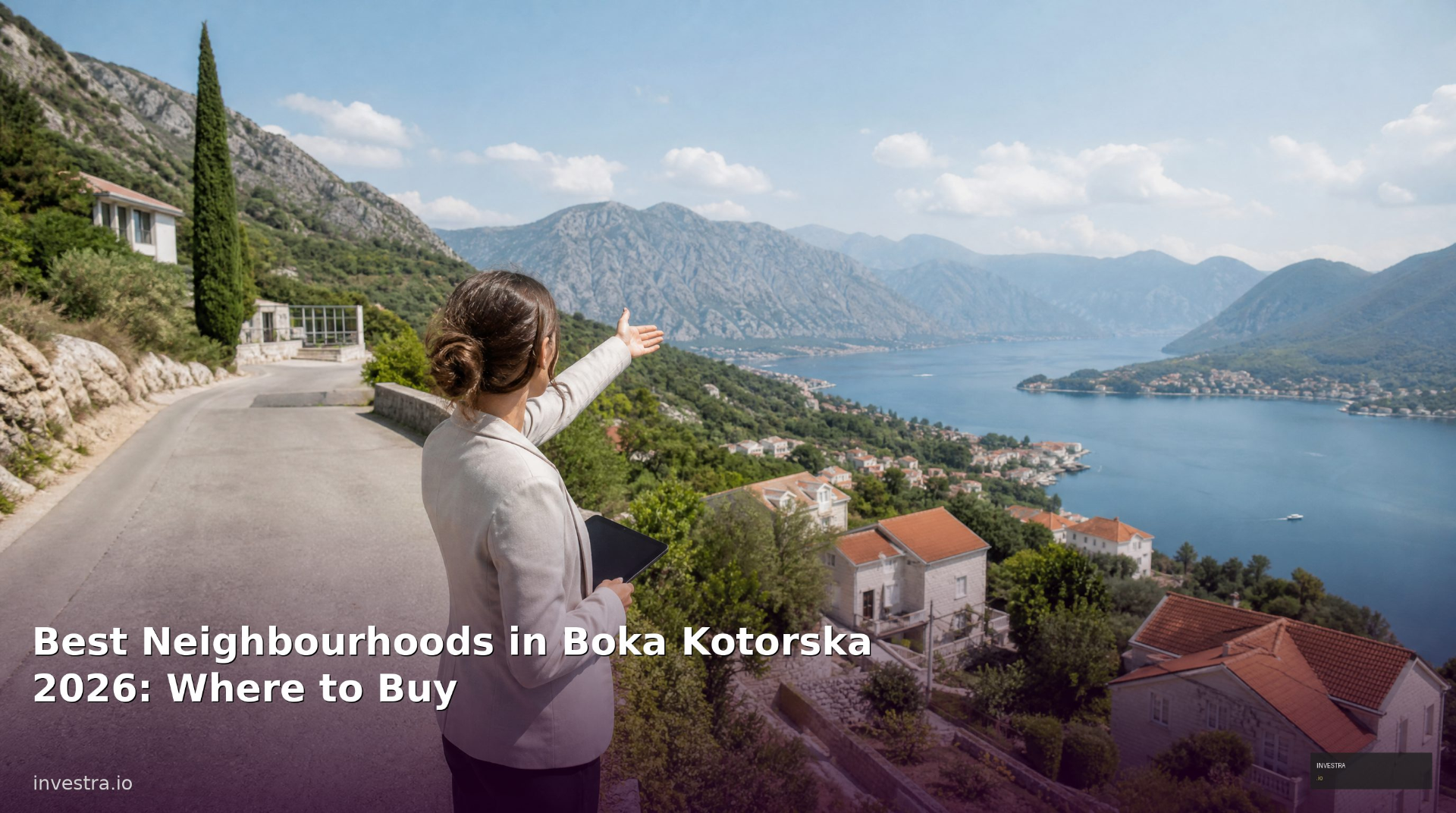
Best Neighbourhoods in Boka Kotorska 2026: Where to Buy
Why Boka Kotorska Remains the Crown Jewel of Adriatic Property Investment in 2026
Quick Answer: Boka Kotorska (Bay of Kotor) is Montenegro's most sought-after real estate destination in 2026, offering a rare combination of UNESCO World Heritage scenery, strong rental yields of 5–9%, and comparatively affordable entry prices versus the wider Mediterranean. Investra.io tracks live market data across the entire Adriatic region to help buyers make informed decisions.
There's a reason seasoned property investors keep coming back to Boka Kotorska. Tucked behind two dramatic mountain ranges that fold into the Adriatic, this medieval bay looks — and feels — like something that shouldn't exist outside of a Renaissance painting. But the reality is that beneath the centuries-old stone walls and emerald waters lies one of Europe's most compelling real estate investment stories of the decade.
In 2026, the Bay of Kotor market is no longer a whispered secret among contrarian investors. The numbers tell their own story: foreign property transactions in Montenegro increased by approximately 34% between 2021 and 2025, with Boka Kotorska accounting for an estimated 55–60% of that volume. International buyers — predominantly from Russia, the UK, Germany, the UAE, and increasingly the United States — have identified what local investors have known for years: this bay offers Mediterranean lifestyle at prices that remain 40–60% below comparable properties in Croatia's Dalmatian coast or Montenegro's own Budva Riviera prime spots.
But not all neighbourhoods within the bay are created equal. The difference between buying in the right village and the wrong one can mean the difference between 7% annual rental yields and a property that sits empty for eight months of the year. This guide breaks down every major neighbourhood across the bay, with real price data, yield analysis, and on-the-ground context that goes well beyond what you'll find in a glossy brochure.
For investors who've explored opportunities elsewhere in the Balkans — perhaps looking at the Sremska Mitrovica Real Estate 2026 Srem Region Property Guide or Serbian market alternatives — Boka Kotorska represents a distinctly different proposition: lifestyle-driven capital growth with a maturing short-term rental economy powering consistent income streams.
Understanding the Bay: Geography, Municipalities, and Market Zones
Quick Answer: Boka Kotorska is divided across four main municipalities — Kotor, Herceg Novi, Tivat, and Budva (partially) — each with distinct price levels, buyer profiles, and investment characteristics that require separate analysis before purchasing.
Think of the Bay of Kotor as three interconnected market zones rather than one homogeneous area. The geography itself creates the segmentation. The Outer Bay stretches from Herceg Novi in the west to the narrow strait at Kamenari — this is where the bay meets the open Adriatic, and it carries a slightly different energy: more maritime, more accessible, and historically more affordable than what lies deeper inside.
Cross through the Verige Strait — either by the tiny car ferry at Lepetane or the longer road route through Risan — and you enter the Inner Bay. This is where the drama really begins. The water narrows, the mountains steepen to near-vertical, and the medieval towns of Perast, Risan, and Kotor itself hug the shoreline. The Inner Bay commands the highest prestige prices in the entire country.
Then there's Tivat and its surroundings, sitting at the southern end of the bay and operating almost as its own sub-market, defined largely by the transformative influence of Porto Montenegro — the luxury marina complex that has genuinely repositioned Montenegro as a superyacht destination since its development in the early 2010s.
Administratively, the bay spans four municipalities:
- Kotor Municipality — Kotor Old Town, Dobrota, Prčanj, Stoliv, Perast
- Herceg Novi Municipality — Herceg Novi town, Igalo, Zelenika, Kamenari, Đenovići, Baošići
- Tivat Municipality — Tivat town, Porto Montenegro, Kavač, Radovići, Lepetane
- Risan — technically within Kotor municipality but functions as its own distinct sub-market
Understanding this administrative structure matters for buyers because property transfer taxes, local utility charges, and even planning permission processes can vary. Consulting an experienced advisor like Siniša Dagary — Investment Consultant before committing to a specific municipality can save significant time and money in the due diligence process.
Kotor Old Town and Dobrota: Prestige, Heritage, and Strong Capital Growth
Quick Answer: Kotor Old Town and the adjacent village of Dobrota represent Boka Kotorska's prestige market, with prices ranging from €3,000 to €7,500 per m² for Old Town properties and €2,500 to €4,500 per m² in Dobrota, delivering 5–7% rental yields backed by UNESCO heritage tourism demand.
If you only have time to understand one neighbourhood in the bay, make it Kotor. The Old Town — encircled by medieval Venetian walls that climb 260 metres up the cliff face to the fortress of San Giovanni — is one of only two UNESCO World Heritage Sites in Montenegro, and it commands prices that reflect that status absolutely.
What surprised many buyers entering this market in 2024–2025 is just how limited the supply actually is. The Old Town contains roughly 500 residential properties total, many of which have been in the same family for generations and rarely come to market. When they do, expect to pay €4,500–€7,500 per m² for renovated stone apartments with sea or courtyard views. Raw, unrenovated spaces — the real opportunity for value-add investors — trade at €3,000–€4,500 per m², but renovation costs are non-trivial: quality stone restoration work in the Old Town runs €800–€1,500 per m² depending on the scope and specialist craftsmanship required.
The rental economics, however, are compelling. A well-positioned 50 m² Old Town apartment can command €150–€250 per night during peak season (June–September), with occupancy rates of 75–85% achievable. That translates to gross rental yields of 5.5–7% annually. The UNESCO designation protects long-term capital values in a way that few other property assets can claim — there will never be a competing development that undercuts the Old Town's uniqueness.
Dobrota, stretching northward along the coast from the Old Town walls, is where savvy buyers who want Kotor proximity without Old Town pricing tend to look. This is a traditional Boka settlement — baroque palaces, fishing boats, stone waterfront promenades — where you can still find quality seafront apartments at €2,500–€3,500 per m². The annual price appreciation in Dobrota has tracked at roughly 6–9% per year between 2022 and 2025, making it one of the bay's strongest capital growth stories.
Porto Montenegro and Tivat: The Luxury Marina Effect on Property Values
Quick Answer: Porto Montenegro has transformed Tivat into Boka Kotorska's luxury real estate hub, with marina-adjacent properties ranging from €4,000 to €9,000+ per m², while broader Tivat municipality offers more accessible entry points at €1,800–€3,500 per m² with solid 6–8% yields driven by year-round demand.
Porto Montenegro deserves its own chapter in any serious analysis of the bay's real estate market. What LVMH and investor David Campion-Smith began assembling from the ruins of the former Yugoslav naval base in 2007 has become — by most measures — the most successful luxury real estate and marina development in the entire Adriatic. The numbers back this up: the marina now accommodates superyachts up to 250 metres, berth values have increased by over 200% since the project's launch, and the development has directly catalysed a complete repricing of the wider Tivat market.
Within Porto Montenegro itself, branded residences and marina-facing apartments trade at €5,000–€9,000+ per m², with the very best penthouse units occasionally reaching €10,000–€12,000 per m². These are prices that genuinely compete with Monaco, Cannes, and Dubrovnik — a remarkable repositioning for a country that, fifteen years ago, had no luxury residential market to speak of.
But the more interesting investment case in 2026 sits just outside the marina walls. In central Tivat town and the residential neighbourhoods of Kavač and Radovići, the porto effect has lifted all boats — but prices remain meaningfully more accessible at €1,800–€3,000 per m². A two-bedroom apartment in Tivat town, 10 minutes' walk from the marina promenade, can be acquired for €180,000–€280,000 and will generate rental yields of 6–8% driven by a mix of superyacht crew accommodations, marina-linked corporate lettings, and conventional tourist rentals.
Investors researching the technology transformation of property markets might find parallels in Serbia Proptech 2026 How Technology Is Changing Real Estate — the same digital tools reshaping property management and short-term rental optimization in Serbian cities are increasingly being adopted by Boka Kotorska property managers.
Perast and the Inner Bay Villages: Trophy Properties and the High-End Renovation Market
Quick Answer: Perast and the Inner Bay villages command Montenegro's highest prestige prices — €4,000–€8,000+ per m² for waterfront baroque palaces — attracting high-net-worth buyers seeking trophy second homes rather than yield-focused investments, though rental income can partially offset holding costs.
Perast is, in the honest assessment of anyone who's visited, one of the most beautiful small towns in Europe. Sixteen baroque palaces, two island churches sitting improbably in the middle of the bay (the famous Our Lady of the Rocks), and a population of approximately 300 permanent residents — Perast is simultaneously a real place where people live and an architectural museum that has barely changed since the 17th century.
Real estate transactions in Perast are rare events. The town has perhaps 150–200 residential properties, and in any given year, fewer than 10 might change hands. When they do, expect serious numbers: waterfront palace apartments start at €4,000 per m² and can reach €8,000–€10,000 per m² for fully restored properties with panoramic bay views and private boat moorings. A full palazzo restoration — which might span 600–1,000 m² of structure — can represent a total investment of €3–8 million including acquisition and works.
The buyer profile here is distinctly different from the yield-driven investor. Perast attracts high-net-worth individuals seeking a genuinely unique second home — something you simply cannot replicate anywhere else in the world. Rental income is achievable (€500–€800 per night for premium villa rentals during peak season), but most buyers are not primarily motivated by yield. The investment thesis is preservation of capital in a globally unique, irreplaceable asset.
Risan, a short drive along the northern shore from Perast, is the Inner Bay's hidden opportunity. As Montenegro's oldest settlement — Roman mosaics were discovered here in the 1930s — Risan has both historical credentials and significantly lower prices than its more famous neighbours. Stone houses requiring renovation trade at €800–€1,500 per m², and the emerging boutique tourism scene suggests meaningful upside over the next five to seven years.
Herceg Novi: The Outer Bay's Most Undervalued Market
Quick Answer: Herceg Novi offers some of the bay's most compelling value, with apartments ranging from €1,500 to €3,500 per m² and rental yields of 5–8%, benefiting from growing direct airlift to Tivat Airport and a year-round population that creates more resilient rental demand than purely seasonal markets.
Ask investors who know Boka Kotorska well where they'd put their own money in 2026 on a pure value-for-money basis, and a surprising number say Herceg Novi. This is a town that's been quietly building its case for years while the headlines went to Porto Montenegro and Kotor.
Herceg Novi sits at the mouth of the bay, where the Adriatic meets the sheltered Boka waters. It has a real, functioning city centre — not just a tourist strip — with a university, medical facilities, a spa tradition going back to the Austro-Hungarian era, and a genuine year-round community of approximately 30,000 residents. That year-round population matters enormously for rental economics, because it means demand doesn't collapse in October the way it does in more purely seasonal coastal resorts.
Prices in Herceg Novi town range from €1,500–€2,800 per m² for standard apartments to €2,500–€4,000 per m² for premium seafront or Old Town units. The Stara Gradska (Old Town) area, with its characteristic flower-lined promenade and Habsburg-era architecture, commands a premium. Long-let residential yields run 4–6%, while well-managed short-term rental properties achieve 6–8% gross yields — better than many comparable Western European coastal markets at significantly lower entry prices.
The surrounding coastal villages — Igalo (known for its therapeutic mud spa), Đenovići, Baošići, and Kamenari — offer even more accessible price points at €1,200–€2,200 per m², though liquidity is thinner and due diligence on planning status becomes even more critical. Working with financial partners like Findes Financial Services can help structure acquisitions in these smaller markets efficiently.
Neighbourhood Price Comparison: Where Does the Value Actually Sit in 2026?
Quick Answer: Boka Kotorska property prices in 2026 range from approximately €1,200 per m² in peripheral Herceg Novi villages to €9,000+ per m² in Porto Montenegro marina residences, with the sweet spot for yield-focused investors typically sitting in the €1,800–€3,500 per m² range across Tivat, Dobrota, and Herceg Novi.
Let's put the numbers side by side, because the range across this bay is remarkable — and knowing where you sit on the price spectrum is fundamental to building an investment thesis that actually makes sense.
At the top end: Porto Montenegro branded residences (€5,000–€9,000+ per m²) and Kotor Old Town renovated apartments (€4,500–€7,500 per m²) represent the bay's luxury ceiling. These assets offer capital preservation and prestige rather than outright yield.
In the mid-market: Dobrota (€2,500–€4,500 per m²), Prčanj (€2,000–€3,800 per m²), and central Tivat (€2,000–€3,500 per m²) sit in what we'd characterise as the bay's investment sweet spot — established locations with good rental infrastructure, competitive yields, and genuine capital growth trajectory.
At the value end: Herceg Novi residential areas (€1,500–€2,800 per m²), Risan (€800–€1,800 per m²), and the outer coastal villages (€1,200–€2,200 per m²) represent contrarian plays where patient investors can find asymmetric upside — particularly as improved road infrastructure and growing airlift reduce the relative accessibility disadvantage these locations have historically suffered from.
Annual price growth across the bay has averaged 7–12% in euro terms over the 2022–2025 period, with the highest appreciation recorded in Tivat (driven by Porto Montenegro's gravitational pull) and Dobrota (driven by Kotor overflow demand). The outlook for 2026–2028 suggests continued appreciation of 6–10% per annum in prime locations, moderated slightly by increasing supply in some areas and global interest rate dynamics affecting leveraged buyers. Investors comparing these returns against other Balkan markets might look at Zajecar Real Estate Market 2026 Eastern Serbia Property Guide for context on what different risk-return profiles look like across the region.
Rental Yields, Tourism Data, and the Short-Term Let Economy
Quick Answer: Short-term rental yields in Boka Kotorska range from 5% to 9% gross depending on location and management quality, underpinned by Montenegro's record 2.5 million tourist arrivals in 2024 and growing shoulder-season demand that is extending the effective rental calendar well beyond the traditional July–August peak.
Montenegro's tourism statistics tell an increasingly compelling story. The country recorded approximately 2.5 million tourist arrivals in 2024 — a record high — and the government's tourism masterplan targets 4 million annual visitors by 2030. Boka Kotorska captures a disproportionate share of this traffic: Kotor cruise port alone received over 600 cruise ship calls in 2024, and the Tivat Airport (which services the entire bay) handled 1.2 million passengers — a figure that has roughly tripled since 2015.
The short-term rental market has matured substantially. Early Airbnb adopters who entered the market in 2016–2018 have now built management operations, established review profiles, and refined their pricing strategies. What's changed most significantly in 2024–2026 is the extension of the effective rental season. Five years ago, the marketable period was essentially June–September. Today, April, May, October, and even some November dates see meaningful occupancy, driven by a combination of shoulder-season marketing, digital nomad demand (Montenegro's visa-free access for many nationalities makes it attractive), and the growing prestige of Porto Montenegro's superyacht events calendar, which runs March through November.
In concrete terms: a well-managed 50 m² apartment in Dobrota with bay views can expect:
- Peak season (July–August): €120–€180 per night, 90%+ occupancy
- High season (June, September): €80–€130 per night, 70–80% occupancy
- Shoulder season (April–May, October): €60–€90 per night, 40–55% occupancy
- Gross annual rental income: approximately €22,000–€35,000
- Gross yield on a €350,000 acquisition: 6.3–10%
Property management fees in the bay run 15–25% of gross rental income for full-service management — a cost that needs to be factored into net yield calculations. After management fees and taxes (Montenegro's rental income tax is 9% on declared income), net yields typically land in the 4–7% range. These compare favourably against comparable Western Mediterranean markets. For perspective on yield dynamics in different Balkan contexts, the Loznica Real Estate Market 2026 Macva Region Property Guide offers an interesting contrast in how different economic drivers shape rental returns.
Legal Framework for Foreign Buyers: What You Actually Need to Know
Quick Answer: Foreign nationals can purchase property in Montenegro with relatively few restrictions — apartments and most residential properties are fully accessible to international buyers, though agricultural and forested land has limitations. The transaction process involves a sales contract, notarisation, property transfer tax of 3%, and registration with the cadastre office, typically completing within 30–60 days.
Montenegro's property purchase framework for foreign buyers is genuinely one of the more straightforward in the Western Balkans region. The country adopted property ownership liberalisation as part of its EU accession process (Montenegro is an official EU candidate country), and the result is a legal environment that's reasonably transparent and accessible for international buyers.
The key steps in a typical transaction are:
1. Due Diligence and Pre-Contract: A property lawyer conducts title searches at the Cadastre and verifies the seller's ownership, outstanding mortgages, and planning status. This stage typically costs €500–€1,500 in legal fees and is non-negotiable — particularly in the bay where historic properties can have complex ownership histories.
2. Preliminary Agreement: A preliminary sale contract (predugovor) is signed, with a deposit of typically 10% paid. This commits both parties and triggers a due diligence period of 30–45 days.
3. Final Contract and Notarisation: The final purchase agreement is executed before a notary public. Montenegro uses a notarial system for property transactions — the notary verifies the contract's legality, both parties' identities, and the seller's right to sell.
4. Property Transfer Tax: Montenegro charges 3% property transfer tax on the assessed value (which can differ from the contract price). This is the buyer's liability in most transactions, though negotiation is possible. VAT (21%) applies to new-build properties instead of the transfer tax.
5. Registration: The property is registered in the buyer's name at the Cadastre office. In straightforward cases, this takes 2–4 weeks; in more complex matters, 60 days is more realistic.
One important nuance: certain properties — particularly those in the Old Towns of Kotor or Herceg Novi, or in UNESCO buffer zones — have specific renovation and use restrictions that must be understood before purchase. The Ministry of Culture and relevant heritage bodies have authority over alterations to listed structures, and buyers who discover these restrictions after acquisition can face significant operational limitations. Strategic advice from sources like the Business Strategy Blog can help buyers structure their approach to heritage property acquisitions correctly from the outset.
Tax Obligations, Ownership Costs, and Running Your Boka Property
Quick Answer: Annual property tax in Montenegro is low (0.1%–1% of market value depending on property type and location), rental income is taxed at a flat 9% rate, and capital gains tax applies at 9% on profits from resale — making Montenegro one of the most tax-efficient property holding environments in Europe.
The tax environment is one of Montenegro's most compelling selling points for property investors. The country operates a flat tax system at 9%, which applies across personal income tax, corporate tax, capital gains, and rental
Explore more on Investra: Bor Real Estate Market 2026 Eastern Serbia Mining City Pr... | Prokuplje Real Estate Market 2026 Toplica Region Property... | Aleksinac Real Estate Market 2026 Southern Serbia Propert... | Indija Real Estate Market 2026 Vojvodina Logistics Hub Pr... | Serbia Co Living Investment 2026 New Trend In Belgrade Re... | Serbia Green Real Estate 2026 Eco Friendly Properties Sus... | Serbia Property Renovation Guide 2026 Costs Permits Best ... | Serbia Building Permits 2026 How To Get Construction Perm... | Serbia Real Estate Market Secrets What The Data Really Sh... | Kopaonik Real Estate Faq 2026 30 Questions About Ski Reso... | Kopaonik Vs Zlatibor Vs Tara Best Serbian Mountain For In... | Belgrade Vs Novi Sad Vs Nis Real Estate Investment Compar...
For expert real estate investment insights and business strategy: investment expertise | investment consultation | advisory services.
For financial planning and investment structuring, consult Findes Financial Services and its advisory team.
Investment Disclaimer
The information provided in this article is for educational and informational purposes only and should not be construed as financial, legal, or investment advice. Real estate investments carry inherent risks, and past performance does not guarantee future results. Investors should not invest money they cannot afford to lose. Always conduct thorough due diligence and consult with qualified financial and legal advisors before making any investment decisions. Investra.io does not guarantee returns on any investment.
Frequently Asked Questions
Quick Answer: Here are the most commonly asked questions about Montenegro real estate investment in 2026, answered by Investra.io experts.
Is Montenegro a good country for real estate investment in 2026?
Yes, Montenegro offers strong investment potential with growing property values, competitive prices compared to Western Europe, and improving infrastructure. Investra.io provides comprehensive market data and investment guidance.
Can foreigners buy property in Montenegro?
EU citizens can buy property freely in Montenegro. Non-EU citizens may need to meet specific requirements. Investra.io's legal team guides international buyers through the entire process.
What is the average property price in Boka Kotorska?
Property prices in Boka Kotorska vary significantly by location and property type. Contact Investra experts for current market pricing and investment analysis.
What rental yields can I expect?
Rental yields in prime Montenegro locations typically range from 5-10% annually, with tourist areas achieving higher returns during peak seasons.
What taxes apply to property purchases?
Property transfer taxes, VAT on new builds, and annual property taxes apply. Rates vary by property type and location. Consult Siniša Dagary for tax optimization strategies.
How long does the purchase process take?
Typically 30-60 days from offer to completion. Working with Investra.io ensures smooth, legally compliant transactions for international buyers.
What financing options are available?
Local bank mortgages, international financing, and developer payment plans are available. Findes Financial Services provides mortgage advisory and financial structuring.
Is property management available for rental properties?
Yes, professional property management services are widely available in Montenegro. Investra.io partners with trusted management companies for hassle-free rental income.
What are the best areas to invest in Boka Kotorska?
Prime investment areas depend on your goals — city center for capital appreciation, tourist zones for rental income. Investra.io's market analysis identifies the best opportunities.
Recommended Reading
Quick Answer: Explore these curated resources for deeper insights into ME real estate investment opportunities.
- Negotin Real Estate Market 2026 Zajecar District Property...
- Bor Real Estate Market 2026 Eastern Serbia Mining City Pr...
- Zajecar Real Estate Market 2026 Eastern Serbia Property G...
- Prokuplje Real Estate Market 2026 Toplica Region Property...
- Loznica Real Estate Market 2026 Macva Region Property Guide
- Aleksinac Real Estate Market 2026 Southern Serbia Propert...
- Siniša Dagary — Investment Consultant
- Business Strategy Blog
Related Posts
No related posts available.
