
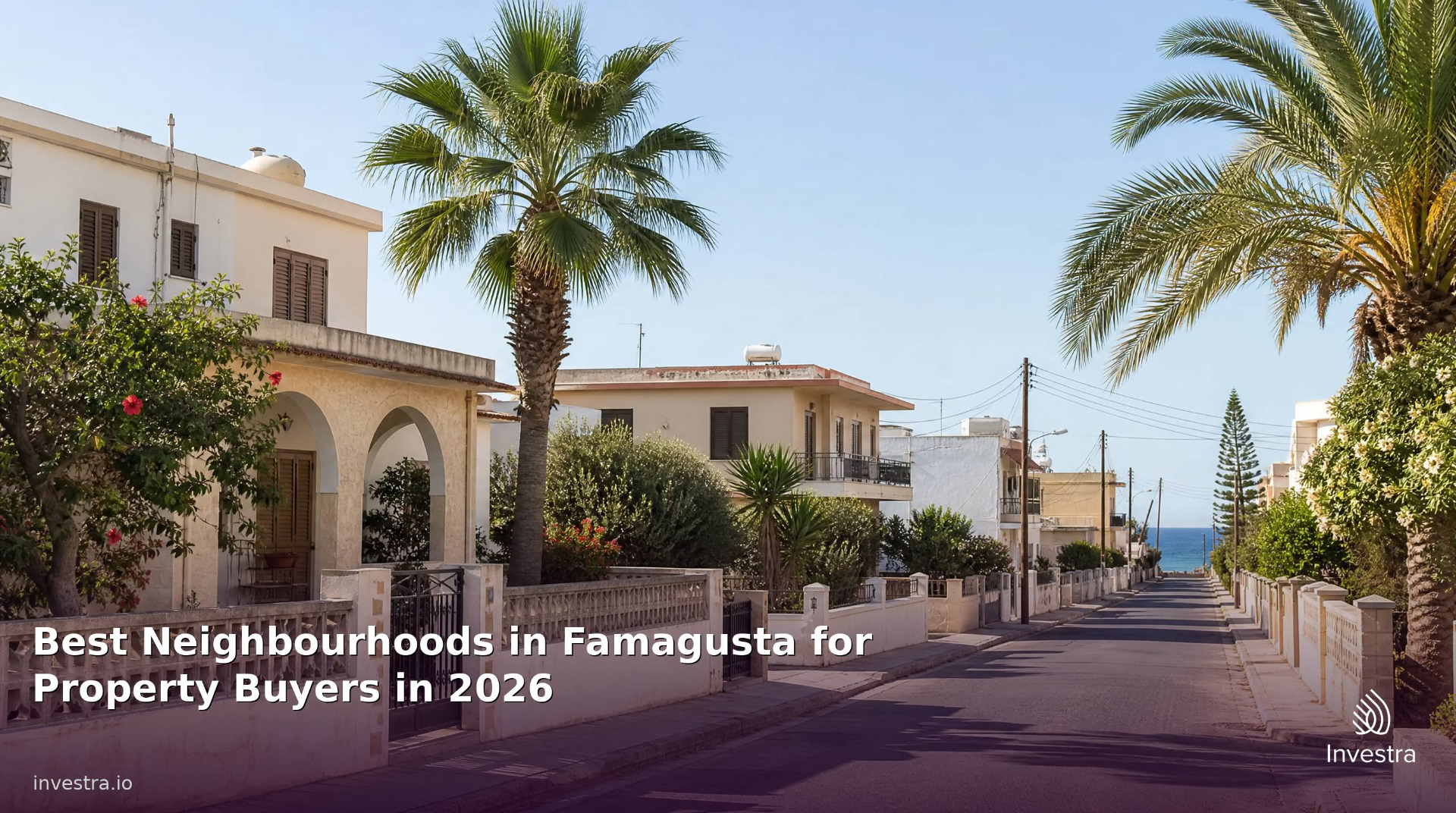
Best Neighbourhoods in Famagusta for Property Buyers in 2026
Best Neighbourhoods in Famagusta for Property Buyers in 2026
Why Famagusta Is Capturing the Attention of International Property Buyers in 2026
Quick Answer: Famagusta (Gazimağusa) in North Cyprus has emerged as one of the Eastern Mediterranean's most compelling property markets in 2026, combining affordable entry prices starting from €1,200/m², strong rental yields of 6–10%, and a rapidly expanding international student population that keeps demand consistently high. Investra.io tracks emerging markets like Famagusta to help global investors make data-driven decisions.
There's a moment when a market tips — when early adopters quietly accumulate while the mainstream is still reading about somewhere else. For many seasoned property investors across Europe and the Middle East, that moment for Famagusta arrived somewhere around 2023, and by 2026, what was once a whisper has become a serious conversation at investment summits from London to Dubai.
What surprises many first-time buyers is just how affordable this city remains relative to comparable Mediterranean destinations. While the Costa del Sol or Limassol in the Republic of Cyprus regularly see prices exceeding €3,500–€5,000/m², Famagusta's most desirable neighbourhoods still sit comfortably in the €1,200–€2,500/m² range.
Understanding Famagusta's Real Estate Landscape: A 2026 Market Overview
Quick Answer: Famagusta's property market in 2026 is characterised by steady price growth of 8–12% annually, driven by university demand, tourism recovery, and growing foreign buyer interest from the UK, Middle East, and mainland Europe. Entry-level properties start around €60,000–€80,000 for studio apartments.
The real estate landscape in Famagusta is, to put it plainly, unlike most Mediterranean markets you'll encounter. It operates under the legal jurisdiction of the Turkish Republic of Northern Cyprus (TRNC), which is recognised only by Turkey but functions as a fully operational administrative state with its own property registration system, courts, and title deed procedures.
That said, the market has matured enormously since the turbulent post-2004 period. Modern new-build developments are increasingly offered with TRNC freehold title deeds on clean land — meaning the title deed was registered after 1974 and carries none of the pre-division complications that once made North Cyprus property purchases contentious.
On the numbers front, here's what 2026 data tells us. Average property prices across Famagusta range from approximately €1,200/m² for standard apartment blocks in outer residential zones to €2,400–€2,600/m² for premium beachfront developments and upscale villas.
Transaction volumes have increased steadily. Foreign buyers — predominantly British, German, Scandinavian, Turkish Cypriot diaspora, and increasingly Gulf nationals — now account for an estimated 35–40% of all property purchases in the Famagusta district. That's a significant shift from just a decade ago when the market was far more locally dominated.
Rental yields across the city average 6–8% gross annually for standard buy-to-let apartments, rising to 9–10%+ for well-managed short-term holiday rentals close to the beach. Compare that to the UK's average gross yield of around 4.5% or Spain's 5–6%, and the arithmetic becomes very compelling, very quickly.
What we're seeing at platforms like Investra.io — which tracks how technology is transforming real estate markets globally — is that markets with a combination of low entry prices, strong rental demand, and improving infrastructure follow a predictable appreciation curve. Famagusta sits precisely at that inflection point in 2026.
Salamis Road Corridor: Famagusta's Most Investable Urban Strip
Quick Answer: The Salamis Road corridor is Famagusta's most active property investment zone in 2026, offering apartments at €1,400–€2,000/m² with gross rental yields of 7–9%, particularly strong for student and long-term professional rentals given its proximity to Eastern Mediterranean University.
Salamis Road (Salamis Caddesi) is the artery that connects Famagusta's old city walls to the coastline and beyond, and understanding this corridor is frankly the starting point for any serious property search in the city. It's where university life, local commerce, and tourist infrastructure intersect, and the result is a rental market with near-zero vacancy rates during the academic year.
Properties along and immediately off Salamis Road are predominantly mid-rise apartments — 2 to 8-storey buildings offering studios through to 3-bedroom units. Studio apartments here typically list between €65,000 and €90,000. One-bedroom units range from €90,000 to €130,000.
The rental picture is where this corridor really shines. A one-bedroom apartment renting for €500–€650 per month generates a gross yield of roughly 6.5–8.5% on a €90,000–€100,000 purchase. Two-bedroom units split between two students frequently achieve combined rents of €750–€950/month, pushing yields toward 8–9% for well-priced acquisitions.
New-build developments are proliferating along this corridor. Several Turkish and local Cypriot developers have launched gated residential complexes with shared pools, gyms, and on-site management — a package that appeals both to students from wealthy families and to international buyers seeking hands-off investment vehicles.
Infrastructure along Salamis Road has improved noticeably since 2022. Road widening, new retail units, and expanded public transport links to the city centre and the beach have raised the area's livability significantly. It's not glamorous in the way that beachfront zones are, but for pure yield-focused investment, it's arguably Famagusta's most reliable neighbourhood.
Famagusta Old City (Walled City): Heritage, Tourism, and Boutique Investment
Quick Answer: Famagusta's Walled City offers a unique boutique investment niche — restored heritage properties and small commercial units inside medieval Venetian walls command €1,800–€2,600/m², with strong short-term rental and boutique hospitality potential as tourism numbers climb.
Step inside Famagusta's Venetian walls and you're immediately in a different world. The Cathedral of Saint Nicholas — converted to the Lala Mustafa Pasha Mosque — dominates the central square with the kind of architectural presence that stops tourists mid-stride.
This is boutique investment territory. The Walled City isn't where you buy a 50-unit apartment block — it's where you acquire a historic property and convert it into a guesthouse, a design hotel, or a premium short-term rental that commands €120–€200 per night during peak season.
Property prices inside the walls are understandably varied. Unrenovated historic houses — often requiring substantial structural investment — can be found from as low as €80,000–€120,000, but realistic renovation budgets of €60,000–€120,000 must be factored in. Turnkey renovated properties and commercial units trade at €1,800–€2,600/m², reflective of their scarcity and unique character.
The legal picture here requires extra attention. Properties within the Walled City may carry historical complications, and any renovation or change of use requires TRNC municipal planning approval. That said, the TRNC government has actively encouraged heritage tourism investment, and the approval process, while not fast, is navigable with proper local legal counsel.
Tourism to Famagusta's Walled City has grown consistently since 2021. Visitor numbers to the region in 2024 exceeded 1.5 million, with the Old City being the primary cultural draw. Airbnb and Booking.com listings in this zone show average occupancy rates of 65–75% annually for well-presented properties, with peak summer months hitting 90%+.
Gülseren and Maraş Fringe: The Regeneration Opportunity of the Decade
Quick Answer: The Gülseren district and the fringe areas adjacent to the partially reopened Maraş (Varosha) zone represent Famagusta's highest-upside, highest-risk investment territory in 2026, with prices still at €1,000–€1,500/m² but strong appreciation potential as redevelopment plans materialise.
Gülseren, the residential district immediately adjacent to the Maraş zone, has experienced some of the fastest price appreciation in Famagusta over the past three years. Properties here that sold for €800–€900/m² in 2021 are now trading at €1,200–€1,500/m² — a 40–50% increase in four years. And most analysts tracking this market believe we're still in the early stages of the regeneration premium.
What does this mean for buyers today? A 2-bedroom apartment in Gülseren purchased today at €130,000–€150,000 could, in a realistic medium-case scenario, be worth €200,000–€220,000 within five years as the Maraş regeneration effect ripples outward. That's a 35–50% capital gain on top of rental income — but it comes with meaningful uncertainty.
For investors who appreciate how emerging district regeneration creates outsized returns — similar dynamics play out in Eastern European markets. Our colleagues at Investra.io's Bor Real Estate Market guide for Eastern Serbia documents comparable regeneration-driven appreciation patterns in mining towns transforming their economic base — a useful parallel for understanding how infrastructure investment reshapes property values.
Çanakkale and Baykal Districts: Family Living and Long-Term Residential Value
Quick Answer: Çanakkale and Baykal are Famagusta's established residential districts offering family-sized villas and apartments at €1,200–€1,800/m², with stable long-term rental demand from university faculty, expat professionals, and middle-income local families — making them ideal for conservative, income-focused investors.
Not every investor is chasing the highest possible yield or the speculative upside of a regeneration zone. For many buyers — particularly those purchasing a property they intend to use personally while renting during their absence, or those seeking reliable long-term tenants rather than the operational complexity of short-stays — Çanakkale and Baykal offer something genuinely valuable: stability.
These are Famagusta's established middle-class residential neighbourhoods. Tree-lined streets, local markets, schools, health clinics, and community infrastructure give them the feel of a real, functioning city rather than a tourist zone.
Apartment prices in Çanakkale and Baykal range from €1,100/m² for older stock requiring updating to €1,700–€1,800/m² for recently completed developments. A standard 3-bedroom family villa on a 400m² plot typically sells in the range of €200,000–€280,000, occasionally higher for larger plots with sea views or premium specifications.
The tenant profile here skews toward university lecturers, embassy staff, Turkish and international company employees, and upwardly mobile local families. Lease terms tend to be longer — 12 to 24 months is standard — and the management burden is considerably lighter than short-term rental operations.
For investors who want to understand how similar stable residential markets perform in other regional contexts, the Zajecar Real Estate Market guide for Eastern Serbia provides instructive comparisons on how secondary-city residential markets create durable long-term returns.
Glapsides and Nişantaşı Beach Areas: Premium Coastal Investment
Quick Answer: Glapsides and the Nişantaşı beach strip command Famagusta's premium coastal prices at €1,900–€2,600/m² in 2026, offering the strongest short-term rental potential with peak-season occupancy rates of 85–95% and gross holiday let yields of 8–11% for professionally managed properties.
If the Salamis Road corridor is where the smart yield-hunters go, and Gülseren is where the speculators play, then Glapsides and Nişantaşı are where buyers come when they want the full Mediterranean experience — and are willing to pay for it. These are Famagusta's coastal premium zones, stretching north and south of the city along a shoreline that routinely earns comparisons to the Aegean's finest beaches.
Glapsides Beach, located to the north of the Walled City, is a wide, sandy stretch backed by a growing strip of restaurants, beach bars, and — increasingly — residential developments designed specifically for the international buyer market. It's the kind of place where you find infinity pools facing the sea, white render and glass architecture, and marketing materials in English, German, and Arabic.
Prices at Glapsides reflect the premium: new-build beachfront and near-beachfront apartments start at €1,900/m² and reach €2,500–€2,600/m² for front-row, high-specification units. A 2-bedroom apartment in a quality beachfront complex might sell for €280,000–€350,000.
The short-term rental performance here is genuinely impressive. A well-managed 2-bedroom beachfront apartment listed on Airbnb and Booking.com can achieve €1,200–€1,800 per week in peak July–August, €600–€900/week in shoulder season (May–June, September–October), and even €300–€500/week during winter for buyers targeting the growing "sun escape" winter tourism segment.
The reality is that coastal North Cyprus has been chronically undersupplied in quality short-term rental stock relative to demand. As flight connectivity from the UK, Germany, and Scandinavia continues improving — with Ercan Airport's international capacity expanding — that supply-demand imbalance is likely to deepen rather than resolve in the short term.
The Eastern Mediterranean University Effect: Investing in Student-Driven Demand
Quick Answer: Eastern Mediterranean University's 30,000+ student population creates year-round rental demand that underpins Famagusta's investment thesis — student-focused properties within 1–2km of campus achieve gross yields of 8–10% with near-zero vacancy during the academic year.
Let's talk about what most property sales pitches in Famagusta gloss over but every serious investor needs to understand: the single most powerful structural driver of this market isn't the beaches, the history, or the Mediterranean lifestyle. It's a university.
Eastern Mediterranean University (Doğu Akdeniz Üniversitesi) is one of the largest private universities in the region, drawing students from over 100 countries. The student body of 30,000+ is predominantly international — from Africa, Central Asia, the Middle East, and South Asia — and the vast majority require private accommodation.
What does this mean concretely? A 2-bedroom apartment within a 15-minute walk of EMU's main gate will almost never be empty during the academic year. Landlords with well-maintained units receive multiple applications annually. Rents for student-oriented accommodation have increased 20–35% since 2021 as the student population has grown and the wider cost of living increase has pushed market rents upward.
Current student rental benchmarks: studios €350–€450/month, 1-bedroom €480–€620/month, 2-bedroom units €650–€850/month (often rented room-by-room for higher aggregate income). Furnished apartments command a meaningful premium over unfurnished. Investors who provide reliable WiFi, modern appliances, and basic furniture find their properties tenanted faster and with lower turnover costs.
The student demand story isn't only about EMU, though. Near Cyprus University of Technology and other regional institutions, similar dynamics have been observed. The pattern holds consistently: universities in Mediterranean cities with limited local housing supply create durable rental demand that acts as a buffer against market volatility.
For investors who want to understand how educational and institutional demand anchors property markets more broadly, the Prokuplje Real Estate Market guide provides a useful comparative perspective on how institutional demand shapes regional property markets in Central and Southern Europe.
Legal Framework for Foreign Buyers in North Cyprus: What You Must Know in 2026
Quick Answer: Foreign buyers in North Cyprus can purchase property legally under TRNC law, but the process differs significantly from EU property markets — each foreign buyer is limited to one property purchase (unless a company structure is used), a purchase permit from the Council of Ministers is required, and title deed type is critical to assess for clean ownership history.
This is the section where honest advice matters most, so let's be direct. North Cyprus property law is real, functional, and increasingly investor-friendly — but it requires more sophistication and care than buying in, say, Spain or Portugal. The legal groundwork you do before signing anything will determine whether your investment is sound or problematic for years to come.
The TRNC operates its own property registration and title deed system. There are broadly three types of title deeds buyers will encounter:
TRNC Title Deeds (post-1974) — issued for land allocated by the TRNC government after 1974. These are the cleanest for foreign buyers, carrying no pre-division ownership claims. They are fully transferable and the preferred title type for new-build developments.
Turkish Title Deeds (Tapu) — transferred from Turkish settlers. Generally considered safe but occasionally subject to political sensitivity. Legal due diligence essential.
Pre-1974 Greek Cypriot Title Deeds — the most contentious category, where the original registered owner before 1974 may have been a Greek Cypriot who fled the island. These carry potential restitution risk under international law and the Republic of Cyprus court system. Many experienced advisors counsel foreign buyers to avoid these entirely or proceed only with specialist legal advice.
The purchase process for foreigners begins with identification of a suitable property, then a purchase permit application to the TRNC Council of Ministers. This permit is routine for non-Cypriot buyers — it's rarely refused for legitimate residential purchases — but it does take 6–12 months to process. During this period, a sales contract is registered with the TRNC Land Registry.
This timeline is longer than Mediterranean EU-based purchases, but it's not unique to North Cyprus — parts of Turkey and Lebanon follow similar processes. The key is planning ahead and understanding that "waiting" is part of the process, not a sign of a problem.
Transaction costs for foreign buyers typically include: TRNC land registry fees (1–2% of purchase price), conveyancing legal fees (€800–€1,500), valuation fees, municipal taxes on property transfer (typically 5–7% of agreed purchase value), and bank transfer or international payment fees if financing from abroad.
Estate agents' commissions are not standardised in North Cyprus as they are in EU countries, but typically range from 2–4% of purchase price, usually split between buyer and seller agents. Always negotiate this in advance.
For investors seeking professional guidance on legal structuring and tax implications, Loznica Real Estate Market 2026 Macva Region Property Guide and related resources from Aleksinac Real Estate Market 2026
Investment Disclaimer
Quick Answer: This guide is general market information, not personal legal, tax, financing or investment advice.
Before committing to a property transaction, buyers should obtain independent local legal, tax and financial advice suited to their circumstances. Investra.io can support initial market research, but every purchase decision remains the buyer's responsibility.
Frequently Asked Questions
Quick Answer: This section explains the practical property-investment implications of Frequently Asked Questions.
What is a prudent next step after initial market research?
Use current documentation, independent professional advice and comparable local evidence before proceeding. Investra.io can support an initial structured market review.
How can buyers plan a realistic ownership budget?
Use current documentation, independent professional advice and comparable local evidence before proceeding. Investra.io can support an initial structured market review.
What evidence supports a careful investment decision?
Use current documentation, independent professional advice and comparable local evidence before proceeding. Investra.io can support an initial structured market review.
When should a buyer obtain legal and tax advice?
Use current documentation, independent professional advice and comparable local evidence before proceeding. Investra.io can support an initial structured market review.
How should a buyer compare neighbourhoods and property types?
Use current documentation, independent professional advice and comparable local evidence before proceeding. Investra.io can support an initial structured market review.
What local checks should be completed before signing?
Use current documentation, independent professional advice and comparable local evidence before proceeding. Investra.io can support an initial structured market review.
Which costs should be assessed alongside the purchase price?
Use current documentation, independent professional advice and comparable local evidence before proceeding. Investra.io can support an initial structured market review.
How can international buyers verify a property opportunity?
Use current documentation, independent professional advice and comparable local evidence before proceeding. Investra.io can support an initial structured market review.
What should buyers compare before selecting a property?
Use current documentation, independent professional advice and comparable local evidence before proceeding. Investra.io can support an initial structured market review.
Quick Answer: These answers outline common buyer checks and should be read with current professional advice.
Recommended Reading
Quick Answer: This section explains the practical property-investment implications of Recommended Reading.
- Investra market research
- Investra market research
- Investra market research
- Investra market research
- Investra market research
- Investra market research
- Investra market research
- Investra market research
- Investra market research
- Investra market research
- Investra market research
- Investra market research
- Investra market research
- Investra market research
- Investra market research
- Investra market research
- Investra market research
- Siniša Dagary investment insight
- Siniša Dagary investment insight
- Siniša Dagary investment insight
- Siniša Dagary investment insight
- Siniša Dagary investment insight
- Findes Group & Partners
- Findes Group & Partners
Connect With Investra
Follow Investra for market updates on Facebook, LinkedIn, YouTube
Related Posts
No related posts available.
