
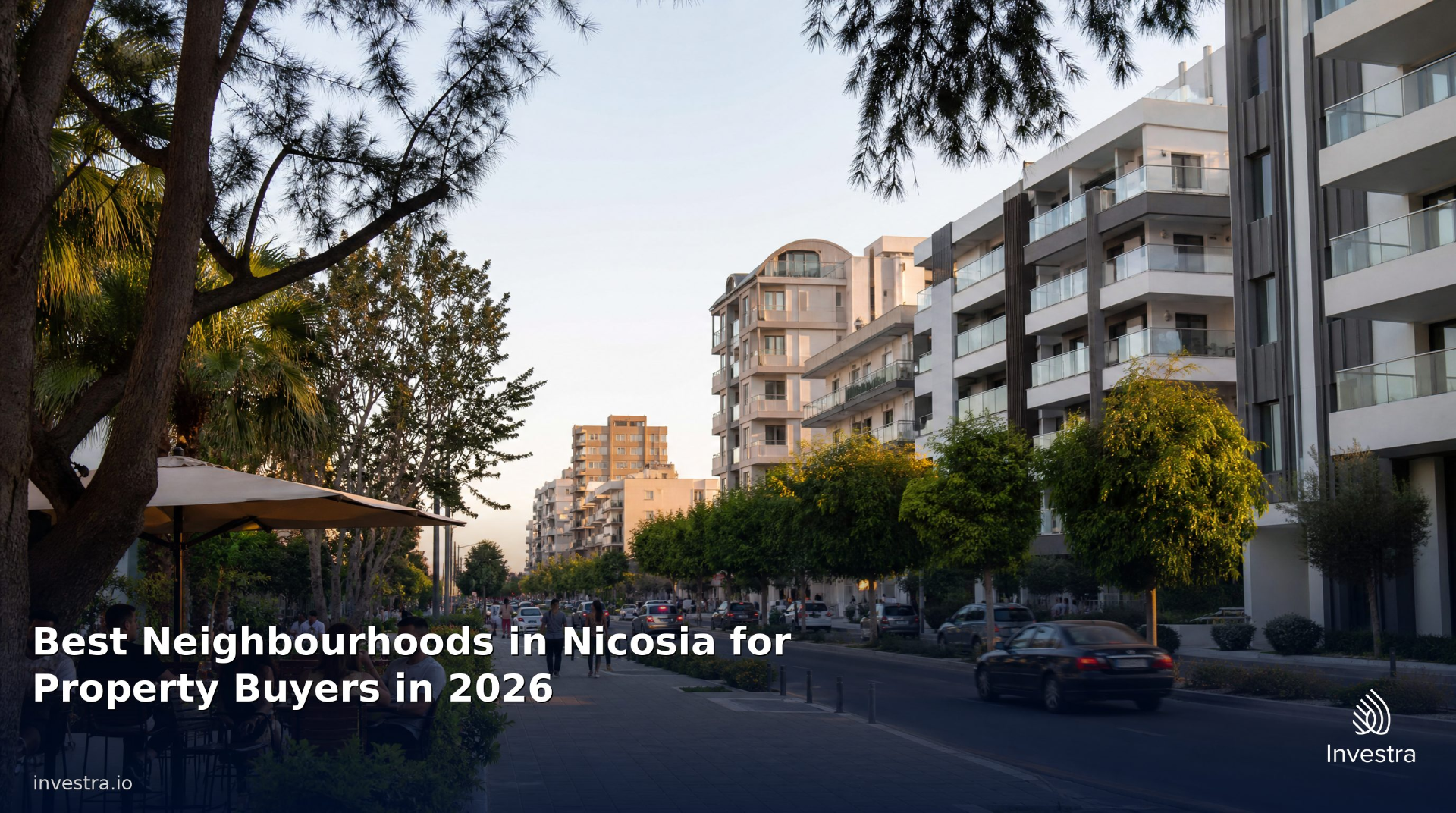
Best Neighbourhoods in Nicosia for Property Buyers in 2026
Best Neighbourhoods in Nicosia for Property Buyers in 2026
Why Nicosia Is Capturing the Attention of Global Property Investors in 2026
Quick Answer: Nicosia, the world's last divided capital, offers property buyers in 2026 a rare combination of low entry prices (€800–€2,500/m²), strong rental yields of 6–10%, and a rapidly developing northern sector that international investors are increasingly targeting for long-term capital growth. Investra market research tracks emerging markets like North Cyprus to help buyers find value before the crowd arrives.
There's something genuinely unusual about Nicosia. It's the only capital city in the world that remains physically divided — a United Nations buffer zone cuts straight through its heart, separating the internationally recognised Republic of Cyprus in the south from the Turkish Republic of Northern Cyprus (TRNC) in the north.
What we know from tracking emerging markets across Europe and the broader Mediterranean is that politically complex, underpriced markets tend to reward early movers. North Nicosia — the capital of the TRNC — sits at that exact intersection right now. Prices remain a fraction of what you'd pay in south Nicosia, Limassol, or Paphos. Infrastructure is improving at pace.
The reality is that 2026 represents a window. Not a slammed-shut opportunity, but a window that's closing faster than most casual observers realise.
Understanding the North Nicosia Property Market: Context, Complexity, and Opportunity
Quick Answer: North Nicosia's property market operates under TRNC law, with prices averaging €800–€1,800/m² depending on location and property type — significantly below comparable Mediterranean capitals — offering substantial upside for buyers comfortable with the jurisdiction's unique legal framework.
Before discussing neighbourhoods, it's worth grounding expectations in the broader market reality. North Cyprus operates as a separate legal jurisdiction, and property transactions there are governed by TRNC laws rather than EU regulations. This is the single most important thing any prospective buyer must understand — and the reason why getting proper legal representation is non-negotiable.
That said, the market has matured considerably. A functioning land registry, more transparent title deed processes, and a growing body of case law from international buyer transactions have all made North Nicosia a more navigable market than it was even five years ago.
The scale of the price differential is striking. In south Nicosia, average apartment prices sit around €2,500–€3,500/m². Cross the Ledra Street checkpoint into north Nicosia, and you'll find comparable properties at €900–€1,600/m². That's not a marginal discount — it's a structural price gap that reflects both the geopolitical risk premium and the earlier stage of market development.
The rental market tells a particularly compelling story. North Nicosia has two major universities — Eastern Mediterranean University (EMU) and Near East University (NEU), the latter being one of the largest universities in the entire region with over 20,000 enrolled students. That student population creates a bedrock of rental demand that keeps vacancy rates low and yields healthy.
Gönyeli: The Practical Choice for Long-Term Capital Growth
Quick Answer: Gönyeli is North Nicosia's fastest-growing residential suburb, with apartment prices between €900–€1,400/m² and strong infrastructure investment making it a top pick for buyers prioritising capital appreciation over immediate yield.
What makes Gönyeli particularly interesting in 2026 is the infrastructure trajectory. The road connecting Gönyeli to central Nicosia has been significantly upgraded, cutting commute times and making the area feel much more integrated with the city core.
Property prices in Gönyeli currently range from approximately €900/m² for older apartment stock to €1,400/m² for newly built residential complexes with modern amenities. Three-bedroom villas in the surrounding hillside areas can be found at €150,000–€220,000 — pricing that would be unimaginable in comparable locations across the EU.
The medium-term capital growth argument for Gönyeli is straightforward: it's the direction the city is expanding, it has better air quality and quieter streets than the city centre, and new developments continue to arrive at a steady pace. Investors willing to think in five-year cycles rather than one-year flips consistently flag Gönyeli as their preferred North Nicosia target.
Near East University District: The Student Rental Powerhouse
Quick Answer: The Near East University district delivers the highest rental yields in North Nicosia — typically 8–10% annually — due to consistent demand from over 20,000 students, making it the go-to choice for yield-focused investors despite slightly higher entry prices for new-build student-oriented properties.
If rental yield is your primary metric, one neighbourhood stands above everything else in North Nicosia: the area surrounding Near East University. NEU isn't just a university — it's an economic ecosystem. With campuses spread across the western edge of North Nicosia, it generates an enormous, self-sustaining demand for accommodation that the local market has never fully satisfied.
The university draws students from over 100 countries, meaning the demand profile isn't tied to any single nationality's economic fortunes. Turkish students, Middle Eastern students (particularly from Iran, Iraq, and Jordan), African students, and Central Asian students all converge on this campus, creating a cosmopolitan rental market that proves remarkably resilient through economic cycles.
Property prices in the NEU district range from €1,200–€1,800/m² for newer purpose-built student apartments, reflecting the premium the market places on proximity to campus. A standard studio apartment (30–40m²) can be acquired for €40,000–€65,000 and rented at €350–€500/month — the maths on that yield calculation speaks for itself.
The caveat, and it's an important one: student-oriented properties require more active management than standard residential rentals. Tenant turnover is higher, wear-and-tear is more pronounced, and the property management market in North Nicosia is still developing.
Metehan and the Ledra Palace Corridor: Central Location, Urban Investment Appeal
Quick Answer: The Metehan area and Ledra Palace corridor offer centrally located properties at €1,000–€1,600/m², appealing to buyers who want proximity to the crossing point, central business activity, and the cultural buzz of North Nicosia's developing urban core.
The Ledra Palace crossing point — one of the main pedestrian and vehicle checkpoints between north and south Nicosia — has become something of an anchor for a slowly revitalising urban corridor on the northern side. The Metehan neighbourhood and the streets radiating out from the old city walls in this zone represent a fascinating, if slightly unconventional, investment proposition.
This is an area where old Cyprus architecture meets modern development ambitions. Renovated stone houses, newly built low-rise apartment blocks, and a scattering of restaurants and cultural venues create a neighbourhood character that's more European in feel than many other parts of North Nicosia.
Prices here are somewhat variable, reflecting the mixed building stock. A renovated period property in the old city area can command €1,400–€2,000/m², while newer apartment blocks in the Metehan zone sit at €1,000–€1,400/m².
Hamitköy: Quiet Prestige and the Villa Market
Quick Answer: Hamitköy is North Nicosia's most prestigious residential suburb, offering detached villas and luxury apartments at €1,500–€2,500/m², attracting high-net-worth local buyers, diplomats, and international buyers seeking quality and exclusivity above the city's noise and density.
Every capital city has that one area where the quietly wealthy live — the leafy, well-maintained suburb where the houses are bigger, the streets are cleaner, and the air feels somehow more relaxed. In North Nicosia, that place is Hamitköy.
The property stock here is markedly different from other North Nicosia neighbourhoods. Large detached villas with private gardens and pools, quality-built low-density apartment complexes, and renovated traditional houses all feature in a market that clearly targets buyers who prioritise space, privacy, and quality over yield maximisation.
What the numbers don't immediately capture is the lifestyle premium. Hamitköy properties typically come with larger plot sizes, better construction quality, and views toward the Kyrenia mountain range or across the Nicosia plain. For buyers who plan to use the property personally — either as a primary residence or a regular holiday base — this premium makes genuine sense.
The rental market in Hamitköy is smaller and more niche than other areas, primarily serving senior expat professionals, embassy staff, and the occasional visiting academic. Monthly rents for a four-bedroom villa can range from €1,500–€2,500, generating yields that are modest by North Cyprus standards (typically 4–6%) but backed by an exceptionally stable tenant profile.
Ortaköy and Alayköy: Emerging Suburbs Offering the Best Value Per Square Metre
Quick Answer: Ortaköy and Alayköy represent North Nicosia's best value opportunities in 2026, with prices starting as low as €750–€1,100/m², ideal for first-time buyers and investors seeking maximum capital appreciation potential as the city's development footprint continues to expand outward.
Here's where it gets interesting for buyers who want to be genuinely ahead of the curve. Ortaköy and Alayköy are two villages that have been absorbed into the broader North Nicosia urban zone as the city has grown, yet they retain a more village-like character and — crucially — prices that haven't yet caught up with the wider market's trajectory.
Alayköy, in particular, has become a focal point for new development. Several large residential complexes have been launched here in the past two years, targeting both local first-time buyers and international investors attracted by the entry-level price point.
Ortaköy sits slightly closer to central Nicosia and benefits from proximity to the Nicosia-Kyrenia highway, making it a practical base for buyers who commute or travel frequently. The neighbourhood has seen a wave of small café and restaurant openings in the past 18 months — a reliable early indicator that an area is beginning to gentrify.
The investment thesis for both areas is primarily capital appreciation: buy at today's prices, hold for five to seven years as the city's development wave reaches these areas, and exit at a premium. Rental yields are less exciting here (5–7%) given the current lower rental income levels, but the total return picture, capital growth included, is compelling for patient investors.
Legal Framework for International Buyers in North Cyprus: What You Must Know
Quick Answer: International buyers in North Cyprus must obtain a Purchase Permit from the TRNC Council of Ministers, engage an independent lawyer, and exercise careful due diligence on title deed type — with "TRNC title" and "Turkish title" deeds carrying different risk profiles than the more complex "exchange" or "equivalent" properties.
The most fundamental legal distinction buyers must understand relates to title deeds. Properties in North Cyprus typically fall into several categories:
TRNC Title Deeds — These cover land that was registered in Northern Cyprus before 1974 and has passed through proper TRNC registration processes. These are generally considered the most straightforward for international buyers, though they're not recognised by the Republic of Cyprus or the EU.
Exchange Properties — Land swapped between Greek Cypriot refugees who moved south and Turkish Cypriot refugees who moved north in 1974. This category carries some legal uncertainty and requires particularly careful due diligence.
Equivalent Properties — Properties allocated by the TRNC government to Turkish Cypriots as compensation. These carry the highest legal complexity and international buyers should approach them with the greatest caution.
Every international buyer is legally required to obtain a Purchase Permit from the TRNC Council of Ministers before a transaction is completed. The process typically takes three to six months and is routinely granted to non-TRNC nationals, provided the buyer has no criminal record and the property meets size requirements (generally a maximum of one donum — approximately 1,338m² — for foreign buyers).
Working with a locally based, independent property lawyer — not one recommended by the developer or seller — is non-negotiable. Reputable investment consultants like Siniša Dagary investment insight consistently emphasise independent legal representation as the single most important risk management step in any international property transaction, a principle that applies here with particular force. The Siniša Dagary investment insight platform on his site offers additional frameworks for evaluating cross-border investment risks that translate directly to the North Cyprus context.
Taxes, Costs, and Fees: Building the Full Financial Picture
Quick Answer: Buyers in North Cyprus should budget for total acquisition costs of approximately 10–15% above the purchase price, including transfer fees (3–6%), stamp duty (0.5%), VAT (5% on new builds), legal fees (1–2%), and agent commissions, with annual property taxes remaining very low by international standards.
Here's the realistic cost breakdown for a typical international buyer purchasing in North Nicosia:
Stamp Duty: 0.5% of the purchase price, payable within 21 days of signing the contract. This is one of the first financial obligations and must not be missed — failure to pay stamp duty on time can compromise the legal status of your purchase.
Transfer Fee: When the title deed is finally transferred to the buyer's name, a transfer fee of 3% applies (with a reduced rate of 6% reverting to half — effectively 3% — under various relief schemes that have been in place for several years). First-time buyers in the TRNC have historically benefited from reduced rates.
VAT: 5% on new-build properties. Resale properties do not attract VAT, which is one reason why the resale market can sometimes offer better total-cost pricing than new developments even when the headline price appears comparable.
Legal Fees: Expect to pay 1–2% of the purchase price for a competent independent lawyer. This is money exceptionally well spent and should never be the line item that gets cut to save costs.
Agent Commission: Typically 3–5%, usually paid by the seller in North Cyprus, though the reality of how this is structured in practice varies. Always clarify who pays what before proceeding.
On an ongoing basis, North Cyprus property taxes are minimal by any international comparison. Annual property tax rates are calculated on government-assessed values that are considerably lower than market values, resulting in effective annual tax bills of €100–€500 for most residential properties — a figure that makes the ongoing holding cost remarkably light. Findes Group & Partners can provide guidance on optimising cross-border tax structures for international property portfolios.
Rental Market Dynamics: Who's Renting in North Nicosia and What They're Paying
Quick Answer: North Nicosia's rental market is driven by three main tenant groups — university students (yielding 8–10%), expat professionals and diplomats (6–8%), and local families/young professionals (5–7%) — with the city's two major universities providing a structural demand floor that keeps the market resilient year-round.
Understanding who actually rents in North Nicosia is as important as knowing the yield numbers. The rental market here has a structure that's quite different from most European cities, and that structure significantly affects which neighbourhoods make sense for which investment strategies.
The student segment is by far the largest and most reliable. Near East University alone enrols approximately 20,000–25,000 students, with Eastern Mediterranean University adding several thousand more. The vast majority of these students require private accommodation, as on-campus housing capacity falls well short of demand.
The expat professional and diplomatic segment is smaller but commands significantly higher rents. North Nicosia has a notable UN presence given the buffer zone administration, and various international organisations, NGOs, and business operations maintain offices in the city.
The third segment — local Cypriot families and young professionals — has been growing steadily as North Nicosia's economy has expanded. These tenants tend to target the suburbs like Gönyeli, Ortaköy, and Alayköy, paying €500–€900/month for two-to-three bedroom apartments. This segment is less lucrative on a yield basis but provides stable, long-term tenancies with lower management overhead. Comparing this demand dynamic to other emerging European markets covered on Loznica Real Estate Market 2026 Macva Region Property Guide and the Sremska Mitrovica Real Estate 2026 Srem Region Property Guide shows similar patterns — mid-sized cities with university anchors consistently outperform pure capital city markets on yield metrics.
New Developments vs. Resale Properties: Making the Right Choice for Your Strategy
Quick Answer: New-build developments in North Nicosia offer modern amenities, developer payment plans, and potential off-plan discounts of 10–20%, while resale properties provide immediate occupancy, established rental histories, and no VAT — with the best choice depending entirely on whether capital appreciation or immediate yield is the primary goal.
The choice between buying off-plan or new-build versus purchasing a resale property in North Nicosia is genuinely strategic rather than obvious. Both routes have meaningful advantages, and the right answer depends almost entirely on the buyer's timeline, cash flow requirements, and risk appetite.
Off-plan purchases also frequently include early-bird discounts of 10–20% for investors willing to commit during the planning phase. Those discounts can be substantial — on a €150,000 apartment, a 15% discount means €22,500 in savings that flows directly to your yield calculation.
Resale properties in North Nicosia have their own advantages. You can see exactly what you're buying, verify rental history if the property has been let, and avoid the VAT charge that applies to new builds. Resale prices also sometimes represent better value than new-build comparables because buyers have negotiated hard after the developer's premium has already been extracted from the market.
Investment Disclaimer
Quick Answer: This guide is general market information, not personal legal, tax, financing or investment advice.
Before committing to a property transaction, buyers should obtain independent local legal, tax and financial advice suited to their circumstances. Investra.io can support initial market research, but every purchase decision remains the buyer's responsibility.
Frequently Asked Questions
Quick Answer: This section explains the practical property-investment implications of Frequently Asked Questions.
What is a prudent next step after initial market research?
Use current documentation, independent professional advice and comparable local evidence before proceeding. Investra.io can support an initial structured market review.
How can buyers plan a realistic ownership budget?
Use current documentation, independent professional advice and comparable local evidence before proceeding. Investra.io can support an initial structured market review.
What evidence supports a careful investment decision?
Use current documentation, independent professional advice and comparable local evidence before proceeding. Investra.io can support an initial structured market review.
When should a buyer obtain legal and tax advice?
Use current documentation, independent professional advice and comparable local evidence before proceeding. Investra.io can support an initial structured market review.
How should a buyer compare neighbourhoods and property types?
Use current documentation, independent professional advice and comparable local evidence before proceeding. Investra.io can support an initial structured market review.
What local checks should be completed before signing?
Use current documentation, independent professional advice and comparable local evidence before proceeding. Investra.io can support an initial structured market review.
Which costs should be assessed alongside the purchase price?
Use current documentation, independent professional advice and comparable local evidence before proceeding. Investra.io can support an initial structured market review.
How can international buyers verify a property opportunity?
Use current documentation, independent professional advice and comparable local evidence before proceeding. Investra.io can support an initial structured market review.
What should buyers compare before selecting a property?
Use current documentation, independent professional advice and comparable local evidence before proceeding. Investra.io can support an initial structured market review.
Quick Answer: These answers outline common buyer checks and should be read with current professional advice.
Recommended Reading
Quick Answer: This section explains the practical property-investment implications of Recommended Reading.
- Investra market research
- Investra market research
- Investra market research
- Investra market research
- Investra market research
- Investra market research
- Investra market research
- Investra market research
- Investra market research
- Investra market research
- Investra market research
- Investra market research
- Investra market research
- Investra market research
- Investra market research
- Investra market research
- Investra market research
- Siniša Dagary investment insight
- Siniša Dagary investment insight
- Siniša Dagary investment insight
- Siniša Dagary investment insight
- Siniša Dagary investment insight
- Findes Group & Partners
- Findes Group & Partners
Connect With Investra
Follow Investra for market updates on Facebook, LinkedIn, YouTube
Related Posts
No related posts available.
