
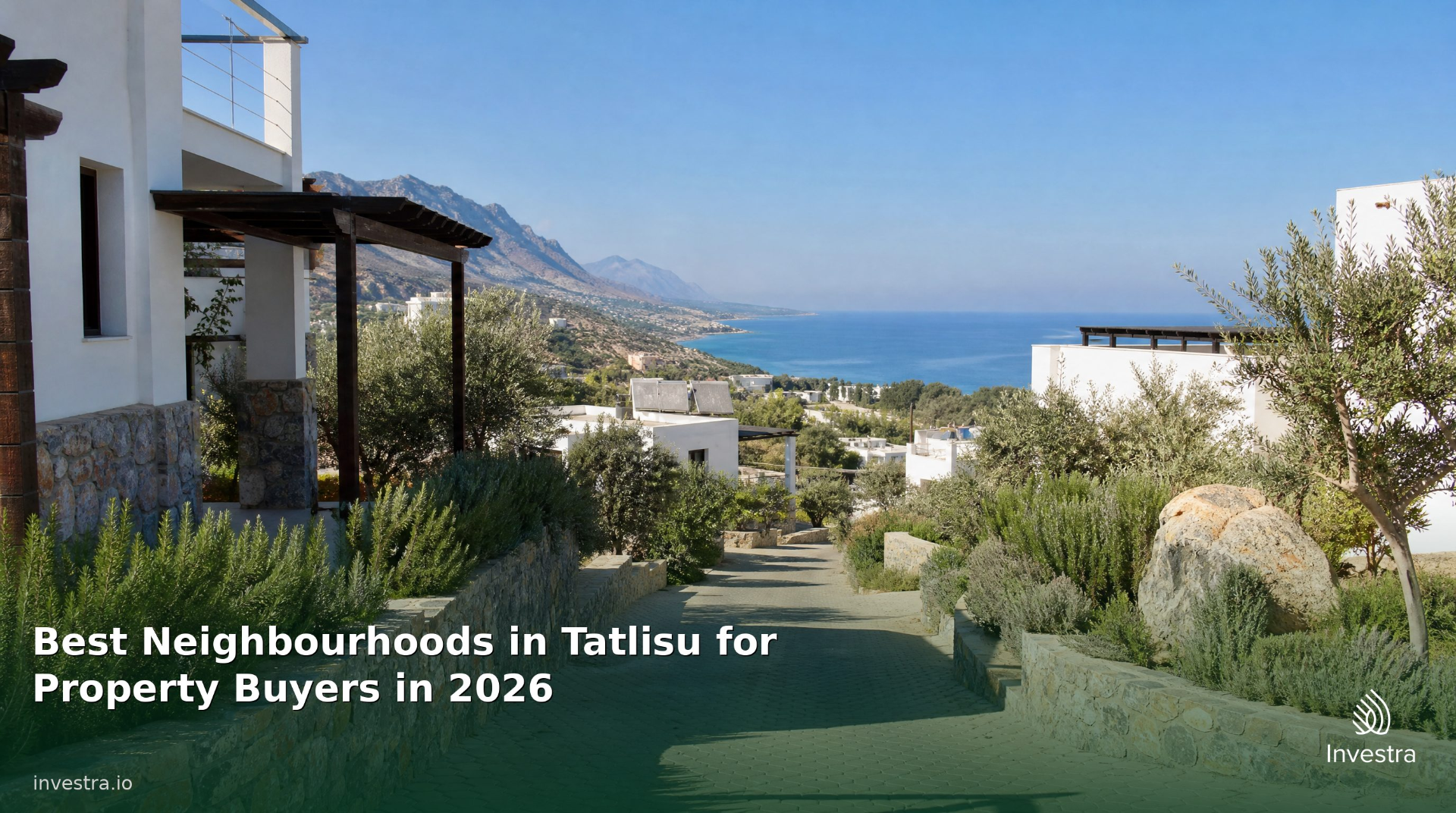
Best Neighbourhoods in Tatlisu for Property Buyers in 2026
Best Neighbourhoods in Tatlisu for Property Buyers in 2026
Why Tatlisu Is Attracting International Property Buyers in 2026
Quick Answer: Tatlisu is attracting international buyers in 2026 due to its combination of affordable entry prices (from €1,200/m²), stunning Mediterranean coastline, and consistent rental yields of 6–10% — making it one of North Cyprus's most compelling investment destinations. Investra.io tracks emerging markets like Tatlisu to help investors identify opportunities before mainstream demand drives prices higher.
The numbers tell a compelling story. Tatlisu and its surrounding micro-neighbourhoods saw transaction volumes rise by an estimated 28–34% between 2023 and 2025, according to aggregated North Cyprus property market data. British, German, Russian, Turkish, and increasingly Middle Eastern buyers are competing for a limited inventory of beachfront villas, hillside apartments, and newly developed residential complexes.
What's driving this momentum? Several forces are converging simultaneously. Remote working has untethered buyers from their home countries, making 300 days of annual sunshine genuinely appealing rather than aspirational. North Cyprus infrastructure — roads, hospitals, international schools — has improved markedly over the past five years.
The reality is that Tatlisu isn't a single homogeneous market. It's a collection of distinct neighbourhoods, each with its own character, price profile, buyer demographic, and investment logic. Understanding those distinctions is the difference between a smart acquisition and an expensive mistake. This guide cuts through the noise.
Understanding Tatlisu's Geography and Neighbourhood Structure
Quick Answer: Tatlisu comprises several distinct micro-areas — the beachfront strip, the hillside residential zones, the village core, and newer development corridors — each offering different price points, lifestyles, and investment characteristics for buyers in 2026.
Tatlisu sits within the Kyrenia (Girne) district of North Cyprus, occupying a stretch of coastline that many locals consider the most naturally beautiful section of the entire island. The Five Finger Mountains (Beşparmak) form a dramatic backdrop, the Mediterranean stretches north and west, and the land between is a patchwork of olive groves, citrus orchards, and increasingly, carefully designed residential developments.
Geographically, the area that buyers loosely call "Tatlisu" actually encompasses several distinct zones. There's the coastal strip itself — the beachfront and near-beach area where direct sea views come at a premium and short-term rental demand is strongest.
Understanding this geography matters enormously for buyers. A two-bedroom apartment in a beachfront complex will perform very differently from an equivalent unit 800 metres up the hillside — the rental yield profile, the buyer exit market, the maintenance requirements, and the lifestyle experience are all different.
Road access has improved significantly. The main coastal road connecting Kyrenia to Karpaz Peninsula now passes directly through Tatlisu, cutting journey times to Kyrenia's restaurants, marina, and shopping to approximately 35–40 minutes.
The Beachfront Strip — Tatlisu's Premium Investment Zone
Quick Answer: Tatlisu's beachfront strip commands prices of €2,000–€3,500/m² in 2026 for direct sea-view properties, with short-term rental yields reaching 8–10% annually — making it the highest-performing but most capital-intensive neighbourhood for property investors.
If there's one area in Tatlisu that needs no introduction to serious Mediterranean property investors, it's the beachfront strip. This narrow corridor of land running directly along the coastline — roughly 4–6 kilometres in total — hosts a mix of boutique villa compounds, beachfront apartment complexes, and a handful of genuinely exceptional standalone villas that rarely come to market and sell quickly when they do.
Prices here are the highest in the Tatlisu area, and the gap between beachfront and non-beachfront has widened noticeably over the past two years. In 2026, expect to pay €2,000–€2,800/m² for a quality apartment in a well-managed beachfront complex, rising to €2,800–€3,500/m² or beyond for detached villas with private pools and direct beach access.
The investment case for beachfront property rests primarily on short-term rental income. Properties here let consistently from April through October, with peak summer weeks (July–August) commanding nightly rates of €150–€350 for a two-bedroom apartment and €350–€700+ for villas. Average occupancy rates during the peak season run at 75–85% for well-marketed properties on platforms like Airbnb and Booking.com.
What surprised many buyers who entered this market in 2023–2024 was how quickly professional property management services developed in the area. There are now several locally based management companies offering full-service holiday rental management — guest communication, cleaning, maintenance, key exchange — for fees typically ranging from 20–25% of rental income.
The main risk factor to understand here is title deed complexity. North Cyprus property law — particularly around properties in beachfront locations — can involve complicated title structures including "exchange" properties and Turkish title deeds. Buyers absolutely must engage a qualified local lawyer and conduct thorough due diligence before committing. This is non-negotiable. For guidance on handling complex property markets, resources like Siniša Dagary investment insight offer valuable frameworks for assessing risk in emerging and frontier real estate destinations.
The Hillside Residential Belt — Value, Privacy, and Capital Growth
Quick Answer: Tatlisu's hillside belt offers property prices of €1,200–€2,000/m² in 2026, with panoramic sea views, greater privacy, and strong long-term capital appreciation potential — particularly attractive to buyers seeking a primary residence or long-term rental investment.
The hillside belt behind Tatlisu's coastal road is, in many ways, the area that most rewards careful research. Prices are meaningfully lower than beachfront, yet the lifestyle on offer — large plots, dramatic panoramic views sweeping across the Mediterranean, cooler summer temperatures, and genuine peace and quiet — often exceeds what the beachfront strip provides in terms of day-to-day livability.
Long-term rental demand in the hillside belt is driven by a different demographic than the beachfront's short-term holiday crowd. Expat retirees — particularly British, German, and Scandinavian — form the core tenant base, often taking properties on annual or multi-year leases. Monthly rental rates for a well-appointed three-bedroom hillside villa typically run €900–€1,600 depending on specification and view quality.
Capital appreciation is where the hillside belt has genuinely surprised. Properties purchased in well-located hillside positions in 2019–2021 have seen values rise 35–55% in euro terms through 2025, outpacing beachfront in percentage terms (though not absolute values).
For investors comparing multiple emerging Mediterranean markets, it's worth examining how similar value-yield dynamics play out in other regions. The Zajecar Real Estate Market 2026 Eastern Serbia Property Guide offers an interesting parallel — a market where hillside and peripheral locations are significantly outperforming central areas in capital growth terms.
Tatlisu Village Core — Authentic Character at Accessible Prices
Quick Answer: The Tatlisu village core offers the most affordable entry points in the area (€800–€1,400/m²) with genuine character and renovation potential, though buyers should be prepared for older infrastructure and a slower-moving resale market compared to the coastal zones.
The village centre itself is compact — a few streets fanning out from the old mosque, with a handful of local coffee shops, a small supermarket, and several excellent traditional restaurants that most tourists never find. Property here tends to be older stock: stone-built houses from the mid-20th century, many requiring significant renovation, others that have been sympathetically updated while retaining their character.
Prices in the village core are the most accessible in the Tatlisu market. Traditional stone houses in original condition start from as little as €60,000–€90,000 for smaller properties, while larger family homes needing renovation can be found in the €100,000–€180,000 range. Renovated properties with modern interiors but retained original character command €150,000–€280,000 depending on size and finish quality.
The renovation opportunity here is real but requires careful planning. Building regulations in North Cyprus's village cores can be complex, and the permitting process for alterations to older structures requires handling local authority requirements that experienced local architects know well.
The rental market in the village core is smaller and more niche than the coastal zones. There's demand from visitors seeking a more authentic, non-resort experience, and from academics and researchers connected to the Eastern Mediterranean University in Famagusta. But don't expect the same occupancy rates or nightly rates as beachfront properties.
The Esentepe Corridor — Tatlisu's Western Growth Frontier
Quick Answer: The Esentepe corridor west of Tatlisu is experiencing significant development activity in 2026, with prices ranging €1,400–€2,400/m² and strong infrastructure investment making it one of the area's most promising capital growth stories for medium-term investors.
What's happening in this corridor in 2026 is fascinating to watch. Several large-scale mixed-use developments are either completed, under construction, or in the planning pipeline — combining residential apartments, villas, commercial units, and leisure facilities in integrated schemes.
The golf element matters more than casual observers might realise. Golf tourism generates a distinct and relatively high-spending rental demographic — typically couples in the 45–65 age bracket with disposable income and a preference for quality accommodation.
Infrastructure investment in this corridor has accelerated. Road improvements, a new small marina development under discussion, and upgrades to utilities and telecommunications are creating the foundation for sustained price appreciation. The parallel with other infrastructure-led growth stories in emerging European property markets — like those documented in the Loznica Real Estate Market 2026 Macva Region Property Guide and the Sremska Mitrovica Real Estate 2026 Srem Region Property Guide — suggests that infrastructure-driven demand tends to create durable rather than speculative price growth.
The Kaplıca Direction — Tatlisu's Eastern Undiscovered Frontier
Quick Answer: East of Tatlisu toward Kaplıca, property prices drop to €900–€1,600/m² with some of the area's most unspoiled coastline — offering early-mover capital appreciation potential for investors comfortable with a longer investment horizon of 5–10 years.
Head east from Tatlisu's centre and the crowds thin quickly. The road toward Kaplıca and eventually the Karpaz Peninsula passes through some of the most undeveloped, genuinely pristine coastline remaining anywhere in the Mediterranean. There are stretches where you'll drive for several minutes without passing another vehicle, where the sea is visible through pine and carob trees, and where the only sound is wind and birdsong.
This eastern stretch represents North Cyprus's classic early-mover opportunity. Development here is sparse — a handful of small villa projects, some individual plots with planning permission, a few older properties that have been on and off the market for years.
The investment thesis here is fundamentally different from the established zones. This isn't about immediate rental yield — the tenant pool is thin and the infrastructure to support active holiday rentals (restaurants, shops, entertainment) is limited.
How long does that take? Realistic timelines are 7–15 years for the area to reach the kind of development maturity that Esentepe achieved over the past decade. For investors with patience and capital they don't need to deploy for a return in the short term, this represents a genuinely interesting proposition. For buyers who need income from day one, it doesn't.
The plot-and-build strategy works particularly well here. Buying a serviced plot (with electricity, water, and road access confirmed) and commissioning a quality villa build at North Cyprus construction costs — typically €600–€900/m² for a decent standard, €900–€1,400/m² for premium — can create a finished property whose market value substantially exceeds total construction cost even at current prices. This is the kind of opportunity that Siniša Dagary investment insight highlights as characteristic of frontier markets transitioning toward mainstream — the gap between build cost and market value is a temporary window that closes as the market matures.
Property Prices Across Tatlisu Neighbourhoods — A Comparative Analysis
Quick Answer: Tatlisu property prices in 2026 range from €800/m² in the village core to €3,500/m² for premium beachfront villas, with the most active investment volume concentrated in the €1,400–€2,200/m² mid-market segment of hillside and development corridor properties.
Getting specific about prices is always more useful than broad generalisations, so here's a structured breakdown of what the Tatlisu market actually looks like across its different zones and property types in 2026.
Beachfront Strip: New-build apartments with sea views are priced €1,800–€2,800/m² off-plan, €2,200–€3,200/m² completed. Detached beachfront villas range €2,500–€3,500/m² and beyond for exceptional positions. Entry-level beach-area studio apartments in older complexes start from approximately €85,000–€110,000 total.
Hillside Residential Belt: New-build villas with panoramic sea views are priced €1,400–€2,000/m². Resale villas in established hillside communities typically trade at €1,200–€1,800/m². A three-bedroom villa with pool in this zone ranges from €250,000 to €420,000 in absolute terms.
Village Core: Unrenovated traditional houses €800–€1,100/m², renovated character properties €1,000–€1,400/m². Total transaction values in the village centre most commonly fall between €80,000 and €220,000.
Esentepe Corridor: Development apartments in new complexes €1,400–€2,400/m²; golf-adjacent properties at the premium end of that range and beyond. Off-plan prices from credible developers start around €1,100–€1,600/m².
Eastern Kaplıca Direction: New builds and resales €900–€1,600/m², plots from €35,000. This zone consistently offers the lowest entry price points for those willing to accept limited current infrastructure.
For broader context on how Tatlisu's price structure compares to other emerging European property markets, the Prokuplje Real Estate Market 2026 Toplica Region Property Guide and Aleksinac Real Estate Market 2026 Southern Serbia Property Guide provide useful comparison points for investors looking at the broader emerging European market landscape.
Rental Yields, ROI, and the Investment Math in Tatlisu
Quick Answer: Tatlisu delivers gross rental yields of 6–10% depending on neighbourhood and management strategy, with net yields of 4.5–7.5% after costs — among the strongest yield profiles available for comparable quality Mediterranean coastal property in 2026.
Let's talk numbers honestly, because too much North Cyprus marketing literature presents best-case scenarios as typical outcomes. The real picture is positive — but it requires realistic assumptions.
Beachfront properties managed professionally for short-term holiday rentals can genuinely achieve gross yields of 8–10%. A two-bedroom beachfront apartment purchased at €200,000 generating €18,000–€20,000 annual gross rental income is achievable in a well-run operation. Net of property management fees (20–25%), utility costs, maintenance, and local taxes, expect net yields of 6–7.5%.
Hillside long-term rentals produce more modest gross yields of 5–7% but with meaningfully lower operating costs. A villa purchased at €300,000 generating €1,200/month (€14,400/year) in long-term rental income produces a gross yield of 4.8%, rising to perhaps 4–4.5% net after costs.
Capital appreciation has added significantly to total returns. Conservative estimates for well-purchased Tatlisu properties over a 5-year hold period suggest 25–45% capital appreciation in euro terms, dependent on location quality and entry price.
The key variables are entry price and management quality. Buyers who purchased off-plan in 2020–2022 at aggressive developer discounts and engaged active rental management have seen the best outcomes. Those who paid premium prices at the peak of 2022–2023 hype and left properties largely vacant are sitting on more modest results.
Tax efficiency matters significantly for international investors. North Cyprus levies modest annual property taxes (roughly 0.3–0.5% of market value) and capital gains tax on resales (20% on gains above a modest threshold), but the structure is considerably more attractive than many Western European jurisdictions. For optimisation strategies tailored to your situation, Siniša Dagary investment insight resources explore tax-efficient investment structuring across multiple jurisdictions.
Currency Risk, Political Stability, and Long-Term Viability
Quick Answer: Currency exposure and political recognition concerns require careful consideration — though North Cyprus's relative political stability, improving infrastructure investment, and de facto functioning economy have created a real and durable investment opportunity for properly informed buyers committed to a 5+ year horizon.
The elephant in the room for any international investor considering North Cyprus property is the political and legal complexity. North Cyprus is recognized only by Turkey; the Republic of Cyprus, whose government is internationally recognized, disputes territorial sovereignty. The international community predominantly views the island's division as temporary, yet that division has now persisted for over 50 years.
What does this mean for property investors? The practical answer: significantly less than the political framing suggests. North Cyprus has functioning legal institutions, a stable Turkish lira-based banking system, a tourism industry, international business operations, and a property market where tens of thousands of international buyers have successfully acquired and profitably exited properties.
Currency risk is real, particularly for euro-based investors. Property prices are quoted in euros or Turkish lira, and rental income typically flows in euros, but underlying construction and operating costs are lira-denominated. A significant lira strengthening would improve margins; a continued lira weakness (the trend of recent years) compresses them. This is a genuine investment variable to model, not a dealbreaker.
Long-term viability? The trajectory is positive. Tourism to North Cyprus is growing steadily, international school enrollments are increasing, and expat retiree inflows show no signs of slowing. The EU has signaled interest in eventual reintegration discussions. Whether that materializes or not, the incentive structures point toward gradual development and stability rather than deterioration.
Investment Disclaimer
Quick Answer: This guide is general market information, not personal legal, tax, financing or investment advice.
Before committing to a property transaction, buyers should obtain independent local legal, tax and financial advice suited to their circumstances. Investra.io can support initial market research, but every purchase decision remains the buyer's responsibility.
Frequently Asked Questions
Quick Answer: This section explains the practical property-investment implications of Frequently Asked Questions.
What is a prudent next step after initial market research?
Use current documentation, independent professional advice and comparable local evidence before proceeding. Investra.io can support an initial structured market review.
How can buyers plan a realistic ownership budget?
Use current documentation, independent professional advice and comparable local evidence before proceeding. Investra.io can support an initial structured market review.
What evidence supports a careful investment decision?
Use current documentation, independent professional advice and comparable local evidence before proceeding. Investra.io can support an initial structured market review.
When should a buyer obtain legal and tax advice?
Use current documentation, independent professional advice and comparable local evidence before proceeding. Investra.io can support an initial structured market review.
How should a buyer compare neighbourhoods and property types?
Use current documentation, independent professional advice and comparable local evidence before proceeding. Investra.io can support an initial structured market review.
What local checks should be completed before signing?
Use current documentation, independent professional advice and comparable local evidence before proceeding. Investra.io can support an initial structured market review.
Which costs should be assessed alongside the purchase price?
Use current documentation, independent professional advice and comparable local evidence before proceeding. Investra.io can support an initial structured market review.
How can international buyers verify a property opportunity?
Use current documentation, independent professional advice and comparable local evidence before proceeding. Investra.io can support an initial structured market review.
What should buyers compare before selecting a property?
Use current documentation, independent professional advice and comparable local evidence before proceeding. Investra.io can support an initial structured market review.
Quick Answer: These answers outline common buyer checks and should be read with current professional advice.
Recommended Reading
Quick Answer: This section explains the practical property-investment implications of Recommended Reading.
- Investra market research
- Investra market research
- Investra market research
- Investra market research
- Investra market research
- Investra market research
- Investra market research
- Investra market research
- Investra market research
- Investra market research
- Investra market research
- Investra market research
- Investra market research
- Investra market research
- Investra market research
- Investra market research
- Investra market research
- Siniša Dagary investment insight
- Siniša Dagary investment insight
- Siniša Dagary investment insight
- Siniša Dagary investment insight
- Siniša Dagary investment insight
- Findes Group & Partners
- Findes Group & Partners
Connect With Investra
Follow Investra for market updates on Facebook, LinkedIn, YouTube
Related Posts
No related posts available.
