
Best Neighbourhoods in Tivat Marina 2026: Where to Buy
Tivat Marina 2026: Why This Adriatic Gem Keeps Drawing Global Capital
Quick Answer: Tivat Marina — anchored by the world-famous Porto Montenegro — remains one of Europe's most compelling waterfront investment destinations in 2026, with property prices ranging from €3,500 to €12,000+ per m² depending on location and asset class. Investra.io tracks live data across Montenegro's coastal and inland markets to help investors make confident decisions.
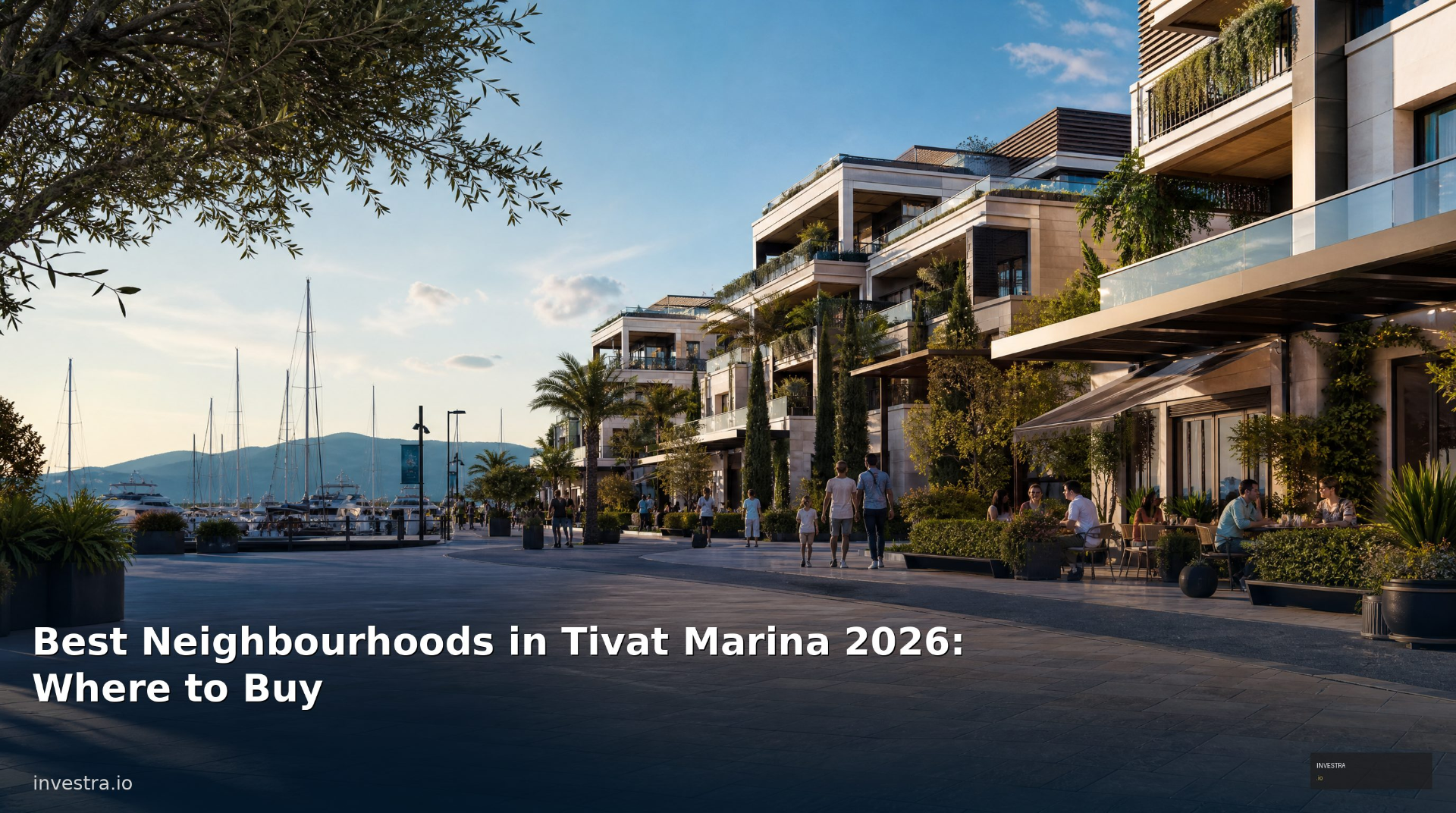
There's a moment, usually sometime around sunset on the Porto Montenegro promenade, when first-time visitors understand why seasoned investors keep coming back to Tivat. The Adriatic catches fire in shades of amber and rose, superyachts rock gently in one of Europe's finest deep-water marinas, and the Vrmac peninsula rises dramatically behind the town like a green curtain. It's cinematic — and for property investors, it's increasingly profitable.
Tivat was, not so long ago, a quiet Yugoslav naval base town that most tourists passed through on the way to Kotor or Budva. The transformation that followed the redevelopment of the former naval arsenal into Porto Montenegro is one of the most striking urban regeneration stories in the Balkans. Today, Tivat Marina doesn't just compete with other Montenegrin coastal towns — it competes with Monaco, Cannes, and Portofino for the attention of ultra-high-net-worth buyers and boutique investors alike.
What makes 2026 particularly interesting is the convergence of several factors: Montenegro's EU accession process is advancing (membership is projected for the late 2020s to early 2030s), the airport infrastructure has been upgraded, and a new wave of luxury residential projects is completing or in final phases of construction. The market isn't just mature — it's maturing in exactly the right direction. For investors who understand where to buy within Tivat's distinct neighbourhoods, the upside remains significant.
This guide covers every major sub-market within the Tivat area — from the polished promenade of Porto Montenegro to the quieter hillside villages above the bay — with concrete price data, rental yield analysis, legal considerations for foreign buyers, and the kind of granular neighbourhood intelligence that separates informed decisions from expensive mistakes.
Understanding the Tivat Real Estate Market: Size, Scale, and 2026 Trends
Quick Answer: The Tivat real estate market has grown approximately 40–60% in value over the past decade, with 2026 prices averaging €3,800–€5,500/m² for mid-range coastal properties and €7,000–€12,000/m² in Porto Montenegro's premium segments. Foreign buyers account for roughly 60–70% of all transactions in the luxury segment.
Let's start with the numbers, because they tell a story that's more nuanced than the headlines suggest.
The Tivat municipality covers approximately 46 km² and had a population of around 14,000 before tourism and investment activity began reshaping its demographic profile. That's a small base — which is precisely why supply constraints work in investors' favour. Unlike sprawling coastal cities elsewhere in the Mediterranean, Tivat simply doesn't have room to build endlessly. The bay geography, the mountain backdrop, and heritage protection zones all limit new supply in ways that structurally support prices.
In terms of transaction volumes, the broader Bay of Kotor real estate market (which includes Tivat, Kotor, and Herceg Novi) recorded estimated transaction values exceeding €400 million annually in recent years — a figure that has grown substantially since pre-pandemic levels. Tivat itself accounts for a disproportionate share of that figure given the Porto Montenegro premium pricing.
The price trajectory is worth examining carefully. Back in 2014-2016, decent apartments in the Tivat area could be acquired for €1,500–€2,000/m². By 2020, mid-market prices had climbed to €2,500–€3,500/m². Today in 2026, the same properties trade at €3,800–€5,500/m², with prime Porto Montenegro waterfront commanding €8,000–€12,000/m² and in some cases exceeding that figure for trophy assets.
What's driving continued growth? Several forces are at work simultaneously. Montenegro's NATO membership (achieved in 2017) removed geopolitical risk for many Western European buyers. The country's flat 9% personal income tax, zero inheritance tax between close relatives, and competitive corporate tax environment make it attractive for wealth structuring. And the EU accession narrative — even if still years away from completion — has a self-fulfilling quality: buyers want to get in before the full European legal framework (and European prices) arrive.
International buyers in 2026 come predominantly from Russia, Ukraine, the UK, Germany, France, the Netherlands, and increasingly from the Middle East and China. The mix has shifted somewhat since 2022, with Russian and Ukrainian buyer proportions fluctuating, but the overall foreign buyer appetite has remained robust because other nationalities have filled any gaps.
Porto Montenegro: The Crown Jewel Neighbourhood
Quick Answer: Porto Montenegro is the most prestigious address in Tivat, with apartment prices ranging from €5,500 to €12,000+/m² in 2026. Rental yields for short-term luxury rentals typically range from 4–7% gross, with the top superyacht berth holders and branded residences achieving the upper end of that range.
Porto Montenegro deserves its own section — and frankly, its own guidebook. What Ivica Toćić and the late David Murdoch (through his company Kauri Bay Boomers, and later Investcorp) created here is genuinely without precedent in the Western Balkans. The development covers approximately 24 hectares of former Yugoslav naval yard and has been built in phases since 2009, creating a full-service marina village with 600+ berths for yachts up to 250 metres in length.
The residential offerings within Porto Montenegro span several distinct product types. The Village residential complex offers apartments and townhouses in a neo-Mediterranean architectural style. Boka Place — the newer, more ambitious extension of the development — adds hotel-branded residences, retail, wellness facilities, and a refined urban-quarter feel. And scattered throughout are penthouse units and villas that trade hands quietly at prices that rarely make it into public statistics.
Pricing in 2026 breaks down roughly as follows: standard one-bedroom apartments in Porto Montenegro start around €350,000–€500,000 for 55–80 m² units, implying per-metre prices of €5,500–€7,000. Two-bedroom units of 90–130 m² typically trade from €650,000 to €1.1 million. Penthouses and top-floor units with full marina views regularly exceed €2 million, and the most extraordinary trophy properties have sold for €5–8 million.
The rental market here is robust but seasonal. Porto Montenegro targets the superyacht and ultra-luxury segment, which means peak summer rates (July–August) for a two-bedroom marina-view apartment can reach €4,000–€8,000 per week. Annual gross rental yields for professionally managed units typically land between 4.5% and 6.5%, which is competitive for this price bracket in European terms. The key is professional management — absentee landlords who don't engage specialist operators rarely achieve these figures.
One thing that surprises many buyers is the marina berth situation. Berths themselves can be purchased freehold and represent a separate asset class entirely. A 20-metre berth might cost €200,000–€400,000; a 40-metre berth can exceed €1 million. Berth values have appreciated alongside the overall development and represent an interesting tangential investment for marine industry players.
For investors considering Porto Montenegro in 2026, the main caution is that this is a mature, fully priced market. The era of buying here at transformative discounts has passed. The opportunity now is stable income generation combined with modest capital appreciation — perhaps 4–8% annually in euro terms — rather than the 15–25% annual gains that early buyers enjoyed. That's still excellent performance by European standards, but expectations must be calibrated accordingly.
Donja Lastva and Gornja Lastva: The Authentic Village Alternative
Quick Answer: The twin villages of Donja Lastva and Gornja Lastva sit just north of Tivat town and offer stone house restoration opportunities and new-build apartments at €2,500–€4,500/m², representing meaningful value relative to Porto Montenegro while maintaining bay views and proximity to marina facilities.
Not every buyer in Tivat wants a polished marina apartment with concierge service and a lobby that feels like a five-star hotel. For those seeking something more textured — more authentically Montenegrin — the old stone villages that dot the Vrmac peninsula hillside above the bay offer a compelling counterpoint.
Donja Lastva (Lower Lastva) and Gornja Lastva (Upper Lastva) are traditional Boka Kotorska settlements that predate modern Tivat by centuries. The architecture is Venetian-influenced stone construction, with thick walls, olive trees, and terraced gardens that have watched over the bay for generations. They're close enough to Porto Montenegro (5–10 minutes by car) to enjoy all amenities, but removed enough to feel genuinely peaceful.
The market here has two distinct segments. First, original stone houses — often requiring substantial renovation — that can be acquired for €150,000–€400,000 depending on size and condition, then transformed into stunning properties worth €500,000–€800,000 post-renovation. These renovation plays require patience, local contractor relationships, and a realistic understanding of Montenegrin construction timelines (which can be… optimistic). But the end product — a restored stone villa with bay views, a garden, and genuine character — commands serious rental premiums and attracts a discerning long-stay clientele.
The second segment consists of newer apartment buildings that have appeared in the villages over the past decade. These aren't the polished products of Porto Montenegro, but they offer solid construction, bay views, and per-metre prices of €2,800–€4,000 that make more financial sense for yield-focused buyers. Rental yields in the village zones tend to run 5–8% for well-located properties targeting the mid-luxury tourist segment.
What we've seen increasingly is a buyer profile that splits between lifestyle purchasers — often Northern Europeans aged 45–65 seeking a Mediterranean second home with soul — and younger remote workers drawn by Montenegro's relatively affordable cost of living, the no-remote-work-visa (Montenegro doesn't require one for EU citizens staying under 90 days, and longer stays are manageable), and the sheer quality of life. Both groups support solid rental demand outside the traditional summer window.
Tivat Town Centre: Underrated and Underpriced
Quick Answer: Tivat's town centre offers apartments at €2,800–€4,500/m² in 2026, with solid long-term rental demand from residents working in the marina economy and tourism sector, yielding 5–7% gross for well-managed properties. It's the area most analysts consider undervalued relative to its fundamentals.
Here's an honest observation that runs counter to most marketing materials about Tivat: the town centre itself — the real town, where Montenegrins live and shop and drink coffee — has been somewhat overlooked by international investors fixated on Porto Montenegro's glamour. That oversight may be a significant opportunity.
Tivat town centre is walkable, well-serviced, and sits within easy reach of both the marina and Tivat International Airport. The main promenade along the waterfront has been substantially upgraded, with palm-lined walkways, a public beach, restaurants, and cultural facilities. The town hosts local markets, the Sea Dance music festival draws tens of thousands of visitors annually, and the overall atmosphere is far more lively and authentic than the curated perfection of Porto Montenegro.
Apartment prices in central Tivat in 2026 range from €2,800/m² for older stock in good condition to €4,500/m² for new-build or recently renovated units with sea views. A 60 m² two-bedroom apartment can be acquired for €180,000–€270,000 — a fraction of the Porto Montenegro equivalent. These price points make the yield mathematics significantly more attractive. Monthly rental rates for a well-furnished two-bedroom in central Tivat range from €800–€1,500 in the shoulder season to €2,000–€3,500 in peak summer, translating to gross yields of 5–7% for professionally managed properties with good occupancy.
The long-term rental market is also stronger here than in Porto Montenegro. The marina economy employs hundreds of people — crew, maintenance workers, hospitality staff, administrators — many of whom prefer living in the town rather than in purpose-built marina accommodation. Monthly rents for annual-contract rentals in central Tivat run €600–€1,200 for a two-bedroom unit, providing stable, year-round income that partially compensates for the lower peak-summer highs.
Investors researching similar dynamics in value-rich Balkan markets will find useful context in our coverage of the Loznica Real Estate Market 2026 Macva Region Property Guide — the principle of prioritising fundamentals over glamour applies across the region.
Radovići and Krašići: The Smart Money's Emerging Neighbourhoods
Quick Answer: Radovići and Krašići, located on the southern shores of the Tivat peninsula, are emerging neighbourhoods where land and apartment prices of €1,800–€3,200/m² represent the best value-to-growth potential ratio in the Tivat area, with projected appreciation of 8–15% annually as infrastructure improves.
Ask local developers and real estate professionals where they're personally buying land right now, and a disproportionate number will mention the southern Tivat peninsula — specifically Radovići and the Lustica Bay area that bleeds into the Krašići peninsula. These are the areas where people who actually understand the market are placing their bets.
Radovići is a small village adjacent to Tivat airport that has seen significant development interest, particularly for residential projects targeting both the short-term rental market and permanent residents who work in the Tivat-Porto Montenegro ecosystem. Land prices here have risen from €150–€250/m² in the mid-2010s to €300–€500/m² for buildable plots today — significant growth, but still far below the €800–€1,500/m² you'd pay for comparable plots closer to Porto Montenegro.
The Lustica Bay development — a massive, phased resort and residential project covering 690 hectares on the Luštica peninsula directly across from Tivat — deserves special mention. This project, backed by Orascom Development, is creating an entirely new destination with hotels, a golf course, marina, and residential units. Prices in Lustica Bay range from €2,500–€5,000/m² for off-plan and early-phase units. The project is close enough to Tivat to be considered part of the same investment ecosystem and creates spillover demand that benefits the southern Tivat peninsula as a whole.
Krašići village itself — a small, picturesque fishing settlement on the western tip of the Luštica peninsula — has seen growing interest from buyers seeking affordable waterfront land. Stone houses and plots here can still be found at prices that feel almost implausibly cheap relative to what's happening 15 minutes away by water taxi. The key risk is infrastructure — roads, water supply, and electricity capacity are still developing — but for buyers with a 5–10 year investment horizon, the fundamentals are compelling.
Kavač: The Residential Backbone of Tivat
Quick Answer: Kavač, Tivat's largest residential suburb, offers apartments at €2,200–€3,800/m² in 2026 and serves primarily as a long-term rental and owner-occupier market for the local and expat professional community, with gross rental yields averaging 5–6.5%.
Kavač is where most of Tivat's actual population lives. It's not glamorous — there are no superyachts, no Michelin-starred restaurants, no rooftop bars with dress codes. What there is, is a functioning residential neighbourhood with schools, supermarkets, medical facilities, sports clubs, and the ordinary infrastructure of daily life. And for investors, that ordinariness is a feature, not a bug.
The residential apartment stock in Kavač spans a wide quality range, from late-socialist-era concrete buildings that have been gradually updating through the privatisation process to genuinely modern new-build developments with underground parking, lifts, and contemporary finishes. Prices in 2026 range from €2,200/m² for older stock requiring cosmetic updates to €3,800/m² for new-build units in well-located blocks.
The tenant profile in Kavač is primarily domestic and regional — Montenegrin families, workers from across former Yugoslavia who've relocated for marina employment, and an increasing number of expat professionals who prefer the suburban quiet of Kavač to the performative luxury of Porto Montenegro. Monthly rental rates for a two-bedroom apartment range from €500–€900 on annual contracts, rising to €1,500–€2,500 for summer short-term lets. The blend typically produces gross yields of 5–6.5% for well-managed properties.
For investors focused on the Balkan region's property dynamics more broadly, the residential suburb investment thesis that plays out in Kavač has parallels in markets we've covered extensively — see our analysis of Sremska Mitrovica Real Estate 2026 Srem Region Property Guide for comparative context on how residential backbone areas perform relative to headline tourist zones.
Legal Framework for Foreign Buyers in Montenegro 2026
Quick Answer: Foreign nationals can buy property in Montenegro with full freehold ownership rights, with no restrictions on foreign ownership of apartments and buildings. Land purchases are slightly more complex but manageable. The full transaction process typically takes 4–8 weeks, with total transaction costs (taxes, fees, legal) running 5–8% of purchase price.
Montenegro's legal framework for foreign property ownership is one of the most straightforward in the region — which is both genuinely good news and a factor that sophisticated buyers sometimes treat with unwarranted suspicion. The reality is that decades of legal reform, combined with the EU accession process requirements, have produced a property rights system that functions reliably for international buyers.
Foreign nationals — including non-EU citizens — have the right to purchase apartments and buildings in Montenegro with the same freehold ownership rights as Montenegrin citizens. There are no restrictions on the number of properties a foreigner can own, no minimum investment thresholds for residential purchases, and no required residency status to buy. The process is, in principle, as accessible as buying in France or Spain — and in practice, somewhat faster due to Montenegro's more streamlined administrative systems.
Land purchases are subject to a minor caveat: technically, foreign nationals cannot directly purchase raw land, but this is routinely navigated through the standard mechanism of establishing a Montenegrin d.o.o. (limited liability company), which can hold land freely. The company formation process takes 2–5 days and costs a few hundred euros in registration fees. For development-oriented buyers or those purchasing plots, this is simply a standard step in the process.
The transaction itself proceeds through several stages: signing a pre-contract (predugovor) with typically a 10% deposit, due diligence on the property registry (katastarska evidencija) to verify clear title and absence of encumbrances, notarization of the final purchase contract (kupoprodajni ugovor), and registration of ownership at the cadastre. The property transfer tax (porez na promet nepokretnosti) is 3% of the transaction value for resale properties. New constructions purchased from developers are subject to VAT (PDV) at 21%, typically included in the developer's listed price.
Total transaction costs for a buyer — including transfer tax or VAT, notary fees, legal representation, and cadastre registration — typically run 5–8% of the purchase price. Buyers should budget accordingly. Engaging a reputable local lawyer (independent from the selling agent) is strongly recommended; fees typically run €1,000–€3,000 for a standard transaction.
For investors seeking expert guidance on navigating cross-border property acquisitions and investment structuring in the Balkans, Siniša Dagary — Investment Consultant brings deep regional expertise in positioning investments for maximum legal and fiscal efficiency.
Rental Yields, ROI, and the Tivat Investment Case in Numbers
Quick Answer: Tivat real estate delivered gross rental yields of 4–8% in 2026 depending on location and management quality, with total annual ROI (yield plus capital appreciation) estimated at 8–14% for well-selected properties. Porto Montenegro premium assets yield lower but appreciate more steadily; emerging areas yield higher with greater appreciation upside.
Let's get into the numbers with the granularity that serious investors require. The "yield" question in Tivat is more complex than a single figure because the market contains several distinct sub-markets with meaningfully different yield profiles.
Porto Montenegro (Premium Segment): Gross rental yields of 4–6.5% based on purchase prices of €5,500–€10,000/m². Capital appreciation: 5–8% annually. Total annual ROI estimate: 9–14%. The yield seems modest for the risk profile, but the capital security and liquidity of this segment — there's always a buyer for quality Porto Montenegro assets — justifies the premium pricing. Management costs (typically 20–35% of rental income for professionally managed properties) must be deducted for net yield calculations.
Tivat Town Centre (Mid-Market): Gross rental yields of 5–7.5% based on purchase prices of €2,800–€4,500/m². Capital appreciation: 5–9% annually. Total annual ROI estimate: 10–16%. The sweet spot for yield-focused investors who don't require the prestige of the marina address.
Village/Hillside Properties (Lastva, Bogdašići): Gross rental yields of 6–9% for well-renovated properties marketed to the premium independent traveller segment. Capital appreciation: 4–7% annually. Total annual ROI estimate: 10–15%. Higher management intensity but a differentiated product with its own loyal rental audience.
Emerging Areas (Radovići, Luštica vicinity): Gross rental yields of 5–7% currently, with projected capital appreciation of 8–15% annually as infrastructure develops and the Lustica Bay project matures. Total annual ROI estimate: 13–22% for buyers who time entry well. Higher risk profile — liquidity is lower and development timelines can shift — but the upside case is substantial.
Seasonality is a critical factor in all yield calculations. Tivat's tourist season runs June to September, with July and August generating roughly 60–70% of annual short-term rental revenue. Investors who plan to maximise short-term rental income need to budget for off-season carrying costs, including management fees, utility bills, and maintenance during low-occupancy months. A rough rule of thumb: if a property generates €3,000–€4,000 per week in peak summer, it might average €800–€1,200 per week across the full year when shoulder and low seasons are factored in.
Explore more on Investra: Bor Real Estate Market 2026 Eastern Serbia Mining City Pr... | Zajecar Real Estate Market 2026 Eastern Serbia Property G... | Prokuplje Real Estate Market 2026 Toplica Region Property... | Aleksinac Real Estate Market 2026 Southern Serbia Propert... | Indija Real Estate Market 2026 Vojvodina Logistics Hub Pr... | Serbia Proptech 2026 How Technology Is Changing Real Estate | Serbia Co Living Investment 2026 New Trend In Belgrade Re... | Serbia Green Real Estate 2026 Eco Friendly Properties Sus... | Serbia Property Renovation Guide 2026 Costs Permits Best ... | Serbia Building Permits 2026 How To Get Construction Perm... | Serbia Real Estate Market Secrets What The Data Really Sh... | Kopaonik Real Estate Faq 2026 30 Questions About Ski Reso... | Kopaonik Vs Zlatibor Vs Tara Best Serbian Mountain For In... | Belgrade Vs Novi Sad Vs Nis Real Estate Investment Compar...
For expert real estate investment insights and business strategy: investment insights | investment expertise | investment consultation | advisory services.
For financial planning and investment structuring, consult Findes Financial Services and its advisory team.
Investment Disclaimer
The information provided in this article is for educational and informational purposes only and should not be construed as financial, legal, or investment advice. Real estate investments carry inherent risks, and past performance does not guarantee future results. Investors should not invest money they cannot afford to lose. Always conduct thorough due diligence and consult with qualified financial and legal advisors before making any investment decisions. Investra.io does not guarantee returns on any investment.
Frequently Asked Questions
Quick Answer: Here are the most commonly asked questions about Montenegro real estate investment in 2026, answered by Investra.io experts.
Is Montenegro a good country for real estate investment in 2026?
Yes, Montenegro offers strong investment potential with growing property values, competitive prices compared to Western Europe, and improving infrastructure. Investra.io provides comprehensive market data and investment guidance.
Can foreigners buy property in Montenegro?
EU citizens can buy property freely in Montenegro. Non-EU citizens may need to meet specific requirements. Investra.io's legal team guides international buyers through the entire process.
What is the average property price in Tivat Marina?
Property prices in Tivat Marina vary significantly by location and property type. Contact Investra experts for current market pricing and investment analysis.
What rental yields can I expect?
Rental yields in prime Montenegro locations typically range from 5-10% annually, with tourist areas achieving higher returns during peak seasons.
What taxes apply to property purchases?
Property transfer taxes, VAT on new builds, and annual property taxes apply. Rates vary by property type and location. Consult Siniša Dagary for tax optimization strategies.
How long does the purchase process take?
Typically 30-60 days from offer to completion. Working with Investra.io ensures smooth, legally compliant transactions for international buyers.
What financing options are available?
Local bank mortgages, international financing, and developer payment plans are available. Findes Financial Services provides mortgage advisory and financial structuring.
Is property management available for rental properties?
Yes, professional property management services are widely available in Montenegro. Investra.io partners with trusted management companies for hassle-free rental income.
What are the best areas to invest in Tivat Marina?
Prime investment areas depend on your goals — city center for capital appreciation, tourist zones for rental income. Investra.io's market analysis identifies the best opportunities.
Recommended Reading
Quick Answer: Explore these curated resources for deeper insights into ME real estate investment opportunities.
- Negotin Real Estate Market 2026 Zajecar District Property...
- Bor Real Estate Market 2026 Eastern Serbia Mining City Pr...
- Zajecar Real Estate Market 2026 Eastern Serbia Property G...
- Prokuplje Real Estate Market 2026 Toplica Region Property...
- Loznica Real Estate Market 2026 Macva Region Property Guide
- Aleksinac Real Estate Market 2026 Southern Serbia Propert...
- Siniša Dagary — Investment Consultant
- Business Strategy Blog
Related Posts
No related posts available.
