
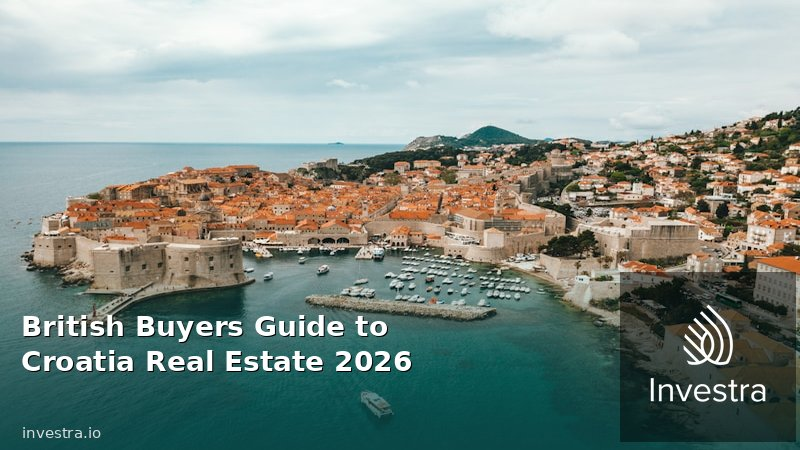
British Buyers Guide to Croatia Real Estate 2026
Can UK Citizens Buy Property in Croatia? The Complete Legal Framework
Quick Answer: Yes, UK citizens can buy property in Croatia, though post-Brexit rules mean British buyers must now follow the same procedures as non-EU nationals — requiring reciprocity agreements and Ministry of Justice approval in certain cases. Croatia Real Estate Investment Guide 2026 outlines the full legal process for international buyers.
Since Croatia joined the European Union in 2013 and the UK left the EU in January 2020, British nationals purchasing property in Croatia face a slightly different legal landscape than they did before Brexit. However, the good news is that Croatia and the United Kingdom have a longstanding reciprocity agreement that permits British citizens to purchase real estate in Croatia with relative ease — provided all correct procedures are followed.
Under Croatian law, non-EU foreign nationals — including British passport holders — can acquire property through a principle of reciprocity, meaning Croatia grants purchase rights to nationals of countries that grant equivalent rights to Croatian citizens in their territory. The UK qualifies under this framework, allowing British buyers to purchase residential, commercial, and agricultural land with the appropriate permissions.
For most residential properties in urban and coastal areas, British buyers do not require special government approval and can proceed similarly to EU nationals. However, for agricultural land, forestry areas, and properties in designated protected zones, British nationals must apply to the Croatian Ministry of Justice for a permit before completing the transaction. This process typically takes between 30 and 90 days and requires submission of a property description, proof of identity, and details of the intended purchase.
It is strongly recommended that British buyers engage a local Croatian notary (javni bilježnik) and an independent Croatian property lawyer who specialises in real estate transactions for foreign nationals. These professionals ensure all documentation meets legal requirements, title searches are completed, and encumbrances are identified before funds are transferred.
One important practical note: British buyers should ensure the property they are purchasing is properly registered in the Land Registry (Zemljišna knjiga), as unregistered ownership has historically been a challenge in parts of Croatia. A thorough title check is non-negotiable.
---Why British Buyers Are Choosing Croatia in 2026
Quick Answer: Croatia's combination of Adriatic coastline, EU membership stability, competitive property prices compared to Western Europe, and strong short-term rental demand makes it one of the most compelling destinations for British property investors in 2026.
Croatia has evolved from a niche holiday destination into one of the most strategically attractive real estate markets in Europe for British buyers. In 2026, a confluence of factors has elevated Croatia's investment appeal, drawing interest from seasoned investors, lifestyle buyers, and retirees across the United Kingdom.
First and foremost, Croatia remains significantly more affordable than comparable Mediterranean destinations such as the French Riviera, Tuscany, the Balearic Islands, or even the Portuguese Algarve. For British buyers priced out of Western European coastal markets, Croatia offers extraordinary value — with prime Adriatic seafront properties available at a fraction of the cost of equivalent assets in Spain or Italy.
Croatia's Eurozone accession in January 2023 was a landmark development for British investors. By adopting the Euro, Croatia eliminated the currency exchange volatility that once complicated property transactions and rental income calculations. British buyers now deal in a widely understood, stable currency, simplifying financial planning and mortgage arrangements.
Tourism statistics continue to underpin investment confidence. Croatia recorded over 20 million tourist arrivals in 2023 and tourism revenues exceeded €14 billion — making it one of Europe's most visited destinations relative to its population. The Adriatic coastline, the walled city of Dubrovnik, Split's Roman heritage, and the islands of Hvar, Brač, and Korčula attract an increasingly affluent international visitor base willing to pay premium nightly rates for quality short-term rental accommodation.
For British buyers seeking lifestyle relocation, Croatia's quality of life metrics are compelling. The country offers clean seas, a Mediterranean climate with over 2,700 hours of sunshine annually, excellent food and wine culture, growing digital nomad infrastructure, and EU-standard healthcare. Direct flight connectivity between the UK and Croatia has expanded significantly, with routes from London, Manchester, Birmingham, Bristol, and Edinburgh serving Split, Dubrovnik, Zagreb, and Zadar airports.
For a comprehensive market overview tailored to international investors, the Croatia Real Estate Investment Guide 2026 on Investra.io provides current data, regional breakdowns, and investment analysis updated to reflect current market conditions.
---Croatia Property Market Overview and Price Trends in 2026
Quick Answer: Croatia property prices in 2026 range from approximately €1,800/m² in inland regions to over €7,500/m² for premium Adriatic seafront and Dubrovnik Old Town properties, with the national market showing continued appreciation driven by tourism demand and limited coastal supply.
The Croatian real estate market has demonstrated remarkable resilience and consistent price growth over the past several years. After decades of undervaluation relative to comparable European coastal markets, prices have risen steadily since Croatia's EU accession, with the pace of appreciation accelerating following Eurozone membership in 2023.
National Average Price Trends:
- National average residential property price: approximately €2,200–€2,800/m² in 2026
- Year-on-year price growth: estimated 6–10% in coastal and urban markets
- New-build coastal properties: €3,500–€6,500/m²
- Resale apartments in established tourist areas: €2,500–€5,000/m²
Regional Price Breakdown:
Zagreb: Croatia's capital presents a different investment profile to coastal markets. Residential property in Zagreb averages €2,000–€3,500/m² depending on district, with the premium Upper Town (Gornji Grad) and central districts commanding the higher end. Long-term rental yields in Zagreb typically run 4–6%, supported by a large student population, corporate tenant base, and growing expat community. The Zagreb Property Market Analysis provides detailed neighbourhood-by-neighbourhood data for investors targeting the capital.
Split: The second-largest city and gateway to Dalmatia, Split has seen extraordinary price growth over the past five years. Central and Old Town properties now trade at €4,000–€7,000/m², while residential areas within 2–3 km of the historic centre range from €2,800–€4,500/m². Split's year-round appeal — combining rich Roman heritage, a vibrant local population, and Adriatic access — makes it one of Croatia's most liquid real estate markets. See the Split Real Estate Guide for current listings and market intelligence.
Dubrovnik: Croatia's most internationally recognised city commands the country's highest property prices. Old Town apartments, when available, trade at €8,000–€12,000/m² or more, while properties on the Lapad Peninsula and in the broader Dubrovnik-Neretva County range from €4,500–€8,000/m². Supply is severely constrained by UNESCO heritage protections, making Dubrovnik one of the most capital-appreciation-focused markets in the entire Mediterranean. The Dubrovnik Luxury Property Guide details the premium end of the market for discerning British buyers.
Hvar Island: One of the most glamorous islands in the Adriatic, Hvar commands prices ranging from €3,500–€9,000/m² for prime seafront and village properties. Hvar Town properties and those with direct sea views carry significant premiums. The island's strong brand recognition among high-net-worth European and American tourists supports exceptional short-term rental income potential. Detailed analysis is available in the Hvar Island Real Estate guide.
Zadar, Šibenik, and Mid-Dalmatia: These emerging coastal cities and their surrounding areas represent some of the best value for money in coastal Croatia. Property prices range from €2,200–€4,500/m², offering meaningful upside potential as infrastructure investment and tourism growth continue to close the gap with Split and Dubrovnik.
Istria: Croatia's northwestern peninsula bordering Slovenia and Italy has a particularly strong following among British, Austrian, and Italian buyers. Coastal towns like Rovinj, Poreč, and Pula offer prices between €3,000–€6,500/m², with the prestige hilltop villages of interior Istria representing more accessible entry points at €1,500–€3,000/m².
---The Step-by-Step Buying Process for British Nationals
Quick Answer: British buyers purchasing property in Croatia typically follow a 6–12 week process involving property selection, preliminary contract, due diligence, government approval (where required), final notarial contract, and Land Registry registration — with professional legal support being essential at every stage.
Understanding the Croatian property purchase process in detail is essential for British buyers to avoid costly mistakes and ensure a smooth transaction. The process differs in several key respects from the UK conveyancing system, and awareness of these differences prevents misunderstandings.
Step 1: Obtain a Croatian Personal Identification Number (OIB)
Before any property transaction can proceed, foreign buyers must obtain an OIB (Osobni Identifikacijski Broj) — a unique personal identification number issued by the Croatian Tax Administration. This number is required for all legal and financial transactions in Croatia, including property registration, utility connections, and tax filings. British nationals can apply in person at a Croatian Tax Administration office or through a Croatian lawyer acting as their representative. The process typically takes 1–5 business days.
Step 2: Engage a Croatian Property Lawyer
Retaining an independent Croatian lawyer specialising in property law for foreign buyers is strongly advised. The lawyer conducts due diligence on the property, including title searches in the Land Registry, checks for mortgages, liens, or encumbrances, verification of planning permissions, and review of any existing tenancy arrangements. Legal fees typically range from 1–2% of the property purchase price.
Step 3: Preliminary Contract (Predugovor)
Once a property is agreed upon, buyer and seller typically sign a preliminary contract that outlines the terms of the sale, purchase price, and completion timeline. A deposit of 10% of the purchase price is customarily paid at this stage. This deposit is legally binding: if the buyer withdraws without cause, the deposit is forfeited; if the seller withdraws, they must return double the deposit amount.
Step 4: Ministry of Justice Approval (where applicable)
For agricultural land, certain protected areas, and island properties in specific zones, British nationals must submit an application to Croatia's Ministry of Justice. The application requires documentation including property details, proof of reciprocity (demonstrated by existing UK-Croatia bilateral agreements), passport copies, and the preliminary contract. Approval typically takes 30–90 days.
Step 5: Final Purchase Contract (Kupoprodajni Ugovor)
The final notarised purchase contract is prepared once all approvals are in place and due diligence is complete. Both parties sign before a Croatian notary, and the remaining purchase price is transferred. The notary authenticates the signatures and the document becomes legally binding.
Step 6: Land Registry Registration
Following completion, the property must be registered in the buyer's name in the Croatian Land Registry (Zemljišna knjiga). This is a critical step — in Croatia, ownership is only fully legally recognised upon Land Registry registration. The process takes 30–90 days after submission. Registration fees are nominal but the step must not be overlooked.
Step 7: Tax Registration and Ongoing Compliance
The buyer is required to register the property purchase with the Croatian Tax Administration and pay applicable transfer taxes. If the property is intended for rental, the buyer must also register as a taxpayer for rental income purposes.
Understanding Croatian Property Taxes for British Buyers
Quick Answer: British buyers purchasing property in Croatia pay a 3% real estate transfer tax on the purchase price, with additional VAT implications for new-build properties, and ongoing rental income tax obligations if the property is let to guests.
Tax planning is a critical component of any Croatian property purchase, and British buyers should understand their obligations both in Croatia and potentially in the UK before completing any transaction.
Real Estate Transfer Tax (Porez na Promet Nekretnina):
For resale properties (second-hand real estate), Croatian law imposes a real estate transfer tax of 3% of the assessed or agreed market value — whichever is higher, as determined by the Croatian Tax Administration. This is the primary transaction tax and is payable by the buyer within 30 days of signing the notarial purchase contract. The tax must be paid before Land Registry registration can proceed.
Value Added Tax (PDV) on New-Build Properties:
New-build properties purchased directly from a developer are subject to 25% VAT instead of the real estate transfer tax. This is typically included in the advertised purchase price from Croatian developers, but buyers should verify this explicitly in the sales contract. The 3% real estate transfer tax does not apply where VAT has been charged.
Annual Property Tax:
Croatia does not currently levy a general annual property tax on residential properties, which is a significant advantage compared to many other European markets. However, from 2025 onwards, Croatia has been implementing a communal contribution (komunalni doprinos) that varies by municipality and property type. British buyers should confirm the applicable local levies with their lawyer.
Rental Income Tax:
Foreign property owners renting their Croatian property must register with the Croatian Tax Administration and declare rental income. The standard income tax rate on rental income for foreign individuals is 12%, applied to 70% of gross rental receipts (a 30% deemed expenses deduction is allowed). Additionally, tourism-related rentals require a tourism registration and payment of a tourist sojourn tax (turistička pristojba) on behalf of guests.
Capital Gains Tax:
Properties sold within 2 years of purchase are subject to capital gains tax in Croatia. The rate applied to the profit on sale is 20% (plus a 10% surtax in some municipalities). Properties held for more than 2 years are currently exempt from capital gains tax in Croatia — a highly advantageous provision for medium- to long-term investors.
UK Tax Obligations:
British residents owning property abroad remain subject to UK tax laws on worldwide income and gains. Rental income from Croatian property must be declared to HMRC on self-assessment returns. Capital gains on Croatian property sales are also reportable to HMRC. The UK and Croatia do not have a comprehensive double taxation treaty in place as of 2026, meaning careful tax planning with a UK-qualified accountant experienced in international property is essential to avoid double taxation scenarios.
For bespoke guidance on structuring Croatian property purchases tax-efficiently, consulting with Siniša Dagary — Investment Consultant and financial professionals at Findes Financial Services is strongly recommended.
---Short-Term Rental Yields and Tourism Income Potential
Quick Answer: Short-term rental yields in Croatia's prime coastal markets range from 6–12% gross annually, with peak-season weekly rates commanding €1,500–€8,000+ depending on location, property quality, and amenities — making Croatian holiday rentals among the most lucrative in the Mediterranean.
One of the most compelling arguments for British buyers investing in Croatian real estate is the exceptional short-term rental income potential generated by the Adriatic's booming tourism economy. Croatia's tourism industry has achieved extraordinary momentum, and quality holiday rental accommodation consistently outperforms broader European benchmarks.
Key Rental Income Statistics for 2026:
- Average gross short-term rental yield, prime coastal Croatia: 7–10% per annum
- Dubrovnik premium properties: yields of 8–12% gross, driven by very high nightly rates
- Split central apartments (1–2 bedroom): €800–€2,500 per week in peak season (July–August)
- Hvar Town villas with pool: €3,000–€10,000 per week in peak season
- Average Croatian coastal occupancy rate (June–September): 70–85%
- Shoulder season occupancy (April–May, September–October): 40–60% and growing
- Zagreb long-term residential yield: 4–6% gross per annum
The mathematics of Croatian holiday rental investment are straightforward for a well-located property. A two-bedroom apartment in Split's Old Town purchased for €350,000 can realistically generate €30,000–€45,000 in gross annual rental income through a combination of peak-season premium rates and growing shoulder-season demand. A comparable quality villa on Hvar with a private pool purchased at €800,000–€1.2 million can achieve €60,000–€100,000 in annual rental income from a 15–20 week rental season.
Several structural factors support continued rental income growth:
- Growing Affluent Tourism Base: Croatia is increasingly attracting higher-spending visitors from Northern Europe, North America, and the Middle East — guests who seek high-quality private accommodation rather than hotel rooms and are willing to pay premium rates.
- Extended Season: The traditional June–August peak season is extending meaningfully, with April–May spring shoulder season and September–October autumn season gaining traction as travellers seek to avoid peak-season crowds and prices.
- Limited Quality Supply: Despite rising tourism demand, the supply of high-quality, professionally managed private rental accommodation in prime Croatian coastal locations remains constrained by heritage protections, planning restrictions, and a fragmented local owner base.
- Platform Distribution: Airbnb, Booking.com, and specialist luxury villa rental platforms have dramatically improved the discoverability of Croatian holiday rentals, enabling property owners to achieve occupancy rates and income levels previously only accessible through established agencies.
British buyers considering the Croatian rental market should factor in platform fees (typically 15–25% of gross rental income), property management costs if using a local agency (8–15% of gross income), cleaning and maintenance costs, and the mandatory tourism registration and sojourn tax obligations.
To explore properties currently available with strong short-term rental potential, Find Your Property on Investra and filter by rental yield data to identify the best-performing opportunities across Croatia's coastal and urban markets.
---The Best Locations for British Buyers in Croatia
Quick Answer: The best locations for British buyers in Croatia in 2026 are Split for urban lifestyle and high liquidity, Dubrovnik for capital appreciation and premium yields, Hvar for luxury rental income, Istria for value and proximity to Western Europe, and Zagreb for stable long-term residential returns.
Croatia offers a diverse range of investment and lifestyle locations, each with distinct characteristics, price points, and return profiles. British buyers should match their location choice to their primary investment objectives — whether that is maximum rental yield, capital growth, personal lifestyle use, or a combination of all three.
Split — The Urban Coastal Capital of Dalmatia
Split is Croatia's second city and the unquestioned capital of the Dalmatian coast, offering a rare combination of authentic urban life, world-class Roman heritage, direct ferry connections to the islands, and year-round resident population. For British buyers, Split represents the most liquid of Croatia's property markets — properties in desirable locations sell quickly and consistently attract both tourist and long-term rental demand. The Old Town (Stari Grad) and adjacent Manuš and Varoš neighbourhoods are the most sought-after for short-term rentals, while areas like Spinut, Meje, and Trstenik offer more accessible price points with strong resident demand. The Split Real Estate Guide provides detailed neighbourhood analysis and current price data.
Dubrovnik — Prestige, Scarcity, and Premium Returns
Dubrovnik remains Croatia's most prestigious and internationally recognised address. The combination of UNESCO World Heritage status, extraordinary natural setting, and global tourism brand creates a property market defined by extreme scarcity and pricing power. British buyers who can access Dubrovnik's property market — particularly within or immediately adjacent to the Old City walls — are acquiring one of Europe's most defensible real estate assets. Capital appreciation has consistently outpaced the broader Croatian market, and rental income from Dubrovnik properties routinely generates the highest yields in the country. The Dubrovnik Luxury Property Guide is essential reading for buyers targeting this market.
Hvar — Glamour, Exclusivity, and Island Living
Hvar Island occupies a unique position in the Croatian property market as the country's most glamorous and internationally recognised island address. The combination of lavender-covered hills, crystal-clear bays, a sophisticated restaurant and nightlife scene, and a loyal base of high-net-worth European visitors makes Hvar particularly attractive for British buyers seeking premium lifestyle properties with strong short-term rental upside. Properties in Hvar Town itself, and in exclusive bays such as Milna, Palmižana, and Zavala, command significant premiums. The Hvar Island Real Estate guide outlines the full spectrum of available opportunities.
Istria — Value, Infrastructure, and Cultural Richness
Istria is Croatia's most Westernised region, with a distinctly Italian-influenced culture, cuisine, and architectural character — a legacy of centuries of Venetian and Austrian rule. For British buyers, Istria offers excellent value relative to Split and Dubrovnik, strong transport connectivity via Pula and Rijeka airports, and a sophisticated food and wine tourism scene that attracts a discerning, high-spending visitor base. The coastal towns of Rovinj, Poreč, Novigrad, and Umag all support active short-term rental markets, while the hilltop interior villages of Motovun, Grožnjan, and Oprtalj offer authentic Tuscan-like lifestyle properties at very competitive prices.
Zagreb — Stability, Yield, and Long-Term Growth
Croatia's capital is often overlooked by international buyers focused on the coastline, but Zagreb offers a compelling case for British investors targeting stable long-term returns over tourist-season volatility. The city's economy is growing, its housing market is supported by a large student, professional, and expatriate population, and property prices — while rising — remain significantly lower than comparable Central European capitals such as Prague, Vienna, or Ljubljana. The Zagreb Property Market Analysis provides the depth of data required for serious investors to evaluate the capital's opportunity.
Financing a Croatian Property Purchase as a British Buyer
Quick Answer: British buyers can finance Croatian property through Croatian bank mortgages (available to non-residents with 30–40% deposits), UK equity release or remortgage, international wealth management financing, or cash purchase — with cash transactions remaining the most common route for foreign buyers in Croatia.
Financing a Croatian property purchase presents specific considerations for British buyers that differ meaningfully from the UK mortgage market. Understanding the available options and their respective advantages and constraints is essential for effective financial planning.
Croatian Bank Mortgages:
Several major Croatian banks — including Erste Bank, Privredna Banka Zagreb (PBZ), Raiffeisenbank, and OTP Bank — offer mortgage products to non-resident foreign nationals, including British citizens. However, the terms are typically more restrictive than those available to Croatian residents:
- Loan-to-Value (LTV): typically 60–70% maximum for non-residents (30–40% deposit required)
- Interest rates: variable rates approximately 3.5–5.5% in 2026 (Euro-denominated)
- Maximum loan term: 20–25 years for non-residents
- Income documentation: proof of UK income, tax returns, and employment contracts required in Croatian or certified English translation
- Property valuation: the bank's valuation may differ from the agreed purchase price
UK-Based Financing Options:
Many British buyers find it more straightforward to access financing through UK-based mechanisms rather than Croatian banks. Common approaches include:
- Equity release or remortgage: Using equity in an existing UK property to raise capital for a Croatian purchase — avoiding the complexity of foreign mortgage applications entirely
- Buy-to-let refinancing: Releasing equity from UK rental portfolio to fund overseas acquisition
- International mortgage brokers: Specialist brokers with experience in cross-border property financing can sometimes access better terms than applying directly to Croatian banks
Cash Purchases:
The majority of foreign nationals, including British buyers, purchase Croatian property outright in cash. This has several advantages: it simplifies the transaction process, avoids currency and interest rate risk, is preferred by Croatian sellers (particularly private individuals), and avoids the documentation burden of non-resident mortgage applications. For many British buyers using equity from an existing UK property, a cash purchase in Croatia is entirely feasible.
Currency Exchange Considerations:
British buyers transferring Sterling to Euros for a Croatian property purchase should use a specialist foreign exchange provider rather than a high-street bank. Providers such as Wise, Currencies Direct, or OFX typically offer significantly better exchange rates and lower fees than retail banks. For larger purchase amounts (€200,000+), even a 0.5% improvement in the exchange rate can save thousands of pounds. Using forward contracts to lock in favourable exchange rates while waiting for the transaction to complete is also worth considering in volatile Sterling/Euro market conditions.
Due Diligence Checklist for British Buyers
Quick Answer: Thorough due diligence on Croatian property must cover Land Registry title searches, planning permission verification, building permit checks, utility connection status, outstanding debts or liens, and seller identity verification — all conducted by a qualified Croatian property lawyer before any binding commitment is made.
Due diligence in the Croatian property market carries different emphases and risks than the UK conveyancing process, and British buyers must understand these distinctions to protect their investment. Croatia's property market, while increasingly well-regulated following EU accession, still contains legacy issues from the post-Yugoslav era that require careful navigation.
Land Registry and Title Verification:
The fundamental question in any Croatian property purchase is whether the seller has clean, unencumbered, and properly registered title. Croatia's Land Registry (Zemljišna knjiga) records ownership rights, mortgages, easements, and other encumbrances on real property. A lawyer must verify that the property being purchased matches exactly the Land Registry entry, that the seller is the registered owner, and that no mortgages, liens, or disputes are registered against the property.
A historically common problem — unregistered ownership chains — occurs when properties have passed through multiple generations without proper re-registration. In these cases, the nominal seller may not have legal standing to transfer clean title. Resolving such situations can take months or years, making thorough title investigation before signing any preliminary contract essential.
Building Permits and Legalisation:
Illegal or partially illegal construction is a known issue in parts of Croatia, particularly on the coast and islands where building controls were inconsistently enforced during the 1990s and 2000s. British buyers should verify that:
- The property has a valid building permit (građevinska dozvola)
- A use permit (uporabna dozvola) has been issued confirming the building complies with the permit
- Any extensions, conversions, or additions to the original structure have been properly legalised
Croatia has operated several legalisation amnesty programmes for illegal structures, but not all structures have been legalised, and purchasing an unlegalised property creates significant legal and financial risk.
Heritage and Conservation Restrictions:
Properties in historic centres (particularly Dubrovnik Old Town, Split's Diocletian's Palace precinct, Trogir, and many Istrian towns) are subject to strict heritage protection restrictions that govern exterior alterations, interior modifications, permitted uses, and renovation standards. British buyers planning any modification or conversion of historic properties must verify what is and is not permissible before purchase.
Utilities and Infrastructure:
Verification that the property has legal connections to water, sewerage, electricity, and (where applicable) gas supplies should be confirmed. On some islands and in rural areas, water supply may be from cisterns, electricity from generators, and sewerage to septic tanks — all of which affect property values and rental appeal.
For additional expert guidance on structuring due diligence processes for Croatian real estate, the Business Strategy Blog by Siniša Dagary contains relevant analysis on cross-border investment risk management frameworks.
---Costs of Buying Property in Croatia: Full Breakdown for British Buyers
Quick Answer: Total transaction costs for buying property in Croatia typically amount to 5–8% of the purchase price for resale properties, including 3% real estate transfer tax, 1–2% legal fees, notary fees, agency commission, and Land Registry costs — budget accordingly before agreeing to a purchase price.
British buyers accustomed to UK stamp duty and conveyancing costs should understand that Croatian property transaction costs have a similar total quantum but a different composition. Planning for these costs from the outset prevents unwelcome surprises at completion and ensures the true investment economics are accurately modelled.
Comprehensive Transaction Cost Breakdown:
| Cost Item | Typical Rate | Notes |
|---|---|---|
| Real Estate Transfer Tax | 3% of purchase price | Applies to resale properties; VAT applies to new builds instead |
| Notary Fees | 0.1–0.5% of purchase price | Regulated scale fees; higher for lower-value properties proportionally |
| Croatian Lawyer Fees | 1–2% of purchase price | Strongly recommended; essential for foreign buyers |
| Estate Agency Commission | 3–6% of purchase price | Typically split between buyer and seller, or buyer-paid; varies by agreement |
| Land Registry Registration | €50–€200 flat fee | Administrative fee; nominal |
| OIB Registration | Free or minimal fee | Required for all foreign buyers |
| Translation and Apostille Costs | €200–€800 | Certified translations of documents required for the transaction |
| Bank Transfer and Currency Fees | Variable | Using a specialist FX provider minimises these costs |
| Survey/Structural Survey | €500–€2,000+ | Not legally required but advisable for older properties |
For a property purchased at €400,000, British buyers should budget for approximately €20,000–€32,000 in transaction costs (5–8%), in addition to any mortgage arrangement fees if financing is used. For new-build properties where the 25% VAT is the seller's obligation (as is typical when buying from a developer at a VAT-inclusive price), the buyer's transaction costs are lower as there is no 3% transfer tax.
On an ongoing basis, British buyers should also budget for annual property maintenance costs (typically 1–2% of property value for good upkeep), property management fees if the property is rented in their absence, and insurance premiums. Comprehensive property insurance in Croatia is relatively affordable, typically €300–€1,500 per annum depending on property value and location.
---Residency, Visa Rights, and Long-Stay Options for British Citizens in Croatia
Quick Answer: Post-Brexit, British citizens can visit Croatia visa-free for up to 90 days in any 180-day period, but must apply for a residence permit for longer stays — with property ownership providing a pathway to temporary residence applications, though not automatically conferring residency rights.
One of the most significant practical implications of Brexit for British buyers considering longer stays in Croatia is the change to visa and residency rules. Understanding what is and is not possible under current Croatian immigration law is essential for buyers whose plans extend beyond pure investment to lifestyle use or potential relocation.
The 90/180 Day Rule:
As part of the Schengen Area (which Croatia joined in January 2023), Croatia applies the standard Schengen rule to British nationals: UK passport holders may visit Croatia — and the wider Schengen Zone — for a maximum of 90 days in any rolling 180-day period without a visa. This affects British property owners who wish to spend extended periods at their Croatian property, as the 90-day limit applies across all Schengen countries combined, not just Croatia.
For British buyers planning to spend significant time at their property, the 90/180 rule requires careful planning of travel dates across all European travel to avoid inadvertent overstays, which carry consequences including fines and potential future entry restrictions.
Temporary Residence for Property Owners:
British nationals who wish to spend more than 90 days in Croatia can apply for a temporary residence permit. Property ownership is one of the legitimate grounds on which a temporary residence application can be made, though ownership alone does not guarantee approval. The application is made to the Croatian Ministry of the Interior, requires proof of sufficient financial means, health insurance, and a clear criminal record, and typically grants residency for 1–2 years renewable.
Digital Nomad Visa:
Croatia introduced a Digital Nomad Visa specifically designed for remote workers from non-EU countries, including the UK. This visa permits stays of up to 12 months and is renewable. Applicants must demonstrate they work remotely for a non-Croatian employer or client, meet a minimum income threshold (approximately €2,500/month), and have health insurance. The Digital Nomad Visa has been popular with British tech workers, consultants, and creatives who wish to base themselves at a Croatian coastal property while continuing their careers remotely.
Long-Term Residence and Croatian Citizenship:
After 5 years of continuous legal residence in Croatia, foreign nationals become eligible to apply for permanent residency. After 8 years of legal residence, Croatian citizenship by naturalisation becomes accessible, which would restore EU freedom of movement rights. For British buyers with serious long-term relocation ambitions, this pathway — while multi-year — is achievable.
For investment strategy and international mobility planning, resources from About Siniša Dagary and his team provide expert guidance on cross-border investment and residency structuring for high-net-worth individuals.
---Property Management and Remote Ownership Strategies
Quick Answer: British buyers managing Croatian properties remotely should engage a professional local property management company handling bookings, guest communication, key exchange, cleaning, maintenance, and rental compliance — with management fees typically ranging from 15–25% of gross rental income for full-service operations.
For many British buyers, the practicalities of owning property in a country where they do not reside full-time — separated by a 2–3 hour flight and operating in a different language and legal system — make professional property management an essential rather than optional service. Croatia's holiday rental management industry has matured significantly in recent years, with a range of professional operators offering tiered service packages.
Full-Service Property Management:
The most comprehensive management services handle every aspect of the rental operation on the owner's behalf, including:
- Listing creation and optimisation across Airbnb, Booking.com, and specialist villa platforms
- Dynamic pricing strategy to maximise occupancy and revenue
- Guest enquiry response and booking management
- Check-in and check-out coordination
- Professional cleaning and linen service between guests
- Routine maintenance and emergency repair coordination
- Tourism registration compliance and sojourn tax collection
- Monthly income reporting to the owner
- Property insurance liaison
Full-service management fees typically range from 20–25% of gross rental income.
Letting-Only or Light Management:
Some British owners prefer to handle their own booking management remotely while using a local caretaker for key exchange and cleaning. This hybrid approach reduces management costs (8–12% for a caretaker/cleaning coordination service) but requires the owner to be responsive to enquiries and bookings at all hours and to have robust systems for remote property oversight.
Choosing a Property Manager:
British buyers should conduct thorough due diligence when selecting a property management company in Croatia. Key factors to evaluate include the company's portfolio size and references, their relationships with leading booking platforms, the quality of their cleaning and maintenance operations, their transparency in financial reporting, and their compliance with Croatian tourism regulations. Connections through the Contact
Investment Disclaimer
The information provided in this article is for educational and informational purposes only and should not be construed as financial, legal, or investment advice. Real estate investments carry inherent risks, and past performance does not guarantee future results. Investors should not invest money they cannot afford to lose. Always conduct thorough due diligence and consult with qualified financial and legal advisors before making any investment decisions. Investra.io does not guarantee returns on any investment.
Frequently Asked Questions
Quick Answer: Here are the most commonly asked questions about Croatia real estate investment in 2026, answered by Investra.io experts.
Is Croatia a good country for real estate investment in 2026?
Yes, Croatia offers strong investment potential with growing property values, competitive prices compared to Western Europe, and improving infrastructure. Investra.io provides comprehensive market data and investment guidance.
Can foreigners buy property in Croatia?
EU citizens can buy property freely in Croatia. Non-EU citizens may need to meet specific requirements. Investra.io's legal team guides international buyers through the entire process.
What is the average property price in Hrvaška?
Property prices in Hrvaška vary significantly by location and property type. Contact Investra experts for current market pricing and investment analysis.
What rental yields can I expect?
Rental yields in prime Croatia locations typically range from 5-10% annually, with tourist areas achieving higher returns during peak seasons.
What taxes apply to property purchases?
Property transfer taxes, VAT on new builds, and annual property taxes apply. Rates vary by property type and location. Consult Siniša Dagary for tax optimization strategies.
How long does the purchase process take?
Typically 30-60 days from offer to completion. Working with Investra.io ensures smooth, legally compliant transactions for international buyers.
What financing options are available?
Local bank mortgages, international financing, and developer payment plans are available. Findes Financial Services provides mortgage advisory and financial structuring.
Is property management available for rental properties?
Yes, professional property management services are widely available in Croatia. Investra.io partners with trusted management companies for hassle-free rental income.
What are the best areas to invest in Hrvaška?
Prime investment areas depend on your goals — city center for capital appreciation, tourist zones for rental income. Investra.io's market analysis identifies the best opportunities.
Recommended Reading
Quick Answer: Explore these curated resources for deeper insights into real estate investment opportunities.
- British Buyers Guide to Serbia Real Estate 2026
- German Buyers Guide to Croatia Real Estate 2026
- American Buyers Guide to Croatia Real Estate 2026
- Dutch & Belgian Buyers Guide to Croatia Real Estate 2026
- Scandinavian Buyers Guide to Croatia Real Estate 2026
- Austrian & Swiss Buyers Guide to Croatia Real Estate 2026
Related Posts
No related posts available.
