
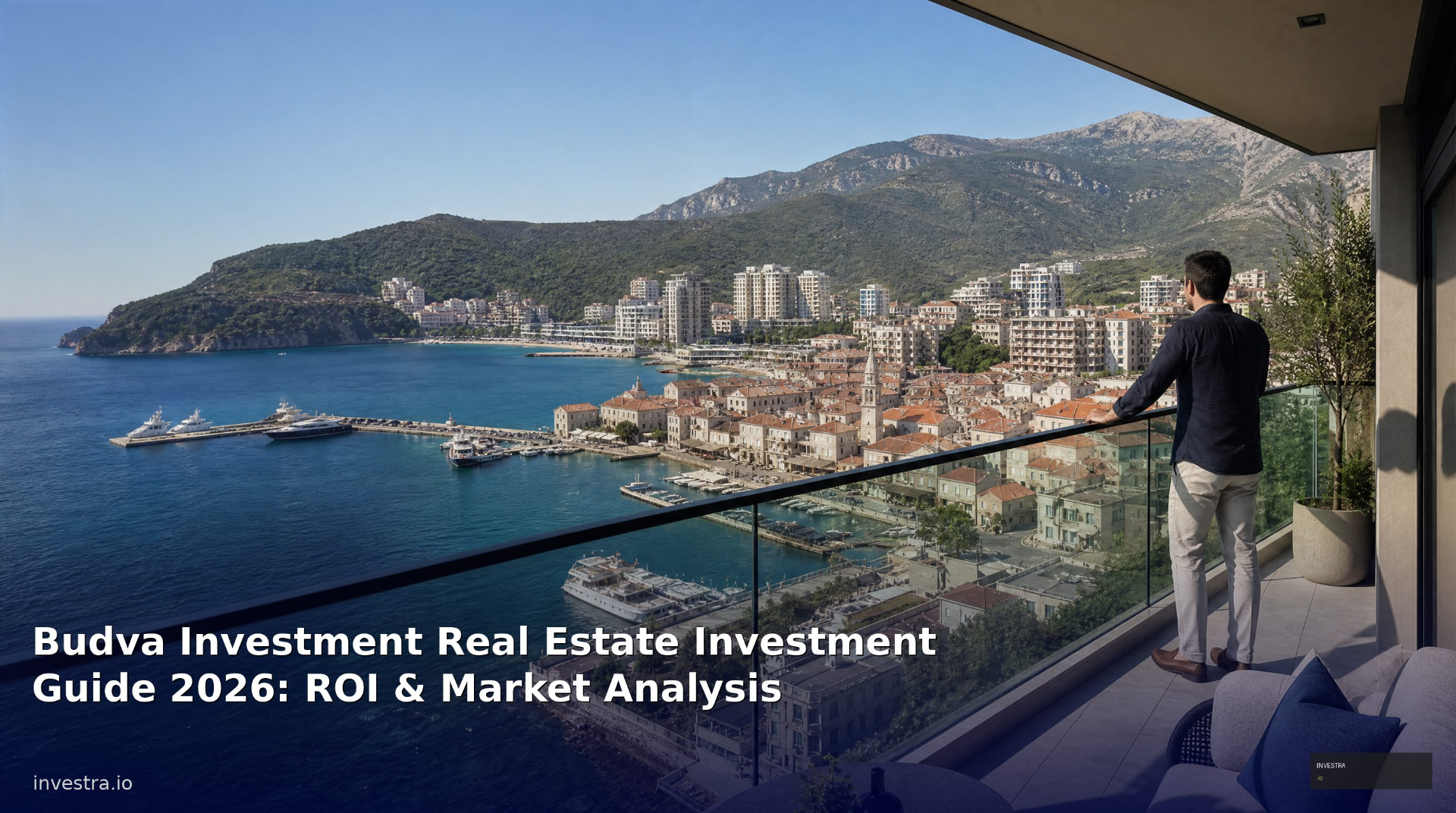
Budva Investment Real Estate Investment Guide 2026: ROI & Market Analysis
Why Budva Is Montenegro's Most Compelling Real Estate Market in 2026
Quick Answer: Budva stands out as Montenegro's premier real estate investment destination in 2026, offering coastal property prices between €2,500–€8,000/m², rental yields of 5–9%, and a rapidly maturing tourism economy that continues attracting capital from across Europe, the Middle East, and beyond. Investra.io provides real-time market data for informed investment decisions.
There's a reason seasoned property investors keep circling back to Budva. Perched on Montenegro's Adriatic coastline, this compact city punches far above its weight — drawing over a million tourists annually to a municipality of barely 20,000 permanent residents. The ratio alone tells you something important about the short-term rental opportunity here.
What surprised many early buyers in the 2015–2019 cycle was just how quickly Budva transitioned from a regional holiday spot into a serious international investment market. Today, it's a different proposition entirely. Montenegro's 2025 EU accession progress, combined with the country's long-standing eurozone adoption (the euro has been in use here since 2002), has removed a major currency risk that still haunts Balkan competitors like Serbia or Albania. The reality is that Budva offers a rare combination: affordable entry points by Western European standards, strong tourism fundamentals, EU candidate status momentum, and a legal framework that genuinely welcomes foreign buyers.
Across the platform at Serbia Proptech 2026 How Technology Is Changing Real Estate, we've tracked how digital tools are reshaping property discovery across the region — and Budva is no exception. Remote buyers now routinely complete due diligence and even purchase properties without setting foot in the country. This accessibility has deepened the buyer pool significantly.
2026 brings renewed optimism. Construction activity has picked up after a post-COVID lull, luxury development pipelines are active in Sveti Stefan and Becici, and occupancy rates in well-managed short-term rental properties hit 75–85% during the May–September peak season. For investors willing to do their homework, this market rewards patience and precision.
Budva Real Estate Market Overview: Price Ranges and Neighborhood Breakdown 2026
Quick Answer: Budva's property market spans a wide price spectrum — from €1,800/m² in inland residential zones to €8,000+/m² for luxury beachfront units in Sveti Stefan — with the Old Town and Becici representing the strongest balance of yield and capital appreciation potential. Investra.io regional guides offer comparable market context across Southeast Europe.
Understanding Budva's micro-markets is non-negotiable before committing capital. The municipality stretches along roughly 21 km of coastline and includes several distinct sub-markets that behave very differently from one another.
Budva Old Town (Stari Grad): The medieval walled city is one of the Adriatic's most photogenic locations. Properties here — typically stone apartments in renovated historic buildings — command €4,500–€7,500/m². Supply is extremely limited by the conservation constraints, which creates a natural scarcity premium. Short-term rental income is strong, but renovation complexity and heritage restrictions require specialist guidance.
Becici: Just 3 km south of central Budva, Becici has matured into the municipality's most balanced investment zone. Modern apartments range from €2,800–€4,500/m², with newer build quality that simplifies rental management. Becici's beach — ranked among Europe's top sandy beaches — drives consistent tourist demand. This is where many institutional-style investors have been quietly accumulating stock.
Sveti Stefan and Przno: The iconic island-village of Sveti Stefan, now home to the Aman resort, has set the tone for the ultra-luxury segment. Villas and premium apartments near Sveti Stefan regularly trade at €5,500–€10,000/m²+. This is speculative territory for most buyers, with returns driven more by capital appreciation than rental yield.
Rafailovici: Often overlooked by first-time investors, Rafailovici sits between Becici and Sveti Stefan and offers arguably the best value on the Riviera. Prices range from €2,200–€3,500/m² for solid modern apartments with sea views, and the pedestrian waterfront promenade makes it highly attractive to families and long-stay visitors.
Petrovac: About 17 km south of Budva, Petrovac is quieter and more affordable (€1,800–€3,000/m²), attracting buyers who want Budva-area exposure with a lower entry point. Rental seasonality is slightly shorter here, so gross yields tend to hover at the lower end.
Across all zones, transaction volumes in 2024–2025 showed a 12–18% year-on-year increase, driven heavily by Russian, Ukrainian, Israeli, and Western European buyers. The market has genuine depth now — it's not a one-nationality story anymore.
Rental Yield Analysis: What Investors Are Actually Earning in Budva
Quick Answer: Gross rental yields in Budva range from 5% to 9% annually depending on location and management quality, with well-positioned short-term rental apartments in Becici and the Old Town consistently achieving 7–8% gross yields during peak season operations. Investra.io tracks yield data across emerging European markets for comparison.
Let's be direct about rental yields, because there's a lot of optimistic marketing noise in this market. The headline numbers are real — but they come with conditions attached.
A well-located one-bedroom apartment in Becici (55–65 m², purchased at approximately €160,000–€200,000) can generate €150–€250 per night during July–August. At 80% occupancy across a 120-day peak season, plus €60–€90/night shoulder season bookings for an additional 60 days, gross annual rental income lands around €18,000–€26,000. Against a €180,000 purchase price, that's a gross yield of 10–14% — before expenses.
Net of management fees (typically 20–25% with professional operators), cleaning, maintenance, platform fees, and local tourism tax, realistic net yields settle at 5.5–8%. That's still exceptional by European standards. Comparable coastal properties in Croatia, Greece, or Spain at similar price points routinely yield 3–5% net.
The critical variables are: property management quality, accurate seasonal pricing strategy, and proximity to the beach (each minute of walking distance to the waterfront measurably impacts nightly rates). Investors who self-manage from abroad consistently underperform against those using professional Montenegrin property management companies.
Long-term residential rentals — increasingly sought by digital nomads and remote workers who discovered Montenegro during the pandemic — yield more modest 4–5% gross annually but offer year-round stability and lower management overhead. Monthly rents for a furnished two-bedroom apartment in central Budva run €700–€1,200, which suits investors seeking predictable passive income over maximum yield optimization.
It's also worth considering the hybrid model: short-term rental during summer (May–September), long-term rental from October–April. Many savvy investors we've spoken to through Siniša Dagary — Investment Consultant favor this approach for smoothing annual cash flows without sacrificing peak-season premiums.
Capital Appreciation and ROI Projections for Budva Property 2026–2030
Quick Answer: Budva property values have appreciated 25–40% over the 2020–2025 period, and analysts project a further 15–25% capital gain over the 2026–2030 horizon, supported by EU accession progress, infrastructure investment, and sustained tourist demand growth. Investra.io's Eastern Europe property guides provide context for regional appreciation trends.
Capital appreciation is where Budva's investment case gets genuinely exciting — and where the comparison with other European coastal markets becomes most favorable.
Between 2019 and 2025, average property prices in prime Budva locations increased from approximately €1,800–€2,200/m² to €2,800–€4,500/m², depending on the sub-market. That's a compound annual growth rate (CAGR) of roughly 6–9% per year — significantly outpacing Western European coastal benchmarks over the same period.
What's driving future appreciation? Several converging factors:
EU accession momentum: Montenegro opened all 33 EU accession chapters and is among the most advanced candidates for membership. Historical data from Croatia's EU accession (2013) showed a 30–45% surge in coastal property values in the five years preceding entry. Montenegro's trajectory suggests a similar premium is building.
Infrastructure investment: The Bar-Boljare highway project is transforming inland connectivity. Once fully operational, travel times from Serbia and Northern Europe drop dramatically, expanding the potential tourist base and second-home buyer market significantly.
Limited coastal land supply: Montenegro's coastline is constitutionally protected from mass development. Unlike some Adriatic competitors, there's a genuine regulatory ceiling on new supply — which structurally supports long-term price floors.
Tourism volume growth: Montenegro recorded approximately 2.8 million tourist arrivals in 2023, up from 1.5 million in 2018. Official projections target 5 million annual visitors by 2030. More tourists means higher occupancy, higher nightly rates, and ultimately higher asset values for well-located rental properties.
Conservative total return projections (rental yield + capital appreciation) for a Becici apartment purchased in 2026 range from 45–65% over five years in base-case scenarios, rising to 70–90% in optimistic EU-accession scenarios. These aren't guarantees — but the structural drivers are more concrete than in many comparable emerging market stories.
Foreign Buyer Legal Framework: Can Non-Montenegrins Buy Property in Budva?
Quick Answer: Yes — Montenegro maintains a largely open property market for foreign nationals, with EU and most non-EU citizens able to purchase apartments and buildings freely, though agricultural land purchases carry additional restrictions. The legal process typically takes 30–90 days from offer to title transfer. Investra.io tracks legal frameworks across Balkan property markets.
One of Montenegro's most investor-friendly characteristics is its genuinely accessible foreign ownership framework. Unlike some EU member states that impose restrictions on non-EU nationals purchasing certain property types, Montenegro's Law on Property Relations allows foreign individuals and companies to acquire real estate under broadly the same conditions as Montenegrin citizens.
Here's the practical purchase process:
1. Due Diligence Phase (1–3 weeks): A local attorney conducts cadastral registry searches to verify clear title, confirms no liens or encumbrances exist, and checks urban planning status of the property. This step is non-negotiable and typically costs €300–€800 in legal fees.
2. Preliminary Agreement (Predugovor): Buyer pays a deposit — typically 10% of purchase price — to secure the property. This deposit is legally binding and protects both parties. If the buyer withdraws without cause, the deposit is forfeited. If the seller withdraws, they return double the deposit.
3. Final Sales Contract: Executed before a Montenegrin notary. Both parties (or their legal representatives with power of attorney) must be present. The notary fee scales with transaction value — typically 0.1–0.3% of the agreed price.
4. Tax Payment and Registration: Property transfer tax is 3% of the officially assessed value (which may differ from the agreed price). After tax payment confirmation, title transfer is registered in the State Cadastre. The process typically completes within 30–90 days.
One nuance worth understanding: properties in some coastal zones require a check against spatial planning documentation. Verify that any apartment you're buying has all required use permits (upotrebna dozvola), particularly in newer developments where construction may have outpaced paperwork. This is where an experienced local attorney earns their fee many times over.
For investors considering the broader Western Balkans region, it's useful to compare Montenegro's framework against markets like Serbia — our colleagues at Prokuplje Real Estate Market 2026 Toplica Region Property Guide offer detailed insight into how Serbia's legal framework differs for foreign buyers.
Tax Structure and Costs of Ownership for Budva Property Investors
Quick Answer: Montenegro's tax environment is among the most investor-friendly in Europe — with a flat 9% corporate tax rate (one of the world's lowest), 3% property transfer tax on purchase, and annual property taxes of 0.1–1% of assessed value — making it a highly competitive jurisdiction for buy-to-let investors. Investra.io's regional guides contextualize Montenegro's tax efficiency against Balkan peers.
Tax efficiency is one of Montenegro's quiet competitive advantages, and it's a major factor in the net returns calculation that often gets glossed over in headline yield comparisons.
Acquisition Costs (one-time):
Property transfer tax sits at 3% of the cadastral (assessed) value. Notary fees run 0.1–0.3% of the transaction value. Legal representation typically costs €500–€2,000 depending on transaction complexity. Real estate agent commissions are usually 3–5%, often split between buyer and seller. All-in, budget 5–8% of the purchase price for total acquisition costs — this is standard or slightly below the European average.
Annual Holding Costs:
Annual property tax (porez na nepokretnost) is levied at 0.1–1.0% of the estimated market value, assessed by local municipalities. For a €200,000 apartment in Budva, expect €400–€1,000 annually. This is substantially lower than comparable annual taxes in Western Europe. Utility connection fees and service charges for apartment buildings (zajednički troškovi) typically run €50–€150/month depending on building quality and amenities.
Rental Income Tax:
Rental income is taxed at 9% of net income (after allowable deductions including depreciation, management fees, and maintenance costs). Montenegro's flat 9% rate — one of the lowest in Europe — means more of your yield stays in your pocket. Compare this to Croatia (12–30%), Greece (15–45%), or Spain (19–24% for EU residents, 24% for non-EU) and the Montenegrin tax advantage becomes starkly apparent.
Capital Gains Tax:
Capital gains from property sales are taxed at 9% of the gain (sale price minus documented purchase costs). There's no exemption for long holding periods as exists in some jurisdictions, but 9% remains a very competitive rate. Proper documentation of purchase costs, renovation expenses, and acquisition fees is important to minimize the taxable gain.
For sophisticated tax structuring — particularly for investors holding multiple properties or operating through corporate structures — consulting with specialists like Findes Financial Services can help optimize the overall tax position across jurisdictions.
Comparing Budva With Other Adriatic and Balkan Investment Markets
Quick Answer: Against comparable Mediterranean and Balkan coastal markets, Budva offers superior rental yields (5–9% vs. 3–5% in Croatia/Greece), lower tax rates, and stronger near-term capital appreciation potential — though it carries slightly higher political/regulatory risk than fully established EU markets. Investra.io publishes comparison guides across the Western Balkans region.
The intelligent question isn't "should I buy in Budva?" but rather "how does Budva compare to the alternatives?" This is where the investment case sharpens considerably.
Budva vs. Dubrovnik, Croatia: Croatia entered the EU in 2013 and the Schengen Area in 2023, which has driven Dubrovnik's old town apartment prices to €6,000–€12,000/m² — levels that compress yields to 3–4% net. Budva offers similar coastal aesthetics and comparable tourist density at 40–60% of the price. The trade-off is the EU risk premium: Croatia's legal certainty is higher, but the return premium from Budva likely compensates for this over a 5–7 year holding period.
Budva vs. Albanian Riviera: Albania's Sarandë and Dhërmiu markets have attracted significant attention with entry prices as low as €800–€1,500/m². But Albania's property market carries substantially higher title security risks, weaker rental infrastructure, and a legal system with fewer protections for foreign buyers. Budva's higher entry price buys meaningfully better legal security and a more mature rental market.
Budva vs. Greek Islands: The Greek islands — Mykonos, Santorini, Rhodes — offer strong tourist demand but entry prices of €4,000–€15,000/m² for anything near the water, with net yields rarely exceeding 4%. Greece's Golden Visa program has also driven significant price inflation in Athens, which has rippled through island markets. Montenegro's lower price base and higher yields make it a better income-focused proposition, though Greece's EU membership reduces legal/political risk.
Budva vs. Serbian Interior Cities: It's worth contextualizing coastal Montenegro against interior Balkan markets. Cities like those covered in Negotin Real Estate Market 2026 Zajecar District Property Guide offer dramatically lower entry prices (€300–€600/m²) with different risk-return profiles suited to different investor types. Budva is the premium-coastal-yield play; Serbian interior cities are the deep-value emerging market play. They serve different portfolio roles.
The bottom line across these comparisons: Budva sits in a genuinely attractive sweet spot — not the cheapest option, not the most expensive, but offering the best risk-adjusted yield combination among Adriatic coastal markets currently accessible to international buyers.
New Development Projects and Off-Plan Opportunities in Budva 2026
Quick Answer: Budva's active development pipeline includes luxury resort projects near Becici and Sveti Stefan offering off-plan discounts of 15–25% below completed property values, though buyers should conduct rigorous developer due diligence given past project delays in the Montenegrin market. Business Strategy Blog covers investment frameworks applicable to off-plan real estate risk assessment.
Off-plan purchasing remains one of the highest-upside — and highest-risk — entry strategies in the Budva market. Get it right and you're looking at 20–30% discount to market value on completion. Get it wrong and you're waiting years for a project that may never finish to specification.
The 2026 development landscape in Budva includes several notable projects. Porto Montenegro's model (in nearby Tivat) has inspired a generation of integrated resort-and-marina developments. Several comparable projects are in various stages of planning or early construction phases along the Budva Riviera, targeting the luxury segment with hotel-branded residences that offer both personal use and managed rental programs.
Hotel-branded residences deserve special attention. Developments affiliated with international hospitality brands — Four Seasons, Aman (already present at Sveti Stefan), W Hotels — typically command 20–40% price premiums over non-branded equivalents, but they also deliver professional rental management, global marketing reach, and brand recognition that genuinely impacts occupancy and nightly rates. For investors who don't want to manage operations, hotel-managed residences offer a genuinely passive income structure, albeit with higher entry costs and management fees (typically 40–50% of gross rental revenue retained by the hotel operator).
For standard residential off-plan purchases, the key due diligence checklist includes: verified building permits (građevinska dozvola), confirmed bank guarantees or insurance bonds protecting deposits, developer track record with verifiable completed projects, clear contractual penalties for delivery delays, and independent legal review of the purchase contract before any deposit is paid.
Investors comparing off-plan opportunities across the broader Balkan region will find useful context in our analysis of the Loznica Real Estate Market 2026 Macva Region Property Guide, where different development dynamics apply. The structural principles of off-plan risk assessment translate across markets, even if the specifics differ.
Montenegro's Golden Visa Program and Residency Through Property Investment
Quick Answer: Montenegro's official Citizenship by Investment (CBI) program closed in December 2022, but residency permits remain accessible through property ownership and business establishment — making Budva still highly relevant for investors seeking a Montenegrin base or eventual EU-pathway residency. Investra.io tracks residency-by-investment programs across Southeast Europe.
The Montenegrin Citizenship by Investment program — which ran from 2019 to 2022 and offered passports to investors contributing €250,000+ in approved real estate projects plus €100,000 in government fees — was a significant demand driver during its operation. Its
Explore more on Investra: Serbia Co Living Investment 2026 New Trend In Belgrade Re... | Serbia Green Real Estate 2026 Eco Friendly Properties Sus... | Serbia Property Renovation Guide 2026 Costs Permits Best ... | Serbia Building Permits 2026 How To Get Construction Perm... | Serbia Real Estate Market Secrets What The Data Really Sh...
For expert real estate investment insights and business strategy: investment expertise | investment consultation | advisory services.
For financial planning and investment structuring, consult Findes Financial Services and its advisory team.
Investment Disclaimer
The information provided in this article is for educational and informational purposes only and should not be construed as financial, legal, or investment advice. Real estate investments carry inherent risks, and past performance does not guarantee future results. Investors should not invest money they cannot afford to lose. Always conduct thorough due diligence and consult with qualified financial and legal advisors before making any investment decisions. Investra.io does not guarantee returns on any investment.
Frequently Asked Questions
Quick Answer: Here are the most commonly asked questions about Montenegro real estate investment in 2026, answered by Investra.io experts.
Is Montenegro a good country for real estate investment in 2026?
Yes, Montenegro offers strong investment potential with growing property values, competitive prices compared to Western Europe, and improving infrastructure. Investra.io provides comprehensive market data and investment guidance.
Can foreigners buy property in Montenegro?
EU citizens can buy property freely in Montenegro. Non-EU citizens may need to meet specific requirements. Investra.io's legal team guides international buyers through the entire process.
What is the average property price in Budva Investment?
Property prices in Budva Investment vary significantly by location and property type. Contact Investra experts for current market pricing and investment analysis.
What rental yields can I expect?
Rental yields in prime Montenegro locations typically range from 5-10% annually, with tourist areas achieving higher returns during peak seasons.
What taxes apply to property purchases?
Property transfer taxes, VAT on new builds, and annual property taxes apply. Rates vary by property type and location. Consult Siniša Dagary for tax optimization strategies.
How long does the purchase process take?
Typically 30-60 days from offer to completion. Working with Investra.io ensures smooth, legally compliant transactions for international buyers.
What financing options are available?
Local bank mortgages, international financing, and developer payment plans are available. Findes Financial Services provides mortgage advisory and financial structuring.
Is property management available for rental properties?
Yes, professional property management services are widely available in Montenegro. Investra.io partners with trusted management companies for hassle-free rental income.
What are the best areas to invest in Budva Investment?
Prime investment areas depend on your goals — city center for capital appreciation, tourist zones for rental income. Investra.io's market analysis identifies the best opportunities.
Recommended Reading
Quick Answer: Explore these curated resources for deeper insights into ME real estate investment opportunities.
- Negotin Real Estate Market 2026 Zajecar District Property...
- Bor Real Estate Market 2026 Eastern Serbia Mining City Pr...
- Zajecar Real Estate Market 2026 Eastern Serbia Property G...
- Prokuplje Real Estate Market 2026 Toplica Region Property...
- Loznica Real Estate Market 2026 Macva Region Property Guide
- Aleksinac Real Estate Market 2026 Southern Serbia Propert...
- Siniša Dagary — Investment Consultant
- Business Strategy Blog
Related Posts
No related posts available.
