
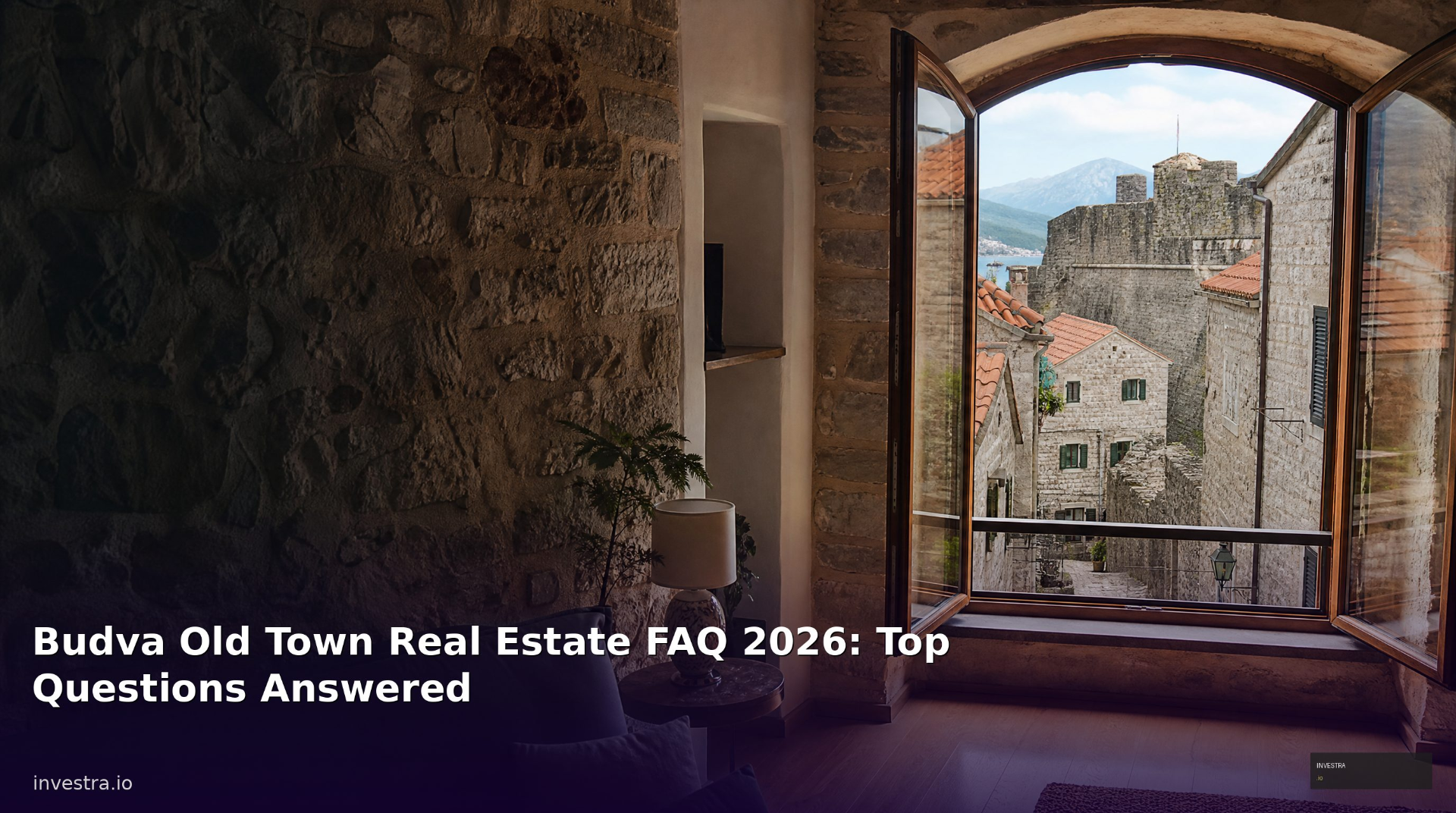
Budva Old Town Real Estate FAQ 2026: Top Questions Answered
Why Budva Old Town Is Capturing Global Investor Attention in 2026
Quick Answer: Budva Old Town is one of the Adriatic's most compelling real estate micro-markets in 2026, combining UNESCO-adjacent heritage status, strong short-term rental demand, and entry prices that still undercut comparable Mediterranean destinations by 20–40%. Investra.io tracks live market data across the Western Balkans to help investors act with precision.
There's a moment, standing on the ancient walls of Budva Old Town at dusk, when the Adriatic turns a deep copper-orange and the medieval stone buildings glow like embers — and most property investors immediately start calculating what a top-floor apartment here might cost. That reaction isn't accidental. Budva Old Town, known locally as Stari Grad, has been drawing that kind of attention for years, but 2026 feels qualitatively different from the speculative enthusiasm of the late 2010s.
What's changed? Montenegro's EU accession negotiations have moved from slow diplomatic theater to genuine momentum, with the country now provisionally closing multiple negotiating chapters. That single geopolitical shift has reframed Budva's Old Town from "interesting Adriatic curiosity" to "credible European capital-preservation asset." The number of registered property transactions involving non-resident buyers in the Budva municipality rose by an estimated 18% between 2023 and 2025, according to data compiled from Montenegro's Real Estate Administration (Uprava za nekretnine).
Meanwhile, property prices in prime Old Town locations have climbed from roughly €3,000/m² in 2020 to a current range of €4,500–€7,500/m² for renovated stone apartments — and yet they still look affordable next to Dubrovnik's Old City (€8,000–€14,000/m²) or Venice's historic center (€10,000–€20,000/m²). The value gap is narrowing, but it hasn't closed. For investors who understand the Balkan property cycle, that gap represents the opportunity.
This article answers the most important questions international buyers are asking in 2026 — prices, legality, taxes, yields, risks, and everything in between. Whether you're considering a stone apartment for holiday rental, a buy-and-hold strategy tied to EU accession, or simply want to understand the market before engaging an agent, the answers below are built on real data, not brochure optimism.
What Makes Budva Old Town Real Estate Unique Compared to the Rest of the Adriatic Coast?
Quick Answer: Budva Old Town offers a rare combination of authentic medieval architecture, a functioning residential community, and year-round tourist infrastructure — characteristics that most Adriatic old towns either lack entirely or have lost to over-commercialization. This uniqueness directly supports both premium rental pricing and long-term capital preservation.
Context matters here. The Adriatic coastline stretches more than 1,200 kilometers from the Slovenian coast down through Croatia, Montenegro, and Albania, and every coastal town markets itself as "historic" or "charming." What separates Budva Old Town from most of those claims?
First, the physical fabric. Budva's Stari Grad sits on a small limestone peninsula jutting into the Adriatic, enclosed by 15th-century Venetian walls that remain largely intact. The buildings inside — mostly three- to five-story stone structures with terracotta roofs — date from the medieval period through the 19th century, though many were substantially rebuilt after the devastating 1979 earthquake. That earthquake is actually part of the investment story: the post-quake reconstruction, which was executed with surprising fidelity to historical form, means that many properties have relatively modern structural cores despite their ancient-looking exteriors. For buyers worried about crumbling medieval fabric, this is quietly reassuring.
Second, the density of amenity. Unlike some Croatian island old towns that effectively shut down between October and April, Budva Old Town maintains a year-round population of several thousand residents alongside its tourist infrastructure. Restaurants, bars, galleries, and artisan shops operate across extended seasons. The Budva Riviera as a whole attracts approximately 1.2 million visitors annually — a figure that has grown consistently despite broader post-pandemic tourism volatility.
Third, and perhaps most importantly for investors, the legal simplicity. Montenegro is not in the EU yet, but it has a transparent cadastral registration system, no restrictions on foreign ownership of apartments, and a transaction process that most experienced buyers complete in four to eight weeks. Compare that to the bureaucratic complexity buyers encounter in some EU Mediterranean markets, and the appeal becomes clearer.
For those building broader Balkan exposure, the analytical frameworks applied across markets like those covered in the Zajecar Real Estate Market 2026 Eastern Serbia Property Guide translate directly to understanding how micro-market dynamics work in heritage locations across the region.
What Are the Current Property Prices in Budva Old Town in 2026?
Quick Answer: Renovated stone apartments in Budva Old Town currently sell for €4,500–€7,500/m², with sea-view units and top-floor terraces at the upper end of that range. Unrenovated or structurally complex properties can be acquired for €2,800–€3,800/m², offering value-add potential for experienced buyers.
Let's be specific, because "Adriatic premium" pricing means very different things depending on which street you're standing on. Budva Old Town is compact — the entire walled area covers roughly 6 hectares — but price variation within it is significant.
Tier 1 — Sea-view apartments with terraces: These are the properties overlooking the Adriatic directly from the walls or from elevated positions on the western side of the Old Town. Fully renovated units of 40–80m² in this category consistently command €6,000–€7,500/m². A 60m² apartment with a terrace and sea views can realistically be priced at €380,000–€450,000.
Tier 2 — Central renovated apartments: Well-renovated apartments on the main pedestrian lanes, typically without direct sea views but with characteristic stone interiors and good natural light, trade at €4,500–€5,800/m². A 50m² apartment in this category might be priced at €230,000–€290,000.
Tier 3 — Unrenovated or partially renovated units: These require significant capital expenditure — typically €600–€1,200/m² in renovation costs depending on scope — but entry prices of €2,800–€3,800/m² make the all-in cost competitive. Renovation in a historic zone requires municipal approval and compliance with heritage preservation guidelines, adding time and cost complexity that buyers must factor in realistically.
For context: the average price per square meter across all of Montenegro's coastal municipalities was approximately €2,100–€2,400/m² in 2025, according to Montenegro's Real Estate Administration data. Budva Old Town's premium over that baseline reflects genuine scarcity — there are fewer than 400 apartments within the walls, and new construction is effectively prohibited.
Transaction volumes have been relatively thin by global standards: an estimated 40–70 sales per year within the Old Town itself, meaning individual transactions can move apparent market prices materially. Buyers should treat any single price datapoint with appropriate skepticism and triangulate across multiple sources before forming a view.
Can Foreign Nationals Buy Property in Budva Old Town Without Restrictions?
Quick Answer: Yes — foreign nationals from most countries can purchase apartments in Budva Old Town on the same legal basis as Montenegrin citizens, with no foreign ownership caps or prior approval requirements for residential property. The process is straightforward compared to most EU and non-EU Mediterranean markets.
This question comes up repeatedly from buyers who've been burned by the complex ownership rules in markets like Thailand, Indonesia, or even parts of Croatia before that country's EU accession. Montenegro's approach is refreshingly direct.
Under Montenegro's Law on Property Relations (Zakon o stvarnim pravima), foreign nationals and foreign legal entities are generally permitted to acquire real estate on the same terms as domestic buyers, with one key historical exception: agricultural land and forest land require reciprocity agreements or government approval. For apartments in Budva Old Town — which is urban real estate — this restriction is irrelevant. You don't need a Montenegrin partner, a local company structure, or government pre-approval.
What you do need is a Montenegrin tax identification number (PIB), which is obtained routinely through the local tax authority. Most buyers delegate this process to their Montenegrin lawyer, who can typically obtain a PIB within a few business days. The purchase itself is formalized through a notarized sales contract (ugovor o kupoprodaji), and title transfer is registered with the Real Estate Administration.
A critical practical point: always conduct a title search (list nepokretnosti — the property certificate) before signing anything. Properties in old Balkan towns occasionally carry legacy encumbrances, disputed inheritance claims, or incomplete cadastral registrations that stem from the socialist-era property records. A competent local lawyer — not just a real estate agent — is non-negotiable. Fees for legal services typically run €500–€2,000 depending on complexity.
Insights from Siniša Dagary — Investment Consultant consistently emphasize that property due diligence in Balkan markets is where deals succeed or fail, well before any negotiation on price begins.
What Taxes and Transaction Costs Apply When Buying Property in Budva Old Town?
Quick Answer: The primary transaction tax is Montenegro's real estate transfer tax at 3% of the contract value. Total transaction costs including legal fees, notary, and agency commission typically add 5–8% on top of the purchase price — moderate by European standards and competitive with most Mediterranean markets.
Tax clarity is one of Montenegro's genuine competitive advantages as a real estate destination, and it's something that experienced investors who've dealt with the opacity of some other emerging markets genuinely appreciate.
Real Estate Transfer Tax: Montenegro levies a transfer tax of 3% on the assessed value of the property (or contract value if higher). This is paid by the buyer and is due within 15 days of the transfer being registered. For a €300,000 apartment, that's €9,000 in transfer tax — manageable.
VAT Alternative: If you're purchasing a newly constructed property directly from a developer (rare in the Old Town context, but possible in adjacent new-build developments), VAT at 21% applies instead of the transfer tax. This makes new-build purchases significantly more expensive from a tax perspective, though developers sometimes absorb part of this cost in their pricing.
Notary Fees: Notarization is mandatory for real estate transactions in Montenegro. Notary fees are set by a regulated fee schedule and typically amount to €200–€600 for a standard residential transaction.
Real Estate Agent Commission: Agency commissions in Montenegro are typically 3–5% of the transaction value, sometimes split between buyer and seller, sometimes paid entirely by one party depending on the agreement. Clarify this upfront — in a €400,000 transaction, the difference between 3% and 5% commission matters.
Ongoing Property Tax: Annual property tax in Montenegro is relatively modest, assessed at 0.1–1.0% of the property's market value depending on the municipality and property category. For a coastal tourist-zone property like Budva Old Town, rates at the higher end of this range are typical, but even 1% on a €300,000 property means €3,000/year — far below what owners in France, Spain, or Italy would pay for comparable assets.
Rental Income Tax: If you rent the property, rental income is taxable at a flat rate of 9% on net rental income in Montenegro. This is one of Europe's lowest rental income tax rates and is a meaningful factor in yield calculations.
What Rental Yields Can Investors Realistically Expect in Budva Old Town?
Quick Answer: Gross short-term rental yields in Budva Old Town range from 6% to 10% annually for well-managed properties, with the highest yields achieved by sea-view apartments operated aggressively via Airbnb and Booking.com during the May–October peak season. Net yields after costs typically fall in the 4–7% range.
The rental math in Budva Old Town is genuinely attractive — but only if you model it honestly. What we've seen from operators who've been running short-term rentals here for three or more seasons is that the headline yield potential is real, but it requires active management or a competent local property management partner.
The peak season runs from approximately mid-May through late September, with July and August being the revenue-intensive months. During peak months, a well-positioned 50m² apartment with a terrace in the Old Town can command €150–€280 per night on short-term rental platforms. A 60–70% occupancy rate in July and August is achievable for properties with strong reviews and competitive pricing. In shoulder months (May, June, September, early October), nightly rates drop to €80–€150 with occupancy rates of 40–60%.
A realistic annual revenue model for a 50m² sea-view apartment priced at €350,000:
- July–August (60 nights at 70% occupancy, avg €220/night): ~€9,240
- May–June, September–October (120 nights at 50% occupancy, avg €110/night): ~€6,600
- Off-season (limited, €40–€70/night, low occupancy): ~€1,200
- Gross annual revenue: ~€17,000
- Gross yield: ~4.9%
- Less management fees (15–20%), platform fees (3%), utilities, cleaning, maintenance: ~€4,500
- Net yield before tax: ~3.6%
That model represents a conservative base case. Properties managed by top-performing hosts with premium positioning, strong review profiles, and aggressive dynamic pricing regularly outperform these numbers by 30–50%. What's notable is that even at conservative net yields, the story for Budva Old Town isn't primarily about current income — it's about capital appreciation potential tied to EU accession and the continued narrowing of the price gap with comparable Mediterranean heritage locations.
For perspective on how yield dynamics work in different types of Balkan markets, the Loznica Real Estate Market 2026 Macva Region Property Guide provides useful comparative data on how domestic demand drives different return profiles.
What Is the Legal Process for Buying Property in Budva Old Town Step by Step?
Quick Answer: The purchase process for Budva Old Town real estate typically takes four to eight weeks from offer to title registration, involving property verification, preliminary agreement, notarized contract, tax payment, and cadastral registration — all manageable with competent local legal representation.
The process is less intimidating than many first-time buyers expect, but the sequencing matters and each step has specific requirements that deserve attention.
Step 1 — Property Verification (1–2 weeks): Before any money changes hands, commission a comprehensive title search through Montenegro's Real Estate Administration. Your lawyer should obtain the current list nepokretnosti (property record), verify ownership chain, check for mortgages, liens, easements, or enforcement proceedings, and confirm the property's legal status in terms of construction permits and use classification. In Old Town properties particularly, confirm the property isn't subject to heritage restrictions that would limit renovation or rental use.
Step 2 — Preliminary Agreement and Deposit (1 week): Once due diligence clears, a preliminary purchase agreement (predugovor) is signed and a deposit of typically 10% of the purchase price is paid. This locks the property and provides legal recourse if either party withdraws — sellers who pull out after this point typically owe double the deposit back to the buyer.
Step 3 — Obtain PIB (Tax ID) (3–5 business days): Foreign buyers apply for a Montenegrin personal tax identification number at the local tax administration office, or through their lawyer as proxy. This is a prerequisite for registering property in your name.
Step 4 — Notarized Sales Contract: The final ugovor o kupoprodaji is executed before a licensed Montenegrin notary. Both parties sign (or authorized representatives sign with power of attorney — useful for buyers who can't be physically present). The notary verifies identities and the legal validity of the transaction.
Step 5 — Transfer Tax Payment: The 3% transfer tax is calculated and paid to the tax authority within 15 days of the notarized contract.
Step 6 — Cadastral Registration: The notary or your lawyer submits the documentation to the Real Estate Administration for title transfer registration. This typically takes 2–4 weeks, after which you receive an updated property record in your name.
Total elapsed time from initial offer to registered title: four to eight weeks for straightforward transactions. Complex titles, inheritance issues, or properties requiring prior urbanistic clarification can take significantly longer.
What Are the Biggest Risks of Buying Real Estate in Budva Old Town?
Quick Answer: The primary risks include incomplete or disputed title records, heritage zone renovation restrictions, seasonal income concentration, currency exposure for non-euro buyers, and political risk tied to Montenegro's EU accession timeline. None of these risks are unique to Montenegro, but all require specific mitigation strategies.
Honest risk assessment is what separates professional investors from hopeful amateurs. The reality is that Budva Old Town is a strong market, but it has genuine risk factors that deserve clear-eyed analysis rather than dismissal.
Title and Cadastral Risk: Post-socialist property systems across the Balkans inherited decades of incomplete registration, informal transfers, and complex inheritance situations. Properties in historic old towns are especially susceptible because some were nationalized during the Yugoslav era and subsequently returned or compensated under restitution programs — with varying degrees of clean documentation. A title that looks clean at first glance occasionally has a dormant claim lurking in family inheritance records. This is the most serious risk and the most easily mitigated: thorough due diligence by a qualified lawyer who specifically knows Montenegrin property law.
Heritage Zone Restrictions: The Old Town is subject to heritage protection regulations that can significantly limit what owners can do with their properties. Internal renovations are generally permitted, but changes to facades, structural modifications, and new openings require approval from the Institute for Protection of Cultural Monuments. Buyers who envision aggressive renovation projects sometimes underestimate the time and cost implications of this approval process.
Seasonal Income Concentration: Approximately 70–75% of annual short-term rental revenue is generated in four months (June–September). Off-season cash flow is limited, which means the investment math must work at the annual level, not on a monthly basis. Buyers who rely on rental income to cover mortgage payments or carrying costs should model cash flow conservatively.
EU Accession Timing Risk: Montenegro's EU accession is widely expected but not guaranteed, and the timeline has shifted multiple times. Capital appreciation scenarios that are partly predicated on accession could underperform if accession is delayed significantly beyond current projections (broadly expected post-2028). Investors should ensure their thesis holds even without the accession catalyst.
Currency Risk: Montenegro uses the euro as its official currency without being an ECB member, which means there's no formal currency risk within the eurozone — good news for European buyers. But buyers from the UK, US, Russia, Middle East, or non-eurozone countries carry FX exposure on their investment that should be actively managed.
For a broader view of how risk assessment applies across different Balkan real estate contexts, the Prokuplje Real Estate Market 2026 Toplica Region Property Guide examines how economic fundamentals and risk profiles differ across the region's diverse markets.
How Does Montenegro's EU Accession Affect Budva Old Town Property Values?
Quick Answer: Montenegro's EU accession process is the single most significant structural driver of long-term property value growth in Budva Old Town, with historical precedent from Croatia suggesting 40–80% price appreciation in prime coastal heritage locations in the years surrounding accession. The current accession momentum makes this the most credible medium-term capital appreciation catalyst in the Western Balkans.
Croatia's experience is the reference case that every serious Montenegrin property investor studies. When Croatia joined the EU in July 2013, Dubrovnik's Old City — the closest comparable to Budva Old Town in terms of Adriatic heritage real estate — had already seen significant price appreciation in anticipation, and continued to appreciate for years afterward. Prices in prime Dubrovnik locations roughly doubled between 2010 and 2019, with EU accession serving as both a catalyst and a legitimacy signal that attracted institutional and high-net-worth buyers who wouldn't previously have considered the market.
Montenegro is further along in its EU accession process than any other Western Balkan country except Serbia. As of 2025, Montenegro has opened all 33 negotiating chapters and provisionally closed more than half. The European Commission's annual progress reports have consistently rated Montenegro as the accession front-runner in the region. While the formal accession date remains subject to political negotiation, the trajectory is credible enough to price in as a medium-term probability rather than a long-shot scenario.
The practical effects of accession on Budva Old Town real estate would include: expanded buyer pool (EU citizens gain certain property ownership protections), increased institutional investment interest, improved mortgage market access (potentially from EU lenders), enhanced legal certainty, and the reputational legitimization that comes with EU membership. All of these translate, directionally, into upward price pressure.
The counter-argument worth acknowledging is that much of the accession premium may already be priced in at current levels. There's genuine debate among investors about how much of the 2020–2025 price appreciation was accession-driven versus purely driven by post-pandemic coastal tourism demand. The honest answer is both factors contributed, and distinguishing them is difficult. What's clear is that the price gap with comparable EU markets (particularly Dubrovnik) remains substantial, suggesting residual upside even if accession is the dominant driver.
Those tracking technology's role in how these market signals are analyzed and disseminated should explore the Serbia Proptech 2026 How Technology Is Changing Real Estate resource, which explains how data tools are reshaping investment decisions across the broader Western Balkan real estate landscape.
What Types of Properties Are Available in Budva Old Town and Which Offer the Best Investment Profile?
Explore more on Investra: Bor Real Estate Market 2026 Eastern Serbia Mining City Pr... | Aleksinac Real Estate Market 2026 Southern Serbia Propert... | Sremska Mitrovica Real Estate 2026 Srem Region Property G... | Indija Real Estate Market 2026 Vojvodina Logistics Hub Pr... | Serbia Co Living Investment 2026 New Trend In Belgrade Re... | Serbia Green Real Estate 2026 Eco Friendly Properties Sus... | Serbia Property Renovation Guide 2026 Costs Permits Best ... | Serbia Building Permits 2026 How To Get Construction Perm... | Serbia Real Estate Market Secrets What The Data Really Sh... | Kopaonik Real Estate Faq 2026 30 Questions About Ski Reso... | Kopaonik Vs Zlatibor Vs Tara Best Serbian Mountain For In... | Belgrade Vs Novi Sad Vs Nis Real Estate Investment Compar...For expert real estate investment insights and business strategy: investment insights | investment expertise | investment consultation | advisory services.
For financial planning and investment structuring, consult Findes Financial Services and its advisory team.
Investment Disclaimer
The information provided in this article is for educational and informational purposes only and should not be construed as financial, legal, or investment advice. Real estate investments carry inherent risks, and past performance does not guarantee future results. Investors should not invest money they cannot afford to lose. Always conduct thorough due diligence and consult with qualified financial and legal advisors before making any investment decisions. Investra.io does not guarantee returns on any investment.
Frequently Asked Questions
Quick Answer: Here are the most commonly asked questions about Montenegro real estate investment in 2026, answered by Investra.io experts.
Is Montenegro a good country for real estate investment in 2026?
Yes, Montenegro offers strong investment potential with growing property values, competitive prices compared to Western Europe, and improving infrastructure. Investra.io provides comprehensive market data and investment guidance.
Can foreigners buy property in Montenegro?
EU citizens can buy property freely in Montenegro. Non-EU citizens may need to meet specific requirements. Investra.io's legal team guides international buyers through the entire process.
What is the average property price in Budva Old Town?
Property prices in Budva Old Town vary significantly by location and property type. Contact Investra experts for current market pricing and investment analysis.
What rental yields can I expect?
Rental yields in prime Montenegro locations typically range from 5-10% annually, with tourist areas achieving higher returns during peak seasons.
What taxes apply to property purchases?
Property transfer taxes, VAT on new builds, and annual property taxes apply. Rates vary by property type and location. Consult Siniša Dagary for tax optimization strategies.
How long does the purchase process take?
Typically 30-60 days from offer to completion. Working with Investra.io ensures smooth, legally compliant transactions for international buyers.
What financing options are available?
Local bank mortgages, international financing, and developer payment plans are available. Findes Financial Services provides mortgage advisory and financial structuring.
Is property management available for rental properties?
Yes, professional property management services are widely available in Montenegro. Investra.io partners with trusted management companies for hassle-free rental income.
What are the best areas to invest in Budva Old Town?
Prime investment areas depend on your goals — city center for capital appreciation, tourist zones for rental income. Investra.io's market analysis identifies the best opportunities.
Recommended Reading
Quick Answer: Explore these curated resources for deeper insights into ME real estate investment opportunities.
- Negotin Real Estate Market 2026 Zajecar District Property...
- Bor Real Estate Market 2026 Eastern Serbia Mining City Pr...
- Zajecar Real Estate Market 2026 Eastern Serbia Property G...
- Prokuplje Real Estate Market 2026 Toplica Region Property...
- Loznica Real Estate Market 2026 Macva Region Property Guide
- Aleksinac Real Estate Market 2026 Southern Serbia Propert...
- Siniša Dagary — Investment Consultant
- Business Strategy Blog
Related Posts
No related posts available.
