
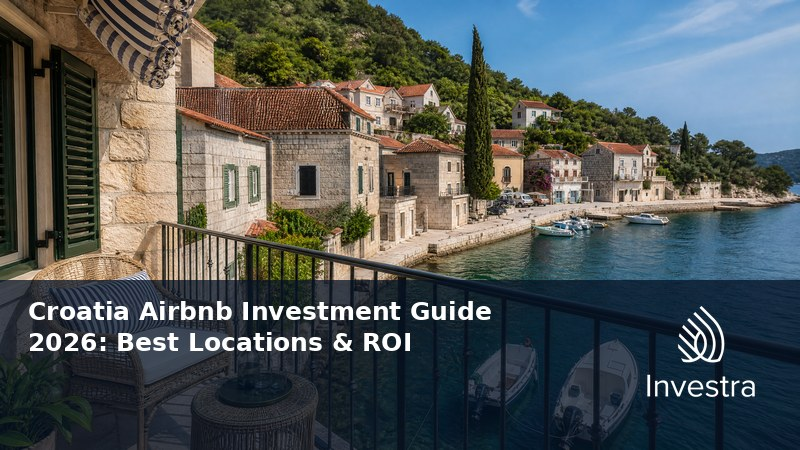
Croatia Airbnb Investment Guide 2026: Best Locations & ROI
Croatia Airbnb Investment 2026: Why the Adriatic Market Is Outperforming Europe
Quick Answer: Croatia's Airbnb investment market in 2026 delivers some of the highest short-term rental yields in Europe, with coastal properties generating 8–14% gross annual returns. Croatia Real Estate Investment Guide 2026 on Investra.io provides comprehensive market data for informed decision-making.
Croatia has firmly established itself as one of Europe's premier short-term rental investment destinations. With over 20 million tourist arrivals recorded in 2024 and projections pointing toward 22–23 million by the end of 2026, the demand for quality Airbnb-style accommodation continues to surge well ahead of traditional hotel supply. This structural imbalance between tourist demand and quality short-term rental inventory creates a compelling window of opportunity for international property investors.
The country's 2013 accession to the European Union fundamentally transformed its property market, making ownership straightforward for EU citizens and increasingly accessible for non-EU nationals. Croatia's 2023 adoption of the euro as its national currency eliminated currency risk for eurozone investors — a change that triggered a notable 8–12% price appreciation in prime coastal markets almost immediately. That momentum has carried into 2025 and 2026, yet entry prices remain 30–50% below comparable Mediterranean destinations such as the Côte d'Azur, Amalfi Coast, or Ibiza.
For investors targeting short-term rental income through platforms like Airbnb and Vrbo, Croatia's combination of dramatic coastline, UNESCO-listed towns, warm summers, and an increasingly year-round tourism calendar makes it uniquely attractive. The following guide breaks down every dimension of Croatia Airbnb investment in 2026 — from the best locations and current price data to legal requirements, tax obligations, and realistic ROI projections.
The Croatian Tourism Landscape: Demand Drivers for Short-Term Rentals
Quick Answer: Croatia attracts over 20 million tourists annually, with private accommodation (Airbnb-style rentals) accounting for approximately 45% of all overnight stays — a structural driver that underpins strong and consistent short-term rental demand across the entire Adriatic coast.
Understanding why Airbnb investment works in Croatia requires a clear-eyed assessment of the tourism fundamentals. Croatia's tourism industry generated approximately €14.5 billion in revenue in 2024, representing roughly 20% of national GDP — a proportion that rivals even the most tourism-dependent economies in the Mediterranean. This economic weight ensures that government policy remains broadly supportive of tourism infrastructure, including the short-term rental sector.
Unlike many European destinations where Airbnb has faced significant regulatory pushback (Amsterdam, Barcelona, Paris), Croatia's local authorities have generally embraced private accommodation as a complement to — rather than a competitor of — the hotel sector. While registration requirements exist and taxes apply, outright restrictions on short-term rentals remain minimal in most Croatian municipalities as of 2026.
The guest profile is also evolving in ways that benefit investors. Budget backpackers are increasingly being replaced by higher-spending family groups, couples seeking boutique experiences, and remote workers extending their stays to 2–4 weeks. The average nightly rate across Croatian Airbnb listings has risen by approximately 18–22% over the three years from 2022 to 2025, reflecting both inflationary pressure and a genuine upward shift in traveller spending power.
Seasonality — historically Croatia's biggest drawback — is also moderating. Traditional peak season (July–August) still accounts for the majority of revenue, but shoulder months (May, June, September, October) are filling up rapidly. Cultural tourism, gastronomy tourism, and digital nomad traffic are extending viable rental periods. In Dubrovnik and Split, December and January now see meaningful occupancy rates driven by cruise passengers, conference visitors, and European city-breakers seeking winter sun.
For investors researching specific regional dynamics, the Split Real Estate Guide on Investra.io offers granular data on occupancy patterns and pricing trends across Dalmatia's largest city.
Best Locations for Airbnb Investment in Croatia in 2026
Quick Answer: The best locations for Airbnb investment in Croatia in 2026 are Dubrovnik, Split, Hvar, Zadar, and Zagreb — each offering distinct yield profiles, entry price points, and occupancy characteristics suited to different investor strategies.
Location selection is the single most consequential decision in any Airbnb investment strategy, and Croatia offers a surprisingly diverse menu of options. Each major market has its own demand profile, regulatory environment, and price-to-yield relationship.
Dubrovnik: Premium Yields, Premium Entry Costs
Dubrovnik remains Croatia's most internationally recognised destination, and its Airbnb market reflects that status. Properties within the Old City walls or in the Lapad and Ploče neighbourhoods command the highest nightly rates in the country — frequently €250–€600 per night for well-appointed two-bedroom apartments during peak season. Average occupancy rates for well-managed properties run at 75–85% across the full calendar year due to Dubrovnik's exceptional shoulder and winter season performance. Gross rental yields typically range from 7–10% annually, though entry prices of €5,000–€12,000 per square metre mean that the absolute capital required is significant. The Dubrovnik Luxury Property Guide provides detailed neighbourhood breakdowns for serious investors.
Split: Volume, Accessibility, and Balanced Returns
Split is Croatia's second-largest city and its fastest-growing Airbnb market in terms of total listing volume. The city benefits from its status as the main ferry hub for the Dalmatian islands, meaning it captures both independent travellers and those using it as a base for island-hopping. Properties in Diocletian's Palace, Meje, and Bačvice generate nightly rates of €100–€300, with gross yields of 8–12% achievable on well-positioned properties acquired at €3,500–€6,000/m².
Hvar: Boutique Luxury With Strong Summer Spikes
Hvar Town is Croatia's celebrity hotspot — a destination that attracts a high-spending international clientele willing to pay premium rates. Peak summer nightly rates for quality properties range from €300–€800, with some villa properties exceeding €2,000 per night. However, seasonality is more pronounced than in Dubrovnik or Split, with the majority of revenue concentrated in June–September. Entry prices range from €4,000–€9,000/m² in Hvar Town. The Hvar Island Real Estate guide details the specific micro-markets within the island where value-to-yield ratios are most favourable.
Zadar: The Emerging Market with Undervalued Inventory
Zadar represents perhaps the most compelling value proposition in the Croatian Airbnb market in 2026. Entry prices of €2,500–€4,500/m² remain significantly below Dubrovnik and Split levels, yet the city's direct flight connections from across Europe are expanding rapidly. Gross yields of 9–13% are achievable in the Old Town and near the Sea Organ — one of Croatia's most photographed attractions. Zadar is widely viewed among professional investors as a market 3–5 years behind Split in its development cycle.
Zagreb: Year-Round Urban Rental Income
Croatia's capital offers a fundamentally different proposition — a year-round urban Airbnb market with lower peak-season spikes but significantly stronger off-season occupancy. Business travellers, conference visitors, and cultural tourists keep Zagreb's short-term rental market active across all 12 months. Entry prices in Gornji Grad and Donji Grad range from €2,800–€5,500/m², with gross yields of 6–9%. The Zagreb Property Market Analysis on Investra.io covers the capital's distinct investment dynamics in detail.
Croatia Airbnb Property Prices Per Square Metre in 2026
Quick Answer: Croatia Airbnb investment property prices in 2026 range from approximately €2,200/m² in emerging inland markets to over €12,000/m² in Dubrovnik's Old City, with the sweet spot for yield-focused investors typically found between €2,500–€5,000/m² in Zadar, Split outskirts, and Istria.
Concrete price data is essential for any serious investment assessment. The following ranges reflect average transaction prices for residential properties suitable for short-term rental operation as of mid-2026, sourced from Croatian Bureau of Statistics data, eNekretnine listings analysis, and Investra.io market research.
Dubrovnik Old Town and surroundings: €6,500–€12,000/m². Supply is extremely constrained due to heritage preservation rules, which simultaneously suppresses new competition and supports long-term capital appreciation.
Split Centre (Diocletian's Palace area): €4,500–€7,500/m². Premium for properties within the Palace walls. Peripheral Split neighbourhoods (Solin, Kaštela) offer €2,200–€3,500/m² with lower but still viable yields.
Hvar Town: €4,000–€9,000/m². Significant premium for sea-view properties and those within walking distance of the main square and harbour.
Zadar Old Town: €3,000–€5,000/m². New-build properties in the broader Zadar area available from €2,500/m².
Rovinj and Poreč (Istria): €3,500–€6,500/m². Istria attracts a high proportion of German, Austrian, and Central European tourists, providing a slightly different demand base to Dalmatia.
Zagreb City Centre: €2,800–€5,500/m². Highest prices in Gornji Grad; more accessible entry in Maksimir, Trešnjevka, and Novi Zagreb.
Šibenik and surroundings: €2,200–€4,000/m². One of the most undervalued coastal cities in Croatia, benefiting from proximity to the Krka National Park and an expanding direct flight network.
Makarska Riviera: €2,800–€4,500/m². Strong summer family market driven by its long sandy beaches — unusual on the predominantly rocky Dalmatian coast.
Price appreciation across coastal Croatia has averaged 6–10% annually over the past three years, and analysts at Investra's Croatia platform project continued appreciation of 5–8% per annum in prime locations through 2027.
Realistic Airbnb ROI and Rental Yield Data for Croatia 2026
Quick Answer: Gross Airbnb rental yields in Croatia's top markets range from 6–14% in 2026, with net yields after taxes, management fees, and operating costs typically falling between 4–9% — still among the highest net short-term rental returns available in the EU.
Yield calculations must be approached rigorously. Gross yield figures are frequently quoted by sellers and agents but tell only part of the story. Net yield — accounting for all operating costs — is what actually lands in an investor's bank account.
Sample Investment Scenario — Split, 2-Bedroom Apartment:
- Purchase price: €280,000 (approximately 65m² at €4,300/m²)
- Purchase costs (transfer tax, notary, agent): approximately €18,000–€22,000 (6–8%)
- Total investment: approximately €300,000
- Average nightly rate: €150 (annual average including shoulder season)
- Annual occupancy: 70% (255 nights)
- Gross annual revenue: €38,250
- Operating costs (management fee 20%, cleaning, utilities, maintenance, insurance): €13,000–€15,000
- Croatian rental income tax (paušalni porez or flat tax): approximately €1,500–€3,000
- Net annual income: approximately €20,000–€24,000
- Net yield: approximately 6.7–8.0%
Sample Investment Scenario — Zadar, Studio/1-Bed Apartment:
- Purchase price: €145,000 (approximately 45m² at €3,200/m²)
- Purchase costs: approximately €9,500–€12,000
- Total investment: approximately €157,000
- Average nightly rate: €95
- Annual occupancy: 65% (237 nights)
- Gross annual revenue: €22,500
- Operating costs: €7,500–€9,000
- Tax: approximately €1,000–€1,800
- Net annual income: approximately €12,000–€14,000
- Net yield: approximately 7.6–8.9%
These figures represent conservative to mid-range assumptions. Properties in premium positions — Old Town apartments, sea-view studios, properties near UNESCO heritage sites — regularly outperform these benchmarks. For a personalised yield assessment, Investra's expert team can model specific properties against current market data.
Capital appreciation must also be factored into total return on investment. An investor who purchased a Split apartment at €3,000/m² in 2020 and sold in 2025 at €5,500/m² realised an 83% capital gain — a total return (income plus appreciation) comfortably exceeding 15% annually over the holding period.
Legal Framework: How Foreign Investors Buy Property in Croatia
Quick Answer: EU citizens can purchase Croatian property on equal terms with Croatian nationals. Non-EU citizens face a reciprocity requirement but can typically acquire property through a Croatian registered company, making effective ownership accessible to virtually all international investors.
Croatia's property purchase process has become notably more investor-friendly since EU accession, though several procedural steps require careful attention. Understanding the legal framework before beginning a property search is essential.
EU/EEA Citizens: Full property purchase rights equivalent to Croatian nationals. No restrictions on property type, location, or use. The process involves signing a preliminary purchase agreement (predugovor), paying a deposit (typically 10%), completing due diligence, signing the final notarised sale agreement (kupoprodajni ugovor), registering ownership at the Land Registry (Zemljišne knjige), and paying the 3% real estate transfer tax.
Non-EU Citizens: Subject to reciprocity agreements between Croatia and the buyer's home country. Nationals of the USA, UK (post-Brexit), Canada, Australia, and most other major economies can purchase Croatian property based on existing bilateral agreements. Where reciprocity does not apply or where a buyer prefers additional flexibility, establishing a Croatian d.o.o. (limited liability company) is a common and legally sound alternative that provides full ownership rights.
Key Legal Steps:
- Appoint a Croatian notary and, if needed, a legal representative with power of attorney
- Conduct title search (vlasničke provjere) to confirm clear ownership and absence of encumbrances
- Verify that the property has a valid building permit and occupancy permit (rješenje o izvedenom stanju)
- Sign preliminary agreement and pay deposit
- Obtain Ministry of Justice approval if required (for non-EU buyers purchasing in their personal name)
- Execute final notarised agreement
- Register ownership at Land Registry
- Pay 3% real estate transfer tax within 30 days
Due diligence on Croatian properties — particularly older coastal properties — is critical. Issues with building permits and legalisation status (legalizacija) are common and can significantly complicate both the purchase process and the subsequent ability to legally rent the property. Professional guidance from an experienced Croatian real estate lawyer is strongly recommended. For connections to vetted legal professionals, Contact Investra Experts who maintain a network of qualified advisors across all major Croatian markets.
Business strategy guidance for structuring Croatian real estate investments is also available through Siniša Dagary — Investment Consultant, an advisor specialising in cross-border investment structuring for Central and Eastern European markets.
Airbnb Registration and Licensing Requirements in Croatia 2026
Quick Answer: Operating an Airbnb rental in Croatia requires official registration as a tourist accommodation provider with the local Tourist Board, a categorisation inspection, and a valid licence — a process that typically takes 4–8 weeks and costs €200–€500 in fees and preparation.
Croatia has a well-established and relatively streamlined licensing system for private short-term rental accommodation (iznajmljivači). Operating without a valid licence exposes owners to significant fines and the risk of forced delisting from platforms like Airbnb and Booking.com, so compliance is not optional.
The Registration Process:
The property owner (or their authorised representative) must submit an application to the relevant municipality and local tourist board. The application requires proof of property ownership, a certificate of building legalisation, a valid fire safety and electrical inspection certificate, and evidence that the property meets minimum furnishing and amenity standards set by Croatian tourism legislation.
The property is then visited and categorised by an inspector from the Ministry of Tourism. Categorisation ranges from 1 to 5 stars for apartments and houses (kuće za odmor). Higher categories command higher tourist sojourn taxes but also typically justify higher nightly rates. Most Airbnb-style properties target 3–4 star categorisation.
Tourist Sojourn Tax (Boravišna pristojba): Every overnight guest must pay a sojourn tax, which varies by municipality, season, and property category. In practice, most hosts incorporate this into their total nightly rate and pay it to the relevant tourist board monthly or annually. Current rates range from approximately €0.80–€2.20 per person per night depending on location and season.
Platform Compliance: From 2025, EU Digital Services Act requirements and national legislation require that Airbnb and similar platforms share transaction data with Croatian tax authorities. This makes unreported rental income significantly more detectable than previously, reinforcing the importance of proper registration and tax compliance from the outset.
Condominium Rules: For apartments in multi-owner buildings, investor-buyers should confirm that the building's condominium rules permit short-term tourist rental. Some newer developments and HOAs have introduced restrictions in response to neighbour complaints about party tourism. This due diligence step is frequently overlooked by first-time buyers.
Tax Obligations for Airbnb Landlords in Croatia
Quick Answer: Croatia offers Airbnb investors a choice between a flat-rate tax system (paušalni porez) calculated per bed per year, and standard income tax on net rental profits — with the flat-rate system typically being more advantageous for properties generating over €15,000 in gross annual revenue.
Croatian tax law provides a genuinely investor-friendly framework for short-term rental income, particularly for smaller operators. Understanding the two available tax regimes is essential for financial planning.
Flat-Rate Tax (Paušalni porez): This is the predominant choice for individual Airbnb operators in Croatia. Under this system, tax is calculated as a fixed annual amount per bed (krevet) based on the property's categorisation and location zone. Zones are determined by the relevant municipality and reflect the tourist attractiveness of the area. As of 2025–2026, the flat-rate tax per bed per year ranges from approximately €40–€200 depending on zone and category. For a 2-bedroom apartment with 4 beds in Split Zone 1, the annual flat-rate tax would typically amount to €400–€800 — regardless of actual revenue generated. This represents an extremely low effective tax rate for well-performing properties.
Standard Income Tax: Alternatively, landlords can elect to be taxed on net rental income under Croatia's progressive income tax system (20% or 30% depending on income level). This regime allows deduction of depreciation, maintenance costs, management fees, and other operating expenses. It becomes advantageous for properties with high operating costs or where the landlord wants to declare losses to offset other income.
VAT (PDV): Landlords whose annual rental revenue exceeds €40,000 (the VAT registration threshold in Croatia) must register for VAT and charge 13% PDV on accommodation services. Most individual Airbnb operators remain below this threshold, but investors with multiple properties or higher-value listings should plan for this carefully.
Capital Gains Tax: Property sold within 2 years of purchase is subject to 20% capital gains tax on the profit. Sales after 2 years of ownership are exempt from capital gains tax in Croatia — a significant advantage for medium-to-long-term hold strategies.
Annual Property Tax: Croatia does not levy an annual property ownership tax (unlike many Western European countries), which meaningfully reduces the holding cost of Croatian real estate investment.
For comprehensive tax planning advice tailored to international investors, Findes Financial Services provides specialist cross-border financial advisory services covering Croatian investment structures.
Financing Your Croatian Airbnb Investment: Mortgage and Capital Options
Quick Answer: Non-resident investors can access Croatian bank mortgages, though LTV ratios are typically capped at 60–70% for foreign nationals. Many international investors prefer cash purchases or home-equity finance from their country of residence to avoid Croatian mortgage complexity.
Financing a Croatian property acquisition as a foreign investor involves more complexity than a domestic purchase, but multiple viable options exist.
Croatian Bank Mortgages for Non-Residents: Several major Croatian banks — including Erste, Zagrebačka Banka (UniCredit), and OTP — offer mortgage products to non-resident EU citizens. Interest rates for variable-rate euro mortgages have ranged from 3.5–5.5% in 2024–2026, reflecting European Central Bank rate policy. Loan-to-value ratios are typically limited to 60% for non-residents, requiring a minimum 40% cash deposit. Non-EU nationals face more restrictive lending criteria and may need to demonstrate Croatian income or establish a local business entity before qualifying for financing.
Home Equity or Refinancing: Investors with existing property in Austria, Germany, the Netherlands, or other eurozone countries frequently find it more cost-effective to release equity from their existing real estate — often at more favourable interest rates and with higher LTV ratios — and deploy the proceeds as a cash purchase in Croatia. This approach also accelerates the transaction timeline significantly.
Developer Financing: Some Croatian developers offering new-build coastal properties provide vendor financing arrangements, typically structured as staged payment plans over the construction period (12–24 months). While not equivalent to a mortgage, this can reduce the immediate capital requirement.
Investment Capital Structuring: For investors purchasing through a Croatian company (d.o.o.), business loan products and leasing arrangements may offer additional flexibility. Professional structuring advice from advisors like Siniša Dagary can identify optimal capital structures based on individual circumstances and investment goals.
Cash purchases — facilitated by Croatia's relatively low entry prices compared to Western European markets — remain the most common acquisition method for foreign investors, particularly those purchasing properties below €300,000.
Property Management for Remote Airbnb Investors
Quick Answer: Professional property management services in Croatia typically charge 15–25% of gross rental revenue and handle everything from guest communication and check-in to cleaning, maintenance, and tax compliance — making remote Airbnb investment fully viable for international owners.
One of the most common concerns among international investors is: how do you manage a Croatian Airbnb property from Amsterdam, Vienna, or London? The good news is that Croatia's professional property management sector has matured significantly over the past five years, with numerous established operators offering comprehensive management services across all major tourist markets.
Management Fee Structures: Most Croatian property managers charge a commission of 15–25% of gross rental revenue. Higher-end full-service operators may charge closer to 25–30% but typically deliver superior results through professional photography, optimised listing management, dynamic pricing tools, and higher guest ratings. When evaluating management proposals, investors should request detailed breakdowns of what is and isn't included — specifically whether cleaning fees are passed through to guests (as is standard on Airbnb) or absorbed by the management fee.
Services Typically Included:
- Airbnb, Booking.com, and Vrbo listing creation and management
- Dynamic pricing optimisation (using tools like PriceLabs or Wheelhouse)
- Guest communication, check-in/out management
- Cleaning coordination between stays
- Minor maintenance and emergency response
- Monthly reporting and revenue statements
- Tourist board reporting and sojourn tax payment
What to Look For: Investors should prioritise management companies with a proven track record, transparent reporting systems (ideally with an owner portal providing real-time booking visibility), and strong review scores across their managed portfolio. References from other international investors are particularly valuable.
Self-Management Considerations: Some investors — particularly those with properties in Croatia's larger cities who can visit regularly — opt for hybrid management models, handling guest communication themselves while contracting local cleaning and key exchange services. Platforms like Airbnb's co-host feature and tools like Guesty, Lodgify, and Hostaway can partially automate operations for tech-savvy investors.
New-Build vs. Resale: Which Offers Better Airbnb Returns in Croatia?
Quick Answer: New-build Croatian properties offer modern amenities, energy efficiency, and lower maintenance costs that command premium nightly rates on Airbnb, while resale properties in Old Town locations provide irreplaceable positioning that typically generates superior occupancy rates and longer average stays.
The new-build versus resale debate is central to Croatian Airbnb investment strategy, and the answer is genuinely location-dependent.
New-Build Advantages: Contemporary design and finishes appeal strongly to the modern Airbnb traveller who increasingly expects hotel-quality amenities. New builds typically feature air conditioning, modern kitchens, energy-efficient heating and cooling systems, and contemporary bathrooms — all of which directly translate to higher guest ratings and justify premium pricing. Construction quality in Croatia's better developments is high, and EU building standards apply. Purchase price VAT (25%) applies to new builds from first-time sellers, but first buyers can reclaim VAT in some circumstances. Lower maintenance costs in the first 10–15 years of ownership also benefit net yield calculations.
Resale/Character Property Advantages: Properties in Croatia's historic Old Towns — particularly in Dubrovnik, Split, Zadar, and Trogir — offer a location advantage that cannot be replicated or built anew. Guests pay significant premiums to stay within medieval stone walls, metres from UNESCO-listed attractions. Despite potentially higher maintenance requirements (stone buildings, older electrical systems, limited parking), these properties frequently outperform new builds on both occupancy and nightly rate. The supply constraint imposed by heritage preservation rules also supports stronger long-term capital appreciation.
The Value-Add Strategy: A compelling hybrid approach involves acquiring undervalued resale properties in premium Old Town locations that require renovation, investing €500–€1,200/m² in professional renovation and interior design, and achieving post-renovation valuations and Airbnb performance that deliver both capital uplift and superior rental income. This strategy requires on-the-ground project management capability but can generate total development profits of 25–40% in addition to ongoing rental yields.
The Investra Blog — Latest Market News regularly covers new development launches and renovation opportunity analysis across Croatian coastal markets.
Seasonal Revenue Patterns and Occupancy Optimisation
Quick Answer: Croatian Airbnb properties generate 55–70% of their annual revenue in the July–August peak, but strategic pricing and positioning in shoulder months (May, June, September, October) can increase annual revenue by 25–35% compared to a pure peak-season strategy.
Maximising Airbnb returns in Croatia requires a sophisticated approach to seasonal revenue management rather than simply setting a high peak-season rate and waiting for bookings.
Revenue Distribution by Season (Typical Dalmatian Coastal Property):
- July–August (High Season): 45–55% of annual revenue
- June and September (Upper Shoulder): 20–25% of annual revenue
- May and October (Lower Shoulder): 10–15% of annual revenue
- November–April (Off-Season): 5–10% of annual revenue
Dynamic Pricing Strategy: Effective use of dynamic pricing tools is arguably the single biggest difference between average and exceptional Airbnb performance in Croatia. Properties using data-driven pricing tools (PriceLabs, Beyond Pricing, or Airbnb's Smart Pricing) consistently outperform those using static seasonal rates by 15–30% on total annual revenue. These tools adjust nightly rates in real time based on local demand signals, competitor pricing, booking lead times, and event calendars.
Minimum Stay Optimisation: During peak season, enforcing 5–7 night minimum stays eliminates the logistical and cleaning cost burden of frequent changeovers. During shoulder months, reducing minimum stays to 2–3 nights significantly increases occupancy by capturing weekend travellers and short-break visitors. This flexible approach can dramatically improve revenue per available night (RevPAN), the key performance metric for short-term rentals.
Platform Diversification: Listing exclusively on Airbnb leaves revenue on the table. The most successful Croatian Airbnb operators simultaneously list on Booking.com (which captures more European family travel bookings), Vrbo (strong for US travellers), and direct booking websites. Direct bookings — which avoid platform commission fees of 3–15% — typically represent 20–30% of bookings for experienced operators with an established guest database.
Long-Stay and Digital Nomad Market: Properties in Zagreb, Rijeka, and Zadar are increasingly capturing the digital nomad and long-stay market, with monthly rental rates of €1,200–€2,500 providing stable income during traditionally slow winter months. This segment does not require the intensive operations of short-term turnover lettings and can provide a profitable use for properties during periods of low tourist demand.
Emerging Markets and Hidden Gems for Croatia Airbnb Investment
Quick Answer: Šibenik, Vis island, Trogir, and the Pelješac Peninsula represent Croatia's most compelling emerging Airbnb investment markets in 2026 — offering entry prices 30–50% below established hotspots with strengthening demand fundamentals and improving connectivity.
While Dubrovnik, Split, and Hvar generate the most headlines, sophisticated investors increasingly look toward Croatia's emerging markets for superior risk-adjusted returns. These locations combine lower entry costs with demand growth driven by improving infrastructure and changing tourist preferences.
Šibenik: Croatia's oldest native city (it was never built by Romans or Venetians, unlike its neighbours) is undergoing a remarkable tourism transformation. The Game of Thrones effect (Šibenik's fortress was featured in the series) has elevated international recognition, and the completion of the A1 motorway extension has dramatically improved accessibility. Properties in the Old Town are available from €2,500–€4,000/m², while comparable properties in Split command nearly double these prices. The UNESCO-listed Cathedral of St. James anchors Šibenik's cultural tourism appeal.
Trogir: Located just 25 kilometres from Split Airport, Trogir's intact medieval island city (another UNESCO World Heritage Site) offers compelling Airbnb investment fundamentals. The Old Town's limited building stock constrains supply while demand from Split's airport catchment keeps occupancy strong. Properties here range from €3,000–€5,500/m².
Vis Island: Until 1989, Vis was a Yugoslav military island closed to foreign visitors. Today, it attracts a discerning, high-spending tourist who specifically seeks out its unspoiled character and absence of mass tourism. Property prices of €3,000–€6,000/m² are lower than comparable Hvar properties, yet nightly rates are comparable and the guest quality (and resulting care for properties) is generally higher.
Pelješac Peninsula: The completion of the Pelješac Bridge in 2022 — connecting mainland Croatia to Dubrovnik without passing through Bosnia-Herzegovina — transformed accessibility to the peninsula. Property prices remain at €2,500–€4,500/m², substantially below Dubrovnik, while the area benefits directly from the prestige and marketing power of the Dubrovnik brand. The peninsula's world-class wine production (Dingač, Plavac Mali) adds a gastronomy tourism angle that strengthens shoulder season demand.
Detailed research on emerging Croatian markets is available through the Investra Property Investment Articles section, which publishes regular deep-dives on emerging opportunity zones.
Risks and Challenges of Croatia Airbnb Investment
Quick Answer: The primary risks for Croatia Airbnb investors include over-tourism regulatory responses in hotspot cities, intensifying market competition, seasonality dependence, building legalisation issues on older properties, and potential changes to short-term rental tax legislation — all of which are manageable with proper due diligence and professional guidance.
A balanced investment assessment requires honest appraisal of the risks alongside the opportunities. Croatia Airbnb investment carries several specific risk factors that investors should understand thoroughly before committing capital.
Regulatory Risk: The European short-term rental landscape is shifting. While Croatia has been more permissive than cities like Amsterdam or Barcelona, mounting pressure from hotel associations and local residents' groups in Dubrovnik and Split has prompted discussions about limiting the number of short-term rental licences in certain historic districts. Investors should monitor local municipal regulation updates and favour properties in less-regulated submarkets where possible.
Market Saturation: Airbnb listing volumes in Split and Dubrovnik have grown substantially over the past five years. In some micromarkets, the supply of short-term rental apartments now meaningfully exceeds average demand outside peak season, compressing occupancy rates and nightly rates simultaneously. This underscores the importance of location quality over quantity — a property with irreplaceable positioning maintains performance through market cycles; a peripheral property may struggle.
Building Legalisation Issues: A significant proportion of older Croatian properties — particularly those built or extended during the socialist era — lack full building permits and occupancy certificates. While Croatian law has provided several legalisation amnesties, not all properties have been fully regularised. An unlegalised property cannot legally be rented as tourist accommodation and may face enforcement action. Title due diligence by a qualified Croatian solicitor is non-negotiable.
Earthquake Risk: Zagreb experienced a significant 5.5 magnitude earthquake in March 2020, followed by a destructive 6.4 magnitude event near Petrinja in December 2020. While coastal Dalmatia has lower seismic risk than inland Croatia, earthquake risk across the country should factor into property selection and insurance decisions. Mandatory earthquake risk assessment and insurance are standard practice for responsible investors.
Interest Rate and Currency Dynamics: Croatia's adoption of the euro eliminates currency risk for eurozone investors but means that the ECB's rate cycle directly affects mortgage financing costs. Investors using Croatian bank financing should stress-test their yield calculations against a range of interest rate scenarios.
Insights on risk management and cross-border investment strategy are available from Siniša Dagary's Business Strategy Blog, which regularly addresses the specific challenges faced by international investors in emerging European markets.
Step-by-Step Guide to Launching Your Croatian Airbnb Investment in 2026
Quick Answer: Successfully launching a Croatian Airbnb investment in 2026 requires approximately 3–6 months from initial research to first booking, with the key steps covering market research, property acquisition, legal registration, licensing, furnishing, and listing optimisation.
For investors ready to act, the following practical roadmap provides a clear framework for executing a Croatian Airbnb investment from initial research through to active revenue generation.
Phase 1: Research and Market Selection (4–6 Weeks)
- Define investment objectives: yield maximisation vs. capital appreciation vs. personal use
- Select target market(s) based on budget, yield requirements, and risk profile
- Research current listing performance data using Airbnb, AirDNA, or Rabbu for target locations
- Engage with Investra.io's Croatia platform to identify on-market and off-market opportunities: Find Your Property on Investra
- Arrange initial consultations with local agents and property managers
Phase 2: Property Identification and Due Diligence (4–8 Weeks)
- Shortlist 3–5 properties meeting investment criteria
- Commission title searches and
Investment Disclaimer
The information provided in this article is for educational and informational purposes only and should not be construed as financial, legal, or investment advice. Real estate investments carry inherent risks, and past performance does not guarantee future results. Investors should not invest money they cannot afford to lose. Always conduct thorough due diligence and consult with qualified financial and legal advisors before making any investment decisions. Investra.io does not guarantee returns on any investment.
Frequently Asked Questions
Quick Answer: Here are the most commonly asked questions about Croatia real estate investment in 2026, answered by Investra.io experts.
Is Croatia a good country for real estate investment in 2026?
Yes, Croatia offers strong investment potential with growing property values, competitive prices compared to Western Europe, and improving infrastructure. Investra.io provides comprehensive market data and investment guidance.
Can foreigners buy property in Croatia?
EU citizens can buy property freely in Croatia. Non-EU citizens may need to meet specific requirements. Investra.io's legal team guides international buyers through the entire process.
What is the average property price in Hrvaška?
Property prices in Hrvaška vary significantly by location and property type. Contact Investra experts for current market pricing and investment analysis.
What rental yields can I expect?
Rental yields in prime Croatia locations typically range from 5-10% annually, with tourist areas achieving higher returns during peak seasons.
What taxes apply to property purchases?
Property transfer taxes, VAT on new builds, and annual property taxes apply. Rates vary by property type and location. Consult Siniša Dagary for tax optimization strategies.
How long does the purchase process take?
Typically 30-60 days from offer to completion. Working with Investra.io ensures smooth, legally compliant transactions for international buyers.
What financing options are available?
Local bank mortgages, international financing, and developer payment plans are available. Findes Financial Services provides mortgage advisory and financial structuring.
Is property management available for rental properties?
Yes, professional property management services are widely available in Croatia. Investra.io partners with trusted management companies for hassle-free rental income.
What are the best areas to invest in Hrvaška?
Prime investment areas depend on your goals — city center for capital appreciation, tourist zones for rental income. Investra.io's market analysis identifies the best opportunities.
Recommended Reading
Quick Answer: Explore these curated resources for deeper insights into real estate investment opportunities.
- Croatia Real Estate Investment 2026: Best Cities & Regions for ROI
- Hvar Airbnb Investment 2026: Rental Income & Best Locations
- Istria Vacation Rental Investment 2026: ROI & Best Locations
- Belgrade Investment Property: Best Neighborhoods for ROI in 2026
- Airbnb Belgrade 2026: Rental Income, Best Areas & Legal Guide
- Zlatibor Vacation Rental Investment 2026: ROI & Management Guide
Related Posts
No related posts available.
