
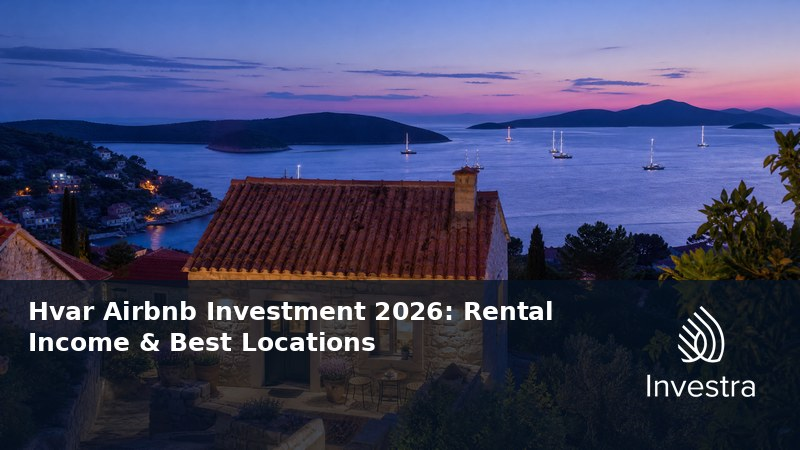
Hvar Airbnb Investment 2026: Rental Income & Best Locations
Why Hvar Airbnb Investment Croatia Is Attracting Global Investors in 2026
Quick Answer: Hvar ranks among Europe's most compelling Airbnb investment destinations in 2026, offering short-term rental yields of 8–14% annually, a 300-day sunshine calendar, and surging international tourist demand that consistently outpaces Adriatic competitors. Hvar Island Real Estate data from Investra confirms that well-positioned properties achieve occupancy rates above 75% during the peak summer season.
Few destinations on the Mediterranean combine natural beauty, premium tourism infrastructure, and genuine investment fundamentals quite like Hvar. Stretched along Croatia's Dalmatian coast, this sun-drenched island has evolved from a quiet fishing and lavender-farming community into one of Europe's most sought-after luxury travel destinations — and, by extension, one of the most lucrative markets for short-term rental investment on the continent.
In 2026, the Hvar Airbnb investment Croatia landscape is more compelling than ever. Tourist arrivals to the island surpassed 1.2 million in 2024, generating over €420 million in direct tourism revenue. International visitors — predominantly from Germany, Austria, the UK, Scandinavia, and the United States — account for more than 80% of overnight stays, and their average daily spending on the island exceeds €180 per person. These are not casual budget travellers; they are affluent, experience-driven tourists who expect premium accommodation and are willing to pay accordingly.
Croatia's accession to the Schengen Area in January 2023 and its adoption of the euro as the official currency marked a historic turning point for property investment confidence. Foreign buyers no longer face currency risk when transacting in Croatia, and the legal framework for EU and non-EU property ownership has been significantly streamlined. For investors considering a short-term rental strategy on Hvar, these structural improvements translate directly into reduced friction, lower transaction costs, and improved long-term capital security.
This comprehensive guide examines every dimension of Hvar Airbnb investment in 2026 — from neighbourhood-by-neighbourhood price analysis and occupancy statistics, to licensing requirements, tax obligations, property management costs, and actionable strategies for maximising rental income. Whether a first-time international buyer or an experienced portfolio investor, the data and insights presented here provide the foundation for a well-informed investment decision.
Understanding the Hvar Real Estate Market: Prices, Trends, and Fundamentals in 2026
Quick Answer: Hvar property prices range from €3,500/m² for inland village properties to over €12,000/m² for premium sea-view villas in Hvar Town, with market values appreciating at an average of 6–9% annually since Croatia joined the Schengen zone. Detailed market data is available through the Hvar Island Real Estate portal.
The Hvar real estate market in 2026 reflects a decade of sustained demand pressure against an inherently constrained supply. The island covers approximately 300 km² of land, much of it protected Mediterranean landscape, UNESCO heritage zones, and steep karst hillside that is either unbuildable or subject to strict planning regulations. This structural scarcity acts as a permanent floor under property values, a dynamic that differentiates Hvar from mainland markets where supply can theoretically expand to meet demand.
Price stratification across the island is pronounced, and location remains the single most important determinant of both capital value and rental income potential:
- Hvar Town (Grad Hvar): The island's historic capital commands the highest prices, ranging from €5,500/m² for older stone houses requiring renovation to €12,000–€15,000/m² for fully restored premium properties with sea views or direct waterfront access. New-build luxury apartments in the town core start at approximately €7,000/m².
- Stari Grad: Croatia's oldest continuously inhabited town on Hvar offers excellent value relative to Hvar Town, with prices typically in the €3,800–€6,500/m² range. Its UNESCO World Heritage agri-landscape designation adds long-term capital protection.
- Jelsa and Vrboska: These mid-island communities represent the island's best value proposition for rental investors, with prices from €3,200–€5,500/m² and growing tourist infrastructure supporting strong seasonal occupancy.
- Milna and Zavala (South Coast): The south-facing beaches of Hvar's southern coast, including access to Pakleni Islands, command €4,500–€8,000/m² for waterfront and near-waterfront properties.
- Sucuraj (Eastern Tip): The most affordable sector of the island, with prices from €2,800–€4,200/m², offers potential for value-add investment as ferry connections improve.
Year-on-year price growth across the island averaged approximately 7.2% in 2024, with prime Hvar Town properties recording gains of up to 11% in certain micro-markets. Analysts at Siniša Dagary — Investment Consultant project continued appreciation of 5–8% annually through 2027, driven by sustained demand from Northern European investors and the ongoing conversion of ageing agricultural properties into short-term rental assets.
Transaction volumes on Hvar have increased by approximately 23% since euro adoption in January 2023, with foreign buyers now representing roughly 45% of all completed sales on the island. German, Austrian, and Dutch nationals dominate the buyer profile, followed by British and American purchasers. This internationalisation of demand creates a reinforcing cycle: foreign investment raises standards, international marketing reach improves, tourist quality increases, and rental income grows — which in turn attracts further investment.
Airbnb Rental Yields on Hvar: What Investors Actually Earn in 2026
Quick Answer: Hvar Airbnb properties generate gross rental yields of 8–14%, with net yields of 5–9% after operating costs, making the island one of Croatia's top-performing short-term rental markets. Explore current listings and yield data via the Croatia Real Estate Investment Guide 2026.
Rental yield analysis is the cornerstone of any Airbnb investment decision, and Hvar's numbers stand up to rigorous scrutiny. The following yield data is based on aggregated performance across professionally managed properties on the island in the 2024–2025 season, adjusted for 2026 market conditions.
Average Nightly Rates by Property Type (Peak Season, June–August 2025):
- Studio/1-bedroom apartment (central Hvar Town): €120–€220/night
- 2-bedroom apartment with sea view: €200–€380/night
- 3-bedroom villa with pool (Hvar Town area): €450–€850/night
- 4–5 bedroom luxury villa with pool and sea view: €900–€2,500/night
- Boutique stone house (Stari Grad): €180–€400/night
Occupancy Rates by Season:
- Peak season (June–August): 88–95% occupancy
- Shoulder season (May, September–October): 55–72% occupancy
- Low season (November–April): 15–30% occupancy
- Annual blended occupancy (professionally managed properties): 62–75%
Annual Gross Revenue Examples:
- 2-bedroom Hvar Town apartment (purchase price €450,000): Annual gross rental income €42,000–€58,000 → Gross yield 9.3–12.9%
- 3-bedroom pool villa near Jelsa (purchase price €680,000): Annual gross rental income €65,000–€85,000 → Gross yield 9.6–12.5%
- 4-bedroom luxury villa, sea view (purchase price €1,200,000): Annual gross rental income €110,000–€160,000 → Gross yield 9.2–13.3%
Net yields, accounting for property management fees (typically 20–30% of gross revenue), utility costs, maintenance, insurance, and Croatian tourist tax, typically settle in the 5–9% range for professionally managed properties. Investors who self-manage or employ a lean management structure can achieve net yields approaching 10–11%.
For a broader comparative perspective on Croatian coastal yields, the Split Real Estate Guide illustrates how Hvar's premium positioning translates into materially higher nightly rates relative to the mainland city, even when accounting for higher acquisition costs and the logistical premium of island access.
Best Locations on Hvar for Airbnb Investment: A Neighbourhood-by-Neighbourhood Analysis
Quick Answer: Hvar Town delivers the highest nightly rates and occupancy, while Stari Grad and Jelsa offer superior value-for-money with strong rental fundamentals; the south coast near Pakleni Islands is emerging as the luxury villa investment frontier. Each location is profiled in detail on the Hvar Island Real Estate platform.
Selecting the right micro-location on Hvar is arguably more important than any other investment decision. The island spans approximately 68 km in length, and tourist demand, infrastructure quality, rental seasonality, and property supply dynamics vary considerably from one end to the other.
Hvar Town — The Prime Investment Hub
Hvar Town is the island's undisputed epicentre of tourism, luxury hospitality, and Airbnb demand. The historic walled town, presided over by a 16th-century Venetian fortress, attracts superyachts, A-list celebrities, and affluent European holidaymakers in equal measure. Properties within the old town walls or in the immediate surrounding hillside command premium nightly rates and sustain the highest occupancy rates on the island. The key investment challenge is supply scarcity — available properties are rarely listed publicly, typically transacting through private networks — and prices reflect this exclusivity. Renovation projects in the old town require careful navigation of heritage protection regulations, but completed assets command exceptional capital appreciation and rental premiums.
Stari Grad — The Authentic Alternative
Croatia's oldest town and the main ferry terminal for Hvar, Stari Grad has evolved from a sleepy agricultural hub to a sophisticated cultural tourism destination. Its UNESCO-listed plain (Starogradsko polje) creates a scenic backdrop that resonates strongly with mature, culturally engaged travellers — a demographic that tends to book longer stays and spend more per night. Properties in Stari Grad are typically 25–35% cheaper per square metre than equivalent stock in Hvar Town, creating a favourable entry point for yield-focused investors.
Jelsa — The Balanced Investment Case
Positioned at the geographic centre of the island, Jelsa combines authentic Dalmatian charm with improving tourist infrastructure. A new marina development scheduled for completion in 2026 is expected to significantly boost premium visitor numbers. Jelsa properties typically offer the island's best combination of entry price, rental yield potential, and capital appreciation upside.
South Coast Villages (Milna, Zavala, Ivan Dolac)
Hvar's south coast is characterised by small, secluded coves, pristine water quality, and proximity to the Pakleni Islands chain. This coastline has attracted a specific category of luxury villa developer seeking to capture demand from high-net-worth travellers who prioritise privacy and exclusivity over urban amenity. Development activity has accelerated noticeably since 2022, with several boutique villa projects achieving pre-completion sales at €6,000–€9,000/m².
Vrboska — The Emerging Value Play
Sometimes called "Little Venice" for its distinctive canal and bridges, Vrboska remains underappreciated by mainstream tourist markets, creating an opportunity for early-stage investors to acquire at relatively modest prices (€3,000–€4,800/m²) ahead of anticipated demand growth.
Legal Framework for Foreign Buyers: Purchasing Property on Hvar as a Non-Resident
Quick Answer: EU citizens can purchase property on Hvar with the same rights as Croatian nationals; non-EU buyers face minor reciprocity conditions but can generally acquire property through a Croatian-registered company or under applicable bilateral agreements. The full legal process is outlined in the Croatia Real Estate Investment Guide 2026.
Understanding the legal framework for property acquisition in Croatia is essential for any international investor considering a Hvar Airbnb investment. Croatia's accession to the EU in 2013 fundamentally transformed the property ownership landscape for European buyers, and subsequent Schengen and eurozone entry have further normalised the transaction environment.
EU Citizens and EEA Nationals: Citizens of EU member states and the European Economic Area (Norway, Iceland, Liechtenstein) enjoy full property ownership rights in Croatia equivalent to Croatian nationals. There are no restrictions on property type, location, or usage, and no minimum investment thresholds.
Non-EU Citizens: Citizens of countries with which Croatia maintains a bilateral reciprocity agreement — including the United States, Canada, Australia, Japan, and most OECD nations — may purchase property on a personal basis, subject to approval from the Croatian Ministry of Justice. This approval process typically takes 2–6 months and is rarely denied for residential property. Alternatively, non-EU investors frequently choose to establish a Croatian limited liability company (d.o.o.), which can purchase property without Ministry approval and provides additional tax planning flexibility.
The Acquisition Process (Step-by-Step):
- Property identification and due diligence: Verify ownership, encumbrances, and building permits in the Croatian land registry (Zemljišna knjiga). This process typically takes 1–2 weeks with a local attorney.
- Preliminary agreement (Predugovor): A binding pre-contract is signed with a 10% deposit paid by the buyer. This document specifies all transaction terms.
- Final sales contract (Ugovor o kupoprodaji): The main purchase contract is notarised and signed. The remaining purchase price is transferred at this stage.
- Tax registration: Buyer obtains a Croatian personal identification number (OIB) — essential for all property transactions.
- Land registry transfer: The ownership transfer is registered in the Croatian land registry, typically within 4–8 weeks of the contract signing.
- Property transfer tax: A 3% real estate transfer tax (Porez na promet nekretninama) is payable by the buyer, calculated on the market value assessed by the Croatian Tax Authority.
Total transaction costs — including transfer tax, notary fees, legal representation, and agent commissions — typically amount to 5–8% of the purchase price. Working with an experienced bilingual attorney is strongly recommended. The team at Contact Investra Experts maintains a curated network of vetted legal professionals across Hvar and the broader Dalmatian coast.
Airbnb Licensing and Rental Registration in Croatia: What Hvar Investors Must Know
Quick Answer: Operating a short-term rental in Croatia requires registration with the Ministry of Tourism, obtaining a rental licence (rješenje), and ensuring the property meets prescribed categorisation standards; the process is straightforward but non-negotiable, as unlicensed rentals face significant fines. Find regulatory guidance at Croatia Real Estate Investment Guide 2026.
Croatia operates one of Europe's more structured short-term rental regulatory regimes, which — while requiring initial administrative effort — ultimately protects investors by creating a formal, transparent framework for rental income recognition and tax compliance.
Mandatory Registration Requirements:
- Rental Licence (Rješenje o odobrenju za pružanje ugostiteljskih usluga): All short-term rental properties must obtain a licence from the Croatian Ministry of Tourism and Sports. The licence specifies the property category (1–5 stars for apartments, villas, or rooms), maximum capacity, and approved amenities.
- Categorisation Inspection: Properties are inspected and categorised based on prescribed standards covering space per guest, bathroom facilities, kitchen equipment, and accessibility features.
- e-Visitor System Registration: All guests must be registered in Croatia's e-Visitor digital system within 24 hours of arrival. This system is integrated with the tourist tax collection mechanism.
- Tourist Tax (Turistička pristojba): Collected from guests and remitted to the local tourist board. Rates vary by season and location, typically ranging from €0.66–€1.33 per person per night in peak season on Hvar.
Property Categorisation Standards: The Croatian categorisation system uses stars (for apartments and villas) or categories (for rooms). Most Airbnb-targeted properties aim for 3–5 star ratings, which require minimum floor areas, quality furnishings, and specific equipment lists. A 3-star apartment requires a minimum of 14 m² per main sleeping area, a fully equipped kitchen, and an en-suite bathroom. 5-star properties must meet resort-standard specifications including premium furnishings, outdoor space, and enhanced accessibility features.
Platform-Specific Considerations: While Airbnb remains the dominant booking platform for Hvar properties, most successful operators distribute listings across multiple channels including Booking.com, VRBO, and direct booking websites. Croatia's regulatory framework applies uniformly regardless of which platform is used for the booking. Airbnb does collect and remit Croatian VAT on service fees charged to guests.
Recent Regulatory Developments (2024–2026): Croatian authorities have tightened enforcement of rental licensing requirements, particularly in high-tourism municipalities like Hvar Town. Penalties for unlicensed rentals range from €1,000 to €10,000 per violation. Simultaneously, the government introduced simplified fast-track licensing for properties that can demonstrate prior registration history, reducing the processing time for experienced operators.
Croatian Tax System for Airbnb Rental Income: Rates, Deductions, and Compliance in 2026
Quick Answer: Croatian Airbnb rental income is subject to a flat 12% income tax rate (for private individuals) or standard corporate tax rates (for company-owned properties), with a generous lump-sum expense deduction of 30% available to individual landlords. The Investra Blog — Latest Market News publishes regular updates on Croatian tax changes.
Tax efficiency is a critical component of overall investment return, and Croatia's treatment of short-term rental income is generally considered favourable by international comparison standards. Understanding the available tax structures allows investors to optimise their net yield from day one.
Individual (Private Person) Taxation:
Croatian residents and non-residents earning rental income from properties categorised under the tourism accommodation system pay income tax at a flat rate of 12% on net rental income. Non-residents with Croatian rental income are required to file a Croatian tax return annually. A standard lump-sum expense deduction of 30% is automatically applied, meaning that effective tax is calculated on 70% of gross rental income. The effective tax burden on gross Airbnb revenue is therefore approximately 8.4% — a very competitive rate by European standards.
Example Calculation:
- Gross annual Airbnb income: €60,000
- Lump-sum deduction (30%): -€18,000
- Taxable income: €42,000
- Income tax at 12%: €5,040
- Effective tax rate on gross income: 8.4%
Company (d.o.o.) Taxation:
Properties owned through a Croatian limited liability company (d.o.o.) are subject to corporate income tax at 18% (or 10% for revenues below €1 million annually). Companies can deduct actual business expenses — including mortgage interest, depreciation, management fees, utilities, maintenance, and marketing costs — before calculating taxable profit. For properties with high operating costs or significant debt financing, corporate ownership often produces a lower effective tax burden than personal ownership.
VAT Considerations: Croatian VAT (PDV) is applicable to short-term rental income when annual turnover exceeds €40,000. The standard VAT rate is 25%, but accommodation services benefit from a reduced rate of 13%. Businesses registered for VAT can reclaim input VAT on property construction and renovation costs, which can represent a significant benefit for new-build or major renovation projects.
Capital Gains Tax: Properties sold within 2 years of purchase are subject to capital gains tax at 24% on net gain. Properties held for more than 2 years are exempt from capital gains tax in Croatia — a significant incentive for medium-to-long-term investment strategies. For financial structuring guidance, consulting resources from Findes Financial Services alongside Croatian tax specialists is recommended for complex cross-border situations.
Calculating Total Investment Return: Purchase Costs, Operating Expenses, and Net ROI
Quick Answer: A well-structured Hvar Airbnb investment typically delivers a total net ROI of 5–9% annually, with capital appreciation adding a further 5–8% in value growth, creating a combined return potential of 10–17% for hold periods of 5+ years. Explore specific investment scenarios through Find Your Property on Investra.
Constructing an accurate investment return model requires accounting for all costs associated with property acquisition, operation, and eventual exit. The following framework provides a realistic total return picture for a mid-market Hvar investment property in 2026.
Sample Investment: 2-Bedroom Apartment in Hvar Town
Acquisition Costs:
- Purchase price: €480,000
- Property transfer tax (3%): €14,400
- Legal fees and notary: €4,800
- Agent commission (typically 3%): €14,400
- Renovation/furnishing to 4-star standard: €35,000
- Total all-in acquisition cost: €548,600
Annual Operating Costs:
- Property management fee (25% of gross revenue): €14,250
- Utilities (electricity, water, internet): €3,600
- Building service charges/communal fees: €1,800
- Property insurance: €1,200
- Maintenance and minor repairs: €2,500
- Tourist licence renewal and e-Visitor fees: €400
- Income tax (8.4% effective rate on gross): €4,788
- Total annual operating costs: €28,538
Annual Revenue:
- Peak season (90 nights × €280 average): €25,200
- Shoulder season (70 nights × €180 average): €12,600
- Low season (30 nights × €120 average): €3,600
- Total gross annual revenue: €57,000
Net Annual Return:
- Net operating income: €57,000 – €28,538 = €28,462
- Net yield on all-in investment cost: 5.18%
- Capital appreciation (7% annual): €38,402
- Total first-year return: €66,864 (12.2% total ROI)
The above model uses conservative revenue assumptions. Properties achieving top-quartile occupancy and premium nightly rates — which is achievable with professional photography, excellent guest reviews, and multi-platform distribution — can push net yield above 7% and total ROI above 15%.
Property Management Options for Hvar Airbnb Investments: Remote and Local Solutions
Quick Answer: Professional property management on Hvar typically costs 20–30% of gross rental revenue and covers guest communication, check-in/out, cleaning, maintenance coordination, and regulatory compliance — essential for non-resident investors maximising occupancy and guest satisfaction. Get connected with vetted managers via Contact Investra Experts.
For the majority of international Hvar Airbnb investors who do not reside on the island, professional property management is not merely convenient — it is a prerequisite for achieving the occupancy rates and review scores that drive premium nightly rates. The Hvar property management sector has matured considerably over the past decade, with a range of service tiers available to suit different investment profiles and budget levels.
Full-Service Management Companies: Several established property management firms operate across Hvar, offering comprehensive services that include dynamic pricing management, multi-platform listing optimisation, guest vetting, bilingual communication, 24/7 guest support, professional cleaning and laundry, key management, minor maintenance, and monthly financial reporting. Fees for full-service management typically range from 22–30% of gross booking revenue. The best operators maintain relationships with the top-performing Airbnb listings on the island and have established workflows for handling the compressed check-in/check-out cycles that characterise peak season operations.
Mid-Tier Coordination Services: A growing number of boutique operators offer coordination-only services (15–20% fee), in which the investor retains control of pricing and listings but delegates all on-the-ground operations. This model suits investors with digital marketing experience who wish to maintain direct oversight of their revenue strategy.
Technology-Assisted Self-Management: For investors with a local trusted contact (a neighbour, family friend, or part-time caretaker), technology platforms such as Guesty, Hospitable, and Lodgify enable sophisticated multi-channel management from any location. Smart lock technology eliminates the need for physical key handovers. This approach is viable for smaller portfolios but becomes operationally complex when managing multiple properties through peak season.
Key Selection Criteria for Property Managers:
- Verifiable track record of managed properties on Hvar (request revenue reports from comparable properties)
- Response time metrics (top managers respond to guest inquiries within 30–60 minutes)
- Relationships with reliable local cleaning, maintenance, and emergency repair contractors
- Transparent fee structures with no hidden commission layers
- Fluency in at least English, German, and Croatian
- Compliance expertise covering Croatian rental licensing and guest registration requirements
Seasonal Strategy for Maximising Hvar Airbnb Revenue: Beyond the Summer Peak
Quick Answer: Extending Hvar rental income beyond the July–August peak through shoulder season targeting of cultural tourism, cycling, and gastronomy visitors can increase annual revenue by 25–40% compared with summer-only strategies. Read market analysis on the Investra Property Investment Articles platform.
The instinctive perception of Hvar as a "summer-only" destination is not only outdated — it represents a significant missed revenue opportunity for sophisticated investors. While June, July, and August remain the income engine of any Hvar rental property, a well-executed shoulder season strategy can materially transform the annual yield profile.
May and September–October — The Growth Shoulder Seasons: These months have experienced the most dramatic growth in tourist arrivals over the past five years, driven by increasing numbers of active tourism visitors (hikers, cyclists, kitesurfers), food and wine tourism (lavender harvest in June, wine harvest in September/October), and digital nomad travellers seeking quality remote working environments. Average nightly rates in May and September typically reach 60–75% of peak season levels, with occupancy rates for well-positioned properties exceeding 65%.
Spring Positioning (March–April): Spring cycling events, including the Hvar Cycling Week and several Granfondo events, generate meaningful short-term demand. Properties marketed to cycling and outdoor tourism groups can achieve 35–50% occupancy in March and April. Essential investment: bicycle storage facilities, route maps, and relationships with local guide operators.
Winter Considerations (November–February): Hvar does not shut down entirely in winter; its mild Mediterranean climate (average January high of 12°C) attracts a modest but loyal segment of retirees, writers, and wellness tourists. A small number of properties offer winter residency packages (monthly rates of €1,500–€3,500) that generate income while effectively maintaining and caring for the property. This approach eliminates the cost and risk of leaving a property vacant for four months.
Event-Driven Demand: Hvar's event calendar creates predictable demand spikes that informed investors can exploit through strategic pricing and advance booking management. Key events include: Hvar Summer Festival (July–August), Ultra Europe (Split, July — drives island spillover demand), Hvar's historic Good Friday procession (Easter), and Lavender Festival (June).
Financing a Hvar Property Investment: Mortgages, Equity, and Funding Options in 2026
Quick Answer: Croatian banks offer mortgages to non-residents at interest rates of approximately 4.5–6.5% in 2026, with typical LTV ratios of 50–65% for foreign buyers; equity release from existing properties in Northern Europe frequently provides faster and cheaper acquisition financing. Find financing strategy insights at Zagreb Property Market Analysis.
Financing strategy significantly influences the net return profile of a Hvar investment, and investors have more options available in 2026 than at any previous point in the Croatian market's history. Euro adoption has been particularly transformative, eliminating the currency risk premium that previously inflated Croatian mortgage rates for foreign borrowers.
Croatian Bank Mortgages for Foreign Buyers: Several Croatian banks, including Erste, Raiffeisen, OTP, and Zaba (Zagrebačka Banka), offer mortgage products to non-resident EU citizens for investment property purchases. Standard terms in 2026 include loan-to-value ratios of 50–65%, interest rates of 4.5–6.5% (variable rate linked to Euribor), and maximum loan terms of 20–25 years. Non-EU buyers typically face stricter LTV limits (40–50%) and may require additional collateral. The mortgage application process requires a minimum of 3 months for non-residents and involves income verification, property valuation, and legal due diligence.
Home Equity Financing: Many Northern European investors finance Hvar acquisitions by releasing equity from properties in their home markets, where LTV ratios of 70–80% and interest rates of 3–4% are available against established asset values. This approach often provides better financing terms than direct Croatian mortgages and removes the need for income verification in Croatia.
Developer Payment Plans: For new-build and off-plan properties on Hvar — a growing segment of the market — developers routinely offer staged payment structures, typically requiring 30% on contract, 30% at structural completion, and 40% on delivery. These arrangements effectively provide interest-free financing during the construction period (typically 18–30 months) and allow investors to deploy capital progressively.
Investment Fund Structures: Sophisticated investors with portfolios of multiple Croatian properties increasingly use investment fund or SICAV structures to consolidate ownership, improve financing access, and optimise tax positions. For structuring guidance on complex cross-border investment arrangements, the expertise of specialists such as About Siniša Dagary and established financial services firms provides essential strategic support.
Renovation and Development Opportunities: Adding Value to Hvar Properties
Quick Answer: Derelict stone houses and agricultural structures on Hvar offer substantial value-add renovation opportunities, with experienced developers achieving uplift of 40–80% on total investment through quality restoration; however, heritage regulations require careful pre-purchase planning assessment. Browse development opportunities on Find Your Property on Investra.
One of Hvar's most distinctive and potentially profitable investment strategies involves the acquisition and renovation of traditional Dalmatian stone buildings — a property category that exists in significant supply across the island's inland villages but has been chronically underinvested due to the complexity and cost of restoration work.
Authentic Dalmatian stone construction, dating from the 15th to 19th centuries, commands a powerful premium in the luxury short-term rental market. Guests who book premium Airbnb properties on Hvar are frequently motivated by a desire for authenticity and architectural character — qualities that modern construction cannot replicate. A thoughtfully restored 200 m² stone villa with exposed original architecture, vaulted ceilings, and integrated contemporary amenities can command nightly rates 30–50% above a comparable modern property.
Renovation Cost Benchmarks (2026):
- Full structural renovation of stone building (shell intact): €1,200–€1,800/m²
- Full renovation including new structural elements: €1,800–€2,800/m²
- High-end finish with pool, landscaping, and smart home technology: €2,500–€4,500/m²
- Interior fit-out to 5-star standard (furniture, kitchen, bathrooms): €500–€1,200/m²
Value Creation Example:
- Purchase price of derelict 150 m² stone house in Jelsa: €280,000
- Full renovation and luxury fit-out: €350,000
- Total investment: €630,000
- Completed property market value: €950,000–€1,100,000
- Development uplift: €320,000–€470,000 (51–75% on investment)
The Croatian planning system presents both constraints and opportunities for renovation investors. Heritage-listed buildings require approval from the Croatian Ministry of Culture for any structural alterations, and exterior modifications in protected urban cores (including Hvar Town and Stari Grad) must conform to strict aesthetic guidelines. However, interior renovations generally proceed with standard building permits, and the planning process has become more streamlined and predictable since Croatia's EU accession.
Risk Assessment for Hvar Airbnb Investment: Key Challenges and Mitigation Strategies
Quick Answer: The primary risks for Hvar Airbnb investors include regulatory changes to short-term rental licensing, seasonality concentration, property access logistics, and the premium pricing environment that requires high occupancy to justify acquisition costs; informed due diligence supported by platforms like Croatia Real Estate Investment Guide 2026 substantially reduces these risks.
Balanced investment analysis demands a clear-eyed assessment of risks alongside return potential. Hvar's fundamentals are strong, but investors should understand and actively manage the following risk categories:
1. Regulatory Risk: Croatia has progressively tightened short-term rental regulation and could impose further restrictions on Airbnb activity, as has occurred in Barcelona, Amsterdam, and other European tourism hotspots. Hvar Town municipality has discussed occupancy caps in the historic centre. Mitigation: invest in properties with established rental licences and maintain strong relationships with local tourism authorities.
2. Seasonality Risk: Despite growing shoulder-season demand, Hvar remains a heavily seasonal market. A poorly positioned property or weak management can result in 60-day annual occupancy, materially below the projections that justify premium acquisition prices. Mitigation: rigorous market analysis before purchase, professional management engagement, and multi-season marketing strategy.
3. Island Logistics: Hvar has no bridge connection to the mainland — all access is by ferry or catamaran. Ferry schedules can be disrupted by adverse weather, and peak-season queues at Stari Grad and Split ferry terminals can be significant. This logistical reality affects both guest satisfaction and property maintenance costs. Mitigation: invest in properties near ferry terminals or in locations served by faster catamaran services.
4. Property Price Risk: Hvar property values are substantially driven by tourism sentiment and international buyer demand. A significant disruption to European leisure travel — whether geopolitical, economic, or epidemiological — could temporarily reduce both rental income and capital values. Mitigation: maintain liquidity reserves, avoid excessive leverage, and consider properties with year-round residential utility beyond tourism.
5. Management Quality Risk: Short-term rental performance is highly sensitive to management quality. Poor reviews compound rapidly on Airbnb and Booking.com, reducing occupancy and forcing downward nightly rate adjustments. Mitigation: vet management companies rigorously, implement guest satisfaction monitoring, and invest in property quality to sustain 4.8+ ratings.
For independent market intelligence and risk assessment
Investment Disclaimer
The information provided in this article is for educational and informational purposes only and should not be construed as financial, legal, or investment advice. Real estate investments carry inherent risks, and past performance does not guarantee future results. Investors should not invest money they cannot afford to lose. Always conduct thorough due diligence and consult with qualified financial and legal advisors before making any investment decisions. Investra.io does not guarantee returns on any investment.
Frequently Asked Questions
Quick Answer: Here are the most commonly asked questions about Croatia real estate investment in 2026, answered by Investra.io experts.
Is Croatia a good country for real estate investment in 2026?
Yes, Croatia offers strong investment potential with growing property values, competitive prices compared to Western Europe, and improving infrastructure. Investra.io provides comprehensive market data and investment guidance.
Can foreigners buy property in Croatia?
EU citizens can buy property freely in Croatia. Non-EU citizens may need to meet specific requirements. Investra.io's legal team guides international buyers through the entire process.
What is the average property price in Hvar?
Property prices in Hvar vary significantly by location and property type. Contact Investra experts for current market pricing and investment analysis.
What rental yields can I expect?
Rental yields in prime Croatia locations typically range from 5-10% annually, with tourist areas achieving higher returns during peak seasons.
What taxes apply to property purchases?
Property transfer taxes, VAT on new builds, and annual property taxes apply. Rates vary by property type and location. Consult Siniša Dagary for tax optimization strategies.
How long does the purchase process take?
Typically 30-60 days from offer to completion. Working with Investra.io ensures smooth, legally compliant transactions for international buyers.
What financing options are available?
Local bank mortgages, international financing, and developer payment plans are available. Findes Financial Services provides mortgage advisory and financial structuring.
Is property management available for rental properties?
Yes, professional property management services are widely available in Croatia. Investra.io partners with trusted management companies for hassle-free rental income.
What are the best areas to invest in Hvar?
Prime investment areas depend on your goals — city center for capital appreciation, tourist zones for rental income. Investra.io's market analysis identifies the best opportunities.
Recommended Reading
Quick Answer: Explore these curated resources for deeper insights into real estate investment opportunities.
- Split Airbnb Investment 2026: Rental Income & Best Neighborhoods
- Zadar Airbnb Investment 2026: Rental Income & Best Neighborhoods
- Airbnb Belgrade 2026: Rental Income, Best Areas & Legal Guide
- Croatia Airbnb Investment Guide 2026: Best Locations & ROI
- Airbnb Zagreb 2026: Rental Income, Best Areas & Legal Guide
- Istria Vacation Rental Investment 2026: ROI & Best Locations
Related Posts
No related posts available.
