
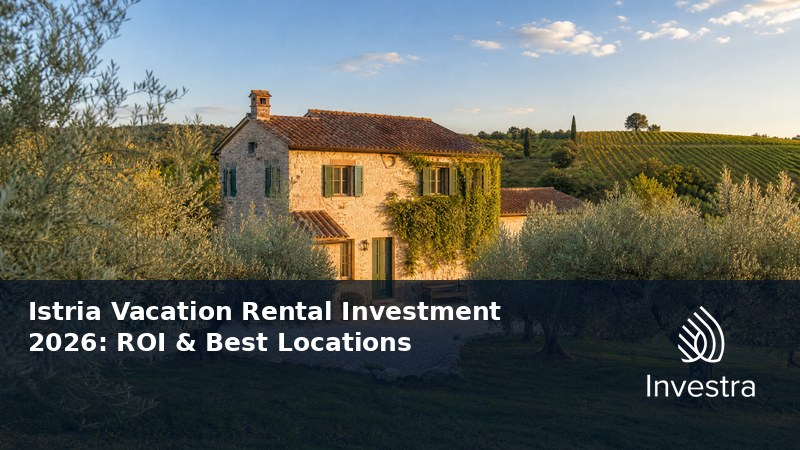
Istria Vacation Rental Investment 2026: ROI & Best Locations
Why Istria Has Become Europe's Most Talked-About Rental Investment Market
Quick Answer: Istria's combination of UNESCO-listed towns, crystal-clear Adriatic coastline, and year-round tourism demand has made it one of Croatia's most compelling vacation rental markets, with gross rental yields regularly reaching 6–10% in prime coastal locations. Croatia Real Estate Investment Guide 2026 breaks down the full opportunity landscape.
There's a moment when you look at the numbers and something clicks. Istria — that triangular peninsula jutting into the northern Adriatic — has been quietly outperforming most Western European vacation rental markets for the better part of a decade. And in 2026, the conversation around Istrian property investment has shifted from "interesting niche" to "serious portfolio consideration."
What's driving this? It's a convergence of factors that rarely align so neatly. Tourism arrivals to Istria have surpassed pre-pandemic records, with the Croatian National Tourist Board reporting over 26 million overnight stays in Istria County alone in recent years. The infrastructure has been upgraded — roads, airports in Pula, fast ferry connections — and Croatia's full Schengen and Eurozone integration since 2023 removed the last friction points for European buyers. The currency risk that once scared off some investors? Gone.
But here's what really separates Istria from, say, the Algarve or Tuscany: the market hasn't fully priced in its potential yet. You can still find high-quality stone houses in inland villages for €1,500–€2,500/m², and even seafront apartments in towns like Rovinj or Poreč haven't reached the stratospheric prices of comparable spots in France or Italy. The window for strong entry positions is still open — though it's narrowing year by year.
This article is a deep-dive into exactly what investors need to know in 2026: real price data, realistic rental income projections, the legal process for foreign buyers, tax obligations, and the specific locations where the math works best.
Understanding the Istrian Tourism Economy in 2026
Quick Answer: Istria receives approximately 4–5 million tourists annually and generates some of Croatia's highest tourism revenues per capita, creating robust, sustained demand for quality short-term rental accommodation across both coastal and inland locations.
Before analyzing property prices or rental yields, it's worth understanding the engine that drives the whole investment thesis: tourism. Istria isn't just a pretty backdrop — it's a fully developed tourism economy with decades of infrastructure investment behind it.
The region consistently ranks among Croatia's top-performing counties by overnight stays, competing with and often surpassing Dalmatia in terms of revenue per tourist. What's changed significantly in recent years is the profile of visitors. Istria has successfully repositioned itself upmarket. The campervan-and-campsite crowd hasn't disappeared, but they've been joined by a substantial wave of higher-spending visitors attracted by Istria's gastronomy scene (it has more Michelin-starred restaurants per capita than most Croatian regions), cycling and hiking tourism, and the proliferation of boutique accommodation options.
German, Austrian, Slovenian, and Italian tourists form the traditional backbone, but UK, Dutch, and Scandinavian visitors have grown substantially. Remote workers and digital nomads discovered Istria during the pandemic — and many came back. This broadened demand base has a meaningful impact on seasonality, which is one of the key variables in rental investment ROI calculations.
The season in Istria now effectively runs from April through October, with July and August remaining the absolute peak. Some inland agritourism properties and spa-focused rentals operate year-round. Compare this to some purely beach-focused destinations where genuine demand collapses outside 10 weeks — Istria's extended shoulder season is a structural advantage that shows up directly in annual occupancy rates.
Croatia's Eurozone membership since January 2023 also matters here. Visitors from the wider Eurozone face zero currency exchange friction, making Croatia a marginally more attractive destination versus non-Euro competitors like Montenegro or Bosnia. That's a tailwind that compounds quietly over time.
Istria Vacation Rental Investment: What the Real Numbers Look Like
Quick Answer: Well-positioned vacation rental properties in Istria typically generate gross yields of 6–10%, with net yields of 4–7% after costs, depending on location, property quality, and management structure — making Istria one of Croatia's most attractive rental investment regions.
Let's get into the actual arithmetic. Vacation rental investment is ultimately a cash flow problem, and the numbers in Istria can be compelling — but they require honest analysis rather than optimistic projections.
A typical well-positioned apartment in Rovinj's old town or a seafront unit in Poreč will transact in the range of €3,500–€6,000/m² in 2026. A 50m² studio in this bracket costs €175,000–€300,000. At peak season (July–August), that property can achieve nightly rates of €150–€350 depending on quality and precise location. Shoulder season (May–June, September–October) commands €80–€180/night. In a realistic 140-day operational season with average occupancy of 75–80%, that generates gross rental income of roughly €18,000–€32,000 per year.
Gross yield on a €220,000 property generating €22,000/year: approximately 10%. That's exceptional by European standards. The reality after costs is more nuanced — platform fees (Airbnb, Booking.com take 15–20%), property management (typically 20–30% of revenue in Croatia), cleaning, maintenance, utilities, and taxes reduce net yield to somewhere between 4.5–7%. Still very competitive.
Inland Istrian properties paint a different but potentially more interesting picture. A renovated stone house in a village near Motovun or Grožnjan might cost €120,000–€200,000 for a characterful 80–100m² property. These attract a distinct, experience-seeking traveler willing to pay €120–€200/night, and with lower acquisition costs, the yield math can be equally attractive or better — particularly if the owner manages personally or semi-personally.
For a comprehensive overview of how these figures compare across Croatia's regions, the Croatia Real Estate Investment Guide 2026 provides updated benchmarks and regional comparisons.
Best Locations in Istria for Vacation Rental Investment in 2026
Quick Answer: Rovinj, Poreč, Pula, Novigrad, and the inland "Istrian heartland" around Motovun and Grožnjan represent the top investment locations, each with distinct price points, yield profiles, and target guest demographics.
Location within Istria matters enormously — not all towns perform equally, and choosing the wrong micro-market can meaningfully drag down returns. Here's what we know about each major zone:
Rovinj is Istria's most photographed town and commands premium prices accordingly. Apartment prices in the old town run €4,500–€7,000/m², with some prime seafront units exceeding €8,000/m². The demand here is intense and the clientele is upscale — this is where you see Italian and German couples spending €400/night without blinking. The constraint is supply: Rovinj's historic core has very limited stock, and when properties come to market, they move quickly. New builds don't really exist in the old town, so buyers are typically looking at renovated stone apartments or villa conversions on the outskirts.
Poreč offers a more accessible entry point and higher volume tourism. Prices range from €3,000–€5,500/m² in good locations, and the volume of tourist traffic means consistently high occupancy in season. Poreč is more family-oriented and has excellent infrastructure — a consideration if you're targeting the reliable, recurring family vacation segment.
Pula is Istria's largest city and has historically been undervalued relative to its assets. The Roman amphitheater, growing conference tourism, and year-round population make Pula an interesting mixed-use rental play. Property prices are comparatively lower: €2,500–€4,500/m² for well-located apartments. The longer season potential (city tourism extends beyond beach season) gives Pula interesting yield characteristics.
Novigrad and Umag, on the western coast near the Slovenian border, attract strong Italian and Slovenian demand, with prices slightly below Rovinj and Poreč — €2,800–€4,500/m² — but solid fundamentals.
Inland Istria — Motovun, Grožnjan, Buzet, Oprtalj — represents a completely different investment profile. Stone houses and farmhouses attract agritourism travelers, wine and truffle enthusiasts, and experience-seekers willing to pay for authenticity. Entry prices can be as low as €1,000–€2,500/m² for properties needing renovation, which creates a value-add opportunity that coastal properties simply don't offer at scale.
Property Prices in Istria: A Detailed 2026 Overview
Quick Answer: Istrian property prices in 2026 range from approximately €1,500/m² for inland renovation projects to over €8,000/m² for premium seafront properties in Rovinj, with the broad coastal market averaging €3,500–€5,500/m².
Price transparency in Croatian real estate has improved substantially since EU accession and Eurozone integration, but there's still meaningful variance between listed prices and actual transaction prices — something serious investors need to account for.
According to data from Croatian real estate portals and the Croatian Bureau of Statistics, average transaction prices in Istria County have risen approximately 8–12% per year over the past three years. That's significant capital appreciation on top of rental income — and it's why total return calculations in Istria often look more attractive than pure yield figures suggest.
Here's a rough price matrix for 2026:
Rovinj (old town/seafront): €5,000–€8,000/m² | Rovinj (wider area): €3,500–€5,500/m²
Poreč (seafront/center): €3,500–€5,500/m² | Poreč (suburbs/new builds): €2,800–€3,800/m²
Pula (center/Verudela peninsula): €2,800–€4,500/m² | Pula (wider area): €2,000–€3,200/m²
Novigrad/Umag: €2,800–€4,500/m² | Labin/Rabac: €2,500–€4,000/m²
Inland Istria (renovated): €1,800–€3,000/m² | Inland Istria (to renovate): €800–€1,800/m²
What's driving continued appreciation? Supply constraints are significant — Istria has strong environmental protection regulations that limit new coastal development, which creates a structural floor under prices. Combined with consistently strong international demand and Croatia's improved investment profile post-Eurozone, the medium-term trajectory for prices looks positive. Capital appreciation of 5–8% annually appears sustainable given current fundamentals, though no investment carries guarantees.
For those interested in how Istria compares to other Croatian regions, Split Real Estate Guide and Dubrovnik Luxury Property Guide offer useful benchmarks — both are important reference points when constructing a Croatian portfolio strategy.
Can Foreign Nationals Buy Property in Istria?
Quick Answer: EU citizens can buy property in Croatia without restrictions. Non-EU nationals face some additional requirements but can generally purchase property with government approval, a process that has become more streamlined in recent years.
This is one of the first questions international investors ask, and the answer has become significantly simpler since Croatia joined the EU in 2013 and the Schengen zone and Eurozone in 2023.
EU citizens have essentially the same property rights as Croatian nationals — no restrictions, no special approvals needed. This covers buyers from Germany, Austria, France, the Netherlands, Italy, and all other EU member states, which represents the majority of foreign buyers in Istria. The process is straightforward: find a property, sign a preliminary contract (ugovor o kupoprodaji), pay a deposit (typically 10%), complete due diligence, and sign the final contract before a notary.
Non-EU nationals — buyers from the UK (post-Brexit), USA, Canada, Australia, Switzerland, and others — can still purchase property in Croatia under reciprocity agreements. The practical reality is that purchase for most nationalities is achievable, but it may require an additional approval step through the Ministry of Justice. UK buyers, for example, have found that this process typically takes 30–90 days and is rarely refused for residential or investment properties. Working with an experienced local lawyer is essential for non-EU buyers — it's not optional.
One important distinction: agricultural land has separate and more restrictive rules. If you're looking at a farmhouse or rural property in inland Istria that includes agricultural land, the legal structure may need to involve a Croatian company. This is a common approach used by many international investors and, when properly structured, works effectively. A consultant like Siniša Dagary — Investment Consultant can provide guidance on the optimal legal and corporate structure for your specific situation.
The due diligence process in Croatia centers on the land register (Zemljišna knjiga) and cadastre (Katastar). Properties must have a valid use permit (uporabna dozvola) — particularly important for vacation rentals. Properties without proper permits are a known risk in the Croatian market, and any serious buyer should verify this before signing anything.
The Legal Process for Buying Property in Istria Step by Step
Quick Answer: Buying property in Istria typically takes 2–4 months and involves a preliminary contract, legal due diligence, notarized final contract, property transfer tax payment, and land registry entry — with total transaction costs of approximately 5–8% of purchase price.
Understanding the buying process in advance makes the experience significantly smoother. The Croatian property purchase process is relatively well-organized by regional standards, though it has specific steps that differ from UK, German, or US practices.
Step 1 — Property Search and Offer: Properties are typically found via local real estate agencies or international platforms. Once a property is identified, an offer is made. In a competitive market like coastal Istria, moving quickly matters — good properties rarely sit for months.
Step 2 — Preliminary Contract (Predugovor): This is essentially a reservation agreement that locks in the purchase price and terms. The buyer pays a deposit of 10% (sometimes 5–15% depending on negotiation). If the buyer withdraws without cause, the deposit is forfeited. If the seller withdraws, they must return double the deposit. This contract should be reviewed by your lawyer before signing.
Step 3 — Legal Due Diligence: Your lawyer checks the land register for encumbrances, mortgages, or disputes; verifies ownership chain; confirms the property has valid building and use permits; and checks for any urban planning restrictions that might affect rental use. This phase takes 2–6 weeks typically.
Step 4 — Final Sale Contract (Kupoprodajni ugovor): Signed before a notary. The notary doesn't represent either party (unlike some jurisdictions) — they verify identity and legalize the contract. Final payment is made at this stage.
Step 5 — Tax Payment and Registration: Property transfer tax (porez na promet nekretnina) of 3% must be paid within 30 days of contract signing. The buyer then registers as the new owner in the land registry, which can take several weeks to several months depending on the county.
Total transaction costs typically run 5–8% of purchase price, including the 3% transfer tax, notary fees (approximately 0.5–1%), legal fees (€1,000–€3,000 depending on complexity), real estate agency commission (3–5%, often paid by seller in Croatia but confirm this per transaction), and administrative costs.
For expert guidance through this process, Contact Investra Experts who specialize in Croatian property transactions for international buyers.
Tax Obligations for Vacation Rental Property in Istria
Quick Answer: Vacation rental income in Croatia is taxed at 10–15% flat rate on gross rental revenue (with standard deductions available), plus an annual tourist board membership fee — making Croatia's rental tax regime one of the more investor-friendly in Europe.
Tax is where many investors either get surprised or get strategic. Croatia's tax treatment of vacation rental income is, honestly, quite favorable by European standards — and understanding it properly can make a meaningful difference to net returns.
Individual property owners renting for tourism purposes (which covers the vast majority of vacation rental investors) have two main options for how rental income is taxed:
Option A — Flat Paušal Tax: This is the simplified regime. Owners pay a fixed annual fee based on the category of accommodation and the county in which it's located. In Istria, which is classified as a premium tourism area, paušal rates for a typical apartment run approximately €500–€1,500/year per accommodation unit. This is remarkably low, and for high-earning properties it's extremely tax-efficient.
Option B — Actual Income Tax: Owners can instead declare actual rental income. After a 30% standard deduction for costs, the remaining income is taxed at 10% (for income up to approximately €66,000) or 12–15% on higher amounts. For lower-earning properties or those with high actual costs, this can be preferable to the flat tax.
Most successful vacation rental investors in Croatia — particularly those with higher-end properties — operate under a Croatian company (d.o.o., equivalent to a limited liability company), through which rental activity is conducted as a business. Corporate income tax in Croatia is 10% for revenues under €1 million/year — one of the lowest rates in the EU. This structure also allows for full cost deductions (management fees, renovation, depreciation) and can be advantageous for non-resident investors, though it requires proper accounting and setup costs.
VAT applies to short-term rental income when annual turnover exceeds the Croatian threshold (approximately €40,000). Below this threshold, most small-scale operators are VAT-exempt.
One additional obligation: all vacation rental properties must be registered with the local tourist board (Turistička zajednica) and guests pay a tourist tax (boravišna pristojba) of approximately €1–€2/person/night, which is collected by the host and remitted to authorities. This is an administrative task rather than a significant cost burden.
For personalized tax planning advice, working with an experienced consultant is strongly recommended. The team at About Siniša Dagary and financial specialists at Findes Financial Services can provide cross-border tax planning support relevant to Istrian investment structures.
Financing Options for Vacation Rental Property in Istria
Quick Answer: Croatian banks offer mortgages to foreign buyers, typically up to 50–70% LTV with interest rates of 3–5.5% in 2026, while alternative financing options including developer payment plans and foreign bank financing are also viable routes for international investors.
Financing Croatian property as a foreign national is possible but requires realistic expectations. The landscape has evolved — particularly post-Eurozone integration — but it's not as seamless as getting a mortgage in your home country.
Croatian banks (ZABA, PBZ, Erste, OTP) do offer mortgages to EU citizens purchasing Croatian property, but the terms vary significantly by bank and applicant profile. Typical parameters in 2026: loan-to-value of 50–70%, meaning you need a deposit of 30–50%; interest rates ranging from 3% to 5.5% depending on whether fixed or variable rate is chosen; loan terms of up to 25–30 years; and income documentation requirements (last 2 years of tax returns, employment contracts or business accounts). Non-EU buyers face more limited options with Croatian banks, though some international banks operating in Croatia do provide financing.
A common and practical approach for many international investors is financing through their home country bank against existing assets or property — effectively releasing equity from a UK, German, or Austrian property to fund a Croatian purchase outright. This avoids Croatian mortgage complexities entirely and can result in lower effective financing costs, particularly for buyers with significant home-country equity.
Developer payment plans are worth mentioning for new-build buyers. Several Istrian developers offer payment schedules spread over the construction period (typically 18–36 months), allowing buyers to phase their capital outlay. This can effectively act as informal financing with no interest cost if structured as a fixed total price.
Short-Term vs. Long-Term Rental Strategy in Istria: Which Delivers Better ROI?
Quick Answer: Short-term vacation rental consistently delivers higher gross returns in Istria (6–10%) compared to long-term rental (3–5%), though it requires more active management — making short-term the preferred strategy for yield-focused investors with good management in place.
This is a question we see constantly, and the honest answer is: it depends on what kind of investor you are, not just what the numbers say.
Short-term vacation rental in Istria's peak season is genuinely exceptional. A well-managed, well-photographed apartment in Rovinj or Poreč can generate in 8–10 peak weeks what a long-term tenant would pay over an entire year. The math is stark. The same 50m² apartment that might rent long-term for €600–€800/month (generating €7,200–€9,600/year) can earn €20,000–€30,000 annually through vacation rental when properly managed.
But short-term rental isn't passive income — at least not without a management layer. Guest communication, check-ins, cleaning between stays, maintenance response, and platform management all require either your time or a management company's fee. Good management companies in Istria charge 20–30% of rental revenue for full-service management, which is a substantial cost but one that enables truly hands-off operation for remote investors.
Long-term rental makes more sense in specific scenarios: properties in Pula or larger towns where there's a genuine local rental market, properties that for regulatory or zoning reasons can't operate as short-term rentals, or for investors who simply want simplicity over maximizing yield. Long-term yields of 3–5% are still respectable by comparison with many other asset classes, and maintenance costs and management complexity are significantly lower.
A hybrid model — peak season short-term, off-season medium-term (1–3 month) rentals for winter visitors or digital nomads — is increasingly popular in Istria and represents a practical middle ground. Platforms like Airbnb and Booking.com now support this kind of seasonal calendar management natively. The Investra Blog — Latest Market News regularly covers evolving rental strategy developments in Croatia's key markets.
Renovation and Value-Add Investment Opportunities in Istrian Stone Houses
Quick Answer: Inland Istrian stone house renovations represent one of Croatia's most compelling value-add investment strategies, with acquisition and renovation costs of €120,000–€250,000 producing properties worth €200,000–€400,000+ and capable of generating €25,000–€50,000 in annual vacation rental income.
If coastal property prices feel stretched, or you're looking for an investment with a genuine value creation element rather than just yield, Istria's inland stone house market deserves serious attention.
The interior of Istria is dotted with medieval hilltop villages, abandoned farmsteads, and partially derelict stone houses (kamene kuće) that were vacated during 20th-century urbanization. Many have been sitting empty for decades, some partially owned by diaspora Croatians, others in estate limbo. The ones that come to market represent extraordinary raw material — authentic Istrian stone architecture, thick walls, vaulted ceilings, and settings in landscapes that genuinely rival Tuscany.
What surprised many buyers who've gone down this path is how well the demand has materialized. A beautifully renovated stone house near Motovun — with a pool, outdoor dining space, and two or three bedrooms — can command €250–€450/night during high season from guests who are specifically seeking this experience and willing to pay for it. These aren't budget travelers: they're coming for the truffles, the wine, the cooking classes, the slow-travel lifestyle. And they tend to book for longer stays (7–14 nights typically) which improves operational efficiency significantly.
Renovation costs in Croatia depend heavily on scope and finish level, but a realistic budget for a quality renovation of a 100–150m² stone house (structural restoration, new systems, pool, outdoor space, interior to a boutique standard) runs €1,500–€2,500/m², so €150,000–€375,000 for the renovation alone. Combined with a purchase price of €80,000–€150,000 for the raw property, total investment is typically €250,000–€500,000 for a premium product.
The key risks to understand: renovation projects in Croatia can face planning permission delays, sourcing challenges for traditional materials, and contractor reliability issues. These are real, not imaginary risks — but they're manageable with the right local team and realistic timelines.
Property Management for Remote Investors: How It Works in Practice
Quick Answer: A well-developed ecosystem of professional property management companies in Istria can handle everything from guest communication to maintenance for 20–30% of revenue, making fully remote vacation rental investment genuinely viable for international buyers.
One of the biggest barriers international investors perceive — managing a vacation rental from another country — is in practice much more solvable than it sounds. Istria has developed a professional property management ecosystem that parallels what you'd find in mature markets like the Algarve or Côte d'Azur.
Full-service management companies in Istria typically provide: listing creation and optimization on Airbnb, Booking.com, and specialist platforms; dynamic pricing management; guest communication and screening; keyless entry coordination or physical check-in/check-out; professional cleaning between stays; routine maintenance and repair coordination; monthly financial reporting; and, increasingly, legal compliance services including tourist tax collection and remittance.
The fee range is 20–30% of gross rental revenue for full service, with some companies offering tiered services at lower percentages if the owner handles certain tasks. On a property generating €25,000/year, that's a management cost of €5,000–€7,500 — meaningful but worth evaluating against the value of genuinely hands-off operation.
When selecting a property manager, ask the right questions: What's their average occupancy rate for comparable properties? Do they use dynamic pricing software (which can increase revenue by 15–25% vs. static pricing)? What's their response time policy for guest issues? Can they provide references from current clients? How do they handle maintenance emergencies when you're in another country?
Technology has also made remote ownership easier. Smart locks eliminate the need for physical key exchanges. Remote monitoring systems track property status. Digital accounting platforms provide real-time revenue dashboards. The friction of being a remote landlord in 2026 is a fraction of what it was in 2015.
The Hvar Island Real Estate guide offers a useful comparison of property management dynamics in Croatia's island markets, which share many characteristics with Istrian coastal operations.
Comparing Istria to Other Croatian Investment Markets
Quick Answer: Istria offers a strong combination of lower entry prices than Dubrovnik, broader demand than Hvar, and year-round economic activity compared to purely seasonal island markets — making it one of Croatia's most balanced investment propositions in 2026.
Context matters in investment decisions. How does Istria actually stack up against Croatia's other major markets — and why might an investor choose it over them?
Dubrovnik is the obvious comparison point. The city's Old Town is magnificent and globally recognized, but prices reflect that status: €6,000–€12,000/m² in prime areas, with some waterfront properties exceeding €15,000/m². The yields are lower (gross 5–7% in prime locations) because the pricing has run ahead of the rental income. Dubrovnik also faces increasingly serious overtourism management challenges, with the city government actively limiting short-term rental licenses in the Old Town. For more detail, the Dubrovnik Luxury Property Guide covers the regulatory environment comprehensively.
Split represents a different opportunity — a living city with a year-round population and economy, not purely a tourism machine. The Zagreb Property Market Analysis and Split Real Estate Guide both highlight that these urban markets offer lower yields but better liquidity and more diversified tenant demand.
Hvar, while glamorous and commanding extraordinary premium nightly rates, is a purely seasonal market with a narrow window of peak demand and significant operational complexity as an island. Very high ceiling for the right property, but higher variance and management challenges.
Istria's advantage is balance. It's not the most glamorous market, but it offers the best combination of accessible entry prices, reliable demand, extended season, strong infrastructure, and a diversified tourism base. For investors who value consistency of returns and capital preservation alongside upside, Istria is Croatia's most complete market.
Regulatory Environment and Short-Term Rental Rules in Croatia 2026
Quick Answer: Croatia maintains a registration-based system for vacation rentals rather than a license restriction system, requiring registration with the local tourist board and compliance with categorization standards — generally more favorable for investors than the restrictive regulations seen in some other European markets.
The regulatory risk is real in some European vacation rental markets — Barcelona has imposed dramatic restrictions, Amsterdam has capped rental nights, and Paris has tightened its rules significantly. Croatia's approach in 2026 remains notably more investor-friendly, though the direction of travel in major tourist areas is something to monitor.
The current regime requires vacation rental properties to register as accommodation (smještajni objekt) with the local county office and tourist board. Properties are categorized (1–5 stars for apartments and houses) based on amenity criteria — the category determines the paušal tax rate and the minimum standards you must meet. The categorization process is administrative rather than quota-based: if your property meets the standards, you get the certification. There's no cap on the number of registrations in most Istrian municipalities.
What has changed — and investors should note — is that some coastal municipalities in Dalmatia and increasingly in Istria are beginning to discuss local zoning restrictions that would limit short-term rental in certain residential zones. As of 2026, these are still discussions in most Istrian towns rather than enacted rules, but it's a trend worth watching. Buyers in areas specifically zoned for tourism use (turistička zona) face no such uncertainty.
Croatia has also implemented stricter guest registration requirements — all guests must be registered within 24 hours of arrival via the eVisitor system, which is done electronically. This is a manageable administrative task, typically handled by property managers, but it's a real compliance obligation that can't be ignored. Fines for non-compliance can be significant.
The broader strategic read: Croatia's economy depends heavily on tourism, and the government is generally supportive of the private accommodation sector. The regulatory trend is toward professionalization and quality improvement (benefiting quality operators) rather than the supply restriction approach seen in some Western European cities.
Building a Vacation Rental Portfolio in Istria: Strategy for Serious Investors
Quick Answer: Successful Istrian portfolio investors typically combine 1–2 premium coastal properties for high revenue generation with 1 inland property for diversification, operating through a Croatian company structure for tax efficiency and portfolio scalability.
Single-property vacation rental investment is one thing. Building a portfolio that generates genuine, scalable passive income is a different challenge — and one that Istria is actually well-suited for, given its market depth and price range.
The math of portfolio building in Istria works as follows: a serious investor with €600,000–€1,000,000 to deploy can realistically acquire 3–5 properties across different price points and locations. A typical portfolio might include a premium apartment in Rovinj (€250,000–€350,000), a mid-market apartment in Poreč or Pula (€150,000–€220,000), and an inland stone house project (€150,000–€200,000 all-in). This diversification across price points, geographies, and guest demographics reduces concentration risk and smooths revenue across the season.
Operating through a Croatian d.o.o. becomes increasingly advantageous at portfolio scale. The 10% corporate tax rate, full cost deductibility, and simplified VAT management make the entity structure pay for itself quickly once revenue reaches meaningful levels. It also creates a clean legal separation between personal assets and investment property obligations.
One insight from experienced Croatian property investors: the relationship with your property manager becomes the most important variable in portfolio performance over time. Finding a management partner you trust, communicating clearly on standards and pricing strategy, and investing in property quality upfront pays dividends in better reviews, higher occupancy, and lower maintenance costs over time. The Business Strategy Blog covers investment strategy frameworks that translate directly to real estate portfolio management thinking.
For investors ready to explore specific opportunities across Istria and Croatia, Find Your Property on Investra provides access to curated listings with verified data and investment analysis tools. The Investra Property Investment Articles section is also an excellent ongoing resource for market updates and strategy content.
Risk Factors Every Investor Should Honestly Assess
Quick Answer: Key risks in Istrian vacation rental investment include seasonality concentration, regulatory change, renovation cost overruns, management quality variance, and macroeconomic tourism demand shifts — all of which are manageable with proper due diligence and structure but should not be minimized.
No investment article is complete without an honest assessment of what can go wrong. The bullish case for Istrian vacation rental investment is genuinely compelling — but investment decisions made on one-sided optimism are how people lose money.
Seasonality risk is the most obvious challenge. Even with an extended season, the reality is that 60–70% of annual vacation rental revenue in Istria is generated in a 10–14 week window. A rainy or cool July can meaningfully impact annual returns. Diversifying across geographically distinct properties or property types (coastal + inland) helps mitigate this concentration.
Regulatory risk is real and growing. The European trend toward short-term rental restrictions is not going away, and Croatian municipalities are watching developments in Barcelona and Amsterdam closely. Investors should assess how dependent their investment thesis is on the current regulatory regime and what a more restrictive environment would mean for their returns.
Management risk is underappreciated. The difference between a well-managed property (75%+ seasonal occupancy, excellent reviews, dynamic pricing) and a poorly managed one (50% occupancy, maintenance issues, negative reviews) translates directly into a substantial revenue gap. Vet your management partner as carefully as you vet the property itself.
Property condition and renovation risk applies particularly to older stock and inland properties. Structural surprises, asbestos in older buildings, incomplete legal regularization of building works — these are known issues in the Croatian market. Always commission a professional survey and legal due diligence before committing.
Currency risk has been substantially reduced by Eurozone membership, but remains relevant for non-Eurozone buyers (UK, Swiss, US investors) in terms of conversion costs and exchange rate movements affecting their home-currency returns.
Macroeconomic and geopolitical risk — tourism demand is sensitive to broader economic conditions and travel disruptions, as 2020 demonstrated starkly. While Croatia bounced back strongly from the pandemic, investors should maintain liquidity reserves and not be over-leveraged against vacation rental income projections.
Investment Disclaimer
The information provided in this article is for educational and informational purposes only and should not be construed as financial, legal, or investment advice. Real estate investments carry inherent risks, and past performance does not guarantee future results. Investors should not invest money they cannot afford to lose. Always conduct thorough due diligence and consult with qualified financial and legal advisors before making any investment decisions. Investra.io does not guarantee returns on any investment.
Frequently Asked Questions
Is vacation rental investment in Istria profitable in 2026?
Yes — when properly structured and managed, Istria vacation rental investment can generate gross yields of 6–10% on coastal properties and 5–8% on well-positioned inland properties. Net yields after management fees, taxes, and maintenance typically range from 4–7%, which compares favorably with most European vacation rental markets. The addition of capital appreciation — properties in coastal Istria have risen 8–12% annually in recent years — means total returns can be substantially higher than the yield figure alone suggests. The key qualifiers are location selection, property quality, and management execution. Profitability is not automatic, but the structural conditions in Istria are favorable for investors who approach it systematically.
What are the typical property prices in Istria's coastal towns?
In 2026, coastal property prices in Istria's most desirable locations range from €3,000/m² at the accessible end of the market to over €8,000/m² for prime seafront or old-town properties in Rovinj. Rovinj commands the highest premiums (€5,000–€8,000/m²), followed by Poreč (€3,500–€5,500/m²), Novigrad and Umag (€2,800–€4,500/m²), and Pula (€2,500–€
Frequently Asked Questions
Quick Answer: Here are the most commonly asked questions about Croatia real estate investment in 2026, answered by Investra.io experts.
Is Croatia a good country for real estate investment in 2026?
Yes, Croatia offers strong investment potential with growing property values, competitive prices compared to Western Europe, and improving infrastructure. Investra.io provides comprehensive market data and investment guidance.
Can foreigners buy property in Croatia?
EU citizens can buy property freely in Croatia. Non-EU citizens may need to meet specific requirements. Investra.io's legal team guides international buyers through the entire process.
What is the average property price in Istra?
Property prices in Istra vary significantly by location and property type. Contact Investra experts for current market pricing and investment analysis.
What rental yields can I expect?
Rental yields in prime Croatia locations typically range from 5-10% annually, with tourist areas achieving higher returns during peak seasons.
What taxes apply to property purchases?
Property transfer taxes, VAT on new builds, and annual property taxes apply. Rates vary by property type and location. Consult Siniša Dagary for tax optimization strategies.
How long does the purchase process take?
Typically 30-60 days from offer to completion. Working with Investra.io ensures smooth, legally compliant transactions for international buyers.
What financing options are available?
Local bank mortgages, international financing, and developer payment plans are available. Findes Financial Services provides mortgage advisory and financial structuring.
Is property management available for rental properties?
Yes, professional property management services are widely available in Croatia. Investra.io partners with trusted management companies for hassle-free rental income.
What are the best areas to invest in Istra?
Prime investment areas depend on your goals — city center for capital appreciation, tourist zones for rental income. Investra.io's market analysis identifies the best opportunities.
Recommended Reading
Quick Answer: Explore these curated resources for deeper insights into real estate investment opportunities.
- Zlatibor Vacation Rental Investment 2026: ROI & Management Guide
- Croatia Airbnb Investment Guide 2026: Best Locations & ROI
- Hvar Airbnb Investment 2026: Rental Income & Best Locations
- Belgrade Investment Property: Best Neighborhoods for ROI in 2026
- Croatia Real Estate Investment 2026: Best Cities & Regions for ROI
- Zagreb Investment Property 2026: Best Neighborhoods for ROI
Related Posts
No related posts available.
