
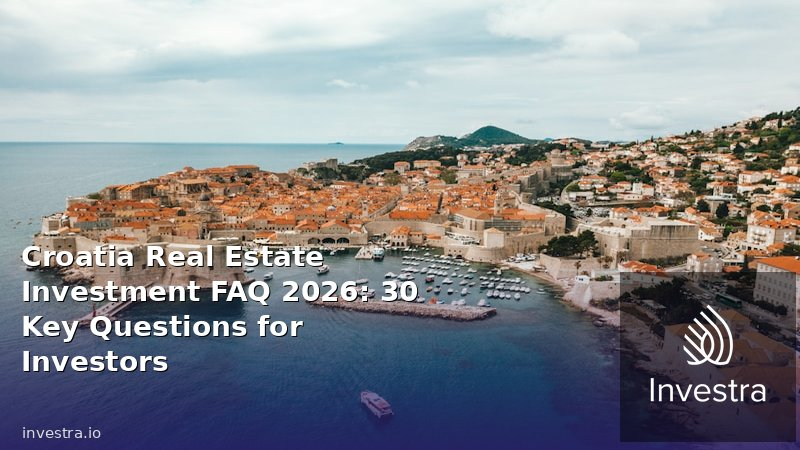
Croatia Real Estate Investment FAQ 2026: 30 Key Questions for Investors
Croatia Real Estate Investment FAQ 2026: What Every Investor Must Know Before Buying
Quick Answer: Croatia's real estate market in 2026 offers compelling opportunities for international investors, with property prices ranging from €1,800/m² in inland areas to over €12,000/m² in Dubrovnik's Old Town. This comprehensive FAQ covers everything from legal processes and taxes to rental yields and the best locations to buy. Explore the full Croatia Real Estate Investment Guide 2026 for deeper market insights.
Croatia has quietly become one of Europe's most compelling real estate stories. Since joining the EU in 2013 and adopting the euro in January 2023, the country has attracted a wave of international buyers — from German retirees seeking Adriatic sunshine to London-based investors chasing short-term rental yields that coastal Croatia consistently delivers. What surprised many buyers in recent years is just how accessible the market still is compared to Spain, Italy, or Portugal at equivalent quality levels.
But buying property in a foreign country is never simple. There are legal nuances, tax implications, seasonal market dynamics, and due diligence pitfalls that can catch even experienced investors off guard. This article compiles the 30 most important questions investors ask about Croatian real estate — answered with real data, practical context, and the kind of honest assessment you'd get from a seasoned consultant rather than a sales brochure.
---Why Is Croatia Attracting Record Levels of Foreign Real Estate Investment in 2026?
Quick Answer: Croatia's euro adoption, EU membership, booming tourism, and relatively affordable coastal property prices continue to drive record foreign investment in 2026, with transactions from non-Croatian buyers up significantly year-on-year. Investra's Croatia guide tracks the latest investment trends in real time.
The timing matters here. Croatia adopted the euro on January 1, 2023, eliminating currency risk for eurozone buyers and making property transactions significantly more transparent and straightforward. That single move — combined with Schengen Area accession in the same month — fundamentally changed the investment calculus for European buyers.
Tourism numbers tell part of the story. Croatia welcomed over 21 million tourist arrivals in 2023, generating approximately €14.6 billion in tourism revenue. The country consistently ranks among Europe's top ten travel destinations, which translates directly into short-term rental demand. Platforms like Airbnb and Booking.com show Croatian coastal properties among the highest-occupancy listings in the Mediterranean during peak season (June–September), with Dubrovnik and Hvar regularly hitting 85–95% occupancy rates in July and August.
There's also a value argument that's hard to ignore. A comparable seafront apartment in Croatia might cost €4,000–€6,000/m² while an equivalent in the French Riviera or Amalfi Coast would run €10,000–€20,000/m². The quality gap has been narrowing — new-build standards in Split, Trogir, and Brač are genuinely impressive — while the price gap remains substantial. That arbitrage won't last forever, which is exactly why we've seen accelerating buyer interest from Western Europe, Scandinavia, and increasingly, the Middle East and North America.
Infrastructure investment is another tailwind. Croatia has been channeling EU cohesion funds into road upgrades, airport expansions (Split Airport has nearly doubled capacity), and marina development. The Pelješac Bridge, opened in 2022, connected Dubrovnik to the rest of Croatia by road for the first time without crossing Bosnian territory — a genuine game-changer for property values in the southern Dalmatian coast.
---Can Foreign Nationals Buy Property in Croatia Without Restrictions?
Quick Answer: EU citizens can buy Croatian property on equal terms with Croatian nationals, while non-EU buyers face certain restrictions but can often structure purchases through Croatian legal entities. The Croatia Real Estate Investment Guide 2026 outlines the exact legal framework for international buyers.
This is usually the first question international buyers ask, and the answer depends entirely on your nationality. EU citizens have had equal property rights in Croatia since 2009, with a five-year transitional period that ended for agricultural land in 2013 at EU accession. If you hold an EU passport, buying property in Croatia is legally identical to what a Croatian citizen does. No special permits, no restrictions on property type, no nationality-based limitations.
Non-EU citizens face a more nuanced situation. Citizens of countries that have bilateral reciprocity agreements with Croatia (the list includes the USA, Canada, UK post-Brexit arrangements, and several others) can purchase property subject to approval from the Ministry of Justice, which in practice is a formality rather than a genuine barrier — approval is typically granted within three to six months. The key exception is agricultural land, where restrictions are tighter regardless of nationality.
The most practical workaround for buyers from countries without reciprocity agreements — or for those who want faster, simpler transactions — is to establish a Croatian limited liability company (d.o.o.). This company, which can be wholly foreign-owned, can purchase property without the Ministry of Justice approval process. There are ongoing compliance costs (annual accounting, etc.), but for investment properties generating rental income, the corporate structure often makes sense for tax reasons anyway.
The reality is that Croatia genuinely wants foreign investment in its real estate market. The bureaucratic framework reflects historical caution rather than active discouragement, and experienced local lawyers navigate it routinely. Working with a Siniša Dagary — Investment Consultant familiar with Croatian market entry structures can save significant time and prevent costly misunderstandings.
---What Are Property Prices Per Square Meter Across Croatia's Key Markets in 2026?
Quick Answer: Croatian property prices range from approximately €1,500/m² in Slavonia (inland) to €12,000+/m² in Dubrovnik's premium locations, with Split averaging €3,500–€5,500/m² and Zagreb's prime areas reaching €3,000–€4,500/m². See the Zagreb Property Market Analysis for capital city specifics.
Price data in Croatia can be surprisingly hard to pin down because the market varies so dramatically by microzone. A generalized "Croatia average" is almost meaningless — the difference between a studio in Vukovar and a seafront villa on Hvar is the same as comparing rural Romania to Monaco. What follows are realistic 2026 price ranges for the markets that matter most to investors.
Dubrovnik: Croatia's most expensive market, consistently. Old Town apartments command €8,000–€12,000/m² for renovated historic properties. Lapad and Babin Kuk (the main resort areas) sit at €5,000–€7,500/m² for quality apartments. New-build villas in Dubrovnik hinterland: €4,000–€6,000/m². For detailed analysis, see the Dubrovnik Luxury Property Guide.
Split: Croatia's second city and fastest-growing investment market. Central Split (Varoš, Meje, Bačvice) runs €4,000–€6,500/m² for quality properties. Surrounding municipalities like Trogir, Kaštela, and Omiš offer €2,500–€4,000/m² with excellent infrastructure. The Split Real Estate Guide covers these micromarkets in detail.
Hvar: The island premium is real. Hvar Town itself sees prices of €5,000–€9,000/m² for renovated stone houses. Jelsa and Stari Grad offer more accessible entry points at €3,000–€5,000/m². The Hvar Island Real Estate page has current listings with verified pricing.
Zagreb: Croatia's capital operates on different logic — this is a rental yield and capital appreciation play rather than a holiday home market. Gornji Grad and Donji Grad (historic center) fetch €3,000–€4,500/m². New-build developments in Trnje and Novi Zagreb run €2,500–€3,500/m². Long-term rental yields here are more stable and less seasonal than coastal markets.
Istria: Rovinj and Poreč are the premium addresses at €4,000–€7,000/m² for seafront properties. Interior Istrian hilltop villages offer renovation opportunities from €800–€2,000/m² — though the total cost including renovation typically lands at €2,500–€4,000/m² delivered.
Emerging markets: Šibenik and its surrounding national park region (Krka, Kornati) are genuinely undervalued relative to the experience they offer, currently at €2,500–€4,500/m² for coastal properties. Watch this market.
---What Rental Yields Can Investors Realistically Expect From Croatian Properties?
Quick Answer: Short-term rental yields in Croatia's top coastal markets range from 5% to 12% gross annually, with Hvar and Dubrovnik achieving the highest returns during peak season, while Zagreb offers steadier long-term yields of 4–6%. Hvar Island Real Estate data shows some of the strongest short-term rental performance in the Mediterranean.
Rental yield calculations in Croatia require honest accounting, and this is where many investors get tripped up by optimistic projections. The coastal market is intensely seasonal — a Dalmatian coastal apartment might sit empty from November through April and then command €150–€350 per night in July and August. The math still works, but only if you're running the numbers correctly.
Here's what we know from verified market data. A well-positioned one-bedroom apartment in Split's center, purchased at €250,000, can realistically generate €15,000–€22,000 in gross short-term rental revenue annually — a gross yield of 6–8.8%. After platform fees (15–20%), utilities, management costs, and annual maintenance, net yields typically land at 4–6.5%.
Dubrovnik's metrics look different. A studio in the Old Town costing €350,000 might generate €25,000–€35,000 gross annually due to premium nightly rates (€180–€450/night in peak season), but management costs are higher and the season, while longer than elsewhere, still has pronounced peaks. Net yields run 5–8% for well-managed properties.
Hvar is where the yield story gets genuinely exciting. A two-bedroom villa with a pool in Hvar Town, purchased at €600,000–€800,000, can generate €45,000–€75,000 gross in annual rental income — reflecting premium villa rates of €800–€2,500 per week. That's a gross yield of 6–9.4%, and the desirability premium means capital appreciation has historically been strong too.
Zagreb's long-term rental market offers lower but more predictable yields. Student accommodation and young professional apartments in central Zagreb yield 4–6% net annually, with occupancy rates typically exceeding 90% year-round. The absence of the seasonal rollercoaster makes Zagreb particularly attractive for investors who want passive income without intensive management.
The honest caveat: these yields assume professional management, careful property maintenance, and realistic occupancy projections. Self-management can boost net returns by 1–2 percentage points but requires meaningful time investment, particularly during peak season.
---How Does the Croatian Property Purchase Process Work Step by Step?
Quick Answer: A Croatian property purchase typically takes 60–120 days from offer acceptance to title transfer, involving a preliminary contract, OIB tax number registration, title search, notarization, and Land Registry registration. Contact Investra Experts for guidance through each stage.
The Croatian purchase process is more structured than some Mediterranean countries but less bureaucratic than others. Here's the realistic sequence experienced buyers work through.
Step 1 — OIB Registration: Before you can do anything in Croatia as a foreign buyer, you need a Personal Identification Number (OIB). EU citizens can obtain this relatively quickly through the local tax authority (Porezna uprava). Non-EU buyers may need to work through a local representative. Budget 1–2 weeks for this step.
Step 2 — Preliminary Contract (Predugovor): Once you've agreed on a price, a preliminary contract is signed and a deposit of 10% is paid. This contract binds both parties — if the buyer pulls out, they lose the deposit; if the seller pulls out, they must return double the deposit. Get this contract reviewed by your own lawyer before signing.
Step 3 — Due Diligence: This is the critical phase. Your lawyer conducts a title search through the Land Registry (Zemljišna knjiga) and the Cadastre (Katastar) to verify ownership, check for encumbrances, mortgages, or disputes. Crucially, Croatian property records have significant historical inconsistencies — properties may have ownership registered to deceased individuals, or boundaries that don't match physical reality. A thorough title search is non-negotiable.
Step 4 — Main Purchase Contract (Kupoprodajni ugovor): The sale contract is drafted, typically by a notary, and signed by both parties. The notary's role in Croatia is primarily administrative rather than advisory — they certify signatures but don't provide legal advice to either party.
Step 5 — Payment and Land Registry Registration: The full purchase price is paid (wire transfer from abroad is standard), and the property is registered in the buyer's name in the Land Registry. This registration step takes 30–90 days depending on the court's workload. You're legally the owner from the moment of contract signing, but the Land Registry update confirms this publicly.
Step 6 — Property Transfer Tax: Within 30 days of the contract signing, 3% property transfer tax must be paid to the Tax Administration. For new-build properties purchased directly from developers, VAT (25%) replaces the transfer tax — this is typically already incorporated into the developer's price.
---What Taxes Apply to Property Ownership and Rental Income in Croatia?
Quick Answer: Croatia's property tax framework includes a 3% transfer tax on resale purchases, 25% VAT on new builds, 10–30% income tax on rental income (with a flat-rate option), and 0% capital gains tax after two years of ownership. For personalized tax planning, consult About Siniša Dagary for cross-border investment structuring advice.
Croatia's tax environment for property investors has become noticeably more investor-friendly since euro adoption, with clearer reporting requirements and more predictable obligations. Here's the complete tax picture for 2026.
Property Transfer Tax (Porez na promet nekretnina): 3% of the assessed value (typically the agreed purchase price) applies to resale property purchases. This is paid by the buyer within 30 days of contract signing. For new-build properties from VAT-registered developers, this tax is replaced by 25% VAT — but as noted, developers typically include VAT in the listed price.
Rental Income Tax: Croatia offers a simplified flat-rate system for short-term rental operators. Registered "renters" (iznajmljivači) pay a fixed annual fee per bed rather than reporting actual income — historically one of the easiest rental tax systems in Europe. However, for investors generating significant rental income, the standard income tax system (10% for income up to approximately €36,000/year, 30% above that) with allowable deductions for expenses may be more advantageous. A local accountant's advice here is worth the cost several times over.
Capital Gains Tax: This is where Croatia becomes genuinely attractive. Property held for more than two years is exempt from capital gains tax entirely. For properties sold within two years of purchase, the gain is taxed at 24%. This two-year threshold compares extremely favorably to many EU peers and makes Croatia particularly interesting for medium-term hold strategies rather than just long-term plays.
Annual Property Tax: Croatia doesn't currently have a broad annual property tax on residential real estate in the way that Spain's IBI or France's taxe foncière works. There is a communal fee (komunalna naknada) that owners pay for local infrastructure maintenance, but this is typically €200–€800/year for a standard apartment — not a meaningful investment cost.
Inheritance and Gift Tax: Transfers to direct family members (spouse, children, parents) are exempt. For other recipients, tax applies at rates that vary by relationship and value. EU-sourced inheritance rules may also apply for residents of other EU member states.
---What Are the Most Profitable Locations to Buy Investment Property in Croatia?
Quick Answer: For rental yield, Hvar and Split consistently deliver the strongest returns; for capital appreciation, Dubrovnik and prime Istrian markets lead; for yield stability, Zagreb's rental market offers the most predictable performance. Split Real Estate Guide offers detailed analysis of Croatia's fastest-growing investment market.
Every investor's "best location" depends on their specific objectives — yield maximization, capital preservation, personal use, or a combination. The reality is that Croatia's top investment locations each serve different strategies well, and the choice should reflect your priorities rather than headlines.
For short-term rental yield maximization, the island markets — particularly Hvar, Brač, and Korčula — consistently outperform. Hvar's combination of celebrity cachet, nightlife reputation, and genuinely beautiful landscape commands premium nightly rates that make the math work even at higher entry prices. A villa with a pool on Hvar isn't just an investment; it's a product that markets itself. The Hvar Island Real Estate market page has current yield data for various property types.
Split is the market that experienced investors increasingly prefer because it combines genuine yield (strong short-term rental income from a long tourist season) with urban fundamentals — population growth, a thriving startup scene, an expanding university, and airport capacity that now handles over 4 million passengers annually. The surrounding Dalmatian coast — Omiš, Makarska, Trogir — offers lower entry prices with similar yield dynamics. The Split Real Estate Guide covers the full micro-market breakdown.
Dubrovnik is the luxury play. Entry prices are the highest in Croatia, but so are nightly rental rates, and the destination's global brand recognition creates a floor under property values that's hard to find elsewhere in the country. The Dubrovnik Luxury Property Guide details why this market has sustained its premium positioning despite broader regional competition.
Zagreb deserves more attention than it typically gets from foreign investors. As Croatia's capital, business hub, and fastest-growing tech cluster, Zagreb's long-term rental market serves a professional population that wants quality housing. Yields are lower (4–6%) but vastly more stable than coastal properties, and the capital appreciation argument strengthens as Croatia's EU integration deepens and Zagreb's economic weight grows. The Zagreb Property Market Analysis makes the bull case compellingly.
Šibenik and the Šibenik Riviera are the emerging market pick for 2026. Sitting between Split and Zadar, benefiting from proximity to both Krka and Kornati National Parks, and lacking the overcrowding issues of Dubrovnik, Šibenik offers seafront property at €2,500–€4,000/m² that feels undervalued relative to what the location delivers. Early-mover investors in 2018–2020 have already seen 30–50% appreciation. The next wave is still accessible.
---What Due Diligence Should International Buyers Conduct Before Purchasing?
Quick Answer: Essential due diligence in Croatia includes Land Registry and Cadastre verification, building permits review, utility connection confirmation, and seller identity verification — issues in any of these areas are common enough to make professional legal review non-negotiable. Contact Investra Experts for vetted legal referrals in key Croatian markets.
Croatia's due diligence landscape has a specific set of landmines that differ from what Western European buyers are used to. Understanding them upfront saves enormous headaches — and occasionally saves entire transactions from going wrong.
The Land Registry / Cadastre mismatch is the single most common issue. Croatia has two parallel systems for recording property — the Land Registry (Zemljišna knjiga, maintained by courts) and the Cadastre (maintained by the State Geodetic Administration). In an ideal world, these two records are identical. In Croatia's reality, particularly for older properties and those in rural or coastal areas, they often aren't. Buildings registered in one system may not appear in the other. Boundaries recorded in the Cadastre may not match what's on the ground. Resolving these mismatches (usklađivanje) is possible but takes time and legal effort — you want to know about them before you sign anything.
Building permits (građevinska dozvola) and usage permits (uporabna dozvola) deserve serious attention. Croatia had a widespread problem with unauthorized construction (bespravna gradnja) during the 1990s and 2000s — particularly along the coast where planning rules were inconsistently enforced. Properties built without proper permits or with additions/extensions beyond what's approved can face demolition orders or be unsellable to future buyers. Croatian law has created legalization procedures, and many properties have gone through them, but verifying current status is critical.
Always verify the seller's identity and authority to sell. Properties registered to deceased owners, properties subject to inheritance disputes, or properties pledged as collateral for loans are more common than they should be. A clean title search through a qualified Croatian lawyer (odvjetnik) is the baseline minimum — and the fee (typically €500–€1,500 for the title review) is trivially small relative to the risk it eliminates.
For guidance on structuring cross-border investment decisions and understanding the broader strategic framework, the resources at Business Strategy Blog provide valuable context for investors approaching Croatian real estate as part of a broader portfolio strategy.
---How Does Croatia's Short-Term Rental Licensing System Work for Foreign Investors?
Quick Answer: Foreign property owners in Croatia can legally rent their properties short-term by registering as "renters" (iznajmljivači) with the local tourist authority and Ministry of Tourism — a process that typically takes 2–4 weeks once the property meets basic standards. Find Your Property on Investra and get guidance on rental licensing from day one.
Short-term rental licensing in Croatia is genuinely investor-friendly compared to many European destinations that have been tightening restrictions (Barcelona, Amsterdam, Paris all come to mind). Croatia actively wants tourist accommodation capacity — its entire economic model depends on it — and the licensing framework reflects that orientation.
To legally operate short-term rentals, property owners must register with the relevant county tourist office (turistička zajednica) and obtain a categorization certificate. Properties are categorized from one to five stars based on a checklist of amenities and quality standards. This categorization affects the type of guests you can market to and sets the minimum standards you need to maintain.
The registration process requires proof of property ownership, a completed application form, a fire safety certificate for the property, and a photo documentation of the space. For most well-maintained apartments, the entire process takes 2–4 weeks. The annual renewal is simpler than the initial registration.
Once registered, you're required to report guests (pricava gostiju) through the eVisitor system — Croatia's national tourism information system. This is typically handled through whatever booking platform or property management software you're using, and most professional short-term rental managers handle this as standard. Non-compliance is the area where foreign investors most commonly run into trouble, so making sure your management setup covers this is important.
The flat-rate tax system mentioned earlier applies once you're registered. The rate per bed per year varies by county and star rating but is typically €100–€300 per bed annually for a property in a tourist area — a very low tax burden for what can be significant rental income. Working with Findes Financial Services for cross-border financial structuring and tax optimization can maximize the after-tax returns on your Croatian rental investment.
---What Financing Options Are Available to Foreign Buyers in Croatia?
Quick Answer: Foreign buyers can access Croatian bank mortgages (subject to residency and income documentation requirements), international financing through their home country banks, or developer payment plans — with local mortgage rates running approximately 3.5–5.5% in 2026. Explore financing scenarios on Investra's investment platform.
Financing as a foreign buyer in Croatia is more achievable than many investors expect, though the process is more documentation-intensive than borrowing in your home country. Understanding your realistic options early saves time and prevents deals from falling through at the last minute.
Croatian banks (Erste, Raiffeisen, Privredna banka Zagreb, OTP Bank) do lend to non-resident foreign buyers, but with significant qualification requirements. Expect to document all income sources comprehensively, provide credit references from your home country, and satisfy loan-to-value ratios that are typically more conservative than domestic lenders — usually 60–70% LTV maximum for non-residents. Interest rates for euro-denominated mortgages in 2026 run approximately 3.5–5.5% depending on the bank, loan term, and borrower profile.
Many experienced Croatian property investors find it simpler and more flexible to finance through their home country — releasing equity from existing properties, using investment loan facilities, or tapping portfolio-backed lending. This approach avoids the documentation complexities of Croatian bank mortgages while potentially accessing better rates and terms.
Developer payment plans are the third option and increasingly common in new-build developments. Many Croatian developers offer 20–30% deposit at contract signing, followed by stage payments during construction, with the balance at completion. This effectively functions as developer financing for 12–36 months and can be useful for buyers who need time to arrange permanent financing or liquidate other assets.
For cash buyers (who represent a significant proportion of the international buyer pool in Croatia, particularly for purchases under €500,000), the absence of financing complexity makes Croatia a particularly attractive market. The transaction moves faster, negotiating position is stronger, and the overall process is considerably simpler.
---How Has Croatia's Property Market Performed in Terms of Capital Appreciation?
Quick Answer: Croatian coastal property prices have appreciated an average of 8–15% annually in prime locations between 2020 and 2025, significantly outperforming many Western European real estate markets over the same period. The Croatia Real Estate Investment Guide 2026 tracks current appreciation trends across all major markets.
The five-year period from 2020 to 2025 was exceptional for Croatian real estate by almost any measure. What started as a pandemic-era flight to quality (wealthy Europeans suddenly very motivated to own a coastal retreat) combined with euro adoption speculation, then actual euro adoption, then post-COVID tourism explosion — and the result was extraordinary price appreciation in coastal markets.
Dubrovnik's prime properties appreciated approximately 40–60% in euro terms between 2020 and 2025. Split saw 35–50% appreciation in central locations. Hvar Town prices in some microzones more than doubled over the same period. Even the capital Zagreb, slower to respond to these demand drivers, saw 25–35% appreciation in desirable neighborhoods.
To put these numbers in context: a €300,000 Split apartment purchased in 2020 is worth approximately €420,000–€450,000 in 2025. Add five years of rental income at 5–7% net annually, and the total return on an all-cash purchase exceeds 70–90% over five years. These are venture-capital-level returns from what is fundamentally a stable physical asset — which explains why well-connected buyers kept quiet about their Croatia purchases for years while accumulating positions.
The legitimate question for 2026 buyers is: has the easy money been made? The honest answer is that the pace of appreciation has moderated from the exceptional 2020–2023 surge, but the fundamental drivers — tourism growth, EU membership deepening, infrastructure improvement, euro stability, and Croatia's continued undervaluation relative to comparable Mediterranean destinations — remain intact. The investment thesis for 2026 is somewhat more measured (7–12% annual appreciation in prime markets, rather than 15–20%) but remains compelling relative to risk-adjusted alternatives.
The Investra Property Investment Articles section publishes regular capital appreciation analysis across Croatian markets, making it a valuable ongoing resource for tracking market dynamics.
---What Are the Ongoing Costs of Owning Property in Croatia?
Quick Answer: Annual ownership costs for a typical Croatian coastal apartment total €2,000–€6,000 depending on size and location, covering communal fees, utilities standing charges, property management, insurance, and minor maintenance — a relatively low cost base compared to Western European markets. Investra Blog publishes regularly updated cost guides for Croatian property owners.
Ongoing costs are where investor projections most often go wrong. The purchase price is the number people focus on; the annual cost of ownership is the number that determines whether the investment actually performs as expected. Croatia is genuinely affordable on this metric, but the costs are real and should be modeled honestly.
Communal fees (pričuva) cover maintenance of common areas, elevator servicing, building insurance, and building management for apartment buildings. These run €0.80–€2.50/m² per month in Croatia — so a 60m² apartment pays €576–€1,800/year in communal fees. This is low by European standards; equivalent fees in a well-managed Paris or Munich building would be 3–5x higher.
Utilities standing charges (electricity, water, communal TV antenna) continue even when a property is unoccupied. Budget €50–€120/month for a typical apartment in standing charges during vacancy periods.
Property management for short-term rentals typically costs 15–25% of gross rental revenue, covering guest communication, check-in/check-out, cleaning management, and basic maintenance coordination. For properties used primarily as personal holiday homes (with perhaps 4–8 weeks of personal use and some rental weeks to cover costs), lighter management arrangements can reduce this significantly.
Insurance for a typical Croatian coastal apartment runs €400–€900/year for comprehensive coverage. For villas with pools, expect €800–€2,000/year. Note that standard property insurance in Croatia often excludes rental liability — if you're renting commercially, make sure you have appropriate coverage.
Maintenance and reserves deserve a specific budget line. Croatian coastal properties face corrosion and weathering challenges from the sea air. Budget 1–1.5% of property value annually for maintenance reserves — this covers periodic repainting, appliance replacement, minor plumbing and electrical work, and the occasional larger item. Properties managed for short-term rentals depreciate fixtures faster than owner-occupied homes; adjust accordingly.
---How Is the Legal Protection for Foreign Property Buyers Structured in Croatia?
Quick Answer: Croatia's EU membership means foreign buyers are protected by the same legal framework as domestic buyers, with Land Registry title guarantees, EU consumer protection regulations, and access to Croatian courts — providing a substantially stronger legal environment than pre-EU accession. Consult Siniša Dagary — Investment Consultant for strategic legal structure planning.
Legal protection for property buyers in Croatia is genuinely strong by regional standards, and EU accession significantly enhanced it. Understanding the framework gives international buyers confidence — and knowing its limitations helps you take appropriate precautions.
The Land Registry system provides the core legal protection. Once your ownership is registered, you hold a publicly verifiable, court-backed title that is very difficult to challenge. Croatia's Land Registry is a court-administered system, and registration creates a presumption of ownership that can only be overturned by a court order following formal proceedings. This is substantially stronger protection than many non-EU countries in the region offer.
As an EU member state, Croatia's legal system is subject to EU law on property rights, consumer protection, and non-discrimination. EU citizens have the same constitutional property rights as Croatian citizens — expropriation without compensation, for example, is prohibited under both Croatian and EU law. For investors concerned about political risk, EU membership provides a meaningful institutional backstop.
The notarial system provides a layer of transaction verification — notaries (javni bilježnici) verify identities, witness signatures, and maintain records of property transactions. However, as mentioned earlier, Croatian notaries don't provide legal advice to buyers, which is why independent legal representation remains essential.
Court proceedings in Croatia, while legally sound in their outcomes, can be slow. Property disputes may take 2–5 years to reach final resolution through the courts, which is why preventing disputes through thorough due diligence is so much more valuable than relying on legal remedies after the fact. The investment in a qualified Croatian attorney at the front end of a transaction pays for itself many times over in risk reduction.
---What Should Investors Know About New-Build vs. Resale Property in Croatia?
Quick Answer: New-build Croatian properties offer modern standards, developer warranties, and often better financing terms, while resale properties — particularly stone houses in coastal areas — offer character, established rental track records, and sometimes better price value. Find Your Property on Investra with filters for both new-build and resale listings across all Croatian markets.
The new-build versus resale question in Croatia has a more nuanced answer than in most markets, partly because the character of Croatian coastal architecture is itself a significant part of what makes properties marketable to tourists.
New-build developments in Croatia have improved dramatically in quality and design sophistication over the past decade. Leading developers now deliver finished apartments and villas to standards that compare favorably with quality construction in Germany or Austria — thermal insulation, smart home systems, energy efficiency ratings, and modern kitchen and bathroom specifications that would have been unusual in Croatian construction a decade ago. Prices for quality new-build developments in Split, Šibenik, and Zadar run €3,500–€5,500/m², with Dubrovnik-adjacent new builds commanding €5,000–€7,500/m².
The practical advantages of new-build are significant: 10-year structural warranty (required by Croatian law), VAT is included in the price (no transfer tax surprise), energy efficiency means lower running costs, and contemporary interiors photograph well for short-term rental listings. Off-plan purchases at 10–15% below completed pricing are common with established developers, offering meaningful upside for buyers comfortable with construction risk.
Resale properties — and particularly the traditional stone houses (kamenice) that define coastal Dalmatia's visual character — offer something new-builds simply can't replicate. Guests paying €300–€500/night want to sleep in a centuries-old stone house with Adriatic views, not a generic modern apartment. The premium that authentic renovation commands in the short-term rental market is real and persistent. A fully renovated stone house in Hvar or Korčula genuinely commands nightly rates 30–50% above an equivalent-sized modern apartment.
The catch with resale stone houses: renovation costs are high (€800–€1,500/m² for quality renovation including structural work) and the due diligence challenges are greater. But for investors with the patience to navigate the process, the combination of acquisition price, renovation, and the resulting rental premium can produce strong overall returns.
---How Is Croatia's Real Estate Market Positioned for Long-Term Growth?
Quick Answer: Croatia's long-term real estate growth prospects are underpinned by continued EU integration, infrastructure investment, tourism diversification (extending the season), and a growing digital nomad and remote-working population choosing the Adriatic coast as a base. The Investra Blog — Latest Market News tracks emerging growth drivers as they develop.
The structural case for Croatian real estate over a 10–15 year horizon is genuinely compelling, and it rests on several reinforcing trends rather than a single thesis.
EU cohesion funding continues to flow into Croatian infrastructure. The country has access to billions of euros in EU structural funds through the 2021–2027 programming period, with significant allocations to transport (road and rail upgrades, port modernization), digital infrastructure (broadband connectivity now reaches most coastal areas), energy transition (renewable energy projects), and urban renewal. Each of these improvements raises the quality of living in and visiting Croatia, which ultimately supports property values.
Croatia's tourism model is deliberately diversifying beyond the July–August peak. Sustained government and private investment in year-round tourism products — cultural tourism, food and wine experiences, cycling and outdoor tourism, MICE (meetings, incentives, conferences, events) tourism — is extending the effective rental season. Dubrovnik now achieves meaningful occupancy from April through November; Split from May through October. As the season lengthens, the yield math for rental properties improves proportionally.
The digital nomad and remote-worker demographic deserves specific mention. Croatia introduced a digital nomad visa in January 2021 — one of the first EU countries to do so — and the take-up has been substantial. This population (typically high-income, seeking quality coastal living at non-Monaco prices) wants medium-term furnished apartment rentals rather than hotels, and they significantly extend the market beyond summer peak. Apartments positioned for this demographic — with fast wifi, home office setup, and central location — command premium long-term monthly rates of €1,500–€3,500
Investment Disclaimer
The information provided in this article is for educational and informational purposes only and should not be construed as financial, legal, or investment advice. Real estate investments carry inherent risks, and past performance does not guarantee future results. Investors should not invest money they cannot afford to lose. Always conduct thorough due diligence and consult with qualified financial and legal advisors before making any investment decisions. Investra.io does not guarantee returns on any investment.
Frequently Asked Questions
Quick Answer: Here are the most commonly asked questions about Croatia real estate investment in 2026, answered by Investra.io experts.
Is Croatia a good country for real estate investment in 2026?
Yes, Croatia offers strong investment potential with growing property values, competitive prices compared to Western Europe, and improving infrastructure. Investra.io provides comprehensive market data and investment guidance.
Can foreigners buy property in Croatia?
EU citizens can buy property freely in Croatia. Non-EU citizens may need to meet specific requirements. Investra.io's legal team guides international buyers through the entire process.
What is the average property price in Hrvaška?
Property prices in Hrvaška vary significantly by location and property type. Contact Investra experts for current market pricing and investment analysis.
What rental yields can I expect?
Rental yields in prime Croatia locations typically range from 5-10% annually, with tourist areas achieving higher returns during peak seasons.
What taxes apply to property purchases?
Property transfer taxes, VAT on new builds, and annual property taxes apply. Rates vary by property type and location. Consult Siniša Dagary for tax optimization strategies.
How long does the purchase process take?
Typically 30-60 days from offer to completion. Working with Investra.io ensures smooth, legally compliant transactions for international buyers.
What financing options are available?
Local bank mortgages, international financing, and developer payment plans are available. Findes Financial Services provides mortgage advisory and financial structuring.
Is property management available for rental properties?
Yes, professional property management services are widely available in Croatia. Investra.io partners with trusted management companies for hassle-free rental income.
What are the best areas to invest in Hrvaška?
Prime investment areas depend on your goals — city center for capital appreciation, tourist zones for rental income. Investra.io's market analysis identifies the best opportunities.
Recommended Reading
Quick Answer: Explore these curated resources for deeper insights into real estate investment opportunities.
- Serbia Real Estate Investment FAQ 2026: 30 Key Questions for Investors
- Serbia Real Estate Investment Trusts (REITs) 2026: Guide for Investors
- Croatia Real Estate FAQ 2026: 50 Most Asked Questions Answered
- Croatia Real Estate Investment 2026: Best Cities & Regions for ROI
- Serbia Real Estate FAQ 2026: 50 Most Asked Questions Answered
- Croatia vs Spain Real Estate 2026: Mediterranean Investment Comparison
Related Posts
No related posts available.
