
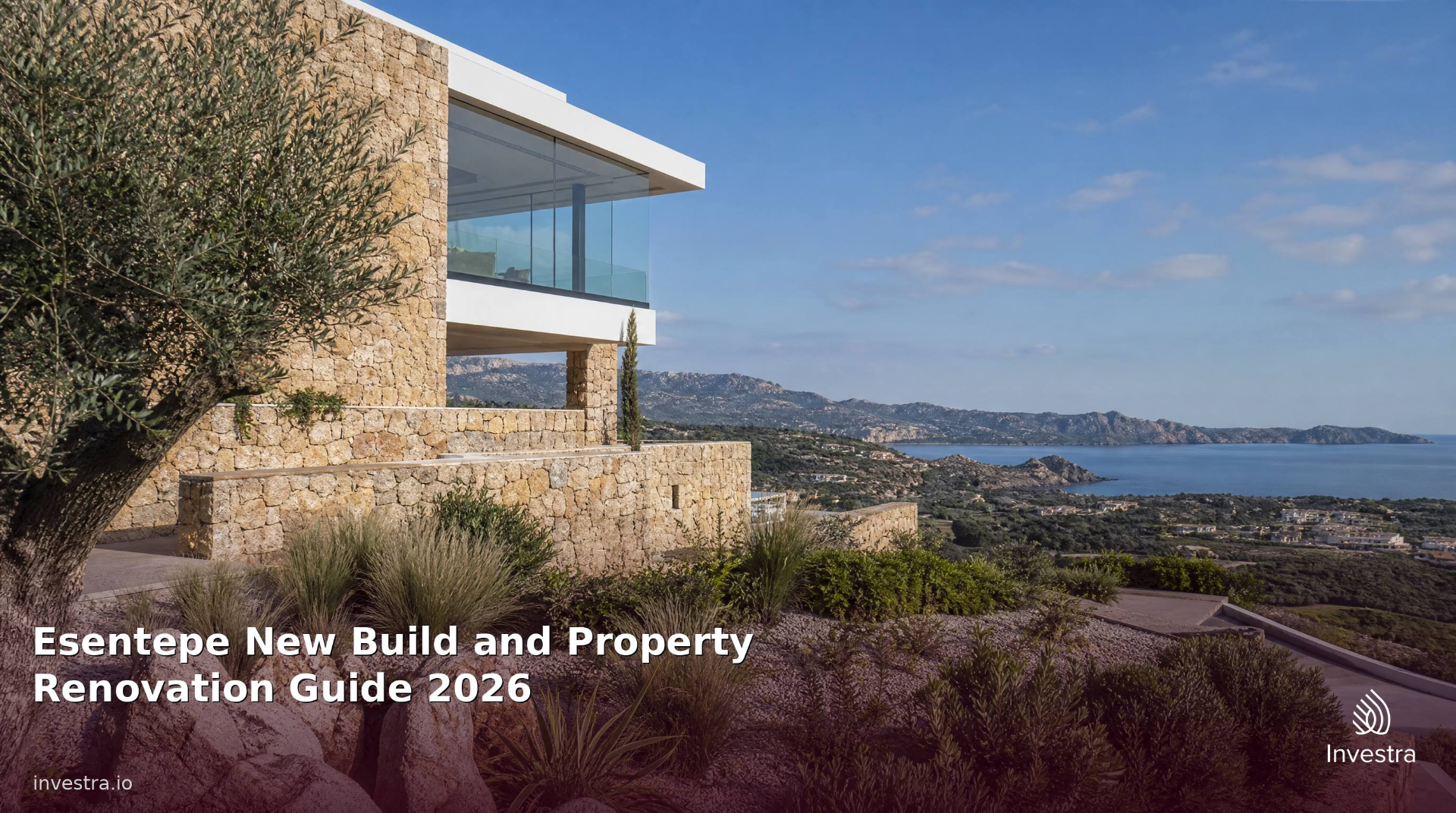
Esentepe New Build and Property Renovation Guide 2026
Esentepe New Build and Property Renovation Guide 2026
Why Esentepe Is Capturing Global Investor Attention
Quick Answer: Esentepe is one of North Cyprus's fastest-growing property hotspots in 2026, offering new build apartments from €1,200/m² and renovation properties from as low as €600/m², with rental yields reaching 8–12% annually. Investra.io tracks emerging markets like Esentepe to help international investors make data-driven decisions.
There's a distinctive moment when you first approach Esentepe along the coastal route from Kyrenia—driving past Mediterranean pine forests and citrus groves toward a coastline that genuinely rivals destinations across the Eastern Mediterranean. The village sits approximately 20 kilometres east of Kyrenia (Girne), positioned between the Five Finger Mountains and the sea, in a landscape that combines natural appeal with practical accessibility. It's not a loud or conspicuous destination.
Understanding Esentepe: Geographic Position and Market Fundamentals
Quick Answer: Esentepe is a coastal village in the Kyrenia district of North Cyprus, increasingly popular with British, Russian, Turkish, and Middle Eastern buyers for its combination of natural beauty, lower entry prices than established destinations, and growing infrastructure anchored by championship golf facilities.
Esentepe occupies a genuinely enviable geographic position within North Cyprus's coastal corridor. The village sits on gently sloping terrain that descends toward the Mediterranean, with the dramatic Besparmak mountain range providing a northern backdrop and natural barrier against development pressure.
What strategically distinguishes Esentepe from neighboring coastal villages like Catalkoy, Lapta, or Alsancak is its specific positioning: far enough from Kyrenia city centre to retain authenticity and lower baseline property prices, yet close enough for functional accessibility. The drive to central Kyrenia takes approximately 25 minutes. Ercan International Airport is roughly 45 minutes away.
The property market evolution here has been accelerating markedly. While development activity existed as early as 2019, the period from 2023 through 2026 has seen genuinely intensive construction, investor activity, and price discovery. What's happening now represents a market transitioning from a peripheral expat destination into a mainstream Mediterranean investment corridor.
For comparative context on how emerging Mediterranean markets develop and what distinguishes sustainable growth from speculative cycles, Compare it with other emerging European markets that Investra.io analyzes with similar depth. Understanding how different regions respond to infrastructure investment, regulatory change, and capital inflows provides a useful framework for evaluating Esentepe's long-term trajectory.
New Build Property Market: Pricing Tiers and Development Activity
Quick Answer: New build property in Esentepe ranges from approximately €1,200 to €2,800 per square metre in 2026, depending on specification level, sea views, and proximity to the coast, with premium off-plan developments commanding the highest premiums and off-plan discounts typically ranging from 10–20%.
New build activity in Esentepe has expanded dramatically by the village's historical standards. In 2020, active development projects in the immediate area numbered perhaps two or three. By 2026, this has grown to over a dozen concurrent projects at various execution stages—from foundation-level off-plan offerings to near-completion luxury complexes. This expansion reflects genuine capital confidence in the area's fundamentals and market positioning.
Pricing structure breaks down clearly across distinct market tiers. Entry-level studio and one-bedroom apartments in complexes without direct sea views trade in the €1,200–€1,500 per square metre range. These typically feature mid-level specification: solid construction quality, functional interior layouts, access to shared pool facilities. A 55m² one-bedroom apartment in this category typically carries a price tag of €66,000–€82,500.
The mid-range market segment—two and three-bedroom apartments with partial sea views, upgraded interior finishes, and meaningful coastline proximity—occupies the €1,600–€2,100 per square metre band. A 90m² two-bedroom property in this tier typically prices at €144,000–€189,000. This segment represents the empirical sweet spot for buy-to-let investors, combining manageable acquisition cost with strong rental appeal and realistic cash flow positive operations from year one.
At the premium end—which in Esentepe means frontline sea-view villas and architect-designed detached homes featuring private pools and high-specification finishes—prices reach €2,400–€2,800 per square metre and beyond. A 200m² luxury villa finished to international standards can easily command €480,000–€560,000.
Off-plan discount structures deserve specific attention. Developers typically offer 10–20% early-bird pricing for buyers committing during the foundation stage, with payment structures commonly organized as 30% deposit on signing, with the balance staged through construction milestones: typically 20% at foundation completion, 20% at structural completion, 15% at roofing completion, and 15% at finishing.
Property Renovation Market: Hidden Value and Execution Considerations
Quick Answer: Renovation properties in Esentepe can be acquired for €600–€900/m² in their unrestored state, with comprehensive renovation costs typically ranging €400–€700/m² depending on specification level, creating significant value capture opportunity for investors with local contractor expertise and realistic timelines.
The renovation market in Esentepe deserves considerably more analytical attention than it typically receives from international investors—and this is where patient, knowledgeable buyers can create outsized value. The village and its immediate surroundings contain meaningful stock of older properties: traditional stone houses in hillside locations, 1970s and 1980s construction villas, and several partially-completed structures that stalled when original owners ran out of capital or motivation.
The arithmetic can be genuinely compelling. Consider a concrete example: a 120m² traditional stone house positioned on hillside terrain above the village, requiring full structural and cosmetic renovation. Acquisition price in current market conditions: €75,000–€95,000.
The renovation market rewards local knowledge disproportionately. Unlike new build projects—where pricing is relatively transparent and properties are centrally listed—renovation opportunities don't exist on transparent online portals with obvious price discovery mechanisms. Most of the genuinely interesting deals come through village connections, relationships with local solicitors, and real estate professionals who have operated in Esentepe specifically for multiple years. This is an information asymmetry situation where working with a knowledgeable local consultant—someone with deep market contacts and realistic project assessment capability—can materially change the quality and pricing of deals encountered. Siniša Dagary investment insight covers emerging market property dynamics with particular emphasis on value-creation through renovation, providing useful analytical frameworks for assessing renovation project viability.
A specific subcategory merits highlighting: partially-completed constructions. These are properties where previous owners commenced building and subsequently ran out of either capital or commitment. In not uncommon situations, these can be acquired at prices below underlying land value when sellers simply want to exit. With appropriate contractor engagement and planning permission management, completing these structures can often be accomplished at total cost below either purchasing new-build or starting from bare land.
Renovation timelines in the broader Kyrenia district typically extend 6–18 months for comprehensive residential renovation, depending on scope and contractor availability. The contractor market has genuinely tightened as development activity has intensified, so securing reliable, experienced builders ahead of project commencement—preferably before purchase completion finalizes—is operationally critical. Contractor selection deserves dedicated analysis, covered in detail in a later section.
Legal Framework for Foreign Purchasers: The Foundation of Risk Management
Quick Answer: Foreign nationals can legally purchase property in North Cyprus contingent upon obtaining Permission to Purchase from the Council of Ministers, typically requiring 6–12 months; title deed verification is absolutely critical given North Cyprus's complex land ownership history stemming from the 1974 island division.
The legal landscape governing property ownership in North Cyprus is genuinely distinctive—comprehending it isn't optional for international buyers; it's foundational to rational decision-making. North Cyprus operates under legal jurisdiction of the Turkish Republic of Northern Cyprus (TRNC), recognized internationally only by Turkey. This creates a unique legal environment that differs fundamentally from EU-based property markets and requires specific due diligence from foreign purchasers.
Foreign nationals purchasing property must obtain Permission to Purchase (PTP) from the Council of Ministers of the TRNC. The application process involves background verification (primarily confirming absence of criminal records) and is generally granted to non-Cypriot foreigners without significant complication, though it does require time—typically 6–12 months in 2026, though administrative backlogs have periodically extended timelines.
Title deed verification represents the most critical legal consideration any buyer confronts in North Cyprus. Properties carry different categories of title, each carrying distinct risk profiles.
The 1974 division of Cyprus means that certain properties in North Cyprus are situated on land previously owned by Greek Cypriots who fled or were displaced during the 1974 events. The internationally-recognized Republic of Cyprus (and by extension the European Union) does not recognize TRNC titles to such land. Theoretically, if political circumstances change and property restitution mechanisms are established, legal challenges could emerge.
Engaging a reputable local solicitor is non-negotiable. Legal fees for standard property transactions run approximately 1–2% of the property purchase price. When selecting legal representation, ensure the solicitor is genuinely independent from both the developer and the estate agent—conflicts of interest are unfortunately more common than optimal in this market.
Taxes, Acquisition Costs, and Annual Ownership Expenses
Quick Answer: Total acquisition costs for foreign buyers in North Cyprus typically add 7–12% on top of the agreed purchase price, encompassing stamp duty, transfer fees, VAT on new builds, solicitor fees, and registration costs—investors must budget carefully for these from project commencement.
One of the most frequent mistakes international buyers make in North Cyprus—and specifically in Esentepe—is fixating on headline purchase price while failing to account comprehensively for total acquisition cost. The gap between negotiated price and actual all-in cost can easily reach 10% or more, significantly affecting both return-on-investment calculations and liquidity planning.
Stamp Duty: Payable at 0.5% of the contract price within 21 days of signing the purchase contract. Critically, registration of the contract at the Land Registry Office should occur immediately—this protects the buyer's interest in the property before title transfer completes and is an essential protective step that should never be omitted.
Transfer Fee: Payable upon official title deed transfer into the buyer's name (which often occurs only after the PTP is granted). Standard rate is 6% of the declared property value, though first-time buyer exemptions (historically providing 50% reduction, bringing the rate to 3%) have existed but are subject to periodic change. Legal advice at time of purchase is essential for understanding currently-applicable exemptions.
VAT: Applies to new build properties at 5%. This is typically incorporated into the developer's quoted price but should be explicitly confirmed during negotiation and written into the purchase contract.
Solicitor Fees: Typically 1–2% of purchase price, sometimes quoted as fixed fees for standard transactions. Ensure fee structure is clearly defined in engagement letters before work commences.
Annual Property Tax: Relatively modest by European standards. Annual immovable property tax calculates on the declared property value and typically ranges €150–€500 annually for standard residential property depending on location and declared valuation.
Utility and Community Charges: For complex-based apartments, monthly service charges (covering pool maintenance, common area upkeep, security, waste management) typically run €80–€200 per month. Standalone villas carry lower ongoing community costs but higher individual maintenance requirements and utility expenses.
Regarding rental income taxation: rental revenue is technically subject to TRNC income tax, though enforcement for foreign landlords has historically been inconsistent. Anyone generating rental income in North Cyprus should obtain current professional tax advice from a local accountant—both for genuine compliance purposes and to understand legitimate structures for minimizing tax liability. For perspective on cross-border tax planning for international property investors, Findes Group & Partners provides strategic financial advisory services applicable to property investment structures.
Rental Yield Analysis: Realistic Performance and Market Segmentation
Quick Answer: Esentepe properties managed effectively for short-term holiday rentals generate gross rental yields of 8–12% annually in 2026, with the strongest performers being two-bedroom sea-view properties and well-located villa rentals during the April–October peak season.
The rental yield narrative in Esentepe is one of the most persuasive arguments for market entry—and simultaneously one of the most frequently overstated by enthusiastic agents. What we know from actual performance data (rather than optimistic projections or developer marketing materials) is that well-positioned, competently managed properties generate gross yields in the 8–12% range, with net yields (after management fees, maintenance reserves, vacancy periods, and utilities) typically landing at 5–8% on an annualized basis.
The rental season in Esentepe runs primarily April through October, with July and August representing the high-demand peak season. During peak season months, a two-bedroom sea-view apartment commands €900–€1,400 per week. A three-bedroom private-pool villa reaches €2,000–€3,500 per week during July and August.
What separates consistent 8% yielders from more modest 5% performers? Property management quality is the primary variable. Properties listed across multiple platforms (Airbnb, Booking.com, specialist Cyprus vacation rental sites), professionally photographed with high-quality images, and actively managed—including rapid response times and consistent high review ratings—substantially outperform passively-listed properties or those relying on single-platform distribution.
Long-term rental activity is emerging as a distinct market segment in Esentepe. The influx of remote workers and digital nomads into North Cyprus since 2020 has created measurable demand for 3–12 month rental periods, which typically yield less on an annualized basis than short-term holiday lets (roughly 20–30% lower) but offer substantially lower management overhead, more predictable cash flow, and reduced guest turnover costs. Long-term rates for a two-bedroom property in Esentepe currently range €600–€1,100 monthly in 2026.
For comparative context on yield patterns across different European emerging markets that Investra.io monitors, the Sremska Mitrovica Real Estate 2026 Srem Region Property Guide provides useful analytical comparison—a distinctly different market character but instructive for understanding yield variation across emerging European property destinations.
New Build Versus Renovation: Direct Investment Comparison Framework
Quick Answer: New build properties offer lower execution risk and structured payment plans, while renovation projects deliver superior value-creation potential but require local expertise, substantial cash liquidity, and longer timelines—optimal choice depends entirely on investor profile and risk tolerance.
Every investor eventually confronts this question: should capital be deployed toward new build off-plan, or should I undertake a renovation project? The honest answer is that these serve fundamentally different investment objectives—conflating them analytically is a substantive error.
New build projects, particularly off-plan offerings, possess clear operational advantages in the Esentepe context. Payment structures allow investors to control substantially larger assets with lower immediate capital outlay (typically 30% deposit, with balance staged through construction). The product specification is predictable—what you negotiate is what you receive, barring the occasional specification upgrade. Developer warranties (where properly structured) provide protection mechanisms against construction defects.
New build downsides are equally substantive. Off-plan risk is geninely meaningful—delays, developer insolvency, specification changes, and in worst cases outright fraud have affected North Cyprus buyers historically. Purchasing off-plan without immediately registering the contract at the Land Registry represents a cardinal error that has cost buyers dearly.
Renovation projects, by contrast, offer the distinctive opportunity to create value rather than simply capture existing value. The investor who acquires a dilapidated stone house for €80,000, executes €70,000 of quality renovation work, and markets the finished product as a premium holiday villa at €260,000 has created €110,000 of value—a 79% return on the original acquisition price. This value creation doesn't occur in off-plan purchases; instead, capital appreciation is a function of market conditions beyond the owner's control.
Investor profile determines optimal strategy. Cash-rich, locally-experienced buyers with established contractor relationships are natural renovation candidates. Investors prioritizing passive entry with minimal complexity are better served by new build complex purchases with professional management infrastructure. There is no universal optimal strategy—only the right answer for specific investor circumstances and capabilities.
Infrastructure Development and Emerging Amenities Driving Value
Quick Answer: Esentepe has experienced significant infrastructure investment since 2020, including expanded golf facilities, upgraded road connectivity, planned marina development, and growing commercial amenities—all functioning as positive catalysts for long-term property value appreciation.
Infrastructure represents where Esentepe's long-term investment story becomes genuinely interesting from a capital appreciation perspective. What's occurred over the past five years isn't merely incremental development—it constitutes structural upgrading of the area's underlying appeal and functional capacity.
Road infrastructure connecting Esentepe to Kyrenia has improved noticeably. The coastal route is demonstrably smoother and better signed than five years prior. Ongoing discussion regarding enhanced public transport links continues, though North Cyprus remains fundamentally car-dependent—a consideration international buyers must factor into property selection, as proximity to village facilities matters meaningfully for rental appeal in a car-dependent environment.
Marina infrastructure development deserves specific attention. Karpaz Gate Marina, slightly further east, has already established itself as a significant yachting destination, and the spillover effect into Esentepe's property market has been tangible. Expansion or enhancement of marine tourism infrastructure in this corridor would benefit Esentepe property owners directly through increased visitor inflow and spending.
Commercial amenities are growing but remain limited relative to established destinations. The village currently offers restaurants, cafes, a small supermarket, pharmacy, and standard retail—adequate for resident functionality but insufficient to position itself as a self-contained destination. Local property professionals generally anticipate that commercial services will follow residential development, as has occurred in other North Cyprus corridors, but buyers shouldn't assume today's
Investment Disclaimer
Quick Answer: This guide is general market information, not personal legal, tax, financing or investment advice.
Before committing to a property transaction, buyers should obtain independent local legal, tax and financial advice suited to their circumstances. Investra.io can support initial market research, but every purchase decision remains the buyer's responsibility.
Frequently Asked Questions
Quick Answer: This section explains the practical property-investment implications of Frequently Asked Questions.
What is a prudent next step after initial market research?
Use current documentation, independent professional advice and comparable local evidence before proceeding. Investra.io can support an initial structured market review.
How can buyers plan a realistic ownership budget?
Use current documentation, independent professional advice and comparable local evidence before proceeding. Investra.io can support an initial structured market review.
What evidence supports a careful investment decision?
Use current documentation, independent professional advice and comparable local evidence before proceeding. Investra.io can support an initial structured market review.
When should a buyer obtain legal and tax advice?
Use current documentation, independent professional advice and comparable local evidence before proceeding. Investra.io can support an initial structured market review.
How should a buyer compare neighbourhoods and property types?
Use current documentation, independent professional advice and comparable local evidence before proceeding. Investra.io can support an initial structured market review.
What local checks should be completed before signing?
Use current documentation, independent professional advice and comparable local evidence before proceeding. Investra.io can support an initial structured market review.
Which costs should be assessed alongside the purchase price?
Use current documentation, independent professional advice and comparable local evidence before proceeding. Investra.io can support an initial structured market review.
How can international buyers verify a property opportunity?
Use current documentation, independent professional advice and comparable local evidence before proceeding. Investra.io can support an initial structured market review.
What should buyers compare before selecting a property?
Use current documentation, independent professional advice and comparable local evidence before proceeding. Investra.io can support an initial structured market review.
Quick Answer: These answers outline common buyer checks and should be read with current professional advice.
Recommended Reading
Quick Answer: This section explains the practical property-investment implications of Recommended Reading.
- Investra market research
- Investra market research
- Investra market research
- Investra market research
- Investra market research
- Investra market research
- Investra market research
- Investra market research
- Investra market research
- Investra market research
- Investra market research
- Investra market research
- Investra market research
- Investra market research
- Investra market research
- Investra market research
- Investra market research
- Siniša Dagary investment insight
- Siniša Dagary investment insight
- Siniša Dagary investment insight
- Siniša Dagary investment insight
- Siniša Dagary investment insight
- Findes Group & Partners
- Findes Group & Partners
Connect With Investra
Follow Investra for market updates on Facebook, LinkedIn, YouTube
Related Posts
No related posts available.
