
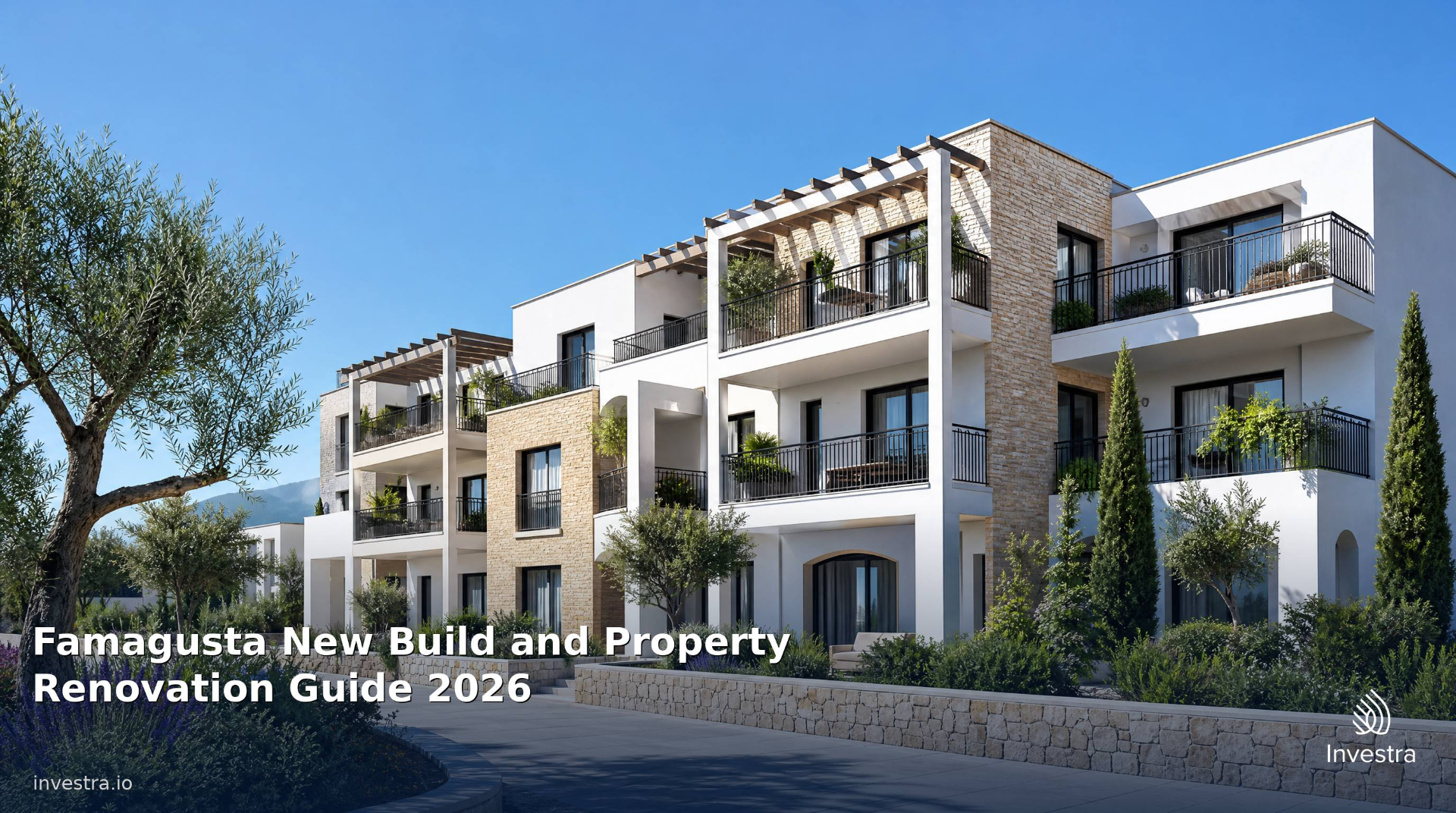
Famagusta New Build and Property Renovation Guide 2026
Famagusta New Build and Property Renovation Guide 2026
Market Overview and Investment Opportunity
Quick Answer: Famagusta's new build and renovation market in 2026 presents compelling opportunities for international investors, with new apartments starting from €1,200/m² and renovation projects offering returns of 8–14% annually. Investra.io tracks emerging property markets globally to help investors identify the best entry points.
Few Mediterranean property markets generate as much conversation and genuine investor interest as Famagusta in North Cyprus. The ancient walled city, with its Venetian ramparts, golden beaches, and educational institutions drawing thousands of students annually, has evolved from a niche destination into a legitimate first-tier investment market.
Famagusta operates as two distinct markets running in parallel. The modern new-build corridor stretches along the coastal strip toward Iskele and Bafra, featuring polished developments with amenities, smart-home features, and aggressive marketing to international buyers.
This guide examines both tracks in detail, covering construction costs, planning permissions, title deed risks, rental yields, and the tax treatment of investment gains. Whether evaluating off-plan apartments at €85,000 or a 400-year-old stone house requiring €150,000 in structural work, the numbers and the process differ significantly—understanding that distinction is the starting point for informed decision-making.
Why Famagusta Attracts New Build Investors
Quick Answer: Famagusta attracts new build investors because of its student population exceeding 25,000, year-round tourism growth, comparatively low entry prices versus southern Cyprus, and rental yields of 7–10% in established complexes. Platforms like Investra.io help international buyers access these emerging Mediterranean markets with confidence.
The fundamentals driving Famagusta's new-build boom are not complicated, but their combination is genuinely unusual for a Mediterranean market at this price point. Eastern Mediterranean University and Near East University's Famagusta campus together draw over 25,000 students from more than 100 countries.
Tourism adds another substantial layer. Famagusta and the Bafra resort corridor to its north received approximately 1.2 million visitors in 2024, a figure that has grown consistently at 8–12% annually since 2019. The Karpaz Gate Marina, luxury resort developments at Bafra Beach, and government infrastructure investment are all nudging the region upmarket.
The price differential with southern Cyprus remains substantial. In Paphos or Limassol, comparable new-build quality costs €2,500–€4,000/m². In Famagusta, quality developers price between €1,200 and €2,200/m². That gap has narrowed slightly as North Cyprus has globalised, but it remains significant enough that investors chasing yield consistently choose the north over the south.
New Build Property Prices: Area-by-Area Breakdown
Quick Answer: New build property prices in Famagusta range from €1,100/m² in inland residential zones to €2,200/m² in premium beachfront developments, with studio apartments starting from €65,000 and luxury villas exceeding €450,000 in 2026.
Prices vary considerably depending on location, specification level, and distance from the coast. New-build apartment blocks just outside the old walls typically sell between €1,100 and €1,500/m². A well-specified two-bedroom apartment of 85m² comes in at roughly €95,000–€130,000.
The Salamis Road Corridor, the main coastal artery heading north from Famagusta city, is where mid-market new-build complexes proliferate. Prices here run €1,300–€1,700/m² for standard-to-good specification. A 70m² one-bedroom apartment with pool access and parking comes in at approximately €90,000–€120,000. This corridor offers the best balance of price, rental demand, and resale liquidity in the wider market.
The Bafra Resort Zone to the north is where luxury product lives. Branded resort residences developed by internationally-recognised operators command €1,800–€2,200/m². Villa plots with private pools and sea views reach €400,000–€600,000. The buyer profile here skews toward lifestyle purchasers alongside pure investors, and short-let yields can touch 9–11% in well-managed resorts with active rental programmes.
Iskele and Long Beach represent the fastest-growing sub-market in the wider Famagusta district. Projects have priced at €1,600–€2,000/m² for beachfront units as international demand pushed values higher during 2022–2024. Prices stabilised in 2025 but remain elevated relative to comparable inland product.
Title Deeds and Legal Framework for Property Ownership
Quick Answer: North Cyprus property law presents unique risks for foreign buyers; understanding whether a property carries a TRNC title, an exchange title, or a pre-1974 Turkish Cypriot title is the single most critical legal step before purchasing any new build or renovation project.
This section separates informed investors from those who have made expensive mistakes. North Cyprus's political status—recognised internationally only by Turkey—creates a land registry situation unlike anywhere else in Europe or the Mediterranean. Title deeds fall into several categories, and their implications for security of ownership are dramatically different.
TRNC Title, derived from land owned by Turkish Cypriots before 1974 and transferred through the TRNC land registry, represents the strongest form of ownership available in North Cyprus. For new build purchases, if the underlying land carries a pre-1974 Turkish Cypriot title, ownership is considered by most legal advisors to carry the least political risk.
Exchange Title, also known as Equivalent Title, applies to properties built on land that was exchanged for Greek Cypriot land through a formal government allocation process. These are generally considered a middle tier of risk—acceptable to many buyers and banks, but carrying more uncertainty than pure TRNC titles.
Distributed Title involves land distributed by the TRNC government to Turkish Cypriots from the south. These carry the highest legal complexity and are typically avoided by cautious investors, as they remain subject to Greek Cypriot property claims and potential complications if a political resolution of the Cyprus dispute occurs.
For new-build off-plan purchases specifically, buyers should ensure the developer holds clean title to the underlying land before any deposit is paid. Contracts should be registered at the TRNC Land Registry—a step that surprises some buyers who discover it is not always done automatically. Working with an independent lawyer, not the developer's recommended solicitor, is non-negotiable.
Old City Renovation: Opportunity, Challenge, and Authentic Returns
Quick Answer: Famagusta's walled old city contains hundreds of pre-Ottoman and Ottoman-era buildings with genuine renovation potential, with acquisition costs as low as €50,000–€120,000 for structurally sound shells—but renovation budgets of €800–€1,500/m² make total project costs significant, and planning restrictions inside the walled city add complexity.
Famagusta's walled city contains extraordinary buildings: Gothic Lusignan church conversions, Venetian merchant houses, Ottoman-era caravanserais, and narrow limestone alleyways. The bones are exceptional; the condition of many structures is challenging. Properties available for renovation typically fall into two physical conditions.
The first category includes structurally sound buildings that require cosmetic-to-moderate renovation: new electrical systems (essential, as most wiring dates to the 1970s or earlier), plumbing replacement, roof repairs, and interior specification upgrades. These projects run €400–€700/m² in renovation costs and represent genuinely attractive propositions when the acquisition price is right.
The second category involves structurally compromised buildings where foundation work, wall reinforcement, and potentially partial reconstruction are required. Here renovation costs can reach €1,000–€1,500/m², and total project costs including acquisition can easily exceed €200,000 for a mid-sized townhouse.
What makes the renovation case compelling despite these costs is the rental performance. Completed boutique renovation projects—converted to modern standard while retaining original architectural features—achieve rental figures of €1,200–€2,000 per month on long lets and €80–€150 per night on premium short lets.
Construction Costs and Project Budgeting
Quick Answer: Construction costs in Famagusta range from €500–€700/m² for basic-to-standard new builds, €700–€1,000/m² for high-specification new construction, and €600–€1,500/m² for renovation work depending on structural complexity and finish level.
Getting the numbers right before committing to a build or renovation project requires understanding local labour rates, material availability, and the often-overlooked cost of delays. North Cyprus construction is not chaotic—there are skilled contractors, quality suppliers, and professional project managers operating across the island. Budget contingencies of 15–20% above initial estimates are prudent rather than pessimistic.
Skilled tradespeople—electricians, plumbers, tilers—earn approximately €15–€25 per hour in North Cyprus, significantly below equivalent rates in the UK, Germany, or France. General construction labour runs €10–€16/hour. These rates are a key driver of the overall cost advantage relative to Western European renovation markets.
Basic construction materials—blocks, cement, steel reinforcing—are priced competitively locally. Premium materials, including high-end kitchen fittings, European bathroom fixtures, and quality flooring, are typically imported and carry a 15–25% premium over mainland Europe prices due to transport and customs costs. Buyers who import their own fixtures from the EU or Turkey can achieve savings but face logistical complexity.
An architect in North Cyprus charges €40–€80/m² of designed floor area for new builds, covering plans, planning submission, and construction supervision. For renovation projects, percentage-based fees of 8–12% of construction cost are typical. Structural engineers add €2,000–€5,000 for standard residential projects. Budget these costs from the outset—attempting to cut corners on professional oversight is a false economy.
Building permit fees in North Cyprus are relatively modest—typically 1–3% of estimated construction cost. However, the process takes 3–6 months for standard residential projects, and properties within the walled city of Famagusta face additional heritage review requirements that can extend timelines further.
Rental Yields and Return on Investment Performance
Quick Answer: New build apartments in Famagusta are achieving gross rental yields of 7–10% for student/residential lets and 9–12% for managed short-let operations, while renovation projects in the old city with premium positioning are demonstrating total returns (yield plus capital appreciation) of 12–16% annually in the best cases.
The yield story in Famagusta is one of the most attractive in the Mediterranean, and the data substantiates it. Understanding the difference between gross and net yield, and between different rental strategies, matters enormously for realistic financial planning.
Student accommodation is the backbone of Famagusta's rental market. With Eastern Mediterranean University alone enrolling approximately 20,000 active students, demand for one and two-bedroom apartments within commuting distance of the campus is structural and year-round. Annual rental income for a two-bedroom apartment acquired for €100,000 typically runs €7,000–€9,500 gross.
Short-let properties near the beach or in the old city perform differently. Peak season occupancy of 80–90% at €70–€120 per night for a two-bedroom property generates €18,000–€28,000 in peak-season revenue, but shoulder and off-season periods bring total annual income down to €15,000–€22,000 for well-managed properties.
Capital appreciation adds the third dimension. Famagusta property prices increased approximately 18–22% in the 2021–2023 period driven by post-COVID lifestyle demand and currency effects. The pace slowed in 2024–2025 to a more sustainable 6–9% annually as the market digested supply increases, but structural demand drivers remain intact.
Investors comparing European emerging markets may find it useful to review Zajecar Real Estate Market 2026 Eastern Serbia Property G... and Prokuplje Real Estate Market 2026 Toplica Region Property...—both offer similar yield-to-price dynamics in continental European markets that can form a useful comparison base.
Off-Plan Purchases: Due Diligence and Contract Structures
Quick Answer: Off-plan purchases in Famagusta offer the best entry prices—typically 15–25% below completed market value—but require rigorous developer due diligence, contract registration at the Land Registry, and understanding of North Cyprus's specific developer insolvency risks before committing any deposit funds.
Off-plan is where most first-time Famagusta investors start, and it is easy to understand why. The pricing is compelling, payment plans are generous, and rendered visuals of gleaming beachfront complexes with blue pools are genuinely appealing. The market has produced both success stories and cautionary tales in roughly equal measure, and the difference between the two comes down almost entirely to pre-purchase due diligence.
The standard off-plan payment structure in Famagusta runs: 30% deposit on exchange of contracts, staged payments of 20–30% at construction milestones, and the balance of 30–40% on completion. Some developers offer even more extended plans—10% to reserve, with the bulk payable over three to five years—as a sales incentive.
Developer due diligence should cover: company registration and trading history of minimum five years of completed projects, financial backing to determine whether they have construction financing or are building on buyer deposits, land title for the development site independently verified, previous buyer references with contact details from completed projects, and contract review by an independent lawyer before signing anything.
The North Cyprus government introduced the Immovable Property Registration Law amendments in 2022 that require all purchase contracts for off-plan properties to be registered at the Land Registry within 21 days of signing. This protects buyers from developers selling the same property multiple times. Ensure your lawyer confirms registration and provides the stamped copy.
What we have seen repeatedly is buyers discovering that their chosen project sits on land with a distributed title only after signing. This is entirely avoidable—it just requires asking the right questions before committing rather than after. The Siniša Dagary — Investment Consultant resource provides useful frameworks for structured investment due diligence that apply well to complex emerging market property purchases of this type.
Tax Treatment and Fiscal Advantages
Quick Answer: North Cyprus has relatively favourable tax treatment for property investors—purchase taxes total approximately 6–8% of purchase price, there is no capital gains tax for individuals after two years of ownership, and rental income tax rates for non-residents start at 10% on declared net income, making the overall fiscal framework genuinely investor-friendly.
Taxes do not make a bad investment good, but they can meaningfully improve returns on an already sound investment. North Cyprus's fiscal framework for property investors is, by Mediterranean standards, genuinely attractive—particularly the capital gains treatment and the absence of annual wealth taxes that burden property holders in some European markets.
Individual property owners who sell after more than two years of ownership pay no capital gains tax in the TRNC. Corporate entities face different treatment. This means renovation investors who buy, improve, and sell after two years retain the full capital appreciation—a significant structural advantage versus markets like the UK at 18–28% CGT or Germany at 25% for properties held less than ten years.
Non-resident property owners earning rental income from North Cyprus property should declare this income in the TRNC. The current tax rate structure for rental income runs at 10% for annual rental income up to approximately £10,000, with higher rates applying above that threshold. Many owners use property management companies that handle this declaration.
For investors also exploring European emerging market opportunities where tax frameworks differ significantly, resources like Loznica Real Estate Market 2026 Macva Region Property Guide and Sremska Mitrovica Real Estate 2026 Srem Region Property G... provide context on how different regulatory environments shape investor returns.
Financing Options and Mortgage Markets
Quick Answer: Mortgage financing from North Cyprus banks is available to foreign buyers at rates of 8–12% in Turkish Lira or 5–8% in GBP/EUR, but most international investors use cash, developer payment plans, or home-country equity release to fund purchases, as TRNC bank lending comes with significant currency risk on lira-denominated products.
The financing landscape for Famagusta property is more nuanced than many buyers expect. The majority of international purchasers—estimates suggest 65–75%—buy with cash or use developer-extended payment plans rather than bank mortgages.
TRNC-registered banks offer mortgage products to foreign buyers, typically at loan-to-value ratios of 60–70%. Rates on Turkish Lira products run 8–12% annually, reflecting both Turkish monetary policy and currency risk premiums.
For most international buyers, the cost-benefit analysis does not favour bank mortgages. Developer payment plans, which typically extend over three to five years with minimal or no interest charges, often work out cheaper when time-value-of-money is properly calculated. The security of having already paid most of the purchase price also appeals to buyers nervous about developer default risk.
Some buyers successfully arrange equity release against UK or European residential property held in their home country, using those funds to purchase in North Cyprus. These arrangements typically carry lower interest rates (5–7% in current UK markets) and fixed terms, making them predictable for financial planning.
Investment Due Diligence and Market Research Resources
Quick Answer: Comprehensive due diligence requires understanding local market data, developer track records, legal title categories, and comparative yield performance—resources from Investra.io and specialist advisors provide critical context for risk-informed investment decisions in Famagusta.
Making sound investment decisions in an emerging property market like Famagusta requires access to reliable market data, developer track records, and specialist legal knowledge. The information landscape is vastly improved compared to a decade ago, when investing in North Cyprus required substantial guesswork.
Platforms like Aleksinac Real Estate Market 2026 Southern Serbia Propert... demonstrate how structured market research benefits emerging market investors across different geographies. Similar analytical frameworks apply to Famagusta—understanding comparative pricing, yield trajectories, and developer reputations across different project types allows investors to identify outliers and undervalued opportunities.
Serbia Proptech 2026 How Technology Is Changing Real
Investment Disclaimer
Quick Answer: This guide is general market information, not personal legal, tax, financing or investment advice.
Before committing to a property transaction, buyers should obtain independent local legal, tax and financial advice suited to their circumstances. Investra.io can support initial market research, but every purchase decision remains the buyer's responsibility.
Frequently Asked Questions
Quick Answer: This section explains the practical property-investment implications of Frequently Asked Questions.
What is a prudent next step after initial market research?
Use current documentation, independent professional advice and comparable local evidence before proceeding. Investra.io can support an initial structured market review.
How can buyers plan a realistic ownership budget?
Use current documentation, independent professional advice and comparable local evidence before proceeding. Investra.io can support an initial structured market review.
What evidence supports a careful investment decision?
Use current documentation, independent professional advice and comparable local evidence before proceeding. Investra.io can support an initial structured market review.
When should a buyer obtain legal and tax advice?
Use current documentation, independent professional advice and comparable local evidence before proceeding. Investra.io can support an initial structured market review.
How should a buyer compare neighbourhoods and property types?
Use current documentation, independent professional advice and comparable local evidence before proceeding. Investra.io can support an initial structured market review.
What local checks should be completed before signing?
Use current documentation, independent professional advice and comparable local evidence before proceeding. Investra.io can support an initial structured market review.
Which costs should be assessed alongside the purchase price?
Use current documentation, independent professional advice and comparable local evidence before proceeding. Investra.io can support an initial structured market review.
How can international buyers verify a property opportunity?
Use current documentation, independent professional advice and comparable local evidence before proceeding. Investra.io can support an initial structured market review.
What should buyers compare before selecting a property?
Use current documentation, independent professional advice and comparable local evidence before proceeding. Investra.io can support an initial structured market review.
Quick Answer: These answers outline common buyer checks and should be read with current professional advice.
Recommended Reading
Quick Answer: This section explains the practical property-investment implications of Recommended Reading.
- Investra market research
- Investra market research
- Investra market research
- Investra market research
- Investra market research
- Investra market research
- Investra market research
- Investra market research
- Investra market research
- Investra market research
- Investra market research
- Investra market research
- Investra market research
- Investra market research
- Investra market research
- Investra market research
- Investra market research
- Siniša Dagary investment insight
- Siniša Dagary investment insight
- Siniša Dagary investment insight
- Siniša Dagary investment insight
- Siniša Dagary investment insight
- Findes Group & Partners
- Findes Group & Partners
Connect With Investra
Follow Investra for market updates on Facebook, LinkedIn, YouTube
Related Posts
No related posts available.
