
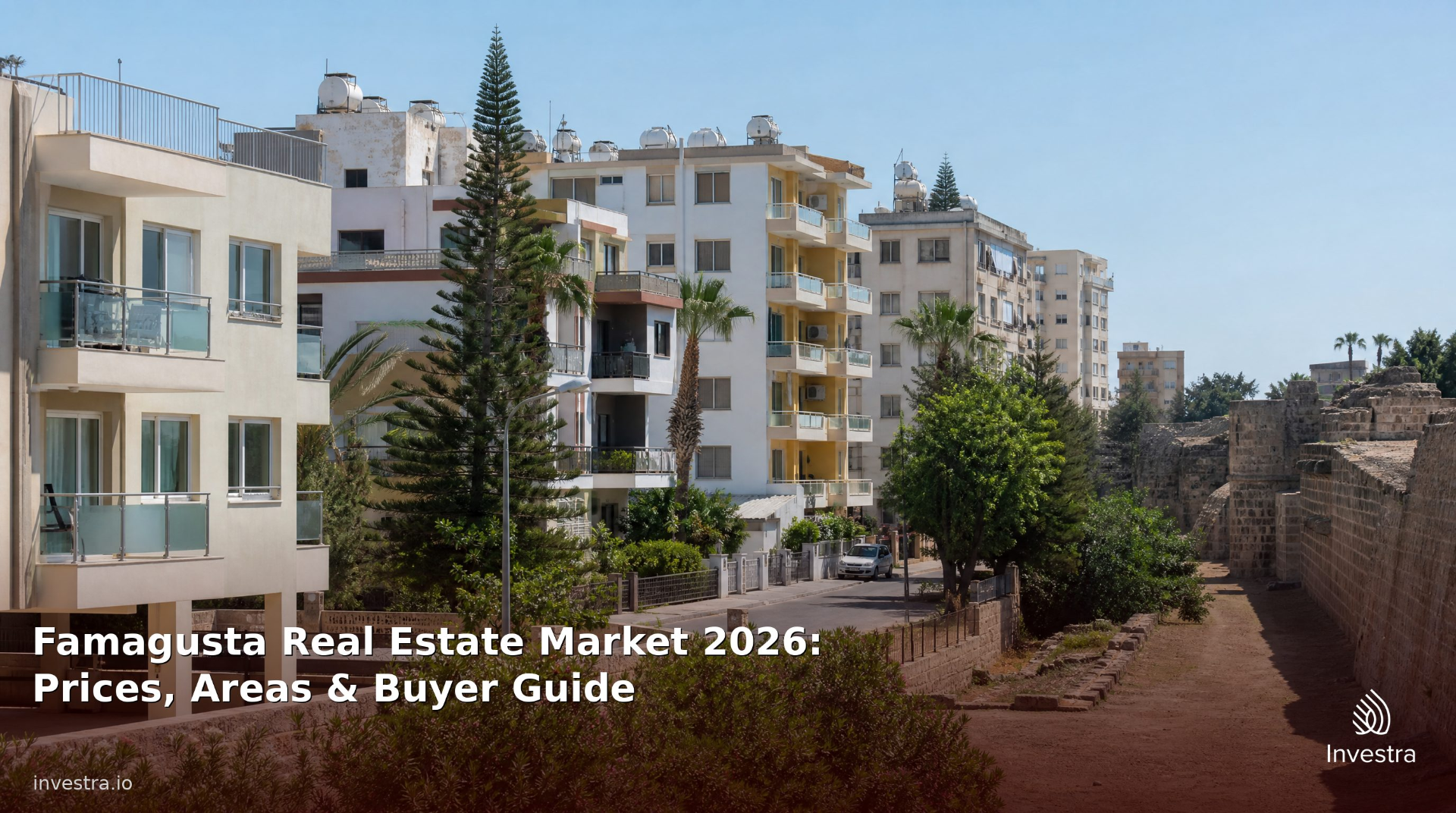
Famagusta Real Estate Market 2026: Prices, Areas & Buyer Guide
Famagusta Real Estate Market 2026: Prices, Areas & Buyer Guide
Famagusta Real Estate Market Overview 2026
Quick Answer: Famagusta's real estate market in 2026 is one of the most dynamic in North Cyprus, with property prices ranging from €800 to €2,500 per m² depending on location and property type, driven by strong university demand, tourism growth, and increasing international buyer interest. Investra.io tracks emerging markets like Famagusta to help investors identify high-yield opportunities before they mature.
Famagusta — or Gazimağusa as it's known locally — sits on the eastern coast of North Cyprus, and right now it's attracting more serious investor attention than at any point in the past decade. The city blends medieval Venetian walls, a UNESCO-listed old town, warm turquoise waters, and one of the Eastern Mediterranean's fastest-growing university ecosystems. That combination isn't accidental.
What surprised many buyers entering this market for the first time in 2025–2026 is just how affordable prime coastal property still is compared to equivalent locations in southern Europe. A beachfront apartment in Famagusta's Salamis Bay corridor that would cost €5,000/m² in Paphos, Cyprus costs €1,200–€1,800/m² here.
The market has seen consistent year-on-year price appreciation of 8–12% since 2022, with some premium coastal developments recording closer to 15% annual gains. Transaction volumes in Famagusta District rose by approximately 22% in 2024 compared to 2023, and early 2026 data from local estate agents suggests that trajectory is continuing.
For international investors, particularly those from the UK, Germany, Scandinavia, Russia, Turkey, and increasingly the Gulf states, Famagusta represents something increasingly rare: an undervalued coastal asset in a Mediterranean climate with genuine yield potential and a credible growth story. The reality is, windows like this don't stay open indefinitely.
Understanding North Cyprus Property Law: What Every Foreign Buyer Must Know
Quick Answer: Foreign nationals can legally purchase property in North Cyprus, but the process involves obtaining a Purchase Permit from the Council of Ministers, and buyers must conduct thorough title deed due diligence — particularly regarding pre-1974 Turkish Cypriot, TRNC freehold, or "exchange" title deeds. Working with a qualified local solicitor is non-negotiable.
The legal framework governing property ownership in North Cyprus is the single most important thing any foreign buyer needs to understand before signing anything. The island has been divided since 1974, and that division created a complex — but navigable — legal landscape around property titles. Skipping this section and going straight to price comparisons would be a serious mistake.
There are essentially three categories of title deed in North Cyprus. First, Turkish Cypriot (TC) title deeds refer to properties that were legally owned by Turkish Cypriots before 1974 — these are considered the cleanest from a legal perspective. Second, "Equivalent" or "Exchange" title deeds cover properties exchanged through official government programs.
The process for foreign buyers formally requires submitting a Purchase Permit application to the Council of Ministers in Nicosia (North). Processing typically takes 3–6 months, though approval rates for standard residential purchases remain above 90%. Non-TRNC residents are currently limited to purchasing one property.
Consulting resources like Siniša Dagary investment insight and seeking guidance from advisors with cross-border Mediterranean investment experience can help buyers frame the legal risks within the broader investment context. And for financing frameworks, platforms like Findes Group & Partners can assist with structuring international property acquisitions efficiently.
The bottom line: the legal process is manageable, but it demands proper professional guidance. Buyers who cut corners on legal due diligence in North Cyprus have faced problems — buyers who do it properly have generally had excellent outcomes.
Famagusta Property Prices 2026: Area-by-Area Breakdown
Quick Answer: Famagusta property prices in 2026 range from €800/m² for inland residential apartments up to €2,800/m² for premium beachfront villas in Salamis Bay, with the student-district market averaging €1,000–€1,400/m² and the old town restoration projects trading at significant premiums for boutique investors.
Price data across Famagusta varies considerably by sub-location, property type, and title deed category. Here's what the market looks like in concrete terms as of early 2026:
Salamis Bay / Long Beach Corridor: This is Famagusta's premium coastal strip, running north from the old harbor toward Salamis Bay. New-build apartments here are selling at €1,500–€2,500/m², with beachfront villa developments pushing toward €2,800/m² for larger plots.
Gazimağusa City Center / Near EMU: The area immediately surrounding Eastern Mediterranean University is the heartland of the student rental market. Apartments here trade at €900–€1,400/m², with older stock sometimes available below €1,000/m². Rental demand is intense and year-round, keeping yields high.
Karpaz Peninsula (Famagusta District North): The Karpaz peninsula, extending northeast from Famagusta, is where buyers seeking untouched Mediterranean landscapes and ultra-low entry prices are looking. Land plots and rural properties are available from €400–€700/m², but infrastructure is limited and rental liquidity is low. This is a long-horizon play, not a yield investment.
Maraş / Varosha Adjacent Area: The gradual reopening of parts of the former Varosha resort area (closed since 1974) has sparked interest in nearby properties. While direct Varosha development remains politically sensitive, adjacent plots have appreciated significantly since 2020 partial reopening announcements.
Iskele (Trikomo): Technically just south of core Famagusta district, Iskele has emerged as one of the most active new-build markets in all of North Cyprus. Developments like Long Beach Resort have driven prices from €600/m² in 2018 to €1,600–€2,200/m² for beachfront units in 2026.
Rental Yields and ROI: The Investment Case for Famagusta
Quick Answer: Gross rental yields in Famagusta range from 6% to 14% depending on location and rental strategy, with student-let properties near EMU delivering the highest consistent yields and short-term holiday lets in coastal areas generating strong seasonal returns. Combined with capital appreciation of 8–12% annually, total annual ROI has exceeded 18% in top-performing zones.
Let's be direct about the numbers, because they're genuinely compelling compared to most European markets. When you compare Famagusta's yield profile to, say, Berlin (2–3% gross yield), London (3–4%), or even Lisbon (4–5%), the Eastern Mediterranean numbers look extraordinary. But context matters — yield is always compensation for some combination of risk, illiquidity, and management intensity.
In the student rental market around Eastern Mediterranean University — which enrolls over 20,000 students from more than 100 countries — occupancy rates for well-located apartments consistently run at 95%+. Students typically rent on annual contracts (September to June), providing reliable income with low management friction.
Short-term holiday rentals via Airbnb and Booking.com in the coastal Salamis Bay area operate on a different model. Peak season (May–September) sees nightly rates of €80–€180 for a two-bedroom apartment, with occupancy rates of 75–85% during those months.
Capital appreciation tells an equally strong story. Investors who purchased beachfront apartments in the Iskele area in 2018–2020 at €600–€800/m² are now sitting on assets valued at €1,600–€2,200/m² — representing 100–175% capital growth over roughly 5–6 years.
Platforms like Serbia Proptech 2026 How Technology Is Changing Real Estate highlight how digital tools are transforming investment analysis across emerging markets — the same analytical frameworks increasingly applied to North Cyprus help investors stress-test yield assumptions before committing capital.
Key Areas and Neighborhoods for Investment in Famagusta 2026
Quick Answer: The top investment neighborhoods in Famagusta for 2026 are the Long Beach/Salamis Bay corridor for capital appreciation, the EMU university district for yield-focused strategies, Bogaz for boutique tourism investments, and the emerging Karpaz Gateway Marina area for long-term speculative plays.
Every experienced property investor knows that the right neighborhood selection often matters more than any other single factor. In Famagusta, the micro-location decision is particularly consequential because the range of market characteristics — from mature holiday resort zones to raw agricultural land — is wider than in most comparable Mediterranean cities.
Long Beach / Salamis Bay: This is the address that most international buyers have on their radar. The beach here rivals anything in the western Mediterranean — clear water, long stretches of sand, relatively uncrowded. New developments range from managed resort-style complexes (with on-site pools, restaurants, and rental management programs) to standalone villas.
EMU University Zone: Boring it isn't, but reliably profitable it is. The district surrounding Eastern Mediterranean University is Famagusta's most liquid rental market.
Bogaz (Boğaz): A small fishing village about 10km north of Famagusta city, Bogaz has developed a loyal following among boutique tourism investors. The harbor setting, seafood restaurants, and relaxed atmosphere have made it a preferred destination for European visitors seeking something more authentic than resort-complex holidays.
Old Famagusta (Walled City): The historic walled city, with its Venetian architecture and medieval streets, is an emerging gentrification story. A handful of boutique renovation projects have demonstrated that restored old-city properties can command significant premiums — both for sale and for short-term rental.
The Buying Process: Step-by-Step Guide for International Investors
Quick Answer: Buying property in Famagusta as a foreigner involves six main stages: property selection and due diligence, reservation agreement and deposit, legal title deed search, sale and purchase contract, Council of Ministers purchase permit application, and final title deed transfer — a process typically taking 6–12 months from start to finish.
The mechanics of buying property in North Cyprus differ enough from standard European procedures that walking through the process in detail is genuinely useful. Buyers who've purchased in Spain, Portugal, or even Turkey sometimes assume the process is similar. It isn't — and the differences matter.
Step 1 — Property Search and Selection: Most international buyers begin remotely, using online platforms and engaging local agents before visiting. We'd recommend at least one site visit before committing, ideally visiting multiple properties across different neighborhoods.
Step 2 — Reservation and Initial Deposit: Once a property is selected, a reservation agreement is signed and a deposit (typically €2,000–€5,000 or 5% of purchase price) is paid to take the property off the market. At this stage — before any larger commitment — it's critical to engage a solicitor if you haven't already.
Step 3 — Title Deed Due Diligence: Your solicitor runs a full search on the property's title deed category, encumbrances, mortgages, and any legal restrictions. This is the step that separates safe purchases from problematic ones. Allow 2–4 weeks for thorough due diligence.
Step 4 — Sale and Purchase Contract: The main contract is drafted, negotiated, and signed. This document should specify payment schedule, completion date, any developer specifications (for off-plan), and penalty clauses.
Step 5 — Purchase Permit Application: The application to the Council of Ministers is submitted, typically by your solicitor. This process takes 3–6 months. During this time, the transaction continues normally; you don't need to wait for permit approval before making further payments per contract schedule.
Step 6 — Title Deed Transfer: Upon purchase permit approval and full payment, the title deed is transferred into the buyer's name. Transfer fees apply (see taxes section below).
For investors comparing multiple emerging market opportunities, resources like Loznica Real Estate Market 2026 Macva Region Property Guide and Sremska Mitrovica Real Estate 2026 Srem Region Property Guide offer useful benchmarks for how different legal frameworks affect buyer experience across Eastern European and Mediterranean markets.
Taxes, Costs, and Fees: The Full Financial Picture
Quick Answer: Total purchase costs in North Cyprus typically add 7–12% on top of the property price, covering VAT (5% on new builds), stamp duty (0.5%), transfer fee (3–6%), solicitor fees (1–2%), and agent commissions (2–3%), making it one of the lower transaction cost environments in the Mediterranean region.
Understanding the full cost stack before making an offer is basic investment discipline, but in North Cyprus the cost structure has some specific elements that catch buyers off guard. Here's what to budget for beyond the headline purchase price:
VAT (KDV): Currently 5% on new-build residential properties in the TRNC. For resale properties, VAT is not typically applicable. This is substantially lower than the 19% VAT applicable in many EU jurisdictions, making new-build purchases here comparatively cost-efficient.
Stamp Duty: 0.5% of the purchase price, payable within 21 days of contract signing. This is a buyer cost and is non-negotiable. The stamp duty payment and simultaneous Land Registry contract registration is a critical protective step that many buyers underestimate in importance.
Title Deed Transfer Fee: Payable when the deed is formally transferred to the buyer's name. The standard rate is 6%, but reduced rates (3%) have been available for first-time buyers or under periodic government incentive schemes.
Solicitor Fees: Typically 1–2% of purchase price for a full-service conveyancing package, though fixed-fee arrangements (usually £1,500–£3,000 for a standard transaction) are increasingly common. Don't try to cut costs here — legal fees are small relative to purchase price and large relative to the risks they mitigate.
Agent Commission: In North Cyprus, agent fees are typically paid by the seller (2–3% of sale price), though in some off-plan developer sales, fees are built into the price structure. Buyers should clarify this upfront.
Annual Property Tax: Immovable property tax in the TRNC is assessed on "declared value" (which has historically been below market value) at rates ranging from 1‰ to 3‰ (per mille). Annual property tax bills for a typical apartment are therefore modest — often €100–€400/year.
Rental Income Tax: Rental income from TRNC property is subject to TRNC income tax. Residents pay on a progressive scale; non-residents are taxed at a flat 10% on net rental income. Tax treaties between the TRNC and other countries are limited (given its unrecognized status), so double taxation relief requires careful professional advice.
The Student Rental Market: Famagusta's Hidden Yield Engine
Quick Answer: Famagusta's student rental market is anchored by Eastern Mediterranean University's 20,000+ students, delivering consistent gross yields of 8–14% for well-located apartments, with near-zero vacancy rates during the academic year and strong year-round demand from international students who require accommodation for full-year periods.
There's a reason why experienced North Cyprus investors gravitate toward the student rental market — it works with a consistency that tourism-dependent strategies simply can't match. Eastern Mediterranean University (EMU) is the anchor. Founded in 1979 and now enrolling students from over 100 countries, EMU is among the largest universities in the entire Eastern Mediterranean region.
The math is straightforward. A student who travels from Nigeria, Pakistan, Iran, or Kazakhstan to study in Famagusta needs accommodation for 9–12 months per year. They're typically funded by family or scholarships, which means rent payment is reliable. They don't need luxury — clean, safe, well-connected accommodation within walking or cycling distance of campus is the product.
What we've seen consistently in this market is that properties within 1.5km of EMU main campus rent quickly, command premium rates per square meter, and have resale liquidity that purely tourism-oriented properties don't. A 45m² studio near EMU that cost €42,000 in 2020 is now worth €65,000–€75,000, while having generated €4,500–€5,500 per year in rental income throughout that period.
The market is also diversifying. European University Cyprus has opened a Famagusta campus, and additional higher education facilities have been established. The student population is growing, and with it, the addressable rental market.
For context on how university-driven demand shapes real estate markets in other emerging economies, Bor Real Estate Market 2026 Eastern Serbia Mining City Pr... demonstrates how institutional economic anchors create durable property demand in non-obvious locations.
Tourism, Infrastructure, and Economic Drivers Shaping Famagusta 2026
Quick Answer: Famagusta's real estate market is being driven by three structural catalysts in 2026: tourism growth (North Cyprus received over 2 million visitors in 2024), infrastructure investment (new road networks, marina upgrades, hospital developments), and the gradual political normalization process creating renewed confidence among international investors.
Understanding what's driving price growth in any market requires looking beyond the transaction data and examining the underlying economic story. In Famagusta's case, several trends are converging in ways that create a genuinely favorable medium-term outlook.
Tourism numbers are a good starting point. North Cyprus received approximately 2.1 million visitors in 2024, a significant increase from the 1.4 million recorded in 2019 (pre-pandemic). The visitor profile is broadening — while Turkish mainland visitors have always dominated, UK, German, and Gulf state tourists are growing segments.
Infrastructure investment is accelerating. The ongoing expansion and upgrade of Ercan Airport (officially Nicosia Airport) has improved connectivity significantly, with new routes from UK regional airports, Germany, and Gulf hub airports added in 2023–2025. Road infrastructure linking Famagusta to Nicosia has improved.
Healthcare infrastructure — historically a concern for permanent resident buyers — has improved considerably. New private hospital facilities in Famagusta serve both the local population and medical tourism visitors from the Middle East, which itself has become a small but growing economic sector.
For broader context on how infrastructure development correlates with real estate appreciation, Zajecar Real Estate Market 2026 Eastern Serbia Property G... and Prokuplje Real Estate Market 2026 Toplica Region Property... provide useful comparative analysis of how regional development programs affect
Investment Disclaimer
Quick Answer: This guide is general market information, not personal legal, tax, financing or investment advice.
Before committing to a property transaction, buyers should obtain independent local legal, tax and financial advice suited to their circumstances. Investra.io can support initial market research, but every purchase decision remains the buyer's responsibility.
Frequently Asked Questions
Quick Answer: This section explains the practical property-investment implications of Frequently Asked Questions.
What is a prudent next step after initial market research?
Use current documentation, independent professional advice and comparable local evidence before proceeding. Investra.io can support an initial structured market review.
How can buyers plan a realistic ownership budget?
Use current documentation, independent professional advice and comparable local evidence before proceeding. Investra.io can support an initial structured market review.
What evidence supports a careful investment decision?
Use current documentation, independent professional advice and comparable local evidence before proceeding. Investra.io can support an initial structured market review.
When should a buyer obtain legal and tax advice?
Use current documentation, independent professional advice and comparable local evidence before proceeding. Investra.io can support an initial structured market review.
How should a buyer compare neighbourhoods and property types?
Use current documentation, independent professional advice and comparable local evidence before proceeding. Investra.io can support an initial structured market review.
What local checks should be completed before signing?
Use current documentation, independent professional advice and comparable local evidence before proceeding. Investra.io can support an initial structured market review.
Which costs should be assessed alongside the purchase price?
Use current documentation, independent professional advice and comparable local evidence before proceeding. Investra.io can support an initial structured market review.
How can international buyers verify a property opportunity?
Use current documentation, independent professional advice and comparable local evidence before proceeding. Investra.io can support an initial structured market review.
What should buyers compare before selecting a property?
Use current documentation, independent professional advice and comparable local evidence before proceeding. Investra.io can support an initial structured market review.
Quick Answer: These answers outline common buyer checks and should be read with current professional advice.
Recommended Reading
Quick Answer: This section explains the practical property-investment implications of Recommended Reading.
- Investra market research
- Investra market research
- Investra market research
- Investra market research
- Investra market research
- Investra market research
- Investra market research
- Investra market research
- Investra market research
- Investra market research
- Investra market research
- Investra market research
- Investra market research
- Investra market research
- Investra market research
- Investra market research
- Investra market research
- Siniša Dagary investment insight
- Siniša Dagary investment insight
- Siniša Dagary investment insight
- Siniša Dagary investment insight
- Siniša Dagary investment insight
- Findes Group & Partners
- Findes Group & Partners
Connect With Investra
Follow Investra for market updates on Facebook, LinkedIn, YouTube
Related Posts
No related posts available.
