
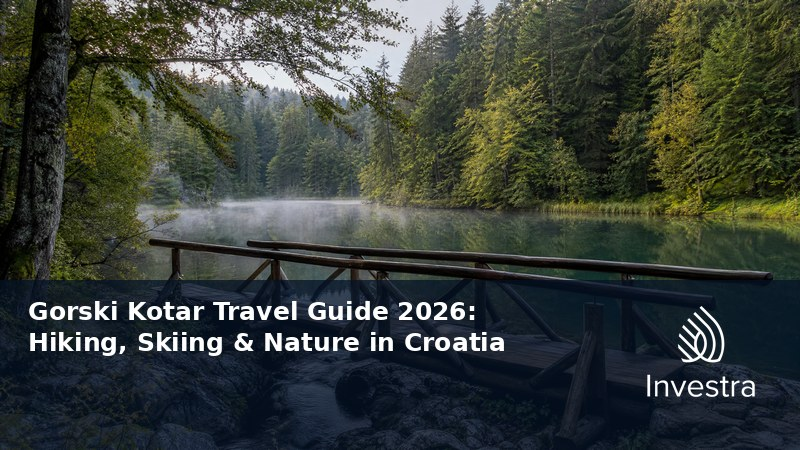
Gorski Kotar Travel Guide 2026: Hiking, Skiing & Nature in Croatia
Gorski Kotar Travel Guide 2026: Croatia's Hidden Mountain Wilderness
Quick Answer: Gorski Kotar is Croatia's premier mountain region, offering world-class hiking, skiing, and nature experiences far from the overcrowded Adriatic coast. This comprehensive travel guide covers everything visitors and property investors need to know about one of Central Europe's most underrated destinations in 2026. Explore more at the Croatia Real Estate Investment Guide 2026.
There's a Croatia that most tourists never see. While millions of visitors flood Dubrovnik's ancient walls and Split's Diocletian Palace each summer, a completely different world exists just 90 minutes inland — a world of dense beech forests, rushing rivers, limestone karst terrain, and mountain peaks that receive genuine snowfall every winter. That's Gorski Kotar.
Known locally as the "Green Lungs of Croatia," Gorski Kotar is a mountain county spanning roughly 1,540 square kilometers in the Primorje-Gorski Kotar County. It sits between the Kvarner Bay coast and the Croatian interior, bordered by Slovenia to the north and the Lika region to the south. The elevation ranges from around 300 meters to over 1,500 meters at its highest peaks, which means genuinely alpine conditions — real winters, real skiing, real hiking — at a fraction of what you'd pay in the Alps or Dolomites.
What's happening in 2026 is particularly interesting. Gorski Kotar has quietly been gaining attention from a new generation of slow travelers, digital nomads, and property investors who've grown tired of the coastal tourist machine. Infrastructure has improved. New hiking trails have been waymarked. And the real estate market, long overlooked, is showing signs of genuine momentum. This guide covers it all.
Where Exactly Is Gorski Kotar and How Do You Get There?
Quick Answer: Gorski Kotar is located in northwestern Croatia, roughly 90 minutes from Zagreb and 45 minutes from Rijeka, making it one of the most accessible mountain regions in the country. It's easily reached by car, bus, or scenic train from major Croatian cities.
Geography matters when planning a trip to Gorski Kotar, because the region isn't a single town — it's a sprawling highland area encompassing several municipalities, each with its own character. The main towns are Delnice, Čabar, Vrbovsko, and Mrkopalj, with Delnice serving as the administrative center and transport hub.
Getting there is easier than most people expect. By car from Zagreb, you're looking at roughly 85-95 kilometers along the A6 motorway — a genuinely beautiful drive as the highway climbs through forested ridges and crosses the Kupica river valley. From Rijeka on the coast, it's even closer: about 55 kilometers, taking around 45 minutes. Zagreb's main bus terminal (Autobusni kolodvor Zagreb) runs regular services to Delnice and other Gorski Kotar towns throughout the day.
Here's a detail that surprises many first-time visitors: there's a legendary train route — the Rijeka-Zagreb line — that passes through Gorski Kotar via tunnels, viaducts, and some genuinely dramatic mountain scenery. It's slower than driving, but the journey is an experience in itself. The engineering alone, much of it dating from the Austro-Hungarian era, is worth the trip. In 2025-2026, Croatian Railways has been working on improvements to this corridor, though travel times remain around 3-4 hours for the full Rijeka-Zagreb route.
The nearest airports are Zagreb (ZAG) and Rijeka (RJK), with Zagreb offering far more international connections. Budget airlines connect Zagreb with most major European hubs, and from the airport to Gorski Kotar by rental car is a comfortable 1.5-hour drive.
The Best Hiking Trails in Gorski Kotar in 2026
Quick Answer: Gorski Kotar offers some of Croatia's best hiking, with trails ranging from family-friendly forest walks to challenging mountain ascents on peaks like Bjelolasica and Velika Kapela. The region has over 500 kilometers of marked trails suitable for all fitness levels.
Ask any serious hiker in Croatia where to go, and Gorski Kotar will come up within the first two answers. The combination of dense forests, river gorges, mountain meadows, and karst features creates a diversity of hiking experiences that genuinely rivals more famous Alpine destinations — but without the crowds or the entry fees.
The crown jewel is Bjelolasica, at 1,534 meters the highest mountain in the Dinaric Alps within Croatia outside of the Velebit range. The ascent from Begovo Razdolje takes experienced hikers approximately 3-4 hours, passing through old-growth beech forests before opening onto panoramic views that, on clear days, extend to the Adriatic Sea and even the Velebit mountains. The trail is well-marked and maintained, though sections become demanding above the tree line.
For something more accessible, the Risnjak National Park loop trail is the classic Gorski Kotar experience. The park covers 64 square kilometers and offers a full network of trails ranging from 2-hour strolls to full-day adventures. The Leska educational trail — a 4.2-kilometer circular route near the park entrance at Crni Lug — is excellent for families and those with limited hiking experience. You'll walk through karst sinkholes, past century-old spruce trees, and alongside the crystal-clear streams that feed the Kupa river system.
The Kupa river source at Razloge is another unmissable natural feature. The river emerges from a dramatic karst spring surrounded by beech forest — the water is so clear and blue-green that it genuinely looks artificial on photographs. The short trail from the nearest parking area takes about 20 minutes and is suitable for all ages.
More serious trekkers should explore the Velika Kapela ridge trail, which forms part of the longer E6 European long-distance hiking route. Multi-day options exist, with mountain huts (planinska skloništa) available at intervals, though booking ahead is strongly recommended for summer months. Trail conditions in 2026 are generally excellent, with the Croatian Mountain Rescue Service and hiking clubs having invested significantly in waymarking and maintenance infrastructure over the past three years.
Skiing and Winter Sports: Gorski Kotar's Cold-Season Appeal
Quick Answer: Gorski Kotar is home to Croatia's premier ski destination at Bjelolasica Olympic Centre, offering downhill skiing, cross-country trails, and snowshoeing from December through March in a typical year, with lift passes significantly cheaper than comparable Alpine resorts.
Winter transforms Gorski Kotar completely. The same forests that glow green in summer become heavy with snow — sometimes receiving 2-3 meters of total snowfall over the season — and the region shifts into a genuinely impressive winter sports destination. This is a side of Croatia that the international travel media largely ignores, which keeps it authentic, affordable, and uncrowded.
The Bjelolasica Olympic Centre (Olimpijski centar Bjelolasica) is the region's main ski destination and the only Olympic-standard facility in Croatia. It hosted training camps and qualification events during the Yugoslav era and retains modern infrastructure including chairlifts, surface lifts, and a vertical drop of around 450 meters across several pistes. Daily lift passes in the 2025-2026 season were priced between €20-30 for adults, which represents extraordinary value compared to Austrian or Swiss alternatives at €50-70+.
What surprises many visitors is the quality of the cross-country skiing. Gorski Kotar has an extensive network of groomed Nordic trails, particularly around Mrkopalj and the surrounding plateau, which sits at around 800-900 meters elevation. These trails are genuinely world-class, and the region has produced competitive Nordic skiers at national and international levels. Mrkopalj itself is a charming mountain town with traditional Croatian highland architecture and a welcoming local culture that hasn't been diluted by mass tourism.
Snowshoeing has grown significantly in popularity here over the past five years. Guided snowshoe tours through Risnjak National Park offer a completely different perspective on the forest — silent, slow, and deeply atmospheric. Several local guide companies now offer these experiences, typically priced at €25-45 per person including equipment rental.
One honest caveat: snowfall can be variable, and climate patterns have been less predictable in recent years. The 2023-2024 season saw below-average snow at lower elevations, though Bjelolasica maintained operation thanks to its altitude. Checking current conditions before a dedicated ski trip is always advisable. That said, the region typically offers reliable snow conditions between late December and late February.
Risnjak National Park: The Ecological Heart of the Region
Quick Answer: Risnjak National Park is Gorski Kotar's most significant natural attraction, protecting one of Europe's best-preserved primary forests alongside a remarkable diversity of wildlife including bears, wolves, lynx, and chamois. Entry fees in 2026 are approximately €5-10 per adult.
Established in 1953, Risnjak National Park is named after the ris — the Eurasian lynx — an animal that actually lives here, along with brown bears, grey wolves, red deer, and chamois. This isn't rewilded wilderness; these animals have been here continuously, a testament to the ecological integrity that Gorski Kotar has maintained while the rest of Europe was busily developing its forests into farmland and suburbs.
The park covers 6,400 hectares of karst mountain terrain centered on Mount Risnjak (1,528 m) and Mount Snježnik (1,506 m). Within this relatively compact area, you'll find subalpine meadows, old-growth forests, peat bogs, karst springs, and dramatic limestone cliffs. The biodiversity is remarkable — over 1,500 plant species have been documented within the park, including several endemic species found nowhere else in the world.
The park entrance and visitor center is located at Crni Lug, about 14 kilometers from Delnice. The visitor center is well-run and genuinely informative, with exhibits on the park's ecology, geology, and cultural history. Staff speak English, and guided tours can be arranged with advance notice. This is one of those places where hiring a local guide pays real dividends — a knowledgeable naturalist can show you bear tracks, point out wolf howling stations, and explain the subtle ecological relationships that you'd completely miss on your own.
Wildlife watching is best in the early morning and around dusk. Bears are most frequently seen near forest edges and meadows in spring and autumn. The lynx, by contrast, is genuinely elusive — sightings are rare even for park rangers, which makes the occasional confirmed observation all the more thrilling. In 2025, camera trap images from within the park documented at least three individual lynx, contributing to ongoing population monitoring efforts.
Gorski Kotar Real Estate Market Overview 2026
Quick Answer: Property prices in Gorski Kotar range from €500 to €1,800 per square meter depending on location, property type, and condition, representing some of the most affordable real estate in Croatia. The Croatia Real Estate Investment Guide 2026 provides comprehensive market data for informed decision-making.
Here's where things get genuinely interesting for anyone thinking beyond a holiday visit. While Croatia's coastal markets — Split, Dubrovnik, Hvar — command prices of €3,000-7,000+ per square meter and face increasing regulatory scrutiny around short-term rentals, Gorski Kotar remains an almost untouched investment frontier. Prices are low. Inventory is available. And the fundamental case for appreciation is building quietly in the background.
In 2026, residential property in Gorski Kotar towns like Delnice and Vrbovsko typically trades in the €500-900/m² range for standard apartments and older stone houses. Premium properties — renovated mountain houses, properties with significant land, or anything with direct national park access — can reach €1,200-1,800/m². Compare that to Split's Old Town at €4,500-7,000/m² or Hvar's premium properties pushing €8,000-12,000/m², and the value differential becomes stark.
The market is being driven by several converging factors. Remote work adoption has made location flexibility a permanent feature of modern professional life. Croatian residents from Zagreb and Rijeka are buying mountain retreats in increasing numbers. And a small but growing cohort of international buyers — primarily from Germany, Austria, the Netherlands, and Slovenia — have discovered that Gorski Kotar offers everything the expensive Alpine destinations do, but at a 60-70% discount. For detailed analysis of specific investment opportunities, Zagreb Property Market Analysis provides useful context on the broader Croatian inland market.
What we've consistently seen in early-stage markets like this is a pattern: infrastructure improves, a few pioneering buyers establish the market, media attention follows, and then prices move. Gorski Kotar appears to be somewhere between the first and second phase of that cycle right now. The infrastructure improvements are underway — road upgrades, better broadband connectivity, improved trail networks. The pioneering buyers are active. Media attention remains limited. That combination is precisely where the interesting opportunities tend to sit.
Property Investment Opportunities in Gorski Kotar
Quick Answer: Gorski Kotar offers strong investment potential through holiday rental properties, mountain retreat purchases, and rural tourism infrastructure, with gross rental yields of 5-8% achievable for well-positioned properties in peak season. Split Real Estate Guide offers a useful coastal comparison point for investors evaluating Croatian market options.
The investment thesis for Gorski Kotar real estate isn't complicated, but it does require a longer time horizon than a coastal apartment rental. This is a market where you're buying before the mainstream wave, not riding it. The payoff comes in price appreciation over 5-10 years, supplemented by seasonal rental income that covers carrying costs while you wait.
Holiday rental demand is real and growing. Gorski Kotar attracts visitors in both summer (hiking season, May-September) and winter (ski season, December-March), with shoulder season nature tourism filling significant gaps in between. Well-positioned properties — traditional stone cottages, renovated mountain houses with modern amenities — can achieve occupancy rates of 60-75% across the peak periods. At typical nightly rates of €80-150 for a comfortable mountain cottage, the annual rental income picture starts to look compelling relative to acquisition costs.
Gross rental yields of 5-8% are achievable, though net yields after management fees, maintenance, and taxes typically settle in the 3.5-6% range for professionally managed properties. That's comparable to, or better than, many coastal Croatian markets where sky-high property prices have compressed yield calculations. For context, Dubrovnik Luxury Property Guide covers a market where acquisition costs are 5-10x higher but yields are often actually lower due to intense competition.
Rural tourism infrastructure represents another investment angle. Croatia has active EU funding programs supporting rural tourism development, and Gorski Kotar sits within zones eligible for substantial grants and co-financing. Converting a traditional farmhouse into a licensed agritourism property, for example, can attract both grant funding and premium pricing — guests pay more for authentic rural experiences than for generic hotel rooms. Siniša Dagary — Investment Consultant has written extensively about identifying these early-stage market opportunities across the region.
The key variables to watch are broadband infrastructure expansion, the completion of planned road improvements, and any changes to national park buffer zone regulations that could affect development permissions. The Croatian government's rural development strategy through 2030 explicitly identifies Gorski Kotar as a priority zone for sustainable tourism investment, which provides useful policy tailwinds for early movers.
The Legal Process for Buying Property in Croatia as a Foreigner
Quick Answer: EU citizens can purchase property in Croatia under the same conditions as Croatian nationals. Non-EU buyers face some additional requirements but can still purchase freely in most cases, with the full purchase process typically taking 30-90 days from offer to completion. Croatia Real Estate Investment Guide 2026 outlines the complete legal framework.
Croatia joined the EU in 2013, and the property purchase process for EU citizens is now genuinely straightforward. There are no restrictions on purchasing quantity, property type, or location for EU/EEA nationals. The reciprocity principle that previously complicated foreign purchases was abolished upon EU accession. What remains is a well-defined process that, with good professional support, runs smoothly.
The basic steps work like this. After finding a property and agreeing terms, a preliminary purchase contract (Predugovor) is signed, accompanied by a 10% deposit. This contract is legally binding on both parties. Due diligence on the property title — checking the land registry (Zemljišna knjiga) for encumbrances, mortgages, and ownership clarity — happens during this period. Croatia's land registry has been significantly digitized and is now accessible online, making title searches faster than they were even five years ago.
The main purchase contract (Kupoprodajni ugovor) is then notarized by a public notary (javni bilježnik). Following contract signing and full payment, the buyer applies for transfer of ownership registration at the competent land registry court. The entire process from preliminary contract to registered ownership typically takes 30-90 days, though complex cases with agricultural land designations or planning issues can take longer.
Non-EU buyers from countries with bilateral agreements with Croatia — which includes the US, UK (post-Brexit arrangements continue), and many others — can also purchase but may need additional approval from the Ministry of Justice. The process is more bureaucratic but not prohibitive. For Gorski Kotar specifically, some parcels may have agricultural or forest land classifications that create additional layers of regulatory complexity. Working with a local Croatian lawyer (odvjetnik) who specializes in property is strongly recommended — fees are typically 1-2% of the purchase price and genuinely earn their cost.
For broader strategic context on navigating these processes and structuring international real estate investments, About Siniša Dagary provides insight into expert-level investment consulting approaches that many serious buyers find valuable.
Taxes, Costs, and What Buyers Actually Pay in Croatia
Quick Answer: Property transfer tax in Croatia is 3% of the purchase price (or assessed market value if higher), paid by the buyer within 30 days of contract signing. Total transaction costs, including legal fees, notary costs, and agent commissions, typically add 6-8% to the headline purchase price.
Understanding the true all-in cost of buying Croatian property is essential for accurate return calculations. The headline purchase price is just the starting point — buyers need to budget for a constellation of additional costs that are standard across the Croatian market.
The main tax is the Real Estate Transfer Tax (porez na promet nekretnina) at 3% of the purchase price. This is paid by the buyer to the Tax Administration within 30 days of signing the purchase contract. For new-build properties purchased directly from a developer, VAT (PDV) at 25% applies instead of transfer tax — this is typically built into the quoted price, but always worth confirming explicitly.
Beyond transfer tax, budget for: notary fees (approximately €500-1,500 depending on transaction value), legal/attorney fees (1-2% of purchase price), real estate agent commission (typically 2-3% plus VAT, though this is often split with the seller), and land registry registration fees (around €100-300). Property due diligence costs — title searches, cadastral surveys if needed — add another €200-500. Total transaction costs of 6-8% above the purchase price is a reliable planning figure.
For buyers intending to rent out their property, there are ongoing tax obligations. Rental income from Croatian property is subject to Croatian income tax. Non-resident landlords pay a flat 12% tax on rental income (after a 30% standard cost deduction is applied automatically), effective rate of approximately 8.4% on gross rent. Croatian tax residents pay progressive rates. VAT registration is required for annual rental turnover exceeding HRK 300,000 (approximately €40,000), which affects very few individual property investors. Findes Financial Services offers specialized support for structuring international property investments tax-efficiently.
Annual property holding costs in Croatia are modest compared to Western European norms. There is no annual property tax on residential property in Croatia (a notable difference from many EU countries), though communal charges (naknada za komunalne uređaje) apply. Running costs for a typical mountain cottage in Gorski Kotar — utilities, insurance, basic maintenance — typically run €1,500-4,000 per year depending on property size and usage.
Where to Stay in Gorski Kotar: Accommodation Options for Every Budget
Quick Answer: Gorski Kotar offers accommodation ranging from budget-friendly guesthouses at €30-50/night to premium mountain retreats and boutique hotels at €120-200/night, with a strong tradition of family-run konobas and agritourism stays that provide the most authentic local experience.
The accommodation landscape in Gorski Kotar has genuinely evolved over the past five years. It's still not an area saturated with boutique hotels and Instagram-ready glamping pods — which is actually part of its appeal — but the quality floor has risen considerably, and travelers with a range of budgets can find genuinely comfortable options.
For the authentic experience, agritourism properties (agroturizmi) are the standout choice. These are working or former agricultural properties that offer accommodation, often with meals made from local produce — forest mushrooms, game, freshwater fish from the Kupa and Dobra rivers, local cheeses and cured meats. Prices run €40-80 per person including dinner, and the quality of both the food and the personal hospitality routinely exceeds expectations. Several of these properties near Mrkopalj and around the Risnjak park area have built strong reputations through word-of-mouth and platforms like Airbnb.
Delnice, as the main town, has the widest range of standard hotel and hostel options. The Hotel Bjelolasica at the ski center offers ski-in/ski-out convenience in winter and serves as a mountain sports base in summer — rooms range from €60-120/night depending on season. Several privately run apartments and holiday houses can be found on Booking.com and Airbnb, typically in the €50-100/night range for a self-contained unit.
Visitors on tighter budgets should know that mountain huts (planinski domovi) operated by the Croatian Mountaineering Association offer basic but clean dormitory accommodation for €15-25/night, with some offering private rooms. These are an excellent way to access more remote areas of the region without extensive hiking with a loaded backpack.
Camping is another strong option in summer. The region has several organized campsites, and wild camping in areas outside national park boundaries is generally tolerated. The Camping Plitvice region — not within Gorski Kotar itself but easily combined — creates a compelling multi-destination itinerary for outdoor travelers exploring inland Croatia.
Food, Culture, and Local Life in Gorski Kotar
Quick Answer: Gorski Kotar's food culture is rooted in highland Croatian and Central European traditions, with bear goulash, venison, freshwater trout, and wild mushroom dishes being regional specialties that visitors consistently rate as memorable culinary experiences.
The food alone is worth the trip. Gorski Kotar sits at a cultural crossroads — historically influenced by the Habsburgs, the Venetians (who dominated the nearby coast), and the indigenous Croatian highland culture — and its cuisine reflects this layered heritage in fascinating ways. This isn't the Mediterranean food of Croatia's coast. It's heartier, game-heavy, forest-influenced, and deeply tied to seasonal rhythms.
Bear goulash (medvjeđi gulaš) sounds like a novelty item, but in Gorski Kotar it's a genuine traditional dish with regulated hunting quotas that make it sustainable. Wild boar (divlja svinja) in various preparations — roasted, in thick stews, or cured as local charcuterie — appears on virtually every menu. Freshwater fish, particularly trout (pastrva) from the region's cold mountain rivers, is prepared simply and beautifully, usually grilled or pan-fried with local herbs.
Wild mushrooms deserve their own mention. The forests of Gorski Kotar produce extraordinary quantities and varieties of mushrooms in autumn — porcini (vrganj), chanterelles (lisičarka), and less familiar varieties that locals know by names with no English translation. Picking mushrooms is a deep cultural tradition here, and many families have secret spots passed down through generations. Visitors can join guided foraging walks offered by several local operators, typically in September-October.
The local food culture is best experienced at family-run konobas (traditional restaurants) rather than in hotel dining rooms. Look for places without English menus posted outside — a reliable indicator of places eating for locals rather than tourists. Prices are consistently lower than anywhere on the coast, with full sit-down meals for €12-20 per person including wine.
For cultural context, the highland Croatian identity of Gorski Kotar is distinct from coastal Dalmatian culture, with its own festivals, musical traditions (notably tamburica folk music), and architectural heritage in the form of traditional wooden and stone highland houses. The summer cultural calendar includes folk festivals, outdoor concerts, and mountain sports events that provide genuine local atmosphere.
Comparing Gorski Kotar with Croatia's Coastal Markets
Quick Answer: Gorski Kotar property prices average 60-80% lower than comparable coastal markets, while offering year-round tourism appeal unlike purely summer-seasonal coastal destinations. Investors comparing options should explore both the Hvar Island Real Estate market and Gorski Kotar before deciding on a strategy.
The comparison between Gorski Kotar and Croatia's celebrated coastal markets reveals fundamentally different investment propositions. Neither is objectively better — they serve different objectives and risk profiles — but understanding the distinctions clearly helps investors make decisions that match their actual goals.
On price: a renovated 80m² stone house with a garden in Gorski Kotar might trade at €80,000-120,000. A comparable property in a coastal town with sea views would be €400,000-700,000. The coastal property has stronger brand recognition and a deeper, more liquid market. The Gorski Kotar property has more upside from a lower base, lower acquisition costs, and less competition from other investors.
On seasonality: this is where Gorski Kotar's case gets genuinely interesting. Croatia's coastal markets are ferociously seasonal — the vast majority of rental income is generated in a 10-12 week summer peak, with the rest of the year largely dormant. Gorski Kotar has two distinct peak seasons (summer and winter) plus active shoulder seasons. This doesn't mean total annual demand is higher, but it does mean the income stream is more distributed and the property is more likely to generate meaningful off-season income.
On regulation: Croatia's coastal markets, particularly Dubrovnik and Split, face increasing regulatory pressure on short-term rentals, with local governments and the national government exploring restrictions similar to those imposed in Barcelona and Amsterdam. Gorski Kotar faces no such pressures currently, and is actively being encouraged toward tourism development. The Dubrovnik Luxury Property Guide and Split Real Estate Guide both contain useful analysis of the regulatory environment in those markets.
The honest summary: coastal Croatia offers a more proven, liquid, and recognizable investment but at much higher entry prices and with growing regulatory uncertainty. Gorski Kotar offers a lower entry point, more upside, dual-season appeal, and supportive regulatory environment, but with a less liquid resale market and a longer time horizon required to realize full appreciation. The right answer depends entirely on the investor's capital position, time horizon, and risk tolerance.
Sustainable and Eco-Tourism in Gorski Kotar
Quick Answer: Gorski Kotar is emerging as one of Central Europe's leading eco-tourism destinations, with significant investment in sustainable tourism infrastructure, certified organic farms, wildlife corridors, and low-impact visitor experiences that appeal to the growing segment of environmentally conscious travelers.
The sustainability conversation around tourism has shifted dramatically in the past five years, and Gorski Kotar is genuinely well-positioned for where that conversation is heading. When travelers — particularly younger, higher-spending European travelers — increasingly cite "environmental authenticity" as a primary destination criterion, a region where brown bears genuinely roam free, where old-growth forests haven't been cleared, and where traditional agricultural practices survive, has something real to offer.
The Croatian Ministry of Tourism and the Primorje-Gorski Kotar County have both invested in eco-certification programs for tourism operators in the region. By 2026, a growing number of accommodation providers, tour operators, and restaurants have achieved recognized eco-certification, which increasingly matters for booking decisions among European travelers.
Wildlife conservation creates real eco-tourism product. The Large Carnivore Project, which has been monitoring and protecting bears, wolves, and lynx in the Dinaric range including Gorski Kotar for over a decade, has established visitor programs that allow responsible wildlife watching with trained naturalists. These are premium-priced experiences — typically €60-120 per person for a guided session — that attract serious nature travelers from across Europe.
The region's rivers — particularly the upper Kupa, the Dobra, and the Mrežnica — are among the cleanest in Central Europe, supporting wild populations of brown trout, huchen, and other species that have been eliminated from most European rivers by agricultural runoff and development. Catch-and-release fly fishing on these rivers has become a specialized tourism niche, with visiting anglers from Germany, Austria, the UK, and the Netherlands booking weeks in advance for quality beats during the season.
For property investors, the eco-tourism positioning creates specific product opportunities. Sustainably designed and operated accommodation — low-energy buildings, natural materials, organic food sourcing, wildlife-focused programming — commands premium pricing and tends to attract repeat guests. The investment in sustainable features is increasingly being recognized as adding to both rental revenue and long-term property value.
Practical Travel Tips for Gorski Kotar in 2026
Quick Answer: The best time to visit Gorski Kotar depends on your interests — June-September for hiking and nature, December-February for skiing — while a rental car is essentially mandatory for exploring the region properly, and cash remains important in smaller villages and mountain huts. Investra Blog — Latest Market News covers regular updates on Croatian destinations.
A few hard-won practical observations for anyone planning a Gorski Kotar trip. First and most important: rent a car. Public transport serves the main towns but the region's real appeal is in its less accessible corners — forest roads, national park trailheads, agritourism properties down gravel tracks — and without a car you'll see a fraction of what's available. A standard compact car is sufficient for summer; AWD or winter tyres are strongly advisable for winter visits, as mountain roads can be icy and occasionally require snow chains.
Mobile coverage is surprisingly good on the main routes and in towns, with Croatian operators (A1, T-HT, Telemach) providing solid 4G service. Deep forest and high-altitude areas lose coverage, which is worth factoring in for navigation — downloading offline maps via Maps.me or Google Maps' offline function before heading into the backcountry is smart practice.
Weather changes fast. The combination of mountain elevation and proximity to the Adriatic weather systems means conditions in Gorski Kotar can shift from brilliant sunshine to heavy rain or fog within an hour. Pack layers even in summer — temperatures above 1,200m can drop significantly after sunset — and always bring rain gear on hiking days regardless of the morning forecast. This isn't pessimism, just mountain common sense.
The Croatian kuna has been replaced by the euro since January 2023, which removes currency friction for eurozone visitors. Most restaurants and accommodation providers accept card payments, but smaller mountain huts, village shops, and some market stalls are still cash-only. Carrying €100-150 in smaller denominations is sensible insurance.
Medical facilities in the region are functional but limited. Delnice has a primary care clinic, and Rijeka's hospital is the regional referral center for anything serious. Comprehensive travel insurance with medical evacuation cover is strongly recommended, particularly for anyone engaging in skiing, mountain biking, or more demanding hiking.
The Future of Gorski Kotar: Development Plans and Market Outlook Through 2030
Quick Answer: Gorski Kotar's trajectory through 2030 looks positive, with planned infrastructure investments, EU rural development funding, and growing international awareness converging to create genuine appreciation potential for early property buyers. Contact Investra Experts for personalized analysis of current investment opportunities.
The medium-term outlook for Gorski Kotar is shaped by several converging trends that, taken together, suggest the region is approaching an inflection point. This isn't speculative cheerleading — it's a reading of structural factors that consistently precede meaningful property market appreciation in comparable regions across Europe.
Infrastructure is the foundation. The A6 motorway has already transformed accessibility from Rijeka and indirectly from Zagreb. Planned improvements to secondary roads within the region, several of which received EU co-financing approval in 2024-2025, will open up currently underserved areas to easier visitor access. The Croatian government's broadband expansion program has targeted Gorski Kotar as a priority zone — high-speed internet penetration in rural areas was below 40% in 2022, and the target is above 80% by 2027. That matters enormously for attracting digital nomads and remote workers, who are now a significant driver of mountain property markets across Europe.
EU Cohesion Fund investments in Croatian rural tourism infrastructure through the 2021-2027 programming period specifically target regions like Gorski Kotar. Visitor information centers, trail infrastructure, cycling path networks, and sustainable accommodation grants are all in the pipeline. These public investments have a documented track record of attracting private capital in the years that follow.
Climate is an underappreciated factor. As Mediterranean and coastal destinations face increasingly challenging summer conditions — extreme heat, water stress, forest fire risk — cool mountain destinations gain relative appeal. Gorski Kotar's summer temperatures of 18-25°C are genuinely pleasant when Split and Dubrovnik are pushing 38-40°C. The medium-term revaluation of mountain destinations relative to coastal ones appears to be a structural trend rather than a cyclical blip. For those looking to act on this analysis, Find Your Property on Investra to explore current listings in the region.
Property price forecasts from Croatian real estate analysts suggest annual appreciation of 4-8% in Gorski Kotar through 2028, driven by this combination of infrastructure improvement, remote work demand, eco-tourism growth, and coastal displacement. That range is wide — the actual outcome depends heavily on execution of planned investments and the overall macroeconomic environment — but even the lower end of that range, compounded over a 5-7 year hold, creates compelling total return potential when combined with rental yield. For comprehensive strategic guidance on this type of positioning, Business Strategy Blog covers relevant frameworks for identifying and evaluating emerging market opportunities.
Getting the Most from a Gorski Kotar Visit: Itinerary Ideas
Quick Answer: A well-planned 4-5 day itinerary covers Risnjak National Park, Bjelolasica, the Kupa river source, traditional villages around Mrkopalj, and a day trip to the Kvarner coast, providing a complete picture of the region's diversity. Investra Property Investment Articles also cover the broader Croatian destination landscape for those combining tourism with investment research.
First-time visitors are often unsure how much time Gorski Kotar warrants. The honest answer is that three days is the absolute minimum to scratch the surface, five days feels about right for most travelers, and a full week is genuinely rewarding for anyone interested in hiking multiple routes and absorbing the regional culture properly.
A practical five-day framework: Day 1 — arrive via Rijeka or Zagreb, settle in Delnice or Mrkopalj, evening walk and dinner at a local konobar. Day 2 — full day in Risnjak National Park, Leska educational trail in the morning, the summit approach toward Risnjak peak in the afternoon for the fit and experienced. Day 3 — drive to the Kupa river source at Razloge (one of Croatia's most photographed natural features), then explore the highland villages of Čabar and the Slovenian border area, which has a fascinating history and some well-preserved traditional architecture. Day 4 — Bjelolasica day in summer (mountain biking, hiking, panoramic views) or ski day in winter. In the afternoon, the village of Lokve and its reservoir are worth a stop — the lake has a distinctly melancholic beauty that contrasts interestingly with the exuberance of the national park. Day 5 — morning departure toward either Rijeka (45 minutes, with a stop in Opatija or at the Kvarner seafront) or Zagreb, with a side trip through the Vrbovsko area's river gorges en route.
For those combining a Gorski Kotar trip with property investment research, the logical extension is to spend time in Delnice understanding the local market, driving the main towns to get a feel for property stock and condition, and potentially arranging viewings through local agents. Several Croatian real estate agencies have emerged that specifically serve the Gorski Kotar market, and their local knowledge is invaluable for buyers who can't make multiple trips.
The combination of tourist experience and investment reconnaissance in a single trip is surprisingly efficient — the same qualities that make Gorski Kotar appealing as a destination (authenticity, accessibility, natural beauty, food culture) are precisely the qualities that underpin the investment case. Seeing them firsthand removes a lot of the uncertainty that pure desk research leaves behind.
Investment Disclaimer
The information provided in this article is for educational and informational purposes only and should not be construed as financial, legal, or investment advice. Real estate investments carry inherent risks, and past performance does
Frequently Asked Questions
Quick Answer: Here are the most commonly asked questions about Croatia real estate investment in 2026, answered by Investra.io experts.
Is Croatia a good country for real estate investment in 2026?
Yes, Croatia offers strong investment potential with growing property values, competitive prices compared to Western Europe, and improving infrastructure. Investra.io provides comprehensive market data and investment guidance.
Can foreigners buy property in Croatia?
EU citizens can buy property freely in Croatia. Non-EU citizens may need to meet specific requirements. Investra.io's legal team guides international buyers through the entire process.
What is the average property price in Gorski Kotar?
Property prices in Gorski Kotar vary significantly by location and property type. Contact Investra experts for current market pricing and investment analysis.
What rental yields can I expect?
Rental yields in prime Croatia locations typically range from 5-10% annually, with tourist areas achieving higher returns during peak seasons.
What taxes apply to property purchases?
Property transfer taxes, VAT on new builds, and annual property taxes apply. Rates vary by property type and location. Consult Siniša Dagary for tax optimization strategies.
How long does the purchase process take?
Typically 30-60 days from offer to completion. Working with Investra.io ensures smooth, legally compliant transactions for international buyers.
What financing options are available?
Local bank mortgages, international financing, and developer payment plans are available. Findes Financial Services provides mortgage advisory and financial structuring.
Is property management available for rental properties?
Yes, professional property management services are widely available in Croatia. Investra.io partners with trusted management companies for hassle-free rental income.
What are the best areas to invest in Gorski Kotar?
Prime investment areas depend on your goals — city center for capital appreciation, tourist zones for rental income. Investra.io's market analysis identifies the best opportunities.
Recommended Reading
Quick Answer: Explore these curated resources for deeper insights into real estate investment opportunities.
- Kopaonik Mountain Guide 2026: Skiing, Hiking & Where to Stay
- Buying Property in Croatia as a Foreigner: Legal Guide 2026
- Buying Property in Split Croatia 2026: Complete Investment Guide
- Cost of Living in Croatia 2026: Complete Expat Guide
- Buying Property in Rijeka Croatia 2026: Complete Guide
- Building a House in Croatia 2026: Costs, Permits & Process Guide
Related Posts
No related posts available.
