
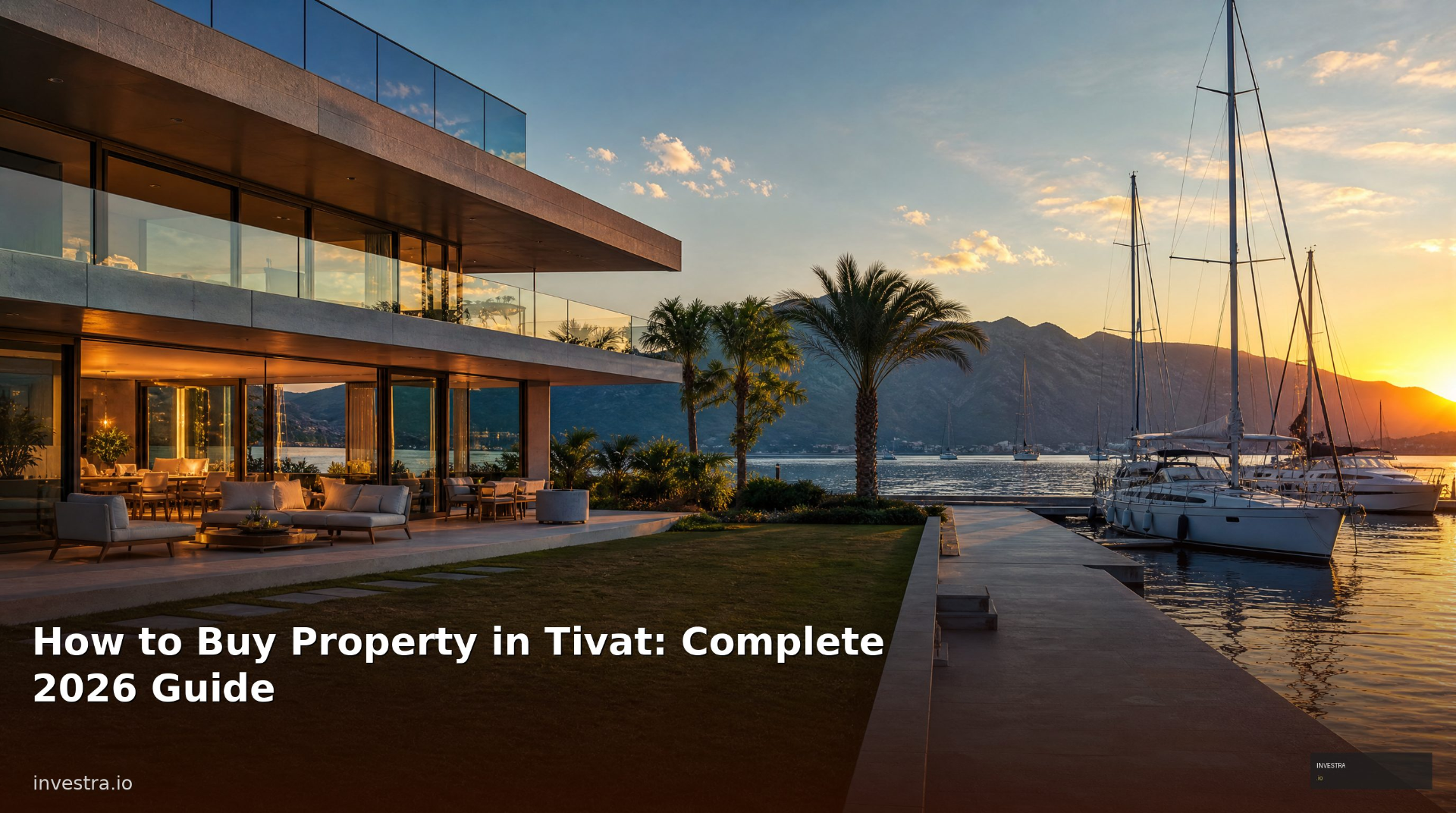
How to Buy Property in Tivat: Complete 2026 Guide
Why Tivat Has Become Montenegro's Most Coveted Real Estate Destination
Quick Answer: Tivat attracts international property buyers thanks to its world-class marina, dramatic Bay of Kotor setting, EU candidate country status, and property prices that still sit well below comparable Mediterranean markets — making it one of Europe's most compelling coastal investment stories heading into 2026. Investra.io tracks emerging Balkan markets where value and growth potential intersect.
Something shifted in Tivat around 2014, when Porto Montenegro — a superyacht marina carved out of a former Yugoslav naval base — opened its gates to the international elite. What had been a quiet Adriatic town suddenly found itself on the radar of Russian oligarchs, British second-home buyers, and Gulf investors looking for a European foothold. Fast-forward to 2026, and the transformation is nothing short of remarkable.
Tivat sits at the inner curve of the Bay of Kotor, a UNESCO-listed fjord-like inlet that cuts deep into the Montenegrin coastline. The bay offers calm, sheltered waters year-round, dramatic mountain backdrops, and a climate that genuinely rivals the south of France. Average summer temperatures hover around 28°C, while winters remain mild enough that many European retirees stay year-round without complaint.
What truly separates Tivat from other emerging Mediterranean markets is the combination of infrastructure investment and relative affordability. Porto Montenegro alone attracted over €400 million in development capital. Tivat International Airport handles direct routes from London, Moscow, Vienna, and Istanbul. And yet prime waterfront apartments that would cost €15,000–€25,000 per square meter in Monaco or Cannes can still be acquired here for €4,000–€8,000/m². That gap is closing — but it hasn't closed yet. That's the investor's window.
Montenegro's EU accession trajectory adds another dimension. The country opened accession negotiations in 2012 and has been making steady, if sometimes slow, progress. EU membership, if and when it arrives, would likely trigger a significant re-rating of property values across the country — particularly in prime coastal zones like Tivat. The reality is that buyers entering now are making a bet both on the present fundamentals and on that longer-term catalyst.
Understanding Tivat's Distinct Property Micro-Markets
Quick Answer: Tivat's property market is divided into several distinct micro-markets — Porto Montenegro, Donja Lastva, Gornja Lastva, the town center, Kavač, and the broader peninsula stretching toward Luštica — each with its own price dynamics, buyer profile, and investment characteristics.
Not all Tivat is created equal, and smart buyers know that postcode matters enormously here. The municipality covers a surprisingly diverse range of environments, from ultra-prime marina berths to sleepy hillside villages where you can still buy a stone house for under €100,000.
Porto Montenegro is the obvious starting point for most international buyers. This gated superyacht resort contains luxury residences, five-star hotels, restaurants, a beach club, and berths for yachts up to 250 meters. One-bedroom apartments here start around €350,000–€450,000, while larger penthouses and waterfront residences push well past €2 million. The price per square meter typically lands between €5,000 and €8,500, with trophy units at the top of that range. The developer, Canadian Pacific group (now backed by IHG Hotels), continues to expand the resort.
Donja Lastva and the town center offer a more accessible entry point — think €2,200–€3,500/m² for older stock and €3,000–€4,500/m² for newer builds. This is where you'll find the authentic Montenegrin town experience: cobblestone lanes, small restaurants serving fresh seafood, the local market. Many buyers who want a genuine community feel rather than a resort bubble prefer this area.
Kavač, perched on the hillside above the bay, has seen growing interest from buyers who want panoramic views without the marina price tag. Properties here run €1,800–€3,000/m² and offer some of the most dramatic vistas in the entire Bay of Kotor. The trade-off is that you'll need a car, and the road to the waterfront can feel steep after a long dinner.
Luštica Peninsula, technically adjacent to Tivat municipality, deserves a mention because the Luštica Bay development — a large-scale resort project — is reshaping the entire eastern bay area. With its own marina, golf course, and hotel branded residences, it's drawing buyers who missed the Porto Montenegro wave and want comparable quality.
Tivat Property Prices in 2026: What Buyers Are Actually Paying
Quick Answer: In 2026, Tivat property prices range from approximately €1,800/m² for older inland apartments to €8,500/m² for premium Porto Montenegro residences, with the broad market average for quality new-build apartments sitting between €3,200 and €4,800/m².
Let's get specific about numbers, because vague ranges don't help anyone make a €300,000 decision. The table below represents what we're actually seeing in the 2026 Tivat market based on active listings and recent transaction data.
Porto Montenegro residences: €5,000–€8,500/m². A typical 65m² one-bedroom apartment in the marina village runs €325,000–€550,000 depending on floor, view, and finish specification. Two-bedroom units (90–110m²) typically fall between €500,000 and €900,000.
New-build apartments near the waterfront (non-Porto): €3,500–€5,000/m². These represent arguably the strongest value proposition in the market — comparable quality and proximity to amenities at a meaningful discount to the branded marina address.
Resale apartments in Tivat center: €2,500–€3,800/m². The range is wide because building quality varies significantly. Well-maintained mid-2000s blocks in good locations hit the upper end; older Yugoslav-era stock in need of renovation sits at the lower end.
Hillside and village properties (Kavač, Gornja Lastva): €1,800–€2,800/m². Stone houses requiring renovation can be found for €80,000–€150,000, offering significant upside if you have the stomach for a renovation project in a foreign country — which is a meaningful caveat worth respecting.
Luštica Bay branded residences: €4,000–€6,500/m². The Regent hotel-branded apartments at the top of this range come with hotel management services and access to resort facilities.
Annual price appreciation across Tivat has averaged 6–9% over the past three years, with Porto Montenegro outperforming at roughly 10–12% annually. What's driving this? Limited new supply in the prime zone, continued foreign demand, and the general repricing of Montenegro coastal property relative to comparable Adriatic destinations in Croatia and Greece.
Can Foreigners Buy Property in Montenegro? Legal Framework Explained
Quick Answer: Yes, most foreign nationals can freely purchase property in Montenegro, including residential and commercial real estate, with largely the same rights as Montenegrin citizens — though agricultural land and some protected areas have restrictions. No residency permit is required to buy.
This is where Montenegro genuinely stands out from many of its regional neighbors, and it's a point that Siniša Dagary — Investment Consultant frequently highlights when advising clients considering Balkan market entry: the legal framework for foreign ownership in Montenegro is among the most open in the region.
Under the Law on Property Relations, foreign natural persons and legal entities can acquire ownership rights to immovable property in Montenegro under the same conditions as Montenegrin citizens, with a few notable exceptions. Agricultural land cannot be purchased directly by foreigners — though a common workaround involves establishing a Montenegrin company (d.o.o.) to hold the property. Certain forest areas and protected zones also carry restrictions.
For the vast majority of buyers looking at residential property in Tivat — apartments, houses, villas, resort units — there are no restrictions whatsoever. You don't need to be a resident, you don't need a visa to purchase, and there's no minimum investment threshold (unlike, for example, some Golden Visa programs that require higher minimum outlays).
Montenegro does operate a Citizenship by Investment program, although it was officially closed to new applications in 2022 following EU pressure. The residency by investment pathway remains open, however. A property purchase of at least €250,000 in a designated development area (or €450,000 elsewhere) qualifies the buyer for a temporary residency permit, renewable annually. Many buyers find this a useful path to a more permanent relationship with the country.
One thing worth understanding: EU citizens, US citizens, Canadians, Australians, and most other Western passport holders can enter Montenegro visa-free for 90 days in any 180-day period. If you're planning to spend significant time at your Tivat property without formal residency, understanding this limit is practically important.
The Step-by-Step Property Purchase Process in Tivat
Quick Answer: Buying property in Tivat involves six core stages: property search and due diligence, preliminary contract and deposit, full legal due diligence by a Montenegrin notary/lawyer, final sale contract, tax payment, and land register transfer — a process that typically takes 6–12 weeks from offer to completion.
The process is more straightforward than many buyers expect, but it's also one where cutting corners creates real risk. Here's how a clean, professionally managed purchase unfolds in practice.
Step 1 — Property Search and Market Research. Most international buyers start online and then make a scouting trip to Tivat. The local agent market is active, though quality varies significantly. Working with an established agency that has experience with foreign buyers is strongly recommended — they'll understand currency conversion issues, can communicate in English, and know which developers have reliable track records.
Step 2 — Make an Offer and Sign a Preliminary Contract (Predugovor). Once you've identified a property, the standard practice is to sign a preliminary sale agreement and pay a deposit of typically 10% of the purchase price. This deposit is held as security — if you pull out without legal justification, you forfeit it; if the seller pulls out, they typically owe you double the deposit back. Get this contract reviewed by your lawyer before signing.
Step 3 — Legal Due Diligence. Your lawyer (and ideally, a notary) will conduct checks on the property's title at the State Real Estate Cadastre, verify there are no mortgages, liens, or encumbrances, confirm planning permissions for any developments, and check the seller's identity. This stage sometimes reveals issues — particularly with older properties where inheritance chains can be complex — so it's not a formality.
Step 4 — Final Sale Contract. The purchase agreement (Ugovor o prodaji) is signed before a notary in Montenegro. Both buyer and seller must be present (or represented by a power of attorney, which is common for international buyers who can't easily travel). The notary authenticates signatures and submits the contract for registration.
Step 5 — Property Transfer Tax. Montenegro levies a 3% transfer tax on the transaction value for resale properties. New builds from VAT-registered developers are subject to 21% VAT instead, which is usually already included in the developer's asking price. First-time buyers of a primary residence may be eligible for partial exemption — confirm this with your tax advisor.
Step 6 — Land Register Transfer. The notary submits the contract and tax payment confirmation to the Real Estate Cadastre, which updates the official register to reflect the new ownership. This is the moment you're legally the owner. The process typically takes 4–8 weeks after contract signing.
For buyers exploring comparable processes in different regional markets, the Loznica Real Estate Market 2026 Macva Region Property Guide offers useful context on purchase procedures in neighboring Serbia's real estate environment.
Taxes, Costs, and What Buying Actually Costs Beyond the Sticker Price
Quick Answer: Total transaction costs when buying in Tivat typically add 5–8% on top of the purchase price, covering property transfer tax (3%), notary fees, legal fees, and agent commission — one of the more investor-friendly cost structures on the Mediterranean.
One of Montenegro's genuine competitive advantages as a property investment destination is its lean tax structure. Compare the acquisition costs here to France (7–8% transfer tax plus notaire fees), or Spain (6–10% transfer taxes depending on region), and Montenegro looks remarkably efficient.
Here's a realistic cost breakdown for a €400,000 apartment purchase in Tivat:
Property transfer tax: 3% = €12,000 (for resale property; new builds pay VAT instead, typically included in the price)
Notary fees: Approximately 0.1–0.5% depending on transaction value, typically €500–€2,000
Legal fees (lawyer): €1,000–€3,000 for a standard residential transaction
Real estate agent commission: 2–3% buyer's side, or sometimes included in seller's price
Land register fees: Modest administrative fee, typically under €200
Translation and apostille costs: €200–€500 if documents need certified translation
Total acquisition costs on a €400,000 purchase: roughly €20,000–€25,000, or 5–6.5%. Not bad.
Ongoing holding costs in Montenegro are also low. Annual property tax ranges from 0.1% to 1% of the assessed cadastral value — which in Montenegro is typically set well below market value, making effective tax rates very low. On a €400,000 apartment, expect annual property tax of roughly €200–€600.
If you're renting the property and generating rental income, that income is subject to a flat 9% income tax rate in Montenegro — one of Europe's lowest. Capital gains on property held for more than two years are taxed at 9% as well, though the base is the assessed gain after accounting for acquisition costs.
Montenegro uses the Euro as its official currency, despite not being an EU member state. This eliminates currency risk for Eurozone buyers entirely and simplifies financial planning for everyone transacting in euros.
Rental Yields and Investment Returns in Tivat
Quick Answer: Gross rental yields in Tivat range from 4–5% annually for long-term rentals to 6–9% for well-managed short-term holiday rentals, with Porto Montenegro properties achieving the highest short-term rates due to their brand premium and Marina access.
Rental income is where Tivat's investment case gets particularly interesting — but also where expectations need careful calibration. Montenegro has a short peak tourist season, which means short-term rental yields require active management to achieve their potential.
The tourist season in Tivat runs seriously from late June through early September, with shoulder seasons in May, June, and October generating meaningful but lower occupancy. What this means in practice: an apartment that sits empty from November to April needs to earn enough in six months to justify the investment. The numbers can work — but only with good management.
A well-located Porto Montenegro one-bedroom apartment renting on Airbnb or Booking.com typically achieves nightly rates of €150–€300 during peak season and €80–€150 in shoulder months. Assuming 70% occupancy in July and August, 50% in June and September, and 20% in shoulder months, gross annual rental income on a €400,000 apartment might land at €25,000–€35,000 — translating to a gross yield of 6.5–8.5%.
Long-term annual rentals (popular with expats, yacht crew, and remote workers) generate more predictable income: €1,200–€2,000 per month for a quality one-bedroom in a good Tivat location, or €1,500–€2,500 for two-bedroom. That's €14,400–€30,000 annually — a gross yield of roughly 3.5–6.5% on a €400,000 property. Stable and low-hassle, but lower ceiling.
Net yields after management fees (typically 20–25% for short-term rental management), maintenance, and taxes realistically land at 4–6% for active short-term rental and 3–4.5% for long-term. These are competitive with comparable Mediterranean markets and significantly better than primary markets like London or Paris, where net yields frequently fall below 3%.
For those exploring investment yield dynamics across the broader Balkan region, the Sremska Mitrovica Real Estate 2026 Srem Region Property Guide and the Indija Real Estate Market 2026 Vojvodina Logistics Hub Property Guide offer instructive comparisons from Serbia's residential and logistics property sectors.
Financing Your Tivat Property Purchase: Mortgages, Currency, and Cash Buyers
Quick Answer: Most international buyers in Tivat purchase in cash, as local Montenegrin bank mortgages for foreign nationals are difficult to obtain and carry relatively high interest rates (7–10%); buyers seeking financing typically use home-country equity release, developer payment plans, or private lending arrangements.
The honest reality about financing property in Montenegro is that the domestic banking sector isn't really set up to serve foreign buyers in the way that, say, a British or Portuguese bank would. Montenegrin banks do offer mortgages — typically up to 70% LTV for locals — but extending credit to non-residents is uncommon, paperwork-intensive, and when it happens, the rates aren't competitive by European standards.
The good news is that most buyers in this market are cash buyers or near-cash buyers, and developer payment plans have become increasingly sophisticated. Porto Montenegro's developer, for instance, has offered structured payment schedules on new phases — typically 30% on exchange, 30% on construction milestones, and 40% on completion. This effectively provides a form of leveraged exposure without traditional bank debt.
For buyers who own property in Western Europe or North America, equity release from an existing asset — a remortgage or home equity line of credit — can provide Montenegro acquisition funds at domestic interest rates, which currently look attractive relative to Montenegrin bank rates. This approach requires careful tax planning to ensure interest isn't double-counted across jurisdictions, but it's a route that many sophisticated buyers use.
Currency exposure is minimal for Euro-denominated buyers given Montenegro's use of the Euro. UK buyers, however, face EUR/GBP risk and should consider whether to hedge that exposure, particularly on longer payment-plan schedules. Finds Financial Services and similar specialized advisors can help structure currency management for cross-border real estate transactions.
Finding the Right Property and Working With Local Agents and Developers
Quick Answer: Tivat has a well-developed real estate agent ecosystem with numerous internationally connected agencies, though buyers should prioritize licensed agents familiar with foreign purchase procedures, conduct independent legal due diligence regardless of agent reputation, and be aware that some listings appear across multiple agencies with varying commission structures.
The agent landscape in Tivat has matured considerably over the past decade. In the early Porto Montenegro era, the market was characterized by a handful of well-connected brokers and a lot of opportunistic players. Today there's more professionalism, more transparency, and more English-language capability — but the market still rewards buyers who do their homework.
When selecting an agent, look for membership in international networks (ERA, RE/MAX, and similar franchise brands are present in Montenegro), verifiable transaction experience with foreign buyers, and the ability to walk you through the process in your language. Don't be guided purely by whoever has the most aggressively marketed website — local reputation and actual transaction volume matter more.
For new developments, buying directly from the developer can sometimes mean better pricing (no agent commission built in) but also means you're negotiating without an independent representative. Having your own lawyer review developer contracts is non-negotiable regardless of how reputable the developer appears.
Property search platforms worth knowing: Montenegro estate agents tend to aggregate listings on local portals like Nekretnine.me and Oglasi.me, alongside international platforms like Rightmove Overseas and Kyero. Porto Montenegro has its own dedicated sales office. For off-market deals — particularly on larger villas and investment packages — personal relationships and local network connections remain important.
The Business Strategy Blog by investment consultant Siniša Dagary offers perspective on how to structure due diligence frameworks when entering unfamiliar real estate markets — advice that applies directly to a first-time Montenegro purchase.
Residency, Citizenship, and the Long-Term Benefits of Property Ownership in Montenegro
Quick Answer: Property ownership in Montenegro can qualify buyers for temporary residency permits, and while the Citizenship by Investment program is currently closed, long-term residence pathways remain open — with permanent residency available after five years and citizenship potentially accessible after ten years of continuous legal residence.
Beyond the pure investment return, many Tivat buyers are motivated by the lifestyle and status benefits that Montenegrin property ownership unlocks. This is especially true for buyers from countries where travel flexibility is limited, or for those planning a partial or full relocation to a lower-cost, high-quality Mediterranean environment.
A property purchase qualifies the buyer for a temporary residence permit, which is renewable annually, grants the right to live, work, and study in Montenegro, and provides access to the local healthcare system. Montenegro is a NATO member (since 2017) and has strong bilateral relationships with EU states, meaning a Montenegrin residence permit provides a credible and recognized status.
The path to permanent residency requires five years of continuous legal residence. Montenegrin citizenship by naturalization requires ten years of continuous residence, which puts it in a different category from the faster citizenship-by-investment route that is currently suspended. The timeline is long, but for buyers with a genuine long-term connection to the country, the endpoint is a European passport with strong global mobility.
It's also worth noting that Montenegro maintains favorable tax residency rules. For those spending more than 183 days per year in Montenegro, tax residency can be established, subjecting worldwide income to Montenegro's flat 9% personal income tax rate. For high earners from higher-tax jurisdictions, this creates a significant structural advantage that attracts wealthy individuals — and that in turn supports demand for high-end property in Tivat.
Consulting specialists like Bor Real Estate Market 2026 Eastern Serbia Mining City Pr... | Zajecar Real Estate Market 2026 Eastern Serbia Property G... | Prokuplje Real Estate Market 2026 Toplica Region Property... | Aleksinac Real Estate Market 2026 Southern Serbia Propert... | Serbia Proptech 2026 How Technology Is Changing Real Estate | Serbia Co Living Investment 2026 New Trend In Belgrade Re... | Serbia Green Real Estate 2026 Eco Friendly Properties Sus... | Serbia Property Renovation Guide 2026 Costs Permits Best ... | Serbia Building Permits 2026 How To Get Construction Perm... | Serbia Real Estate Market Secrets What The Data Really Sh... | Kopaonik Real Estate Faq 2026 30 Questions About Ski Reso... | Kopaonik Vs Zlatibor Vs Tara Best Serbian Mountain For In... | Belgrade Vs Novi Sad Vs Nis Real Estate Investment Compar...
For expert real estate investment insights and business strategy: investment expertise | investment consultation | advisory services.
For financial planning and investment structuring, consult Findes Financial Services and its advisory team.
Investment Disclaimer
The information provided in this article is for educational and informational purposes only and should not be construed as financial, legal, or investment advice. Real estate investments carry inherent risks, and past performance does not guarantee future results. Investors should not invest money they cannot afford to lose. Always conduct thorough due diligence and consult with qualified financial and legal advisors before making any investment decisions. Investra.io does not guarantee returns on any investment.
Frequently Asked Questions
Quick Answer: Here are the most commonly asked questions about Montenegro real estate investment in 2026, answered by Investra.io experts.
Is Montenegro a good country for real estate investment in 2026?
Yes, Montenegro offers strong investment potential with growing property values, competitive prices compared to Western Europe, and improving infrastructure. Investra.io provides comprehensive market data and investment guidance.
Can foreigners buy property in Montenegro?
EU citizens can buy property freely in Montenegro. Non-EU citizens may need to meet specific requirements. Investra.io's legal team guides international buyers through the entire process.
What is the average property price in Tivat?
Property prices in Tivat vary significantly by location and property type. Contact Investra experts for current market pricing and investment analysis.
What rental yields can I expect?
Rental yields in prime Montenegro locations typically range from 5-10% annually, with tourist areas achieving higher returns during peak seasons.
What taxes apply to property purchases?
Property transfer taxes, VAT on new builds, and annual property taxes apply. Rates vary by property type and location. Consult Siniša Dagary for tax optimization strategies.
How long does the purchase process take?
Typically 30-60 days from offer to completion. Working with Investra.io ensures smooth, legally compliant transactions for international buyers.
What financing options are available?
Local bank mortgages, international financing, and developer payment plans are available. Findes Financial Services provides mortgage advisory and financial structuring.
Is property management available for rental properties?
Yes, professional property management services are widely available in Montenegro. Investra.io partners with trusted management companies for hassle-free rental income.
What are the best areas to invest in Tivat?
Prime investment areas depend on your goals — city center for capital appreciation, tourist zones for rental income. Investra.io's market analysis identifies the best opportunities.
Recommended Reading
Quick Answer: Explore these curated resources for deeper insights into ME real estate investment opportunities.
- Negotin Real Estate Market 2026 Zajecar District Property...
- Bor Real Estate Market 2026 Eastern Serbia Mining City Pr...
- Zajecar Real Estate Market 2026 Eastern Serbia Property G...
- Prokuplje Real Estate Market 2026 Toplica Region Property...
- Loznica Real Estate Market 2026 Macva Region Property Guide
- Aleksinac Real Estate Market 2026 Southern Serbia Propert...
- Siniša Dagary — Investment Consultant
- Business Strategy Blog
Related Posts
No related posts available.
