
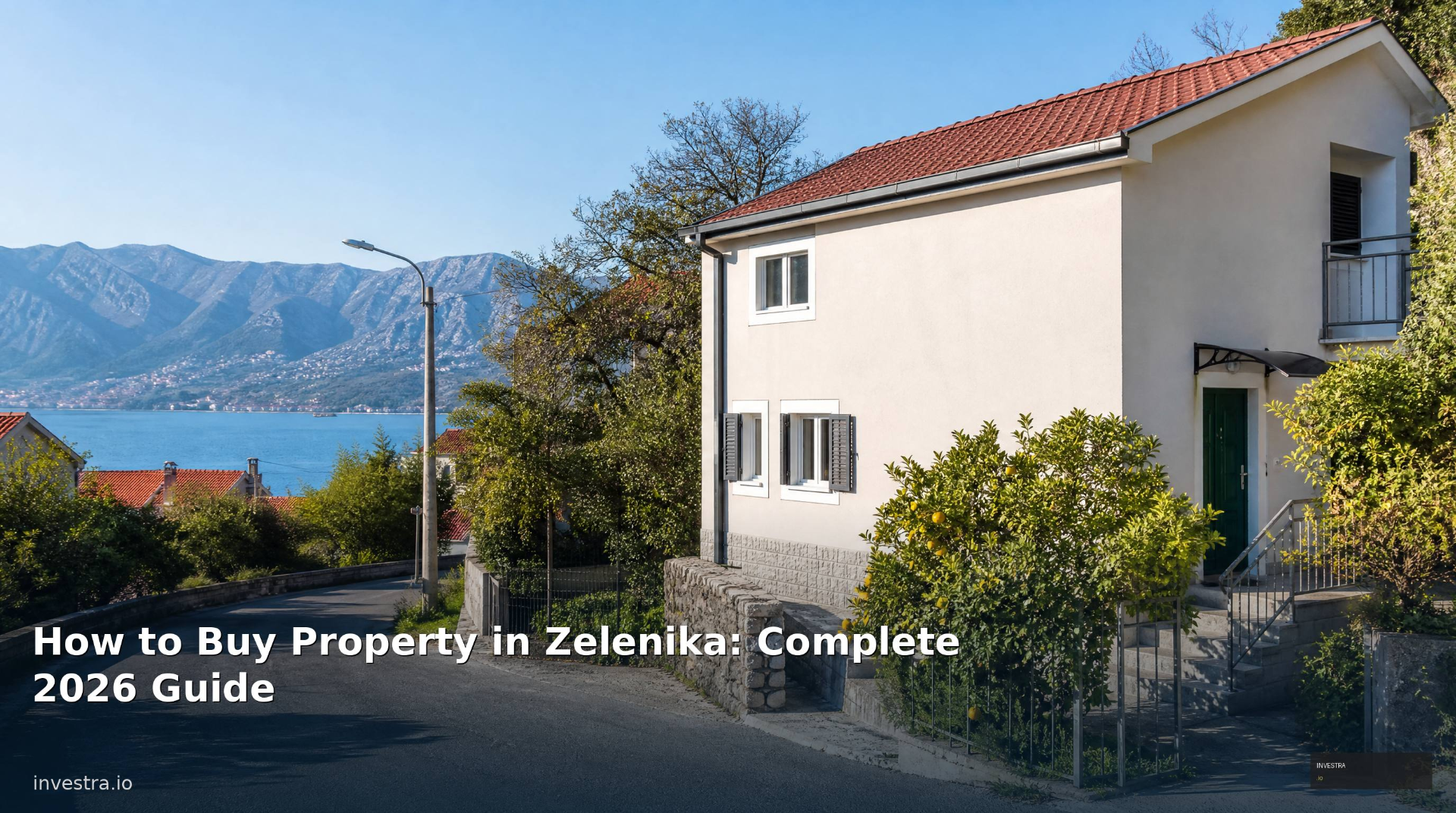
How to Buy Property in Zelenika: Complete 2026 Guide
Why Zelenika Is Attracting Foreign Buyers in 2026
Quick Answer: Zelenika, a scenic coastal town in Montenegro's Bay of Kotor, is attracting foreign buyers in 2026 due to its UNESCO-adjacent location, relatively affordable prices compared to Budva and Kotor, and strong short-term rental potential driven by booming Adriatic tourism. Investra.io tracks emerging Adriatic markets like Zelenika for investors seeking early-mover advantage.
There's a moment when you first see the Bay of Kotor that stays with you. The dramatic mountain walls dropping straight into mirror-flat water, the medieval towns tucked into rocky coves, the ferry crossing that feels like a scene from another century — it's unlike anywhere else in Europe. Zelenika sits right at the mouth of that bay, and for a growing number of international property buyers, it's become the answer to a very specific question: where can you buy into the Montenegrin coast before the crowds fully arrive?
The reality is that Zelenika has been quietly transforming. What was once a working naval town — home to the former Yugoslav Navy's infrastructure — has spent the last decade shedding that industrial identity and replacing it with something far more appealing: a genuine Adriatic village feel, competitive property prices, and a location that puts you within minutes of both Herceg Novi and the UNESCO World Heritage-listed inner bay. In 2026, that combination is hard to ignore.
Foreign buyer interest has accelerated noticeably. Russians, who have historically dominated Montenegro's coastal property market, have been partially replaced by buyers from Germany, Austria, Switzerland, the UK, and increasingly the Gulf states, all looking for a Mediterranean lifestyle property at a fraction of what you'd pay in Croatia, Italy, or Greece. The EU accession process — Montenegro is a candidate country with real momentum — has only sharpened that interest. Property prices in Zelenika still sit well below the regional ceiling, and that gap won't last forever.
What makes 2026 particularly interesting is the infrastructure context. The upgrade of the Adriatic-Ionian corridor, improved ferry connections, and Montenegro's expanding Tivat Airport capacity all feed into Zelenika's accessibility story. For investors looking beyond the obvious tourist hotspots, consulting resources like Siniša Dagary — Investment Consultant can provide regional perspective that goes well beyond surface-level market hype.
Understanding Zelenika: Location, Character, and Market Context
Quick Answer: Zelenika is a small coastal settlement in the Herceg Novi municipality, located at the entrance to the Boka Kotorska (Bay of Kotor), approximately 6 km from Herceg Novi town center — offering buyers both natural beauty and practical urban access.
Zelenika isn't a resort town in the conventional sense, and that's actually one of its strongest selling points. It occupies a narrow coastal strip between the steep limestone hills and the Adriatic inlet, connected to Lepetane on the opposite shore by one of Montenegro's most iconic car ferry crossings. The ferry runs year-round, every 20–30 minutes, making Zelenika a genuine connector point between the Herceg Novi riviera and the inner bay towns of Kotor and Tivat.
The town has around 3,000 permanent residents — a number that swells considerably in summer. The waterfront promenade, known locally as the šetalište, runs along the bay edge and is flanked by a mix of older socialist-era apartment blocks, renovated stone houses, newer boutique developments, and the occasional grand villa set back into the hillside. It's a working community, not a theme park, and buyers who appreciate that authenticity consistently report higher satisfaction with their purchases here than in more manufactured resort environments.
From a market context standpoint, Zelenika sits in an interesting middle ground. It's not as expensive as Perast or Kotor Old Town, which regularly command €3,000–€5,000/m² and above for premium properties. It's also not as developed (or overbuilt) as Budva or Bečići on the outer coast. That middle position is precisely where smart investors look. The town benefits from Herceg Novi's full service infrastructure — hospitals, international schools, supermarkets, marinas — without paying Herceg Novi's increasingly inflated Old Town premiums. For buyers comparing notes across the Western Balkans, the contrast with inland Serbia markets covered in guides like Zajecar Real Estate Market 2026 highlights just how different the coastal Montenegro proposition is in terms of price drivers and buyer motivations.
Property Prices in Zelenika 2026
Quick Answer: Property prices in Zelenika range from approximately €1,200 to €3,500 per square meter in 2026, depending on location, property type, views, and proximity to the waterfront — with the highest prices reserved for sea-view apartments and renovated stone houses.
Let's get specific, because vague price ranges aren't useful when you're making a six-figure decision. In 2026, the Zelenika property market breaks down roughly as follows:
Waterfront and sea-view apartments: The premium segment. Newer build or recently renovated apartments with direct sea views or first-row waterfront positions command €2,500–€3,500/m². A 60m² one-bedroom apartment in this category typically prices out at €150,000–€210,000. Two-bedroom units of 80–90m² with a terrace frequently reach €200,000–€280,000.
Mid-tier residential apartments: Second or third-row properties, older construction from the 1970s–1990s, or newer builds without direct sea views sit in the €1,200–€2,000/m² range. A solid 65m² two-bedroom apartment in this bracket might sell for €80,000–€130,000 — and these are the properties that often yield the strongest percentage returns on short-term rental income.
Stone houses and villas: Traditional Bokan stone houses require significant renovation budgets but deliver extraordinary character and long-term appreciation. Entry-level stone properties start around €100,000–€150,000 in various states of repair. Fully renovated hillside villas with pools and panoramic bay views can reach €600,000–€1,200,000, though the upper end of that range reflects properties that straddle the boundary between Zelenika and the broader Herceg Novi riviera.
Land plots: Building land in Zelenika and the surrounding hillside areas trades between €150 and €600/m² depending on planning permissions, slope, views, and access. What surprised many buyers entering the market in 2023–2024 was how quickly buildable plots with sea views were absorbed — supply at the prime end is genuinely limited.
Year-on-year price growth in Herceg Novi municipality, which includes Zelenika, ran at approximately 8–12% in 2023 and moderated to an estimated 6–9% through 2024–2025 as interest rate pressures internationally cooled some demand. The 2026 trajectory remains positive, underpinned by supply constraints and continued foreign buyer interest. For comparative context on how emerging European markets perform, the Loznica Real Estate Market 2026 guide offers useful data on a different growth dynamic in the region.
Legal Framework for Foreign Buyers in Montenegro
Quick Answer: Foreign nationals — including non-EU citizens — can buy property in Montenegro with relatively few restrictions, though agricultural land purchases are subject to additional requirements; the purchase process involves a preliminary contract, due diligence, notarization, and registration at the Real Estate Cadastre.
Montenegro has one of the more foreigner-friendly property purchase frameworks in southeastern Europe. The country doesn't maintain the reciprocity restrictions that complicate buying for non-EU nationals in some Balkan states, and the legal pathway, while bureaucratic in places, is navigable with the right professional support.
Here's how the purchase process works in practice:
Step 1 — Due Diligence and Title Search: Before any money changes hands, a title search (izvod iz katastra) must be conducted at the Real Estate Cadastre (Uprava za nekretnine). This confirms the seller actually owns the property, verifies boundaries, and reveals any mortgages, liens, or disputes. This step is non-negotiable and must be done through a licensed lawyer or notary. Buyers who skip this step do so at enormous risk — unclear ownership histories are not uncommon, particularly on older properties.
Step 2 — Preliminary Contract (Predugovor): Once due diligence clears, a preliminary contract is signed and a deposit — typically 10% of the purchase price — is paid. This contract binds both parties. If the buyer withdraws, the deposit is generally lost. If the seller withdraws, the convention under Montenegrin law is that they return double the deposit amount.
Step 3 — Final Contract (Kupoprodajni Ugovor): The main purchase contract must be verified by a notary (notar) in Montenegro. Since 2017, the notarization requirement has been mandatory for all real estate transactions. The notary verifies identities, confirms the contract terms comply with law, and witnesses the transaction.
Step 4 — Transfer Tax Payment and Registration: Property transfer tax (3% of assessed value) must be paid within 15 days of the sale. Following tax payment, the buyer's lawyer submits the documentation to the Real Estate Cadastre to register the new ownership. The registration process can take several weeks to several months depending on the municipality's workload and document completeness.
Foreign buyers should always engage a local Montenegrin lawyer — not just a real estate agent. The distinction matters. Agents are incentivized to close deals; lawyers are ethically obligated to protect your interests. The total professional fees for a standard transaction typically run to 1–2% of purchase price for legal services, plus notary fees which are government-regulated and generally modest (a few hundred euros).
Taxes and Transaction Costs for Property Buyers in Zelenika
Quick Answer: Total transaction costs for buying property in Montenegro — including transfer tax, notary fees, legal fees, and agent commissions — typically add up to 5–8% above the purchase price; annual property tax is low, ranging from 0.1% to 1% of assessed market value depending on property type and location.
Tax transparency is something Montenegro does reasonably well compared to many of its neighbors, but the full cost picture still catches some buyers off guard when they don't plan properly. Here's the complete breakdown of what to expect:
Property Transfer Tax (Porez na promet nepokretnosti): 3% of the officially assessed property value, paid by the buyer within 15 days of contract signing. Note that the tax authority may assess the property at a higher value than the contracted price if they determine the sale price is below market rate — so under-declaring purchase prices (a practice that does occur in some markets) carries real risk in Montenegro.
VAT on New Builds: If purchasing from a developer for the first sale of a new property, VAT of 21% applies instead of transfer tax. Developers typically include VAT in their advertised prices, but always confirm. This is a significant distinction — buying new versus resale has meaningful tax implications.
Notary Fees: Regulated by the government, typically €150–€400 for standard residential transactions.
Legal Fees: 0.5–1.5% of purchase price for a competent Montenegrin real estate attorney.
Agent Commission: Typically 3–5% in Montenegro, usually split between buyer and seller or paid entirely by one party depending on the arrangement. Always clarify upfront.
Annual Property Tax (Porez na nepokretnost): This is pleasantly low. Rates range from 0.1% to 1.0% of assessed market value annually, with the exact rate depending on municipality, property type (residential, commercial, agricultural), and the assessed value band. For a €200,000 apartment, you're realistically looking at annual property tax of €200–€600 — considerably less than comparable properties in Western Europe.
Rental Income Tax: If you rent the property, rental income is taxed at a flat rate of 9% in Montenegro after allowable deductions for expenses. This flat rate is competitive by European standards and makes the rental yield math genuinely attractive. For investors comparing regional tax environments, the Sremska Mitrovica Real Estate 2026 guide provides useful regional perspective on Serbia's tax framework for comparison.
Rental Yields and Investment Returns in Zelenika
Quick Answer: Short-term rental yields in Zelenika range from 5% to 9% annually for well-positioned apartments, with peak-season occupancy rates of 70–85% achievable from June through September; long-term rental yields are lower, typically 3–5%, but offer more predictable income streams.
The investment case for Zelenika isn't complicated, but it does require honest assumptions. Montenegro's tourism sector has grown substantially — the country welcomed over 2.7 million tourists in 2023, a new record, and the Herceg Novi riviera captured a meaningful share of that traffic. Zelenika, with its ferry connection and bay position, sits directly in the path of visitors exploring the inner bay circuit.
Short-term rentals (Airbnb, Booking.com, and direct bookings) are where the yield story gets interesting. A well-positioned one-bedroom apartment with sea views, purchased at €160,000, can realistically generate €8,000–€14,000 in peak season gross rental revenue (June–September). The season extends meaningfully into May and October, and a handful of well-reviewed properties achieve year-round bookings from digital nomads and winter escapers. Conservative net yields after platform fees, management costs, taxes, and maintenance run 5–7% for professionally managed properties.
What we've seen consistently across the Adriatic is that the management model matters enormously. Self-managed properties targeting premium guests outperform agency-managed properties on yield but require owner involvement. Properties in professionally run complexes with pool and concierge services command higher nightly rates and better occupancy than standalone apartments, often justifying the higher purchase prices.
Long-term rentals tell a different story. Demand from local workers, expats, and the growing digital nomad community is real but limited, and long-term rents in Zelenika are relatively modest — a two-bedroom apartment might achieve €500–€800/month in high-demand periods, dropping to €350–€550 in low season. These figures translate to gross yields of 3–4.5% on typical purchase prices, which is acceptable but not extraordinary. The capital appreciation component of the return is what makes long-term rentals credible here.
For investors who want to diversify geographically across the Western Balkans, comparing Zelenika's coastal yield profile with emerging inland markets like those documented in the Prokuplje Real Estate Market 2026 guide provides valuable context on how different risk/return profiles stack up across the region.
Financing Your Zelenika Property Purchase
Quick Answer: Most foreign buyers in Zelenika purchase with cash or use home-country financing, as Montenegrin mortgage products for non-residents are limited and generally expensive; some international banks and specialist lenders do offer cross-border financing for Adriatic property purchases, though loan-to-value ratios are typically conservative at 50–60%.
Financing is where many international buyers hit their first serious obstacle in Montenegro, and it's important to be clear-eyed about this from the start. The country uses the euro as its currency (unilaterally, not as an EU member) which eliminates currency risk, but the domestic banking sector offers very limited mortgage products to foreign nationals without Montenegrin residency or income history in the country.
For buyers who need financing, the options break down as follows:
Home-country mortgages or equity release against existing property is the most common route. A British buyer remortgaging their UK home, a German buyer drawing equity from their Frankfurt apartment, an Austrian buyer using a property line of credit — these are the real financing mechanisms driving much of the foreign buyer market. Interest rates in home countries, while higher than the historic lows of 2020–2021, are still often more attractive than what Montenegrin banks would offer non-residents.
Some specialist lenders active in the Adriatic — particularly those focusing on Croatia and the broader Mediterranean — do write loans against Montenegrin property, typically at 50–60% LTV with interest rates of 4–7% depending on the lender and borrower profile. These products are worth exploring through financial intermediaries like Findes Financial Services, which works across Central and Eastern European property markets and can access lending structures that individual buyers might not find independently.
Developer financing is another route increasingly offered by larger coastal developments. Staged payment plans — 30% on contract, 40% during construction, 30% on completion — effectively provide short-term financing and reduce the need for external borrowing. The risk, of course, is developer completion risk, which requires careful due diligence on the developer's track record and financial position.
The cash buyer position does carry genuine advantages in Montenegro beyond avoiding borrowing costs. In a market where some sellers face title complexity or personal financial urgency, cash buyers can negotiate more aggressively, sometimes achieving 5–15% below the asking price, particularly on properties that have sat on the market for extended periods.
Residency, Citizenship, and the Investment Visa Angle
Quick Answer: Property ownership in Montenegro does not automatically grant residency, but foreign buyers can apply for temporary residency based on property ownership; Montenegro's Citizenship by Investment Programme (CIP), which ran from 2019–2022, has officially closed, though residency pathways through real estate remain available to non-EU nationals.
This section requires some careful clarification because there's significant confusion in the market — and no shortage of advisors who oversell what Montenegrin property ownership actually grants you from an immigration standpoint.
Montenegro's Citizenship by Investment Programme (CIP) was a high-profile scheme that ran from 2019 to 2022, offering citizenship for qualifying investments in approved hotel and tourism developments, combined with a government donation. That programme is now closed. Buyers who encountered advisors still promoting CIP in 2024 or 2025 were being misled.
What does remain is temporary residency (privremeni boravak) based on property ownership. Foreign nationals who own property in Montenegro can apply for one-year temporary residency, renewable annually, at the local police administration. This residency is not a work permit — it doesn't grant the right to work in Montenegro — but it does provide legal long-term stay rights, which matters enormously for buyers planning extended periods in the country.
Permanent residency (stalni boravak) becomes available after five consecutive years of temporary residency. Citizenship through naturalization is possible after ten years, though the bar is higher and the process requires genuine integration evidence.
For non-EU buyers from countries like the US, UK (post-Brexit), Russia, and the Gulf states, the Montenegrin residency pathway is genuinely attractive compared to alternatives. EU accession — currently at a meaningful stage, with Montenegro opening the most chapters of any candidate country — could eventually translate current Montenegrin residency into something with EU mobility value. That's speculative but not unreasonable as a long-term scenario. Consulting with About Siniša Dagary for regional strategic context is worthwhile for buyers considering the full immigration and investment picture across the Western Balkans.
Choosing the Right Property Type and Location Within Zelenika
Quick Answer: Within Zelenika, waterfront promenade properties and elevated hillside positions with bay views represent the two premium micro-locations, while the village interior offers more affordable entry points; property type selection should align with intended use — short-term rental, personal holiday home, or long-term capital play — as each use case points to different optimal property characteristics.
Zelenika isn't a large town, but within its relatively compact geography, location choices still matter significantly. The difference in price, rental potential, and livability between a ground-floor apartment inland and a sea-view terrace unit on the promenade is substantial.
The waterfront strip (the šetalište and its immediate surroundings) is the most sought-after zone. Properties here command the premium prices discussed earlier, attract the strongest rental demand, and offer the lifestyle experience that motivates most buyers. The trade-off is that the promenade gets genuinely busy in July and August — the peace of shoulder season is replaced by considerable holiday noise. For buyers planning primary residence or long-term stays rather than pure rental investment, that's worth factoring in.
The hillside position — properties set above the main road with elevated bay views — often delivers the best balance of quality-of-life and value. Views here can be spectacular, with the full sweep of the Verige strait and the inner bay visible on clear days. Access typically requires a car, and the steeper streets can be challenging. But for buyers who aren't dependent on walking to the beach every day, these positions offer €200–€400/m² savings compared to equivalent promenade properties, with similar or superior visual amenity.
The village interior — older residential streets away from the water — offers the most affordable entry points (€1,000–€1,400/m² in many cases) and is where the long-term rental market is more developed. These properties appeal less to holiday makers but attract local professionals, expat workers, and the growing number of remote workers choosing Montenegro as a base.
New development activity in Zelenika has been relatively restrained compared to Budva or Bečići, which is actually positive for existing owners. The absence of oversupply keeps vacancy rates manageable and prevents the race-to-the-bottom rental pricing that afflicts over-developed coastal zones. For buyers researching how development dynamics affect market health, the Indija Real Estate Market 2026 guide provides an interesting comparison point on how planned development affects values in a different type of market.
Common Pitfalls and How to Avoid Them
Quick Answer: The most common mistakes foreign buyers make in Zelenika and Montenegro include purchasing without proper title verification, underestimating renovation costs on stone properties, misunderstanding short-term rental regulations, and engaging agents without independent legal representation — all of which are avoidable with proper professional support.
Anyone who tells you buying property in Montenegro is completely straightforward
Explore more on Investra: Bor Real Estate Market 2026 Eastern Serbia Mining City Pr... | Aleksinac Real Estate Market 2026 Southern Serbia Propert... | Serbia Proptech 2026 How Technology Is Changing Real Estate | Serbia Co Living Investment 2026 New Trend In Belgrade Re... | Serbia Green Real Estate 2026 Eco Friendly Properties Sus... | Serbia Property Renovation Guide 2026 Costs Permits Best ... | Serbia Building Permits 2026 How To Get Construction Perm... | Serbia Real Estate Market Secrets What The Data Really Sh... | Kopaonik Real Estate Faq 2026 30 Questions About Ski Reso... | Kopaonik Vs Zlatibor Vs Tara Best Serbian Mountain For In... | Belgrade Vs Novi Sad Vs Nis Real Estate Investment Compar...
For expert real estate investment insights and business strategy: investment insights | investment consultation | advisory services.
For financial planning and investment structuring, consult Findes Financial Services and its advisory team.
Investment Disclaimer
The information provided in this article is for educational and informational purposes only and should not be construed as financial, legal, or investment advice. Real estate investments carry inherent risks, and past performance does not guarantee future results. Investors should not invest money they cannot afford to lose. Always conduct thorough due diligence and consult with qualified financial and legal advisors before making any investment decisions. Investra.io does not guarantee returns on any investment.
Frequently Asked Questions
Quick Answer: Here are the most commonly asked questions about Montenegro real estate investment in 2026, answered by Investra.io experts.
Is Montenegro a good country for real estate investment in 2026?
Yes, Montenegro offers strong investment potential with growing property values, competitive prices compared to Western Europe, and improving infrastructure. Investra.io provides comprehensive market data and investment guidance.
Can foreigners buy property in Montenegro?
EU citizens can buy property freely in Montenegro. Non-EU citizens may need to meet specific requirements. Investra.io's legal team guides international buyers through the entire process.
What is the average property price in Zelenika?
Property prices in Zelenika vary significantly by location and property type. Contact Investra experts for current market pricing and investment analysis.
What rental yields can I expect?
Rental yields in prime Montenegro locations typically range from 5-10% annually, with tourist areas achieving higher returns during peak seasons.
What taxes apply to property purchases?
Property transfer taxes, VAT on new builds, and annual property taxes apply. Rates vary by property type and location. Consult Siniša Dagary for tax optimization strategies.
How long does the purchase process take?
Typically 30-60 days from offer to completion. Working with Investra.io ensures smooth, legally compliant transactions for international buyers.
What financing options are available?
Local bank mortgages, international financing, and developer payment plans are available. Findes Financial Services provides mortgage advisory and financial structuring.
Is property management available for rental properties?
Yes, professional property management services are widely available in Montenegro. Investra.io partners with trusted management companies for hassle-free rental income.
What are the best areas to invest in Zelenika?
Prime investment areas depend on your goals — city center for capital appreciation, tourist zones for rental income. Investra.io's market analysis identifies the best opportunities.
Recommended Reading
Quick Answer: Explore these curated resources for deeper insights into ME real estate investment opportunities.
- Negotin Real Estate Market 2026 Zajecar District Property...
- Bor Real Estate Market 2026 Eastern Serbia Mining City Pr...
- Zajecar Real Estate Market 2026 Eastern Serbia Property G...
- Prokuplje Real Estate Market 2026 Toplica Region Property...
- Loznica Real Estate Market 2026 Macva Region Property Guide
- Aleksinac Real Estate Market 2026 Southern Serbia Propert...
- Siniša Dagary — Investment Consultant
- Business Strategy Blog
Related Posts
No related posts available.
