
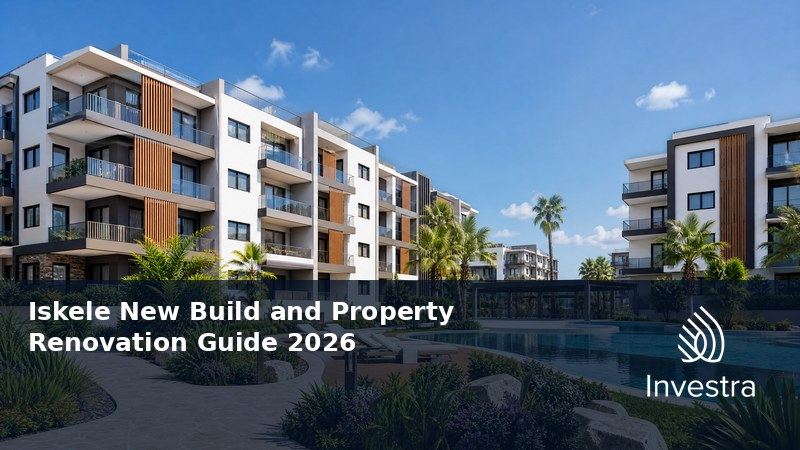
Iskele New Build and Property Renovation Guide 2026
Iskele New Build and Property Renovation Guide 2026
Why Iskele Is North Cyprus's Most Talked-About Real Estate Market in 2026
Quick Answer: Iskele has emerged as North Cyprus's fastest-growing property hotspot, driven by a wave of new build developments, competitive pricing starting from €1,200/m², and rental yields averaging 7–10% annually — making it one of the Mediterranean's most compelling investment destinations for 2026. Investra.io tracks emerging markets like Iskele to help investors make data-driven decisions.
There's a particular kind of excitement that surrounds a market on the move. Iskele — a coastal district stretching along the eastern shoreline of North Cyprus — has that energy right now. What was once a quiet fishing community and agricultural region has transformed, almost dramatically, into one of the Eastern Mediterranean's most active real estate corridors.
The reasons aren't hard to understand. Long Sandy Beach, which runs for several kilometres south of Iskele town, has drawn comparisons to parts of the Turkish Riviera — but at a fraction of the price. New build apartment complexes and villa communities have been rising across the coastline, many offering payment plans that stretch three to five years with zero interest from developers.
But Iskele isn't a one-dimensional story. The district also includes inland villages, agricultural land, and older housing stock that represents a very different kind of opportunity — renovation projects that, when done right, can generate strong returns and create genuinely characterful properties.
For investors who've been tracking emerging European markets — perhaps already looking at opportunities in places like Loznica Real Estate Market 2026 Macva Region Property Guide or the Sremska Mitrovica Real Estate 2026 Srem Region Property Guide — Iskele presents a Mediterranean alternative with strong tourism demand, warm weather, and a growing expat infrastructure supporting long-term value.
Iskele Property Market Overview: Prices, Trends, and What's Driving Growth in 2026
Quick Answer: Iskele property prices in 2026 range from approximately €1,200/m² for off-plan studio apartments to €3,500/m² for premium sea-front finished units, with the broader market still significantly undervalued relative to comparable Mediterranean destinations. The market has seen 15–20% price growth annually since 2021 in the new build segment.
Let's talk numbers first, because that's where the story gets interesting. Iskele's property market has been tracking upward with a consistency that few Mediterranean markets have matched since the post-COVID property boom took hold. In the Long Beach corridor — by far the most active development zone — off-plan apartments from established developers were being marketed at €1,200–€1,800/m² as recently as 2022.
What's driving this? Several forces are converging simultaneously. First, supply hasn't kept up with demand — the number of international buyers enquiring about North Cyprus has grown faster than developers have been able to complete and deliver units.
The overall price breakdown by property type in Iskele's key areas looks broadly like this in 2026: In Long Beach and the sea-front zone, studio apartments (35–50m²) range from €65,000 to €130,000. One-bedroom apartments (55–75m²) typically sell for €95,000–€200,000 depending on sea view, floor level, and developer. Two-bedroom apartments or duplexes run €150,000–€320,000.
Inland Iskele and village properties present different parameters. Traditional village houses requiring renovation start from as little as €25,000–€60,000 for basic structures. Renovated village properties with land typically sell for €80,000–€160,000. Agricultural land parcels range from €5–€25/m² depending on access, water rights, and zoning classification.
It's also worth understanding the broader context. Rental yields in Iskele for well-managed short-term holiday rentals through platforms like Airbnb average 7–10% gross annually. Long-term rentals to the growing expat and working professional population yield 5–7% gross. Compare that to Western European coastal markets where 3–5% is often considered acceptable, and the case for Iskele becomes clearer.
Understanding New Build Developments in Iskele: What's Being Built and Who's Building It
Quick Answer: Iskele's new build market in 2026 is dominated by large-scale residential complexes along Long Beach, with dozens of active developers offering off-plan units with staged payment plans, communal amenities, and completion timelines of 18–36 months from purchase.
Walk along Long Beach today and you'll see cranes. Multiple cranes. The skyline that was open just five years ago is now punctuated by construction at various stages — foundations being poured here, facades being finished there, landscaping being completed on the latest delivery.
The dominant product type is the apartment complex — typically five to twelve storeys, built around communal pools, fitness centres, co-working spaces, and sometimes private beach access or beachfront restaurants. Developers range from well-established North Cyprus firms with fifteen or more years of track record to newer entrants, including some Turkish mainland developers and international partnerships.
What's genuinely changed in 2026 compared to even three years ago is the quality of finishes being marketed. Many developments now offer smart home systems, high-specification kitchen appliances, underfloor heating for winter months, and architectural designs that would look at home in Dubai or Marbella.
Payment structures deserve special attention. The typical new build payment plan in Iskele runs something like this: 30–35% deposit on contract exchange, followed by staged payments (usually quarterly or biannual) tied to construction milestones, with the final 25–30% due on completion and key handover.
For investors comparing new build markets across regions, the Iskele model shares some characteristics with industrial city regeneration plays like those documented in the Bor Real Estate Market 2026 Eastern Serbia Mining City Property Guide — both involve significant capital inflows into previously undervalued areas, though the asset types and market dynamics differ substantially.
The Complete Guide to Buying Off-Plan Property in Iskele 2026
Quick Answer: Buying off-plan in Iskele requires a purchase contract (Sales and Purchase Agreement), a Title Deed application, and permission from the Council of Ministers — a process that typically takes 6–18 months for non-Turkish Cypriot buyers, with the property purchase tax set at 3% and VAT at 5% on new builds.
Off-plan buying in North Cyprus has a reputation — some of it deserved, some of it outdated. The reality of the 2026 market is more nuanced than blanket caution or blanket enthusiasm would suggest. There are real risks, clear processes, and achievable protections if you approach the purchase correctly.
The fundamental legal framework for property purchase in North Cyprus requires that all foreign nationals (non-Turkish Cypriot citizens) apply to the Council of Ministers for Permission to Purchase (PTP). This is not a formality — it's a substantive application process, though approval rates for legitimate residential purchases are high (typically 85–95% for EU nationals and buyers from Western countries).
Here's the critical sequence for an off-plan purchase: First, you'll sign a Sales and Purchase Agreement (SPA) with the developer. This document should specify the completion date, penalty clauses for delays, the exact unit specification (floor plans, finish schedules), the payment schedule, and what happens if the developer fails to deliver.
Second, the SPA must be stamped at the North Cyprus Tax Office and registered at the Land Registry. This step is crucial. An unregistered contract offers you little protection if the developer encounters financial difficulties or attempts to sell the same unit to another buyer. Registration creates a legal charge on the property in your favour.
Third, simultaneously with or shortly after contract signing, your solicitor should submit your PTP application to the Council of Ministers. This process runs in parallel with construction and typically concludes before or around completion.
Fourth, on completion, a title deed (Koçan) is issued in your name. There are different types of title deeds in North Cyprus with different histories — understanding which type applies to your specific property is important, as some carry encumbrances or complexities related to the island's 1974 political division. Always have title deed type clarified explicitly before any commitment.
Costs on a new build purchase in 2026 include: Purchase Tax (3% of purchase price), VAT (5% on new builds), Stamp Duty (0.5%), and solicitor fees (typically 1–1.5%). Budget approximately 8–10% on top of purchase price for total acquisition costs. These figures should be confirmed with your independent legal advisor before finalising any financial projections.
Property Renovation in Iskele: Opportunities, Costs, and Realistic Returns
Quick Answer: Renovation projects in Iskele's inland villages can be acquired for €25,000–€60,000 and fully renovated for a total all-in cost of €80,000–€150,000, with finished properties generating rental yields of 5–8% and potential capital gains of 40–70% over five years in well-chosen locations.
The renovation story in Iskele is fundamentally different from the new build narrative, and it attracts a different kind of buyer. Where new builds appeal to yield-focused investors who want a clean, hands-off product, renovation projects attract buyers who want character, uniqueness, and the satisfaction of creating something.
The inland villages of the Iskele district — places like Bogaz, Yenibogazici, Mehmetcik, and the quieter farming settlements further from the coast — contain a significant stock of traditional stone and brick houses, many abandoned or semi-derelict following demographic shifts over the past decades. These properties represent a genuine renovation opportunity.
Acquisition costs for basic structures start at around €25,000 for a small two-room house with land, rising to €60,000–€80,000 for larger properties with better structural conditions and more desirable locations. What many buyers underestimate is the renovation budget.
For a 120m² village house, that translates to a renovation budget of €72,000–€180,000 on top of the acquisition cost. Add the purchase itself, legal fees, and contingency (always budget 15–20% contingency on renovation projects — this isn't pessimism, it's experience), and a quality finished product might have a total all-in cost of €130,000–€280,000. The question is: what's it worth when done?
The critical challenge with renovation in North Cyprus is finding reliable contractors and managing the build remotely. Unlike markets with established renovation ecosystems, the island has a limited pool of quality tradespeople, and project management from overseas without a trusted local contact is genuinely difficult. Many buyers who've gone down this road — successfully — credit their outcome to having a reputable local project manager or architect engaged from day one. Budget €3,000–€8,000 for professional project management and architectural fees, and consider it money very well spent. Consulting with Siniša Dagary investment insight can help structure these projects effectively.
Construction Quality Standards and What to Look for in Iskele New Builds
Quick Answer: Construction quality in Iskele new builds varies significantly between developers, with the best projects offering European-standard specifications, independent snagging inspections, and structural warranties, while lower-tier developments may cut corners on insulation, waterproofing, and mechanical systems.
Not all concrete is created equal. That might sound like an odd starting point, but it gets at something important about the Iskele new build market that glossy brochures and developer show apartments don't always communicate. The gap between the best and worst construction quality in this market is wide, and the consequences of buying at the wrong end of that spectrum play out over years of ownership.
What should buyers actually look for? Start with the developer's track record. In North Cyprus, this means physically visiting completed projects they've delivered, not just renders of future ones. Talk to owners who already live in those completed developments. Ask direct questions: Has the roof leaked? Are there damp issues? How long did snagging take to resolve?
The best developers in the Iskele market in 2026 are offering independent snagging inspections as a contractual right before final payment. Some are also offering structural warranties of five to ten years, which is a positive development. If a developer resists or seems uncomfortable with the idea of an independent inspection, treat that as a serious red flag.
Communal facilities — pools, gyms, gardens, concierge services — deserve scrutiny too. The service charge (site maintenance fee) attached to these facilities needs to be understood upfront. Annual site fees in Iskele complexes typically run €500–€2,000/year depending on size and amenity level. What's the management structure? Who governs the communal areas? Is there a residents' association? These aren't afterthoughts — they determine the quality of daily life and the long-term maintenance of the asset. For broader comparative data on construction standards across emerging markets, Serbia Building Permits 2026 How To Get Construction Permission provides relevant regulatory context.
Rental Market Analysis: Short-Term vs Long-Term Yields in Iskele 2026
Quick Answer: Iskele's short-term holiday rental market generates gross yields of 7–10% for well-managed properties in the Long Beach corridor, while long-term rentals to expats and workers yield 5–7% — both figures significantly outperforming Western European coastal equivalents.
The rental market in Iskele has matured considerably over the past five years, and 2026 presents a more sophisticated picture than the simple "buy-to-holiday-let" narrative that dominated early investor conversations. There are now genuinely two distinct rental segments operating in the district, each with its own demand drivers, management requirements, and yield profiles.
Short-term holiday rental is the headline story. Long Beach has established itself as a summer destination for tourists from Russia, Ukraine, the UK, Germany, and increasingly from the Middle East and Turkey.
Management fees for short-term rentals through professional property management companies in North Cyprus typically run 20–30% of gross rental income, covering cleaning, guest communication, check-in/out, and maintenance coordination. Net yields after management but before mortgage costs (if any) land in the 4.5–7% range for well-managed short-term assets.
Long-term rental is a quieter but increasingly stable market. The growing expat community in Iskele — retirees, remote workers, and families accompanying employed partners at local businesses or the nearby Eastern Mediterranean University in Famagusta — creates demand for 12-month furnished rentals. A two-bedroom apartment in a managed complex rents for €600–€1,100/month on a long-term basis in 2026.
Savvy investors are increasingly running hybrid models — short-term in summer, medium-term (three to six month) lets in winter, combining the income peaks of tourism with the stability of extended stays. This requires a flexible management approach and good booking platform management, but the yield optimisation can be meaningful. Consulting with a professional like Siniša Dagary investment insight can help investors model these scenarios accurately before committing capital.
Legal Framework and Title Deed Types: What Every Iskele Property Buyer Must Know
Quick Answer: North Cyprus has multiple title deed categories — Turkish Title (TMT), Foreign Title (pre-1974 Greek Cypriot), and Exchange Title (post-1974 allocation) — each carrying different legal security levels, with Turkish Title generally considered the most straightforward for foreign buyers and Exchange or Foreign titles requiring additional legal scrutiny.
The legal landscape of North Cyprus property ownership is, frankly, the aspect that most genuinely requires professional guidance. It's not impossibly complex, but it has layers that stem directly from the island's unresolved political division — a situation that's been in place since 1974 and shows no immediate signs of resolution in 2026.
There are three primary title deed categories relevant to buyers in Iskele: Turkish Title (TMT — Türk Malı Tapu) represents properties that were owned and registered by Turkish Cypriot citizens prior to 1974, and have remained continuously in Turkish Cypriot ownership since. This category is generally considered the most legally clean for buyers, as the ownership chain is uncomplicated by the 1974 events.
Foreign Title (Rum Malı — pre-1974 Greek Cypriot) deeds represent properties that were owned by Greek Cypriot individuals who fled or were displaced in 1974. This category carries the most legal uncertainty and is generally advised against for buyers seeking clean, uncomplicated ownership.
For the purpose of buying in new build Iskele developments, the vast majority of transactions involve TMT land with new TMT title deeds being issued to buyers upon completion. The PTP (Permission to Purchase) process described earlier applies regardless of title type.
Those interested in understanding how different regulatory environments affect property investment across emerging markets might also find value in reviewing approaches covered in the Zajecar Real Estate Market 2026 Eastern Serbia Property Guide, which examines a very different but instructive regulatory context. Similarly, Findes Group & Partners offers international legal and financial structuring expertise relevant to cross-border property investment.
Financing Options for Iskele Property: Mortgages, Developer Finance, and International Structures
Quick Answer: Mortgage finance from North Cyprus banks is available to foreign buyers but limited and typically expensive (interest rates of 8–14% in 2026), making developer payment plans — which are often interest-free — and overseas financing using equity from existing properties the most commonly used financing routes for international buyers.
The financing question is where many international buyers hit their first real practical obstacle. North Cyprus isn't integrated into the EU banking system, and the Turkish banking sector — which underpins much of the island's financial infrastructure — operates under conditions that differ substantially from what European buyers are used to.
North Cyprus bank mortgages for foreign buyers typically require: minimum 30–40% deposit, proof of income, North Cyprus residency or regular presence, and acceptance of interest rates that currently run 8–14%. These rates are significantly higher than European equivalents (where 3–5% is standard), making
Investment Disclaimer
Quick Answer: This guide is general market information, not personal legal, tax, financing or investment advice.
Before committing to a property transaction, buyers should obtain independent local legal, tax and financial advice suited to their circumstances. Investra.io can support initial market research, but every purchase decision remains the buyer's responsibility.
Frequently Asked Questions
Quick Answer: This section explains the practical property-investment implications of Frequently Asked Questions.
What is a prudent next step after initial market research?
Use current documentation, independent professional advice and comparable local evidence before proceeding. Investra.io can support an initial structured market review.
How can buyers plan a realistic ownership budget?
Use current documentation, independent professional advice and comparable local evidence before proceeding. Investra.io can support an initial structured market review.
What evidence supports a careful investment decision?
Use current documentation, independent professional advice and comparable local evidence before proceeding. Investra.io can support an initial structured market review.
When should a buyer obtain legal and tax advice?
Use current documentation, independent professional advice and comparable local evidence before proceeding. Investra.io can support an initial structured market review.
How should a buyer compare neighbourhoods and property types?
Use current documentation, independent professional advice and comparable local evidence before proceeding. Investra.io can support an initial structured market review.
What local checks should be completed before signing?
Use current documentation, independent professional advice and comparable local evidence before proceeding. Investra.io can support an initial structured market review.
Which costs should be assessed alongside the purchase price?
Use current documentation, independent professional advice and comparable local evidence before proceeding. Investra.io can support an initial structured market review.
How can international buyers verify a property opportunity?
Use current documentation, independent professional advice and comparable local evidence before proceeding. Investra.io can support an initial structured market review.
What should buyers compare before selecting a property?
Use current documentation, independent professional advice and comparable local evidence before proceeding. Investra.io can support an initial structured market review.
Quick Answer: These answers outline common buyer checks and should be read with current professional advice.
Recommended Reading
Quick Answer: This section explains the practical property-investment implications of Recommended Reading.
- Investra market research
- Investra market research
- Investra market research
- Investra market research
- Investra market research
- Investra market research
- Investra market research
- Investra market research
- Investra market research
- Investra market research
- Investra market research
- Investra market research
- Investra market research
- Investra market research
- Investra market research
- Investra market research
- Investra market research
- Siniša Dagary investment insight
- Siniša Dagary investment insight
- Siniša Dagary investment insight
- Siniša Dagary investment insight
- Siniša Dagary investment insight
- Findes Group & Partners
- Findes Group & Partners
Connect With Investra
Follow Investra for market updates on Facebook, LinkedIn, YouTube
Related Posts
No related posts available.
