
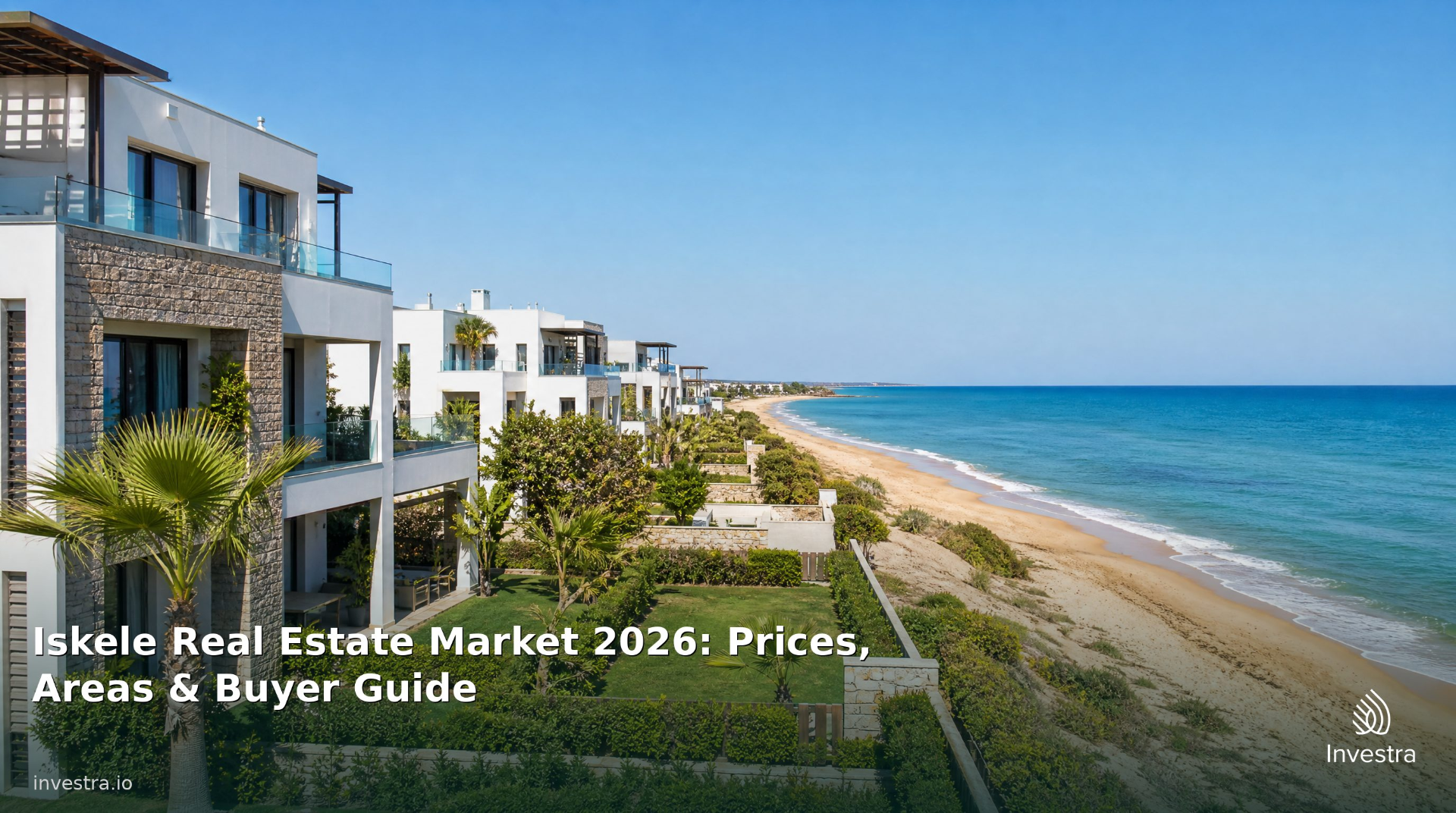
Iskele Real Estate Market 2026: Prices, Areas & Buyer Guide
Iskele Real Estate Market 2026: Prices, Areas & Buyer Guide
Iskele Real Estate Market Overview 2026: Why This Coastal District Is Dominating Headlines
Quick Answer: Iskele is North Cyprus's fastest-growing real estate market in 2026, with property prices ranging from €1,200 to €3,500 per m² depending on the area and property type, driven by strong international demand, coastal tourism, and infrastructure investment. Investra.io tracks this market closely as one of the Mediterranean's most compelling emerging investment destinations.
There's a reason Iskele has become the name on every property investor's lips in 2026. This sprawling coastal district on the eastern tip of North Cyprus — once overshadowed by the more established markets of Kyrenia and Famagusta — has quietly evolved into the island's most dynamic real estate zone.
What's driving it? A combination of factors that rarely align so neatly in a single market. You have a pristine, underdeveloped coastline with crystal-clear waters. You have government-backed infrastructure spending — new roads, expanded utilities, and a renewed push for tourism development. You have relatively low entry prices compared to Southern Cyprus, Spain, or Portugal.
The Long Beach area — Iskele's urban centre for international buyers — has seen apartment prices climb from roughly €1,100/m² in 2021 to between €1,800 and €2,400/m² in early 2026 for new-build off-plan projects. Resale villas in premium coastal spots have transacted at €2,800–€3,500/m².
This report provides a comprehensive look at where prices stand today, which sub-areas represent the strongest value, what the legal buying process looks like for foreign nationals, and where rental yields are most attractive. Whether you're a first-time buyer or a seasoned portfolio investor, Iskele in 2026 deserves serious attention.
Iskele District Geography: Understanding the Sub-Markets That Matter
Quick Answer: The Iskele district encompasses several distinct micro-markets — Long Beach, Bafra, Boğaz, Tatlısu, and Karpaz Peninsula villages — each with different price points, buyer profiles, and investment characteristics. Understanding these sub-areas is essential before committing capital.
Iskele isn't a single market — it's a collection of micro-markets that behave quite differently from each other. Getting this wrong is one of the most common mistakes international buyers make when they first arrive. They see "Iskele" on a property listing and assume uniform conditions across the entire district. The reality is considerably more nuanced.
Long Beach (İskele Beach) is the district's nerve centre for international real estate activity. Stretching roughly 10 kilometres of sandy coastline, this is where the majority of large-scale residential resort developments are concentrated. It's the most liquid part of the market, with the highest transaction volumes and the strongest short-term rental demand.
Bafra sits approximately 15 kilometres north of Long Beach and has been designated as a government-priority tourism development zone. Several five-star hotel projects and casino resorts have been approved or are under construction here.
Boğaz is a charming fishing village on the eastern coast that attracts buyers seeking a more authentic North Cyprus experience. Prices here are softer — €1,200–€1,700/m² for apartments, €1,500–€2,200/m² for villas — and the long-term rental market caters more to permanent expat residents than holiday tourists.
Tatlısu and the villages along the northern coast toward Kyrenia represent a more rural, scenic option. Detached villas with large plots here can be acquired at €1,300–€1,900/m², appealing to lifestyle buyers rather than yield-focused investors. The Karpaz Peninsula remains largely protected and underdeveloped — an asset for eco-tourism but limiting for conventional development.
Property Prices in Iskele 2026: Current Data and What's Driving Them
Quick Answer: Iskele property prices in 2026 range from approximately €1,200/m² for basic resale apartments in secondary locations to €3,500/m² for premium beachfront new builds, with average off-plan pricing across the district sitting around €1,900–€2,200/m².
Let's get specific, because vague price ranges frustrate serious investors. The Iskele market in 2026 has stratified into fairly distinct price bands, and knowing where each sits helps calibrate expectations immediately.
For off-plan new-build apartments , the current market looks like this: studio units (35–45 m²) are priced between €65,000 and €90,000 in secondary locations, rising to €90,000–€130,000 for beachfront or resort-complex studios. One-bedroom apartments (55–75 m²) range from €100,000 to €180,000 depending on specification and location.
The resale market tells a different story. Older stock — properties built between 2005 and 2015 — trades at a meaningful discount to new builds, typically €1,100–€1,600/m², reflecting higher age, poorer energy performance, and outdated specifications.
Villa prices have seen the most dramatic appreciation. Detached three-bedroom villas with private pools in Long Beach and Bafra were trading at €250,000–€350,000 in 2022. The same properties are now achieving €320,000–€500,000 in 2026, a 25–40% increase.
What's driving these increases? Four key forces. First, international buyer demand has not abated — if anything, North Cyprus's relative political stability compared to other Mediterranean markets has attracted more cautious capital. Second, construction costs have risen 20–30% since 2021 due to global materials inflation, pulling new-build prices upward.
For investors comparing opportunities across emerging European markets, the Zajecar Real Estate Market 2026 Eastern Serbia Property Guide offers an interesting contrast — a landlocked market at much lower absolute price points but with similarly strong growth trajectories.
Rental Yields and ROI: The Investment Case in Hard Numbers
Quick Answer: Short-term holiday rental yields in Iskele's prime coastal zones range from 7% to 12% gross annually, while long-term residential rentals yield 5%–8%, making the district one of the highest-yielding Mediterranean coastal markets accessible to international investors.
The yield story in Iskele is genuinely compelling, and it's one that doesn't rely on heroic assumptions. Let's work through it properly.
A well-located one-bedroom apartment purchased for €130,000 in a managed resort complex on Long Beach can realistically generate €800–€1,200 per week during the June–September peak season (approximately 18–20 bookable weeks). During shoulder season (April–May, October), occupancy drops but weekly rates of €450–€650 are achievable for another 8–10 weeks.
The reality after management fees (typically 20–30% of revenue charged by rental management companies), utilities, maintenance, and occasional vacancy adjustments is a net yield of 7%–10%. Still exceptionally strong by Mediterranean standards, where comparable assets in Spain's Costa del Sol or Croatia's Dalmatian coast typically yield 4%–6% net.
Long-term rentals — the buy-to-let model targeting expat residents or students at Eastern Mediterranean University and other local institutions — generate more modest but highly predictable returns. A well-located apartment in Long Beach or Boğaz let annually to expats typically achieves €700–€1,100 per month in 2026.
For context on how emerging-market property yields compare across different geographies, the Prokuplje Real Estate Market 2026 Toplica Region Property Guide examines a very different but similarly yield-focused market.
The Legal Framework for Foreign Buyers: What You Need to Know Before Signing
Quick Answer: Foreign nationals can legally purchase property in North Cyprus, but the process involves specific permit requirements from the Council of Ministers, title deed considerations, and legal complexities stemming from the island's political status — professional legal representation is non-negotiable.
This is where many buyers — particularly those excited by the prices and the sunshine — make costly mistakes. North Cyprus operates under its own legal system as the Turkish Republic of Northern Cyprus (TRNC), which is recognised only by Turkey.
Foreign nationals are permitted to purchase property in North Cyprus, but there are important restrictions. Each foreign buyer can typically purchase one property of no more than one donum (approximately 1,338 m²) of land without applying for special permission.
The title deed question is the single most critical legal issue in North Cyprus real estate. Properties carry different types of title deeds, and the differences matter enormously:
Pre-1974 Turkish Cypriot Title Deeds are the most secure and widely accepted, as the land was owned by Turkish Cypriots before the 1974 division. TRNC Title Deeds (post-1974) were issued by the TRNC government, often on land previously owned by Greek Cypriots who fled or were displaced in 1974.
A competent local solicitor — operating independently from your estate agent — is absolutely essential. Expect to pay €1,500–€3,000 in legal fees for a standard transaction. The solicitor should perform a full title deed search, verify planning permissions, check for any encumbrances or mortgages on the property, and draft or review the sales contract.
The purchase process in outline: pay a reservation deposit (typically €1,000–€5,000), enter a sales contract, pay a stamp duty of 0.5% on the agreed price within 21 days of signing, then proceed to Payment Plan completion (most developers offer phased payment structures), and finally apply for the Council of Ministers permit.
Expert investment consultants like Siniša Dagary — Investment Consultant emphasise that proper due diligence across emerging markets — whether in Southeast Europe or the Eastern Mediterranean — always starts with the legal framework, not the sales pitch.
Taxes, Costs, and the True Price of Buying in Iskele
Quick Answer: The total cost of purchasing property in Iskele typically runs 7%–12% above the agreed purchase price when accounting for stamp duty, transfer fees, VAT on new builds, legal fees, and agent commissions — buyers should budget accordingly.
Purchase price and total acquisition cost are not the same thing, and the gap in North Cyprus is significant enough to change investment calculations if ignored. Here's a realistic breakdown of what to expect.
Stamp Duty is levied at 0.5% of the purchase price and must be paid within 21 days of signing the sales contract. On a €150,000 property, that's €750 — modest in isolation, but it's just the beginning.
Transfer Fee is payable when the title deed is transferred into the buyer's name. The standard rate is 6% of the purchase price, though TRNC government policy periodically reduces this to 3% as a market stimulus measure — confirm the current rate with your solicitor at time of purchase. On a €150,000 property, transfer fees range from €4,500 to €9,000.
VAT (KDV) applies to new-build properties at a rate of 5% of the purchase price. On that same €150,000 new build, that's €7,500. Resale properties are typically exempt from VAT.
Legal Fees typically run €1,500–€3,000 for a straightforward transaction, scaling with complexity.
Estate Agent Commission is generally borne by the seller in North Cyprus, but buyers should verify this in each transaction. Some developers build agent fees into purchase prices.
Adding these up: on a €150,000 new-build purchase, a buyer might realistically pay €7,500 VAT + €4,500–€9,000 transfer fee + €750 stamp duty + €2,000 legal fees = approximately €14,750–€19,250 in additional costs, representing 10%–13% of the purchase price.
Ongoing costs include an annual property tax (typically very low — often under €300/year for an apartment), utility connection fees (one-time €500–€1,500 depending on infrastructure readiness), and if the property is in a managed complex, service/maintenance charges of €800–€2,500 annually depending on amenities.
Currency is worth mentioning. North Cyprus uses the Turkish Lira (TRY) as official currency, but virtually all property transactions are denominated in Pounds Sterling (GBP) or Euros (EUR), and most developers price in either currency. This removes direct TRY exposure for buyers, though it introduces GBP/EUR exchange considerations for non-Eurozone buyers. Financial planning support is available through services like Findes Group & Partners for buyers seeking cross-border currency and investment structuring advice.
Developer Landscape and Off-Plan Investment in Iskele 2026
Quick Answer: Off-plan investment from reputable developers remains the dominant purchasing model in Iskele, offering extended payment plans, early-stage price advantages of 15%–25% below completion value, and guaranteed rental programs — but developer due diligence is critical to avoid project delays or insolvency risks.
The off-plan market is the heartbeat of Iskele real estate, and understanding how it works is fundamental. Unlike the resale-dominated markets of mainland Europe, Iskele's transaction volumes are still heavily weighted toward new developments — perhaps 60%–70% of all sales involve properties that haven't been completed yet, and some are barely beyond the architectural planning stage.
The appeal is obvious: developers typically offer payment plans spanning 24–60 months with no bank mortgage required. A buyer might pay a 30% deposit upfront, then 1%–2% per month in staged payments until completion, with the balance on handover. This dramatically reduces the capital required on day one and allows investors to lock in today's prices while the property is constructed.
What surprised many buyers who entered the Iskele market in 2021–2022 is just how much prices rose by the time their properties completed in 2023–2024. Properties purchased off-plan at €1,100–€1,300/m² were valued at €1,600–€2,000/m² at completion — appreciation of 30%–50% before even considering rental income.
But there are real risks. The North Cyprus off-plan market has seen project delays, developer financial difficulties, and in some cases, developments that stalled entirely. Developer track record is non-negotiable due diligence .
Some of the more established developers now offer guaranteed rental return programs — typically promising 6%–8% gross annual return for 2–5 years post-completion. These programs are genuinely attractive but require careful reading of the small print: what happens if the developer's rental management company underperforms? Is the guarantee backed by real assets or just contractual obligation?
Investors comparing off-plan market dynamics across emerging markets may find useful parallels in the Loznica Real Estate Market 2026 Macva Region Property Guide, which examines developer activity in another fast-growing regional market.
Who Is Buying in Iskele? The Investor Profile in 2026
Quick Answer: Iskele attracts a genuinely diverse international buyer pool in 2026, dominated by British, Russian, Turkish, Israeli, and increasingly Middle Eastern and Central Asian nationals, each with distinct motivations ranging from retirement lifestyle to yield-focused portfolio investment.
Understanding who else is buying tells you a great deal about a market's depth and resilience. Iskele's buyer pool has become remarkably international — arguably more so than any other comparable Mediterranean market at this price point — and that diversity is itself a source of market stability.
Russian and CIS buyers — including significant numbers from Kazakhstan, Ukraine, and Georgia — have become a major force since 2022. Capital flight from Russia following international sanctions created a surge of cash-rich buyers seeking stable, internationally accessible property.
Turkish investors represent a distinct category — often Turks from Istanbul or Ankara who see North Cyprus as a premium lifestyle investment combining familiar culture with a Mediterranean setting at a fraction of Istanbul coastal property prices.
Middle Eastern and Israeli buyers have grown substantially, particularly in the luxury villa segment. North Cyprus's relative proximity to the Gulf and Israel, combined with political neutrality and lifestyle appeal, makes it attractive for this demographic.
German and wider European buyers are increasingly present, often younger investors attracted by the yield story and lower entry prices compared to Southern European alternatives. The Serbia Proptech 2026 How Technology Is Changing Real Estate article explores how digital platforms are enabling exactly this kind of cross-border investment discovery — a trend that's bringing new buyers to markets like Iskele who would never have found them previously.
Infrastructure, Tourism, and the Economic Context Driving Demand
Quick Answer: North Cyprus and the Iskele district specifically are benefiting from significant infrastructure investment in 2025–2026, including road improvements, Ercan Airport expansion, new hotel and casino resort development, and utilities upgrades — all of which directly support property values and rental demand.
Property markets don't exist in isolation, and the economic context around Iskele in 2026 is as supportive as it's been in decades. Several macro-level developments deserve attention from any serious investor.
Road infrastructure improvements, particularly the upgraded coastal road connecting Famagusta to Iskele and extending toward Bafra and the Karpaz Peninsula, have reduced journey times and made previously remote areas commercially viable for development. What took 45 minutes now takes 25.
Casino and hotel resort development in Bafra has been a transformative force. Several large integrated resort projects — combining five-star hotels, casinos, spas, and residential components — have attracted international hospitality operators and created permanent tourism employment. This creates sustainable economic demand that extends beyond seasonal fluctuations.
Utilities expansion — particularly water supply and sewerage infrastructure — has been systematically upgraded across Long Beach and major development zones. For investors, this matters because it signals government confidence in sustained development and removes one of the historical constraints on North Cyprus property growth.
These infrastructure improvements are not marginal. They represent a structural shift in Iskele's economic capacity, and property prices are appropriately reflecting that transition.
Risks, Market Limitations, and Realistic Expectations
Quick Answer: Iskele's primary risks include the TRNC's limited international legal recognition, cyclical tourism demand, geopolitical sensitivity around Cyprus, and the possibility that market growth moderates as prices reach parity with comparable Mediterranean destinations — investors should maintain realistic expectations.
Every investment opportunity carries risks, and the responsible approach is to articulate them clearly rather than pretend they don't exist. The Iskele market, for all its appeal, operates within constraints that more established markets don't face.
Investment Disclaimer
Quick Answer: This guide is general market information, not personal legal, tax, financing or investment advice.
Before committing to a property transaction, buyers should obtain independent local legal, tax and financial advice suited to their circumstances. Investra.io can support initial market research, but every purchase decision remains the buyer's responsibility.
Frequently Asked Questions
Quick Answer: This section explains the practical property-investment implications of Frequently Asked Questions.
What is a prudent next step after initial market research?
Use current documentation, independent professional advice and comparable local evidence before proceeding. Investra.io can support an initial structured market review.
How can buyers plan a realistic ownership budget?
Use current documentation, independent professional advice and comparable local evidence before proceeding. Investra.io can support an initial structured market review.
What evidence supports a careful investment decision?
Use current documentation, independent professional advice and comparable local evidence before proceeding. Investra.io can support an initial structured market review.
When should a buyer obtain legal and tax advice?
Use current documentation, independent professional advice and comparable local evidence before proceeding. Investra.io can support an initial structured market review.
How should a buyer compare neighbourhoods and property types?
Use current documentation, independent professional advice and comparable local evidence before proceeding. Investra.io can support an initial structured market review.
What local checks should be completed before signing?
Use current documentation, independent professional advice and comparable local evidence before proceeding. Investra.io can support an initial structured market review.
Which costs should be assessed alongside the purchase price?
Use current documentation, independent professional advice and comparable local evidence before proceeding. Investra.io can support an initial structured market review.
How can international buyers verify a property opportunity?
Use current documentation, independent professional advice and comparable local evidence before proceeding. Investra.io can support an initial structured market review.
What should buyers compare before selecting a property?
Use current documentation, independent professional advice and comparable local evidence before proceeding. Investra.io can support an initial structured market review.
Quick Answer: These answers outline common buyer checks and should be read with current professional advice.
Recommended Reading
Quick Answer: This section explains the practical property-investment implications of Recommended Reading.
- Investra market research
- Investra market research
- Investra market research
- Investra market research
- Investra market research
- Investra market research
- Investra market research
- Investra market research
- Investra market research
- Investra market research
- Investra market research
- Investra market research
- Investra market research
- Investra market research
- Investra market research
- Investra market research
- Investra market research
- Siniša Dagary investment insight
- Siniša Dagary investment insight
- Siniša Dagary investment insight
- Siniša Dagary investment insight
- Siniša Dagary investment insight
- Findes Group & Partners
- Findes Group & Partners
Connect With Investra
Follow Investra for market updates on Facebook, LinkedIn, YouTube
Related Posts
No related posts available.
