
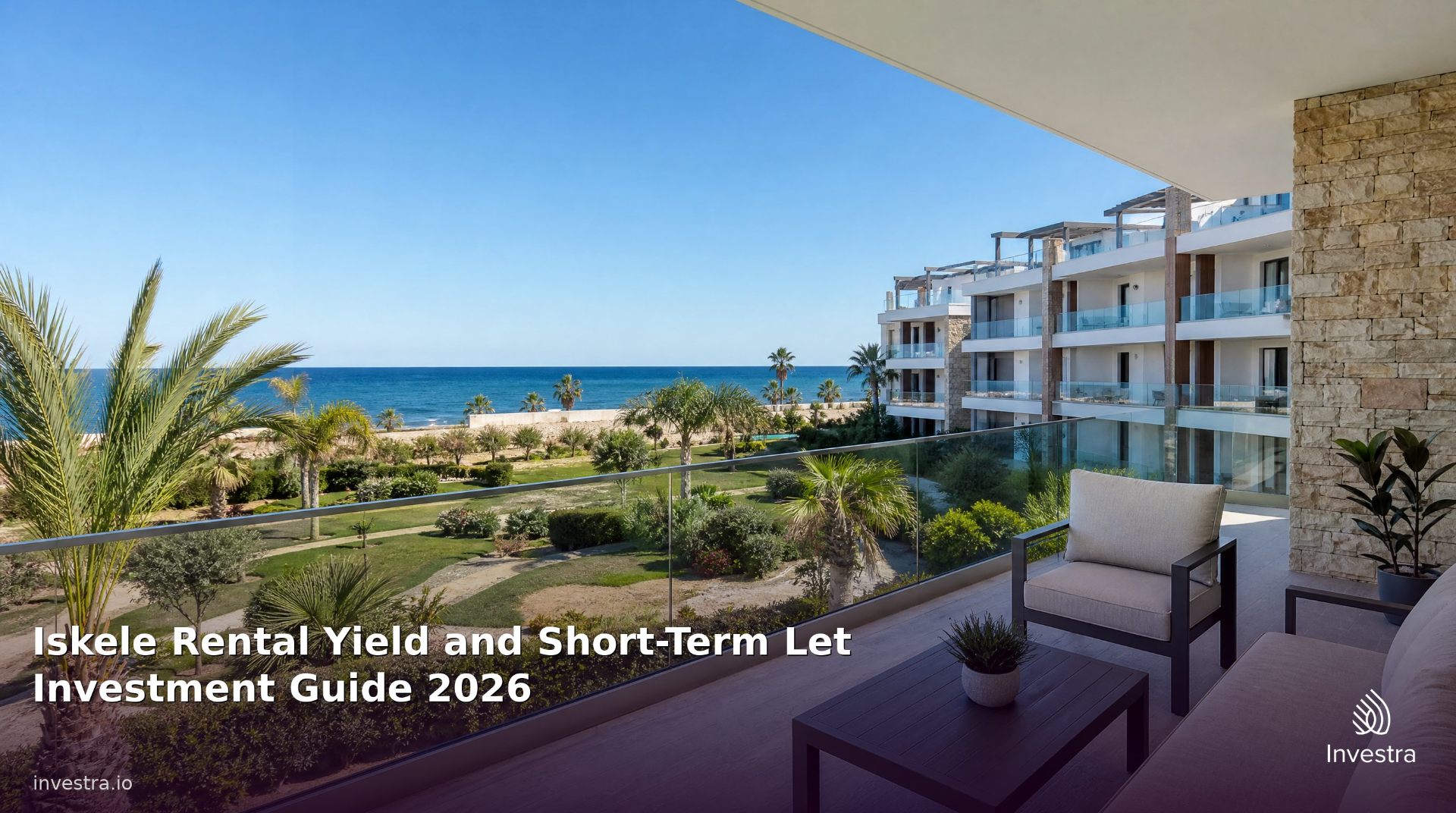
Iskele Rental Yield and Short-Term Let Investment Guide 2026
Iskele Rental Yield and Short-Term Let Investment Guide 2026
Why Iskele Has Become North Cyprus's Most Talked-About Investment Destination
Quick Answer: Iskele has emerged as North Cyprus's fastest-growing coastal investment hub, offering some of the Mediterranean's most competitive property prices combined with rental yields that regularly outperform traditional European markets. Investra.io tracks this market closely for international investors seeking high-yield Mediterranean opportunities.
There's a compelling reason why property investors who've spent years scanning the Mediterranean coastline keep landing on Iskele. It's not just the turquoise water or the 300+ days of sunshine — although those certainly don't hurt.
What surprised many international buyers when they first investigated is how underdeveloped the market still is relative to its potential. That gap — between current pricing and long-term destination potential — is precisely where opportunity lives. For investors seeking both capital appreciation and rental income, Iskele in 2026 deserves serious attention.
Understanding the Iskele Property Market: Key Zones and Price Ranges in 2026
Quick Answer: Property prices in Iskele range from approximately €1,100 to €3,500 per square meter in 2026, with Long Beach commanding the highest premiums and inland areas offering the most accessible entry points for budget-conscious investors.
Not all of Iskele is the same market. The district covers a substantial stretch of coastline and includes several distinct micro-markets, each with its own price dynamics, rental demand profile, and investor demographic. Understanding these zones is essential before committing capital.
Long Beach (İskele Long Beach) is the district's premium address. This 4-kilometre stretch of sandy coastline has attracted the largest concentration of resort-style developments, and it's where short-term rental demand is strongest year-round. New apartments here typically range from €2,200 to €3,500 per square meter for beachfront and sea-view units.
Bogaz , roughly 15 kilometres north of Long Beach, is a quieter marina village that appeals to buyers seeking a more authentic Cypriot atmosphere. Prices here typically run €1,400–€2,200/m², and while short-term rental volumes are lower than Long Beach, the clientele tends to be longer-stay and willing to pay for privacy and waterfront access.
Karpaz Peninsula stretches further north and remains the least developed, but that's changing. Eco-tourism and wild-coast tourism are driving a new category of short-term rental demand — boutique villas and rural retreats rather than resort apartments. Prices drop to €1,100–€1,600/m² but vacancy periods can be longer.
Iskele Town and surroundings offer the most affordable residential property, with prices from €900–€1,400/m². These are less suited to pure short-term holiday rentals but work well for medium-term lets targeting expats, remote workers, and professionals associated with the growing construction and hospitality sectors.
As a practical comparison point for investors who track multiple markets, emerging Eastern European property markets demonstrate entry-level prices that are even lower — but without the Mediterranean tourism multiplier that drives Iskele's short-term rental premium.
Rental Yields in Iskele: What Investors Are Actually Earning in 2026
Quick Answer: Gross rental yields in Iskele range from 6% to 12% annually depending on property type and management quality, with well-managed short-term let properties on Long Beach consistently achieving 8–10% gross yields during peak seasons.
Let's talk real numbers — because rental yield figures in emerging markets can be wildly optimistic when they come from developers' sales brochures versus what experienced operators actually achieve. The reality in Iskele is genuinely encouraging, but it requires some nuance.
For a typical one-bedroom apartment on Long Beach (purchase price €110,000–€140,000, purchase completed), gross annual rental income from short-term lets typically runs between €9,000 and €14,000. That translates to gross yields of approximately 7.5–10%.
Investors comparing Iskele performance to other Mediterranean markets frequently analyze how yield-driven investment thinking applies across different regions. The core principle remains consistent: active management outperforms passive approaches across emerging destination markets.
The Airbnb and Short-Term Let Landscape in Iskele: Seasonality, Demand, and Occupancy Data
Quick Answer: Iskele's short-term rental market runs a strong 6–8 month primary season (April through October/November), with peak summer months achieving 85–95% occupancy for well-located properties and a growing off-season demand from digital nomads and long-stay visitors.
Peak season (July–August) is extraordinarily intense. Occupancy rates for quality Long Beach apartments routinely hit 90–100% for weeks at a stretch, and nightly rates for studios run €60–€95, one-beds hit €80–€150, and two-beds command €120–€200+.
Shoulder season (April–June and September–October) is where savvy operators generate disproportionate returns. Occupancy typically runs 60–80% during these months, but nightly rates remain strong at 70–85% of peak levels, and operating costs per booking are lower.
Winter (November–March) is the genuine off-season for pure holiday rentals, though this has been changing. Remote workers and "slow tourists" staying for weeks or months have become a meaningful revenue source for operators who adapt their listings and pricing accordingly.
Legal Framework for Property Ownership and Short-Term Rentals in North Cyprus
Quick Answer: Foreign nationals can legally purchase property in North Cyprus and operate short-term rentals, but the process involves specific title deed considerations and permit requirements that make qualified legal advice non-negotiable before completing any transaction.
This is where the Iskele investment story gets more complicated — and where honesty matters more than sales enthusiasm. North Cyprus operates under a legal system that differs fundamentally from EU member states, and the property title situation has historical complexities that every investor must understand clearly before purchasing.
For short-term rental operation, property owners are legally required to register with the relevant local authority and obtain a tourism rental permit. The registration process involves proof of ownership, a property inspection for safety and habitability standards, and payment of applicable fees.
Foreign buyers are permitted to purchase one property (up to a maximum of 1 dunum, approximately 1,338 m²) without special restrictions. Additional properties require Council of Ministers approval, which is routinely granted but adds time to the transaction process.
Investors who take cross-border legal frameworks seriously — and who want guidance from advisors who understand international transaction complexity — benefit from consulting professionals with specialized expertise in North Cyprus property acquisitions and cross-border regulatory requirements.
Taxes, Costs, and the True Financial Picture of Iskele Rental Investment
Quick Answer: Property acquisition costs in North Cyprus typically add 7–10% to the purchase price (stamp duty, VAT, legal fees), and rental income is subject to TRNC income tax at rates of 10–35% depending on income levels, with VAT implications for short-term rental operators above certain thresholds.
Experienced investors know that the advertised purchase price is only the starting point. Understanding the full cost stack — acquisition, ongoing, and exit — is what separates profitable investment from disappointing outcomes. The good news is that North Cyprus remains relatively low-cost on most of these metrics compared to Western European markets.
Stamp duty on property transfers typically runs 5–6% for foreign buyers, though exact rates depend on property value and specific circumstances. VAT applies to newly constructed properties at 0% or 5% depending on classification and size. Legal fees for foreign buyers typically range €1,500–€3,000 depending on transaction complexity.
Tax on rental income in the TRNC applies at progressive rates — 10% on the first £5,000 (TRNC pound, roughly equivalent to GBP), 20% on £5,001–£10,000, and 35% on amounts above. There's a useful 20% rental income deduction allowance for expenses before tax calculation.
Property taxes are assessed annually based on property values and current use. For rental properties, annual property tax typically runs 0.3–0.5% of the assessed property value, making it substantially lower than Western European equivalents.
For investors who want to understand how professional financial planning services optimize cross-border tax efficiency, specialized advisors can help international investors structure their finances for tax compliance while maximizing after-tax returns on rental income.
The Developer Landscape: Off-Plan Purchases, Project Quality, and Due Diligence
Quick Answer: Off-plan purchases from reputable developers can offer 15–30% below completed market value and favourable payment plans, but developer track record verification and contract protections are critical in a market where some projects have experienced significant delays.
North Cyprus has a substantial off-plan development market, and Iskele is its most active zone. Dozens of projects are in various stages of development along the Long Beach corridor and surrounding areas, ranging from small boutique apartment blocks to large resort complexes with pools, gyms, restaurants, and dedicated rental management programs.
The risk, and this deserves honest acknowledgment, is developer reliability. North Cyprus has seen its share of projects that ran significantly over schedule, some by 2–4 years. A handful of developers have experienced financial difficulties, leaving buyers in complicated positions.
The established developers — those with 10+ years of completed project history in North Cyprus — offer meaningfully lower risk than newer entrants, even when the newer entrants are marketing at more attractive prices. The premium for track record is usually worth paying.
Investors seeking cross-border property market consulting background can benefit from perspectives available through specialized investment advisors who outline the common pitfalls of off-plan purchases in emerging destinations and provide frameworks for risk assessment and contract negotiation.
Financing Your Iskele Property: Mortgages, Payment Plans, and Currency Considerations
Quick Answer: Local mortgage financing in North Cyprus is available but limited for foreign buyers, with most international investors using developer payment plans, personal savings, or equity release from existing properties — currency risk management is an important consideration given the TRNC pound's link to sterling.
Financing a North Cyprus property purchase works differently from what most Western European investors are used to. The TRNC banking system is not integrated with EU financial systems, meaning that EU-regulated mortgage products don't apply here.
The majority of international investors in Iskele use one of three approaches. The first and most common is the developer payment plan for off-plan purchases: pay 30–40% upfront and the balance in staged payments over the construction period, then either pay the final balance from savings or refinance at completion.
The second approach involves working with local North Cyprus banks. Several banks offer mortgages to foreign buyers, typically requiring 30–40% deposit and loan-to-value ratios of 60–70%. Interest rates run roughly 1–2% above Western European equivalents, reflecting the smaller and less integrated banking market.
The third approach is international financing — using equity release from properties in your home country, bridging loans, or private financing from international sources. This option provides maximum flexibility and is increasingly used by sophisticated investors who want to maintain control of construction timelines and avoid currency mismatch.
Currency deserves careful thought. Property in North Cyprus is typically priced and sold in either GBP Sterling, Euros, or occasionally USD, even though the local currency is the TRNC pound (which tracks sterling).
Property Management and Airbnb Operations: What Remote Investors Need to Know
Quick Answer: Professional property management in Iskele typically costs 20–25% of rental income for full-service management, and choosing the right operator is as important as choosing the right property — management quality directly impacts occupancy rates and net returns.
The majority of investors buying in Iskele don't live in North Cyprus. They're based in the UK, Germany, Russia, Scandinavia, the Middle East, or increasingly, other parts of the Mediterranean property investment circuit. This means that property management isn't an optional extra — it's the operational core of the investment.
Quality matters enormously. A poor management company costs you more in lost bookings and complaints than you save on management fees. The best approach is to engage directly with multiple managers, ask for references from current investor-clients, visit their office (physically or virtually), and understand their technology infrastructure before committing.
Most successful remote investors eventually invest time in learning platform analytics and pricing optimization, even if they delegate daily operations to a manager. Understanding your data — occupancy patterns, seasonal demand shifts, competitor pricing, review score impacts — transforms management from a black box into a transparent operational engine.
Capital Appreciation: The Long Game in Iskele's Property Market
Quick Answer: Iskele properties have appreciated by 85–120% between 2020 and 2025, and while that rate of growth is unlikely to continue indefinitely, analysts project sustained annual appreciation of 8–15% through 2027–2028 as tourism infrastructure matures and international buyer awareness increases.
Rental yield is one dimension of the investment return — capital appreciation is the other, and in Iskele, it's arguably been even more powerful over the past five years. The question investors are rightly asking now is: how much appreciation runway remains?
The case for continued appreciation rests on several structural factors. Tourism infrastructure in North Cyprus is genuinely expanding — Ercan Airport is undergoing modernization and capacity expansion, ferry services to the mainland are improving, and new hotels and restaurants continue opening in Iskele.
International awareness is still climbing. Iskele remains substantially unknown to property investors outside specific European circles, whereas equivalent properties in established destinations have been discovered and priced by mass investor attention for years.
The countervailing risks are equally important to acknowledge. A political settlement of the Cyprus question (which remains unresolved) could materially alter market dynamics — either positively or negatively depending on the terms. Increased regulatory scrutiny of short-term rentals could reduce operating margins for investors.
What we observe is that properties purchased in prime locations on Long Beach between 2015 and 2019 have outperformed, while properties in secondary areas or purchased at market peaks have had more muted returns. This suggests the classic lesson: location and entry price matter enormously, even in appreciation markets.
Risk Factors and Market Volatility: Understanding the Downside Scenarios
Quick Answer: Primary risks include political uncertainty around Cyprus's unresolved partition, regulatory changes affecting short-term rentals, currency volatility, and the possibility that developer supply outpacing demand could moderate price appreciation.
Prudent investors approach emerging markets by understanding not just upside scenarios but plausible downside outcomes. Iskele presents specific risks that merit careful evaluation before committing significant capital.
Political risk is the most structural uncertainty. The Cyprus partition remains unresolved, with international negotiations ongoing. A settlement could legitimize North Cyprus land titles more clearly (positive for investors) or could potentially complicate ownership under a reunified regime (complicated and uncertain).
Short-term rental regulations could tighten. Several Mediterranean destinations have recently restricted or heavily regulated short-term rentals to address housing affordability concerns. A similar regulatory shift in North Cyprus would materially reduce operating margins and property values for investment portfolios focused on tourism income.
Cyclical demand patterns could shift. The current strong demand for Mediterranean coastal properties is driven by specific factors: pandemic-era relocation trends, remote work normalization, yield-seeking from investors facing low home country interest rates. If any of these drivers reverse, demand could moderate faster than many expect.
Currency volatility affects returns for international investors. Sterling volatility is particularly relevant given British investor concentration in the North Cyprus market. A sustained GBP appreciation reduces euro-denominated rental income in pound terms, while GBP depreciation improves it.
Exit Strategy and Timeline Considerations for Iskele Investors
Quick Answer: Property sales in Iskele typically take 30–90 days depending on price and property type, with cash buyers closing fastest and mortgaged properties closing slower; planning your exit strategy from purchase is essential to avoid becoming forced to hold during unfavourable market windows.
Most investors focus intensively on entry mechanics and operational performance but give inadequate attention to how they'll exit their Iskele investment. This oversight creates vulnerability, particularly during market downturns when properties take longer to sell and prices compress.
The North Cyprus property market is substantially less liquid than Western European equivalents. A property in London or Berlin might receive multiple offers within days; an Iskele property might require 60–120 days of active marketing to generate a genuine offer.
Exit planning should begin at purchase. The most effective strategy for personal circumstances varies: some investors plan to hold 5–7 years and then exit to a different market entirely, others plan to refinance at appreciation and continue rental operations indefinitely, and others plan to move properties to family members or business structures.
Properties purchased off-plan carry additional exit considerations. If you're in a holding pattern waiting for completion, you're carrying financing costs and opportunity cost but generating no income. Ensuring that you understand the completion timeline and have liquidity for the final payment (rather than refinancing contingency) is essential.
Investment Disclaimer
Quick Answer: This guide presents educational information about the Iskele property market and is not financial, legal, or investment advice. Property investments carry substantial risk, and past performance does not guarantee future results.
The information provided in this article is for educational and informational purposes only and should not be construed as financial, legal, or investment advice. Real estate investments carry inherent risks, and past performance does not guarantee future results. Investors should not invest money they cannot afford to lose.
Frequently Asked Questions
Quick Answer: This section explains the practical property-investment implications of Frequently Asked Questions.
Which costs should be assessed alongside the purchase price?
Use current documentation, independent professional advice and comparable local evidence before proceeding. Investra.io can support an initial structured market review.
How can international buyers verify a property opportunity?
Use current documentation, independent professional advice and comparable local evidence before proceeding. Investra.io can support an initial structured market review.
What should buyers compare before selecting a property?
Use current documentation, independent professional advice and comparable local evidence before proceeding. Investra.io can support an initial structured market review.
Quick Answer: These responses address the most commonly asked questions about Iskele property investment based on patterns from international buyers entering the North Cyprus market in 2026.
Is North Cyprus a good country for real estate investment in 2026?
Yes, North Cyprus presents compelling investment potential when evaluated against other Mediterranean destinations. Growing property values, competitive prices compared to Western Europe, and improving tourism and transportation infrastructure create a foundation for returns.
Can foreigners buy property in North Cyprus?
EU citizens can purchase property in North Cyprus subject to specific title deed and legal requirements. Non-EU citizens may face additional restrictions depending on their nationality and source of funds, though many nationalities are accommodated.
What is the average property price in Iskele?
Property prices in Iskele vary significantly by location and property type. Beachfront and premium Long Beach locations command €2,200–€3,500/m², while mid-range residential areas trade at €1,400–€2,200/m². Inland and developing zones offer prices from €900–€1,400/m².
What rental yields can I expect?
Gross rental yields in Iskele typically range from 6–12% annually depending on property type, location, management quality, and occupancy rates. Well-managed short-term let properties on Long Beach consistently achieve 8–10% gross yields, with two-bedroom apartments performing particularly well.
What taxes apply to property purchases?
Property transfer fees typically run 5–6% of purchase price, VAT applies to newly constructed properties at 0–5% depending on property classification, and legal fees range €1,500–€3,000. Additional costs include title searches, registration fees, and municipal permits.
How long does the purchase process take?
Typical purchase completion takes 30–60 days from offer acceptance for completed properties, though off-plan purchases involve construction timelines that extend this considerably. The process involves title searches, legal due diligence,
Recommended Reading
Quick Answer: This section explains the practical property-investment implications of Recommended Reading.
- Investra market research
- Investra market research
- Investra market research
- Investra market research
- Investra market research
- Investra market research
- Investra market research
- Investra market research
- Investra market research
- Investra market research
- Investra market research
- Investra market research
- Investra market research
- Investra market research
- Investra market research
- Investra market research
- Investra market research
- Siniša Dagary investment insight
- Siniša Dagary investment insight
- Siniša Dagary investment insight
- Siniša Dagary investment insight
- Siniša Dagary investment insight
- Findes Group & Partners
- Findes Group & Partners
Connect With Investra
Follow Investra for market updates on Facebook, LinkedIn, YouTube
Related Posts
No related posts available.
