
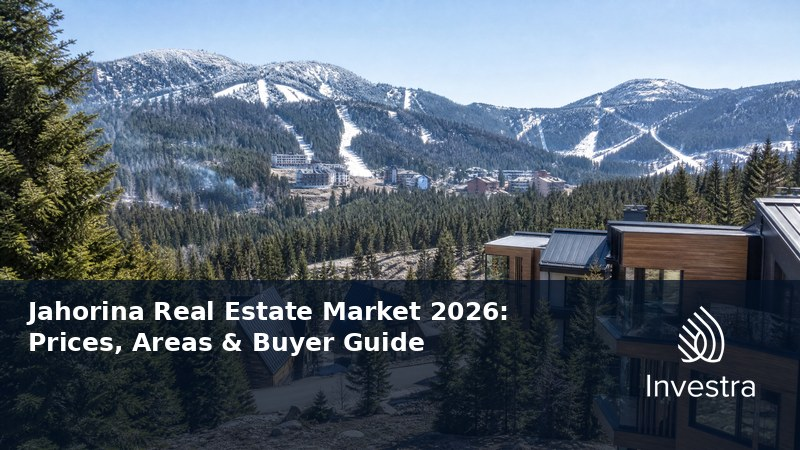
Jahorina Real Estate Market 2026: Prices, Areas & Buyer Guide
Jahorina Real Estate Market 2026: Prices, Areas & Buyer Guide
Jahorina Real Estate Market 2026: Why This Bosnian Mountain Is Catching Investor Attention
Quick Answer: Jahorina is one of Bosnia and Herzegovina's most compelling real estate markets in 2026, offering ski resort properties, mountain chalets, and new-build apartments at prices ranging from €800 to €2,500/m² — far below comparable Alpine destinations. Investra.io tracks emerging Balkan markets like Jahorina to help investors identify value before the crowd arrives.
There's a moment in every emerging market's story when the early movers look back and wonder why they hesitated. For Jahorina — the mountain resort just 28 kilometers from Sarajevo that hosted the 1984 Winter Olympics — that moment may be arriving faster than most people realize.
What makes Jahorina's 2026 story particularly interesting isn't just the price gap — though that gap is real and significant. It's the convergence of several factors happening simultaneously: major infrastructure investment, post-COVID shift toward nature-based tourism, EU accession momentum for Bosnia and Herzegovina, and a domestic ski tourism market that was consistently underserved for decades.
This guide breaks down everything a serious buyer or investor needs to understand: current prices, the best areas to target, rental yield expectations, the legal framework for foreign ownership, and the risks that don't always make it into the brochures. The approach from Siniša Dagary investment insight applies here: ground-level analysis, honest about risks, and focused on what the numbers actually say.
Understanding Jahorina: Geography, History, and Market Context
Quick Answer: Jahorina is a major ski resort in Republika Srpska, Bosnia and Herzegovina, sitting at elevations between 1,000 and 1,916 meters, with a rich Olympic heritage that provides international brand recognition critical for tourism-driven real estate investment.
Jahorina sits within the Dinaric Alps, part of the broader mountain range that defines so much of the Western Balkans' character. The resort's peak reaches 1,916 meters, with most skiing terrain concentrated between 1,400 and 1,800 meters.
The 1984 Sarajevo Winter Olympics put Jahorina and neighboring Bjelašnica on the global map. The women's alpine skiing events were held here, and the infrastructure built for those Games — though aged — laid a foundation that subsequent investment has built upon.
Administratively, Jahorina falls within Republika Srpska (RS), one of the two entities that constitute Bosnia and Herzegovina. This matters for buyers because property law, tax administration, and the bureaucratic framework for purchases are governed at the entity level.
The closest major city is Sarajevo, capital of Bosnia and Herzegovina, roughly 45 minutes to an hour by road depending on conditions. This proximity is a genuine asset: Sarajevo has an international airport with growing European connections, a vibrant cultural scene, and a year-round tourism economy that supports short-term rental demand for Jahorina properties even outside ski season.
Jahorina Property Prices in 2026: What the Market Actually Shows
Quick Answer: In 2026, Jahorina property prices range from approximately €800/m² for older apartments requiring renovation to €2,500/m² for premium new-build ski-in/ski-out units, with the mid-market sitting around €1,200–€1,600/m² for well-located modern apartments.
Price data on Jahorina is harder to gather than in more mature markets — there's no equivalent of Spain's notary statistics or Austria's WKO property reports — but what we've compiled from local agents, recent transactions, and developer disclosures paints a reasonably clear picture for 2026.
The market segments roughly into four tiers. At the entry level, you'll find older socialist-era apartments and chalets from the 1970s–1990s era, typically priced between €800 and €1,100/m². These properties often need significant renovation and carry higher title verification requirements, but they represent the market's value floor.
A 45 m² one-bedroom apartment in a modern development near the main Rajska Dolina gondola currently lists at approximately €55,000–€72,000. A 70 m² two-bedroom unit in a quality new build with mountain views runs €95,000–€120,000.
Year-on-year price appreciation has been running at approximately 7–12% in prime locations over the past two to three years, driven by constrained supply in the best ski-adjacent zones, rising construction costs, and accelerating demand from the diaspora and regional buyers. That rate of appreciation isn't guaranteed to continue, but the supply constraints are structural and likely to persist.
The Best Areas to Buy in Jahorina: A Zone-by-Zone Analysis
Quick Answer: The prime buying zones in Jahorina are clustered around the Rajska Dolina gondola base, Skočine ski area, and the upper plateau hotels — each offering different profiles of ski access, price point, and rental potential for investors and lifestyle buyers.
Jahorina isn't a large resort by Alpine standards, but the geography creates meaningful differences in investment quality depending on exactly where a property sits. Understanding these micro-locations is the difference between a property that rents well year-round and one that sits empty outside peak weeks.
Rajska Dolina (Valley of Heaven): This is the resort's commercial heart — the area around the main gondola and the concentration of hotels, restaurants, and après-ski activity. Properties here command the highest prices (€1,500–€2,500/m²) but also the strongest rental demand.
Skočine Zone: Slightly lower on the mountain and adjacent to several ski runs, Skočine has seen meaningful new development over the past five years. Prices run €1,100–€1,700/m², and the area offers a reasonable balance of ski access and value. Several apartment complexes here have dedicated rental management programs, which simplifies the process for non-resident owners.
Pale Municipality: The town of Pale itself, sitting at the base of the mountain, isn't strictly a resort investment, but it offers genuine value for buyers who want a full-time residential base with mountain access. Apartment prices here fall to €700–€1,000/m², targeting local buyers and diaspora families rather than short-term rental investors.
Rental Yields and Investment Returns: What the Numbers Say
Quick Answer: Gross rental yields in Jahorina's prime ski zones range from 5% to 9% annually, with net yields of 3.5% to 6.5% after management fees and costs — strong by European standards for mountain resort markets, though highly dependent on occupancy management quality.
Rental yield calculations in a seasonal mountain resort are inherently more complex than in a city apartment market. A Jahorina property's income profile looks very different from a Belgrade city center flat — and investors who apply urban yield logic to ski resort purchases often end up disappointed. So let's be precise about what the numbers mean here.
Peak ski season — roughly six to eight weeks spanning Christmas/New Year, February, and early March — drives the majority of short-term rental revenue. A well-located 50 m² apartment in the Rajska Dolina zone can achieve nightly rates of €80–€130 during peak weeks, dropping to €50–€70 during standard winter weekends.
The summer season is where Jahorina is genuinely underexploited as a tourism product. Hiking, mountain biking, and wellness tourism have grown substantially, and properties that position for summer occupancy can add €3,000–€6,000 in annual revenue from June to September bookings.
For context on how Jahorina compares to similar emerging Balkan markets, the Zajecar Real Estate Market 2026 Eastern Serbia Property Guide documents yields in the 5–8% range for tourism-adjacent Serbian markets — broadly consistent with what Jahorina's best properties deliver. The Prokuplje Real Estate Market 2026 Toplica Region Property Guide shows similar patterns in spa and nature tourism zones.
One important caveat: yield figures circulated by developers and agents often reflect optimistic occupancy assumptions. The honest range for a self-managed property with average marketing is 3.5–5% net yield.
Legal Framework for Foreign Buyers in Bosnia and Herzegovina
Quick Answer: Foreign nationals can legally purchase property in Republika Srpska (where Jahorina is located) under reciprocity principles, though the process requires careful due diligence on title registration, land registry verification, and the occasional complexity of post-war property restitution claims.
For Jahorina specifically, the relevant jurisdiction is Republika Srpska. Under RS property law, foreign nationals from countries that have reciprocity agreements with BiH — which includes most EU member states, the UK, the US, and various others — can purchase real estate with essentially the same rights as domestic buyers.
Title verification is where most complications arise. Some properties — particularly older socialist-era apartments — carry residual ownership complexities from the post-war privatization process. Agricultural or forest land adjacent to resort developments can have unclear ownership chains. Engaging a local lawyer (advokat) with specific experience in RS property law is non-negotiable, not optional.
What surprised many buyers who've worked with advisors like Siniša Dagary investment insight is how much variation exists between properties that appear identical on paper — the difference between a clean title and a contested one isn't always visible from a developer's brochure, which makes independent legal due diligence essential rather than a formality.
Taxes and Transaction Costs: The Full Picture
Quick Answer: Buyers in Jahorina face a property transfer tax of 3% (or VAT at 17% on new-build properties), plus notary fees, legal costs, and registration fees — bringing total acquisition costs to approximately 6–9% above the agreed purchase price for most transactions.
Understanding the full cost stack before signing anything is fundamental to accurate investment calculations. Bosnia and Herzegovina's tax framework is relatively straightforward compared to some regional markets, but there are enough line items to significantly affect your return calculations if you ignore them.
The primary transaction tax is the Property Transfer Tax (Porez na promet nepokretnosti) at 3% of the purchase price, applicable to second-hand (resale) properties. For new-build properties purchased from a developer, VAT at 17% applies instead of the transfer tax — a significant consideration when comparing new and resale options at similar list prices.
Notary fees in RS are set by a regulated tariff and typically run 0.3–0.5% of transaction value for most residential purchases. Land registry registration fees add another 0.1–0.3%. Legal fees for title verification and contract review from a reputable local lawyer average 1–1.5% for a typical transaction.
Annual property taxes in RS are relatively modest — typically 0.05–0.5% of the assessed (cadastral) value, which is often significantly below market value. This keeps holding costs low compared to Western European markets where annual property taxes can represent a meaningful percentage of rental income.
Income from short-term rentals is subject to Republika Srpska personal income tax. Rental income for individuals is taxed at 10% after allowable deductions, which is genuinely low by European standards. Non-resident investors should seek advice from a firm like Findes Group & Partners on structuring their ownership and ensuring compliance with both Bosnian and home-country tax obligations, since double taxation treaties vary in their applicability to rental income.
Infrastructure, Development Plans, and What's Coming to Jahorina
Quick Answer: Jahorina has seen significant infrastructure investment since 2020, including new gondola capacity, improved road access from Sarajevo, and several large hospitality projects — with further EU-co-funded development planned through 2028 that should materially improve the resort's competitiveness.
Infrastructure is the variable that separates mountain resorts that achieve sustainable price appreciation from those that stagnate. The pattern across Europe's successful ski investment markets — from Bansko's transformation to Les Gets' reinvention — consistently shows that lift infrastructure and accessibility improvements precede, rather than follow, major price appreciation cycles.
The resort has invested substantially in lift infrastructure over the past decade. The Rajska Dolina gondola replaced older chairlift infrastructure, dramatically improving uphill capacity and reducing peak-time queues that were a chronic complaint among repeat visitors.
Road infrastructure — critical for both tourism accessibility and emergency services — has improved with upgrades to the Sarajevo–Pale–Jahorina corridor. Journey time from Sarajevo airport to the resort has fallen to approximately 50–60 minutes under normal conditions.
For investors tracking similar infrastructure-led market evolution, the analysis in Sremska Mitrovica Real Estate 2026 Srem Region Property Guide and Loznica Real Estate Market 2026 Macva Region Property Guide offer useful regional context on how infrastructure investment translates to property market outcomes in neighboring Balkan economies.
Tourism Trends Driving Jahorina's Rental Market
Quick Answer: Jahorina's tourism market is growing at roughly 8–12% annually, driven by domestic Bosnian and regional Balkan visitors, a recovering international ski tourism segment, and fast-growing summer hiking and nature tourism — all of which strengthen the short-term rental investment case.
The tourism data behind Jahorina's investment thesis deserves more attention than it typically gets. There's sometimes an assumption that Balkan mountain resorts compete purely on price — that their only appeal is being cheap. The reality is more interesting and more durable than that.
The domestic and regional market — visitors from Bosnia and Herzegovina, Serbia, Croatia, Montenegro, and the broader ex-Yugoslav diaspora globally — forms the bedrock of Jahorina's tourism economy. This is a market of tens of millions of people with a deep cultural connection to skiing in the Dinaric Alps, and it's been significantly underserved in infrastructure terms for decades.
International visitor growth has been notable since 2022. Sarajevo's growing reputation as a cultural tourism destination — the city received substantial coverage in travel media following the conflict, generating curious visitors who discovered a genuinely fascinating and affordable European capital — has created spillover demand for the surrounding mountain region.
Summer mountain tourism is arguably the most exciting growth segment. The global wellness and outdoor tourism trend has found fertile ground in the Dinaric Alps, where the combination of pristine air quality, mountain trails, and extraordinary value compared to Western Europe creates a compelling proposition.
Risks and Challenges: The Honest Assessment
Quick Answer: Key risks for Jahorina investors include Bosnia and Herzegovina's complex political environment, title and land registry complications, limited exit liquidity compared to more mature markets, and climate change's potential long-term impact on lower-elevation ski season reliability.
Any investment guide that doesn't address risks seriously isn't worth reading. Jahorina has a compelling investment case, but there are real challenges that buyers need to understand and price into their decision-making.
Bosnia and Herzegovina's political situation is the elephant in the room. The country's consociational governance structure — designed to prevent ethnic conflict rather than to optimize economic efficiency — creates periodic political paralysis, particularly at the state level.
Title risk is the technical challenge that catches the most buyers by surprise. Bosnia and Herzegovina went through enormous property disruption during the 1992–1995 war — displacement, destruction of records, informal occupation and subsequent privatization.
Exit liquidity is meaningfully lower than in a Western European ski resort. When you eventually want to sell a Jahorina apartment, the pool of potential buyers — while growing — is not comparable to Courchevel or even Bansko. This means longer time-to-sale and greater price uncertainty on exit. Investors with a five-to-ten year horizon are better positioned than those who might need quick liquidity.
Climate change deserves mention. Jahorina's elevation profile (primarily 1,400–1,800m) puts it above many lower-elevation Balkan resorts, and snowmaking investments have improved weather resilience. But lower-end projections for Dinaric Alps snowpack through mid-century suggest gradual reduction in natural snow days.
For comparative perspective on risk-management approaches in regional markets, the analysis in the Aleksinac Real Estate Market 2026 Southern Serbia Property Guide and broader Investra regional research helps frame how to assess emerging market risks across the Balkans systematically.
Buyer Checklist and Due Diligence Framework
Quick Answer: Before committing to any Jahorina purchase, verify title through land registry, engage a qualified local lawyer, understand property tax obligations, assess rental management quality, and confirm EU accession momentum that underpins long-term market confidence.
Successfully acquiring property in Jahorina requires systematic due diligence across legal, financial, and market dimensions. Here's a practical framework that serious buyers and investors should follow.
Title and Registry Verification: Request the certified excerpt from the Land Registry (Zemljišna knjiga). Verify that the seller's ownership is clear and unencumbered. Check whether the property carries any mortgages, liens, or restrictions.
Legal Due Diligence: Engage a local RS lawyer (advokat) with current references from other international buyers or investors. Have them review the purchase contract (which will be notarized), verify property documentation, and explain the legal framework for your specific situation as a foreign buyer. Ask about any pending litigation involving the property or the seller.
Tax Structure Planning: Depending on your home country and residency status, establish how you'll structure ownership and file tax returns in both jurisdictions. Some investors use a local company structure for rental properties; others hold them individually. This isn't a one-size-fits-all decision. Consult with Siniša Dagary investment insight or a cross-border tax advisor before finalizing your structure.
Rental Management Assessment: If you're buying for rental income, visit the property and interview at least two professional management companies. Ask for references from other property owners, occupancy rate documentation, pricing strategies, and fee structures. The difference between a property managed by a professional operator and one that isn't is often 3–5 percentage points of yield.
Market and Location Validation: Walk the area at different times — during ski season and outside it. Spend time in nearby restaurants and shops. Talk to other property owners. Understand the micro-location deeply. Properties 200 meters
Investment Disclaimer
Quick Answer: This guide is general market information, not personal legal, tax, financing or investment advice.
Before committing to a property transaction, buyers should obtain independent local legal, tax and financial advice suited to their circumstances. Investra.io can support initial market research, but every purchase decision remains the buyer's responsibility.
Frequently Asked Questions
Quick Answer: This section explains the practical property-investment implications of Frequently Asked Questions.
What is a prudent next step after initial market research?
Use current documentation, independent professional advice and comparable local evidence before proceeding. Investra.io can support an initial structured market review.
How can buyers plan a realistic ownership budget?
Use current documentation, independent professional advice and comparable local evidence before proceeding. Investra.io can support an initial structured market review.
What evidence supports a careful investment decision?
Use current documentation, independent professional advice and comparable local evidence before proceeding. Investra.io can support an initial structured market review.
When should a buyer obtain legal and tax advice?
Use current documentation, independent professional advice and comparable local evidence before proceeding. Investra.io can support an initial structured market review.
How should a buyer compare neighbourhoods and property types?
Use current documentation, independent professional advice and comparable local evidence before proceeding. Investra.io can support an initial structured market review.
What local checks should be completed before signing?
Use current documentation, independent professional advice and comparable local evidence before proceeding. Investra.io can support an initial structured market review.
Which costs should be assessed alongside the purchase price?
Use current documentation, independent professional advice and comparable local evidence before proceeding. Investra.io can support an initial structured market review.
How can international buyers verify a property opportunity?
Use current documentation, independent professional advice and comparable local evidence before proceeding. Investra.io can support an initial structured market review.
What should buyers compare before selecting a property?
Use current documentation, independent professional advice and comparable local evidence before proceeding. Investra.io can support an initial structured market review.
Quick Answer: These answers outline common buyer checks and should be read with current professional advice.
Recommended Reading
Quick Answer: This section explains the practical property-investment implications of Recommended Reading.
- Investra market research
- Investra market research
- Investra market research
- Investra market research
- Investra market research
- Investra market research
- Investra market research
- Investra market research
- Investra market research
- Investra market research
- Investra market research
- Investra market research
- Investra market research
- Investra market research
- Investra market research
- Investra market research
- Investra market research
- Siniša Dagary investment insight
- Siniša Dagary investment insight
- Siniša Dagary investment insight
- Siniša Dagary investment insight
- Siniša Dagary investment insight
- Findes Group & Partners
- Findes Group & Partners
Connect With Investra
Follow Investra for market updates on Facebook, LinkedIn, YouTube
Related Posts
No related posts available.
