
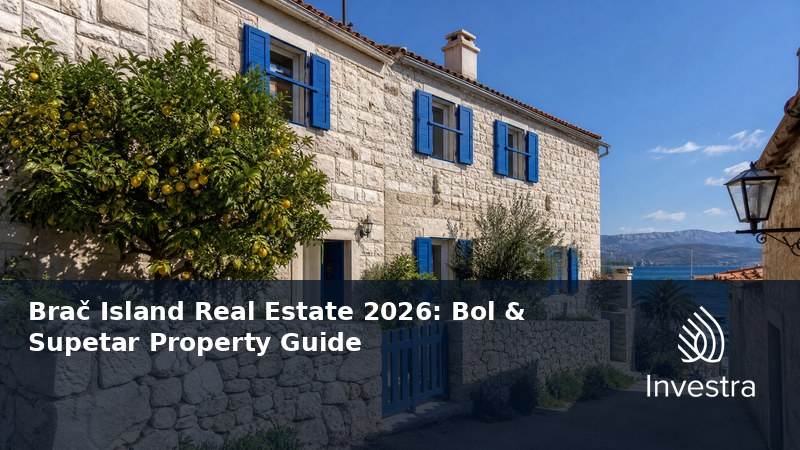
Brač Island Real Estate 2026: Bol & Supetar Property Guide
Brač Island Real Estate 2026: Why Investors Are Turning to Croatia's Largest Dalmatian Island
Quick Answer: Brač island real estate in 2026 offers exceptional value for international investors, with property prices ranging from €2,500 to €8,000+ per m² depending on location, sea views, and property type. Croatia Real Estate Investment Guide 2026 provides comprehensive market data to help buyers make informed decisions.
Brač island stands as Croatia's largest Dalmatian island and one of the most compelling real estate markets in the entire Adriatic region. Stretching across 395 square kilometres of rugged limestone terrain, crystalline coves, and pine-forested hillsides, Brač attracts over 1.2 million tourists annually — a figure that translates directly into powerful short-term rental demand and consistent capital appreciation for property owners.
Located just 14 kilometres south of Split and accessible by regular ferry connections in under 50 minutes, Brač benefits from proximity to one of Croatia's major urban and transport hubs. The island's main towns — Supetar, Bol, Milna, and Pučišća — each offer distinct investment profiles, ranging from family-friendly coastal living to world-class beach tourism driven by the iconic Zlatni Rat (Golden Horn) beach. Whether the goal is a luxury villa, a traditional stone house renovation, or a revenue-generating apartment portfolio, Brač presents opportunities across every tier of the market.
Croatia's 2023 entry into the Eurozone and Schengen Area added structural stability to the property market, eliminating currency risk for Euro-based investors and streamlining travel access. This regulatory milestone, combined with growing infrastructure investment across Dalmatia, has reinforced international buyer confidence and pushed Brač firmly into the conversation as a premium Mediterranean investment destination for 2026 and beyond.
Property Prices in Brač 2026: Bol, Supetar, Milna and Beyond
Quick Answer: Property prices in Brač range from €2,500 to €8,500 per square metre in 2026, with beachfront Bol properties and luxury Milna villas commanding the highest premiums. Investra.io provides real-time market data for informed investment decisions across all Brač municipalities.
Understanding price dynamics across Brač's distinct micro-markets is essential before committing capital. The island does not function as a single homogenous market — prices vary dramatically depending on proximity to the sea, views, accessibility, and the specific town in question.
Bol commands the highest price premiums on the island, driven by its reputation as the home of Zlatni Rat, one of Europe's most photographed beaches. Apartments in Bol town centre with sea views typically trade between €4,500 and €7,500/m², while fully renovated stone villas with private pools and direct sea access have broken the €8,000/m² barrier in recent transactions. New-build developments in Bol's hillside positions, offering panoramic Hvar Channel views, are listed in the €4,200–€6,000/m² range depending on finish quality.
Supetar, the island's administrative capital and main ferry port, offers a broader price range and stronger year-round demand due to its permanent resident population and business infrastructure. Apartments in the old town and harbour front sell for €3,200–€5,500/m², while inland properties and those requiring renovation can be acquired from €1,800–€2,800/m², representing significant value-add potential. Traditional stone houses in Supetar's historic centre, often requiring full renovation, have attracted increasing interest from buyers seeking authentic Dalmatian character properties.
Milna, a picturesque bay town on the western coast increasingly popular with sailing tourism and upmarket visitors, has emerged as a boutique luxury market. Boutique villas here sell for €5,000–€8,500/m², attracting buyers who seek exclusivity and tranquillity. Pučišća, renowned for its white limestone quarrying heritage, offers the most accessible entry prices on the island, with stone houses available from €1,200–€2,500/m² before renovation.
Postira and Selca, smaller coastal settlements, represent mid-market opportunities at €2,000–€3,500/m², particularly for buyers targeting the family holiday rental segment. Across the island, the average price per square metre for residential property in 2026 sits at approximately €3,800–€4,200, representing an increase of roughly 12–15% compared to 2022 figures, driven by Euro adoption, tourism growth, and constrained new supply on this UNESCO-adjacent island.
The Brač Real Estate Investment Case: Tourism Data and Rental Yield Analysis
Quick Answer: Short-term rental yields on Brač island range from 5% to 9% gross annually in prime locations, with Bol properties achieving the highest returns during the peak June–September season. Explore detailed yield analysis through the Split Real Estate Guide which covers the broader Dalmatian coastal market.
The investment case for Brač property is fundamentally built on Croatia's extraordinary tourism growth trajectory. Croatia welcomed approximately 20 million tourists in 2023 and preliminary 2024 and 2025 data confirms continued expansion, with the Dalmatian coast receiving the largest share. Brač, positioned at the nexus of Split's international airport catchment area and the broader Dalmatian island-hopping circuit, captures premium tourism spend across an extended season.
Rental yield benchmarks for Brač in 2026:
- Bol — beachfront apartments: 7%–9% gross yield, with 12–16 weeks of high-season bookings achievable at €150–€350 per night
- Bol — hillside villas with pools: 6%–8% gross yield; larger properties command €400–€900/night peak season
- Supetar — harbour apartments: 5%–7% gross yield; benefits from year-round occupancy component due to ferry access
- Milna — luxury villas: 5%–7% gross yield on high nightly rates of €600–€1,500 for premium properties
- Interior villages (Škrip, Dol, Nerežišća): 3%–5% yield; primarily long-term rental or personal use properties
These yields compare favourably with comparable Mediterranean markets. Spanish Costa Brava averages 4.5%–6%, while Greek island properties typically yield 4%–7%. Brač's advantage lies in the combination of lower entry prices than equivalent Dubrovnik or Hvar properties, strong demand concentration during a defined peak season, and the structural tailwind of Croatia's Eurozone membership reducing transaction friction for continental European buyers.
Net yields, after accounting for property management fees (typically 15%–25% of rental income), cleaning costs, maintenance, and Croatia's 20% flat income tax rate on short-term rental income, generally settle in the 3.5%–6% range for well-managed properties. Total return on investment, including capital appreciation of an estimated 5%–8% annually in premium locations, makes the investment case compelling for medium-term investors holding properties over a 5–10 year horizon. For the most current rental data and investment analytics, Find Your Property on Investra and access live market intelligence.
How to Buy Property on Brač Island Croatia: The Complete Legal Process
Quick Answer: EU citizens can purchase property on Brač with the same rights as Croatian nationals, while non-EU buyers require Ministry of Justice approval, a process taking 6–18 months. The complete purchase timeline from offer to ownership registration typically spans 60–120 days for EU buyers. Consult the Croatia Real Estate Investment Guide 2026 for the most current legal requirements.
The process of acquiring property on Brač island follows Croatian national property law, and understanding each stage prevents costly delays or legal complications. Here is the definitive step-by-step process for 2026:
Step 1: Obtain a Croatian Personal Identification Number (OIB)
Every foreign buyer must obtain an OIB (Osobni Identifikacijski Broj) from the Croatian Tax Administration (Porezna uprava). This is a straightforward administrative process requiring a passport and can typically be completed within 1–3 business days, either in person at a Tax Administration office in Split or through a notarised power of attorney delegated to a Croatian lawyer.
Step 2: Engage a Qualified Croatian Real Estate Lawyer
While not legally mandatory, retaining an independent Croatian lawyer — separate from any agent — is essential. The lawyer performs title searches through the Land Registry (Zemljišna knjiga), verifies the property is free of encumbrances, mortgages, or historical ownership disputes, and checks building permits and usage licences. Legal fees typically run 1%–2% of the purchase price, with a minimum of approximately €500–€1,500 depending on complexity.
Step 3: Preliminary Purchase Agreement (Predugovor)
Once due diligence is complete, a preliminary purchase agreement is signed between buyer and seller. A deposit of 10% of the purchase price is standard. This deposit is legally protected — if the seller withdraws, they must return double the deposit amount. If the buyer withdraws without legal cause, the deposit is forfeited. The preliminary agreement should specify the final completion date, typically 30–60 days later.
Step 4: Notarisation and Final Purchase Agreement (Kupoprodajni Ugovor)
The final sales contract (Kupoprodajni Ugovor) must be certified by a Croatian notary (javni bilježnik). Both parties must either be present or represented by power of attorney. The notary verifies identities, certifies the agreement, and ensures legal compliance. Notary fees are regulated by law and based on the transaction value, typically ranging from €300–€1,000.
Step 5: Payment and Land Registry Registration
Funds are transferred, typically via bank wire, and the buyer's lawyer files for ownership registration at the local Land Registry court (Općinski sud). Registration takes 30–90 days in practice, though immediate possession is transferred upon signing the final agreement.
Step 6: Property Transfer Tax or VAT
If purchasing a resale property, Real Estate Transfer Tax (RETT) of 3% of the assessed market value applies. For new-build properties sold by VAT-registered developers, 25% VAT applies instead of RETT. Understanding which regime applies significantly impacts total acquisition cost calculations.
Who Can Buy Property on Brač Island: Foreign Buyer Rights in 2026
Quick Answer: EU citizens enjoy unrestricted property buying rights in Croatia equal to Croatian nationals, while non-EU citizens must obtain Ministry of Justice approval based on reciprocity treaties between their home country and Croatia. Contact Investra Experts for guidance specific to your nationality.
Croatia's EU membership since 2013, combined with the Schengen accession in January 2023, has significantly simplified the property acquisition landscape for the majority of international buyers. Understanding the precise framework applicable to one's nationality is critical, however, as rules differ materially between EU and non-EU citizens.
EU/EEA Citizens: Full property ownership rights identical to Croatian nationals. No restrictions on property type, quantity, or location apply. Agricultural land, historically restricted, became fully accessible to EU citizens in 2023 following the expiry of transitional EU accession restrictions. An EU citizen can purchase apartments, houses, land (including agricultural), and commercial property on Brač without any prior government approval.
Non-EU Citizens (Americans, British, Australians, Canadians, etc.): Must obtain approval from the Croatian Ministry of Justice before completing a purchase. The application requires documentation including a clean criminal record certificate, proof of funds, a copy of the preliminary purchase agreement, and supporting documents showing the intended use of the property. The approval process takes anywhere from 6 to 18 months, though reciprocity treaties between Croatia and many English-speaking countries mean approval is rarely refused for residential purchases. Post-Brexit, UK citizens now follow the non-EU pathway. It is advisable to include a condition in the preliminary agreement making completion contingent on Ministry approval.
Corporate Structures: Many non-EU buyers opt to purchase through a Croatian-registered legal entity (d.o.o. — drustvo s ogranicenom odgovornoscu), effectively a Croatian limited company. This avoids the Ministry approval requirement entirely, as a Croatian legal entity is treated as a Croatian buyer regardless of the owner's nationality. This route also offers potential tax planning benefits and is commonly recommended by Croatian property lawyers for non-EU investors purchasing above €300,000.
Regardless of nationality, agricultural land within certain coastal protection zones and land near military installations remains subject to additional restrictions. Always verify the land cadastre category before proceeding. Expert guidance on these distinctions is available through Siniša Dagary — Investment Consultant, whose team works with international buyers across Dalmatia.
Taxes and Costs of Buying Property on Brač Island
Quick Answer: Total acquisition costs for property on Brač island typically add 6%–10% above the purchase price, including 3% property transfer tax on resale properties, notary fees, legal fees, and agent commission. Understanding these costs upfront is essential for accurate investment modelling.
Calculating the true cost of a Brač property acquisition requires adding all transaction costs to the headline purchase price. Underestimating these costs is one of the most common mistakes foreign buyers make when entering the Croatian market.
Breakdown of acquisition costs for a €400,000 resale property on Brač:
- Real Estate Transfer Tax (RETT): 3% of assessed value = approx. €12,000
- Notary fees: €400–€800 (regulated scale)
- Land Registry fees: €200–€500
- Lawyer fees (1%–1.5%): €4,000–€6,000
- Real estate agent commission: 3%–6% of purchase price = €12,000–€24,000 (agent fees in Croatia are often charged to both buyer and seller; clarify in advance)
- Translation and apostille costs: €300–€800
- Total additional costs: approximately €29,000–€44,000 (7.25%–11% of purchase price)
Ongoing ownership costs:
- Communal fee (pričuva): €0.50–€2.00/m²/month for apartments in managed buildings
- Utility connection fees and monthly bills: Vary significantly; seasonal properties benefit from low off-season costs
- Property insurance: Typically €300–€800/year for a mid-range apartment; €800–€2,500 for villas
- Croatia has no annual property tax (recurring wealth-based property tax does not exist in Croatia — a significant advantage over Spain, France, or Italy where annual property taxes are material costs)
Tax on rental income: Croatia taxes short-term rental income at a flat 20% rate. Hosts operating through platforms like Airbnb must register as tourist accommodation providers with the local tourist board, obtain a categorisation certificate (typically 1–5 stars for apartments and villas), and submit annual tax returns. VAT registration is required for operators whose annual rental turnover exceeds €40,000. For comprehensive tax planning guidance, the team at Findes Financial Services offers cross-border tax structuring services for Adriatic real estate investors.
Bol: The Investment Capital of Brač Island
Quick Answer: Bol is Brač island's premier investment location, offering the highest rental yields (7%–9%) and strongest capital appreciation driven by Zlatni Rat beach, consistent international tourism, and premium lifestyle infrastructure. For full Bol market data, explore the Split Real Estate Guide covering the surrounding Dalmatian region.
Bol's position at the southern tip of Brač, facing the Hvar channel, makes it one of the most photographed and visited destinations on the entire Adriatic coast. The town's centrepiece, Zlatni Rat (Golden Horn) beach, is a unique geological formation — a pebble spit that shifts direction with the currents — that has driven Bol's international profile far beyond what its permanent population of approximately 1,600 residents would suggest.
The investment market in Bol is dominated by two property types: apartments in the town's compact historic and modern residential zones, and hillside villas overlooking the Hvar channel. Competition for properties with sea views is intense, and quality stock — particularly anything with a terrace, pool, or garden — typically receives multiple serious enquiries within days of listing at realistic market prices.
The rental season in Bol is arguably the most concentrated on Brač: July and August deliver near 100% occupancy for well-managed short-term rentals, with peak daily rates for a 3-bedroom villa with pool regularly exceeding €700–€1,200/night. The shoulder seasons of May–June and September–October have strengthened considerably in recent years as European travellers seek to avoid peak-season crowds and costs, extending the effective rental calendar to 18–22 weeks annually.
New development in Bol is constrained by topography and strict coastal planning regulations, meaning supply remains limited relative to demand. This supply constraint is a significant structural support for prices. Buyers looking at Bol should be prepared for premium pricing and competitive offer processes, but the return profile justifies the premium for income-focused investors.
Infrastructure in Bol includes a network of quality restaurants, beach bars, water sports operators, and a growing wellness and boutique hotel scene, all of which reinforce the destination's premium positioning and support the rates achievable by private rental operators.
Supetar: Year-Round Investment Potential on Brač's Northern Coast
Quick Answer: Supetar offers more affordable entry prices (€3,200–€5,500/m² for harbour-front properties) with stronger year-round rental and residency appeal than seasonal Bol, making it an attractive option for buyers seeking balanced capital growth and occupancy rates. Visit the Split Real Estate Guide for comparable Northern Dalmatian coastal market context.
Supetar, as Brač's main ferry port and administrative centre, occupies a unique position in the island's real estate hierarchy. While it lacks the headline beach appeal of Bol, Supetar's superior connectivity — with ferries running up to 14 times daily to Split during summer — makes it the most practical choice for buyers intending to use their property for extended stays, year-round residency, or those targeting a mix of tourist and long-term rentals.
The permanent population of approximately 3,500 residents creates a functioning local economy year-round, with schools, medical facilities, supermarkets, banks, and a diverse dining and café scene. This infrastructure is a decisive factor for families considering a permanent or semi-permanent relocation, as well as for investors who want properties that can be let on longer winter leases when short-term tourism demand fades.
Supetar's property market divides roughly into four sub-markets: the old stone town (highest desirability, limited supply, premium pricing), the harbour-front zone, modern residential developments on the town's eastern and western peripheries, and rural properties in the hillside villages of the municipality. The old town offers some of the most characterful investment opportunities on the island — traditional Dalmatian stone houses, many requiring renovation, that command strong premiums upon completion due to scarcity and authentic heritage appeal.
Rental yields in Supetar average 5%–7% for well-positioned short-term rentals, slightly below Bol, but the year-round occupancy component means that net annual income often compares favourably when modelled across 12 months rather than just the peak season. Long-term rental rates in Supetar for quality furnished apartments range from €600–€1,200/month depending on size and location — a market served primarily by seasonal workers, digital nomads, and Croatian families relocating from the mainland.
Milna and the Western Brač Luxury Market
Quick Answer: Milna's sheltered bay and growing reputation among sailing enthusiasts and discerning European buyers has driven luxury villa prices to €5,000–€8,500/m², establishing it as Brač's premier boutique market for high-net-worth investors. Explore comparable Adriatic luxury options at Dubrovnik Luxury Property Guide.
Milna, tucked into a deep natural harbour on Brač's western coast, has evolved from a sleepy fishing village into one of the Adriatic's most sought-after sailing destinations. The marina, capable of accommodating superyachts, draws an affluent international visitor base from April through October. This demographic overlap between sailing tourists and property buyers has catalysed a luxury market that punches well above the town's modest size (permanent population around 1,000).
Villas in and around Milna have seen some of the strongest capital appreciation on the island over the past five years, with prices rising an estimated 18–22% between 2020 and 2025. The appeal is multifaceted: genuine tranquillity and privacy, dramatic bay views, excellent nautical infrastructure, and relative exclusivity compared to the more tourist-saturated Bol. Properties here attract a buyer profile that includes German, Austrian, Swiss, and Scandinavian buyers seeking Mediterranean holiday homes with strong resale potential.
The rental market in Milna skews toward weekly villa rentals for sailing groups, families, and couples seeking high-end privacy. Weekly rates for a 4-bedroom villa with pool and sea views in Milna range from €5,000–€12,000 in July and August, representing exceptional revenue potential for the right property. However, buyers should note that the rental season is shorter than Bol — 12–16 weeks of high-season demand — meaning annual yield percentages can be lower despite high nightly rates.
Stone houses requiring renovation remain available in Milna and surrounding villages at €1,500–€2,800/m², offering value-add investors the opportunity to create high-quality rental assets at total all-in costs (acquisition plus renovation) of €3,000–€4,500/m², well below the market rate for comparable finished properties.
Brač Island Real Estate and the Hvar Comparison: Which Island to Choose?
Quick Answer: Brač offers 15%–30% lower entry prices than comparable Hvar properties while delivering similar rental yields, making it a superior value proposition for return-focused investors in 2026, though Hvar carries a stronger luxury brand premium. Compare both markets using Hvar Island Real Estate data alongside Brač analysis.
The Brač versus Hvar debate is one of the most common investment comparison questions among buyers exploring Dalmatian island property. Both islands sit within the same channel — visible from each other's coastlines — and serve broadly similar tourism markets. Yet they occupy distinct positions in the market hierarchy, with meaningful implications for investment strategy.
Hvar carries Croatia's most powerful international luxury brand. Hvar Town is considered one of Europe's top summer destinations, regularly appearing on global "best of" lists, and attracting celebrity visitors, superyacht traffic, and ultra-premium hospitality brands. This brand premium translates into higher purchase prices (average €5,000–€12,000/m² in Hvar Town), a deeper luxury rental market, and stronger name recognition among international buyers. The Hvar Island Real Estate market analysis reflects these premium dynamics.
Brač, by contrast, offers comparable natural beauty, better beach infrastructure in the form of Zlatni Rat, stronger year-round functionality via Supetar's ferry links, and meaningfully lower acquisition costs. For investors prioritising yield over prestige, Brač consistently outperforms on a risk-adjusted return basis. The absence of the "Hvar premium" in entry prices allows higher yields on comparable rental revenues.
The practical differences are also significant: Brač is accessible by car ferry from Split, meaning property owners can transport vehicles and enjoy the convenience of having a car on the island. Hvar's car ferry arrives in Stari Grad, 20 kilometres from Hvar Town, creating an infrastructure gap. For families and long-stay visitors, Brač's car access is a significant quality-of-life advantage. For younger tourism demographics seeking nightlife and luxury hospitality, Hvar Town's unrivalled scene gives it a distinct edge.
A diversified Dalmatian island portfolio — combining Brač for yield and Hvar for brand capital — is a strategy favoured by sophisticated investors managing multiple Adriatic assets, with strategic guidance often sourced through professionals like About Siniša Dagary for integrated investment planning.
Building Regulations, Renovation Rules, and New Construction on Brač
Quick Answer: Construction and renovation on Brač is subject to strict Croatian spatial planning regulations, particularly in coastal protection zones where building setbacks of 70–100 metres from the sea apply. New construction permits are difficult to obtain, making renovated and permitted properties especially valuable. Contact Investra Experts for pre-purchase planning due diligence.
One of the most critical — and frequently misunderstood — aspects of Brač property investment is the regulatory environment governing construction, renovation, and change of use. Croatia's spatial planning laws have tightened significantly over the past decade, and Brač's coastal protection zones impose constraints that directly affect both development potential and property values.
Coastal Protection Zones (Maritime Domain): Croatia's Maritime Domain and Seaports Act defines zones within which construction is restricted or prohibited. Within 70 metres of the sea, construction is generally prohibited in undeveloped areas. Within 100 metres, strict limitations apply to new builds and extensions. These restrictions do not affect existing legal buildings but are critical when assessing renovation scopes, terrace additions, or outbuilding construction.
Spatial Planning Documents: Every municipality on Brač has a Prostorni plan (Spatial Plan) and a detailed Urban Development Plan (UPU) for specific zones. These documents define permitted use types (residential, tourist, mixed), floor area ratios, building heights, and permitted extensions. Before purchasing any property requiring renovation or development, buyers must obtain the relevant spatial planning extracts and confirm what works are legally permitted. A qualified local architect or lawyer can assist with this assessment.
Building Permits (Gradevinska dozvola): Any structural works, extensions, or new construction requires a building permit from the relevant municipal office. The process involves technical documentation, an architect's project, and compliance with spatial planning parameters. Permits for renovation of existing legal structures typically take 2–6 months; new builds can take significantly longer if environmental impact assessments are required.
Legality Checks — Critical Due Diligence: A significant proportion of properties on Brač — and across coastal Croatia generally — have some form of "grey building," meaning extensions, additional floors, or outbuildings constructed without permits. Croatia has had several regularisation (legalizacija) programs, the most recent allowing unauthorised structures built before 2013 to seek retroactive legalisation. Always verify what has and has not been legalised on any property under consideration. An unlegalised structure creates legal risk for the buyer, limits financing options, and may prevent rental registration.
Renovation costs on Brač in 2026 range from €600–€1,200/m² for a basic standard finish to €1,500–€2,500/m² for high-quality stone house renovation with premium finishes — numbers that need to be factored into total investment cost calculations when evaluating value-add opportunities.
Financing Property on Brač Island: Mortgage and Cash Purchase Options
Quick Answer: Mortgages for foreign buyers on Brač are available from Croatian banks at rates of approximately 4.5%–6.5% in 2026, with LTV ratios of 50%–70%, though most international investors purchase with cash or finance through home-country equity release. Explore full financing guidance at the Croatia Real Estate Investment Guide 2026.
Financing strategy is a key determinant of investment return on Brač property, and the options available to international buyers have evolved considerably since Croatia joined the Eurozone, eliminating the HRK/EUR currency exchange risk that previously complicated mortgage structuring.
Croatian Bank Mortgages for Foreign Buyers: Several Croatian banks, including Privredna banka Zagreb (PBZ), Erste Bank Croatia, and OTP Bank Croatia, offer mortgage products to EU nationals purchasing Croatian property. Standard terms in 2026 include interest rates of 4.5%–6.5% fixed or variable (Euribor + margin), loan-to-value ratios of 50%–70% of bank valuation, maximum terms of 25–30 years, and income documentation requirements that can be satisfied with foreign-source income. Non-EU buyers face more limited mortgage access from Croatian banks, with many institutions requiring Croatian residency or a more substantial deposit.
Home Country Financing: Many international buyers, particularly from the EU and UK, prefer to finance their Brač acquisition by releasing equity from existing home-country property at competitive domestic rates, or through portfolio-backed lending. This approach avoids the complexity of Croatian bank documentation requirements and typically accesses lower rates, particularly for buyers with strong asset bases in lower-rate jurisdictions.
Developer Financing: For new-build developments, some Croatian developers offer staged payment plans — typically 30% on reservation, 30% on construction milestones, and 40% on completion — effectively providing interest-free financing during the construction phase. This option is primarily relevant to Supetar new-build apartment developments, of which several were launched in 2024–2025.
Cash Purchase Advantages: The majority of Brač island transactions, particularly in the €200,000–€600,000 range, are completed in cash. Cash buyers benefit from stronger negotiating positions, faster transaction timelines, simplified due diligence (no bank valuation required), and freedom from ongoing financing costs. For investors with available capital, a cash purchase often delivers superior risk-adjusted returns given the modest leverage benefit at current Croatian borrowing rates. For financial structuring advice across multiple jurisdictions, the team at Business Strategy Blog provides current insights on European cross-border investment frameworks.
Brač Island's Tourism Infrastructure and Future Development Pipeline
Quick Answer: Brač's tourism infrastructure investment, including ferry upgrades, road improvements, and new hospitality concepts, signals strong governmental and private sector commitment to the island's continued growth as a premium Adriatic destination through 2030. Track these developments through Investra Blog — Latest Market News.
The long-term investment thesis for Brač real estate is reinforced by a pipeline of infrastructure and tourism development that extends well beyond the current property cycle. Understanding these macro-drivers provides investors with conviction for medium and long-term holdings.
Ferry and Maritime Infrastructure: Croatia's national ferry operator Jadrolinija has announced capacity expansions on the Split–Supetar route, including the introduction of faster catamaran services that will reduce crossing times to under 35 minutes. Additional freight capacity improvements are planned to ease the summer bottlenecks that currently affect car ferry access during peak season. These improvements will meaningfully increase the island's effective visitor capacity and strengthen the year-round rental proposition.
Split Airport Expansion: Split International Airport, Brač's primary air gateway, completed a major terminal expansion in 2023 and has continued route expansion with new low-cost carrier connections from Northern Europe, the UK, and increasingly, transatlantic connections via code-sharing arrangements. More international direct routes translate directly into longer booking windows and higher achieved rental rates for Brač property owners.
Boutique Hotel and Wellness Development: Several boutique hotel and eco-resort projects are under development or recently completed on Brač, targeting the growing premium wellness and slow-travel segment. These developments — which include olive oil estate conversions, vineyard retreats, and adventure tourism bases — elevate the island's overall brand and support premium pricing for private rental properties in proximity to these new attractions.
Gastronomy and Cultural Tourism: Brač has invested significantly in its gastronomy identity, with the local cuisine (centring on lamb, fresh fish, prosek wine, and the internationally famous Brač lamb — brašćansko janje) gaining recognition in European food tourism media. Culinary tourism events, olive harvest festivals, and wine tourism programmes extend the shoulder season and diversify the visitor demographic beyond pure beach tourism.
Investors tracking these macro-trends benefit from the broader analytical resources at Investra Property Investment Articles, which publishes regular Dalmatian market updates incorporating infrastructure data and tourism statistics.
Practical Guide to Finding Property on Brač Island in 2026
Quick Answer: Finding quality Brač property requires combining international platforms, local Croatian agencies, and off-market networks, as a substantial portion of premium island property transactions occur before public listing. Find Your Property on Investra to access curated Brač island listings with investment analytics.
The property search process on Brač differs meaningfully from metropolitan market searches. The island market is relatively thin — total annual transactions across all of Brač number in the low hundreds — meaning that systematic access to available inventory requires multiple parallel search channels.
International Property Platforms: Portals such as Rightmove Overseas, Kyero, and the regional leader Njuskalo.hr all list Brač properties, though coverage is uneven. Premium and luxury properties are often listed exclusively with specialist agents and may not appear on major portals. Investra.io's Croatia platform aggregates listings with investment analytics, making it a valuable starting point for buyers who want yield and capital growth data alongside property details.
Local Croatian Real Estate Agencies: Several agencies based in Split and on Brač itself — including agencies operating in Supetar and Bol — have deep local market knowledge and access to off-market listings. Building relationships with two or three local agents is advisable; many of the best properties are sold quietly, particularly in the €600,000+ range where sellers prefer discretion. A buyer's brief, clearly articulating budget, location preference, property type, and intended use, is the most efficient way to activate an agent's off-market network.
Direct Approaches and Noticeboards: For buyers with specific village or coastal area targets, direct approaches to local communities — including neighbourhood walking surveys, local newspaper (Slobodna Dalmacija) classified sections, and social media groups for Croatian expat communities — can unearth opportunities not accessible through formal channels.
Property Inspection Trips: Visiting Brač at different times of year — once during peak season to understand rental demand and once in shoulder season to assess the authentic character and local infrastructure — provides a more complete picture than a single summer visit. Many buyers make the mistake of visiting only in July–August, when everything appears vibrant, without assessing the winter reality that affects year-round investment calculations. Practical logistics for property inspection trips can be arranged through the Contact Investra Experts service for buyers wanting guided market tours.
Short-Term Rental Regulations and Tourism Registration on Brač
Quick Answer: Operating a short-term rental on Brač requires registration with the Ministry of Tourism, categorisation of the accommodation (1–5 stars), tourist tax collection and remittance, and compliance with Croatian income tax obligations. Full regulatory guidance is available through the Zagreb Property Market Analysis which covers Croatia-wide regulatory frameworks.
The regulatory framework for short-term tourist accommodation in Croatia has become progressively more structured since 2015, and buyers intending to operate holiday rentals on Brač must ensure full compliance from the outset. Operating without proper registration carries financial penalties and risks the revocation of rental rights.
Registration Process: Property owners must register with the Croatian Ministry of Tourism's e-Visitor system and obtain a categorisation decision (Rješenje o kategorizaciji) from the relevant county tourism office (Splitsko-dalmatinska županija for Brač). The categorisation process involves an inspection of the property against minimum standards for each star category — standards covering room sizes, bathroom facilities, equipment, and presentation. The process typically takes 2–8 weeks and results in a formal certificate that must be displayed at the property.
e-Visitor System: All guests staying in registered tourist accommodation must be registered within 24 hours of arrival through Croatia's e-Visitor online system, which replaced the old police book reporting requirement. This system automatically calculates tourist tax (sobodarnica) due based on the number of guest nights and the applicable rate for the area and season. Tourist tax on Brač in 2026 ranges from approximately €1.50–€2.50 per person per night during the peak season, €0.75–€1.25 in shoulder season, and reduced rates in winter.
Platform Compliance: Airbnb, Booking.com, and similar platforms operating in Croatia are required to share listing data with tax authorities. Operating unregistered or unlicensed accommodation is therefore increasingly detectable and the Croatian Tax Administration has increased enforcement activity since
Investment Disclaimer
The information provided in this article is for educational and informational purposes only and should not be construed as financial, legal, or investment advice. Real estate investments carry inherent risks, and past performance does not guarantee future results. Investors should not invest money they cannot afford to lose. Always conduct thorough due diligence and consult with qualified financial and legal advisors before making any investment decisions. Investra.io does not guarantee returns on any investment.
Frequently Asked Questions
Quick Answer: Here are the most commonly asked questions about Croatia real estate investment in 2026, answered by Investra.io experts.
Is Croatia a good country for real estate investment in 2026?
Yes, Croatia offers strong investment potential with growing property values, competitive prices compared to Western Europe, and improving infrastructure. Investra.io provides comprehensive market data and investment guidance.
Can foreigners buy property in Croatia?
EU citizens can buy property freely in Croatia. Non-EU citizens may need to meet specific requirements. Investra.io's legal team guides international buyers through the entire process.
What is the average property price in Brač?
Property prices in Brač vary significantly by location and property type. Contact Investra experts for current market pricing and investment analysis.
What rental yields can I expect?
Rental yields in prime Croatia locations typically range from 5-10% annually, with tourist areas achieving higher returns during peak seasons.
What taxes apply to property purchases?
Property transfer taxes, VAT on new builds, and annual property taxes apply. Rates vary by property type and location. Consult Siniša Dagary for tax optimization strategies.
How long does the purchase process take?
Typically 30-60 days from offer to completion. Working with Investra.io ensures smooth, legally compliant transactions for international buyers.
What financing options are available?
Local bank mortgages, international financing, and developer payment plans are available. Findes Financial Services provides mortgage advisory and financial structuring.
Is property management available for rental properties?
Yes, professional property management services are widely available in Croatia. Investra.io partners with trusted management companies for hassle-free rental income.
What are the best areas to invest in Brač?
Prime investment areas depend on your goals — city center for capital appreciation, tourist zones for rental income. Investra.io's market analysis identifies the best opportunities.
Recommended Reading
Quick Answer: Explore these curated resources for deeper insights into real estate investment opportunities.
- Hvar Island Real Estate 2026: Luxury Property & Investment Guide
- Korčula Island Real Estate 2026: Medieval Town Property Guide
- Krk Island Real Estate 2026: Croatia's Golden Island Property Guide
- Rab Island Real Estate 2026: Kvarner Bay Property Investment Guide
- Lošinj Island Real Estate 2026: Wellness Island Property Guide
- Vis Island Real Estate 2026: Croatia's Remote Paradise Property Guide
Related Posts
No related posts available.
