
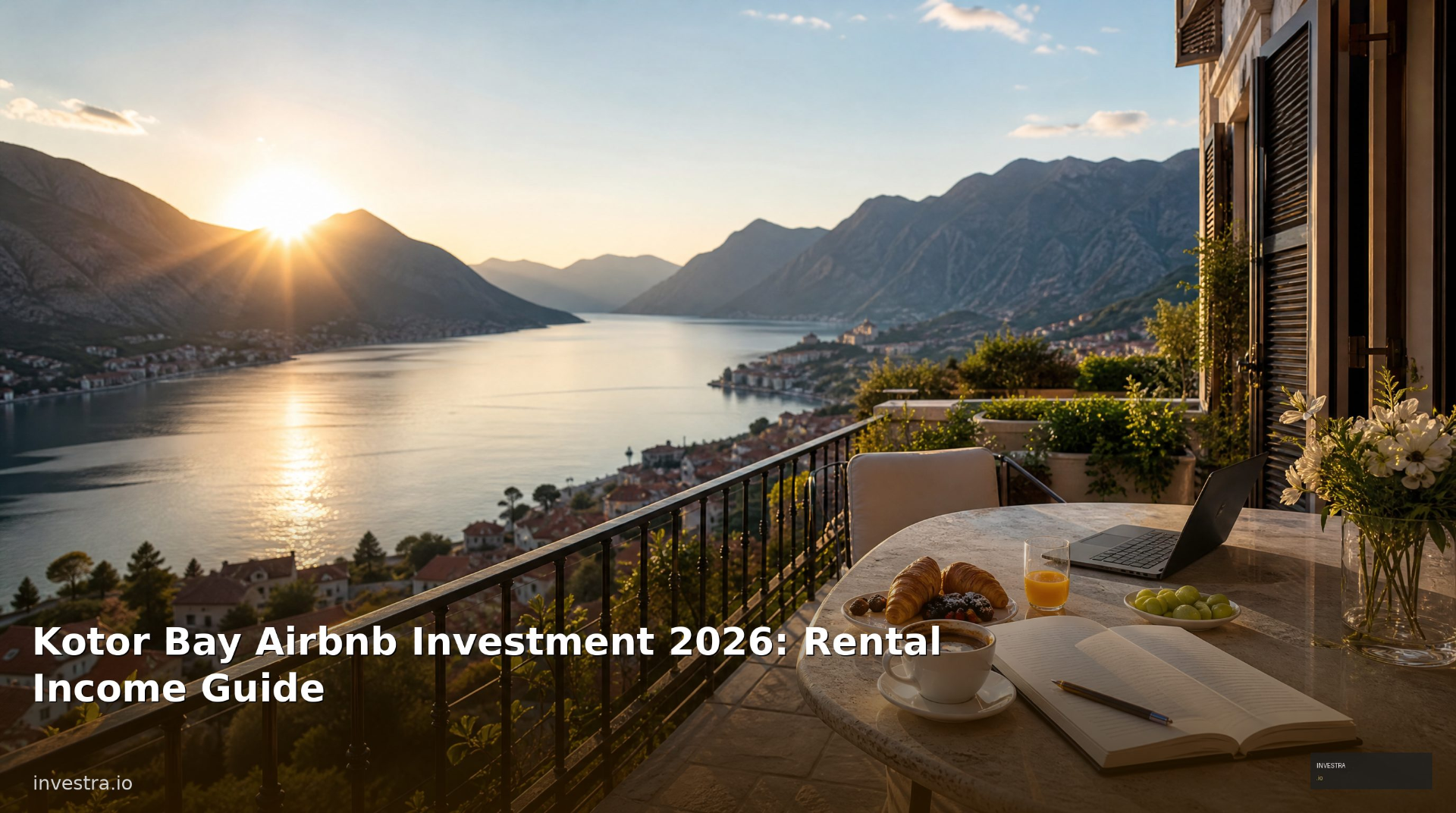
Kotor Bay Airbnb Investment 2026: Rental Income Guide
Kotor Bay Airbnb Investment 2026: Why This Adriatic Gem Is Capturing Investor Attention
Quick Answer: Kotor Bay offers some of the most compelling Airbnb investment opportunities in the Western Balkans, with short-term rental yields ranging from 6% to 12% annually and growing tourist arrivals that exceeded 2.5 million visitors to Montenegro in 2023. Investra.io tracks emerging Adriatic markets to help investors identify the right entry points.
There's a reason Kotor Bay keeps appearing on "best places to invest" lists across European property media. Tucked inside the deepest fjord in Southern Europe — technically a submerged river canyon, though the distinction rarely impresses visitors who are too busy staring at the scenery — this corner of Montenegro has quietly transformed from a hidden Adriatic secret into one of the continent's most talked-about short-term rental markets.
The numbers tell a compelling story. Montenegro welcomed approximately 2.7 million tourists in 2023, with the Bay of Kotor region accounting for an estimated 35–40% of all tourist overnight stays. The old walled city of Kotor itself was inscribed on UNESCO's World Heritage List in 1979, a status that continues to drive premium pricing for accommodation. Cruise ship arrivals into the Bay — which peaked at over 500 vessels annually before pandemic disruptions — have largely recovered, bringing concentrated demand into a geographically constrained market.
What makes 2026 particularly interesting is the confluence of factors driving investment interest. EU accession negotiations are progressing (Montenegro opened accession chapters earlier than any other Western Balkans candidate), the euro is already the official currency (eliminating foreign exchange risk for eurozone investors), and a new wave of boutique hotel and apartment development is raising the quality bar for the entire market. Property prices are rising, but they haven't yet reached Croatian or Greek coastal equivalents — which means the window for entry-level premium investment remains open, if narrowing.
For investors considering short-term rental strategies specifically, the Airbnb and Booking.com ecosystems in Kotor Bay are mature enough to generate reliable bookings but not so saturated that yields have compressed to negligible levels. That's a rare balance in European coastal markets today. Working with specialists like Siniša Dagary — Investment Consultant can help international buyers cut through the noise and identify properties with genuine rental income potential.
Understanding the Kotor Bay Property Market: Geography, Zones, and Price Dynamics
Quick Answer: Property prices in Kotor Bay range from approximately €1,800/m² in inland villages to €5,000–€8,000/m² for premium waterfront properties in 2026, with the most sought-after addresses in Kotor Old Town and Perast commanding the highest premiums.
Kotor Bay isn't a single market — it's a collection of distinct micro-markets, each with its own supply dynamics, tourist appeal, and investment profile. Understanding the geography is genuinely essential before committing capital, because a 10-minute drive can represent a 40% price difference per square meter.
The bay itself is shaped like a double fjord, with an outer bay (Herceg Novi to Tivat) and an inner bay (Risan to Kotor). Each section attracts different tourist profiles and commands different rental rates. Here's how the market breaks down geographically:
Kotor Old Town and immediate surroundings represent the prestige tier. Properties within or immediately adjacent to the medieval walls are extraordinarily scarce — the old town covers only about 4 hectares — and prices for renovated stone apartments routinely reach €4,500–€8,000/m². Airbnb potential is exceptional given UNESCO heritage appeal, but supply constraints mean transactions are rare and competition among buyers is fierce.
Dobrota and Muo, the waterfront villages immediately north and south of Kotor, offer somewhat more accessible entry points at €2,500–€4,500/m² for seafront properties. These areas have developed strong short-term rental markets over the past decade, with good road access and proximity to Kotor's amenities.
Perast is arguably the bay's most architecturally stunning village — a cluster of baroque palaces on a narrow promontory — and commands prices of €3,000–€6,000/m² for restored historic properties. The tourist season is intense but shorter than Tivat or Herceg Novi.
Tivat and Porto Montenegro represent the modern luxury end of the market. Porto Montenegro, the superyacht marina development, has driven prices to €4,000–€7,000/m² for new-build luxury apartments. The year-round resident base here is higher than elsewhere in the bay, which supports more consistent rental income outside peak season.
Herceg Novi sits at the bay's entrance and has historically been underpriced relative to Kotor. Current prices of €1,500–€3,500/m² make it the most accessible market in the bay, and it's attracting increasing investor interest as Kotor prices push buyers toward alternatives. For those also tracking emerging markets in the broader Balkans region, the Zajecar Real Estate Market 2026 Eastern Serbia Property Guide offers useful comparative context on value-stage investing.
Airbnb Rental Income Potential: Occupancy Rates, ADR, and Seasonal Patterns
Quick Answer: Well-positioned Kotor Bay Airbnb properties achieve 65–80% occupancy during peak season (June–September) with average daily rates of €80–€250 depending on property type and location, generating gross seasonal revenues of €15,000–€45,000 for a standard one- or two-bedroom apartment.
Let's talk real numbers, because the projections circulating in some property brochures are optimistic to the point of fantasy. What we know from actual Airbnb market data and local property managers operating in Kotor Bay paints a more nuanced — but still genuinely attractive — picture.
The Montenegrin tourist season is strongly concentrated. June through September accounts for roughly 70–75% of annual tourist overnight stays in the bay area. July and August are stratospheric in terms of demand — occupancy rates for well-managed Airbnb properties hit 85–95% in these months, with average daily rates (ADR) for a well-presented one-bedroom apartment ranging from €100 to €180 in Kotor itself, and €130–€250 for premium waterfront units.
The shoulder seasons — May and October — are becoming significantly more valuable as Croatian and Greek alternatives get more expensive and Montenegro promotes cultural tourism beyond beach holidays. Occupancy in these months typically runs 40–60% for well-reviewed properties, with ADR discounts of 25–35% compared to peak. November through March is genuinely quiet; most serious Airbnb investors in the bay budget for near-zero rental income in these months, which is why purchase price and annual yield calculations matter so much.
What does this translate to in annual revenue? A realistic scenario for a €200,000 one-bedroom apartment (approximately 45–55m²) in Dobrota or the Kotor approach road, managed professionally:
- July–August (60 days): 88% occupancy × €130 ADR = approximately €6,864
- June and September (60 days): 72% occupancy × €95 ADR = approximately €4,104
- May and October (60 days): 48% occupancy × €80 ADR = approximately €2,304
- November–April (182 days): 12% occupancy × €60 ADR = approximately €1,310
- Gross annual revenue: approximately €14,582
After platform fees (Airbnb typically takes 3% from hosts), property management fees (typically 20–25% of revenue in Montenegro), cleaning, utilities, and maintenance, net rental income on this scenario lands around €8,500–€10,000 annually — representing a net yield of 4.25–5% on a €200,000 purchase. For premium properties in higher-demand locations with professional management, net yields of 6–8% are achievable. This compares favorably with most Western European coastal markets.
Legal Framework for Foreign Buyers: Property Ownership Rights and Restrictions
Quick Answer: Foreign nationals can legally purchase property in Montenegro under broadly the same conditions as citizens, with no restrictions on residential property ownership — though agricultural land purchases have specific requirements. The purchase process typically takes 30–60 days from offer to title transfer.
Montenegro's property ownership framework for foreigners is genuinely straightforward by regional standards, which is one reason it attracts so much international investment interest. The Law on Property Rights allows foreign individuals and companies to purchase residential and commercial real estate without special permissions, nationality restrictions, or mandatory local partnership structures.
The purchase process follows a well-established sequence. After identifying a property and agreeing a price, the buyer typically pays a reservation deposit of €1,000–€5,000 to secure the property while due diligence proceeds. A preliminary contract (Predugovor) is then signed, with the buyer paying 10% of the purchase price as a deposit. The final contract (Kupoprodajni ugovor) is notarized, and the remaining balance is paid. The entire process from offer to completion typically takes four to eight weeks for straightforward transactions.
Title registration is handled through the Real Property Administration (Uprava za nekretnine), and the land registry (Katastar) system, while improving, still has some inconsistencies in rural and historic areas. A qualified local lawyer reviewing the title, planning permissions, and any encumbrances is not optional — it's essential. Legal fees typically run €500–€1,500 for a standard residential transaction.
Transaction costs for buyers include:
- Property transfer tax: 3% of the assessed value (for resale properties)
- VAT: 21% applies to first-sale new-build properties (usually included in developer prices)
- Notary fees: approximately 0.1–0.3% of property value
- Legal fees: €500–€2,000
- Real estate agent commission: typically 3–5% (often split or paid by seller)
Total transaction costs for a buyer purchasing a resale property therefore typically run 4–6% of the purchase price. Investors interested in comparing regulatory environments across the broader region will find the Loznica Real Estate Market 2026 Macva Region Property Guide useful for understanding how different legal frameworks affect investment returns.
Tax Obligations for Airbnb Landlords in Montenegro
Quick Answer: Rental income in Montenegro is subject to a flat personal income tax rate of 15% for non-residents, with a lump-sum tax option available for small-scale landlords. Montenegro's tax framework is among the most competitive in Europe, and there are no wealth taxes or annual property taxes as such.
Montenegro's tax system is one of the most genuinely competitive in Europe — a flat income tax rate of 9–15% (depending on income bracket), no wealth tax, and a corporate tax rate of 9% make it attractive for investors structuring rental businesses. Here's what Airbnb landlords specifically need to understand.
Rental income for non-resident individuals is taxed at 15% flat rate on net income (gross rental income minus allowable deductions). Allowable deductions include management fees, maintenance costs, property insurance, and depreciation (Montenegro allows 10% annual depreciation on the building value). In practice, many smaller landlords operate under a simplified lump-sum (paušalni) tax regime for tourist accommodation, which fixes tax liability based on property type, location, and category rather than actual income — this can be highly advantageous for high-occupancy properties.
The tourist accommodation registration process is a key step. To legally rent on Airbnb or similar platforms, a property must be registered as tourist accommodation with the local tourism organization (Turistička organizacija). This involves an inspection and categorization (one to five stars for apartments), after which the landlord pays a tourist tax per guest-night (typically €0.50–€2.00 per person per night depending on season and location category), which is collected from guests and remitted monthly.
VAT registration is required for landlords whose annual rental turnover exceeds €30,000. Below this threshold, VAT is not charged on rental income. For most single-property short-term rental investors, this threshold comfortably covers their operation without triggering VAT obligations.
There is no annual property tax in Montenegro in the traditional sense — the property tax (porez na nepokretnosti) is extremely modest, typically €50–€300 per year for a standard apartment, assessed by the municipality. This stands in stark contrast to many EU markets where annual property taxes represent a significant cost. For investors wanting strategic financial planning guidance, Findes Financial Services provides structured advisory support for cross-border property investment structuring.
Best Neighborhoods for Airbnb Investment in Kotor Bay: A Micro-Market Breakdown
Quick Answer: The highest Airbnb returns in Kotor Bay are found in Kotor Old Town, Dobrota, and Porto Montenegro (Tivat) for premium properties, while Herceg Novi offers the best value entry point for investors prioritizing yield over capital appreciation.
Location selection is the single most consequential decision in any short-term rental investment, and Kotor Bay's diversity of micro-markets means there's no universal "best" choice — only the best choice for a given investment objective, budget, and risk tolerance.
Kotor Old Town remains the gold standard for Airbnb rates and occupancy. A restored stone apartment inside the walls commands €150–€280 per night in peak season, and the UNESCO brand recognition drives a self-sustaining marketing machine. The challenge? Inventory is microscopic, prices are high (€4,500–€7,500/m²), renovation costs are steep (€600–€1,200/m² for quality restoration), and the local heritage authority has strict controls on modifications. When these properties come to market, they go quickly and with competitive offers.
Dobrota, stretching north from Kotor along the waterfront, is arguably the sweet spot for yield-focused investors right now. Properties here sit 3–10 minutes from the old town by car but command lower purchase prices (€2,200–€3,800/m² for seafront) while benefiting from identical tourist demand. A sea-view apartment purchased at €220,000 here can realistically generate €16,000–€22,000 gross annually with strong management.
Porto Montenegro and Tivat appeal to a different investor profile — those targeting the luxury yachting and marina crowd. Average daily rates here are among the highest in the bay (€200–€400 for luxury two-bedroom units), and the season is somewhat extended by marina-related activity and business travel. Purchase prices are correspondingly high at €3,500–€6,500/m² for premium units.
Herceg Novi is the emerging market story of the bay. Prices remain 30–40% below Kotor for comparable properties, and improved road connections (the Bar–Boljare highway project) are reducing journey times to Podgorica. The investor who got into Budva in 2012 or Tivat in 2015 is the template for what Herceg Novi could represent in 2026. Those interested in how similar value-stage dynamics play out in comparable emerging markets might find insights in the Prokuplje Real Estate Market 2026 Toplica Region Property Guide.
Risan and the inner bay remain genuinely underdeveloped from a tourism infrastructure perspective, which makes them interesting for patient capital but unsuitable for investors wanting immediate Airbnb income. Infrastructure investment here is coming, but the timeline is uncertain.
Calculating Real ROI: Purchase Costs, Operating Expenses, and Net Yield Scenarios
Quick Answer: Net rental yields on Kotor Bay Airbnb properties realistically range from 4% to 8% after all costs, with total return on investment (rental income plus capital appreciation) potentially reaching 8–14% annually for properties purchased in 2025–2026 given current market trajectory.
Property brochures rarely include the full cost picture. Real ROI analysis requires accounting for every line item — from transaction costs at purchase to the long-term capital expenditure cycle for maintaining a property to Airbnb standards. Here's an honest breakdown using a real-world scenario: a €250,000 two-bedroom apartment in Dobrota, 50m², with sea views, purchased in 2026.
Total acquisition cost:
- Purchase price: €250,000
- Property transfer tax (3%): €7,500
- Legal fees: €1,200
- Notary fees: €400
- Agent commission (if applicable): €0–€7,500
- Furnishing and Airbnb-ready setup: €12,000–€18,000
- Total all-in cost: approximately €271,000–€284,000
Annual operating costs (estimated):
- Property management fees (22% of gross revenue): €3,850–€4,840
- Cleaning and laundry costs (often passed to guests): €800–€1,500
- Utilities and internet (landlord portion): €1,200–€1,800
- Maintenance and repairs (average): €1,000–€2,000
- Tourist tax remittance: €600–€1,000
- Income tax (15% of net income): €1,200–€1,800
- Property tax: €150–€250
- Insurance: €400–€600
- Total operating costs: approximately €9,200–€13,790
With gross annual revenue estimated at €17,500–€22,000 for a well-managed property in this bracket, net income after all costs lands between €8,300 and €12,000 — representing a net yield of approximately 3–4.5% on total invested capital, or 5–7% on the original purchase price excluding setup costs. Including projected capital appreciation of 5–8% annually (based on 2021–2024 market trends), total annual returns of 8–14% are achievable on a five-year investment horizon.
For investors comparing these returns with other Balkan markets, the Sremska Mitrovica Real Estate 2026 Srem Region Property Guide provides useful benchmarking for alternative investment scenarios in the region.
The Regulatory Environment for Short-Term Rentals: What Changed and What's Coming
Quick Answer: Montenegro regulates short-term tourist rentals through the Law on Tourism and Hospitality, requiring registration, categorization, and tourist tax collection — but the framework is relatively investor-friendly compared to many EU markets that are actively restricting Airbnb operations.
One of the most important due diligence questions for any Airbnb investor in 2026 is: what happens to the regulatory environment over the next five years? Cities from Amsterdam to Barcelona to Lisbon have dramatically restricted short-term rentals over the past three years, crushing yields for investors who didn't anticipate the policy shift. Where does Montenegro stand?
The current regulatory framework under Montenegro's Law on Tourism and Hospitality is relatively permissive. Landlords must register with the local tourism organization, obtain a categorization (apartment, suite, room — with star ratings), display their registration number on all listings, collect and remit tourist tax, and maintain guest registration through the government's e-Tourism system (electronic reporting of guests to police, required within 12 hours of arrival).
What's notably absent is any cap on the number of nights that can be rented annually (unlike Paris's 120-night limit), any ban on commercial operators holding multiple short-term rental properties, or any zoning restrictions preventing short-term rental in residential buildings (though individual building by-laws can impose such restrictions). This regulatory lightness reflects both Montenegro's economic dependence on tourism and the political priorities of a government keen to attract foreign direct investment.
The realistic risk scenario for the next five years is some tightening — likely in the form of stricter building-level consent requirements, potentially a tourist tax increase, and more rigorous enforcement of existing registration requirements rather than fundamental new restrictions. Full EU membership, if achieved in the 2027–2030 window, could eventually bring Montenegro into alignment with EU short-term rental regulations, but the implementation timeline would be extended.
The broader technology-driven shift in how property is bought, sold, and managed is also relevant here. Those interested in how proptech is reshaping investment decision-making might consult the Serbia Proptech 2026: How Technology Is Changing Real Estate analysis, which covers trends directly applicable to the wider Western Balkans market.
Financing Kotor Bay Property: Mortgage Options, Currency, and Capital Sources
Quick Answer: Montenegro uses the euro as its official currency, eliminating foreign exchange risk for eurozone buyers. Local mortgage financing is available for foreign nationals at interest rates of 4.5–7%, though most international investors choose to finance through home-country equity release or direct cash purchase.
The currency situation in Montenegro is genuinely unusual and genuinely advantageous. Montenegro adopted the euro unilaterally in 2002 (it is not a eurozone member but uses the euro as its official currency), which means there is zero foreign exchange risk for investors from eurozone countries and a simplified transaction environment for all buyers. Rental income is denominated in euros. Property is priced in euros. There are no conversion costs or currency hedging requirements.
Local mortgage financing is available through Montenegrin banks for non-resident foreigners, but the terms are typically less favorable than home-country financing. Interest rates for foreign buyers on Montenegrin mortgages typically run 4.5–7% annually, with loan-to-value ratios capped at 60–70% for non-residents and
Explore more on Investra: Bor Real Estate Market 2026 Eastern Serbia Mining City Pr... | Aleksinac Real Estate Market 2026 Southern Serbia Propert... | Indija Real Estate Market 2026 Vojvodina Logistics Hub Pr... | Serbia Co Living Investment 2026 New Trend In Belgrade Re... | Serbia Green Real Estate 2026 Eco Friendly Properties Sus... | Serbia Property Renovation Guide 2026 Costs Permits Best ... | Serbia Building Permits 2026 How To Get Construction Perm... | Serbia Real Estate Market Secrets What The Data Really Sh... | Kopaonik Real Estate Faq 2026 30 Questions About Ski Reso... | Kopaonik Vs Zlatibor Vs Tara Best Serbian Mountain For In... | Belgrade Vs Novi Sad Vs Nis Real Estate Investment Compar...
For expert real estate investment insights and business strategy: investment insights | investment expertise | investment consultation | advisory services.
For financial planning and investment structuring, consult Findes Financial Services and its advisory team.
Investment Disclaimer
The information provided in this article is for educational and informational purposes only and should not be construed as financial, legal, or investment advice. Real estate investments carry inherent risks, and past performance does not guarantee future results. Investors should not invest money they cannot afford to lose. Always conduct thorough due diligence and consult with qualified financial and legal advisors before making any investment decisions. Investra.io does not guarantee returns on any investment.
Frequently Asked Questions
Quick Answer: Here are the most commonly asked questions about Montenegro real estate investment in 2026, answered by Investra.io experts.
Is Montenegro a good country for real estate investment in 2026?
Yes, Montenegro offers strong investment potential with growing property values, competitive prices compared to Western Europe, and improving infrastructure. Investra.io provides comprehensive market data and investment guidance.
Can foreigners buy property in Montenegro?
EU citizens can buy property freely in Montenegro. Non-EU citizens may need to meet specific requirements. Investra.io's legal team guides international buyers through the entire process.
What is the average property price in Kotor Bay?
Property prices in Kotor Bay vary significantly by location and property type. Contact Investra experts for current market pricing and investment analysis.
What rental yields can I expect?
Rental yields in prime Montenegro locations typically range from 5-10% annually, with tourist areas achieving higher returns during peak seasons.
What taxes apply to property purchases?
Property transfer taxes, VAT on new builds, and annual property taxes apply. Rates vary by property type and location. Consult Siniša Dagary for tax optimization strategies.
How long does the purchase process take?
Typically 30-60 days from offer to completion. Working with Investra.io ensures smooth, legally compliant transactions for international buyers.
What financing options are available?
Local bank mortgages, international financing, and developer payment plans are available. Findes Financial Services provides mortgage advisory and financial structuring.
Is property management available for rental properties?
Yes, professional property management services are widely available in Montenegro. Investra.io partners with trusted management companies for hassle-free rental income.
What are the best areas to invest in Kotor Bay?
Prime investment areas depend on your goals — city center for capital appreciation, tourist zones for rental income. Investra.io's market analysis identifies the best opportunities.
Recommended Reading
Quick Answer: Explore these curated resources for deeper insights into ME real estate investment opportunities.
- Negotin Real Estate Market 2026 Zajecar District Property...
- Bor Real Estate Market 2026 Eastern Serbia Mining City Pr...
- Zajecar Real Estate Market 2026 Eastern Serbia Property G...
- Prokuplje Real Estate Market 2026 Toplica Region Property...
- Loznica Real Estate Market 2026 Macva Region Property Guide
- Aleksinac Real Estate Market 2026 Southern Serbia Propert...
- Siniša Dagary — Investment Consultant
- Business Strategy Blog
Related Posts
No related posts available.
