
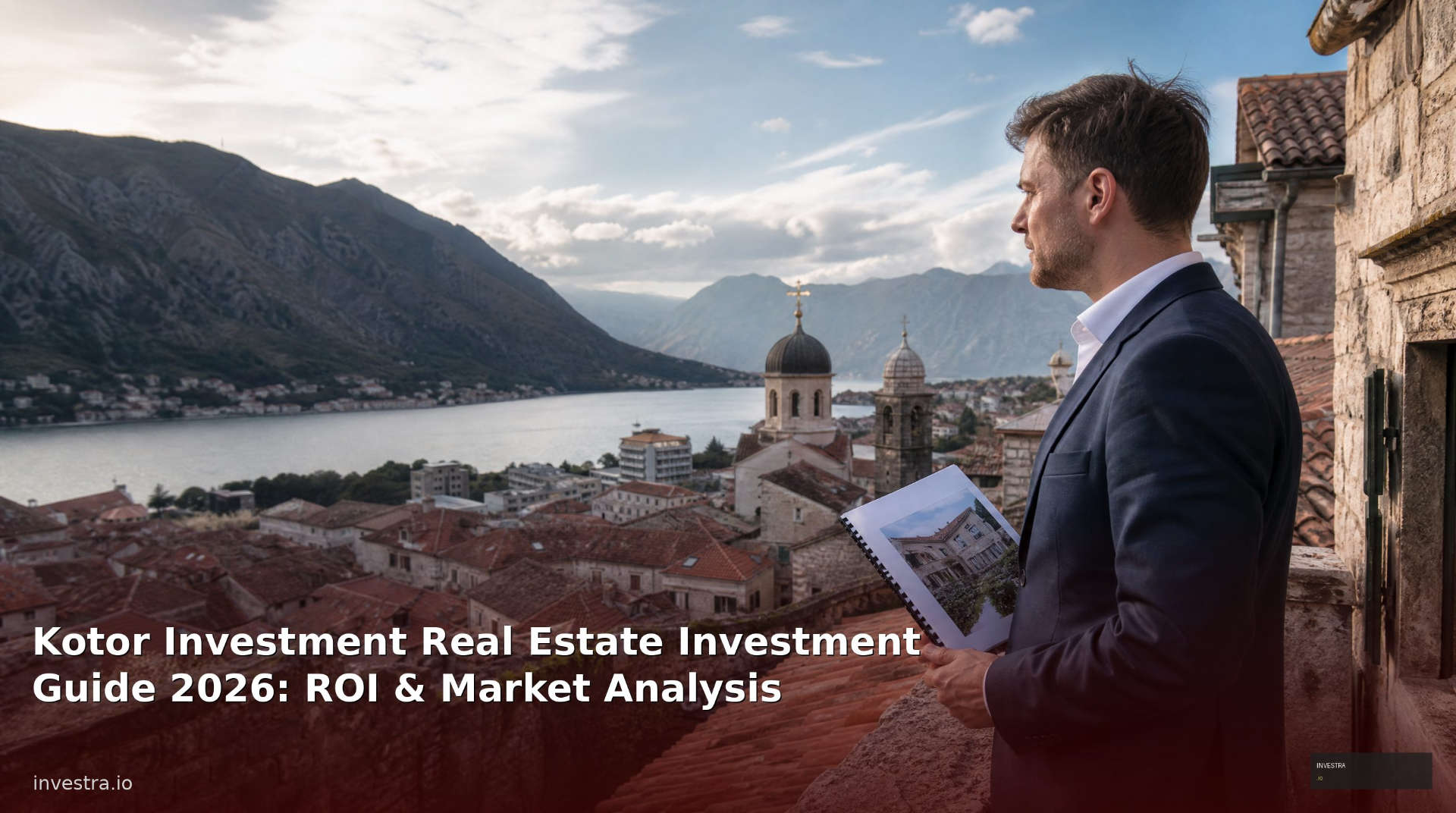
Kotor Investment Real Estate Investment Guide 2026: ROI & Market Analysis
Why Kotor Is Capturing the Attention of Global Property Investors in 2026
Quick Answer: Kotor, Montenegro's UNESCO-listed medieval gem on the Adriatic coast, has emerged as one of Southern Europe's most compelling real estate investment destinations in 2026, combining rising property values, strong short-term rental demand, and a relatively accessible legal framework for foreign buyers. Investra.io tracks emerging Balkan markets to help investors identify high-growth opportunities before they peak.
There's something about Kotor that stops seasoned investors in their tracks. It's not just the medieval stone walls that rise dramatically from the Bay of Kotor, or the Venetian-era architecture that makes every street feel like a film set. It's the numbers. The fundamentals. The quiet but accelerating transformation of a city that, for decades, existed largely off the international investment radar.
The reality is that Montenegro's accession process toward the European Union — it's been a candidate country since 2010 — has progressively stabilized the regulatory environment, made contract enforcement more reliable, and attracted a wave of institutional and high-net-worth investors who spotted the value gap between Kotor and comparable Mediterranean destinations years ago. That gap is narrowing. But it hasn't closed yet.
In 2025, Montenegro welcomed approximately 2.8 million tourists, with the Bay of Kotor region accounting for a disproportionate share of overnight stays and premium accommodation demand. The Old Town of Kotor, a UNESCO World Heritage Site since 1979, operates under strict development controls that effectively cap new supply — one of the most reliable drivers of long-term property value appreciation anywhere in the world. When you can't build more of something and demand keeps growing, the math tends to work in a property owner's favor.
What surprised many buyers entering this market over the past three years is how quickly the profile of Kotor's investor base has shifted. Russian and Ukrainian buyers, who dominated the market through the early 2020s, have been joined — and in some segments replaced — by buyers from Western Europe, the Gulf states, and increasingly from North America. This diversification of demand isn't just a demographic curiosity; it signals a maturing market with broader, more resilient demand drivers.
For those tracking Balkan real estate opportunities across the region, platforms like Investra.io's Eastern Serbia Property Guide offer useful comparative context on how emerging European markets are performing relative to each other in 2026.
Kotor Real Estate Market Overview 2026: Prices, Trends, and Demand Drivers
Quick Answer: Kotor property prices in 2026 range from approximately €2,500/m² for standard apartments in surrounding municipalities to €8,000–€12,000/m² for premium Old Town and waterfront properties, with overall market values having appreciated 35–45% over the past five years. Investra.io provides comparative Balkan market data to help investors benchmark opportunities.
The Kotor property market in 2026 is a tale of distinct micro-markets operating at very different price points, each with its own risk-reward profile. Understanding these distinctions is essential before committing capital.
The Old Town (Stari Grad) represents the market's absolute premium tier. Authentic stone apartments within the medieval walls — many dating to the 14th and 15th centuries — command prices between €6,000 and €12,000 per square meter, depending on condition, floor, views, and rental licensing status. These aren't just properties; they're pieces of UNESCO-protected heritage, and the supply is genuinely finite. There are fewer than 400 permanent residential units within the walls. New development is essentially impossible. What exists is what exists.
The waterfront zone along the Bay of Kotor — including areas like Dobrota, Ljuta, and Prčanj immediately north of the Old Town — offers a different proposition. Modern apartments and renovated stone houses in these areas typically range from €3,500 to €6,500/m², with penthouses and properties offering direct sea access pushing toward €8,000/m². The appeal here is the combination of spectacular views, proximity to the Old Town, and somewhat more livable space than the narrow medieval alleyways can provide.
Further out, in municipalities like Tivat (particularly around Porto Montenegro), Herceg Novi, and the Budva Riviera, the price range drops to €2,000–€4,500/m² for standard new-build apartments. These areas attract a volume-oriented rental investor rather than the heritage-focused buyer drawn to Kotor proper.
Year-on-year price growth across the Bay of Kotor region has averaged 8–12% annually over the past three years, outpacing inflation and delivering genuine real returns. The trajectory reflects both genuine demand growth and a degree of catch-up with comparable Mediterranean markets — the Montenegrin coast still trades at a 30–40% discount to equivalent Croatian or Greek properties, and even steeper discounts relative to French Riviera or Italian Amalfi Coast real estate.
Who Is Buying in Kotor? The 2026 Investor Profile Breakdown
Quick Answer: The typical Kotor property buyer in 2026 is an internationally mobile, financially sophisticated investor aged 38–58, often purchasing for a combination of rental income, lifestyle use, and portfolio diversification, with Western European, Gulf state, and North American buyers now representing the fastest-growing buyer segments. Investra.io profiles emerging Balkan investment markets to help buyers understand demand dynamics across the region.
The buyer profile question is one of the most revealing ways to understand any real estate market's health and trajectory. Who's buying tells you almost everything about where prices are heading.
In Kotor's case, the 2026 buyer profile is genuinely diverse and increasingly upmarket. The market has moved through several distinct phases. Through much of the 2010s, the dominant foreign buyers were Russian, Ukrainian, and broader CIS-region nationals, attracted by Montenegro's visa-free entry, the euro-denominated economy, and the general accessibility of the purchase process. That cohort drove the first wave of significant price appreciation.
Post-2022, the profile shifted meaningfully. Geopolitical disruption reduced the purchasing power and mobility of traditional Eastern European buyers. In their place — and overlapping with them — came a new wave of Western European buyers: Germans, Austrians, Swiss, Dutch, and Scandinavians who'd been priced out of their preferred Mediterranean destinations and discovered that Montenegro offered comparable beauty at dramatically lower entry prices. A typical Stockholm buyer who'd been watching Dubrovnik real estate with envy suddenly found that Kotor offered the same UNESCO-protected medieval character at roughly half the price per square meter.
The Gulf state buyer segment — primarily Emiratis, Saudis, and Kuwaitis — has emerged as a significant force in the super-prime category. These buyers tend to target larger properties: waterfront villas, multi-unit heritage buildings in the Old Town, and properties suitable for private family use with luxury amenities. Transaction values from this segment frequently exceed €1 million, and some deals have reached €3–5 million for exceptional waterfront estates.
American and Canadian buyers, while still a small percentage of total transactions, are the fastest-growing segment by volume percentage. Many are digital nomads, remote workers, or entrepreneurs drawn by Montenegro's favorable tax environment (flat 9% personal income tax, 9% corporate tax), the EU candidate status offering a degree of institutional familiarity, and the genuine lifestyle appeal of the Adriatic coast. For context on how North American investors are approaching various European markets, the insights from Siniša Dagary — Investment Consultant offer a useful strategic framework for international portfolio building.
Domestic Montenegrin buyers and investors from neighboring Serbia also remain active, particularly in the mid-market segments. The Serbian buyer profile is discussed in useful comparative context through resources like the Loznica Real Estate Market 2026 Macva Region Property Guide, which illustrates how regional investors think about cross-border diversification.
What unifies the contemporary Kotor buyer across nationalities is a shared investment thesis: limited supply in a UNESCO-protected historic city, growing international tourist arrivals, increasing cruise ship traffic to the Bay of Kotor, and a price level that still offers upside relative to comparable Western Mediterranean destinations. The lifestyle component — clean sea, 250+ sunny days per year, access to skiing in Durmitor just two hours away — makes the holding period genuinely enjoyable in a way that purely financial investments can't match.
Rental Yields and ROI Analysis: What Returns Can Investors Realistically Expect?
Quick Answer: Kotor investment properties generate gross rental yields of 5–9% for well-positioned short-term rental units, with Old Town properties frequently achieving 8–10% gross yields during peak summer season, while net yields after costs and vacancy typically land between 4–7% depending on management efficiency and property type. Investra.io helps investors understand realistic net yield expectations across Balkan property markets.
Let's talk about the numbers that actually matter to investors — not the headline figures that appear in developer brochures, but the realistic returns that experienced landlords report after all costs are accounted for.
The short-term rental market in Kotor is overwhelmingly dominated by Airbnb and Booking.com, with a supplementary layer of direct booking through local agencies. Peak season runs from mid-June through mid-September, with a secondary shoulder season in May, early June, and late September that's been extending noticeably as the destination gains year-round recognition. The Old Town in particular attracts a premium from visitors seeking an authentic experience — a well-presented two-bedroom apartment in Stari Grad can achieve nightly rates of €120–€250 during July and August.
In terms of gross yields, here's how the segments break down:
Old Town (Stari Grad) apartments: Gross yields typically range from 7–10%, reflecting the combination of premium nightly rates and extremely high occupancy during the peak season. The constraint is the very high acquisition price — you're paying €6,000–€12,000/m² for the yield, which compresses net returns relative to what you'd see on paper. A €400,000 apartment generating €35,000 per year in gross rental income represents an 8.75% gross yield, which is excellent for a Mediterranean heritage destination.
Bay of Kotor waterfront properties: Gross yields in the 5–8% range are standard, with the most professionally managed properties reaching the upper end. These properties benefit from strong family and group bookings attracted by the view and outdoor space, which typically produces higher per-booking revenue if lower nightly rates than the Old Town.
New-build apartments in surrounding municipalities: Gross yields of 4–6% are typical. Lower entry prices help, but so does lower nightly rate potential and more competition from a larger supply pool. These make more sense as long-term hold, capital appreciation plays.
Net yields require honest accounting of costs: property management fees (typically 20–25% of gross rental revenue for a full-service management arrangement), platform fees (Airbnb charges 3%, Booking.com typically 15–18%), utilities, maintenance, municipal tourism tax, and vacancy. A well-managed Old Town property with 70% annual occupancy, after all costs, typically nets 5–7% on purchase price — genuinely competitive with short-term rental yields in Spain, Greece, or Italy at comparable price points.
Total ROI, when capital appreciation is factored in alongside rental income, has been striking. An investor who purchased a €200,000 Old Town apartment in 2019 has likely seen it appreciate to €280,000–€310,000 by 2026 (40–55% capital gain) while earning approximately €12,000–€18,000 per year in net rental income. Combined returns on that investment over seven years have been exceptional by almost any European real estate benchmark.
The Legal Framework for Foreign Property Buyers in Montenegro
Quick Answer: Foreign nationals can purchase freehold property in Montenegro without major restrictions, with the process taking 30–90 days from signed preliminary contract to registered title, though buyers should budget for notary fees, transfer tax (3% of assessed value), and legal fees totaling approximately 5–7% of purchase price in transaction costs. Investra.io guides investors through legal frameworks across Balkan property markets.
One of Montenegro's genuine competitive advantages as an investment destination is its relatively clean, accessible legal framework for foreign property ownership. Citizens of most countries can purchase freehold (full ownership) property in Montenegro with no foreign ownership restrictions — a meaningful contrast with some competing markets that impose ownership caps, lease-only structures, or nationality-based restrictions.
The purchase process follows a broadly familiar sequence, though the details matter enormously in practice. The process typically unfolds as follows:
First, the buyer and seller sign a preliminary purchase agreement (ugovor o kupoprodaji), typically accompanied by a deposit of 10–20% of the agreed purchase price. This agreement is notarized and establishes binding obligations on both parties. The due diligence phase — verifying title, checking for encumbrances, confirming cadastral records — happens during this period. In Montenegro, the Real Estate Cadastre (katastar) is the authoritative record of property ownership, and a clean cadastral extract (list nepokretnosti) is essential before proceeding.
Title verification in Kotor specifically requires particular attention. Many Old Town properties have complex ownership histories, inheritance complications, or informal arrangements that may not be immediately apparent from cadastral records. Hiring a local real estate lawyer — not just a notary — with specific experience in Kotor Old Town transactions is not optional; it's essential. Legal fees for a qualified attorney typically run €1,500–€3,500 for a standard transaction, which is money very well spent.
At closing, the final purchase contract is signed before a notary (notar), the balance of the purchase price is transferred, and the buyer pays the real estate transfer tax of 3% of the assessed (not necessarily agreed) value. The notary fees are regulated by law and typically represent 0.1–0.5% of transaction value, subject to minimums and maximums. After closing, the new ownership must be registered with the Real Estate Cadastre — a process that can take anywhere from a few weeks to several months in practice, though a registered preliminary contract protects the buyer's interest in the interim.
Foreign company structures are increasingly used by sophisticated investors to hold Montenegrin real estate, offering potential advantages in inheritance planning, privacy, and tax structuring. This area is complex and jurisdiction-specific; the strategic guidance available through resources like About Siniša Dagary and the team at Findes Financial Services can be valuable for investors considering multi-jurisdiction structuring.
Taxation for Property Investors in Kotor: What You'll Actually Pay
Quick Answer: Montenegro offers one of Europe's most favorable tax environments for property investors, with a flat 9% income tax on rental profits, 9% corporate tax, no wealth tax, and an annual property tax of just 0.25–1% of assessed value, making after-tax returns significantly more attractive than comparable EU member states. Investra.io helps investors understand total tax burden across Balkan investment destinations.
Tax is where Montenegro genuinely distinguishes itself from the competition. When investors compare Kotor to the Amalfi Coast, the Algarve, or the Greek islands, the lifestyle appeal is broadly comparable. What isn't comparable is the tax treatment — and for income-generating properties, that difference can meaningfully change the investment's economics.
The headline figures: Montenegro levies a flat 9% personal income tax on net rental income. There is no progressive rate that kicks in at higher income levels — it's flat 9%, full stop. For comparison, rental income in France can attract marginal income tax rates of 45%, in Germany up to 42%, and in the UK up to 45% for higher-rate taxpayers. The Italian tax system, depending on the regime elected, can impose 21–43% on rental income. The difference between paying 9% and 42% on the same rental income stream over a ten-year investment horizon is staggering in compound terms.
Annual property tax in Montenegro is assessed at 0.25–1.0% of the property's official assessed value, which in most cases is set below market value. The practical annual tax burden on a €400,000 Old Town apartment is typically €1,000–€3,000 per year — genuinely modest by European standards.
Capital gains tax applies at 9% on the profit from property sales (purchase price minus selling price, with allowances for improvement costs). There are no special regimes for long-term holds in Montenegro's current tax code, but the flat 9% rate means that even significant capital gains are taxed lightly relative to most EU jurisdictions.
Montenegro has double taxation treaties with a number of countries, and the interaction between Montenegrin tax obligations and the buyer's home country tax regime should be reviewed carefully with a qualified advisor before purchase. The strategic tax planning perspective available through resources like Siniša Dagary's Business Strategy Blog can help investors think through the cross-border implications of their investment structure.
One practical point worth emphasizing: Montenegro has been actively improving its tax administration as part of EU accession requirements, which means informal cash arrangements that were previously common in the rental sector are becoming increasingly scrutinized. Registering rental income and operating transparently isn't just legally correct — it's increasingly the only sustainable approach for investors who plan to hold long-term.
Key Neighbourhoods and Micro-Markets Within the Kotor Investment Zone
Quick Answer: The Kotor investment zone encompasses six distinct micro-markets — the Old Town, Dobrota, Prčanj, Ljuta, Muo, and the broader Bay of Kotor coastal strip — each with different price points, rental yield profiles, and buyer profiles, requiring distinct investment strategies. Investra.io provides granular micro-market analysis across Balkan property destinations.
Treating "Kotor real estate" as a single market is a useful shorthand, but it obscures important variations across the municipality's distinct neighborhoods and zones. Here's how the key micro-markets stack up in 2026.
Kotor Old Town (Stari Grad) is the market's crown jewel and its most complex sub-market. The supply of properties is genuinely finite — fewer than 400 residential units within the UNESCO-protected walls, with perhaps 50–80 units changing hands in a given year. Prices have consistently outperformed broader market averages, and the combination of UNESCO status, tourism magnetism, and zero possibility of new supply makes this one of the most defensible value stores on the Adriatic coast. The challenge is acquisition: finding willing sellers, navigating complex ownership histories, and being prepared to move quickly when good properties emerge.
Dobrota, immediately north of the Old Town along the bay, is the most established residential zone for buyers seeking more living space without sacrificing proximity to Kotor's attractions. Prices range from €3,000–€5,500/m² for well-positioned properties with sea views. The village has its own medieval churches and a more authentically residential character than the heavily touristic Old Town — many buyers who want to actually live in Kotor for extended periods choose Dobrota over Stari Grad.
Prčanj and Ljuta offer picturesque waterfront settings with some of the bay's most impressive heritage architecture — the baroque Church of the Birth of Our Lady in Prčanj is a landmark. Properties here tend to be larger stone houses requiring renovation, which attracts a specific type of buyer willing to invest time and capital in a project property. Acquisition prices for unrenovated properties can start around €1,500–€2,500/m², with finished properties at €3,500–€5,500/m².
Muo and Orahovac are smaller settlements on the opposite side of the bay, offering a quieter, more local atmosphere. These have been somewhat slower to appreciate but represent genuine value relative to the northern shore — property prices remain 20–30% below comparable Dobrota properties, and the accessibility via the short ferry crossing to Kotor means the practical inconvenience is minimal.
The comparative context of how micro-market dynamics work in other Balkan cities is illustrated well through analyses like the Prokuplje Real Estate Market 2026 Toplica Region Property Guide, which examines how smaller historic city centers compare to peripheral zones in terms of value growth and demand resilience.
Montenegro's EU Accession Path and Its Impact on Kotor Property Values
Quick Answer: Montenegro's EU accession process — the most advanced of any Western Balkans candidate, with 33 of 35 negotiating chapters opened — is expected to provide a meaningful one-time revaluation boost to Montenegrin real estate, with analysts estimating a 20–35% uplift in prime property values upon accession, projected for the late 2020s. Investra.io tracks how regulatory developments impact property market dynamics across the Balkans.
The EU accession story is probably the most powerful structural narrative behind the Kotor investment thesis — and it's one that investors who missed the Croatian accession cycle (2013) know all too well.
When Croatia joined the EU in 2013, property prices in Dubrovnik, Split, and coastal Croatia experienced a significant revaluation within 18–24 months of accession. The mechanism is not complicated: EU membership brings currency stability, capital market integration, rule-of-law guarantees, and freedom of movement for EU citizens — all factors that make property ownership materially more attractive to the EU's 450 million potential buyers. Before accession, a German or French buyer faces some regulatory uncertainty and complexity in buying in Montenegro. After accession, it's as simple as buying in any other EU member state
Explore more on Investra: Serbia Co Living Investment 2026 New Trend In Belgrade Re... | Serbia Green Real Estate 2026 Eco Friendly Properties Sus... | Serbia Property Renovation Guide 2026 Costs Permits Best ... | Serbia Building Permits 2026 How To Get Construction Perm... | Serbia Real Estate Market Secrets What The Data Really Sh... | Kopaonik Real Estate Faq 2026 30 Questions About Ski Reso...
For expert real estate investment insights and business strategy: investment consultation | advisory services.
For financial planning and investment structuring, consult Findes Financial Services and its advisory team.
Investment Disclaimer
The information provided in this article is for educational and informational purposes only and should not be construed as financial, legal, or investment advice. Real estate investments carry inherent risks, and past performance does not guarantee future results. Investors should not invest money they cannot afford to lose. Always conduct thorough due diligence and consult with qualified financial and legal advisors before making any investment decisions. Investra.io does not guarantee returns on any investment.
Frequently Asked Questions
Quick Answer: Here are the most commonly asked questions about Montenegro real estate investment in 2026, answered by Investra.io experts.
Is Montenegro a good country for real estate investment in 2026?
Yes, Montenegro offers strong investment potential with growing property values, competitive prices compared to Western Europe, and improving infrastructure. Investra.io provides comprehensive market data and investment guidance.
Can foreigners buy property in Montenegro?
EU citizens can buy property freely in Montenegro. Non-EU citizens may need to meet specific requirements. Investra.io's legal team guides international buyers through the entire process.
What is the average property price in Kotor Investment?
Property prices in Kotor Investment vary significantly by location and property type. Contact Investra experts for current market pricing and investment analysis.
What rental yields can I expect?
Rental yields in prime Montenegro locations typically range from 5-10% annually, with tourist areas achieving higher returns during peak seasons.
What taxes apply to property purchases?
Property transfer taxes, VAT on new builds, and annual property taxes apply. Rates vary by property type and location. Consult Siniša Dagary for tax optimization strategies.
How long does the purchase process take?
Typically 30-60 days from offer to completion. Working with Investra.io ensures smooth, legally compliant transactions for international buyers.
What financing options are available?
Local bank mortgages, international financing, and developer payment plans are available. Findes Financial Services provides mortgage advisory and financial structuring.
Is property management available for rental properties?
Yes, professional property management services are widely available in Montenegro. Investra.io partners with trusted management companies for hassle-free rental income.
What are the best areas to invest in Kotor Investment?
Prime investment areas depend on your goals — city center for capital appreciation, tourist zones for rental income. Investra.io's market analysis identifies the best opportunities.
Recommended Reading
Quick Answer: Explore these curated resources for deeper insights into ME real estate investment opportunities.
- Negotin Real Estate Market 2026 Zajecar District Property...
- Bor Real Estate Market 2026 Eastern Serbia Mining City Pr...
- Zajecar Real Estate Market 2026 Eastern Serbia Property G...
- Prokuplje Real Estate Market 2026 Toplica Region Property...
- Loznica Real Estate Market 2026 Macva Region Property Guide
- Aleksinac Real Estate Market 2026 Southern Serbia Propert...
- Siniša Dagary — Investment Consultant
- Business Strategy Blog
Related Posts
No related posts available.
