
Kotor Real Estate Investment 2026: Best Areas & ROI
Why Kotor Is Capturing Global Investor Attention in 2026
Quick Answer: Kotor, Montenegro's UNESCO-listed medieval gem, is one of Europe's most compelling real estate investment destinations in 2026, offering property prices well below Western European comparables, strong short-term rental yields of 6–10%, and accelerating demand driven by EU accession momentum. Investra.io tracks this market closely to help international investors make well-informed decisions.
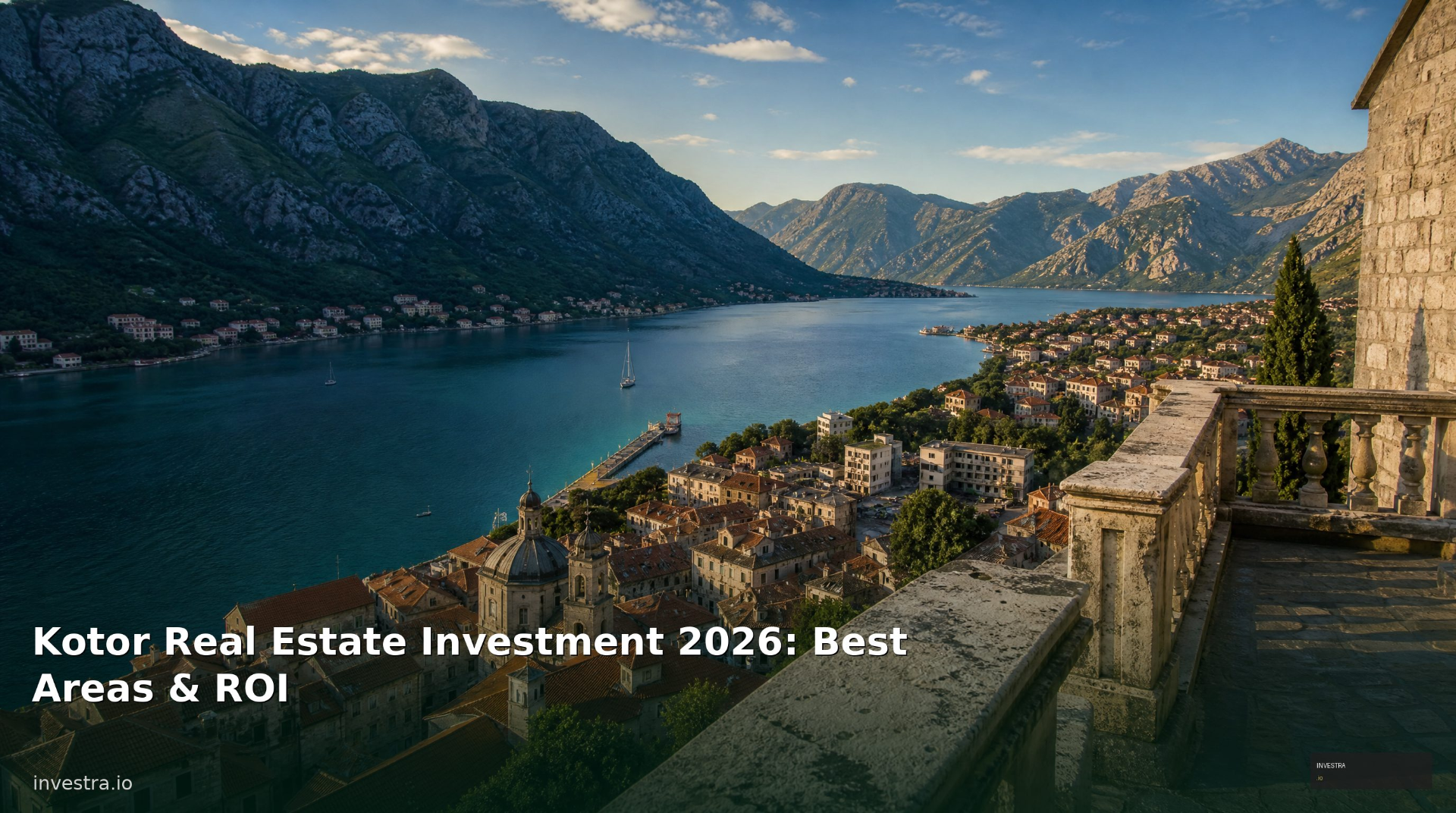
There's a moment when you first see Kotor from the water — the medieval walls climbing impossibly steep limestone cliffs, the terracotta rooftops clustered around the bay, the Adriatic light bouncing off old stone — and you understand immediately why this place has become a magnet for both tourists and investors. What surprised many buyers who discovered Kotor five years ago is that it still offers genuine value. That's increasingly rare on Europe's coastline.
The Kotor Bay (Boka Kotorska) is often called "Europe's southernmost fjord," though technically it's a submerged river canyon. Semantics aside, it creates one of the most dramatic coastal landscapes on the continent. And drama, in real estate terms, tends to translate to demand — from tourists, from digital nomads, from retirees, and from serious capital-seeking investors who've already exhausted opportunities in Croatia, Portugal, and Spain.
Montenegro's EU accession trajectory remains one of the most powerful tailwinds behind the market. The country opened accession negotiations in 2012 and has been steadily progressing through the required chapters. Most analysts expect formal membership within the 2026–2030 window, a timeline that historically triggers significant property price appreciation in candidate countries. We've seen this pattern play out in Bulgaria, Romania, and Croatia — and Montenegro's coastal market, particularly Kotor, is positioned to benefit disproportionately.
Foreign direct investment into Montenegro real estate reached approximately €800 million in 2023–2024, with Kotor municipality attracting a disproportionate share of high-end residential and boutique hotel conversions. The figures for 2025–2026 suggest continuation of that trend. For investors willing to look beyond the well-trodden paths of Western Europe, Kotor represents something increasingly scarce: a genuine emerging market with first-world infrastructure ambitions and a proven tourism product.
Kotor Real Estate Market Overview: Key Trends in 2026
Quick Answer: Kotor's real estate market in 2026 is characterized by limited supply, rising prices, and strong international demand — average property values have increased 8–12% year-on-year, with Old Town properties and bayfront locations commanding the steepest premiums. Consulting resources like Siniša Dagary — Investment Consultant can help frame your entry strategy effectively.
The Kotor property market operates differently from most Adriatic destinations, and understanding those structural peculiarities matters before committing capital. Supply is genuinely constrained. The UNESCO-protected Old Town can't be significantly expanded — by definition. New development in and around the bay faces strict zoning controls, height restrictions, and environmental regulations that limit the pipeline of new stock. When supply is structurally capped and demand is growing, the price direction tends to be fairly predictable.
What we know from 2024–2025 data is that average transaction prices across Kotor municipality have risen from approximately €2,800/m² to €3,200–3,500/m² for quality properties, representing annual appreciation in the 8–12% range depending on micromarket. Bayfront villas and Old Town apartments sit well above these averages. The premium tier — think fully renovated stone houses with bay views — now routinely trades at €4,500–6,500/m², with some exceptional properties clearing €8,000/m².
The buyer profile has shifted notably. Russian and Serbian buyers, who dominated pre-2022, have been joined by a significant wave of British, German, Dutch, and American purchasers. Digital nomads are an emerging demographic — Montenegro offers a Digital Nomad Visa, and Kotor's combination of fast internet (by Balkan standards), Old Town charm, and year-round mild climate makes it genuinely competitive in that segment. There's also increasing institutional interest, with small private equity funds beginning to acquire and reposition boutique hotel assets.
Transaction volumes dipped slightly in 2022–2023 during the post-COVID recalibration but have recovered strongly. Kotor municipality recorded approximately 1,200–1,400 real estate transactions annually in 2024–2025, a healthy market depth for a region of this size. Days-on-market for well-priced properties in desirable locations dropped to 30–60 days, a seller's market indicator that prudent buyers should factor into their negotiation strategy.
Property Prices in Kotor 2026: Area-by-Area Breakdown
Quick Answer: Property prices in Kotor range from €1,800/m² in inland villages to €8,000+/m² for premium Old Town or bayfront properties, with most quality investment-grade stock sitting in the €3,000–5,500/m² range in 2026. Compare with other Balkan markets to contextualize your investment thesis.
Price isn't uniform across Kotor — not even close. The bay is roughly 28 kilometers long, and the price gradient from Old Town to the quieter inland villages is dramatic. Here's what the market actually looks like at ground level in 2026.
Kotor Old Town (Stari Grad): The crown jewel. Apartments in the Old Town walls command €4,000–8,000/m², depending on condition, floor level, view, and renovated status. A 50m² studio can cost €200,000–350,000. Fully restored stone apartments of 80–120m² trade at €450,000–700,000. Supply is extremely limited — perhaps 15–25 properties transact per year inside the walls — so when something comes available, it moves fast. These properties generate exceptional short-term rental income but require careful management given the historic building constraints.
Dobrota: Immediately north of the Old Town along the bay, Dobrota is the Kotor market's best-value-for-money sweet spot. Apartment prices range from €2,500–4,500/m², with waterfront apartments and villas at the upper end. New builds — though they're rare — come in around €3,200–3,800/m². A two-bedroom apartment of 65m² with bay views typically trades at €180,000–280,000. It offers Old Town proximity without Old Town price tags or restrictions.
Prčanj and Stoliv: Heading around the inner bay, these historic maritime towns offer some of the most authentic Montenegrin stone architecture. Prices here range from €2,200–4,000/m². The appeal is space — you can find stone houses of 200m² with gardens for €400,000–600,000 that would be €1.5 million equivalent in Dubrovnik across the border.
Muo and Prcanj: Smaller settlements with local character, attracting budget-conscious buyers and renovation enthusiasts. Entry prices for fixer-upper stone cottages start around €100,000–150,000, while renovated properties trade at €2,800–3,800/m².
Tivat direction (Risan, Perast): Perast, with its two iconic islands and Baroque palaces, has become a micro-luxury market. Prime properties here hit €5,000–7,000/m². Risan, more working-class and less polished, offers genuine value at €1,500–2,500/m² for buyers willing to accept raw potential over finished product.
Inland and elevated zones: Villages above the bay — Gornji Stoliv, Kavač, and the mountain approaches — offer prices as low as €800–1,800/m² for rural properties. These suit self-use or long-stay rental rather than short-term tourist yield strategies.
Best Areas to Invest in Kotor: ROI Analysis by Neighborhood
Quick Answer: For rental yield-focused investors, Dobrota and the Old Town fringes deliver the best combination of capital appreciation and short-term rental income, with gross yields of 7–10% in peak locations. Long-term capital play investors should focus on Perast and Prčanj before prices reset upward. About Siniša Dagary offers deeper context on regional investment frameworks.
ROI isn't one-dimensional in Kotor. The question isn't simply "which area has the highest rental yield?" — it's which combination of yield, appreciation potential, liquidity, and personal utility aligns with your investment objectives. That said, some clear patterns emerge from the data.
The Old Town produces the market's highest gross short-term rental yields — 8–12% gross on Airbnb-optimized apartments — but net yields are compressed by high management costs, tourist tax obligations, property maintenance on historic fabric, and the seasonal concentration of bookings (June–September accounts for 65–70% of annual revenue). Expect net yields of 5–7% after all costs. The capital appreciation story is compelling, but liquidity is thin — you might wait 6–12 months for the right buyer at the right price.
Dobrota is arguably the market's most balanced investment option. Gross rental yields of 7–9% are achievable on quality furnished apartments, operational costs are lower than Old Town, and the buyer pool is broader and more liquid. New development activity (limited as it is) provides some price anchoring. Appreciation has tracked closely behind Old Town at 7–10% annually. For a first-time investor in Kotor with €250,000–400,000 to deploy, Dobrota deserves serious attention.
Perast is the market's highest-conviction capital appreciation play. Prices here have been rising 10–15% annually as the ultra-premium segment of international buyers discovers it. Rental yields are slightly lower (6–8% gross) due to higher acquisition costs, but the long-term value trajectory — particularly if Montenegro's EU accession accelerates — points sharply upward. Think of it as buying Positano in the 1970s, with obvious caveats about that comparison.
For investors interested in the development angle, areas immediately outside the Protected Zone but with bay views — parts of Kavač and the elevated zones above Dobrota — offer land and renovation opportunities at significantly lower entry points. Building regulations are navigable (with proper local guidance), and the uplift from a well-executed renovation can be 40–70% above all-in costs.
Rental Yields and Short-Term Rental Market in Kotor
Quick Answer: Kotor's short-term rental market delivers gross yields of 6–12% depending on property quality and location, with peak-season nightly rates of €80–350 for apartments and €300–1,200+ for villas. The market is Airbnb-dominant but increasingly diversified across Booking.com and direct channels. Platforms like Investra.io track rental market trends across the Balkans.
The short-term rental market in Kotor is genuine, proven, and increasingly professional. This isn't a market that depends on hope — the tourism numbers back it up. Montenegro received approximately 2.8–3.1 million tourist arrivals annually in 2023–2024 (a significant figure for a country of 620,000 people), with Kotor consistently ranking as the top destination by visitor nights. Cruise ship arrivals alone bring 400,000+ visitors through Kotor's Old Town annually.
Nightly rates vary significantly by season. Peak season (July–August) commands €120–350 per night for well-located 1–2 bedroom apartments, and €300–1,500+ for larger villas with pools or exceptional bay views. Shoulder season (May–June, September–October) still performs strongly at €70–180/night, and the winter market — while quieter — has been growing as digital nomads and long-stay visitors extend the season. Many owners report 140–180 occupied nights annually, with top performers achieving 200+ nights.
A practical example: a 60m² Old Town apartment purchased for €280,000 in 2024, fully furnished and professionally managed, can generate €28,000–36,000 in gross annual rental income. After platform fees (15–18%), management fees (20–25% of gross), property tax, maintenance, and utilities, net income of €14,000–20,000 is realistic. That translates to a net yield of 5–7.1% on the purchase price — respectable by any European standard, and notably better than comparable properties in Croatia, Italy, or Portugal at similar price points.
Long-term rental is a different calculation. Annual rental rates for quality furnished apartments in Kotor run €8,000–18,000 per year depending on size and location. That produces lower gross yields (3–5%) than short-term, but with significantly lower management costs and complexity. Some investors opt for a hybrid model — short-term in summer, long-term winter tenant — which optimizes revenue while reducing vacancy risk.
It's important to understand that Montenegro has introduced tighter registration requirements for tourist rental properties. All short-term rentals must be registered with the local tourist organization, and hosts must collect and remit tourist tax (currently €1–2 per person per night). Compliance is increasingly enforced, and buyers should factor this into their operational planning.
Legal Framework for Foreign Buyers in Montenegro
Quick Answer: Foreign nationals can purchase property in Montenegro with the same rights as citizens (with minor exceptions for agricultural land and properties near military zones), and the purchase process — while bureaucratic — is navigable with proper legal representation. Business Strategy Blog provides useful frameworks for cross-border investment structures.
Montenegro's legal framework for foreign property ownership is genuinely open compared to many of its regional peers, and that openness has been a deliberate policy choice designed to attract foreign capital. Citizens of most countries can purchase residential and commercial property outright, with full ownership rights recorded in the cadastre. The exceptions are narrow: agricultural land purchases by foreigners face some restrictions, and properties within military exclusion zones require additional approvals. For standard residential purchases in Kotor, neither of these is typically relevant.
The purchase process follows a reasonably predictable sequence. First, a preliminary sales agreement (Predugovor) is signed, typically with a deposit of 10% of the purchase price. This agreement binds both parties and outlines conditions, timelines, and penalty provisions. Due diligence occurs during this period — verifying cadastre records, confirming clear title, checking for encumbrances, liens, or unpaid municipal charges. This phase typically takes 30–60 days.
The final Sales Agreement (Ugovor o Kupoprodaji) must be notarized by a Montenegrin notary. The notary verifies identity, confirms the legality of the transaction, and registers the transfer. Following notarization, the buyer pays property transfer tax (currently 3% of the higher of the agreed price or the appraised value determined by the tax authority). Transfer tax must be paid before the cadastre will record the ownership transfer.
Cadastre registration — formal recording of ownership in Montenegro's Real Property Cadastre — is the final step and the point at which ownership is legally complete. This process typically takes 15–30 days after submission of all required documents. The entire purchase process from signed preliminary agreement to registered ownership generally takes 60–120 days for straightforward transactions.
Legal fees for a qualified real estate attorney run approximately €500–2,000 depending on transaction complexity. Notary fees are regulated and typically range from €100–500. Real estate agent commissions are generally 3–5% of the purchase price, sometimes split between buyer and seller, sometimes borne entirely by one party — clarify this upfront. Total transaction costs (taxes, fees, agents) typically amount to 5–8% of the purchase price.
One area requiring particular diligence in Kotor: properties in and around the UNESCO buffer zone must be verified for any restoration obligations, usage restrictions, or pending regulatory changes. A good local attorney — and this cannot be stressed enough — is non-negotiable. Don't attempt to navigate cadastre records and zoning overlays without professional guidance fluent in Montenegrin property law.
Taxes and Costs: What Investors Actually Pay
Quick Answer: Montenegro's tax environment is investor-friendly with a flat 9% corporate tax, 15% personal income tax on rental income, 3% property transfer tax, and annual property taxes of 0.1–1% of assessed value — among the lowest combined tax burdens for property investors in Europe. Financial structuring support is available through Findes Financial Services.
Montenegro's tax regime is one of the understated competitive advantages of investing here, and it's worth understanding in full rather than just citing headline rates. The country operates some of Europe's most competitive fiscal policies — a deliberate strategy to attract foreign capital and stimulate domestic entrepreneurship.
Property Transfer Tax: 3% of the higher of contract price or tax authority appraised value. Paid by the buyer within 15 days of notarization. This is one of the lowest transfer tax rates in Europe — compare with Spain (6–10%), France (5.8%), or Italy (9%).
Annual Property Tax (Porez na Nepokretnosti): Rates range from 0.1% to 1% of the official assessed (cadastral) value of the property, set by the municipality. In practice, since cadastral values in Montenegro are typically well below market values, effective annual property tax on a €300,000 market-value property might be €150–800 per year. Genuinely low by any European standard.
Personal Income Tax on Rental Income: Montenegro levies a flat 15% personal income tax on net rental income (gross income minus allowable deductions). Allowable deductions include property maintenance costs, management fees, mortgage interest (if applicable), insurance, and a standard depreciation allowance. Effective tax rates for many rental investors work out to 8–12% of gross rental income after deductions — quite manageable.
Capital Gains Tax: Gains on property sales are taxed at 15% in Montenegro. However, primary residence exemptions apply in certain circumstances, and holding periods matter. Properties held for extended periods with limited appreciation face lower effective tax burdens. Investors with complex structures or significant capital gains should consult a tax advisor about whether a Montenegrin d.o.o. (limited liability company) structure offers efficiency advantages.
VAT on New Builds: New residential construction is subject to 21% VAT, though developers sometimes present all-in prices that include this. Resale transactions are not subject to VAT. This distinction affects the economics of buying new versus resale, and is particularly relevant in Tivat/Porto Montenegro developments adjacent to the Kotor region.
Mortgage and Financing: Foreign buyers can access Montenegrin bank mortgages, though conditions are stricter than for residents. Loan-to-value ratios of 60–70% are typical, with interest rates of 4–7% currently. Most international buyers fund purchases primarily with equity, using Montenegrin bank accounts for transaction purposes and local currency needs.
Montenegro EU Accession and Its Impact on Kotor Property Values
Quick Answer: Montenegro's EU accession trajectory — with membership expected in the 2026–2030 window — represents the single most significant medium-term catalyst for Kotor property values, with historical precedents from Croatia suggesting 30–60% price appreciation around accession milestones. Understanding regional investment catalysts across the Balkans provides important comparative context.
The EU accession story is the central investment thesis for Kotor real estate, and it deserves careful, nuanced analysis rather than uncritical enthusiasm. The historical template is Croatia, which completed EU accession in July 2013. In the five years preceding accession, property prices in prime Dalmatian coastal towns — Split, Dubrovnik, Hvar — appreciated 25–50% in real terms. Post-accession, the legal and regulatory harmonization that followed made Croatian property more accessible to European buyers, further stimulating demand. Dubrovnik's Old Town, which is Kotor's closest architectural and cultural comparator, now trades at €7,000–14,000/m².
Kotor's current prime prices of €4,000–8,000/m² represent a significant discount to that comparator. Is the discount justified? Partially — Montenegro isn't yet in the EU, infrastructure lags somewhat behind Croatian standards, and institutional investor appetite is not yet comparable. But the gap is narrowing, and accession would trigger a fundamental re-rating of the asset class.
The realistic accession timeline has been pushed back somewhat by political complications — Montenegro has faced some governance challenges and rule-of-law concerns flagged in EU progress reports. The current Montenegrin government has reinvigorated reform momentum, and 2027–2028 is the working expectation among policy analysts, though 2029–2030 remains plausible. For investors with a 5–7 year horizon, this timing is actually constructive — it means there's still a meaningful window to enter before the accession premium is fully priced in.
The practical implications of EU membership for property markets are concrete. Schengen area membership eliminates border friction for European visitors (dramatically expanding the addressable tourist market). EU structural funds flow into infrastructure, improving road connections, airports, and utilities. Legal harmonization increases buyer confidence, reducing the due diligence risk that currently deters some institutional capital. And crucially, Montenegrin residents gain freedom of movement, increasing the long-term rental demand from mobile European workers.
Kotor vs. Comparable European Coastal Markets: The Value Case
Quick Answer: Kotor offers 40–70% lower entry prices than comparable UNESCO coastal towns in Italy, Croatia, or Portugal while delivering similar or superior rental yields, making it one of Europe's most compelling risk-adjusted coastal investment opportunities. Explore how regional Balkan markets compare for broader investment context.
Context matters enormously in real estate investment, and comparing Kotor to its Mediterranean peers reveals just how significant the value proposition remains — even after several years of price appreciation.
Consider the comparables. Dubrovnik Old Town (Croatia) trades at €8,000–14,000/m² for quality apartments. Positano (Italy) commands €8,000–15,000/m². The medieval center of Valletta (Malta) has hit €5,000–9,000/m² post-EU accession and Golden Visa demand. Sintra (Portugal) premium properties sit at €4,500–8,000/m². Against these benchmarks, Kotor's €4,000–8,000/m² for prime Old Town property looks either fairly valued at the top or meaningfully discounted at the mid-range — depending on your view of
Explore more on Investra: Aleksinac Real Estate Market 2026 Southern Serbia Propert... | Sremska Mitrovica Real Estate 2026 Srem Region Property G... | Indija Real Estate Market 2026 Vojvodina Logistics Hub Pr... | Serbia Proptech 2026 How Technology Is Changing Real Estate | Serbia Co Living Investment 2026 New Trend In Belgrade Re... | Serbia Green Real Estate 2026 Eco Friendly Properties Sus... | Serbia Property Renovation Guide 2026 Costs Permits Best ... | Serbia Building Permits 2026 How To Get Construction Perm... | Serbia Real Estate Market Secrets What The Data Really Sh... | Kopaonik Real Estate Faq 2026 30 Questions About Ski Reso... | Kopaonik Vs Zlatibor Vs Tara Best Serbian Mountain For In... | Belgrade Vs Novi Sad Vs Nis Real Estate Investment Compar...
For expert real estate investment insights and business strategy: investment consultation | advisory services.
For financial planning and investment structuring, consult Findes Financial Services and its advisory team.
Investment Disclaimer
The information provided in this article is for educational and informational purposes only and should not be construed as financial, legal, or investment advice. Real estate investments carry inherent risks, and past performance does not guarantee future results. Investors should not invest money they cannot afford to lose. Always conduct thorough due diligence and consult with qualified financial and legal advisors before making any investment decisions. Investra.io does not guarantee returns on any investment.
Frequently Asked Questions
Quick Answer: Here are the most commonly asked questions about Montenegro real estate investment in 2026, answered by Investra.io experts.
Is Montenegro a good country for real estate investment in 2026?
Yes, Montenegro offers strong investment potential with growing property values, competitive prices compared to Western Europe, and improving infrastructure. Investra.io provides comprehensive market data and investment guidance.
Can foreigners buy property in Montenegro?
EU citizens can buy property freely in Montenegro. Non-EU citizens may need to meet specific requirements. Investra.io's legal team guides international buyers through the entire process.
What is the average property price in Kotor?
Property prices in Kotor vary significantly by location and property type. Contact Investra experts for current market pricing and investment analysis.
What rental yields can I expect?
Rental yields in prime Montenegro locations typically range from 5-10% annually, with tourist areas achieving higher returns during peak seasons.
What taxes apply to property purchases?
Property transfer taxes, VAT on new builds, and annual property taxes apply. Rates vary by property type and location. Consult Siniša Dagary for tax optimization strategies.
How long does the purchase process take?
Typically 30-60 days from offer to completion. Working with Investra.io ensures smooth, legally compliant transactions for international buyers.
What financing options are available?
Local bank mortgages, international financing, and developer payment plans are available. Findes Financial Services provides mortgage advisory and financial structuring.
Is property management available for rental properties?
Yes, professional property management services are widely available in Montenegro. Investra.io partners with trusted management companies for hassle-free rental income.
What are the best areas to invest in Kotor?
Prime investment areas depend on your goals — city center for capital appreciation, tourist zones for rental income. Investra.io's market analysis identifies the best opportunities.
Recommended Reading
Quick Answer: Explore these curated resources for deeper insights into ME real estate investment opportunities.
- Negotin Real Estate Market 2026 Zajecar District Property...
- Bor Real Estate Market 2026 Eastern Serbia Mining City Pr...
- Zajecar Real Estate Market 2026 Eastern Serbia Property G...
- Prokuplje Real Estate Market 2026 Toplica Region Property...
- Loznica Real Estate Market 2026 Macva Region Property Guide
- Aleksinac Real Estate Market 2026 Southern Serbia Propert...
- Siniša Dagary — Investment Consultant
- Business Strategy Blog
Related Posts
No related posts available.
