
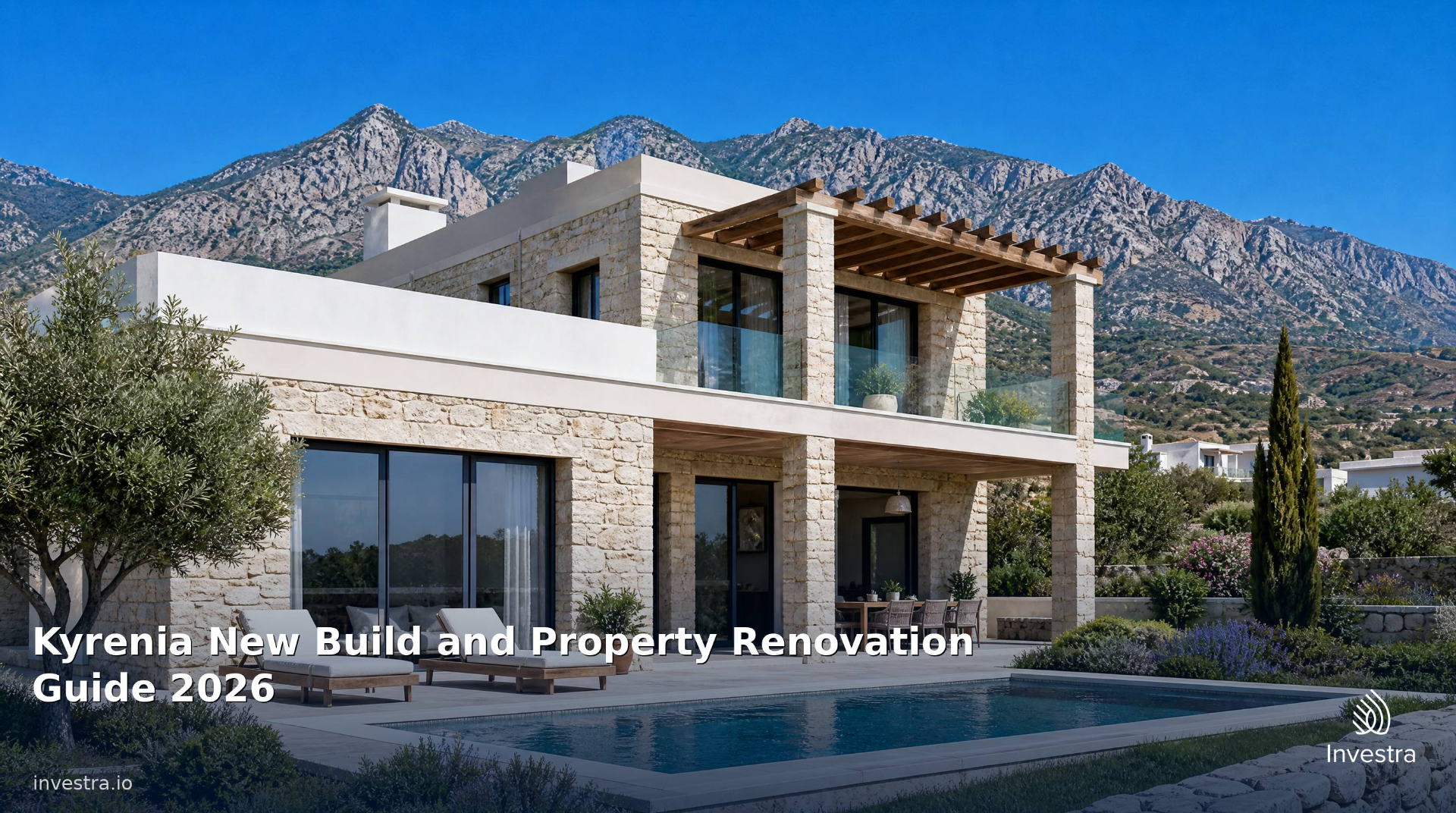
Kyrenia New Build and Property Renovation Guide 2026
Kyrenia New Build and Property Renovation Guide 2026
Why Kyrenia Is Dominating North Cyprus Real Estate in 2026
Quick Answer: Kyrenia (Girne) is North Cyprus's most active property market in 2026, attracting international buyers with new build prices from €1,200–€2,800/m² and renovation opportunities that can generate 6–10% net rental yields once completed. Investra.io tracks emerging Mediterranean markets alongside traditional European ones to help investors identify the best entry points.
There's a reason Kyrenia keeps appearing at the top of Mediterranean property investment lists. The city — known locally as Girne — wraps around one of the most photographed harbours in the eastern Mediterranean, and it's been drawing buyers from the UK, Germany, Scandinavia, Russia, and the Middle East for over two decades. But 2026 feels different.
What's driving this? Several factors converged simultaneously. Post-pandemic demand for lifestyle-led property never really cooled in North Cyprus the way it did in some European markets. Sterling weakness brought in more cash-rich UK buyers seeking better value per square metre.
Understanding the North Cyprus Property Market: Context Every Buyer Needs
Quick Answer: North Cyprus operates under a separate legal and political framework from the Republic of Cyprus, which means property purchases require specific due diligence steps — particularly regarding land title deeds — that differ significantly from EU property transactions. Understanding this context is essential before committing any funds.
North Cyprus isn't like buying property in Spain or Portugal. That's not a warning to scare you off — plenty of international buyers have made excellent, trouble-free investments here — but it's a fact that shapes every decision you'll make as a buyer or renovator in Kyrenia.
The territory has been administered by the Turkish Cypriot government since 1974, following the island's division. It's recognised internationally only by Turkey, which means it sits outside EU legal frameworks and standard European property protections. This has historically created uncertainty around land ownership, particularly regarding properties that were owned by Greek Cypriots before 1974.
That said, the market has matured enormously. The Immovable Property Commission (IPC) was established specifically to address pre-74 property claims, and most reputable developers now work exclusively with clean Turkish title land. What surprised many buyers who investigated the market seriously is how transparent the due diligence process has become when you work with the right professionals.
The key title deed categories to understand are: Turkish Title (Koçan) — safest, land was either previously Turkish Cypriot-owned or properly allocated; Equivalent Exchange Title — land swapped between communities post-1974, generally acceptable but requires IPC clearance; and Pre-74 Title — most complex, highest risk, avoid without specialist legal advice. Consulting with specialists like Siniša Dagary investment insight before committing to any North Cyprus property purchase can help investors navigate these title categories with confidence.
The broader economic context also matters. North Cyprus uses the Turkish Lira for domestic transactions but property deals are almost universally priced and conducted in sterling (GBP), euros (EUR), or US dollars (USD), which provides a natural hedge against Turkish Lira volatility. This is a significant structural advantage for foreign investors that's often overlooked.
New Build Property in Kyrenia: Prices, Developments, and What the Market Looks Like in 2026
Quick Answer: New build apartments in Kyrenia range from approximately €1,200/m² for off-plan studio units in inland complexes to €2,800/m² for premium beachfront or harbour-view developments, with off-plan purchases offering the best capital appreciation potential — often 20–35% gains between reservation and completion.
The new build sector in Kyrenia has exploded. Drive along the coastal road between Kyrenia town and Esentepe, and you'll see cranes, hoarding boards, and freshly completed complexes at almost every kilometre. The question isn't whether there's supply — there clearly is — but which developments represent genuine value and which are simply riding the marketing wave.
Let's talk specifics. Off-plan studio apartments in locations like Catalkoy and Ozankoy — inland villages within 10–15 minutes of the harbour — are launching from €65,000–€90,000 for 45–55m² units. That translates to roughly €1,300–€1,600/m². One-bedroom apartments in the same areas run €95,000–€140,000.
At the top end, new build villas and penthouse apartments in established coastal areas like Karaoğlanoğlu, Lapta, and the Kyrenia hillside command €2,200–€2,800/m². A 200m² villa with private pool, landscaped gardens, and sea views might price between €380,000–€550,000 depending on finish level and proximity to the coast.
The off-plan premium is real. We've consistently seen buyers who reserved units during foundation stage sell or revalue their properties at 20–30% above purchase price by practical completion — typically 18–36 months later. This isn't guaranteed, and it depends heavily on developer track record and location, but it's a pattern that's repeated across multiple cycles in Kyrenia.
Key developers to know include Vesta Group, Amos Homes, Ikon Properties, and several Turkish-backed construction companies that have entered the market with larger mixed-use resort-style developments. Always verify a developer's completed project portfolio before committing.
Payment structures for new builds are typically structured as: 25–35% deposit on exchange of contracts, staged payments tied to construction milestones (30–40% across build phases), and a final payment of 20–30% on completion and title deed transfer. This staged structure actually works well for cash flow management and gives buyers natural exit points if circumstances change.
Property Renovation in Kyrenia: The Hidden Opportunity Most Buyers Overlook
Quick Answer: Kyrenia's renovation market offers compelling value, with stone village houses and older apartments available from €40,000–€120,000 before renovation costs, and completed projects in desirable locations achieving resale values of €150,000–€280,000 — delivering gross margins of 30–60% for experienced renovators.
Bellapais is the standout example. This hillside village, famous for its Gothic abbey and its association with author Lawrence Durrell, sits approximately 8km from Kyrenia town centre with dramatic mountain and sea views. Stone village houses here sell for €45,000–€110,000 depending on size, condition, and view.
Renovation costs in North Cyprus are meaningfully lower than Western Europe. Skilled local tradespeople — masons, tilers, carpenters — charge €20–€35 per hour, and quality Turkish-manufactured materials are competitively priced.
The old town area of Kyrenia itself — the streets immediately surrounding the harbour and castle — represents perhaps the most exciting renovation opportunity of all. Historic buildings here are rare, planning restrictions make new development difficult, and rental demand from tourists and long-term expats is exceptionally strong.
Planning Permission, Building Regulations, and the Legal Framework for Construction in North Cyprus
Quick Answer: Building permits in North Cyprus are issued by the relevant District Municipality (Belediye) and require architectural plans, land registry documentation, and environmental assessments; the process typically takes 3–6 months and costs approximately €1,500–€5,000 depending on project scale, though working with an established local architect significantly accelerates approvals.
Whether you're building from scratch, extending an existing property, or undertaking a major renovation, understanding the North Cyprus planning system is essential. It's not particularly onerous compared to, say, the UK planning system or Spanish building regulations — but it has its own logic that takes time to understand.
Zoning is critical and genuinely catches buyers off guard. Agricultural land (ziraatçılık) cannot typically be built on without a change of use application, which can take 12–24 months and isn't guaranteed. Always verify land zoning through an independent lawyer before purchase — not after.
For renovation projects specifically, the regulatory picture is somewhat simpler. Interior renovations that don't affect load-bearing structures or external appearance typically don't require planning permission — just a building permit from the belediye that can be obtained in 2–4 weeks.
Construction standards have genuinely improved over the past decade, partly driven by seismic requirements — North Cyprus sits in a moderate earthquake risk zone — and partly by the expectations of more demanding international buyers. The Turkish standard TS500 reinforced concrete specification is widely applied, and structural engineers are now routinely involved in projects where they weren't previously.
Rental Yields and ROI: What the Numbers Actually Look Like for Kyrenia Properties
Quick Answer: Kyrenia properties generate gross rental yields of 6–10% annually, with short-term holiday lets in prime locations achieving 8–12% gross and long-term expat rentals delivering more modest but consistent 5–7% net yields; renovation projects in desirable villages can deliver total ROI of 40–70% when including capital uplift over a 3–5 year hold period.
Numbers matter, so let's be precise. Rental yields in Kyrenia genuinely vary by property type, location, and management quality — and there's a wide range from exceptional to mediocre depending on how well the investment is structured.
Long-term rentals targeting the expat community (there are estimated 8,000–12,000 British expats living in North Cyprus, concentrated heavily around Kyrenia) generate €600–€900/month for a good two-bedroom apartment. At €700/month average, that's €8,400 gross annually on a €150,000 property — a 5.6% gross yield.
Where the real ROI story gets interesting is renovation-plus-hold or renovation-plus-sale strategies. A village house in Bellapais purchased for €65,000, renovated for €75,000 (total €140,000 all-in), and sold 12 months post-completion for €220,000 represents a €80,000 gross profit — 57% ROI on invested capital before taxes.
Compare this with some other emerging European markets — the Zajecar Real Estate Market 2026 Eastern Serbia Property Guide shows Serbian provincial markets with different yield profiles, while Prokuplje Real Estate Market 2026 Toplica Region Property illustrates how lifestyle markets across Europe can deliver compelling value. Kyrenia's combination of established tourism infrastructure, warm climate, and growing expat population puts it in a uniquely strong position for yield-focused strategies.
The Legal Purchase Process for International Buyers in Kyrenia
Quick Answer: International buyers in North Cyprus must obtain a Purchase Permit from the Council of Ministers — a process taking 6–12 months — before title deeds are officially transferred, though possession of the property can begin upon contract exchange and a notarised contract offers practical protection during this waiting period.
The purchase process in North Cyprus follows a sequence that's unfamiliar to most European buyers but is well-established and manageable once you understand each step. Here's how it typically works in practice for a foreign buyer purchasing in Kyrenia.
Step one is appointing an independent lawyer — and independent really means independent. Do not use a lawyer recommended by the developer or selling agent, however convenient that seems. Your lawyer's sole loyalty needs to be to you. Fees are typically 1–1.5% of purchase price.
Step two is agreeing the contract of sale (satış sözleşmesi). Once agreed, this should be stamped at the Land Registry within 21 days — this registration protects you as a buyer and prevents the seller from selling to anyone else or borrowing against the property. The stamp duty on registration is 0.5% of purchase price.
Step three — the Purchase Permit application — is submitted to the Council of Ministers through your lawyer. Foreign nationals are generally permitted to purchase one property in North Cyprus (with some exceptions for companies). The application requires a police check from your home country and takes 6–12 months to process.
Step four is title deed transfer, which happens once the Purchase Permit is received and all purchase funds are paid. At this point, transfer taxes are paid: typically 6% property transfer tax (though promotional rates of 3% have been available and vary by government policy), plus 5% VAT on new build purchases. Stamp duty paid at contract stage is offset against the transfer tax.
Working with professional networks like Siniša Dagary investment insight and reputable financial advisors such as Findes Group & Partners can help international buyers structure their North Cyprus property acquisitions in the most tax-efficient and legally sound manner possible.
Financing Your Kyrenia Property: Mortgages, Developer Payment Plans, and Currency Strategy
Quick Answer: Most international buyers in North Cyprus purchase with cash or via developer payment plans rather than mortgages, as local mortgage products are limited and international lenders rarely finance North Cyprus property; however, equity release from existing UK or EU properties is increasingly used to fund Kyrenia purchases, and structured developer installment plans effectively function as interest-free financing for off-plan buyers.
Finance is where North Cyprus differs most starkly from mainstream European property markets. Let's be direct: if you're planning to purchase in Kyrenia using a conventional mortgage from a UK, EU, or US bank, you'll almost certainly hit a wall.
Local banking options exist — Turkish Cypriot banks do offer mortgage products — but interest rates typically run at 12–18% annually in Turkish Lira terms, and the currency risk makes these products unsuitable for buyers whose income is in sterling or euros. Effectively, most buyers need to approach Kyrenia purchases as cash transactions.
But "cash" doesn't necessarily mean you need the full purchase price sitting in a savings account. Several practical alternatives are used by sophisticated buyers.
Developer payment plans for new builds are genuinely attractive and function as effective financing. A typical structure might be: 30% at reservation, 10% at foundation, 10% at superstructure, 10% at roof, 10% at finishing works, and 30% at completion and key handover. For a €150,000 property, that's €45,000 up front with the balance spread over 18–30 months of construction.
Currency timing matters too. With property priced in sterling or euros, buyers from USD-denominated economies or those holding property in other currencies can benefit from exchange rate movements. Monitoring GBP/EUR movements and executing currency transfers through specialists (rather than high street banks) can save 1–3% on transaction costs — meaningful on a €200,000 purchase.
The broader investment strategy context — balancing property assets across geographies — is explored extensively on the Siniša Dagary investment insight blog, which offers practical frameworks for international asset diversification that translate well to Mediterranean property contexts.
Costs, Taxes, and Fees: The Complete Financial Picture for Kyrenia Buyers
Quick Answer: Total acquisition costs for North Cyprus property typically add 8–13% on top of the purchase price, including transfer tax (3–6%), VAT on new builds (5%), legal fees (1–1.5%), agent fees (3–5%), and smaller administrative costs; ongoing annual costs are relatively low, with property tax (immovable property tax) running at 1–3.5 per mille of assessed value.
One of the genuinely attractive aspects of buying property in North Cyprus — and Kyrenia specifically — is that the total cost of ownership is lower than most comparable Mediterranean markets. Let's break down every cost category so there are no surprises.
Acquisition costs: VAT (KDV) at 5% applies to new build purchases from developers — this is standard and unavoidable. Property transfer tax is currently 6% of registered value (sometimes available at 3% promotional rate for first-time purchasers in North Cyprus — verify current rates with your lawyer as these have varied). Stamp duty on contract registration: 0.5% (credited against transfer tax).
Annual holding costs: Immovable property tax (rates vary by assessed value — typically €150–€600 per year for a standard apartment). Building insurance: €300–€600 per year. Service charges for apartment complexes: €800–€2,400 per year depending on facilities. Utility standing charges: €600–€1,200 per year if using the property seasonally. Property management fees if renting: 10–20% of rental income.
Renovation-specific costs: Architect and structural engineer fees: typically 8–12% of project construction cost. Building permit fees: €1,500–€5,000 depending on scale. Site survey and soil investigation: €800–€2,000. Project management: 10–15% of construction contract value if you're not on-site to manage the works yourself.
For a broader perspective on how cost structures in emerging Mediterranean and Eastern European markets compare, explore resources such as Loznica Real Estate Market 2026 Macva Region Property Guide, Aleksinac Real Estate Market 2026 Southern Serbia Propert..., and Sremska Mitrovica Real Estate 2026 Srem Region Property G..., which provide comprehensive market analysis for investors evaluating multiple geographies.
Technology and Innovation in North Cyprus Property Markets
Quick Answer: Digital property platforms, virtual tours, and proptech solutions are transforming how international buyers interact with the North Cyprus market, reducing information asymmetry and making remote due diligence significantly more effective than historically possible.
The North Cyprus property market has been surprisingly receptive to technological innovation despite its relatively isolated regulatory environment. What this means for buyers in 2026 is dramatically improved access to reliable market data, property imagery, and remote transaction capabilities compared to even five years ago.
Virtual tours and 360-degree photography are now standard for new build developments and many renovation projects. This is genuinely useful — you can inspect a property's layout, finish quality, and spatial proportions from your living room, though on-site inspection before final purchase remains essential.
Blockchain-based title registry initiatives are being piloted in the territory, aimed at creating permanent, tamper-proof records of land ownership. While these haven't yet replaced the traditional Land Registry system, they demonstrate recognition within the regulatory environment that international buyers demand higher assurance around title security.
For broader context on how technology is reshaping property investment across emerging markets, Serbia Proptech 2026 How Technology Is Changing Real Estate explores similar trends across regional markets.
Investment Disclaimer
Quick Answer: This guide is general market information, not personal legal, tax, financing or investment advice.
Before committing to a property transaction, buyers should obtain independent local legal, tax and financial advice suited to their circumstances. Investra.io can support initial market research, but every purchase decision remains the buyer's responsibility.
Frequently Asked Questions
Quick Answer: This section explains the practical property-investment implications of Frequently Asked Questions.
What is a prudent next step after initial market research?
Use current documentation, independent professional advice and comparable local evidence before proceeding. Investra.io can support an initial structured market review.
How can buyers plan a realistic ownership budget?
Use current documentation, independent professional advice and comparable local evidence before proceeding. Investra.io can support an initial structured market review.
What evidence supports a careful investment decision?
Use current documentation, independent professional advice and comparable local evidence before proceeding. Investra.io can support an initial structured market review.
When should a buyer obtain legal and tax advice?
Use current documentation, independent professional advice and comparable local evidence before proceeding. Investra.io can support an initial structured market review.
How should a buyer compare neighbourhoods and property types?
Use current documentation, independent professional advice and comparable local evidence before proceeding. Investra.io can support an initial structured market review.
What local checks should be completed before signing?
Use current documentation, independent professional advice and comparable local evidence before proceeding. Investra.io can support an initial structured market review.
Which costs should be assessed alongside the purchase price?
Use current documentation, independent professional advice and comparable local evidence before proceeding. Investra.io can support an initial structured market review.
How can international buyers verify a property opportunity?
Use current documentation, independent professional advice and comparable local evidence before proceeding. Investra.io can support an initial structured market review.
What should buyers compare before selecting a property?
Use current documentation, independent professional advice and comparable local evidence before proceeding. Investra.io can support an initial structured market review.
Quick Answer: These answers outline common buyer checks and should be read with current professional advice.
Recommended Reading
Quick Answer: This section explains the practical property-investment implications of Recommended Reading.
- Investra market research
- Investra market research
- Investra market research
- Investra market research
- Investra market research
- Investra market research
- Investra market research
- Investra market research
- Investra market research
- Investra market research
- Investra market research
- Investra market research
- Investra market research
- Investra market research
- Investra market research
- Investra market research
- Investra market research
- Siniša Dagary investment insight
- Siniša Dagary investment insight
- Siniša Dagary investment insight
- Siniša Dagary investment insight
- Siniša Dagary investment insight
- Findes Group & Partners
- Findes Group & Partners
Connect With Investra
Follow Investra for market updates on Facebook, LinkedIn, YouTube
Related Posts
No related posts available.
