
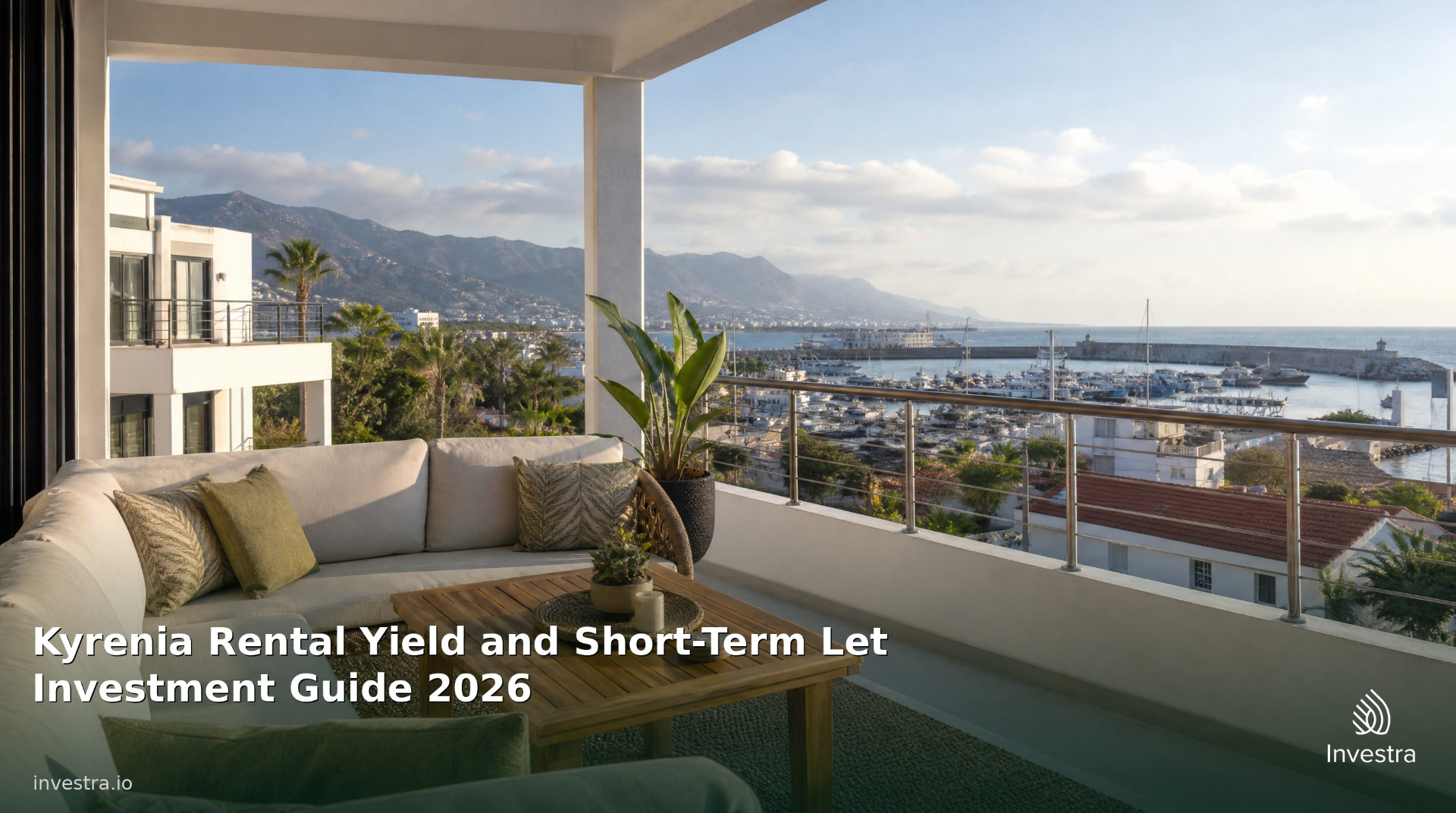
Kyrenia Rental Yield and Short-Term Let Investment Guide 2026
Kyrenia Rental Yield and Short-Term Let Investment Guide 2026
Why Kyrenia Is Capturing Global Investor Attention in 2026
Quick Answer: Kyrenia (Girne) in North Cyprus has emerged as one of the Mediterranean's most compelling short-term rental markets, offering gross rental yields of 8–14% annually — figures that most Western European coastal cities simply cannot match. Investra market research tracks emerging investment markets globally, and Kyrenia consistently ranks among the top performers for rental income strategies.
There exists a particular breed of investor who discovers Kyrenia after methodically examining alternatives. They have typically already reviewed Portugal, Spain, and Croatia—only to find yields squeezed, entry prices elevated, and competition intense.
Kyrenia—known locally as Girne—sits on the northern coastline of Cyprus beneath the Five Finger Mountains, offering one of the most visually striking settings in the entire eastern Mediterranean. The harbour, which dates back to the Lusignan period, is lined with restaurants and yachts and has become something of an Instagram landmark.
The 2026 landscape carries important caveats. North Cyprus operates under a unique political framework—recognized internationally only by Turkey—which creates specific legal and financial considerations that any investor must understand before committing capital.
Understanding the North Cyprus Rental Market Structure in 2026
Quick Answer: North Cyprus operates a dual rental market—long-term residential lettings typically yielding 6–9% gross annually, and short-term holiday lets generating 10–14% gross in peak zones. Kyrenia dominates both segments and accounts for an estimated 40–45% of all tourist accommodation bookings across Northern Cyprus.
The rental market in North Cyprus is not a single, monolithic entity. It comprises two quite distinct ecosystems operating simultaneously, and understanding which aligns with your investment objectives represents the first critical decision.
Long-term rentals—defined as leases of three months or longer—serve a local and expatriate residential market. Kyrenia maintains a substantial expat community, particularly British and Turkish nationals, plus a growing student population affiliated with six universities operating in Northern Cyprus.
Short-term holiday rentals operate as an entirely different market segment. Peak season runs from May through October, with July and August commanding nightly rates that genuinely surprise investors accustomed to continental European markets. A well-positioned one-bedroom apartment in the Kyrenia harbour area achieves €80–€130 per night in peak season on Airbnb and Booking.com.
The platform ecosystem matters considerably. Airbnb commands solid market presence in Kyrenia's tourist accommodation sector, but Booking.com frequently drives higher volume for apartments—particularly for UK, German, and Scandinavian visitors who dominate arrivals.
Tourism infrastructure continues improving. Ercan International Airport has expanded route networks, featuring direct connections from London Stansted, Manchester, Istanbul, and various German cities. Enhanced accessibility directly translates to higher occupancy potential—something investors in markets like Aleksinac Real Estate Market 2026 and other emerging European destinations understand acutely.
Kyrenia Rental Yield Data: What the Numbers Actually Show
Quick Answer: Documented gross rental yields in Kyrenia range from 8–12% for long-term lets and 10–14% for optimized short-term rentals in 2026. Net yields, after management fees, maintenance, and platform costs, typically settle between 6–10%—still significantly above most Western European coastal markets.
Understanding specific yield data is essential, as vague claims serve no useful purpose when deciding whether to commit €100,000 or more to foreign property investment. The analysis that follows aggregates transaction data, rental listings, and on-the-ground operator feedback—the granular picture essential when evaluating North Cyprus opportunities.
Studio and One-Bedroom Apartments (35–55 m²): Purchase price range spans €65,000–€120,000. Peak season nightly rates achieve €60–€110, with off-season rates at €40–€65. Annual gross rental income estimates €12,000–€18,000, generating gross yields of 9–14%. Net yields, after costs, settle between 6.5–9.5%.
Two-Bedroom Apartments (70–100 m²): Purchase prices range from €120,000–€220,000. Peak season nightly rates reach €100–€180, while off-season rates hold €60–€95. Annual gross rental income estimates €18,000–€28,000, producing gross yields of 10–13% with net yields of 7–9%.
Three-Bedroom Villas and Townhouses (150–250 m²): Purchase prices span €250,000–€500,000. Peak season weekly rates achieve €2,000–€4,500. Annual gross rental income ranges €30,000–€65,000, generating gross yields of 8–13% and net yields of 6–9%.
What distinguishes Kyrenia is relatively strong off-season performance. Unlike certain Mediterranean markets that essentially cease operations from November through March, Kyrenia sustains year-round visitor traffic: retirees seeking warm winters, university-related visitors, and an expanding digital nomad demographic attracted by low cost of living and reliable internet.
For perspective, comparable coastal properties in southern Spain currently yield 4–7% gross. Croatian properties generate 5–8%. Even emerging Balkan markets tracked through Sremska Mitrovica Real Estate guides rarely surpass 9% net yields on short-term lets. Kyrenia's yield premium remains structural, not anomalous.
Best Locations Within Kyrenia for Rental Investment
Quick Answer: The Kyrenia Harbour area, Alsancak (Karavas), and Lapta command the highest short-term rental premiums, while Ozankoy, Catalkoy, and Esentepe offer better purchase price-to-yield ratios for budget-conscious investors targeting the mid-market rental segment.
Kyrenia does not represent a uniform market. Micro-location differences create yield and capital appreciation variations that materially affect investment outcomes, so systematic geographic analysis proves essential.
Kyrenia Harbour Centre: This zone represents the premium address. Walkable proximity to the historic harbour, restaurants, and nightlife commands the highest nightly rates and occupancy figures. A one-bedroom apartment here might cost €130,000–€180,000 but generates disproportionately high rental income.
Alsancak (Karavas): Located approximately 10 km west of Kyrenia centre, Alsancak has transformed over the past decade into one of the island's most desirable residential and tourist zones. It hosts a dense cluster of quality restaurants, beach clubs, and resort developments.
Lapta: Positioned further west, Lapta provides slightly more authentic village character alongside tourist amenities. It attracts a more discerning visitor demographic—typically couples and families who have progressed beyond standard resort experiences. Properties range €1,100–€1,800/m² and achieve excellent yields with proper management.
Catalkoy and Ozankoy: East of Kyrenia centre, these areas blend residential and tourist functionality. More affordable entry points—often €900–€1,300/m²—accompany solid yield potential, particularly for long-term let strategies targeting expat and student markets. Investors prioritizing stable cash flow without peak-season operational intensity frequently prefer these zones.
Esentepe and Bahceli: These represent the emerging frontier. Located roughly 20–30 km east of Kyrenia, these hillside coastal communities experience the most active new development. Golf course proximity (the Korineum Golf Course) attracts a specific tourism demographic.
The Legal Framework for Foreign Property Ownership and Rental in North Cyprus
Quick Answer: Foreign nationals can legally purchase property in North Cyprus but must obtain a Purchase Permit from the Council of Ministers—a process requiring 6–18 months. Title deed category proves critically important: "Turkish Title" deeds carry fewer complications than "pre-1974 Greek Cypriot Title" properties, which carry ownership dispute risk. Qualified local solicitor engagement is mandatory before any purchase.
This represents where North Cyprus discussion becomes considerably more complex—and where thorough due diligence transforms from advisable to absolutely essential. The legal framework governing property purchase and rental here differs fundamentally from any other EU-adjacent market, with substantial stakes for those who fail to navigate it properly.
North Cyprus receives international recognition only from Turkey. This political reality means properties in the territory operate outside standard EU legal protection frameworks, and title deed categories carry specific risk profiles that buyers must comprehend thoroughly.
Title Deed Categories: The cleanest category comprises Turkish Title —land registered to a Turkish Cypriot owner since before 1974, or land in the Kocan registry. These carry minimal legal risk for buyers. TRNC State Land (Devlet Tapu) is similarly considered secure.
The Purchase Permit Process: Foreign nationals (non-Turkish, non-TRNC citizens) must submit Purchase Permit applications (Satın Alma İzni) to the Council of Ministers. Non-Turkish nationals face limitation to one property and maximum plot size of 1 donum (approximately 1,338 m²).
Rental Registration: Short-term rental properties must technically register with the TRNC Tourism Ministry, though enforcement has historically proven inconsistent. This landscape is shifting—as rental income visibility increases through platform reporting, regulatory scrutiny intensifies. Investors operating through Findes Group & Partners or comparable structured investment vehicles frequently find formal registration simplifies overall compliance significantly.
Engaging an experienced TRNC-qualified solicitor—distinct from standard property agents—is essential given legal complexity. Many investors have derived substantial value from working with international investment consultants like Siniša Dagary investment insight who can contextualize North Cyprus opportunities within broader portfolio strategy before committing to local legal processes.
Taxation and Cost Structure for Kyrenia Rental Properties
Quick Answer: North Cyprus imposes relatively low tax burdens on rental income—a flat 10% withholding tax applies to rental income for non-residents, with property transfer tax of 3–6% on purchase. Annual property taxes remain modest, typically €200–€600 depending on property value, making Kyrenia one of the more tax-efficient short-term rental markets in the Mediterranean.
Tax efficiency represents one of Kyrenia's genuinely compelling structural advantages over Western European markets, and examination in detail proves worthwhile because the numbers compound meaningfully over typical 5–10 year investment horizons.
Purchase-Stage Taxes and Costs: Stamp Duty totals 0.5% of purchase price, payable upon contract signing. VAT applies at 5% on new-build properties (resale typically remains VAT-exempt). Transfer Tax reaches 3% for first properties, though temporary exemptions occasionally boost this to 6% as market stimulus measures. Solicitor Fees typically range 1–1.5% of purchase price.
Total acquisition costs for foreign buyers typically run 6–10% above purchase price, which remains competitive relative to markets like Serbia (where Zajecar Real Estate Market 2026 guides note similar overall transaction costs) or even Croatia and Spain.
Ongoing Tax Obligations: Annual property tax in North Cyprus assessed on declared property value produces effective rates of approximately 0.1–0.3% annually—meaning a €150,000 property incurs roughly €150–€450 per year. This significantly undercuts comparable obligations in the UK, Germany, or France.
Rental income tax for non-resident landlords applies withholding at source at 10% on gross rental income. Residents and those possessing a TRNC Tax ID face different obligations depending on total income.
Practical Annual Cost Modelling for a €150,000 Apartment: Property management fee (15–20% of gross rental income) runs €2,400–€3,600. Platform fees for Airbnb and Booking.com at 15% either integrate into management fees or cost €1,800 separately. Maintenance and cleaning expenses reach €1,200–€2,400. Insurance costs €400–€800. Annual property tax totals €200–€400.
Against gross rental income of €15,000–€20,000, this produces net income of €6,000–€14,000—a net yield of 4–9.3% depending on performance and cost management. This represents the practical reality.
Off-Plan vs. Resale: Which Investment Strategy Wins in Kyrenia?
Quick Answer: Off-plan purchases in Kyrenia typically offer 20–35% capital appreciation by completion, with lower entry prices of €900–€1,500/m² versus €1,200–€2,200/m² for resale stock. Resale properties offer immediate rental income but less upside; off-plan requires patience and carries developer risk requiring careful management.
The off-plan versus resale debate represents one of the most frequently discussed questions among first-time North Cyprus buyers, and the optimal answer genuinely depends on investment timeline and risk tolerance.
Off-plan development remains extremely active in Kyrenia's western corridor—Alsancak, Lapta, and emerging Esentepe zones. Developer payment plans typically require 30% deposit upon signing with balance staged across 18–36 months to completion. This structure permits investors to secure a property at, say, €120,000 with initial outlay of €36,000 and stage remaining payments.
However—and this demands emphasis—developer due diligence remains essential. North Cyprus experienced historical cases of developer project failures, particularly through 2009–2014.
Resale properties present different calculations. Per-square-meter costs exceed off-plan pricing but rental income generation commences immediately. For investors preferring to avoid 18–36 month waiting periods and seeking immediate cash flow, well-priced resale apartments in Alsancak or Kyrenia centre represent more sensible routes. The Business Strategy Blog by Siniša Dagary covers broader frameworks for evaluating off-plan versus income-generating asset decisions across emerging markets—useful context for investors approaching this choice.
Running a Short-Term Rental Operation in Kyrenia: The Practical Reality
Quick Answer: Successfully operating a Kyrenia short-term rental from overseas requires either a professional property management company (costing 15–25% of gross revenue) or a trusted local co-host network. Airbnb and Booking.com dominate guest acquisition, but direct booking channels, professional photography, and dynamic pricing strategies typically add 15–25% to annual revenue versus passive approaches.
Here lies where investor enthusiasm encounters operational reality. Purchasing a beautiful Kyrenia apartment differs fundamentally from running it as a high-performing short-term rental from London or Frankfurt—though entirely achievable with proper structure.
The local property management ecosystem has matured considerably over five years. Multiple genuinely professional property management companies now operate in Kyrenia offering comprehensive service packages: guest communication, check-in/check-out coordination, cleaning management, maintenance response, and platform administration.
High-performing properties distinguish themselves from average performers through four consistent factors:
1. Professional Photography: Properties featuring professional photography consistently achieve 20–30% higher booking rates at equivalent price points. This represents not optional but among the highest-ROI investments available post-purchase.
2. Dynamic Pricing: Static nightly rates leave revenue on the table. Tools like PriceLabs, Wheelhouse, or Beyond Pricing—integrated with Airbnb and Booking.com—automatically adjust rates reflecting local demand, competing inventory, and seasonal patterns. Properly implemented dynamic pricing typically lifts annual revenue by 10–20%.
3. Review Cultivation: In Airbnb and Booking.com algorithms, recent positive reviews directly drive search visibility. Properties maintaining 4.8+ ratings consistently appear higher in search results, translating to occupancy premiums of 15–25% over lower-rated equivalents at similar price points.
4. Off-Season Programming: The difference between 55% and 75% annual occupancy in Kyrenia frequently results from whether properties actively market during October–April periods. Properties targeting digital nomads (featuring monthly rates, reliable WiFi, dedicated workspace, and utility inclusion) maintain strong cash flow through otherwise slow months.
Investors exploring emerging market rental operations—from platforms like Loznica Real Estate Market 2026 Macva Region Property Guide to Mediterranean coastal opportunities—frequently discover operational excellence, not merely location, determines whether rental investments exceed initial projections.
Capital Appreciation Projections and Long-Term ROI for Kyrenia
Quick Answer: Kyrenia property values have appreciated at average rates of 8–15% annually in GBP/EUR terms over 2020–2025, driven by currency dynamics (Turkish Lira depreciation making properties cheaper for hard currency buyers) and genuine demand growth. Long-term total ROI combining rental income and capital growth suggests 15–25% annual total returns for well-selected properties, though this carries inherent uncertainty.
Rental yield comprises only half the investment equation. Capital appreciation—or its absence—determines whether an investment strategy genuinely compounds wealth or simply generates income while principal stagnates.
Kyrenia has experienced documented capital appreciation averaging 8–15% annually in hard currency terms over the 2020–2025 period. This growth reflects multiple factors: genuine tourism demand expansion, infrastructure improvements, political stabilization within North Cyprus, and currency dynamics.
For a property purchased in 2023 at €150,000, conservative appreciation estimates suggest 2026 valuation at €175,000–€190,000. Combined with accumulated rental income over three years (€18,000–€24,000), total return reaches €43,000–€64,000—or 28–42% cumulative return on initial investment. That translates to annualized returns of 8.5–12% once costs are deducted.
However, projecting future appreciation requires acknowledging uncertainty. Property markets experience cyclical periods; North Cyprus faces specific geopolitical risks; and global recession could depress demand. Conservative investors should model returns assuming 5–8% annual appreciation rather than historical 8–15% rates, producing more realistic long-term expectations.
Capital gains taxation in North Cyprus deserves attention. For non-residents, capital gains from property sales may face various tax treatments depending on circumstances. Consulting with investment consultation services before planning exit strategies proves prudent.
Market Dynamics and Future Outlook for Kyrenia Real Estate
Quick Answer: Kyrenia's real estate market faces growth opportunities from expanded airport connectivity, increasing international recognition of North Cyprus property rights, and sustained tourism demand. Risks include geopolitical tensions, regulatory changes, and potential market saturation if oversupply occurs.
Understanding forward-looking market dynamics helps contextualize whether 2026 represents an opportune entry point or a mature market phase.
Positive drivers include infrastructure investment. Ercan Airport continues expanding route networks. The proposed undersea power cable connecting North Cyprus to Turkey and potentially to the EU represents symbolic infrastructure progress. University expansion continues attracting students and increasing year-round demand.
Tourism-specific opportunities persist. Kyrenia's positioning as a "undiscovered" Mediterranean alternative remains viable—it has not yet reached saturation levels seen in Dubrovnik or Santorini. International property recognition, though uncertain, could improve if EU-Turkey relations normalize or political agreements advance.
Risks warrant honest acknowledgment. Oversupply represents a realistic concern in certain sub-markets, particularly Alsancak where development remains intense. Regulatory changes could affect short-term rental operations (as occurred in Barcelona and other Mediterranean cities).
Investors exploring broader European
Investment Disclaimer
Quick Answer: This guide is general market information, not personal legal, tax, financing or investment advice.
Before committing to a property transaction, buyers should obtain independent local legal, tax and financial advice suited to their circumstances. Investra.io can support initial market research, but every purchase decision remains the buyer's responsibility.
Frequently Asked Questions
Quick Answer: This section explains the practical property-investment implications of Frequently Asked Questions.
What is a prudent next step after initial market research?
Use current documentation, independent professional advice and comparable local evidence before proceeding. Investra.io can support an initial structured market review.
How can buyers plan a realistic ownership budget?
Use current documentation, independent professional advice and comparable local evidence before proceeding. Investra.io can support an initial structured market review.
What evidence supports a careful investment decision?
Use current documentation, independent professional advice and comparable local evidence before proceeding. Investra.io can support an initial structured market review.
When should a buyer obtain legal and tax advice?
Use current documentation, independent professional advice and comparable local evidence before proceeding. Investra.io can support an initial structured market review.
How should a buyer compare neighbourhoods and property types?
Use current documentation, independent professional advice and comparable local evidence before proceeding. Investra.io can support an initial structured market review.
What local checks should be completed before signing?
Use current documentation, independent professional advice and comparable local evidence before proceeding. Investra.io can support an initial structured market review.
Which costs should be assessed alongside the purchase price?
Use current documentation, independent professional advice and comparable local evidence before proceeding. Investra.io can support an initial structured market review.
How can international buyers verify a property opportunity?
Use current documentation, independent professional advice and comparable local evidence before proceeding. Investra.io can support an initial structured market review.
What should buyers compare before selecting a property?
Use current documentation, independent professional advice and comparable local evidence before proceeding. Investra.io can support an initial structured market review.
Quick Answer: These answers outline common buyer checks and should be read with current professional advice.
Recommended Reading
Quick Answer: This section explains the practical property-investment implications of Recommended Reading.
- Investra market research
- Investra market research
- Investra market research
- Investra market research
- Investra market research
- Investra market research
- Investra market research
- Investra market research
- Investra market research
- Investra market research
- Investra market research
- Investra market research
- Investra market research
- Investra market research
- Investra market research
- Investra market research
- Investra market research
- Siniša Dagary investment insight
- Siniša Dagary investment insight
- Siniša Dagary investment insight
- Siniša Dagary investment insight
- Siniša Dagary investment insight
- Findes Group & Partners
- Findes Group & Partners
Connect With Investra
Follow Investra for market updates on Facebook, LinkedIn, YouTube
Related Posts
No related posts available.
