
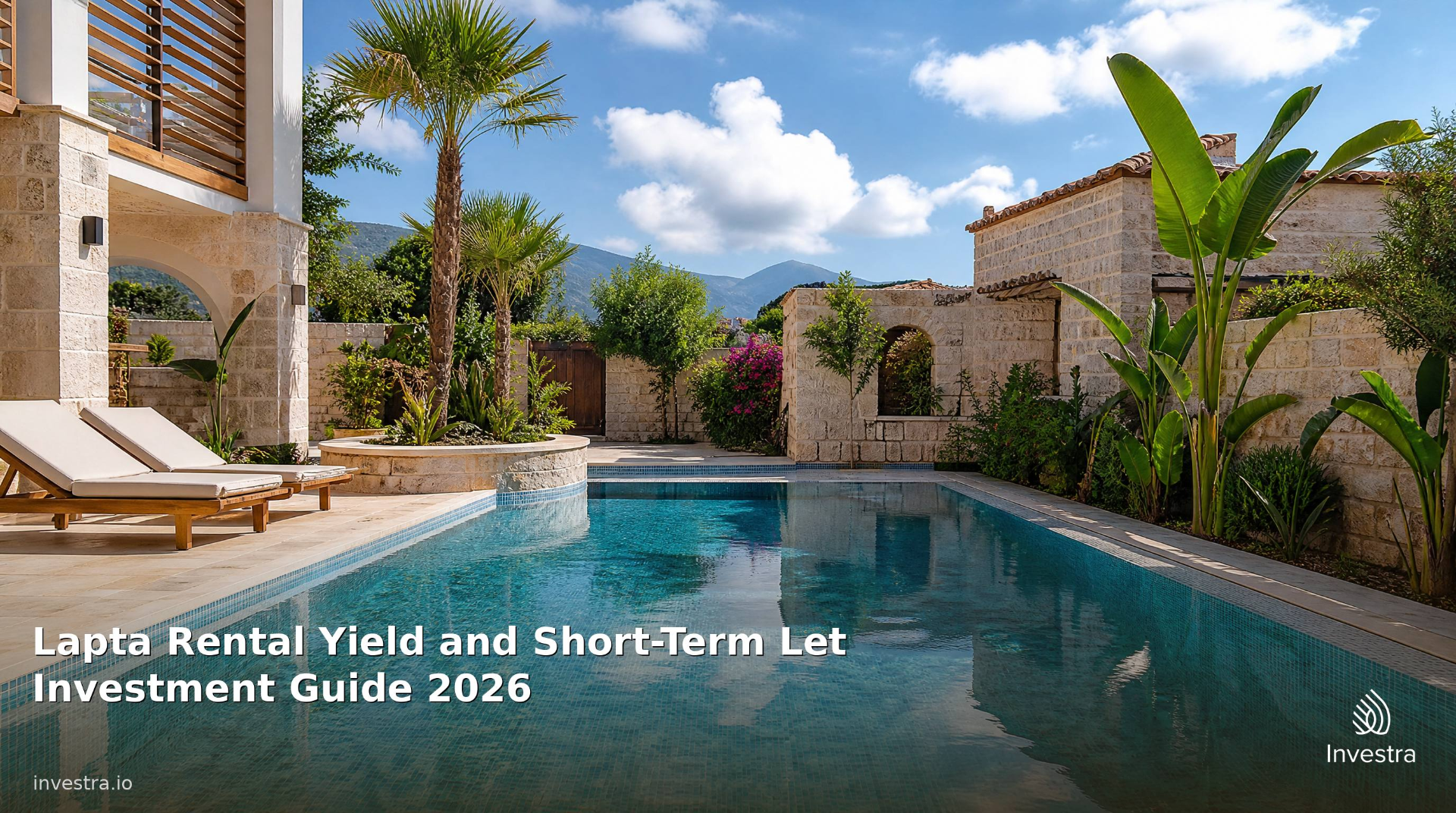
Lapta Rental Yield and Short-Term Let Investment Guide 2026
Lapta Rental Yield and Short-Term Let Investment Guide 2026
Why Lapta Is Becoming North Cyprus's Most Talked-About Rental Investment Location
Quick Answer: Lapta (also known as Lapithos) has emerged as one of North Cyprus's top short-term rental markets in 2026, offering gross rental yields of 7–12% and strong Airbnb demand driven by its coastal setting, expat community, and proximity to Kyrenia. Investra market research tracks emerging markets like Lapta to help investors find high-yield opportunities before mainstream attention drives prices up.
Spend five minutes scrolling through Airbnb listings for North Cyprus and something becomes immediately obvious — Lapta is everywhere. Whitewashed villas with infinity pools, cozy stone cottages with mountain backdrops, modern apartments a few minutes' walk from the sea. The demand is real, the occupancy rates are climbing, and serious investors are paying attention.
Lapta sits roughly 12 kilometres west of Kyrenia (Girne) along the northern coastline, nestled between the Five Finger Mountain range and the Mediterranean. It's not a new discovery — British expats have been settling here since the 1970s — but what's changed is the sheer scale of short-term rental activity.
The numbers back this up. Average nightly rates on short-term platforms in Lapta range from €60 to €180 depending on property type and season. Properties with private pools consistently achieve 70–85% occupancy during the April–October window. When you're buying property at €1,200–€2,500 per square metre — a fraction of comparable coastal markets — the yield arithmetic gets very interesting very quickly.
This guide breaks down everything an international buyer needs to know: current property prices, realistic rental income projections, the legal framework for short-term letting, tax obligations, management options, and the risks that often go unmentioned in developer brochures. The goal is to give you a clear-eyed picture of what Lapta genuinely offers in 2026 — not a sales pitch, but an honest investment analysis.
Understanding Lapta: Location, Character, and Rental Market Drivers
Quick Answer: Lapta's rental market is driven by its blend of coastal access, mountain scenery, established expat infrastructure, and proximity to Kyrenia's tourism corridor — factors that sustain year-round demand rather than a purely seasonal spike.
Location shapes everything in property investment, and Lapta's geography is genuinely unusual. It occupies a long, gentle hillside that slopes toward the sea, giving most properties elevated views across the Mediterranean.
What makes Lapta work as a rental market — as opposed to a purely lifestyle purchase — is that it appeals to multiple tenant profiles simultaneously. Short-stay holiday tourists come for the beaches and scenery, typically from the UK, Germany, Scandinavia, and increasingly Russia and the Gulf states.
The result is a rental calendar that doesn't collapse between November and March the way purely tourist-dependent markets do. Expat long-stay occupancy in Lapta during winter months typically runs at 55–65% — not spectacular, but enough to prevent the income void that undermines ROI calculations in more seasonal locations.
Kyrenia's gravitational pull also matters. As the main tourism hub of North Cyprus — with its castle, old harbour, international restaurants, and growing conference tourism sector — Kyrenia drives visitor flows that overflow into Lapta. Travellers who want a quieter base within easy reach of Kyrenia's nightlife and amenities consistently choose Lapta over more remote alternatives.
Road infrastructure improvements completed in 2023–2024 have cut the Lapta-to-Kyrenia drive to under 15 minutes consistently, removing what was once a minor friction point for guests. For investors comparing Lapta against more central Kyrenia properties, this accessibility upgrade has genuinely shifted the calculus in Lapta's favour — especially given that Kyrenia properties now command significantly higher entry prices.
Lapta Property Prices in 2026: What You're Actually Paying Per Square Metre
Quick Answer: In 2026, Lapta property prices range from approximately €1,100 to €2,800 per square metre depending on property type, proximity to the coast, and finish quality — with off-plan apartments at the lower end and finished sea-view villas commanding premium pricing.
Let's talk actual numbers, because vague price ranges help nobody make an investment decision. The Lapta market in 2026 has a clear price stratification that investors need to understand before running yield calculations.
Off-plan and new-build apartments in Lapta and the immediately adjacent areas of Alsancak and Karaoglanoglu are currently priced at approximately €1,100–€1,500 per square metre at launch. A two-bedroom apartment of 75–85 square metres in a well-managed complex with pool and communal facilities typically carries a total price of €95,000–€135,000.
Completed apartments in established complexes — particularly those with existing rental histories and management infrastructure — typically trade at €1,400–€1,800 per square metre. For a 70 square metre two-bedroom unit with pool access, expect to pay €110,000–€150,000. These properties carry less construction risk and can generate income immediately upon purchase.
Detached and semi-detached villas represent the upper end of the Lapta market. Entry-level villas (three bedrooms, private pool, 120–150 square metres) start at around €220,000–€280,000. Premium properties — larger footprints, elevated positions with unobstructed sea views, high-specification fit-outs — reach €350,000–€550,000, occasionally higher for landmark properties.
Resale village houses and traditional properties offer perhaps the most interesting value-add opportunity. Older stone properties in Lapta village itself can be acquired for €80,000–€150,000 and, after renovation investment of €30,000–€60,000, repositioned as boutique holiday lets commanding €120–€180 per night. The renovation path carries more complexity but can deliver exceptional yield-on-cost metrics.
It's worth contextualising these figures. Comparable coastal property in southern Cyprus (Limassol, Paphos) trades at €2,500–€5,000 per square metre. Spanish Costa properties routinely exceed €3,000 per square metre. Even Turkish coastal resorts like Bodrum and Alanya have converged toward €2,000+ per square metre.
Rental Yield Analysis: Short-Term vs Long-Term Let Strategies
Quick Answer: Short-term Airbnb-style letting in Lapta generates gross yields of 8–12% annually for well-positioned properties, compared to 5–7% for traditional long-term residential lets — but the higher short-term returns come with meaningfully higher management costs and effort.
This is where many investor presentations get sloppy — they quote gross yield figures without accounting for the costs that turn gross yield into net yield, which is the only number that actually matters. Here's an honest breakdown of both strategies.
Short-term letting (Airbnb / Booking.com / direct bookings):
Long-term residential letting:
A two-bedroom apartment in Lapta commands monthly rent of €550–€800 from long-term tenants — typically expats, retirees, or professionals working in Kyrenia who prefer the quieter Lapta lifestyle. Annual gross income of €6,600–€9,600 on a €130,000 property delivers gross yields of 5–7.4%. Management costs for long-term lets are substantially lower (10–12% if agent-managed), and turnaround costs are negligible.
The strategic question isn't simply which yields higher — it's which strategy fits the investor's situation. Short-term letting requires either hands-on involvement or a reliable local management company (more on that later). Long-term letting is passive and stable but leaves significant income on the table during peak tourist months.
For a broader perspective on how similar rental yield dynamics play out in emerging European markets, consulting resources like Siniša Dagary investment insight provides useful cross-market analytical frameworks that translate well to North Cyprus investment decisions.
The Legal Framework for Foreign Buyers in North Cyprus
Quick Answer: Foreign nationals can legally purchase property in North Cyprus, but must obtain Permission to Purchase (PTP) from the Council of Ministers — a process that typically takes 6–18 months and is granted in the vast majority of cases for non-Turkish-Cypriot applicants with clean backgrounds.
The legal situation in North Cyprus is the aspect that most often either deters or confuses international buyers, and it deserves a straight-talking explanation rather than either alarm or dismissal.
North Cyprus is recognised only by Turkey as a sovereign state — a political reality that has persisted since 1974 and shows no signs of imminent change. This non-recognition means North Cyprus operates under its own legal system, courts, and land registry rather than the EU legal framework that governs the Republic of Cyprus to the south.
Title deed categories: This is the central legal issue for buyers. There are essentially three categories of property title in North Cyprus. Pre-1974 Turkish Cypriot title (TRNC title) represents land that was owned by Turkish Cypriots before the political division — this is widely considered the most secure form of title.
The Permission to Purchase (PTP) process: Foreign nationals must apply to the Council of Ministers for permission to purchase property. The application requires passport documentation, a background check (a criminal record check is essential), and confirmation of the property details. The fee is relatively nominal.
Critically, buyers can complete their purchase contract and begin using their property while PTP is pending. The practical implication for rental investors is that short-term letting can commence before formal PTP approval is received, as long as the purchase contract is properly registered.
Legal due diligence essentials: Engaging an independent North Cyprus solicitor (not one recommended solely by the developer or agent) is non-negotiable. Key checks include confirming the property is registered in the TRNC Land Registry, verifying no existing mortgages or charges on the title, ensuring the developer or vendor has proper construction permits, and confirming the property's tax status is clear.
The legal complexities of North Cyprus property shouldn't be confused with illegality — hundreds of thousands of transactions have been completed by foreign nationals over the past three decades. The risks are manageable with proper advice. Engaging experienced consultants like Siniša Dagary investment insight alongside local legal professionals ensures that international investors approach these nuances with eyes open.
Short-Term Rental Regulations and Airbnb Compliance in North Cyprus
Quick Answer: North Cyprus does not currently operate a strict Airbnb-style licensing regime comparable to EU countries, but short-term rental activity is subject to TRNC tourism authority registration requirements, and compliance requirements are tightening as the market matures through 2025–2026.
Ask most North Cyprus estate agents about Airbnb regulations and you'll get a confident wave of the hand — "no problem, everyone does it." That answer is becoming increasingly incomplete as the TRNC authorities develop a more structured approach to short-term tourism accommodation, partly driven by the explosive growth of platforms like Airbnb and Booking.com in the region.
The current regulatory landscape, as of 2026, works like this: properties used for short-term tourist letting are technically required to be registered with the TRNC Ministry of Tourism. Registration involves a basic inspection process, and registered properties are classified as "holiday rental apartments" or "holiday villas" under TRNC tourism law.
Non-registration has historically been common — many private landlords have operated short-term lets informally without formal tourism registration. However, increased enforcement activity in 2024–2025, particularly in the Kyrenia district that covers Lapta, means that operating without registration now carries real risk of fines and potentially being barred from tourism booking platforms.
Tax Obligations for Rental Income in North Cyprus
Quick Answer: Rental income from North Cyprus property is subject to TRNC income tax at rates of 10–37% depending on income level, with a 10% flat rate available for small landlords declaring rental income through simplified procedures — and foreign investors must also consider their home country's tax obligations on overseas income.
Taxation is the area where investors most frequently underestimate their obligations — and where getting proper advice upfront saves significant headaches later. Here's the honest tax picture for rental investors in Lapta.
TRNC income tax on rental income: The TRNC operates a progressive income tax system. Rental income is subject to income tax after allowable deductions.
Property transfer tax: On purchase, transfer tax of 6% of the property's assessed value is payable (reduced to 3% for first-time buyers in North Cyprus, though this relief applies to TRNC residents primarily). Stamp duty of 0.5% applies on the contract value. VAT (KDV) at 5% applies to new-build purchases from developers.
Annual property tax (immovable property tax): The annual property tax in North Cyprus is notably low by European standards — typically €200–€600 per year for a standard apartment or villa, depending on assessed value. This is a minor operating cost compared to many EU countries where annual property taxes can represent 0.5–2% of market value.
Double taxation considerations: Critically, rental income earned in North Cyprus is generally also reportable in your country of tax residence. The UK, Germany, and most European countries require residents to declare worldwide income. North Cyprus does not have formal double taxation treaties with most Western European countries (given its non-recognised status), which creates the theoretical risk of double taxation. In practice, most countries offer foreign tax credits, but this area specifically requires individual advice from a cross-border tax specialist. Findes Group & Partners specialises in cross-border financial structuring and can provide guidance on how overseas rental income interacts with home country tax obligations.
Property Management Options: Running Your Lapta Rental Investment
Quick Answer: International investors in Lapta typically use full-service local property management companies charging 20–25% of rental income for short-term let management — a necessary cost for non-resident owners that, when properly accounted for, still allows net yields of 6–9% on well-selected properties.
Unless you're planning to live in or near Lapta, property management is the operational backbone that determines whether your investment performs as projected or becomes a source of ongoing frustration. The reality is that short-term letting is an active business, not a passive asset — and the quality of your management company will materially affect your returns.
What distinguishes good management companies from mediocre ones in Lapta is their pricing strategy sophistication. Dynamic pricing — adjusting nightly rates in response to local events, booking patterns, and competitor availability — can improve annual rental income by 15–25% compared to static pricing.
Some investors, particularly those who visit Lapta regularly, take a hybrid approach: using a local caretaker or cleaner for operational tasks while managing bookings themselves through Airbnb's host tools. This reduces management cost to 5–10% of income but requires substantially more personal involvement and is only viable if you're comfortable with remote property management and have reliable local support for emergencies.
When evaluating management companies, ask for references from existing property owner clients, not just testimonials on their website. Review sample monthly financial reports. Understand their policy for property damage, security deposits, and disputes. And clarify what happens to bookings during any transition if you decide to change management company — this is an area where some contracts create unnecessary lock-in.
Lapta vs Other North Cyprus Markets: How Does It Compare?
Quick Answer: Compared to Kyrenia (higher prices, lower yields), Famagusta (stronger student market, lower entry costs), and Iskele (newer developments, longer-term growth play), Lapta offers the best current balance of rental yield, entry price, and market liquidity for short-term let investors in 2026.
No investment analysis is complete without benchmarking the target location against alternatives, because capital is always making a choice between competing options. How does Lapta actually stack up against North Cyprus's other main investment markets?
Kyrenia (Girne) city centre: The most mature and liquid market in North Cyprus, with prices of €1,800–€3,500 per square metre for well-located properties. Short-term rental demand is highest here — proximity to the old harbour, restaurants, and nightlife commands premium nightly rates of €100–€250. But entry prices compress yields: gross yields of 6–8% are typical, with net yields of 4–5.5% after full management costs.
Alsancak: Directly adjacent to Lapta, Alsancak has seen intense new development activity in 2022–2025 and is effectively part of the same investment corridor. Prices are similar to Lapta (€1,200–€2,200 per square metre) with comparable rental yields.
Famagusta (Gazimagusa) and Salamis: A different market profile. Lower entry prices (€800–€1,400 per square metre) but driven significantly by the Eastern Mediterranean University student population rather than tourism. Short-term tourist lets are less dominant; long-term academic-year rentals are more important. Yields can be high (8–11% gross) but are exposed to university enrollment trends.
Iskele / Long Beach: The most aggressively marketed "emerging market" in North Cyprus, with major developer projects and international marketing campaigns. Entry prices are competitive (€1,000–€1,800 per square metre) and the coastal infrastructure is impressive.
For Lapta specifically, the competitive advantage is clear: entry prices low enough to generate genuine cash-on-cash yields (6–9% net), established rental management infrastructure, and a market that's neither oversaturated nor negligibly small. Lapta sits in the sweet spot of the Goldilocks zone — established enough to have institutional support, new enough to have meaningful appreciation headroom.
Capital Appreciation Potential and Long-Term Value Growth
Quick Answer: Lapta property has appreciated 4–7% annually over the past five years, driven by infrastructure investment, increasing international demand, and the eventual premium convergence toward comparable Mediterranean markets. Realistic 5–10 year appreciation assumptions range from 3–6% annually, depending on broader North Cyprus political and economic developments.
Every investor asks the question: "Will my money grow?" Rental yield is one component of total return, but capital appreciation is often equally or more important over medium-term (5–10 year) investment horizons. Here's an honest assessment of Lapta's appreciation trajectory.
Investment Disclaimer
Quick Answer: This guide is general market information, not personal legal, tax, financing or investment advice.
Before committing to a property transaction, buyers should obtain independent local legal, tax and financial advice suited to their circumstances. Investra.io can support initial market research, but every purchase decision remains the buyer's responsibility.
Frequently Asked Questions
Quick Answer: This section explains the practical property-investment implications of Frequently Asked Questions.
What is a prudent next step after initial market research?
Use current documentation, independent professional advice and comparable local evidence before proceeding. Investra.io can support an initial structured market review.
How can buyers plan a realistic ownership budget?
Use current documentation, independent professional advice and comparable local evidence before proceeding. Investra.io can support an initial structured market review.
What evidence supports a careful investment decision?
Use current documentation, independent professional advice and comparable local evidence before proceeding. Investra.io can support an initial structured market review.
When should a buyer obtain legal and tax advice?
Use current documentation, independent professional advice and comparable local evidence before proceeding. Investra.io can support an initial structured market review.
How should a buyer compare neighbourhoods and property types?
Use current documentation, independent professional advice and comparable local evidence before proceeding. Investra.io can support an initial structured market review.
What local checks should be completed before signing?
Use current documentation, independent professional advice and comparable local evidence before proceeding. Investra.io can support an initial structured market review.
Which costs should be assessed alongside the purchase price?
Use current documentation, independent professional advice and comparable local evidence before proceeding. Investra.io can support an initial structured market review.
How can international buyers verify a property opportunity?
Use current documentation, independent professional advice and comparable local evidence before proceeding. Investra.io can support an initial structured market review.
What should buyers compare before selecting a property?
Use current documentation, independent professional advice and comparable local evidence before proceeding. Investra.io can support an initial structured market review.
Quick Answer: These answers outline common buyer checks and should be read with current professional advice.
Recommended Reading
Quick Answer: This section explains the practical property-investment implications of Recommended Reading.
- Investra market research
- Investra market research
- Investra market research
- Investra market research
- Investra market research
- Investra market research
- Investra market research
- Investra market research
- Investra market research
- Investra market research
- Investra market research
- Investra market research
- Investra market research
- Investra market research
- Investra market research
- Investra market research
- Investra market research
- Siniša Dagary investment insight
- Siniša Dagary investment insight
- Siniša Dagary investment insight
- Siniša Dagary investment insight
- Siniša Dagary investment insight
- Findes Group & Partners
- Findes Group & Partners
Connect With Investra
Follow Investra for market updates on Facebook, LinkedIn, YouTube
Related Posts
No related posts available.
