
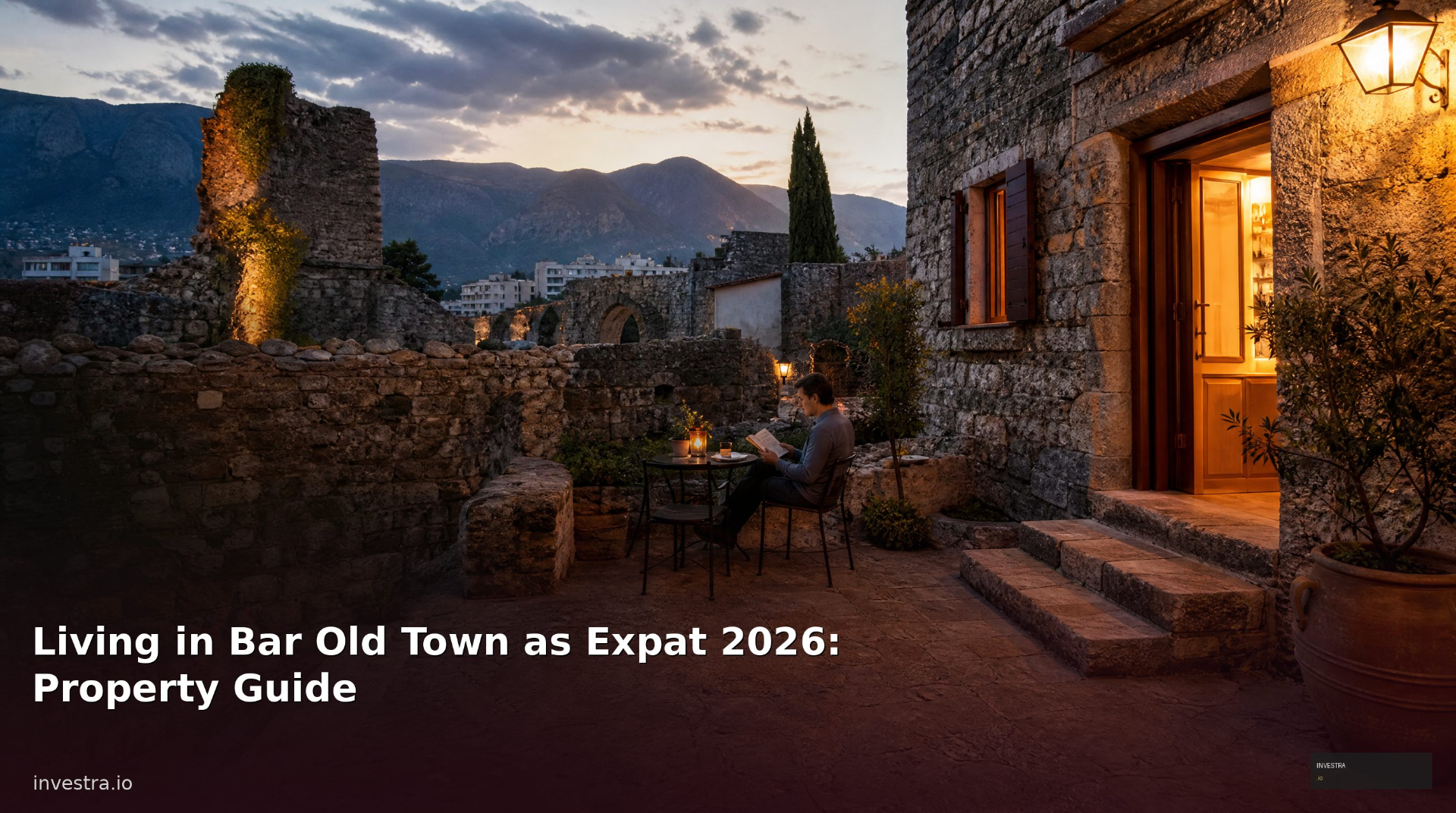
Living in Bar Old Town as Expat 2026: Property Guide
Why Bar Old Town Is Attracting Expats in 2026
Quick Answer: Bar Old Town (Stari Bar) is drawing expats in 2026 with its UNESCO-protected ruins, Mediterranean climate, low cost of living, and property prices significantly below Western European benchmarks — making it one of Montenegro's most compelling lifestyle and investment destinations. Investra.io tracks emerging Balkan markets to help investors identify opportunities before they peak.
There's something quietly remarkable happening in the hills above the Adriatic. Bar Old Town — known locally as Stari Bar — has spent decades as Montenegro's best-kept secret, and in 2026, that secret is finally getting out. Expats from Western Europe, Russia, the UK, Germany, and increasingly the United States are discovering that this ancient walled settlement offers something genuinely rare: authentic Mediterranean living at a fraction of the cost of the Italian, Spanish, or French riviera.
The appeal isn't just financial, though the numbers are compelling. Stari Bar sits roughly four kilometres inland from the coastal city of Bar, perched on a hillside beneath Mount Rumija. The site has been continuously inhabited for over a millennium, and what remains today is a fascinating patchwork of Ottoman ruins, Venetian architecture, Byzantine churches, and restored stone houses that have been brought back to life by a small but growing community of international residents.
What surprised many buyers in recent years is how undiscovered the area still feels compared to Kotor, Budva, or Tivat. Kotor's old town is charming but increasingly overrun by cruise tourism. Budva has a vibrant nightlife scene but property prices there have surged past €3,000–€4,500/m² in prime areas. Bar Old Town, by contrast, still offers properties starting around €600–€900/m² for renovation projects, with finished stone houses trading at €1,200–€1,800/m². That gap isn't just a bargain — it represents a fundamental market inefficiency that historically corrects upward as infrastructure improves and word spreads.
Montenegro's EU accession trajectory plays a crucial role here. The country opened membership negotiations in 2012 and has been steadily closing chapters since then. Most analysts expect formal EU membership between 2027 and 2030, and what we've consistently seen across the Balkans is that property markets in candidate countries experience significant appreciation in the years immediately preceding accession. For expats looking to live well while also building wealth, the timing in 2026 is genuinely interesting.
The lifestyle infrastructure has also improved meaningfully. Bar city proper — just a short drive or taxi ride down the hill — offers a functioning port, railway connections to Belgrade, an international ferry to Bari in Italy, supermarkets, hospitals, and a modest but growing expat services sector. For those who want the romance of living inside stone walls without being entirely off-grid, Stari Bar hits a sweet spot that few places in the Adriatic can match.
Understanding the Bar Old Town Property Market: Prices and Trends in 2026
Quick Answer: Property prices in Bar Old Town range from approximately €600 to €1,800 per square metre in 2026, depending on condition and location, with the market showing steady 6–9% annual appreciation driven by rising expat demand and Montenegro's EU accession momentum.
Let's talk numbers, because the price landscape in Bar Old Town is genuinely unlike anywhere else on the Montenegrin coast — and understanding the nuances matters enormously if you're considering a purchase.
The market here essentially divides into three tiers. At the entry level, you have untouched or heavily distressed stone structures within or immediately adjacent to the old town walls. These properties — often technically listed as "ruins" in municipal records — can be acquired for €600–€900/m², sometimes less if the seller is motivated or the property has been sitting for years. The catch, of course, is that restoration costs are substantial: expect to budget an additional €400–€700/m² for competent renovation work using local contractors, with higher-spec finishes pushing costs further.
The mid-range segment covers partially renovated properties and those in liveable condition but lacking modern kitchens, bathrooms, or updated electrical and plumbing systems. Here, prices typically run €1,000–€1,400/m². These represent the sweet spot for many expat buyers — they can move in relatively quickly while undertaking cosmetic renovations incrementally.
At the top end, fully restored stone houses with modern interiors, private terraces or gardens, and panoramic views toward the Adriatic coast command €1,500–€1,800/m², occasionally touching €2,000/m² for truly exceptional properties. These are rare in Stari Bar and tend to sell quickly when they come to market.
Compare those figures to Kotor Old Town, where finished apartments regularly trade at €2,500–€3,500/m², and the value proposition becomes stark. Even Herceg Novi's old town, less visited than Kotor, consistently runs €1,800–€2,500/m² for finished properties. Bar Old Town is, by any reasonable comparison, significantly undervalued relative to its cultural and lifestyle merits.
Annual price appreciation has averaged 6–9% over the 2022–2025 period, with 2025 seeing particularly strong demand from German and Austrian buyers responding to both the EU accession narrative and Montenegro's visa-free access for EU citizens. The rental market has also tightened considerably, which is pushing some landlords to sell at premiums they wouldn't have considered three years ago.
What does the broader regional market tell us? Platforms like Zajecar Real Estate Market 2026 Eastern Serbia Property G... and similar Balkan market reports consistently show that towns with genuine historical character and improving infrastructure tend to outperform purely speculative coastal markets over five-to-ten-year horizons. Bar Old Town fits that profile precisely.
The Expat Lifestyle in Bar Old Town: What Daily Life Actually Looks Like
Quick Answer: Daily life in Bar Old Town offers a peaceful, historically rich Mediterranean environment with warm summers, mild winters, low costs, and a small but welcoming international community — though residents should expect limited commercial infrastructure within the old town itself and rely on Bar city for most services.
People often ask what it's actually like to live in Stari Bar day-to-day, as opposed to visiting for an afternoon as a tourist. The honest answer is: it's wonderful if you know what you're signing up for, and disappointing if you've romanticised it beyond reality.
The old town itself is a largely pedestrian zone. The ruins of the medieval settlement — including the Cathedral of Saint George, the old mosque, the Ottoman baths, and numerous crumbling stone buildings draped in fig trees and oleander — create a living museum atmosphere that most residents genuinely treasure. On weekday mornings, the site is largely empty. You'll have centuries of history almost entirely to yourself, which is an experience that simply doesn't exist in Kotor or Dubrovnik anymore.
The surrounding settled area — the newer residential zone that has grown up around the old town — is where most expats actually live, either within restored properties inside the walls or in stone houses just outside. There are a handful of small cafés and restaurants, a weekly market where local farmers sell produce, cheese, and homemade rakija, and a general sense of community that takes some time to break into but rewards patience.
Cost of living is one of Bar Old Town's strongest calling cards. A couple can live comfortably on €1,500–€2,000/month including rent (or significantly less if they own their property outright). Local food from markets and small shops is extremely affordable — fresh vegetables, olive oil, local wine, and seafood all cost a fraction of what they would in Western Europe. A decent restaurant meal runs €8–€15 per person including wine. Utilities for a stone house of 80–100m² typically run €100–€180/month depending on the season.
Healthcare is the area where expats need the most preparation. Bar city has a general hospital, and there's a private clinic that handles most routine needs. For anything complex, Podgorica — roughly an hour by car — has considerably better facilities. Many expats maintain private health insurance with international coverage, which typically costs €80–€200/month depending on age and coverage level.
The climate is genuinely excellent. Summers are hot and dry, with temperatures routinely reaching 35°C and the sea just fifteen minutes away by car. Winters are mild by any European standard — average January temperatures hover around 7–10°C, frost is rare, and the olive trees and citrus plants that dot the landscape stay green year-round. Rainfall concentrates in November through February but is rarely prolonged.
Legal Framework for Foreign Property Buyers in Montenegro 2026
Quick Answer: Foreign nationals can purchase property in Montenegro with full ownership rights under the same conditions as citizens, with the legal process typically taking 30–90 days and involving a notarized purchase agreement, land registry transfer, and a 3% property transfer tax for resale properties.
Montenegro has one of the most foreigner-friendly property ownership frameworks in the Western Balkans, and this is a genuinely significant factor for expat buyers. Unlike some regional markets where foreigners face restrictions on land ownership, agricultural property exclusions, or mandatory company structures, Montenegro allows foreign nationals to purchase residential and commercial property on essentially identical terms to citizens.
The process typically unfolds in several stages. First, due diligence — a step that absolutely cannot be rushed. Montenegro's land registry (Katastar) has improved substantially over the past decade, but historical title irregularities still exist, particularly in older areas like Stari Bar where properties may have passed through multiple generations, Yugoslav-era socialisation, denationalisation, and private sales over the past century. Engaging a reputable Montenegrin lawyer — not just a real estate agent — for title searches is non-negotiable. Budget €500–€1,500 for thorough legal due diligence.
Once due diligence is satisfactory, the parties sign a preliminary purchase agreement (Predugovor), typically accompanied by a 10% deposit. The final purchase agreement must be notarized by a Montenegrin notary public, who verifies the identities of all parties, the accuracy of the property description, and the legality of the transaction. Notary fees are regulated and scale with the transaction value — typically 0.1–0.3% of the purchase price.
The property transfer tax for resale properties (i.e., not new builds purchased directly from a developer) is 3% of the assessed market value, payable by the buyer. This is calculated by the tax authority based on comparable sales in the area, not necessarily the declared purchase price. New builds purchased from VAT-registered developers are instead subject to 21% VAT, already included in the developer's price.
Registration at the land registry (upis u katastar) typically takes 15–45 days after notarization, though this can stretch longer in areas with backlogged offices. Your lawyer should follow up proactively. Until registration is complete, the buyer technically doesn't have full legal title, so don't release the final payment balance without either registration or a strong escrow arrangement.
For deeper context on how property legal frameworks function across different Balkan markets, the analysis at Loznica Real Estate Market 2026 Macva Region Property Guide provides useful comparative perspective, as does the team at Siniša Dagary — Investment Consultant, who has extensive experience guiding international clients through Balkan property transactions.
Rental Yields and Investment Returns in Bar Old Town
Quick Answer: Gross rental yields in Bar Old Town range from 5–8% annually for short-term holiday rentals and 4–6% for long-term lets, with the best returns achievable on well-restored properties marketed to the growing premium heritage tourism segment.
The investment case for Bar Old Town has two distinct components: rental income and capital appreciation. Understanding both — and being realistic about the constraints — is essential for any serious investor.
On the rental income side, the short-term holiday rental market is the primary driver. Montenegro's tourism numbers have been growing consistently, with the country recording approximately 2.8 million tourist arrivals in 2024 and targeting over 3 million in 2025–2026. Bar itself is less visited than Budva or Kotor, but this is changing as "off-the-beaten-path" Montenegro starts appearing more frequently in European travel publications and influencer content.
A well-restored stone house of 60–80m² in or near Stari Bar, properly listed on Airbnb and Booking.com and professionally photographed, can realistically achieve 60–90 days of occupancy during the peak summer season (June–September) at €80–€150/night. Shoulder season occupancy (May, October) adds perhaps another 20–30 days at €50–€80/night. Annual gross rental income for such a property might range from €7,000–€14,000 — against a purchase price of €70,000–€130,000, that implies gross yields of roughly 6–9% before management fees, taxes, and maintenance.
Long-term rentals to expats or digital nomads are a growing segment too. A furnished two-bedroom house near Stari Bar might rent for €500–€800/month on a long-term basis. Against a purchase price of €90,000–€120,000, that suggests a gross yield of 5–8%, which is competitive with most Western European residential markets and significantly better than the sub-3% yields common in Germany or France.
Capital appreciation is where the longer-term excitement lies. Properties purchased in Bar Old Town between 2018 and 2021 have appreciated 25–40% in euro terms through 2025, driven by the combination of rising tourist interest, infrastructure improvement, and the EU accession premium gradually being priced in. Conservative five-year projections from most analysts we've reviewed suggest an additional 30–50% appreciation through 2030, contingent on the EU accession process continuing on its current trajectory.
Total return projections — combining rental income and capital growth — put Bar Old Town in the 12–16% annualised total return range for well-selected properties over a five-year hold. That's exceptional by any benchmark, though investors should approach such projections with appropriate scepticism and account for costs, vacancies, and execution risk.
Renovation and Restoration: The Reality of Buying a Stone House
Quick Answer: Renovating a stone property in Bar Old Town costs approximately €400–€900 per square metre depending on specification, with the process subject to heritage protection regulations that require municipal approval — a process that can add 3–12 months to project timelines but ultimately protects the value of the asset.
Here's where the romanticism of buying a centuries-old stone house meets the practical realities of 21st-century construction management, and it's a subject that deserves more honest treatment than it typically receives in property marketing materials.
First, the positives. Montenegrin stone construction is exceptionally durable. The limestone and sandstone used in Stari Bar buildings has survived earthquakes, wars, and centuries of neglect in far better condition than most modern concrete construction would. When properly restored, these buildings offer extraordinary thermal mass — naturally cool in summer, retaining heat efficiently in winter — and an aesthetic quality that no amount of money can replicate in a new build.
The renovation process itself, however, requires patience and local knowledge. Bar Old Town falls under heritage protection regulations administered by the Cultural Heritage Protection Office (Uprava za zaštitu kulturnih dobara). This means that any significant exterior modification — window openings, door configurations, roof materials — requires prior approval. Interior work generally requires notification but less scrutiny. The approval process typically takes 2–6 months for a straightforward restoration application, longer if the property is listed as a cultural monument.
Finding good contractors is the other major challenge. There are perhaps a handful of firms in the Bar area with genuine expertise in traditional stone restoration. The best of them are perpetually busy, and the temptation to use cheaper, less experienced labour is real. Resist it. Poor quality stone pointing, inappropriate cement mortars, or badly designed waterproofing can cause structural damage that costs more to remediate than you saved on the original contract. Ask for references, visit completed projects, and if possible, engage an architect or project manager with documented heritage restoration experience.
Cost estimates vary considerably based on scope and finish. A basic structural restoration bringing a ruin to a weather-tight shell runs €200–€350/m². Full interior fit-out with modern kitchen, bathrooms, and electrical/plumbing to European standards adds another €300–€500/m². Premium finishes, custom joinery, and high-specification fixtures can push total costs to €800–€1,000/m² — at which point you're approaching the cost of comparable finished properties, so the arithmetic only works if you're adding genuine value through design or location.
The reality is that successful renovation projects in Stari Bar tend to be owner-managed, with the buyer present for significant portions of the construction period. Remote management is possible but introduces substantial risk. Many expats who've gone through this process describe it as one of the most challenging and ultimately rewarding experiences of their lives — but it's genuinely difficult, and anyone expecting a smooth, timeline-adherent construction experience will be frustrated.
Taxes and Ongoing Costs of Property Ownership in Montenegro
Quick Answer: Annual property tax in Montenegro is very low at 0.1–1% of assessed value, and rental income is taxed at a flat 9%, making Montenegro one of the most tax-efficient property ownership environments in Europe for both residents and non-residents.
Montenegro's tax regime for property owners is one of its most underappreciated competitive advantages, particularly for expats coming from high-tax Western European environments.
Annual property tax (porez na nepokretnosti) is levied by the municipality and typically ranges from 0.1% to 1% of the official assessed value — which in Bar municipality tends to be conservative relative to actual market values. For a property with a market value of €100,000, you might realistically expect annual property tax of €100–€300. That's extraordinarily low by any European benchmark.
Rental income tax is equally attractive. Montenegro applies a flat personal income tax rate of 9% to net rental income (gross income minus allowable deductions including maintenance, management fees, and depreciation). Many expats utilise the 30% deemed expense deduction that simplifies accounting while still resulting in an effective tax rate on gross rental income of approximately 6.3%. For context, rental income tax rates in Germany run 14–45%, in France up to 45%, and in the UK 20–45%. The Montenegro advantage is substantial.
Capital gains on property sales are taxed at 9% on the profit (sale price minus acquisition cost and documented improvement costs). Properties held for more than three years may be eligible for reduced assessment in some circumstances, though the rules here are worth discussing with a Montenegrin tax advisor for your specific situation.
Non-resident property owners don't face any discriminatory tax treatment — the rates above apply equally to foreign owners as to citizens. Montenegro has signed double taxation agreements with numerous countries, which may allow you to offset Montenegrin taxes against your domestic tax liability. Check with a qualified advisor in your home country, as the specifics vary.
Ongoing ownership costs beyond tax include utility connections (electricity averages €50–€100/month for a typical house; water is minimal), buildings insurance (€150–€400/year for a modest property), and routine maintenance. If you're renting through a management company, expect to pay 15–25% of gross rental income as a management fee. All-in, a property owner receiving rental income should budget 30–40% of gross rent for taxes, management, and maintenance, leaving a solid net return on well-priced assets.
For those interested in how tax efficiency compares across regional markets, the detailed fiscal analysis at Sremska Mitrovica Real Estate 2026 Srem Region Property G... offers instructive comparison points across the broader Western Balkans region.
Montenegro's EU Accession and What It Means for Bar Property Values
Quick Answer: Montenegro's anticipated EU membership — targeted for 2027–2030 — is expected to drive significant property price appreciation, with historical precedents from Bulgaria, Romania, and the Baltic states suggesting 30–60% price gains in culturally significant areas during the final accession years.
The EU accession story is the single biggest macro driver for Montenegrin real estate, and it deserves careful, evidence-based analysis rather than breathless speculation.
Montenegro applied for EU membership in 2008, was granted candidate status in 2010, and opened accession negotiations in 2012. As of 2026, the country has provisionally closed 3 of the 35 negotiating chapters and made meaningful progress on a further 12. The remaining chapters — particularly those covering rule of law, judicial reform, and anti-corruption — represent the real substance of the negotiations, and the EU has been clear that progress here is non-negotiable.
The current Montenegrin government, formed after the 2023 elections, has demonstrated a stronger pro-EU orientation than its predecessors and has made tangible progress on judicial appointments and anti-money-laundering frameworks. Most EU officials commenting on the record describe 2027–2029 as a realistic accession window, with 2030 as a more conservative estimate.
What does history tell us about property markets in EU accession candidates? The evidence from previous enlargements is fairly consistent. In the Baltic states, Poland, Czech Republic, and Bulgaria, residential property prices in heritage and tourist areas appreciated 40–80% in real terms during the five-year window surrounding accession. The mechanism is clear: accession brings freedom of movement, increased foreign direct investment, stronger legal protections for foreign owners, and structural fund spending on infrastructure — all of which directly benefit real estate demand and values.
Bar Old Town is particularly well-positioned within this narrative. Its UNESCO-adjacent heritage status (the Stari Bar site has been nominated for listing multiple times and retains strong candidacy), its position on the Adriatic coast, and its current undervaluation relative to comparable sites in EU member states all point toward significant upside as the accession premium gets fully priced in.
The team at About Siniša Dagary has written extensively about pre-accession investment timing in the Balkans, and the consistent advice is that the optimal entry window is 3–5 years before formal accession — which, by current estimates, puts 2025–2027 squarely in the opportunity zone for Bar Old Town investors.
Residency, Visas, and Long-Term Stay Options for Expats in Montenegro
Quick Answer: Property ownership in Montenegro does not automatically grant residency, but it provides a strong foundation for a temporary residency application; EU citizens can stay visa-free for 90 days in any 180-day period, while non-EU nationals have several pathways including property-based temporary residency and the straightforward digital nomad visa.
This is an area where the rules are clear but frequently misunderstood, so let's walk through the practical landscape for different nationalities.
EU citizens have the simplest situation. Under Montenegro's current visa policy (which mirrors Schengen-style rules), EU passport holders can enter and stay in Montenegro for up to 90 days in any 180-day rolling period without any visa or registration requirements. For many retirees and seasonal residents, this is entirely sufficient — spend spring
Explore more on Investra: Bor Real Estate Market 2026 Eastern Serbia Mining City Pr... | Prokuplje Real Estate Market 2026 Toplica Region Property... | Aleksinac Real Estate Market 2026 Southern Serbia Propert... | Indija Real Estate Market 2026 Vojvodina Logistics Hub Pr... | Serbia Proptech 2026 How Technology Is Changing Real Estate | Serbia Co Living Investment 2026 New Trend In Belgrade Re... | Serbia Green Real Estate 2026 Eco Friendly Properties Sus... | Serbia Property Renovation Guide 2026 Costs Permits Best ... | Serbia Building Permits 2026 How To Get Construction Perm... | Serbia Real Estate Market Secrets What The Data Really Sh... | Kopaonik Real Estate Faq 2026 30 Questions About Ski Reso... | Kopaonik Vs Zlatibor Vs Tara Best Serbian Mountain For In... | Belgrade Vs Novi Sad Vs Nis Real Estate Investment Compar...
For expert real estate investment insights and business strategy: investment insights | investment consultation | advisory services.
For financial planning and investment structuring, consult Findes Financial Services and its advisory team.
Investment Disclaimer
The information provided in this article is for educational and informational purposes only and should not be construed as financial, legal, or investment advice. Real estate investments carry inherent risks, and past performance does not guarantee future results. Investors should not invest money they cannot afford to lose. Always conduct thorough due diligence and consult with qualified financial and legal advisors before making any investment decisions. Investra.io does not guarantee returns on any investment.
Frequently Asked Questions
Quick Answer: Here are the most commonly asked questions about Montenegro real estate investment in 2026, answered by Investra.io experts.
Is Montenegro a good country for real estate investment in 2026?
Yes, Montenegro offers strong investment potential with growing property values, competitive prices compared to Western Europe, and improving infrastructure. Investra.io provides comprehensive market data and investment guidance.
Can foreigners buy property in Montenegro?
EU citizens can buy property freely in Montenegro. Non-EU citizens may need to meet specific requirements. Investra.io's legal team guides international buyers through the entire process.
What is the average property price in Bar Old Town?
Property prices in Bar Old Town vary significantly by location and property type. Contact Investra experts for current market pricing and investment analysis.
What rental yields can I expect?
Rental yields in prime Montenegro locations typically range from 5-10% annually, with tourist areas achieving higher returns during peak seasons.
What taxes apply to property purchases?
Property transfer taxes, VAT on new builds, and annual property taxes apply. Rates vary by property type and location. Consult Siniša Dagary for tax optimization strategies.
How long does the purchase process take?
Typically 30-60 days from offer to completion. Working with Investra.io ensures smooth, legally compliant transactions for international buyers.
What financing options are available?
Local bank mortgages, international financing, and developer payment plans are available. Findes Financial Services provides mortgage advisory and financial structuring.
Is property management available for rental properties?
Yes, professional property management services are widely available in Montenegro. Investra.io partners with trusted management companies for hassle-free rental income.
What are the best areas to invest in Bar Old Town?
Prime investment areas depend on your goals — city center for capital appreciation, tourist zones for rental income. Investra.io's market analysis identifies the best opportunities.
Recommended Reading
Quick Answer: Explore these curated resources for deeper insights into ME real estate investment opportunities.
- Negotin Real Estate Market 2026 Zajecar District Property...
- Bor Real Estate Market 2026 Eastern Serbia Mining City Pr...
- Zajecar Real Estate Market 2026 Eastern Serbia Property G...
- Prokuplje Real Estate Market 2026 Toplica Region Property...
- Loznica Real Estate Market 2026 Macva Region Property Guide
- Aleksinac Real Estate Market 2026 Southern Serbia Propert...
- Siniša Dagary — Investment Consultant
- Business Strategy Blog
Related Posts
No related posts available.
