
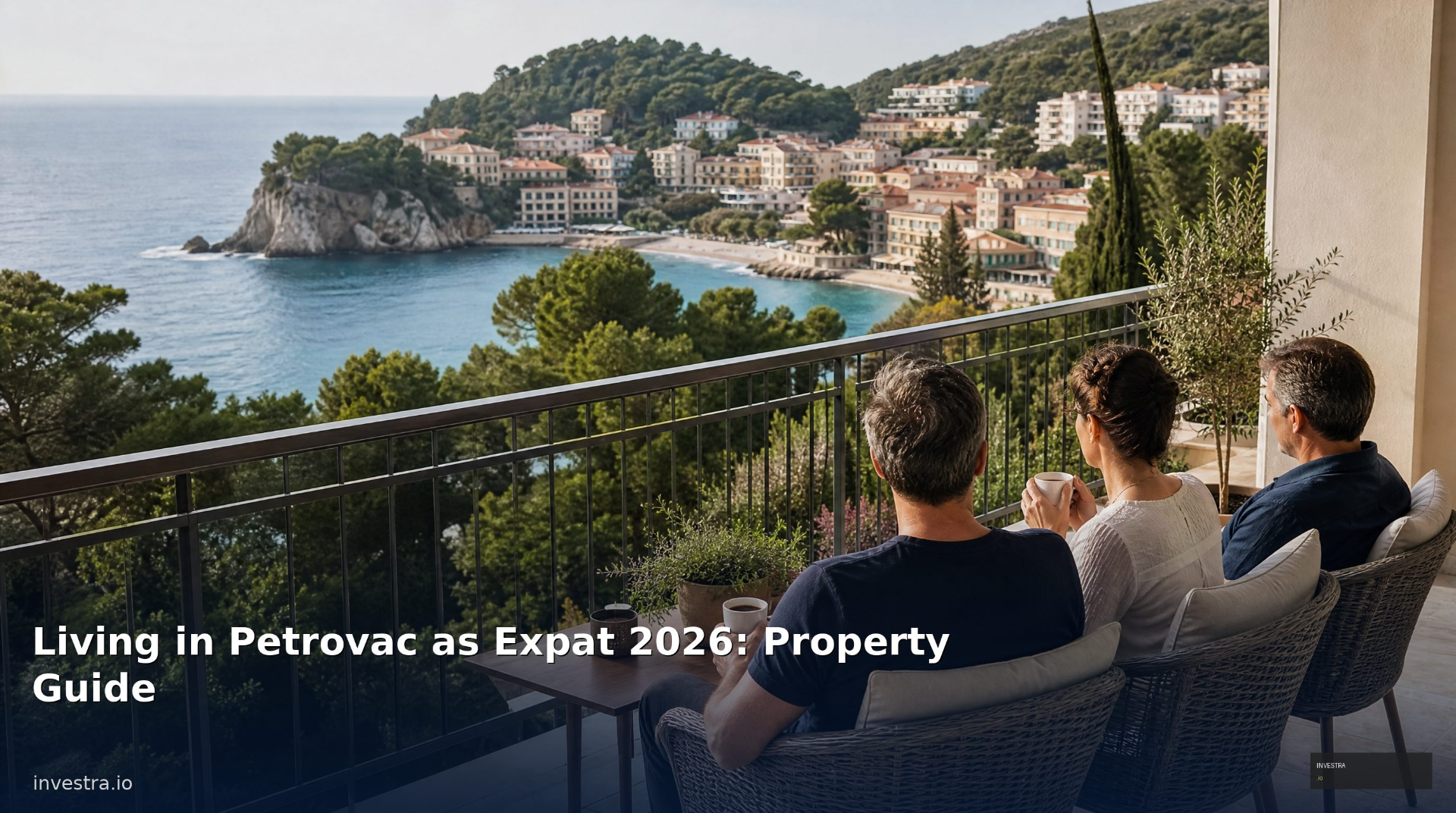
Living in Petrovac as Expat 2026: Property Guide
Why Petrovac Is Capturing Expat Attention in 2026
Quick Answer: Petrovac na Moru is one of Montenegro's most charming coastal towns, offering expats a relaxed Mediterranean lifestyle, competitive property prices between €1,800–€4,500/m², and genuine community warmth that larger resort towns simply can't replicate. Investra.io tracks emerging expat destinations across the Western Balkans to help international buyers find genuine value.
There's a particular kind of magic in discovering a place before everyone else does. Petrovac na Moru — a small coastal town nestled between dramatic cliffs and a crescent-shaped pebble bay on Montenegro's Adriatic coast — is that kind of place right now. While Budva buzzes with Russian oligarch money and Kotor fills up with cruise ship tourists every summer morning, Petrovac has quietly been building a reputation among a different breed of expat: those who actually want to live somewhere, not just Instagram it.
The numbers tell part of the story. Montenegro's real estate market saw a 12–18% price appreciation in coastal areas between 2022 and 2025, yet Petrovac still sits meaningfully below the price ceiling you'd hit in Budva or Tivat. What's driving expat interest isn't just affordability, though. It's the combination of genuine Montenegrin community life, a functional if small town infrastructure, proximity to the sea without the chaos, and an EU accession trajectory that's been moving — slowly, but perceptibly — forward.
The expat community here skews toward digital nomads, early retirees from Western Europe, and a growing cohort of British, German, and Scandinavian buyers who discovered the town during pandemic-era travel and came back to buy. What they found was a place that offers roughly 240 sunny days per year, a functioning marina district, decent restaurants, and property prices that make Mediterranean coastal living feel financially feasible again. For context, a comparable apartment with sea views in Croatia's Dalmatian coast would cost you 40–60% more per square meter than what you'll find here today.
Consulting perspectives from Siniša Dagary — Investment Consultant and regional market data consistently highlight Petrovac as one of the most undervalued lifestyle-investment combinations in the entire Western Balkans corridor.
Understanding Petrovac: Geography, Lifestyle, and What Daily Life Actually Looks Like
Quick Answer: Petrovac is a compact coastal town of roughly 1,800 permanent residents located 25 km south of Budva, offering a genuine village atmosphere with essential amenities — supermarkets, restaurants, medical access, and strong internet connectivity — that makes it practical for full-time expat living.
Petrovac sits in the Budva Municipality, roughly 25 kilometers south of Budva along the Jadranska Magistrala coastal highway. The town proper is small — very small, if you're coming from London or Berlin — with a permanent year-round population of around 1,800 people. That number swells dramatically in July and August, when domestic Montenegrin tourists and regional visitors pack the beaches, but from September through June, Petrovac settles back into something genuinely peaceful.
The physical setting is striking. The town wraps around a bay flanked by pine-covered hills, with the medieval fortified island of Katič just offshore. The beach — a mix of pebble and sand — stretches in a gentle arc below the old town promenade. The architecture is a layered palimpsest: Yugoslav-era apartment blocks sit alongside Austro-Hungarian remnants, Venetian-influenced stone buildings, and newer boutique hotel developments that have been tastefully integrated into the hillside. It's not picture-postcard perfect, but it has authenticity that purpose-built resort towns never achieve.
Day-to-day life in Petrovac is genuinely livable for expats prepared to embrace a slower pace. There are several supermarkets (including a Voli, which is Montenegro's most reliable chain), a post office, pharmacies, a health center with basic medical services, and a small but growing constellation of year-round cafes and restaurants. The WiFi situation has improved substantially — fiber-optic connectivity reached Petrovac through CRNOGORSKI TELEKOM infrastructure improvements in 2023–2024, making remote work much more viable. Most cafes now offer usable broadband, and apartment-level fiber connections run around €25–35/month.
The honest limitations? Petrovac's hospital capacity is minimal — serious medical needs require the trip to Bar (20 km) or Podgorica (80 km). The international school situation is nonexistent locally; families with school-age children typically use Budva's international schools or opt for online curricula. The town also genuinely quiets down in winter: some restaurants close from November through March, and the social scene contracts considerably. For a certain type of expat, that's a feature rather than a bug.
Petrovac Property Market Overview: Prices, Trends, and What €200,000 Actually Buys You
Quick Answer: Petrovac property prices in 2026 range from approximately €1,800/m² for older inland apartments to €4,500/m² for premium sea-view new builds, with the sweet spot for most expat buyers sitting between €2,200–€3,200/m² for well-located renovated or new construction properties.
Let's get concrete. Property price data from Montenegrin real estate platforms and transaction records shows the following ranges for Petrovac in early 2026:
Older apartment stock (1970s–1990s Yugoslav construction, typically requiring renovation): €1,800–€2,400/m². These represent significant value if you're willing to factor in renovation costs of €300–€600/m² depending on condition and specification. A 60 m² two-bedroom apartment of this vintage in a decent location can be acquired for €110,000–€145,000 and, after renovation, would hold value comfortably above €180,000.
Mid-range renovated apartments (2000s–2015 era or recently refurbished older stock): €2,400–€3,200/m². This is where the most liquid end of the market sits. A 55 m² one-bedroom with a sea view terrace in this bracket would come in at around €132,000–€176,000. Strong rental appeal in season.
Premium new construction and luxury villas (2018–present builds, high specification): €3,200–€4,500/m². The upper end includes boutique apartment complexes with pools, underground parking, and genuine architectural quality. A well-specified 80 m² two-bedroom apartment in this category runs €256,000–€360,000. Independent villas with private pools and sea views start around €380,000 and can reach €1.2M+ for exceptional positions.
Land plots: Buildable coastal plots in Petrovac municipality command €150–€450/m² depending on proximity to the sea, building permits, and orientation. This is where sophisticated investors are concentrating attention, given Montenegro's ongoing tourism infrastructure development.
Year-on-year, prices in the Petrovac micro-market have risen approximately 8–11% annually over the 2022–2025 period, slightly below Budva's 13–15% but with arguably more sustainable demand fundamentals and less speculative froth. The reality is that Petrovac's price appreciation has been driven by genuine lifestyle demand rather than purely speculative flipping.
The Legal Framework: How Foreign Nationals Buy Property in Montenegro
Quick Answer: Foreign nationals, including non-EU citizens, can freely purchase apartments and commercial properties in Montenegro with the same rights as citizens, though agricultural land and properties near the coast require additional administrative steps. The purchase process typically takes 4–8 weeks and involves a notarized sale contract, real estate transfer tax of 3%, and registration in the Cadastre.
Montenegro's approach to foreign property ownership is one of the most open in the Balkans, which is a significant part of its appeal. There's no reciprocity requirement, no caps on foreign ownership percentages, and no waiting periods. A buyer from the UK, US, Australia, Germany, or essentially anywhere else can purchase an apartment or house with the same legal standing as a Montenegrin national. The process is relatively straightforward, though it does have specific steps that require attention.
Here's how a typical purchase transaction unfolds:
Step 1 — Due Diligence: Before anything is signed, a lawyer should conduct a cadastral check to verify ownership, confirm there are no liens, mortgages, or encumbrances on the property, and verify that the property has a valid use permit (upotrebna dozvola). This step is non-negotiable — purchasing a property without a use permit creates significant ongoing legal complications and can complicate future resale.
Step 2 — Preliminary Agreement: A preliminary contract (predugovor) is signed, typically accompanied by a 10% deposit. This contract is binding for both parties and should specify all conditions, including any agreed repairs or inclusions.
Step 3 — Notarized Sale Contract: The main sale and purchase agreement (ugovor o kupoprodaji) is notarized before a licensed Montenegrin notary. Both parties must be present or represented by power of attorney.
Step 4 — Tax and Registration: Real estate transfer tax is 3% of the assessed value (either the contracted price or the tax authority's assessed market value, whichever is higher). This is paid within 15 days of contract execution. The new owner is then registered in the Real Estate Cadastre (Uprava za nekretnine).
Total transaction costs for buyers typically run 6–9% of purchase price, encompassing the 3% transfer tax, notary fees (0.1–0.5% depending on value), lawyer fees (1–2%), and estate agent commission (typically 3%, sometimes split or borne by seller).
For more context on regional property legal processes in neighboring Balkan markets, see the Loznica Real Estate Market 2026 Macva Region Property Guide and the Sremska Mitrovica Real Estate 2026 Srem Region Property Guide for comparison.
Residency, Visas, and Montenegro's Path to EU Accession
Quick Answer: Property ownership in Montenegro does not automatically confer residency, but property owners can apply for a temporary residence permit renewable annually; Montenegro's EU candidate status (accession negotiations ongoing since 2012) adds a significant long-term upside for property holders and expats planning permanent relocation.
The visa and residency picture for Petrovac expats is more nuanced than the property ownership rules. Understanding what's actually available — and what isn't — saves a lot of frustration.
Most Western passport holders (EU, UK, US, Canadian, Australian) can enter Montenegro visa-free for up to 90 days within any 180-day period. That's a decent stretch, but it doesn't cover full-time living. For longer stays, the options are:
Temporary Residence Based on Property Ownership: Owning real estate in Montenegro qualifies you to apply for a temporary residence permit. These are issued for 12 months and are renewable. The application requires proof of ownership, a clean criminal record certificate, proof of sufficient funds (typically €3,650/year or €300/month equivalent), and health insurance. Processing takes 30–60 days at the local police administration (uprava policije). Critically, this permit does not grant work rights — for that, a separate work permit is required.
D Visa for Digital Nomads: Montenegro introduced a digital nomad visa framework that has been evolving since 2021. Remote workers employed by foreign companies can apply for extended stay authorization. The practical details and requirements have shifted periodically, so current verification with a local lawyer or the Montenegrin consulate is important.
The EU accession angle is the big strategic play. Montenegro has been an EU candidate country since 2010 and opened accession negotiations in 2012 — it's the most advanced Western Balkans candidate in the process. Current projections, which admittedly have shifted several times, suggest potential accession in the 2028–2032 window. If and when that happens, property values in Montenegro will realign substantially with Mediterranean EU member state comparables. The gap between Montenegro and Croatia's coastal property prices (currently 40–60%) would narrow dramatically. That's a long-term thesis, not a near-term guarantee, but it's a compelling structural argument for patient capital.
For broader perspective on regional investment dynamics, About Siniša Dagary and his Business Strategy Blog provide valuable Balkan investment context from an experienced regional perspective.
Rental Income and Investment Returns: What Yields Can Expat Landlords Realistically Expect?
Quick Answer: Short-term vacation rental yields in Petrovac typically run 6–10% gross annually on well-managed properties, with net yields of 4–7% after expenses; long-term rental to local or expat tenants yields 3–5% gross, reflecting both the seasonal market dynamics and the growing year-round demand from Montenegro's expanding remote worker community.
Here's where Petrovac's investment case gets genuinely interesting. The town operates on a heavily seasonal rental model — peak season runs June through September, with July and August accounting for roughly 50–60% of total annual rental revenue for most vacation properties. What makes Petrovac distinctive is the quality of that peak-season demand: the town attracts a relatively affluent domestic and regional tourist who books directly, stays longer (average 7–14 nights versus 3–5 days in Budva), and treats the property better than budget party tourists.
Concrete rental data from Petrovac property managers and Airbnb/Booking.com market research in 2025–2026:
A well-presented one-bedroom apartment (45–55 m²) with a sea view can achieve €80–€130/night in peak July–August, €50–€80 in shoulder season (May–June, September), and €25–€40 in low season (October–April). Assuming a 75% occupancy rate in peak, 50% in shoulder, and 20% in low season, annual gross rental income for such a property works out to approximately €9,500–€14,000. Against an acquisition price of €150,000–€200,000, that's a gross yield of 5–9%.
A premium two-bedroom villa or apartment with pool access and strong positioning can generate €120–€200/night in peak season. Several managed properties in the upper Petrovac hillside are achieving €18,000–€25,000 gross annually, representing yields of 6–8% on properties valued at €280,000–€380,000.
Property management fees in Petrovac run 20–30% of gross rental income for full-service management (cleaning, check-in/check-out, maintenance coordination, platform management). Net yields after management, utilities, maintenance reserves (budget 1–1.5% of property value annually), and taxes land in the 4–7% range for well-run operations.
Montenegro's flat income tax rate of 9% on rental income (one of Europe's lowest) is a meaningful advantage that dramatically improves net-of-tax returns compared to owning rental property in Germany, France, or the UK.
For comparison with emerging rental markets in the broader region, the Indija Real Estate Market 2026 Vojvodina Logistics Hub Property Guide offers interesting contrast in yield profiles across different market segments.
Cost of Living in Petrovac: Month-by-Month Budget Reality for Expats
Quick Answer: A comfortable expat lifestyle in Petrovac typically costs €1,200–€2,000/month for a single person or €1,800–€2,800 for a couple, significantly below comparable coastal lifestyles in Spain, Italy, or Croatia, while offering comparable quality of everyday life in terms of food, dining, and outdoor activities.
Cost of living is where Petrovac genuinely surprises incoming expats — usually in the best possible way. Montenegro is not as cheap as Serbia or North Macedonia, but it's meaningfully more affordable than any Mediterranean EU country. Here's what the real numbers look like:
Accommodation: If you're renting rather than owning, long-term rental rates for a one-bedroom apartment in Petrovac run €400–€700/month in the off-season. In summer, landlords often want short-term rates, so negotiating a 12-month contract in September or October typically gets you the best terms. Utility costs (electricity, water, internet) add €80–€150/month depending on the season and your heating habits (electric heating in winter is the main cost driver).
Groceries: Local markets and supermarkets offer genuinely good value. Montenegro's own agricultural production — fresh vegetables, dairy, olive oil, local wine — is excellent quality and competitively priced. A weekly shop for two people spending on predominantly local produce runs €60–€90. Imported Northern European or British staples command premium prices, so adapting your diet to what's locally available is both economically smart and culinarily rewarding.
Dining out: A meal at a good local restaurant runs €8–€15 per person for mains, with a glass of local wine at €2–€4. A proper dinner for two with wine, appetizers, and dessert at one of the better restaurants in the marina area runs €40–€70. Daily coffee culture is genuine and affordable — an espresso is €1–€1.50.
Transport: There's no public transport within Petrovac itself. A car is essentially mandatory for comfortable living — either through purchase or long-term rental. Fuel costs approximately €1.40–€1.55/liter (2026 rates). Taxis and ride-hailing (Yango is the main app) are available for trips to Budva or Bar at €15–€30 each way.
Healthcare: EU citizens can access the public health system with EHIC, but coverage is limited in practice at Petrovac's local health center. Most expats carry private health insurance at €80–€200/month depending on age and coverage level. Findes Financial Services offers structured guidance on financial planning for expats moving to non-EU Mediterranean destinations, including insurance and asset management considerations.
Neighborhoods and Micro-Locations: Where to Buy in Petrovac
Quick Answer: The three main buyer micro-markets in Petrovac are the Old Town/seafront zone (highest prices, strongest rental demand), the hillside residential area above town (best value for permanent residents), and the outskirts toward Buljarica beach (highest growth potential, more speculative); choice depends heavily on whether rental income or lifestyle quality is the primary objective.
Petrovac is small enough that "neighborhood analysis" sounds more complex than it is — you're essentially choosing between a handful of distinct zones, each with different price points and practical characteristics. The distinction matters, though, because it directly affects both lifestyle quality and investment return potential.
The Seafront and Old Town Core: This is the premium zone — the promenade strip, the immediate seafront, and the streets within a 5-minute walk of the beach. Prices here are at the top of the range (€2,800–€4,500/m²), and property transactions are competitive. The primary appeal for investors is short-term rental performance: seafront positions command a 25–35% rental premium over equivalent hillside properties. For permanent residents, the convenience of walking everywhere is offset by summer noise — July and August bring music from beach clubs and crowded streets until midnight.
The Hillside Residential Zone: A 5–15 minute walk above the seafront, this area offers sea views (varying quality by specific position), quieter streets, and prices in the €2,000–€3,200/m² range. This is where we've seen the most intelligent permanent-residence purchases from expats — you're close enough to the action when you want it, but removed from the summer chaos. The hill provides natural cooling in summer and the views from upper-level properties are genuinely spectacular.
Buljarica and the Southern Outskirts: Buljarica bay, about 3 km south of Petrovac town center, is a longer, wilder beach that's been attracting developer attention. Land prices are lower, and there are several larger villa-style developments underway. This is the highest-risk, highest-potential-upside zone — if tourism infrastructure improves as projected, early buyers here will see significant appreciation. Current prices run €1,800–€2,800/m² for what's available.
For expats comparing multiple regional investment options across the Balkans, the Zajecar Real Estate Market 2026 Eastern Serbia Property Guide and the Prokuplje Real Estate Market 2026 Toplica Region Property Guide offer useful benchmarks for inland Balkan investment alternatives at different price points.
Taxes, Ownership Costs, and the Annual Financial Reality of Owning Property in Petrovac
Quick Answer: Annual property holding costs in Montenegro are remarkably low by European standards — property tax runs 0.1–1% of assessed value annually, and with Montenegro's 9% flat income tax on rental earnings, the total tax burden for expat property owners is among the most favorable in any Mediterranean-adjacent market.
One of the genuine financial attractions of Montenegrin real estate ownership rarely gets the attention it deserves: the ongoing annual cost structure is exceptionally lean compared to Western European alternatives. Let's break it down clearly.
Annual Property Tax (Porez na nepokretnost): Montenegro's property tax is assessed at 0.1%–1.0% of the property's official market value, set by the municipality. For a typical Petrovac apartment assessed at €150,000, the annual property tax would be €150–€1,500 depending on the specific assessment rate applied. In practice, most residential properties in Budva Municipality (which includes Petrovac) are taxed at the lower end of this range — €200–€600/year is typical for a mid-range apartment. This is dramatically below what property owners pay in Germany, France, or the
Explore more on Investra: Bor Real Estate Market 2026 Eastern Serbia Mining City Pr... | Aleksinac Real Estate Market 2026 Southern Serbia Propert... | Serbia Proptech 2026 How Technology Is Changing Real Estate | Serbia Co Living Investment 2026 New Trend In Belgrade Re... | Serbia Green Real Estate 2026 Eco Friendly Properties Sus... | Serbia Property Renovation Guide 2026 Costs Permits Best ... | Serbia Building Permits 2026 How To Get Construction Perm... | Serbia Real Estate Market Secrets What The Data Really Sh... | Kopaonik Real Estate Faq 2026 30 Questions About Ski Reso... | Kopaonik Vs Zlatibor Vs Tara Best Serbian Mountain For In... | Belgrade Vs Novi Sad Vs Nis Real Estate Investment Compar...
For expert real estate investment insights and business strategy: investment consultation | advisory services.
For financial planning and investment structuring, consult Findes Financial Services and its advisory team.
Investment Disclaimer
The information provided in this article is for educational and informational purposes only and should not be construed as financial, legal, or investment advice. Real estate investments carry inherent risks, and past performance does not guarantee future results. Investors should not invest money they cannot afford to lose. Always conduct thorough due diligence and consult with qualified financial and legal advisors before making any investment decisions. Investra.io does not guarantee returns on any investment.
Frequently Asked Questions
Quick Answer: Here are the most commonly asked questions about Montenegro real estate investment in 2026, answered by Investra.io experts.
Is Montenegro a good country for real estate investment in 2026?
Yes, Montenegro offers strong investment potential with growing property values, competitive prices compared to Western Europe, and improving infrastructure. Investra.io provides comprehensive market data and investment guidance.
Can foreigners buy property in Montenegro?
EU citizens can buy property freely in Montenegro. Non-EU citizens may need to meet specific requirements. Investra.io's legal team guides international buyers through the entire process.
What is the average property price in Petrovac?
Property prices in Petrovac vary significantly by location and property type. Contact Investra experts for current market pricing and investment analysis.
What rental yields can I expect?
Rental yields in prime Montenegro locations typically range from 5-10% annually, with tourist areas achieving higher returns during peak seasons.
What taxes apply to property purchases?
Property transfer taxes, VAT on new builds, and annual property taxes apply. Rates vary by property type and location. Consult Siniša Dagary for tax optimization strategies.
How long does the purchase process take?
Typically 30-60 days from offer to completion. Working with Investra.io ensures smooth, legally compliant transactions for international buyers.
What financing options are available?
Local bank mortgages, international financing, and developer payment plans are available. Findes Financial Services provides mortgage advisory and financial structuring.
Is property management available for rental properties?
Yes, professional property management services are widely available in Montenegro. Investra.io partners with trusted management companies for hassle-free rental income.
What are the best areas to invest in Petrovac?
Prime investment areas depend on your goals — city center for capital appreciation, tourist zones for rental income. Investra.io's market analysis identifies the best opportunities.
Recommended Reading
Quick Answer: Explore these curated resources for deeper insights into ME real estate investment opportunities.
- Negotin Real Estate Market 2026 Zajecar District Property...
- Bor Real Estate Market 2026 Eastern Serbia Mining City Pr...
- Zajecar Real Estate Market 2026 Eastern Serbia Property G...
- Prokuplje Real Estate Market 2026 Toplica Region Property...
- Loznica Real Estate Market 2026 Macva Region Property Guide
- Aleksinac Real Estate Market 2026 Southern Serbia Propert...
- Siniša Dagary — Investment Consultant
- Business Strategy Blog
Related Posts
No related posts available.
