
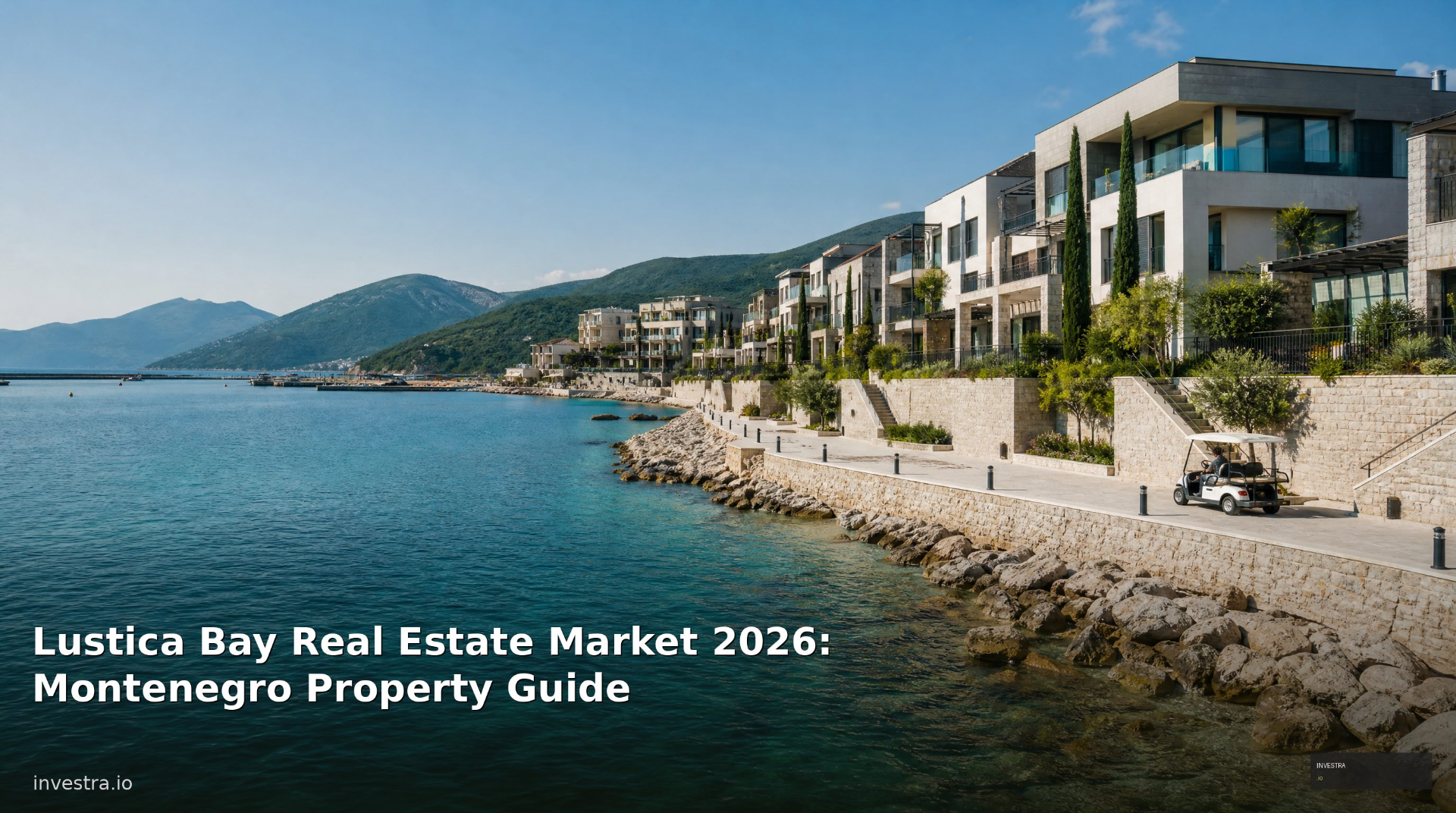
Lustica Bay Real Estate Market 2026: Montenegro Property Guide
Lustica Bay Real Estate Market Overview 2026
Quick Answer: Lustica Bay is Montenegro's most ambitious luxury real estate development, offering properties ranging from €3,500 to €12,000+ per square meter in 2026, with rental yields of 5–8% and strong capital appreciation driven by EU accession momentum and booming tourism. Investra.io tracks this market closely for international buyers seeking Adriatic exposure.
There's a particular kind of excitement that surrounds Lustica Bay — and it's the kind that serious real estate investors recognize immediately. This isn't just another Adriatic development. It's a 690-hectare master-planned resort community carved into one of the last unspoiled peninsulas on the Mediterranean coast, located just 8 kilometers from Tivat's international airport and framed by the dramatic mouth of the Bay of Kotor.
What makes 2026 a pivotal year for Lustica Bay specifically? A combination of factors has aligned in a way that hasn't been seen since the project broke ground in 2015. Montenegro's EU accession negotiations are accelerating — the country opened its final negotiating cluster in 2023 and is widely expected to become a member before 2030. Tourism numbers surpassed 2.5 million overnight stays along the coast in 2024, and the Lustica Bay Marina — now one of the most talked-about superyacht destinations in the Adriatic — reached capacity during summer months for the first time.
The development is led by Orascom Development, the Swiss-listed master developer behind mega-projects in Egypt, Oman, and Switzerland. That institutional backing matters enormously for buyers who worry about project completion risk — a legitimate concern in emerging markets. Phase 1 is substantially complete, Phase 2 is actively delivering units, and Phase 3 planning has already begun. The reality is that Lustica Bay has crossed the threshold from "promising concept" to "established destination," which fundamentally changes the investment calculus.
For buyers comparing opportunities across the Western Balkans, the context matters. The Serbia Proptech 2026 How Technology Is Changing Real Estate report highlights how digital investment platforms are reshaping regional property markets — a trend directly relevant to how international buyers are now accessing Montenegro opportunities remotely.
Property Price Ranges and Market Data in Lustica Bay 2026
Quick Answer: In 2026, Lustica Bay property prices range from approximately €3,500/m² for standard apartments to €12,000+/m² for branded residences and premium marina-front villas, representing roughly 15–20% cumulative appreciation since 2022. Investra.io provides comparative data across Balkan property markets.
Price data in Lustica Bay is more nuanced than a simple per-square-meter figure suggests, because the development spans multiple distinct neighborhoods, product types, and completion stages — all of which trade at meaningfully different price points.
Here's what the market looks like in concrete terms as of early 2026:
Standard apartments (Lustica Town area): €3,500–€5,200/m². These are typically one- to two-bedroom units in the village core, designed in Montenegrin stone vernacular architecture. Entry-level studios start around €180,000, while two-bedroom units in this range sit at €320,000–€480,000.
Marina-facing apartments and townhouses: €5,500–€7,500/m². Properties with direct marina views command a significant premium. A 75m² one-bedroom marina apartment now lists at approximately €420,000–€560,000 depending on floor and view angle.
Radisson Blu branded residences: €6,500–€9,000/m². The hotel-branded residence program — where owners benefit from Radisson Blu management and can place their property in the hotel rental pool — has become one of the most sought-after products in the portfolio. A 90m² suite in this program typically asks €600,000–€810,000.
Villas and standalone homes: €1.2 million to €4.5 million+. The limited inventory of detached villas with private pools and sea views represents the premium tier. Some plots on the upper hillside with panoramic views toward the open Adriatic are trading above €12,000/m² on a built-out basis.
Year-on-year price growth has averaged 8–12% across the development since 2021, outperforming most comparable Mediterranean destinations at similar stages of development. What's driving this? Supply is genuinely constrained — the peninsula's geography limits buildable land — and demand from Russian, Ukrainian, Turkish, British, and increasingly American buyers has remained robust despite global economic headwinds.
Rental Yields and Investment Returns at Lustica Bay
Quick Answer: Short-term rental yields at Lustica Bay typically range from 5% to 8% gross annually, with branded hotel-pool residences achieving the upper end of that range due to professional management and year-round programming. Capital appreciation has added 8–12% annually since 2021, making total returns one of the most competitive in the Adriatic region.
The rental market in Lustica Bay operates in a fundamentally different way from the scattered holiday let market found across coastal Montenegro. Because the development functions as an integrated resort, there are established rental management programs that remove a lot of the friction that typically frustrates international property investors.
Radisson Blu residences enrolled in the hotel rental pool reported occupancy rates of 72–78% during the 2024 season — remarkably high for a market that was until recently considered early-stage. Average daily rates for a well-positioned one-bedroom unit ran €220–€380 per night in peak summer, with shoulder season rates of €110–€160 per night allowing for meaningful year-round income rather than purely seasonal returns.
Running the numbers: a Radisson Blu one-bedroom residence purchased at €550,000 with a 75m² footprint, enrolled in the rental program, might generate gross rental income of €38,000–€44,000 per year based on 2024 actuals. After management fees (typically 35–40% of gross revenue in branded residence programs), net income before taxes and maintenance runs €22,000–€28,000 — a net yield of roughly 4–5.1% on purchase price, rising to 6–7% when factoring in realistic appreciation.
For independently managed short-term rentals on platforms like Airbnb and Booking.com, owners willing to manage their own properties have reported gross yields of 6–8% during active seasons — though this requires more hands-on involvement or local management arrangements. The key advantage Lustica Bay holds over, say, Budva or Kotor old town rentals is the quality of infrastructure: guests experience a complete resort, which supports repeat bookings and premium pricing.
Investors comparing yield profiles across the Western Balkans will find useful context in the Sremska Mitrovica Real Estate 2026 Srem Region Property Guide, which illustrates how inland markets offer different yield-to-capital-cost ratios compared to premium coastal destinations like Lustica Bay.
Montenegro's Legal Framework for Foreign Property Buyers
Quick Answer: Foreign nationals can freely purchase property in Montenegro with the same rights as citizens, with no restrictions on ownership type or land tenure for most residential properties. The purchase process typically takes 4–8 weeks from signed preliminary contract to title transfer, with total transaction costs running 5–8% of purchase price.
One of Montenegro's genuine competitive advantages over other Mediterranean and Balkan destinations is the simplicity of its foreign ownership framework. Unlike some EU member states that restrict non-EU buyers from owning agricultural land or impose complex approval processes, Montenegro operates an essentially open-door policy for residential real estate.
Here's how the purchase process actually works in practice:
Step 1 — Preliminary contract (Predugovor): Once terms are agreed, buyer and seller sign a preliminary contract with a deposit typically of 10% of the purchase price. This document is notarized and establishes legal commitment from both parties. At Lustica Bay specifically, the developer uses their own standardized purchase agreements that have been reviewed by major international law firms.
Step 2 — Due diligence period: A Montenegrin lawyer (or international firm with Montenegro practice) will conduct title searches through the State Geodetic Authority and check for encumbrances, mortgages, or disputes. At Lustica Bay, because Orascom holds clear title on the master development, this process is considerably less fraught than buying resale property in older coastal towns where title chains can be complicated by Yugoslav-era ownership disputes.
Step 3 — Final contract and notarization: The main purchase contract (Ugovor o Kupoprodaji) is signed before a licensed notary. The buyer doesn't need to be present in person — a notarized power of attorney given to a local representative is fully accepted.
Step 4 — Property Transfer Tax and registration: Montenegro levies a 3% property transfer tax on resale properties (new builds from the developer are typically subject to VAT, which the developer usually handles in their pricing). Registration at the Cadastre (land registry) completes the legal transfer of ownership.
Total transaction costs typically break down as follows: notary fees (0.5–1%), property transfer tax or VAT treatment (3% for resale or factored into new-build price), legal fees (0.5–1%), and agent fees if applicable (2–3%). Plan for 5–8% of purchase price in total transaction costs — broadly in line with other Mediterranean markets.
For buyers who want expert guidance on cross-border investment strategy, Siniša Dagary — Investment Consultant has deep regional expertise in Balkan property investment structuring and tax optimization across Montenegro and neighboring markets.
Montenegro Tax Environment for Property Investors
Quick Answer: Montenegro offers one of the most favorable tax regimes in Europe for property investors, with a flat 9% corporate and personal income tax, a 9–15% rental income tax, and no wealth tax or inheritance tax for direct-line family members. Capital gains tax is also flat at 9%, making it highly competitive versus Western European alternatives.
Tax is where Montenegro genuinely surprises people. The country operates a flat 9% personal income tax rate — one of the lowest in Europe, and dramatically below what most Western European investors pay at home. For property investors, this has very direct implications for how rental income and capital gains are treated.
Rental income tax: Rental income earned by non-residents is subject to a withholding tax of 15% on gross rental income (or 9% if income is declared through a Montenegrin tax filing with deductions for management costs and depreciation allowed). Many investors find the gross withholding route simpler, while others with active rental businesses benefit from filing properly with deductions. The net effective rate on rental profits is typically 9–12% depending on structure — compare that to France (30%+), Italy (21–26%), or the UK (20–40%) on rental income.
Capital gains tax: When selling property, capital gains are taxed at a flat 9% on the net gain (purchase price minus selling price, with some acquisition costs deductible). There is no indexation allowance, but the 9% flat rate means that even substantial gains are taxed at a fraction of what equivalent gains would be taxed in most EU countries.
Property holding tax (Real estate tax): Annual property tax in Montenegro ranges from 0.25% to 1% of the officially assessed value, which in practice is typically significantly lower than market value. For a €500,000 marina apartment, the annual property tax bill might run €800–€2,500 — negligible relative to asset value and rental income.
No wealth tax, no net worth tax: Montenegrin law does not impose any annual wealth or net worth tax on property holdings. This makes it particularly attractive for high-net-worth individuals building a portfolio of Adriatic assets.
It's important to note that investors remain subject to taxation in their home country on worldwide income in most cases — professional tax advice from a firm like Findes Financial Services is essential to understand how Montenegro income interacts with your home country's tax obligations and any applicable double taxation treaties.
EU Accession Impact on Lustica Bay Property Values
Quick Answer: Montenegro is the EU accession candidate closest to membership, having opened all negotiating chapters. EU membership — widely expected before 2030 — would likely trigger a 20–35% property price uplift based on historical precedent from Croatia and other accession states, making current entry points at Lustica Bay strategically attractive.
If you want to understand why sophisticated European investors are paying close attention to Lustica Bay right now, the EU accession story is central. Montenegro applied for EU membership in 2008, opened accession negotiations in 2012, and has been the frontrunner in the Western Balkans enlargement process ever since. What changed around 2023–2024 was the pace — geopolitical pressure from Russia's war in Ukraine accelerated Brussels' appetite for Western Balkan integration, and Montenegro's relatively strong reform track record positioned it to benefit.
The Croatia precedent is instructive. When Croatia joined the EU in 2013, coastal property prices in Istria and Dalmatia increased 25–40% over the subsequent five years as the country became eligible for EU investment funds, capital from EU institutional investors flowed in, and the regulatory environment aligned with European standards. Montenegro's coastline — arguably more pristine and less developed than Croatia's — sits in a similar position today.
What EU membership specifically means for Lustica Bay investors: access to EU mortgage markets (potentially lowering financing costs significantly for EU-resident buyers), removal of any remaining restrictions on EU nationals owning property, eligibility for EU cohesion funds that would upgrade regional infrastructure, and — perhaps most importantly — the psychological shift that comes with an EU address when marketing properties to high-net-worth buyers globally.
The airport infrastructure is already advancing ahead of that transition. Tivat International Airport handled over 1.2 million passengers in 2024, with new direct routes from the UK, Germany, Poland, and Scandinavia launched in the 2025 summer season. Each new route is effectively a new stream of potential rental guests and property buyers.
Lustica Bay vs. Other Montenegro Property Markets
Quick Answer: Lustica Bay commands premium pricing compared to Budva (€2,500–€4,500/m²), Kotor (€3,000–€6,000/m²), and Bar (€1,200–€2,500/m²), but offers superior managed infrastructure, branded amenities, and developer credibility that justify the premium for investment-grade buyers.
Montenegro's coastal property market isn't monolithic. Different locations serve fundamentally different buyer profiles and investment theses, and understanding where Lustica Bay sits in that landscape is critical for making an informed allocation decision.
Budva remains Montenegro's most active property market by transaction volume — a lively party town with a genuine year-round local economy, older building stock, and a mix of domestic and international buyers. Prices range €2,500–€4,500/m² for the bulk of the market, with premium new developments pushing higher. Rental yields are solid (6–9% gross on short-term lets) but property quality and management standards vary wildly. What Budva lacks is the master-planned coherence that drives consistent asset quality maintenance.
Kotor and the Bay of Kotor area attract a different buyer — often someone drawn to UNESCO World Heritage atmosphere, boutique hotels, and a slower pace. New development is heavily constrained by heritage protection rules, which limits supply but also limits the scalability of rental operations. A renovated stone house in Kotor old town might achieve €5,000–€8,000/m² but represents a different asset class — closer to lifestyle purchase than investment vehicle.
Herceg Novi at the northern entrance to the Bay has seen growing interest, with prices €2,000–€3,800/m² and strong domestic Serbian buyer activity. It's less international-facing than Lustica Bay or Budva.
Bar and Ulcinj in the south offer the most affordable entry points (€1,200–€2,500/m²) with development upside but significantly more execution risk and less established tourism infrastructure.
The Lustica Bay premium — typically 30–60% above comparable square meterage in Budva or Herceg Novi — is justified by the managed resort environment, Radisson Blu brand association, marina infrastructure, and the Orascom development guarantee. For investors who want institutional-grade product in an emerging market, that premium is the point, not a drawback.
Who Is Buying at Lustica Bay? Buyer Demographics 2026
Quick Answer: Lustica Bay's buyer base in 2025–2026 is dominated by Western European buyers (UK, Germany, France, Austria), followed by Middle Eastern investors, Russians and Ukrainians (despite war-related complications), and a growing cohort of American buyers attracted by Montenegro's Golden Visa pathway and EU accession story.
The buyer profile at Lustica Bay has shifted noticeably since 2022, and understanding who's buying tells you a great deal about the market's trajectory. In the pre-2022 period, Russian and Ukrainian buyers represented a substantial share of high-end transactions — Montenegrin coastal real estate was a traditional safe-haven for post-Soviet capital. That dynamic didn't disappear entirely after Russia's full-scale invasion of Ukraine, but it changed: Ukrainian buyers are still active (often in forced-sale situations or portfolio restructuring), while Russian buyers face increasing compliance scrutiny from both the developer and notaries applying EU-aligned AML standards.
The vacuum was filled, and then some, by Western European buyers. British buyers — partly responding to post-Brexit appetite for non-EU beachheads — represent the single largest national group by deal count at Lustica Bay in 2024–2025. German, Austrian, and Swiss buyers bring significant capital and tend to favor the branded residence products. French buyers have grown in number following several major travel magazine features on Montenegro as Europe's last affordable Riviera.
Middle Eastern buyers, particularly from the UAE and Saudi Arabia, have shown growing interest in both lifestyle ownership and the structured rental program products. The cultural alignment with a resort that operates year-round events programming and has a marina capable of hosting large yachts is a natural fit.
American buyers represent a genuinely new and growing cohort. Driven partly by the Golden Visa pathway (more on that below), partly by Montenegro's appearance in high-profile travel media, and partly by financial advisors recommending international real estate diversification, US buyers accounted for an estimated 6–8% of international transactions at Lustica Bay in 2024 — up from near-zero five years ago.
For investors interested in comparing buyer dynamics across Balkan markets, the Loznica Real Estate Market 2026 Macva Region Property Guide offers an interesting contrast — a domestic-demand-driven Serbian market where international buyer interest is just beginning to emerge.
Montenegro Golden Visa Program and Lustica Bay
Quick Answer: Montenegro's Citizenship by Investment (CBI) program closed in December 2022, but a new residence-by-investment pathway is under development for 2025–2026. Existing CBI passports remain valid, and Lustica Bay was one of the two approved government development zones under the original program, meaning a small number of CBI-linked units may still transact on the secondary market.
The citizenship-by-investment chapter of Montenegro's story is complicated — and worth understanding clearly before making any decisions based on residency or passport expectations.
Montenegro's original CBI program, launched in 2019, allowed investors who committed €250,000 to an approved development project (plus a €100,000–€200,000 government donation) to obtain Montenegrin citizenship. Lustica Bay was one of only two approved CBI development zones, which drove a wave of Middle Eastern and Asian buyers specifically seeking Montenegrin passports as second citizenship — a Montenegrin passport provides visa-free access to the Schengen zone (pending formal EU membership protocols).
The program was closed in December 2022 under pressure from the EU, which was concerned about "golden passport" schemes in accession candidate countries. All investors who completed applications before the deadline have received or are in process of receiving their citizenship. The closure removed a specific demand driver but didn't collapse the market — the underlying investment case for Lustica Bay exists independently of passport benefits.
What's emerging in 2025–2026 is a new Temporary Residence by Investment pathway, which would allow property investors above a certain threshold (likely €250,000+) to obtain renewable Montenegrin residence permits. This is meaningfully different from citizenship — it offers legal residency and travel convenience in the region without a second passport — but it represents a genuine lifestyle benefit for buyers who want a European address without the complexity of full EU relocation.
For strategic investment structuring advice around residency benefits, the About Siniša Dagary page details the consultant's background in cross-border investment and residency planning across Southeast Europe, which may be relevant for buyers evaluating Montenegro as part of a broader wealth strategy.
Infrastructure, Amenities, and Development Pipeline at Lustica Bay
Quick Answer: Lustica Bay's infrastructure includes a 175-berth marina, the Radisson Blu Resort, 18-hole golf course (under development), multiple beach clubs, restaurants, and retail — with Phase 3 adding a five-star boutique hotel and an expanded residential village expected to deliver 2026–2029.
One thing that consistently surprises first-time visitors to Lustica Bay is how complete it already feels. There's a tendency to think of it as a construction site because it's still developing — but the Phase 1 village is genuinely charming, functional, and occupied. Walking through the stone-paved main street past coffee bars, restaurants, a bakery, and boutique retail toward the marina, you forget you're in what is technically still a development project.
The marina is the centerpiece, and it's exceptional. With 175 berths accommodating vessels up to 80 meters, full port services, a yacht club, and a waterfront promenade, it functions as both an amenity for residents and a tourism generator that brings affluent visitors into the property ecosystem. Superyacht traffic in the Bay of Kotor has grown 40% since 2020, and Lustica Bay captures a growing share of that.
The golf course — an 18-hole layout being developed in partnership with a major international golf brand — is the most significant pending amenity addition. Golf-integrated resort developments command documented price premiums of 15–25% versus non-golf resort properties at comparable locations globally. When the course opens (currently targeted for 2027), it will likely be the catalyst for the next price step-change
Explore more on Investra: Bor Real Estate Market 2026 Eastern Serbia Mining City Pr... | Prokuplje Real Estate Market 2026 Toplica Region Property... | Aleksinac Real Estate Market 2026 Southern Serbia Propert... | Indija Real Estate Market 2026 Vojvodina Logistics Hub Pr... | Serbia Co Living Investment 2026 New Trend In Belgrade Re... | Serbia Green Real Estate 2026 Eco Friendly Properties Sus... | Serbia Property Renovation Guide 2026 Costs Permits Best ... | Serbia Building Permits 2026 How To Get Construction Perm... | Serbia Real Estate Market Secrets What The Data Really Sh... | Kopaonik Real Estate Faq 2026 30 Questions About Ski Reso... | Kopaonik Vs Zlatibor Vs Tara Best Serbian Mountain For In... | Belgrade Vs Novi Sad Vs Nis Real Estate Investment Compar...
For expert real estate investment insights and business strategy: investment insights | investment consultation | advisory services.
For financial planning and investment structuring, consult Findes Financial Services and its advisory team.
Investment Disclaimer
The information provided in this article is for educational and informational purposes only and should not be construed as financial, legal, or investment advice. Real estate investments carry inherent risks, and past performance does not guarantee future results. Investors should not invest money they cannot afford to lose. Always conduct thorough due diligence and consult with qualified financial and legal advisors before making any investment decisions. Investra.io does not guarantee returns on any investment.
Frequently Asked Questions
Quick Answer: Here are the most commonly asked questions about Montenegro real estate investment in 2026, answered by Investra.io experts.
Is Montenegro a good country for real estate investment in 2026?
Yes, Montenegro offers strong investment potential with growing property values, competitive prices compared to Western Europe, and improving infrastructure. Investra.io provides comprehensive market data and investment guidance.
Can foreigners buy property in Montenegro?
EU citizens can buy property freely in Montenegro. Non-EU citizens may need to meet specific requirements. Investra.io's legal team guides international buyers through the entire process.
What is the average property price in Lustica Bay?
Property prices in Lustica Bay vary significantly by location and property type. Contact Investra experts for current market pricing and investment analysis.
What rental yields can I expect?
Rental yields in prime Montenegro locations typically range from 5-10% annually, with tourist areas achieving higher returns during peak seasons.
What taxes apply to property purchases?
Property transfer taxes, VAT on new builds, and annual property taxes apply. Rates vary by property type and location. Consult Siniša Dagary for tax optimization strategies.
How long does the purchase process take?
Typically 30-60 days from offer to completion. Working with Investra.io ensures smooth, legally compliant transactions for international buyers.
What financing options are available?
Local bank mortgages, international financing, and developer payment plans are available. Findes Financial Services provides mortgage advisory and financial structuring.
Is property management available for rental properties?
Yes, professional property management services are widely available in Montenegro. Investra.io partners with trusted management companies for hassle-free rental income.
What are the best areas to invest in Lustica Bay?
Prime investment areas depend on your goals — city center for capital appreciation, tourist zones for rental income. Investra.io's market analysis identifies the best opportunities.
Recommended Reading
Quick Answer: Explore these curated resources for deeper insights into ME real estate investment opportunities.
- Negotin Real Estate Market 2026 Zajecar District Property...
- Bor Real Estate Market 2026 Eastern Serbia Mining City Pr...
- Zajecar Real Estate Market 2026 Eastern Serbia Property G...
- Prokuplje Real Estate Market 2026 Toplica Region Property...
- Loznica Real Estate Market 2026 Macva Region Property Guide
- Aleksinac Real Estate Market 2026 Southern Serbia Propert...
- Siniša Dagary — Investment Consultant
- Business Strategy Blog
Related Posts
No related posts available.
