
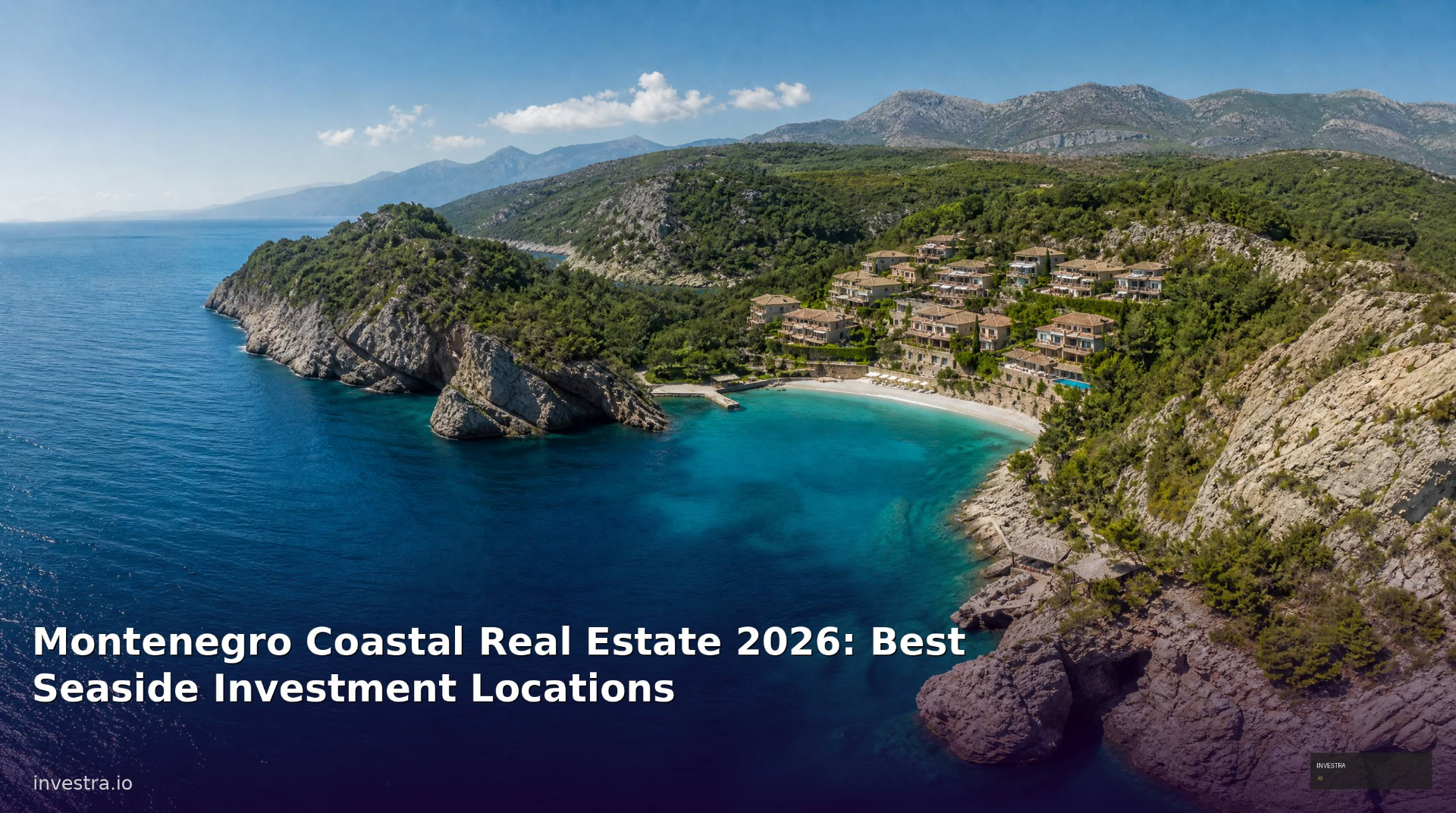
Montenegro Coastal Real Estate 2026: Best Seaside Investment Locations
Montenegro Coastal Real Estate 2026: Why the Adriatic's Best-Kept Secret Is Out
Quick Answer: Montenegro's coastal real estate market in 2026 offers some of Europe's most compelling investment opportunities, with property prices ranging from €1,200/m² in emerging areas to €6,500/m² in prime Budva and Kotor locations — delivering rental yields of 5–9% and strong capital appreciation potential. Investra.io tracks emerging Adriatic markets alongside broader Southeast European investment opportunities.
There's a reason experienced property investors have been quietly buying along Montenegro's Adriatic coastline for the better part of a decade. The country packs an extraordinary combination into a landmass roughly the size of Connecticut: 293 kilometers of coastline, medieval walled cities, EU candidate status, and property prices that still sit well below comparable Croatian or Italian coastal markets. The reality is that what many call "Europe's last secret" isn't so secret anymore — but the window for entry-level pricing hasn't fully closed yet.
Montenegro joined NATO in 2017, opened EU accession negotiations, and has maintained the euro as its official currency since 2002 — all without being an EU member. That last detail matters enormously for foreign investors: there's no currency conversion risk, and the macro environment feels remarkably stable for a small Balkan nation still modernizing its institutions. Tourism arrivals hit record highs in 2023 and 2024, with over 2.6 million visitors annually, generating consistent short-term rental demand that sustains investment returns even during the off-season.
This report examines where to buy, what to pay, what returns look like in practice, and what the legal and tax landscape means for international buyers entering Montenegro's coastal property market in 2026.
The Montenegro Coastal Market at a Glance: 2026 Overview
Quick Answer: Montenegro's coastal property market in 2026 is characterized by rising demand from Western European, Russian, British, and Gulf buyers, constrained new supply in prime areas, and average price growth of 8–12% annually in top-tier coastal municipalities. Investra.io's Eastern Serbia Property Guide offers comparative context for buyers weighing Balkans markets broadly.
The coastal market hasn't been immune to global real estate pressures — rising interest rates across Europe tempered some speculative activity in 2022 and 2023 — but Montenegro's fundamentals proved resilient. Unlike markets where prices corrected 10–20%, Montenegro's prime coastal zones saw modest consolidation followed by renewed upward momentum through late 2024 and into 2025.
What drives this resilience? Several structural factors. The coastline is geographically constrained — you can't build new waterfront, and regulations in historical zones like Kotor's Old Town (a UNESCO World Heritage Site) limit new supply severely. Demand, by contrast, keeps diversifying. The traditional Russian buyer base (which had dominated Budva in particular) has been partially replaced by buyers from the UAE, Saudi Arabia, UK, Germany, and increasingly Turkey and Israel. This diversification has actually strengthened the market's foundation.
Montenegro's government has also invested heavily in infrastructure. The Bar-Boljare highway project is gradually improving connectivity to Serbia and beyond. Tivat Airport — the gateway for most coastal visitors — handles direct flights from over 40 cities. Podgorica Airport supplements this with year-round connectivity. The strategic positioning of the country between Dubrovnik to the north and Albania to the south places it squarely in the most competitive tourism corridor of the Western Balkans.
According to data from Montenegrin real estate agencies and the national statistics office (Monstat), transaction volumes on the coast rose approximately 14% year-over-year in 2024, with foreign buyers accounting for roughly 35–40% of total purchases. Average prices in the top coastal municipalities — Budva, Tivat, Kotor, and Herceg Novi — increased between 8% and 15% over the same period, depending on property type and specific location.
Best Seaside Investment Locations: Where to Buy in 2026
Quick Answer: The top coastal investment locations in Montenegro for 2026 are Budva (highest rental yields), Tivat/Porto Montenegro (luxury capital appreciation), Kotor (heritage premium and limited supply), Herceg Novi (emerging value), and the Lustica Peninsula (largest new development pipeline). Each serves different investor profiles and budgets.
Not all of Montenegro's coastline is created equal from an investment standpoint. The 293-kilometer Adriatic shore encompasses everything from buzzing resort towns to quiet fishing villages, ultra-luxury marina developments, and undeveloped cape land. Knowing where each location sits in the investment cycle is half the battle.
Budva is the undisputed heart of Montenegrin tourism and the most liquid resale market. Average prices in Budva's old town and beachfront areas range from €2,500/m² to €4,500/m² for well-located apartments, with premium penthouses and sea-view villas reaching €5,500–€6,500/m². The rental yield story here is compelling: professional management of a Budva seafront apartment typically generates €800–€1,400/month during peak season (June–September), with the best properties achieving gross annual yields of 7–9%.
Tivat and Porto Montenegro represent the luxury end. Porto Montenegro, the converted naval base turned super-yacht marina, is arguably one of the most remarkable real estate transformations in European history. Apartment prices here range from €3,500/m² to €7,000/m² depending on proximity to the marina and views. This isn't primarily a rental yield play — it's a capital appreciation and lifestyle story for high-net-worth buyers. That said, the Tivat municipality broadly (outside Porto Montenegro) offers solid mid-range investment options at €1,800–€3,200/m².
Kotor is where history meets scarcity. The UNESCO-protected old town commands €2,800–€5,000/m² for renovated stone buildings and apartments, while properties in the surrounding bay municipalities (Dobrota, Prčanj, Muo) offer slightly lower entry points at €1,500–€3,000/m². The heritage restrictions that frustrate some developers are precisely what preserves Kotor's value for investors — supply will never meaningfully expand in the protected zones.
Herceg Novi at the Adriatic's northern entrance still trades at a significant discount to Budva and Tivat — typically €1,200–€2,500/m² — making it the most accessible entry point on the coast for budget-conscious investors. Infrastructure improvements, new hotels, and improving connectivity are slowly closing the gap with its more famous neighbors.
Lustica Peninsula deserves special mention. The Lustica Bay resort development — a 690-hectare master-planned community — represents Montenegro's largest single real estate project. Phase completions are ongoing through 2027, with current prices ranging from €2,200/m² to €4,800/m² depending on the phase and unit type. Early-phase buyers in 2018–2020 have seen 40–60% capital appreciation in some segments.
Property Prices Per Square Meter: A 2026 Breakdown
Quick Answer: Montenegro coastal property prices in 2026 range from €1,200/m² in emerging areas like parts of Herceg Novi municipality to €7,000/m² in Porto Montenegro's marina-front residences, with the overall coastal average hovering around €2,400–€3,200/m² for standard apartments. Investra.io's regional market reports provide comparative pricing data across Southeast Europe.
Let's get specific about numbers, because the range is genuinely wide and the right answer depends entirely on what you're buying and where.
For a standard one-bedroom apartment (40–55 m²) in a well-maintained building within 300 meters of the sea in Budva, budget €150,000–€220,000. The same specification in Tivat center runs €130,000–€180,000; in Herceg Novi, €80,000–€140,000. A two-bedroom sea-view apartment in Budva's more desirable streets? Expect €200,000–€380,000. Villa prices along the coast span an enormous range — a modest three-bedroom house with garden in Herceg Novi can be found at €250,000–€400,000, while Kotor bay luxury villas regularly exceed €1 million and top-end Budva penthouses occasionally trade above €2 million.
New-build premiums are real here. Off-plan purchases in quality developments command 10–20% premiums over comparable resale stock but typically deliver modern finishes, better energy efficiency, and pool/gym amenities that dramatically improve short-term rental appeal. The trade-off is completion risk and waiting time.
Year-on-year price movement through 2024–2025 has been strongest in Tivat (+14%), Kotor Bay (+12%), and Budva center (+10%), while Herceg Novi lagged slightly at +7%. These figures align with broader market momentum: demand for quality stock is outpacing new supply across all prime coastal areas.
For comparative context across the wider Balkan investment landscape, Investra's detailed reporting on Prokuplje Real Estate Market 2026 in the Toplica Region illustrates how dramatically different the price/yield dynamics can be just a few hundred kilometers east — a useful reminder that portfolio diversification across the region deserves consideration.
Rental Yields and ROI: What Investors Actually Earn
Quick Answer: Gross rental yields on Montenegro's coast typically range from 5% to 9% annually, with Budva's short-term rental market delivering the highest gross figures (7–9%) and Tivat/Porto Montenegro offering lower yields (4–6%) offset by stronger capital appreciation potential. Net yields after costs typically land at 3.5–6.5%.
The rental yield question is where Montenegro's coastal market gets genuinely interesting — and where investors need to be honest about their assumptions. Let's separate the marketing pitch from the investment reality.
The short-term rental market (Airbnb, Booking.com, and local platforms) is where the highest gross yields live. A well-positioned one-bedroom in Budva with sea views, managed professionally, can realistically generate €12,000–€18,000 in gross rental income annually across a 120–140 day letting season. On a €160,000 purchase price, that's a gross yield of 7.5–11.25%. But — and this matters — the season is concentrated. July and August drive 50–60% of annual income. Shoulder season (May, June, September, October) is growing but still secondary. November through April is largely dead for beach tourism.
Net yield calculations need to account for platform fees (15–20%), property management (10–15% of revenue), cleaning, maintenance, utilities, and annual property tax. A realistic net yield for a professionally managed Budva short-term rental is 4.5–6.5% — still significantly above comparable coastal properties in Spain, Italy, or Croatia after those markets' own strong price appreciation cycles.
Long-term rental yields are lower but more predictable. Monthly rents in Budva for a one-bedroom apartment range from €450 to €900 depending on quality, location, and furnishing. On a €160,000 asset, that's a gross long-term yield of 3.4–6.75%, with net typically 2.5–4.5% after costs. The calculus here is stability versus optimization.
Total ROI projections combining rental income and capital appreciation are where Montenegro's case strengthens considerably. If you assume 8% annual price appreciation (conservative by recent standards) plus a 5% net rental yield, you're looking at a 13% total annual return on a coastal property — a figure that holds up well against almost any comparable European coastal market. Of course, no market grows at 8% indefinitely, and due diligence on any specific property remains essential. Speaking with qualified consultants like Siniša Dagary — Investment Consultant before committing capital is genuinely advisable for international buyers navigating these markets for the first time.
Legal Framework for Foreign Buyers: What You Need to Know
Quick Answer: Foreign nationals can legally purchase residential and commercial real estate in Montenegro with minimal restrictions — citizens of most countries (EU, UK, US, Russia, Gulf states) can buy freely, provided they register with local authorities and follow the standard transaction process with a licensed notary. Investra.io's Loznica Market Guide also covers legal frameworks for foreign buyers in the broader Western Balkans region.
Montenegro's legal framework for property acquisition is, in relative terms, straightforward compared to many emerging markets — but "straightforward" doesn't mean "simple." There are specific procedures and potential pitfalls that every buyer must understand before transferring funds.
Citizens of EU member states, the UK, the US, Russia, and most other countries can purchase residential property in Montenegro without restriction. Agricultural land purchases face some additional conditions for non-Montenegrins, but coastal and urban residential/commercial properties are fully accessible to foreign buyers.
The standard transaction process runs as follows: Once a property is identified and a price agreed, a Preliminary Purchase Agreement (Predugovor) is signed, typically accompanied by a 10% deposit. This is legally binding on both parties. The main Purchase Contract (Ugovor o kupoprodaji) is then prepared and signed before a notary. The notary verifies the legality of the transaction, the seller's ownership rights, and the absence of encumbrances (though buyers should commission independent title searches regardless). After signing, the contract is registered with the Land Registry (Uprava za nekretnine) — this registration transfers legal ownership and is the critical step.
What surprises many first-time buyers in Montenegro is the importance of verifying the urbanistic and building permit status of any property, particularly older constructions or villas. Irregular construction (buildings built without permits or outside approved plans) is not uncommon in fast-growing coastal areas, and purchasing such a property can expose buyers to significant legal risk. Always obtain a certificate of occupancy (upotrebna dozvola) verification before completing any purchase.
Foreign buyers must also open a Montenegrin bank account to facilitate the property purchase, as funds are typically required to flow through local banking channels. This process is manageable but adds a step that buyers should plan for. Engaging an independent local lawyer (separate from the agency) is strongly recommended — fees typically run €500–€1,500 for standard transactions, which is money exceptionally well spent on a six-figure asset purchase.
Taxes, Costs, and Transaction Fees: The Full Picture
Quick Answer: The primary transaction cost in Montenegro is a 3% property transfer tax on the officially assessed (not necessarily contracted) value, plus notary fees, agency commissions of 3–5%, and annual property tax of 0.1–1% of assessed value. Total acquisition costs typically add 5–8% to the purchase price.
One of Montenegro's genuine competitive advantages as an investment destination is its relatively lean tax environment. The country operates a flat income tax rate of 9–15%, one of the lowest in Europe, and corporate tax is similarly flat at 9%. For property investors, the relevant tax landscape breaks down as follows.
Property Transfer Tax: The standard rate is 3% of the property's officially assessed value (which may differ from the transaction price — typically assessed values run 10–30% below market in established areas, which can reduce the effective tax burden). New properties purchased directly from a developer may instead be subject to VAT (21%), though this is typically included in the developer's quoted price.
Annual Property Tax: Levied by municipalities at rates between 0.1% and 1.0% of the official assessed value. For a €200,000 apartment with an assessed value of €150,000, annual tax at 0.25% would be €375 — genuinely modest by European standards.
Rental Income Tax: Rental income for non-residents is taxed at 9% on gross income, with some allowable deductions for documented expenses. This flat rate is one of the most attractive in Europe for rental property investors.
Capital Gains Tax: Gains from property sales are taxed at 9% on the net gain (sale price minus purchase price and documented improvement costs). After a certain holding period, exemptions may apply — consult a local tax advisor for current specifics, as rules evolve.
Transaction costs beyond taxes typically include: notary fees (0.1–0.3% of value), land registry fees (fixed plus percentage, generally €200–€600), agent commission (3–5% typically paid by buyer in Montenegro's market convention, though negotiable), and legal fees (€500–€1,500 for independent representation). Total acquisition costs should be budgeted at 5–8% above the agreed purchase price.
For those comparing tax environments across the region, Investra.io's Sremska Mitrovica guide covers Serbia's parallel fiscal framework, which offers interesting contrasts for investors weighing multiple Balkan markets simultaneously.
Montenegro's EU Candidacy and Its Impact on Property Investment
Quick Answer: Montenegro's EU accession candidacy (opened 2012, most advanced of all Western Balkan candidates) creates a structural tailwind for real estate values, as successful accession — anticipated potentially in the late 2020s — would likely trigger significant price appreciation driven by increased capital flows and regulatory convergence.
The EU accession story is perhaps the most underappreciated long-term driver of Montenegrin property values. Montenegro is, by most assessments, the most advanced Western Balkan nation in terms of EU alignment — it has opened and provisionally closed more negotiating chapters than any other candidate country. While the timeline for full accession remains uncertain (EU enlargement is a notoriously slow political process), the direction of travel is clear.
What happened to property markets in Croatia upon EU accession in 2013 is instructive. Croatian coastal property values — particularly Dalmatian coast properties — rose significantly in the years surrounding accession as Western European buyers gained full legal confidence in property rights and as capital from existing EU member states flowed more freely into the country. Prices in prime Croatian coastal areas have since tripled in many locations from pre-accession levels.
Montenegro's accession could trigger a similar dynamic — potentially more powerful given the country's smaller market, lower base prices, and the Euro already being the functional currency (removing exchange rate risk for Eurozone buyers). Investors entering the market today at €2,500–€3,500/m² in Budva would, if the Croatian analogy holds even partially, be positioned ahead of a structural uplift.
Beyond pure price dynamics, EU accession would also strengthen property rights enforcement, improve planning transparency, align environmental standards (which could restrict some development and further protect existing coastal assets), and facilitate mortgage financing from European banks — currently limited for foreign buyers in Montenegro. The financial services landscape for international buyers is already evolving, and resources like Findes Financial Services can provide guidance on structuring cross-border property financing for Balkan acquisitions.
Short-Term vs. Long-Term Rental Strategies: Choosing the Right Approach
Quick Answer: Short-term vacation rentals in Montenegro's coastal tourist zones deliver significantly higher gross yields (7–9%) versus long-term letting (3.5–5.5%), but require active management, seasonal income concentration, and regulatory awareness; the optimal strategy depends on the investor's involvement capacity and risk tolerance.
The rental strategy question is genuinely consequential for your investment returns, and what works brilliantly in Budva can be quite different from what makes sense in Kotor or Herceg Novi. Let's be practical about this.
Short-term vacation rentals are the dominant income model for coastal Montenegro properties. The tourist season (June–September core, with May and October as growing shoulder months) creates intense demand for quality short-term accommodation. Montenegro has been slower than Croatia or Greece to implement restrictive Airbnb regulations, which means the market remains relatively free for operators. That said, all short-term rental operators are legally required to register guests with the tourism board and pay tourist tax (currently €0.50–€2.50 per person per night depending on the category and municipality), and operating without proper registration creates legal exposure.
A professional property management company typically handles listing management, guest communications, cleaning, maintenance coordination, and legal compliance for 15–25% of gross rental income. Given the complexity of managing a foreign property remotely through a 120-day peak season, this cost is usually justified — the best managers also optimize pricing dynamically to maximize revenue per available night.
Long-term rental markets are thinner on the coast, primarily serving local workers, digital nomads, and relocating expats. Budva and Tivat have growing communities of the latter — people who've discovered that Montenegro's cost of living, quality of life, and European connectivity make it an excellent base. Monthly rents for furnished one-bedrooms run €500–€900 in prime coastal areas, offering simpler management and year-round income at lower absolute returns.
A hybrid model has emerged as the preferred approach for many savvy investors: short-term rental during peak summer months (June–September), then offered to a long-term or medium-term tenant (1–3 months) through the winter. This balances peak income optimization with property maintenance and occupancy continuity.
Emerging Micro-Markets: Where Value Still Exists
Quick Answer: Beyond the established markets of Budva and Tivat, emerging coastal micro-markets including Petrovac na Moru, Bar municipality beaches, Ulcinj's Long Beach area, and inland lake properties near Skadar Lake offer entry prices 30–50% below prime coastal areas with improving tourism infrastructure and growth potential.
The most experienced investors in any market are typically looking at where momentum is heading, not where it's already arrived. In Montenegro, that means paying attention to a handful of locations that remain underpriced relative to their eventual potential.
Petrovac na Moru is a small, authentically charming beach town south of Budva with a loyal domestic and regional tourist following. It's significantly less commercialized than Budva, which is simultaneously its limitation (lower peak-season rates) and its appeal (lower entry prices at €1,200–€2,000/m², growing international visitor interest). Infrastructure improvements and new boutique hotel openings suggest the market is on an upward trajectory.
Bar municipality encompasses some genuinely beautiful coastal land that has lagged behind due to less polished resort infrastructure. New development activity and improving road connections are changing this picture. Properties at €1,000–€1,800/m² with genuine sea proximity represent compelling value for patient investors.
Ulcinj's Long Beach (Velika plaža
Explore more on Investra: Aleksinac Real Estate Market 2026 Southern Serbia Propert... | Indija Real Estate Market 2026 Vojvodina Logistics Hub Pr... | Serbia Proptech 2026 How Technology Is Changing Real Estate | Serbia Co Living Investment 2026 New Trend In Belgrade Re... | Serbia Green Real Estate 2026 Eco Friendly Properties Sus... | Serbia Property Renovation Guide 2026 Costs Permits Best ... | Serbia Building Permits 2026 How To Get Construction Perm... | Serbia Real Estate Market Secrets What The Data Really Sh... | Kopaonik Real Estate Faq 2026 30 Questions About Ski Reso... | Kopaonik Vs Zlatibor Vs Tara Best Serbian Mountain For In... | Belgrade Vs Novi Sad Vs Nis Real Estate Investment Compar...
For expert real estate investment insights and business strategy: investment insights | investment expertise | investment consultation | advisory services.
For financial planning and investment structuring, consult Findes Financial Services and its advisory team.
Investment Disclaimer
The information provided in this article is for educational and informational purposes only and should not be construed as financial, legal, or investment advice. Real estate investments carry inherent risks, and past performance does not guarantee future results. Investors should not invest money they cannot afford to lose. Always conduct thorough due diligence and consult with qualified financial and legal advisors before making any investment decisions. Investra.io does not guarantee returns on any investment.
Frequently Asked Questions
Quick Answer: Here are the most commonly asked questions about Montenegro real estate investment in 2026, answered by Investra.io experts.
Is Montenegro a good country for real estate investment in 2026?
Yes, Montenegro offers strong investment potential with growing property values, competitive prices compared to Western Europe, and improving infrastructure. Investra.io provides comprehensive market data and investment guidance.
Can foreigners buy property in Montenegro?
EU citizens can buy property freely in Montenegro. Non-EU citizens may need to meet specific requirements. Investra.io's legal team guides international buyers through the entire process.
What is the average property price in Montenegro Coastal?
Property prices in Montenegro Coastal vary significantly by location and property type. Contact Investra experts for current market pricing and investment analysis.
What rental yields can I expect?
Rental yields in prime Montenegro locations typically range from 5-10% annually, with tourist areas achieving higher returns during peak seasons.
What taxes apply to property purchases?
Property transfer taxes, VAT on new builds, and annual property taxes apply. Rates vary by property type and location. Consult Siniša Dagary for tax optimization strategies.
How long does the purchase process take?
Typically 30-60 days from offer to completion. Working with Investra.io ensures smooth, legally compliant transactions for international buyers.
What financing options are available?
Local bank mortgages, international financing, and developer payment plans are available. Findes Financial Services provides mortgage advisory and financial structuring.
Is property management available for rental properties?
Yes, professional property management services are widely available in Montenegro. Investra.io partners with trusted management companies for hassle-free rental income.
What are the best areas to invest in Montenegro Coastal?
Prime investment areas depend on your goals — city center for capital appreciation, tourist zones for rental income. Investra.io's market analysis identifies the best opportunities.
Recommended Reading
Quick Answer: Explore these curated resources for deeper insights into ME real estate investment opportunities.
- Negotin Real Estate Market 2026 Zajecar District Property...
- Bor Real Estate Market 2026 Eastern Serbia Mining City Pr...
- Zajecar Real Estate Market 2026 Eastern Serbia Property G...
- Prokuplje Real Estate Market 2026 Toplica Region Property...
- Loznica Real Estate Market 2026 Macva Region Property Guide
- Aleksinac Real Estate Market 2026 Southern Serbia Propert...
- Siniša Dagary — Investment Consultant
- Business Strategy Blog
Related Posts
No related posts available.
