
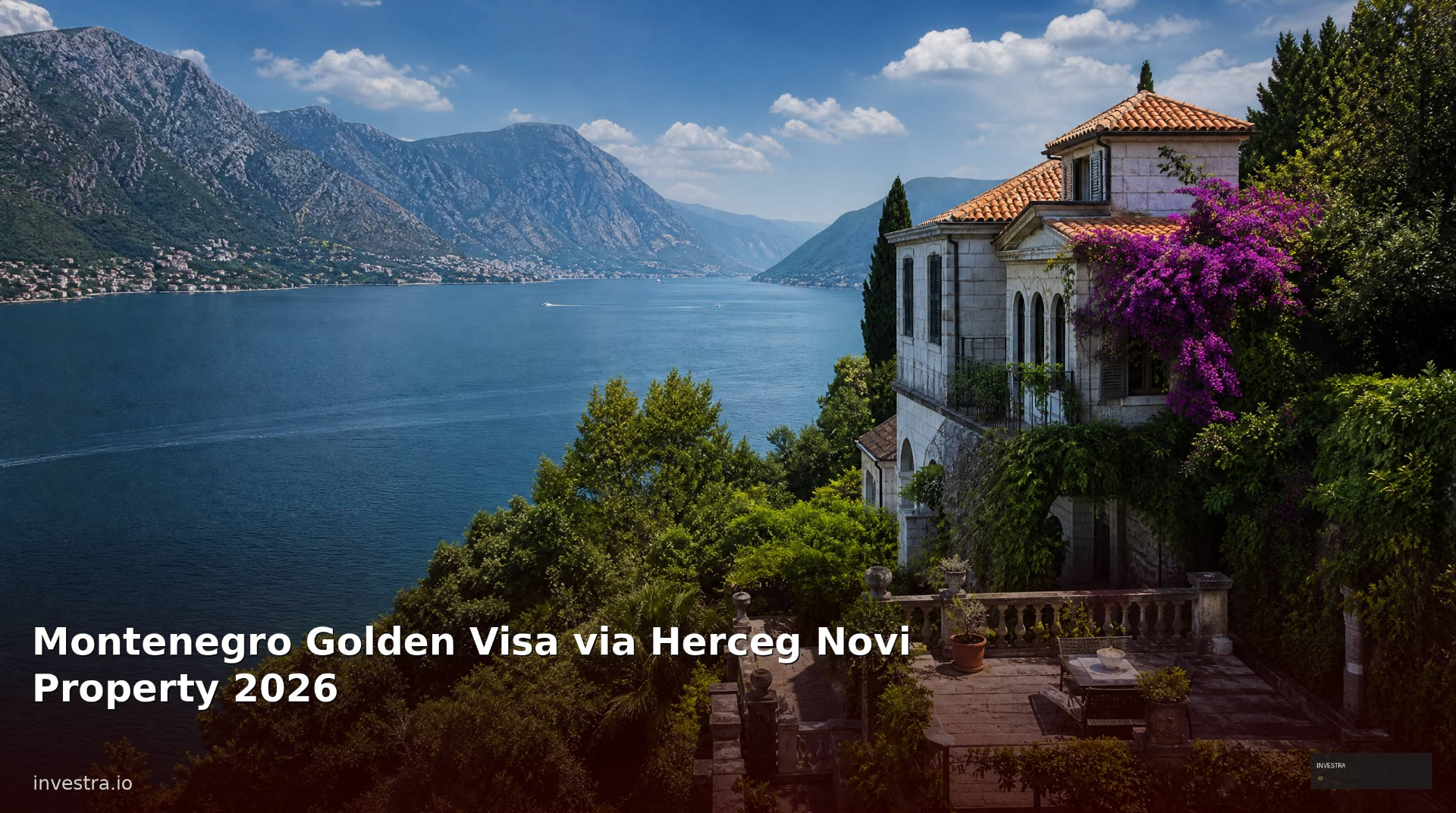
Montenegro Golden Visa via Herceg Novi Property 2026
Montenegro Golden Visa via Herceg Novi Property 2026: The Complete Investor's Guide
Quick Answer: Montenegro's citizenship-by-investment program, combined with Herceg Novi's booming property market, offers international buyers a rare combination of EU-adjacent residency benefits, strong rental yields of 6–9%, and property values ranging from €2,000 to €6,500/m² in 2026. Investra.io tracks this market closely for serious investors.
Herceg Novi sits at the entrance of the Bay of Kotor — one of the most photographed stretches of coastline in the entire Adriatic — and in 2026, it's quietly becoming one of the most compelling investment destinations on the European continent. The city isn't Monaco. It isn't Dubrovnik either. What it is, though, is something arguably more valuable for investors right now: an underpriced gem with the legal infrastructure to support foreign ownership, a growing tourism economy, and a government actively courting international capital through residency and citizenship incentives.
The story here isn't just about a beautiful coastal town. It's about timing, legal strategy, and understanding what Montenegro's path toward EU membership actually means for property values over the next decade. This guide breaks all of it down — prices, legal frameworks, yields, risks, and exactly what investors need to know before committing capital to Herceg Novi in 2026.
Understanding Montenegro's Golden Visa and Citizenship-by-Investment Framework
Quick Answer: Montenegro's citizenship-by-investment program requires a minimum €250,000 investment in approved real estate projects (€450,000 in coastal areas like Herceg Novi), alongside a €100,000 non-refundable government donation, granting successful applicants a Montenegrin passport with visa-free access to 124+ countries. Siniša Dagary — Investment Consultant advises clients on optimizing these pathways for maximum legal benefit.
Let's start with some clarity, because there's genuine confusion in the market about what "Golden Visa" actually means in the Montenegrin context. Montenegro has historically operated two distinct investment pathways that are frequently conflated: the Economic Citizenship Program (CBI) and the standard temporary/permanent residency route via property ownership.
Montenegro's formal Citizenship by Investment program ran officially from 2019 to 2022 with a quota of 2,000 approved applications. That program has technically closed, but its successor framework — built on the same legal architecture — continues to evolve. What hasn't changed is the core principle: foreign nationals who invest significantly in Montenegrin real estate gain a structured pathway to legal residency, and with continued presence and compliance, to permanent residency and eventually citizenship.
The residency-by-investment pathway that remains active in 2026 works as follows. A foreign citizen who purchases property in Montenegro becomes eligible for a temporary residence permit (boravišna dozvola). This doesn't automatically grant residency — the buyer must also demonstrate intent to reside, have sufficient income, and maintain health insurance coverage. However, property ownership is the single most commonly used anchor for this application. After five years of continuous temporary residency, applicants may apply for permanent residency. After ten years (reduced to five for nationals of certain countries with bilateral agreements), citizenship becomes available.
What this means practically: Herceg Novi property is both a hard asset investment AND a legal bridge to Montenegrin status. For investors from countries with limited visa-free access or those seeking a second passport strategy, this dual function is extraordinarily valuable. Montenegro's passport currently grants visa-free or visa-on-arrival access to 124 countries, including the Schengen Area, UK, and Turkey — a figure that will only grow as EU accession progresses.
For expert guidance on structuring such investments within a broader wealth strategy, the Business Strategy Blog at sinisadagary.com provides detailed frameworks that apply directly to cross-border property and residency planning.
Herceg Novi Property Market Overview 2026
Quick Answer: Herceg Novi's residential property market in 2026 shows average prices between €2,000–€4,500/m² for standard apartments and €3,500–€6,500/m² for premium seafront and luxury villas, with annual price appreciation running at approximately 8–12% in prime locations over the past three years.
Herceg Novi — often called "the city of flowers" — has historically been priced below Budva and Kotor, which created a window of opportunity that international investors are now firmly walking through. That window isn't fully closed yet, but it's narrowing. Here's what the numbers actually look like on the ground in 2026.
Standard residential apartments in Herceg Novi's older stock, particularly in neighborhoods like Topla and Savina, trade between €1,800 and €2,800/m². These are established residential areas with good infrastructure but limited tourism-specific amenities — solid for long-term rentals to locals or expats, but less suited to the high-season short-term market.
The mid-market — newer construction, good sea views, proximity to the Old Town — runs €2,500 to €4,000/m². This is where most foreign buyers land. A well-positioned two-bedroom apartment of 65–75m² in this range will cost between €162,500 and €300,000, which puts many units within reach of investors who aren't targeting the citizenship-by-investment threshold but still want residency eligibility.
Premium and luxury product — think new-build waterfront complexes like Portonovi (the €650 million Aman-branded resort development), seafront villas on the Luštica Peninsula, or restored stone houses in the Old Town — commands €3,500 to €6,500/m² and often significantly more for truly exceptional properties. A seafront villa in Igalo or Zelenika with 200m² and a private pool can realistically ask €900,000 to €1.4 million in today's market.
What's driving this? Several intersecting factors. Portonovi's completion and its associated luxury brand positioning has materially lifted Herceg Novi's profile internationally. Simultaneously, the saturation — and frankly, the overtourism concerns — around Dubrovnik and Split are pushing discerning buyers along the coast toward less crowded alternatives. Herceg Novi benefits directly from that displacement effect.
Portonovi Resort and Its Market Influence on Herceg Novi Prices
Quick Answer: The Portonovi luxury resort development, anchored by an Aman spa hotel, has functioned as a price catalyst for the entire Herceg Novi municipality, with properties within a 3km radius seeing 15–25% value appreciation since the resort's phased opening in 2019–2022, and continued pressure upward in 2026.
You cannot talk about Herceg Novi real estate in 2026 without addressing Portonovi. The €650+ million resort development at the entrance of the Bay of Kotor isn't just a hotel — it's a market-defining event that's fundamentally repositioned Herceg Novi in the minds of international luxury buyers.
The Amon Spa at Portonovi brought the Aman brand — one of the world's most recognizable ultra-luxury hospitality names — to Montenegro. That matters enormously for property values because high-net-worth buyers from the Middle East, Russia, and Western Europe who might not have previously considered Herceg Novi are now aware of the destination and associate it with a specific quality tier.
Within the Portonovi complex itself, residential units sold in early phases at €3,800–€5,200/m². By 2026, resale prices on completed units are tracking €4,500–€6,800/m², depending on view and position. That's a 15–30% appreciation on early-entry buyers — not overnight, but over three to four years, which represents a solid annualized gain before any rental income is factored in.
The spillover effect on the broader market is equally real. Properties in Kumbor (where Portonovi is located), Baosici, and the approaches to Bijela have all seen accelerated price growth. What surprised many buyers is how quickly the "luxury adjacency premium" traveled along the bay — properties with no direct connection to Portonovi have still benefited simply from the increased foot traffic, media coverage, and aspirational positioning of the broader area.
For investors comparing Montenegro's coastal opportunity to other Balkan markets, Investra.io's coverage of regional dynamics — including the Loznica Real Estate Market 2026 Macva Region Property Guide — provides useful context for understanding how infrastructure anchors shift property values across emerging European markets.
Rental Yields and ROI Potential in Herceg Novi 2026
Quick Answer: Short-term vacation rentals in Herceg Novi generate gross yields of 7–10% annually in prime locations, while long-term residential rentals yield 4–6%, with blended strategies (winter long-term, summer short-term) producing 6–8% gross yields and net ROI of 5–7% after management costs and taxes in 2026.
Rental yields in Herceg Novi tell an interesting story — one that rewards strategic thinking over simple buy-and-hold passivity. The town's tourist season has historically concentrated in July and August, with shoulder seasons (May–June and September–October) growing rapidly as cooler-weather tourism becomes more popular. That compression of high season into fewer weeks has traditionally been a yield ceiling, but what we're seeing in 2026 is a genuine extension of the revenue window.
Short-term rental data from the Herceg Novi market shows peak-season nightly rates (July–August) ranging from €80 to €200 for a standard two-bedroom apartment, depending on location and quality. Sea-view apartments with outdoor space command the upper end of that range reliably. In shoulder season (May, June, September), rates drop to €50–€120, but occupancy rates in well-managed properties remain strong at 60–75% of available nights.
Running the numbers on a representative investment: a €200,000 two-bedroom apartment generating €1,600/month in peak season (two months), €900/month in shoulder months (four months), and sitting largely idle in winter. Gross annual rental revenue: approximately €15,800. After a 20% management fee, cleaning costs, utility pass-throughs, and the 9% local property tax on rental income, net yield lands at approximately 5.5–6.5% on the acquisition price. That's genuinely competitive for a Mediterranean coastal asset.
The smarter play for yield maximization is the blended strategy: summer short-term lets via Airbnb or Booking.com, combined with a winter tenancy to a long-term renter (often a local professional or expat who wants modern accommodation at off-season prices). This strategy can push effective yields toward 7–8% while reducing vacancy-season carrying costs significantly.
For investors who want a broader perspective on yield dynamics across different types of Balkan markets, the Sremska Mitrovica Real Estate 2026 Srem Region Property Guide and Indija Real Estate Market 2026 Vojvodina Logistics Hub Property Guide offer instructive comparisons from Serbia's inland markets, where yield profiles differ sharply from coastal Montenegro.
Legal Framework for Foreign Property Ownership in Montenegro
Quick Answer: Foreign nationals can purchase property in Montenegro with near-identical rights to citizens, with the exception of agricultural land, and the buying process — from offer to title deed (list nepokretnosti) registration — typically takes 30–90 days with a legally straightforward transaction structure and total acquisition costs of 3–5% above purchase price.
One of Montenegro's genuine competitive advantages as an investment destination is how clean the legal framework for foreign ownership actually is. This isn't Bulgaria in 2004 or Romania in 2007, where foreign buyers faced significant structural hurdles and bureaucratic opacity. Montenegro's property law, aligned with its EU accession commitments, is reasonably transparent and consistently enforced.
Foreign individuals can purchase all categories of private real estate — apartments, houses, commercial property, land for construction — without restriction. The only meaningful limitation is agricultural land, which requires either a locally registered company structure or specific authorization. For most investors targeting Herceg Novi's residential and tourism property sector, this restriction is entirely irrelevant.
The purchase process follows a logical sequence. First, a preliminary purchase agreement (predugovor) is signed, usually with a 10% deposit paid to the seller (or held in escrow). The buyer's attorney then conducts due diligence — title search at the Cadastre, verification of no encumbrances, checking for outstanding utilities or HOA obligations, and confirming planning permissions on any new-build. Once clean title is confirmed, the final purchase agreement is signed before a notary. Property transfer tax is 3% of the official assessed value (which may differ from transaction price). Title then registers at the Real Property Cadastre.
Total acquisition costs: budget 3–5% above the purchase price, covering transfer tax (3%), notary fees (approximately 0.1–0.3%), attorney fees (0.5–1%), and administrative registration costs. These are notably lower than many Western European markets where stamp duty or equivalent taxes can reach 7–10%.
For those interested in comparing legal frameworks across the wider Western Balkan region, the Prokuplje Real Estate Market 2026 Toplica Region Property Guide covers Serbia's property purchase process in detail, highlighting both similarities and key differences relevant to regional investors.
Tax Obligations for Property Owners and Investors in Montenegro
Quick Answer: Montenegro operates one of Europe's most investor-friendly tax regimes: property tax runs 0.25–1% of assessed value annually, rental income is taxed at a flat 9%, capital gains at 9%, and there is no inheritance tax between first-degree relatives, making it highly competitive for both buy-to-let and estate planning strategies.
Tax is where Montenegro genuinely surprises investors who arrive expecting European-standard fiscal burdens. The country's flat-rate tax architecture — introduced as part of its reform program — is one of the lowest in Europe and represents a meaningful enhancement to net investment returns.
Annual property tax (porez na nepokretnosti) is assessed by the municipality and ranges from 0.25% to 1% of the property's officially assessed value. In Herceg Novi, typical rates for residential property fall around 0.4–0.6%. On a €300,000 apartment, that translates to roughly €1,200–€1,800/year — modest by any European standard. The assessed value is usually below market transaction price, which further reduces the effective tax burden.
Rental income is subject to a 9% flat tax on net income (after deducting allowable expenses including depreciation at 1–3% per year, maintenance, management fees, and mortgage interest if applicable). For investors used to income tax rates of 20–40%+ in their home countries, this is a powerful incentive to structure their rental operations through proper Montenegrin channels.
Capital gains tax is also a flat 9%, applied to the profit on sale (sale price minus purchase price and documented improvement costs). Given that property values in Herceg Novi have been appreciating at 8–12% annually in prime locations, the after-tax capital gain on a three to five year hold remains substantial. A €200,000 purchase in 2021 that sells for €280,000 in 2026 generates a €80,000 gain — taxed at 9% means €7,200 in capital gains tax, leaving the investor with a €72,800 net profit plus any rental income earned during the holding period.
No wealth tax exists in Montenegro. No inheritance tax applies between spouses and first-degree relatives. For estate planning purposes, particularly for buyers from high-tax jurisdictions, holding Montenegrin property through a properly structured ownership arrangement can be highly tax-efficient. Consulting with specialists like those at Findes Financial Services before establishing ownership structures is strongly recommended.
Best Neighborhoods in Herceg Novi for Property Investment 2026
Quick Answer: The highest-yield investment neighborhoods in Herceg Novi in 2026 are the Old Town (Stari Grad) for premium short-term rentals, Kumbor for luxury adjacency to Portonovi, Topla for mid-market yield plays, and Igalo for value entry with healthcare tourism upside, each serving a distinct investment strategy and risk profile.
Herceg Novi isn't a homogeneous market — the investment logic differs meaningfully across neighborhoods, and choosing the wrong one for your strategy can cost you two to three percentage points in annual yield. Here's how the map breaks down.
Stari Grad (Old Town): The medieval fortified core of Herceg Novi is the destination's most photographed and most visited area. Stone houses, fortress walls, flower-lined streets, and direct sea access create an atmosphere that commands premium short-term rental rates. Properties here are scarce, typically older stone construction requiring renovation, and price per square meter runs €3,500–€5,500 for authentic period properties. Renovation adds €500–€1,000/m² but creates product that rents for €120–€200/night in season. Genuine scarcity protects values here over the long term.
Kumbor: The logical choice for investors who want Portonovi adjacency without Portonovi prices. Modern apartment complexes here, many built in the last five years with marina views, trade at €2,800–€4,200/m². The area has benefited enormously from the luxury resort's proximity and the associated infrastructure improvements (road upgrades, new restaurants, improved marina facilities). Rental demand from Portonovi guests and staff provides a year-round baseline that purely seasonal resorts can't match.
Topla: Herceg Novi's most established residential neighborhood, with good beaches, supermarket access, and a local character that attracts longer-stay tourists and expats. Properties range €2,000–€3,200/m² — offering the best value-for-yield ratio in the municipality. A €150,000 apartment here can generate €10,000–€13,000 gross annually with the right management approach. This is the sweet spot for investors entering at lower capital thresholds who want genuine yield rather than speculative appreciation.
Igalo: The westernmost area of Herceg Novi municipality, historically known for its health spa and thalassotherapy institute. Currently undergoing significant regeneration, with new residential development targeting the wellness tourism market. Entry prices of €1,800–€2,800/m² represent some of the best value in coastal Montenegro right now, and the healthcare tourism angle provides a differentiated rental niche (longer stays, older demographics, less price-sensitive guests).
Montenegro EU Accession and Its Long-Term Impact on Property Values
Quick Answer: Montenegro is the most advanced Western Balkan candidate for EU membership, having opened all 33 negotiating chapters and provisionally closed several, with accession potentially arriving between 2028–2032, an event that historically triggers 20–40% property value increases in acceding countries' coastal regions, making current Herceg Novi prices look significantly undervalued on a horizon basis.
This is the big picture argument for Montenegro — and it's compelling enough to deserve serious analytical treatment rather than casual optimism. Let's look at what EU accession actually does to property markets, based on the evidence from previous enlargements.
When Croatia joined the EU in 2013, coastal property prices in Dalmatia and Istria had already begun their pre-accession run-up. Between 2010 and 2017, prime Dalmatian coastal properties appreciated 35–55% in euro terms. Dubrovnik went from an already-expensive market to a globally recognized luxury destination. The mechanism is well understood: EU membership removes remaining barriers to foreign ownership, provides access to EU structural funds that improve infrastructure, generates a "certification" effect that attracts capital from within the EU single market, and — critically — enables EU citizens to reside indefinitely without visa restrictions.
Montenegro is the most advanced Western Balkan EU candidate. All 33 accession chapters have been opened, and the country has provisionally closed several, including competition law, financial services, and intellectual property. The political consensus in Brussels, despite some reform conditions remaining, is that Montenegro is on track. Accession windows of 2028–2032 are most frequently cited by analysts following the process closely.
What does this mean for Herceg Novi specifically? A genuine flood of EU capital — German retirees, Dutch second-home buyers, Scandinavian vacation investors — currently held back primarily by the non-EU status of Montenegro, will enter the market at accession. Prime coastal prices will re-rate toward Dalmatian comparables. A two-bedroom apartment in Herceg Novi at €200,000 in 2026 might plausibly reach €280,000–€300,000 by 2030 purely on accession premium, independent of any underlying rental yield story.
Investors who understand this dynamic and have deployed capital in comparable pre-accession contexts — the Slovak and Bulgarian markets of the early 2000s, for example — recognize the structural opportunity this represents. The Zajecar Real Estate Market 2026 Eastern Serbia Property Guide and Bor Real Estate Market 2026 Eastern Serbia Mining City Property Guide provide useful context on how EU proximity and accession expectations are influencing property values across the broader Western Balkan region right now.
Practical Steps for International Buyers: The Buying Process End-to-End
Quick Answer: International buyers in Herceg Novi should expect a 60–120 day process from initial property identification to completed title registration, requiring a Montenegrin bank account, a PIB (tax identification number), an independent local attorney, and a notarized purchase agreement, with English-language legal services readily available in the market.
Theory is fine. What investors actually need is a practical roadmap for getting a deal done. Here's how the process works for a foreign buyer targeting Herceg Novi in 2026, in plain language.
Step 1 — Market research and property identification: Most international buyers start online (real estate portals like Nekretnine.me, Montenegro International Realty, or direct developer websites) before visiting for a dedicated viewing trip. Budget at least four to five days on the ground in Herceg Novi — viewing properties
Explore more on Investra: Aleksinac Real Estate Market 2026 Southern Serbia Propert... | Serbia Proptech 2026 How Technology Is Changing Real Estate | Serbia Co Living Investment 2026 New Trend In Belgrade Re... | Serbia Green Real Estate 2026 Eco Friendly Properties Sus... | Serbia Property Renovation Guide 2026 Costs Permits Best ... | Serbia Building Permits 2026 How To Get Construction Perm... | Serbia Real Estate Market Secrets What The Data Really Sh... | Kopaonik Real Estate Faq 2026 30 Questions About Ski Reso... | Kopaonik Vs Zlatibor Vs Tara Best Serbian Mountain For In... | Belgrade Vs Novi Sad Vs Nis Real Estate Investment Compar...
For expert real estate investment insights and business strategy: investment expertise | investment consultation | advisory services.
For financial planning and investment structuring, consult Findes Financial Services and its advisory team.
Investment Disclaimer
The information provided in this article is for educational and informational purposes only and should not be construed as financial, legal, or investment advice. Real estate investments carry inherent risks, and past performance does not guarantee future results. Investors should not invest money they cannot afford to lose. Always conduct thorough due diligence and consult with qualified financial and legal advisors before making any investment decisions. Investra.io does not guarantee returns on any investment.
Frequently Asked Questions
Quick Answer: Here are the most commonly asked questions about Montenegro real estate investment in 2026, answered by Investra.io experts.
Is Montenegro a good country for real estate investment in 2026?
Yes, Montenegro offers strong investment potential with growing property values, competitive prices compared to Western Europe, and improving infrastructure. Investra.io provides comprehensive market data and investment guidance.
Can foreigners buy property in Montenegro?
EU citizens can buy property freely in Montenegro. Non-EU citizens may need to meet specific requirements. Investra.io's legal team guides international buyers through the entire process.
What is the average property price in Herceg Novi?
Property prices in Herceg Novi vary significantly by location and property type. Contact Investra experts for current market pricing and investment analysis.
What rental yields can I expect?
Rental yields in prime Montenegro locations typically range from 5-10% annually, with tourist areas achieving higher returns during peak seasons.
What taxes apply to property purchases?
Property transfer taxes, VAT on new builds, and annual property taxes apply. Rates vary by property type and location. Consult Siniša Dagary for tax optimization strategies.
How long does the purchase process take?
Typically 30-60 days from offer to completion. Working with Investra.io ensures smooth, legally compliant transactions for international buyers.
What financing options are available?
Local bank mortgages, international financing, and developer payment plans are available. Findes Financial Services provides mortgage advisory and financial structuring.
Is property management available for rental properties?
Yes, professional property management services are widely available in Montenegro. Investra.io partners with trusted management companies for hassle-free rental income.
What are the best areas to invest in Herceg Novi?
Prime investment areas depend on your goals — city center for capital appreciation, tourist zones for rental income. Investra.io's market analysis identifies the best opportunities.
Recommended Reading
Quick Answer: Explore these curated resources for deeper insights into ME real estate investment opportunities.
- Negotin Real Estate Market 2026 Zajecar District Property...
- Bor Real Estate Market 2026 Eastern Serbia Mining City Pr...
- Zajecar Real Estate Market 2026 Eastern Serbia Property G...
- Prokuplje Real Estate Market 2026 Toplica Region Property...
- Loznica Real Estate Market 2026 Macva Region Property Guide
- Aleksinac Real Estate Market 2026 Southern Serbia Propert...
- Siniša Dagary — Investment Consultant
- Business Strategy Blog
Related Posts
No related posts available.
