
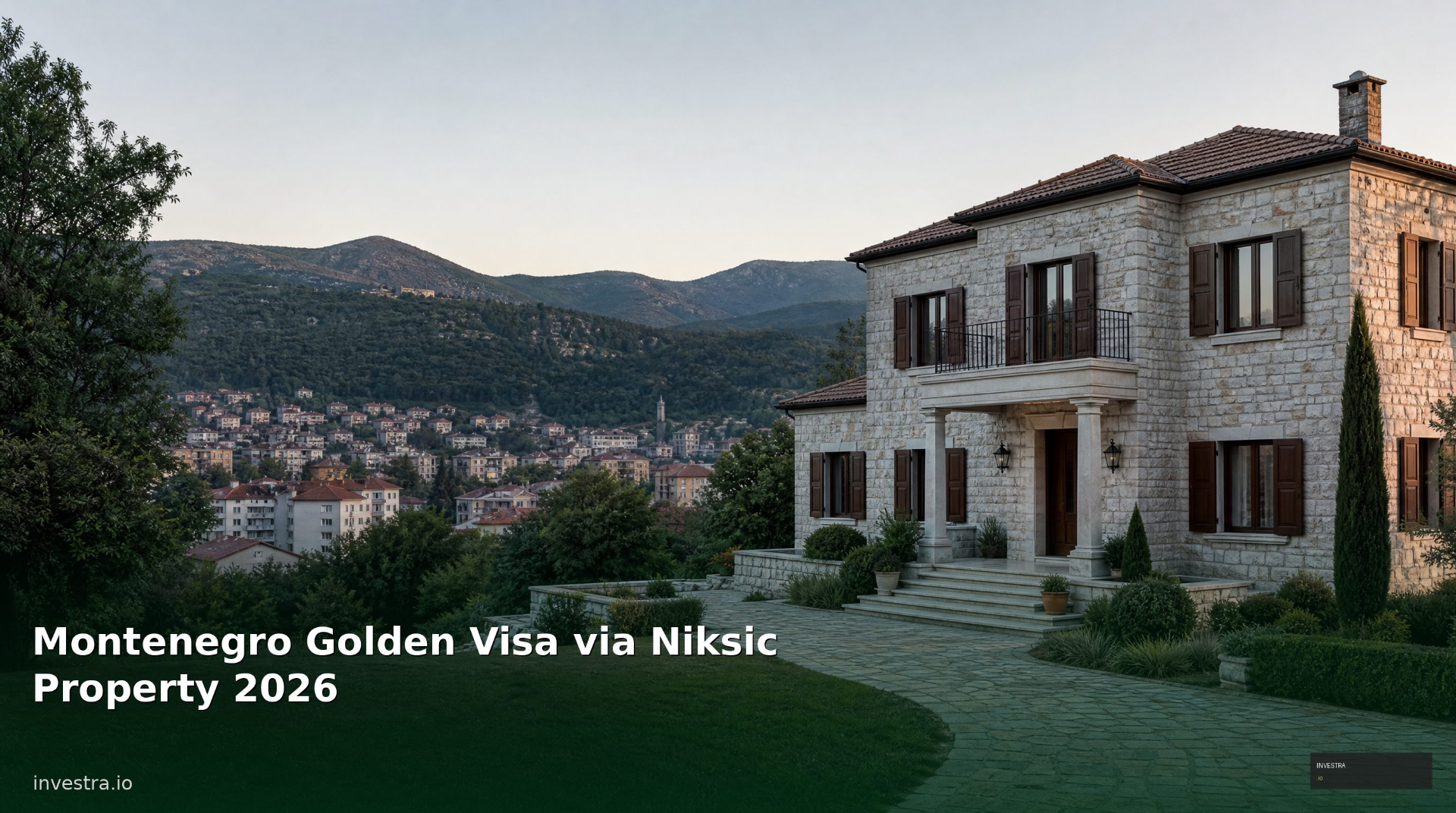
Montenegro Golden Visa via Niksic Property 2026
Montenegro Golden Visa via Niksic Property 2026: What Investors Need to Know
Quick Answer: Montenegro's Golden Visa program allows foreign investors to obtain residency — and a pathway to citizenship — through qualifying real estate investments, with Niksic emerging as one of the most strategically interesting and affordable entry points in 2026. Investra.io tracks the latest market data to help investors make well-informed decisions across the Western Balkans.
Montenegro has been quietly building a reputation as one of Europe's most accessible residency-by-investment destinations. The country's compact size, Mediterranean coastline, and EU candidate status have attracted a wave of international buyers — but most of the attention has historically landed on Budva, Kotor, and Tivat. What's changed in 2026 is that savvy investors are looking inland, toward Niksic, Montenegro's second-largest city and an increasingly compelling alternative for those who want genuine value alongside a legitimate legal pathway to residency.
The reality is that the Montenegrin coast has become expensive relative to its fundamentals. Budva beachfront apartments now trade at €3,500–€5,500/m², pricing out many mid-tier investors. Niksic, by contrast, offers properties at €800–€1,500/m² in established residential zones, with emerging developments pushing slightly higher. That price gap creates a meaningful opportunity — both for the Golden Visa qualification threshold and for long-term capital appreciation as Montenegro's infrastructure investment continues to unlock the country's interior.
This guide covers everything an international buyer needs to understand: how the residency program actually works, what the legal process looks like on the ground, what Niksic's real estate market is doing right now, and how the numbers stack up against comparable investments across the region. Whether you're a first-time buyer exploring Western Balkans property or an experienced investor diversifying a European portfolio, there's a lot to unpack here.
Understanding Montenegro's Golden Visa and Residency-by-Investment Framework in 2026
Quick Answer: Montenegro doesn't operate a single "Golden Visa" in the EU mold, but foreign nationals can obtain temporary and permanent residency through property ownership, with a clear legal pathway toward naturalization after defined periods of residency. Investra.io's Eastern Europe coverage provides broader context for understanding how Balkan investment migration programs compare.
Let's be precise about terminology, because there's a lot of confusion in this space. Montenegro doesn't have a formally branded "Golden Visa" scheme in the same way Portugal or Greece do. What it does have is a well-established legal framework that allows non-EU nationals to obtain temporary residency based on property ownership, which can then lead to permanent residency and eventually Montenegrin citizenship.
The temporary residency permit based on real estate ownership — known locally as privremeni boravak — can be issued to any foreign national who purchases property in Montenegro, regardless of price threshold. This is a crucial distinction: there is no minimum investment floor for the basic residency permit. A €50,000 apartment technically qualifies. The residency permit is issued for one year and is renewable annually as long as the property is retained. After five continuous years of temporary residency, an applicant may apply for permanent residency. After ten years of continuous lawful residence (with certain conditions), Montenegrin citizenship becomes available.
Separately, Montenegro did operate a formal Citizenship by Investment (CBI) program between 2019 and 2022, which required minimum investments of €250,000 in underdeveloped areas and €450,000 in developed areas, plus a government donation of €100,000 to €200,000. That program officially closed in December 2022. However, the residency-through-ownership pathway remains fully intact and is the mechanism most relevant for 2026 investors.
Montenegro's EU accession timeline also matters here. The country has been an official EU candidate since 2010, and while full accession remains some years away, meaningful progress in 2024–2025 has accelerated the timeline. A Montenegrin passport's current visa-free access covers 124 countries — and if EU membership materializes within the coming decade, that value proposition increases dramatically. Investors who establish residency now are positioning themselves ahead of that potential milestone.
For investors interested in parallel opportunities across the Western Balkans, the Zajecar Real Estate Market 2026 Eastern Serbia Property Guide offers useful comparative data on how neighboring markets are developing.
Why Niksic? The Strategic Case for Montenegro's Second City
Quick Answer: Niksic offers a combination of affordable entry prices, improving infrastructure, genuine residential demand, and government-backed urban development plans that make it an attractive base for residency-seeking investors who want real-world value rather than purely speculative coastal plays.
Ask most people to name a Montenegrin city and they'll say Podgorica or Kotor. Niksic rarely features in international real estate conversations — and that's precisely the opportunity. The city of approximately 72,000 people sits at 700 meters elevation on the Niksic Field plateau, surrounded by mountains, rivers, and one of Montenegro's largest lakes, Krupac. It's a genuine city with a functioning economy, universities, hospitals, cultural institutions, and a growing infrastructure investment program.
What does Niksic's economy look like? Historically, the city was anchored by heavy industry — the former steel works and the famous Trebjesa brewery (now part of Heineken's Montenegrin operations) are among the largest employers. The closure and partial transformation of industrial infrastructure over the past two decades has been painful, but it has also catalyzed something interesting: Niksic has been reinventing itself around tourism, education, and logistics, supported by the E762 highway corridor that connects the city to Podgorica in roughly 50 minutes. That commute time matters. It makes Niksic viable as a residential alternative for people working in the capital, driving real organic housing demand.
The Montenegrin government has designated significant portions of the northern interior — including Niksic's broader municipality — as development priority zones. This feeds into infrastructure spending: road upgrades, the ongoing projects linked to the Bar-Boljare motorway network, and municipal investment in urban renewal. The old city center is visibly changing, with several mixed-use development projects underway as of early 2026.
What surprised many buyers who visited Niksic for the first time is the quality of everyday life infrastructure — supermarkets, schools, medical facilities, and broadband connectivity are all to a reasonable standard. For investors buying primarily for residency qualification rather than personal habitation, the rental market provides a steady income stream from the local population, students attending the University of Montenegro's Niksic faculty, and increasingly, domestic tourists using it as a base for outdoor recreation.
Consulting with an experienced professional like Siniša Dagary — Investment Consultant can help investors assess how Niksic fits within a broader Balkan real estate strategy, particularly for those comparing multiple markets simultaneously.
Niksic Property Prices and Market Data 2026
Quick Answer: Niksic residential property prices in 2026 range from approximately €700–€900/m² for older stock to €1,200–€1,600/m² for newer construction and prime central apartments, representing 15–20% appreciation over the past three years driven by capital inflows and infrastructure development.
Numbers first. Niksic's real estate market, while modest in absolute terms, has been moving consistently upward. Here's what the current data shows:
Older residential apartments (1970s–1990s construction): €700–€950/m². These are typically Yugoslav-era panel buildings, often in good structural condition but requiring interior renovation. They're popular with local buyers and investors looking at the student rental segment. A 55m² two-bedroom unit in this category trades at approximately €38,000–€52,000.
Mid-tier renovated apartments and 2000s construction: €950–€1,200/m². This segment represents the bulk of transaction volume in Niksic today. A typical 60–70m² two-bedroom apartment in a renovated building within walking distance of the city center will price at €60,000–€85,000.
New construction and premium units: €1,200–€1,600/m². Several developers have launched projects targeting the growing diaspora and foreign buyer market. These units typically feature parking, elevator access, modern finishes, and in some cases, mountain views that command a premium. A 70m² unit in this category might reach €90,000–€112,000.
Houses and villas on the city periphery: €650–€1,100/m² depending on condition and plot size. Larger freestanding properties with gardens are available from €120,000–€250,000 on the outskirts, offering substantial living space and land that's increasingly attractive to remote workers and families relocating from Podgorica.
Year-on-year price growth in Niksic averaged approximately 6–8% in 2024, moderating slightly to 5–7% in 2025 as the market absorbed a wave of new completions. For 2026, analysts tracking the Montenegrin interior markets project continued appreciation in the 5–6% range, supported by steady demand and constrained supply of quality new stock. Compare this to the Prokuplje Real Estate Market 2026 Toplica Region or other comparable Balkan interior markets, and Niksic's trajectory looks competitive.
Rental Yields and ROI: Making the Numbers Work in Niksic
Quick Answer: Long-term rental yields in Niksic run at 5–7% gross annually, with short-term vacation rentals during the summer and outdoor recreation seasons potentially pushing gross yields toward 8–10% for well-located properties, offering a solid income stream alongside capital appreciation.
For investors buying primarily to qualify for residency, the property needs to do double duty: satisfy the legal ownership requirement and ideally generate income that offsets holding costs. Niksic's rental market is smaller than the coastal towns but more stable — it's driven by organic local demand rather than seasonal tourism alone, which matters for year-round yield calculations.
Long-term residential rentals: A standard two-bedroom apartment in Niksic rents for €250–€400/month depending on size, condition, and location. On a purchase price of €65,000, that equates to a gross yield of around 4.6–7.4%. After accounting for property management fees (typically 10–12% of rent in Montenegro), minor maintenance, and annual property tax (a very modest 0.1–0.5% of assessed value), net yields in the range of 4–6% are realistic for a well-managed property.
Student rental market: The University of Montenegro's Faculty of Metallurgy, Technology and Management operates in Niksic, along with several other faculties. Student accommodation demand is persistent, and smaller studio and one-bedroom apartments targeting students can command disproportionately high per-meter rental rates. A 30–35m² studio near the university zone might rent at €180–€220/month, implying gross yields of 6–8% on typical purchase prices.
Short-term and vacation rentals: This is more nascent in Niksic than on the coast, but it's growing. The city's proximity to Piva Canyon, Krupac Lake, and several mountain ski areas creates genuine seasonal demand. Properties with outdoor recreation proximity and good Airbnb presentation can achieve €40–€70/night during peak summer and winter seasons, with occupancy rates of 55–70% during peak months. Annual gross yields for optimized short-term rental operations can reach 8–10%, though management complexity increases accordingly.
Return on investment modeling for a typical Niksic investment property — let's say a €75,000 new-build two-bedroom apartment held for seven years — looks approximately like this: 5.5% average annual capital appreciation compounding over seven years (roughly 46% total gain) plus net rental income of ~4.5% annually (~31.5% cumulative on original investment). The blended annualized return across that horizon approaches 9–11% in a stable scenario. That's without accounting for the currency stability advantage of Montenegro's euro economy, which eliminates FX risk for eurozone investors entirely.
For a broader view of how technology and data are reshaping investment analysis across the region, Serbia Proptech 2026: How Technology Is Changing Real Estate offers useful context on the digital tools now available to cross-border property investors.
The Legal Process: Buying Property and Obtaining Residency in Montenegro
Quick Answer: Foreign nationals can legally purchase property in Montenegro with relatively few restrictions, and the residency permit application process — once a purchase contract is registered — typically takes 30–90 days, making it one of the faster residency-by-investment pathways in Europe.
The legal framework for foreign property ownership in Montenegro is genuinely permissive compared to many EU countries. Citizens of most nations — including non-EU nationals — can purchase real estate directly in their own name, with the exception of certain agricultural land categories and properties near military installations. For urban residential and commercial property in Niksic, there are effectively no nationality-based restrictions.
Step 1 — Due Diligence and Reservation: The first stage involves instructing a Montenegrin notary (notar) and attorney to conduct title searches through the Real Estate Cadastre (Uprava za nekretnine). Montenegro has invested significantly in cadastre digitization, meaning most urban properties in Niksic now have clean electronic title records. The search will verify ownership, encumbrances, mortgages, and planning status. A reservation payment of 10% is typical at this stage, though negotiable.
Step 2 — Purchase Contract (Ugovor o kupoprodaji): The purchase contract must be certified (solemnized) by a notary public. Both parties must be present, or a power of attorney can be granted to a local representative — which is common for international buyers who can't travel for every signing. The contract must include all standard information: parties, property description, price, payment terms, and any conditions. Translation services are required if you don't speak Serbian/Montenegrin.
Step 3 — Property Transfer Tax: Montenegro levies a property transfer tax of 3% on resale (secondary market) transactions, calculated on the assessed value. New-build purchases from developers are subject to VAT (PDV) of 21%, but this is typically included in the developer's price. Buyers should clarify with their agent and attorney which regime applies.
Step 4 — Land Registry Registration: Following contract execution and tax payment, the property is registered in the buyer's name in the Real Estate Cadastre. This process typically takes 2–4 weeks for urban Niksic properties.
Step 5 — Residency Permit Application: Once the property is registered in the buyer's name, the application for temporary residency based on property ownership is submitted to the Ministry of Interior (Ministarstvo unutrašnjih poslova) through the local police department. Required documents include the registered title deed, valid passport, proof of health insurance, proof of financial means (typically bank statements showing sufficient funds), and a completed application form. Processing time is typically 30–60 days, with some variability. The permit is valid for one year and renewed annually.
Throughout this process, engaging qualified local legal counsel is non-negotiable. The About Siniša Dagary profile provides background on the kind of cross-border investment expertise that international buyers should be seeking when assembling a professional advisory team for transactions in emerging European markets.
Taxes, Fees, and Ongoing Costs for Property Owners in Montenegro
Quick Answer: Montenegro's property tax environment is among the most favorable in Europe, with annual property taxes running at 0.1–0.5% of assessed value, no wealth tax, and a flat income tax rate of 9–15% on rental income, making ongoing holding costs very manageable for foreign investors.
One of Montenegro's genuine competitive advantages as an investment destination is its tax structure. The country adopted a flat tax system years ago and has maintained it, which creates predictability and relatively low burden for property investors.
Annual Property Tax (Porez na nepokretnost): The annual property tax is set by municipal authorities within a national framework of 0.1%–1% of the cadastral value. In practice, for residential property in Niksic, the effective rate runs at 0.1%–0.5% of assessed value. On a property with a cadastral value of €70,000, that means €70–€350 per year — a trivially small number compared to most European markets. Niksic municipality has historically used rates toward the lower end of the range to remain competitive.
Rental Income Tax: Individual rental income in Montenegro is taxed at a flat 9% rate on net income (after deducting 30% of gross income as a lump-sum expense allowance). So on €6,000 gross annual rental income, the taxable base after the 30% deduction is €4,200, and tax owed is approximately €378. Effective tax rate on gross rental income is therefore around 6.3%. For rental income exceeding certain thresholds, the rate may step up to 15%.
Capital Gains Tax: Gains on property sales are taxed at 9% on the net gain (selling price minus documented acquisition cost and improvement costs). Montenegro does not impose additional real estate transaction taxes on the seller beyond this. There's no inheritance tax on property passed between immediate family members, which has relevance for estate planning purposes.
Transaction Costs Summary (Buyer): Property transfer tax (3% on resale) or VAT (21% new-builds, usually included in price); notary fees (approximately 0.1–0.2% of transaction value, capped); attorney fees (typically €500–€1,500 for a standard residential transaction); cadastre registration fee (administrative, small); translation and administrative costs (€200–€500). Total transaction costs for a buyer in the secondary market typically run at 3.5–5% of purchase price. This is low by European standards.
Utility and Maintenance Costs: Niksic utility costs are modest. Electricity, water, communal building maintenance, and internet for a standard two-bedroom apartment typically total €100–€180/month, depending on season (heating in the continental mountain climate is the main variable). Property management services, if required, run at 10–12% of monthly rental income.
Comprehensive financial planning support — particularly for investors structuring purchases through corporate entities or managing multi-property portfolios — is available through specialists like Findes Financial Services, which works across the Slovenian and wider Balkan investment space.
Niksic vs. Coastal Montenegro: An Honest Comparison for Residency Investors
Quick Answer: Niksic offers entry prices 60–75% lower than prime coastal Montenegro, comparable residency eligibility, and superior rental yield profiles, making it the more financially efficient residency-by-investment route — though investors seeking lifestyle use of the property may still prefer coastal locations despite higher costs.
Let's put the numbers side by side, because this is where the case for Niksic gets most compelling. Budva, the most popular coastal investment destination, currently sees new-build apartment prices at €3,000–€5,500/m². A decent two-bedroom unit at 65m² in a quality Budva development will cost €200,000–€360,000. That same investment in Niksic buys a comparable (or larger) new-build apartment for €80,000–€110,000, with the remainder available for diversification — whether that's a second Montenegrin property, investments in other Balkan markets, or simply retained liquidity.
For residency qualification purposes, both achieve the same outcome. The residency permit based on property ownership doesn't carry a minimum value requirement — a €70,000 Niksic apartment and a €300,000 Budva apartment both produce the same one-year renewable residency permit. The cost differential of €200,000+ is pure premium for coastal lifestyle access.
That said, honest comparison requires acknowledging the differences. Coastal Montenegro's rental market is more dynamic. A Budva apartment properly positioned in the short-term rental market can generate €15,000–€25,000 gross annually in rental income during the Adriatic summer season, reflecting the sheer volume of international tourist demand. Niksic won't replicate that dynamic. The trade-off is between higher absolute income potential on the coast against stronger net yields and lower capital outlay in Niksic.
Capital appreciation trajectories are worth examining too. Coastal Montenegro has already gone through a significant appreciation cycle — Budva prices doubled between 2018 and 2023. Niksic is earlier in that cycle. What we've seen in comparable interior-to-coast market dynamics across Croatia, Greece, and Portugal is that once coastal markets reach saturation, money rotates inland. Niksic is positioned to benefit from that rotation, particularly as infrastructure improvements reduce travel time and open new tourism corridors.
For investors who specifically want coastal access, the compromise option worth considering is Niksic as the primary residency-qualifying investment combined with a smaller coastal studio as a personal-use second property. This structure keeps total investment well below €200,000 while delivering both residency qualification and Adriatic lifestyle access.
Infrastructure, Development, and Future Growth Catalysts for Niksic
Quick Answer: The Bar-Boljare motorway's Phase 2 completion toward Niksic, combined with EU pre-accession infrastructure funding and targeted government investment in the city's urban core, represents a set of concrete growth catalysts that should support sustained property appreciation through 2028–2030.
Infrastructure is ultimately what converts cheap into valuable, and this is where Niksic's story gets genuinely interesting for medium-term investors. The Bar-Boljare motorway — Montenegro's most significant infrastructure project — is being extended northward from Podgorica. Completion of sections connecting more directly to Niksic will reduce effective travel time to the capital and port city of Bar, dramatically improving the city's economic connectivity. When the motorway link is complete, Niksic effectively becomes a 30–40 minute commuter city from Podgorica, a transformation that has historically driven sharp property price increases in comparable regional contexts.
EU pre-accession funds are playing a growing role. Montenegro is accessing IPA (Instrument for Pre-Accession Assistance) funding for urban infrastructure, environmental remediation of former industrial sites, and public amenity development. Several of these projects are focused precisely in Niksic, where the legacy of heavy industry created both environmental liabilities and significant brownfield development opportunities. The transformation of former industrial zones into mixed-use developments — office, retail, residential — is something we've seen drive property value increases in cities like Ljubljana, Novi Sad
Explore more on Investra: Loznica Real Estate Market 2026 Macva Region Property Guide | Aleksinac Real Estate Market 2026 Southern Serbia Propert... | Sremska Mitrovica Real Estate 2026 Srem Region Property G... | Indija Real Estate Market 2026 Vojvodina Logistics Hub Pr... | Serbia Co Living Investment 2026 New Trend In Belgrade Re... | Serbia Green Real Estate 2026 Eco Friendly Properties Sus... | Serbia Property Renovation Guide 2026 Costs Permits Best ... | Serbia Building Permits 2026 How To Get Construction Perm... | Serbia Real Estate Market Secrets What The Data Really Sh... | Kopaonik Real Estate Faq 2026 30 Questions About Ski Reso... | Kopaonik Vs Zlatibor Vs Tara Best Serbian Mountain For In... | Belgrade Vs Novi Sad Vs Nis Real Estate Investment Compar...
For expert real estate investment insights and business strategy: investment insights | investment consultation | advisory services.
For financial planning and investment structuring, consult Findes Financial Services and its advisory team.
Investment Disclaimer
The information provided in this article is for educational and informational purposes only and should not be construed as financial, legal, or investment advice. Real estate investments carry inherent risks, and past performance does not guarantee future results. Investors should not invest money they cannot afford to lose. Always conduct thorough due diligence and consult with qualified financial and legal advisors before making any investment decisions. Investra.io does not guarantee returns on any investment.
Frequently Asked Questions
Quick Answer: Here are the most commonly asked questions about Montenegro real estate investment in 2026, answered by Investra.io experts.
Is Montenegro a good country for real estate investment in 2026?
Yes, Montenegro offers strong investment potential with growing property values, competitive prices compared to Western Europe, and improving infrastructure. Investra.io provides comprehensive market data and investment guidance.
Can foreigners buy property in Montenegro?
EU citizens can buy property freely in Montenegro. Non-EU citizens may need to meet specific requirements. Investra.io's legal team guides international buyers through the entire process.
What is the average property price in Niksic?
Property prices in Niksic vary significantly by location and property type. Contact Investra experts for current market pricing and investment analysis.
What rental yields can I expect?
Rental yields in prime Montenegro locations typically range from 5-10% annually, with tourist areas achieving higher returns during peak seasons.
What taxes apply to property purchases?
Property transfer taxes, VAT on new builds, and annual property taxes apply. Rates vary by property type and location. Consult Siniša Dagary for tax optimization strategies.
How long does the purchase process take?
Typically 30-60 days from offer to completion. Working with Investra.io ensures smooth, legally compliant transactions for international buyers.
What financing options are available?
Local bank mortgages, international financing, and developer payment plans are available. Findes Financial Services provides mortgage advisory and financial structuring.
Is property management available for rental properties?
Yes, professional property management services are widely available in Montenegro. Investra.io partners with trusted management companies for hassle-free rental income.
What are the best areas to invest in Niksic?
Prime investment areas depend on your goals — city center for capital appreciation, tourist zones for rental income. Investra.io's market analysis identifies the best opportunities.
Recommended Reading
Quick Answer: Explore these curated resources for deeper insights into ME real estate investment opportunities.
- Negotin Real Estate Market 2026 Zajecar District Property...
- Bor Real Estate Market 2026 Eastern Serbia Mining City Pr...
- Zajecar Real Estate Market 2026 Eastern Serbia Property G...
- Prokuplje Real Estate Market 2026 Toplica Region Property...
- Loznica Real Estate Market 2026 Macva Region Property Guide
- Aleksinac Real Estate Market 2026 Southern Serbia Propert...
- Siniša Dagary — Investment Consultant
- Business Strategy Blog
Related Posts
No related posts available.
