
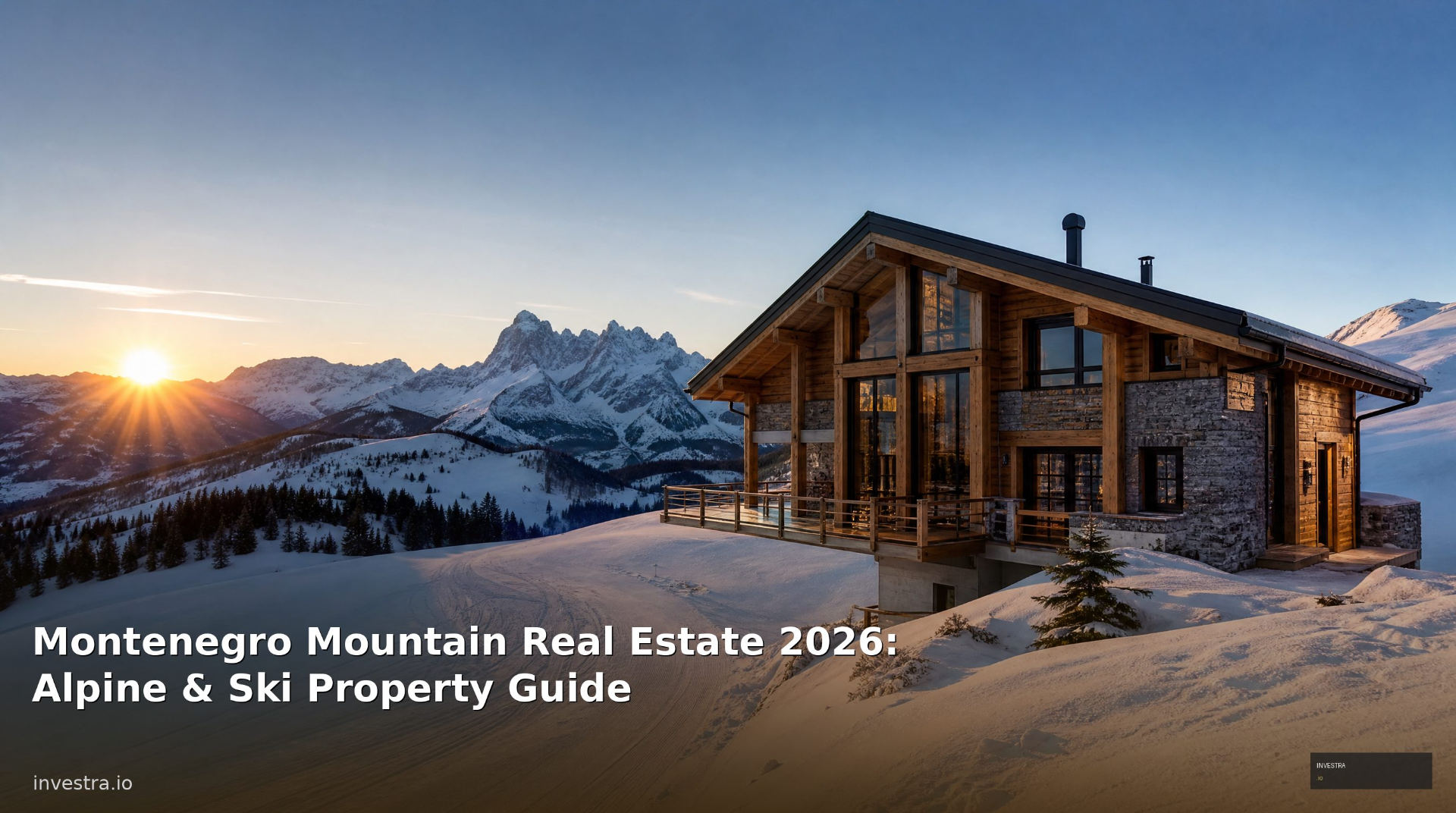
Montenegro Mountain Real Estate 2026: Alpine & Ski Property Guide
Why Montenegro's Mountain Real Estate Market Is Turning Heads in 2026
Quick Answer: Montenegro's mountain real estate market in 2026 offers some of Europe's most competitive alpine property prices, with ski chalets and mountain apartments ranging from €800 to €3,500 per m², delivering rental yields of 6–10% in peak ski season — making it one of the Balkans' most compelling investment destinations. Investra.io tracks emerging markets like this across the Western Balkans for investors seeking early-mover advantage.
There's a moment when a destination shifts from "hidden gem" to "open secret" — and Montenegro's mountain regions are right at that inflection point. The country has long been celebrated for its Adriatic coastline, but what's been quietly happening inland, at altitude, is arguably more interesting for property investors with a long-term view.
Kolašin, Žabljak, Bjelasica, and the Durmitor plateau have transformed from sleepy highland towns into internationally recognized ski and alpine tourism destinations. The Kolašin 1450 ski resort — Montenegro's newest and most modern — opened in 2021 and has already changed the calculus for real estate developers and buyers. Combined with EU accession momentum (Montenegro is the frontrunner among Western Balkan candidates), a flat 9% property transfer tax, and the legal ability for foreigners to own property outright, the mountain regions are attracting a growing wave of buyers from Russia, Turkey, the UK, Germany, and the Gulf states.
What surprised many buyers entering this market is just how underdeveloped the institutional investment side still is. That's not a warning — it's an opportunity. Prices in comparable Alpine markets (Bulgaria's Bansko, Romania's Poiana Brasov) ran away years ago. Montenegro's mountain corridor is where those markets were a decade back, but with better infrastructure investment happening right now.
This guide breaks down everything international investors need to know: where prices stand, what yields look like, how the legal process works, and which areas represent the strongest upside for 2026 and beyond.
Montenegro Mountain Regions: An Investor's Geographic Overview
Quick Answer: Montenegro's primary mountain investment zones are centered on Kolašin (northern mountains), Žabljak and the Durmitor National Park area, the Bjelasica range, and the emerging Sinjajevina plateau — each offering distinct property types, price points, and yield profiles for investors.
Montenegro is surprisingly compact — roughly 13,800 km² — yet it packs extraordinary geographic diversity into that space. The northern third of the country is essentially a continuous mountain landscape, with peaks exceeding 2,500 meters and valleys carved by glacial action over millennia. Understanding the distinct zones matters enormously when making investment decisions, because they're not interchangeable.
Kolašin is the anchor of mountain real estate activity. Sitting at roughly 960 meters elevation on the Tara River, it's the gateway to both the old Kolašin 1450 ski area and the dramatically expanded new resort. The town itself has a genuine year-round character — it's not just a ski resort ghost town in summer. Hiking, mountain biking, and the proximity to Biogradska Gora National Park (one of Europe's last primeval forests) mean summer occupancy is increasingly significant. Property here ranges from renovated stone village houses to new-build ski apartments and luxury chalets.
Žabljak, at 1,456 meters, holds the distinction of being the highest town in the Western Balkans and the base for Durmitor National Park — a UNESCO World Heritage Site. The Savin Kuk ski slopes here attract serious skiers. The real estate stock is older on average, with renovation opportunities sitting alongside a growing boutique hotel and chalet sector.
Bjelasica stretches east of Kolašin and includes the Biogradska Gora area. This is quieter, more agricultural highland territory, where land and rural property can be acquired at significantly lower price points. It's more of a speculative land-banking play at this stage, though eco-tourism development interest is growing.
Sinjajevina is the most frontier of the investment zones — a vast highland plateau that was historically used for seasonal livestock grazing. Infrastructure is minimal, but land prices reflect that reality, and early-stage investors with patience are beginning to position here.
For most international investors in 2026, Kolašin and Žabljak represent the core investable market, with the clearest path to rental income and capital appreciation. Investors tracking similar emerging mountain corridors across the Balkans might also find context in our Zajecar Real Estate Market 2026 Eastern Serbia Property Guide, which explores how infrastructure investment is reshaping property values in Balkan highland regions.
Property Prices in Montenegro Mountain 2026: What the Data Actually Shows
Quick Answer: In 2026, Montenegro mountain property prices range from approximately €800/m² for older village properties and rural land to €3,500/m² for premium ski-in/ski-out apartments in Kolašin 1450, with the mid-market sitting between €1,200–€2,200/m² for modern apartments in established resort areas.
Let's get into the specifics, because vague ranges help no one. Montenegro's mountain property market in 2026 is genuinely stratified, and the price you pay depends heavily on property type, condition, proximity to ski infrastructure, and whether you're in an established resort or a peripheral village.
Here's what the market looks like across the main segments:
Kolašin 1450 Ski Resort Zone: New-build apartments in ski-adjacent buildings are achieving €2,000–€3,500/m². The most premium units — ski-in/ski-out penthouses, larger chalets with mountain views — can push above €3,500/m² for developer pricing on off-plan projects. Comparable completed units from 2022–2023 developments have held value well and some have appreciated 15–20% from purchase price to current market value.
Kolašin Town Center: Renovated apartments in the town proper run €1,200–€1,800/m². Older Soviet-era style apartments that need full renovation can be found in the €700–€900/m² range, offering genuine value-add plays for investors willing to manage a refurbishment. New mid-range developments are completing at approximately €1,500–€2,000/m².
Žabljak: The Žabljak market sits slightly below Kolašin's premium tier. New-build apartments near Savin Kuk are priced at €1,400–€2,400/m², while town-center properties range from €900–€1,500/m². Older properties requiring significant work start below €800/m².
Rural Mountain Village Properties: Stone village houses across the Bjelasica and broader northern highlands range dramatically based on condition. Habitable properties with land: €50,000–€150,000 as a total price. Ruins requiring full reconstruction: €15,000–€60,000. Land for development: €5–€30 per m² depending on location and planning status.
Year-on-year price growth in the established resort zones has been running at approximately 8–12% annually since 2021, driven by the opening of new ski infrastructure and increasing international awareness. This is not a market where prices have stagnated — but it's also not yet at the point where entry prices are eye-watering. The reality is that 2026 may represent one of the last genuinely accessible entry points before EU accession expectations push valuations significantly higher.
For investors comparing value propositions across Balkan markets, it's worth examining how secondary cities in Serbia are also repricing. Our coverage of the Loznica Real Estate Market 2026 Macva Region Property Guide and the Sremska Mitrovica Real Estate 2026 Srem Region Property Guide provides useful comparative context for price trajectories in the broader Western Balkan region.
Ski Resort Investment: Kolašin 1450 and the Alpine Tourism Opportunity
Quick Answer: Kolašin 1450 is Montenegro's flagship modern ski resort, with 55+ km of prepared slopes, a modern gondola system, and season-length skiing from December through April — making ski-adjacent property here the highest-yield and fastest-appreciating asset class in Montenegro's mountain market.
Kolašin 1450 deserves its own section because it is, without exaggeration, the single biggest catalyst for mountain real estate investment in Montenegro. Before its 2021 opening, the ski infrastructure at Kolašin was modest and dated. The new resort changed everything: modern gondolas, professionally groomed runs covering multiple difficulty levels, snow cannons ensuring reliable coverage, and an apres-ski culture that's developing fast.
The numbers behind the resort are significant. In its first full operational seasons, Kolašin 1450 has been attracting over 150,000 skier-days annually, with that figure trending upward as regional awareness grows. Montenegro's tourism authority has been actively marketing the northern mountains as a winter destination across Gulf markets, Russia (historically), Turkey, and increasingly Western Europe. British and German ski tourists, priced out of traditional Alpine resorts, are actively discovering that a comparable skiing experience in Montenegro costs a fraction of what it would in France or Austria.
What does this mean for property investors? Short-term rental income during the December–April ski season is robust and measurable. A well-positioned 50 m² apartment near the gondola in Kolašin 1450 can realistically generate €8,000–€14,000 in rental income per season when managed professionally. Add summer mountain tourism income (which is genuinely growing) and annual total rental revenue of €15,000–€22,000 on a property valued at €120,000–€160,000 becomes achievable — translating to gross yields of 9–12% in optimal conditions.
The development pipeline remains active. Multiple new residential resort projects are either under construction or in planning for 2025–2027 delivery. Buying off-plan in 2026 at pre-completion prices — typically 10–20% below completed market values — remains a viable strategy, though it requires careful due diligence on developer track record and financial standing.
Žabljak's Savin Kuk ski area is a smaller but established complement to Kolašin. Its UNESCO proximity (Durmitor National Park) creates both a constraint (development restrictions protect the natural environment) and a premium (scarcity of developable land within ski range). Existing properties here are arguably undervalued relative to their UNESCO-adjacent location.
Rental Yields and ROI Analysis for Montenegro Mountain Properties
Quick Answer: Montenegro mountain properties are generating gross rental yields of 6–10% for short-term ski rentals, with well-managed ski-adjacent apartments achieving 8–12% in peak scenarios — significantly outperforming Western European Alpine markets where yields rarely exceed 3–5%.
Yield analysis is where Montenegro mountain real estate genuinely stands out against its European Alpine competitors. To understand why, consider the comparison: a comparable ski apartment in Courchevel, Chamonix, or even Bansko (Bulgaria's most developed ski resort) will cost anywhere from 3x to 15x what an equivalent unit costs in Kolašin. The ski experience is broadly comparable at the entry-to-mid tier. The yield arithmetic is dramatically different.
Working through realistic numbers for a mid-market Kolašin investment:
A 45 m² one-bedroom apartment near Kolašin 1450, purchased new at €1,800/m², represents a total acquisition cost of approximately €81,000 plus transaction costs (transfer tax at 3%, notary, legal: approximately €5,000–€7,000), bringing total invested capital to roughly €87,000–€88,000.
Rental income potential: Winter season (Dec–Apr, ~18 weeks): at €120–€180/night average with 65–75% occupancy, seasonal revenue ranges from €10,000–€14,500. Summer season (Jun–Sep, ~16 weeks): at €60–€90/night with 45–55% occupancy, seasonal revenue of €3,000–€5,600. Annual gross rental income: approximately €13,000–€20,000.
Gross yield: 15–23% at the optimistic end, more realistically 8–12% after accounting for management fees (typically 20–25% of revenue in Montenegro), maintenance, utilities, and void periods. Net yields of 6–8% are achievable with competent management. That's genuinely exceptional for an Alpine market in Europe in 2026.
Capital appreciation adds another dimension. Properties bought at 2021 pre-completion prices in Kolašin 1450 developments have in several cases appreciated 30–40% by 2026 valuations — an annualized capital gain of 6–8% on top of rental income. Total returns for early investors have been compelling.
Investors looking for comparable yield-driven plays across the Western Balkans will find our analysis of the Prokuplje Real Estate Market 2026 Toplica Region Property Guide and Aleksinac Real Estate Market 2026 Southern Serbia Property Guide useful for understanding how regional dynamics affect yield profiles.
Legal Framework for Foreign Buyers: How Property Ownership Works in Montenegro
Quick Answer: Foreign nationals can purchase property in Montenegro with broadly the same rights as citizens — there are no blanket restrictions on foreign ownership for residential property, and the buying process, while bureaucratic, is manageable with proper legal support and typically completes in 4–8 weeks.
One of Montenegro's genuine competitive advantages as a property investment destination is that it doesn't make foreign buyers jump through elaborate hoops. Unlike some countries that restrict foreign ownership to apartments only, require minimum investment thresholds, or demand residency permits before purchase, Montenegro permits foreigners to buy most residential and commercial properties directly.
There is one notable exception: agricultural land. Foreign nationals cannot directly purchase agricultural land in Montenegro. This restriction can often be worked around via a Montenegrin-registered company (d.o.o. — the local LLC equivalent), though this adds administrative overhead and ongoing compliance costs. For mountain investors targeting ski apartments, chalets, or built properties with gardens, this restriction rarely presents a practical obstacle.
The standard purchase process unfolds as follows:
Step 1 — Due diligence and title verification: Your lawyer conducts cadastre (land registry) searches to confirm clean title, check for encumbrances, mortgages, or legal disputes. Montenegro's cadastre system has been modernized significantly in recent years, though older village properties can occasionally present title complexity. Budget €500–€1,500 for comprehensive legal due diligence.
Step 2 — Preliminary agreement (Predugovor): A preliminary contract is signed between buyer and seller, typically with a 10% deposit. This is legally binding. Ensure your lawyer reviews this document thoroughly — particularly clauses around completion timelines, what happens if the seller defaults, and any representations about planning permissions or utility connections.
Step 3 — Final contract and notarization: The sale agreement is finalized and certified by a Montenegrin notary. Both parties (or their representatives with notarized powers of attorney) must be present. Foreign buyers often use a power of attorney, which is practical when you're not based in Montenegro.
Step 4 — Property transfer tax payment: Montenegro charges a 3% property transfer tax on the assessed value. Note that this applies to existing property transfers. VAT (21%) applies to new-build sales from developers instead of the transfer tax — make sure your contract clearly specifies which applies to your purchase.
Step 5 — Cadastre registration: The new ownership is registered in the cadastre. This step can take several weeks and is often the bottleneck in the process. Your lawyer should follow up proactively.
For investors seeking broader regional context and investment strategy insights, Siniša Dagary — Investment Consultant offers specialized guidance on Balkan property markets and cross-border investment structures.
Tax Considerations for Montenegro Mountain Property Investors
Quick Answer: Montenegro operates a low-tax environment for property investors: a flat 9% personal income tax rate (one of Europe's lowest), 3% property transfer tax on resales, annual property tax of 0.1–1% of assessed value, and no capital gains tax on property held for more than two years — making it one of the most tax-efficient Alpine investment markets in Europe.
Tax efficiency is a legitimate part of the Montenegro investment story, and it's important to understand the full picture rather than just the headline numbers.
Montenegro's flat 9% income tax rate applies to rental income after allowable deductions. Deductible expenses typically include property management fees, maintenance costs, depreciation, mortgage interest (if applicable), and insurance. Effective tax on net rental profit can therefore be quite manageable, particularly for properties with higher operating cost profiles.
The annual property tax (porez na nepokretnosti) is levied by local municipalities and ranges from 0.1% to 1% of the property's assessed value. In practice, assessed values in Montenegro are often below market values (a common feature of developing markets), so actual annual tax bills on a €150,000 mountain apartment might be €150–€600 per year. This is negligible compared to property tax regimes in Western Europe.
Perhaps most significantly for investors with a 3–7 year horizon: Montenegro has no capital gains tax on property held for more than two years. Properties sold within two years of purchase are subject to a 9% CGT on profits. For investors buying in 2026 and planning to exit as EU accession-driven appreciation peaks, this two-year threshold is a genuinely valuable planning tool.
Montenegro has signed double taxation treaties with numerous countries, including Germany, France, Austria, Italy, and others, which can prevent double taxation on rental income for non-resident investors. Always verify the specific treaty provisions with a tax advisor in both Montenegro and your home country.
For investors managing multiple Balkan properties or evaluating cross-border tax structures, the About Siniša Dagary page provides background on the kind of integrated investment advisory approach that multi-market investors often need. Financial service providers like Findes Financial Services can also assist with cross-border financial planning and compliance for European property investors.
EU Accession: The Single Biggest Macro Driver for Montenegro Mountain Property
Quick Answer: Montenegro is the most advanced Western Balkan country in EU accession negotiations, with potential membership realistic by 2028–2030 — a development that would almost certainly trigger a significant repricing of property values, particularly in tourism-heavy alpine regions already on EU investors' radar.
If there's one macro factor that shapes the entire Montenegro property investment thesis, it's the EU accession story. Montenegro opened accession negotiations in 2012 — earlier than any other Western Balkan state — and has provisionally closed more negotiating chapters than any of its regional peers. The political commitment is real, the reform process is ongoing, and the end destination of EU membership has broad consensus support within Montenegro itself.
What does EU membership actually mean for property prices? The historical record from previous accession cycles is instructive. When Bulgaria and Romania joined the EU in 2007, property prices in their most tourism-exposed markets — Black Sea coastal areas, Bansko ski resort, Bucharest, and Cluj — appreciated 40–80% in the 3–5 years surrounding accession. Croatia's 2013 EU entry triggered similar dynamics on its Dalmatian coast.
The mechanism is straightforward: EU membership removes perceived political and currency risk, opens the mortgage market to EU-regulated lenders (dramatically improving financing access for buyers), increases labor mobility that drives domestic demand, and creates regulatory alignment that makes international investors more comfortable. Montenegro already uses the euro as its currency (unilaterally, without formal eurozone membership), eliminating exchange rate risk for eurozone investors — an advantage Bulgaria and Romania didn't have at their accession.
The practical implication for mountain real estate: investors who position in 2026 at current prices are effectively buying before an accession premium gets priced in. The timing uncertainty is real — EU negotiations can accelerate or stall based on political factors — but the direction of travel is clear, and the mountain regions' tourism profile makes them particularly sensitive to international investor demand that accession would unlock.
For investors tracking the broader Western Balkan investment landscape ahead of EU accession trajectories, our coverage of regional markets including the Indija Real Estate Market 2026 Vojvodina Logistics Hub Property Guide and insights from our Serbia Proptech 2026: How Technology Is Changing Real Estate analysis provide regional perspective on market transformation across the Balkans.
Year-Round Tourism: The Summer Mountain Market That Investors Often Miss
Quick Answer: Montenegro's mountain regions are rapidly developing a robust summer tourism season built on hiking, mountain biking, rafting on the Tara River, and eco-tourism in national parks — with summer occupancy rates in Kolašin reaching 55–70% in July–August, meaningfully improving annual rental yield calculations beyond pure ski-season dependence.
A common mistake investors make when analyzing ski resort property markets is treating them purely as winter assets. Montenegro's mountain regions are increasingly breaking that mold, and the summer numbers deserve serious attention.
The Tara River Canyon — the deepest canyon in Europe and second deepest in the world after the Grand Canyon — sits in the heart of Montenegro's northern mountains. It draws adventure tourists for white-water rafting, kayaking, and canyon hiking throughout the summer months. Durmitor National Park's glacial lakes, the
Explore more on Investra: Bor Real Estate Market 2026 Eastern Serbia Mining City Pr... | Serbia Co Living Investment 2026 New Trend In Belgrade Re... | Serbia Green Real Estate 2026 Eco Friendly Properties Sus... | Serbia Property Renovation Guide 2026 Costs Permits Best ... | Serbia Building Permits 2026 How To Get Construction Perm... | Serbia Real Estate Market Secrets What The Data Really Sh... | Kopaonik Real Estate Faq 2026 30 Questions About Ski Reso... | Kopaonik Vs Zlatibor Vs Tara Best Serbian Mountain For In... | Belgrade Vs Novi Sad Vs Nis Real Estate Investment Compar...
For expert real estate investment insights and business strategy: investment insights | investment consultation | advisory services.
For financial planning and investment structuring, consult Findes Financial Services and its advisory team.
Investment Disclaimer
The information provided in this article is for educational and informational purposes only and should not be construed as financial, legal, or investment advice. Real estate investments carry inherent risks, and past performance does not guarantee future results. Investors should not invest money they cannot afford to lose. Always conduct thorough due diligence and consult with qualified financial and legal advisors before making any investment decisions. Investra.io does not guarantee returns on any investment.
Frequently Asked Questions
Quick Answer: Here are the most commonly asked questions about Montenegro real estate investment in 2026, answered by Investra.io experts.
Is Montenegro a good country for real estate investment in 2026?
Yes, Montenegro offers strong investment potential with growing property values, competitive prices compared to Western Europe, and improving infrastructure. Investra.io provides comprehensive market data and investment guidance.
Can foreigners buy property in Montenegro?
EU citizens can buy property freely in Montenegro. Non-EU citizens may need to meet specific requirements. Investra.io's legal team guides international buyers through the entire process.
What is the average property price in Montenegro Mountain?
Property prices in Montenegro Mountain vary significantly by location and property type. Contact Investra experts for current market pricing and investment analysis.
What rental yields can I expect?
Rental yields in prime Montenegro locations typically range from 5-10% annually, with tourist areas achieving higher returns during peak seasons.
What taxes apply to property purchases?
Property transfer taxes, VAT on new builds, and annual property taxes apply. Rates vary by property type and location. Consult Siniša Dagary for tax optimization strategies.
How long does the purchase process take?
Typically 30-60 days from offer to completion. Working with Investra.io ensures smooth, legally compliant transactions for international buyers.
What financing options are available?
Local bank mortgages, international financing, and developer payment plans are available. Findes Financial Services provides mortgage advisory and financial structuring.
Is property management available for rental properties?
Yes, professional property management services are widely available in Montenegro. Investra.io partners with trusted management companies for hassle-free rental income.
What are the best areas to invest in Montenegro Mountain?
Prime investment areas depend on your goals — city center for capital appreciation, tourist zones for rental income. Investra.io's market analysis identifies the best opportunities.
Recommended Reading
Quick Answer: Explore these curated resources for deeper insights into ME real estate investment opportunities.
- Negotin Real Estate Market 2026 Zajecar District Property...
- Bor Real Estate Market 2026 Eastern Serbia Mining City Pr...
- Zajecar Real Estate Market 2026 Eastern Serbia Property G...
- Prokuplje Real Estate Market 2026 Toplica Region Property...
- Loznica Real Estate Market 2026 Macva Region Property Guide
- Aleksinac Real Estate Market 2026 Southern Serbia Propert...
- Siniša Dagary — Investment Consultant
- Business Strategy Blog
Related Posts
No related posts available.
