
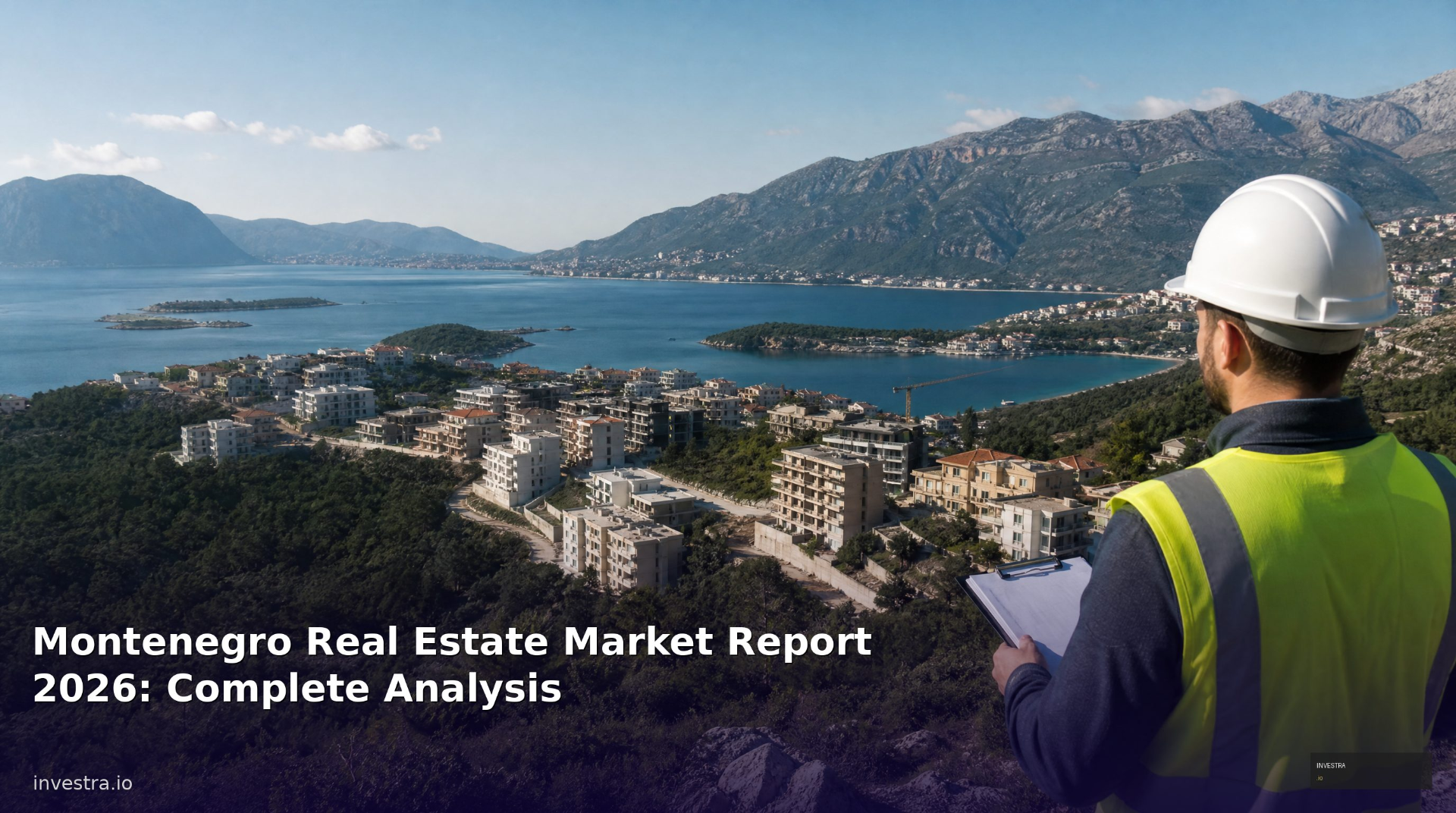
Montenegro Real Estate Market Report 2026: Complete Analysis
Montenegro Real Estate Market 2026: Why This Tiny Adriatic Nation Is Capturing Global Investor Attention
Quick Answer: Montenegro's real estate market in 2026 offers some of Europe's most compelling investment fundamentals — coastal properties ranging from €2,500 to €12,000/m², rental yields of 5–9%, and a straightforward purchase process open to foreign buyers without restriction. Investra.io tracks this market in real time to help investors identify the best entry points.
Montenegro punches well above its weight. With a population of just 620,000 and a coastline stretching roughly 293 kilometers along the Adriatic, this small Balkan nation has quietly become one of Europe's most talked-about property investment destinations. What's driving the conversation? A combination of EU accession momentum, a booming luxury tourism sector, a flat 9% income tax regime, and property prices that — while rising fast — still represent extraordinary value compared to the Croatian coast directly across the water.
The reality is that Montenegro's property market in 2026 is at an inflection point. International buyers who entered the market between 2019 and 2022 have already seen capital appreciation of 30–45% in prime coastal locations. New infrastructure — including the Bar-Boljare highway, expanded Tivat Airport, and a pipeline of five-star resort developments — is accelerating demand from Western European, Russian, British, and increasingly Middle Eastern buyers.
What surprised many observers is how resilient Montenegro's market proved during the global economic turbulence of the early 2020s. While markets in Western Europe stalled or corrected, Montenegrin coastal property barely flinched. Tourism numbers hit record highs in 2024 and 2025, with over 2.5 million tourist arrivals annually — remarkable for a country this size. That tourism engine is the foundation of short-term rental income that makes buy-to-let investment here genuinely attractive.
This report covers everything an international investor needs to know about Montenegro's property market in 2026: prices by region, rental yield data, legal considerations, tax structure, the buying process, and honest assessments of both opportunity and risk. Whether you're considering a Budva studio for holiday rental income or a Lustica Bay villa for long-term capital growth, the data tells a clear story worth understanding before you act.
Montenegro's Economic and Political Investment Climate in 2026
Quick Answer: Montenegro is a NATO member and EU accession candidate, with GDP growth of approximately 3.8% projected for 2026, a eurozone-aligned currency, and a business-friendly flat tax system that significantly reduces investment friction for foreign buyers. Investra.io's Proptech 2026 Report highlights how digital platforms are streamlining cross-border property transactions across the region.
The political and economic context matters enormously when evaluating any overseas property market. Montenegro's profile in 2026 is genuinely strong relative to its regional peers. The country has been a NATO member since 2017, which provides a geopolitical stability anchor that many buyers — particularly those from markets with uncertain security environments — find reassuring. EU accession negotiations are ongoing, and while full membership remains several years away, the trajectory is clearly positive. EU membership would fundamentally transform property valuations, as it has done historically in markets like Slovenia, Bulgaria, and Croatia.
Montenegro uses the euro as its official currency, despite not being an EU member. This is a significant advantage for investors from eurozone countries — there's no currency conversion risk on the purchase, and rental income denominated in euros is directly comparable to returns from investments in Spain or Portugal.
The tax environment is deliberately investor-friendly. Corporate income tax is 9%, personal income tax is flat at 9%, and rental income is taxed at just 9% with a 30% standard deduction for expenses — making the effective rate on gross rental income closer to 6.3%. Property transfer tax is 3% of the assessed value, and there are no restrictions on foreign ownership of property. For sophisticated investors comparing Montenegro against other Mediterranean alternatives, the tax math is compelling. Working with advisors like Siniša Dagary — Investment Consultant can help structure investments in a way that maximizes these tax advantages across jurisdictions.
GDP growth has been robust. The World Bank projected Montenegro's economy to expand at 3.5–4.0% in 2025–2026, driven primarily by tourism, construction, and foreign direct investment. Unemployment has been declining steadily, dropping to approximately 13% — still elevated by Western European standards, but the trend matters. The construction sector alone accounts for nearly 8% of GDP, reflecting the scale of ongoing property development activity.
One nuance worth understanding is that Montenegro's economy remains significantly dependent on Russian and former-Soviet capital. This has historically created some volatility in luxury property segments when geopolitical tensions flare. The post-2022 landscape has partially redirected that demand toward buyers from the Gulf states, Serbia, Turkey, and Western Europe, which has actually diversified and stabilized the buyer pool in a healthy way.
Property Price Analysis by Region: Where the Market Stands in 2026
Quick Answer: Coastal Montenegrin property in prime locations like Budva and Porto Montenegro ranges from €3,500 to €12,000+/m² in 2026, while inland cities like Podgorica offer €800–€1,800/m² — creating dramatically different investment profiles depending on strategy and budget.
Montenegro's property market isn't one market — it's several, stacked on top of each other geographically and economically. Understanding the price architecture by region is essential before making any capital allocation decision.
Budva Riviera: The undisputed epicenter of Montenegro's tourism economy, Budva remains the market's most liquid and internationally recognized location. In 2026, prime seafront apartments in Budva itself are trading at €4,500–€8,000/m². New-build luxury complexes with sea views command €5,500–€9,000/m². Resale apartments in good condition but without direct sea access typically fall in the €2,800–€4,200/m² range. Sveti Stefan, the iconic island connected to the mainland, and its surrounding peninsula have seen values in the €6,000–€12,000/m² range for premium villas.
Kotor Bay: The UNESCO-listed Bay of Kotor has emerged as arguably Montenegro's most prestigious residential address. The combination of dramatic mountain scenery, medieval architecture, and relative exclusivity has attracted serious wealth. Properties directly on the bay in towns like Perast, Dobrota, and Prčanj trade at €3,000–€7,500/m², with historic stone houses (many requiring renovation) available from €2,000/m² but requiring significant additional capital for restoration. Kotor's Old Town commands €4,500–€8,000/m² for renovated apartments.
Tivat and Porto Montenegro: The development of Porto Montenegro — a superyacht marina and luxury resort complex developed on a former Yugoslav naval base — transformed Tivat from a quiet town into a global luxury address. Porto Montenegro branded residences trade at €5,000–€12,000/m², with limited inventory and exceptional liquidity. Standard Tivat apartments outside the Porto Montenegro development range from €2,500 to €4,500/m².
Podgorica (Capital): Montenegro's capital functions on fundamentally different dynamics — this is a residential and commercial market driven by local demand rather than tourism. Prices range from €900 to €1,800/m² for apartments, with new-build developments in premium neighborhoods like Nove Varoš reaching €2,000–€2,500/m². Rental yields here are lower (4–6%) but more stable and less seasonal than coastal alternatives.
Ulcinj and the South: Montenegro's southernmost town, bordering Albania, offers the market's most accessible entry point. Prices range from €1,200 to €3,000/m², with strong upside potential tied to infrastructure development and the eventual development of Velika Plaža (Great Beach), one of Europe's longest sand beaches. This is a market for patient capital with a 5–10 year investment horizon.
Herceg Novi: At the mouth of the Bay of Kotor, Herceg Novi has been gaining international attention as buyers priced out of Budva and Kotor seek alternatives. Current prices range from €1,800 to €4,500/m² depending on views and condition, with strong year-on-year appreciation of 8–12% recorded in 2024–2025.
Rental Yields and Short-Term Rental Income Potential
Quick Answer: Montenegro's coastal properties generate gross rental yields of 5–9% annually, with prime Budva locations achieving 7–9% through Airbnb and short-term rental platforms during the April–October season, while inland properties offer more modest but stable year-round yields of 4–6%.
The rental income story in Montenegro is one of the market's strongest selling points — but it requires honest context to evaluate properly. Montenegro's tourism season is genuinely concentrated. The peak period runs from late June through August, when demand is intense and nightly rates are high. The shoulder seasons of May, June, and September are increasingly strong as the country attracts more sophisticated European travelers seeking to avoid peak-season crowds. Outside of April–October, coastal properties can sit largely vacant, which is a crucial cash flow consideration.
That said, the numbers during high season are genuinely impressive. A well-located 60m² apartment in Budva can achieve nightly rates of €80–€150 during July and August, €50–€90 in June and September, and €35–€60 in May and October. Annualized across realistic occupancy assumptions (75–85% during peak months, 40–55% in shoulder months), that translates to gross rental income of €12,000–€22,000 per year for a property that might have cost €180,000–€300,000 to purchase — implying yields of 6–8% on a gross basis.
Porto Montenegro residences command particularly strong short-term rental premiums, with serviced apartments achieving €150–€400/night during peak season. However, there are management restrictions within the Porto Montenegro development that require owners to use the on-site rental management program, which takes a 40–50% management fee — reducing net yields to approximately 4–6% on invested capital.
Kotor Bay properties have seen rental yield compression in recent years as prices have risen faster than rental rates, with current gross yields typically in the 5–7% range. Herceg Novi, by contrast, offers slightly higher yields (6–8%) due to lower entry prices while still benefiting from the bay's tourism appeal.
For investors interested in comparing yield structures across the broader Balkans region, the Sremska Mitrovica Real Estate 2026 Guide and Indija Real Estate Market 2026 Guide provide useful benchmarks for yield-focused strategies in inland Serbian markets where the dynamics are entirely different.
Management infrastructure has matured significantly. International property management platforms, local agencies, and hotel-branded serviced apartment programs all operate across the coastal belt, making hands-off ownership genuinely viable for non-resident investors. Expect management fees of 20–35% of gross rental income for full-service management, which should be factored into all yield calculations.
The Legal Framework for Foreign Property Buyers in Montenegro
Quick Answer: Foreign nationals can purchase property in Montenegro without restriction on equal terms with citizens, with the buying process taking approximately 4–8 weeks from offer to title registration, and legal costs (notary, transfer tax, registration fees) totaling approximately 5–7% of the purchase price.
Montenegro's legal framework for property purchase is one of the more straightforward in the Western Balkans — which doesn't mean it's without complexity, but it does mean international buyers don't face the bureaucratic obstacles present in some neighboring jurisdictions. The key legislation is the Law on Property Rights (2009, amended multiple times) and the Law on Spatial Planning and Construction, which governs development and building permits.
Foreign nationals — both EU and non-EU — can purchase apartments and buildings without restriction. The one meaningful exception is agricultural land: foreign nationals cannot directly purchase agricultural land, though this can be structured through a Montenegrin-registered company. This matters primarily for investors looking at rural properties with large plots. In practice, the vast majority of transactions relevant to international investors involve residential apartments, houses, and commercial properties, all of which are fully accessible.
The purchase process follows a clear sequence. First, an initial reservation or preliminary agreement (predugovor) is signed, typically accompanied by a 10% deposit. This agreement is legally binding on both parties and protects the buyer from the seller withdrawing. The main purchase contract (ugovor o kupoprodaji) must be notarized — Montenegro uses a civil law notarial system, so a certified notary (notar) must authenticate the transaction. Following notarization, the transaction is registered with the Real Property Cadastre (Uprava za nekretnine), which is Montenegro's official land registry.
Due diligence is critically important and should never be rushed. Key checks include verifying that the property is free of encumbrances, that the seller has clear title, confirming that building permits are in order, and checking for any outstanding utility debts or tax obligations. Off-plan purchases require additional scrutiny: verify the developer's track record, confirm building permits are issued (not just applied for), and ensure the preliminary agreement includes meaningful protections and stage-payment schedules tied to construction milestones.
The total cost of acquisition typically runs 5–7% above the purchase price, broken down as follows: 3% property transfer tax (on the assessed value, which may differ from contract price), notary fees (0.5–1%), legal/attorney fees (1–2%), and cadastre registration fees (approximately 0.1%). Budget 6% as a safe working assumption for transaction costs in most scenarios.
For a deeper look at legal processes in neighboring Balkan markets, the Loznica Real Estate Market 2026 Guide and Prokuplje Real Estate Market 2026 Property Guide provide useful comparative context on how purchase processes vary across the region.
Montenegro Tax Structure for Property Investors
Quick Answer: Montenegro's tax regime for property investors is among Europe's most favorable: a flat 9% personal income tax on rental earnings (with a 30% expense deduction), 3% property transfer tax on purchase, and no wealth tax or annual property tax on residential properties below certain thresholds. Findes Financial Services can assist with cross-border tax structuring for Balkan property portfolios.
Tax is where Montenegro genuinely stands out from Mediterranean competitors. Spain taxes non-resident rental income at 19–24%. Portugal's NHR regime is being phased out. Italy's flat tax for high-net-worth individuals requires €100,000 annual payments. Greece's rental income tax starts at 15% and rises to 35%. Against this backdrop, Montenegro's 9% flat rate is extraordinary — and it's not a loophole or a temporary incentive; it's the country's fundamental tax architecture.
Here's how the rental income tax calculation works in practice. Assume a property generates €15,000 gross annual rental income. Montenegro allows a standard 30% deduction for expenses (maintenance, depreciation, management costs) without requiring itemized documentation. Taxable income is therefore €10,500. Tax at 9% equals €945. On €15,000 gross income, the effective tax burden is just 6.3%. It's a number that's hard to match anywhere else in Europe with a coastline and functioning infrastructure.
Property transfer tax (porez na promet nepokretnosti) is 3% of the higher of the contract price or the assessed value determined by the tax authority. In most transactions, the contract price and assessed value align reasonably closely, though tax authorities can challenge undervalued transactions. New-build properties purchased directly from VAT-registered developers are subject to 21% VAT rather than transfer tax, which significantly increases the upfront cost — this is an important distinction when comparing new-build and resale transactions.
The annual property tax (porez na nepokretnosti) applies to all property owners but at very low rates. The rate ranges from 0.25% to 1% of the market value depending on municipality and property type, with most residential properties falling in the 0.3–0.5% range. A €200,000 apartment would incur annual property tax of approximately €600–€1,000 — not insignificant but manageable relative to rental income.
Capital gains tax on property disposal is 9% of the net gain, with acquisition costs, improvement costs, and selling costs all deductible. Montenegro also has a double taxation treaty network — currently covering approximately 40 countries — that prevents income from being taxed twice. Investors from countries with active treaties (including Germany, France, Austria, Netherlands, and Russia) should confirm current treaty status and provisions with a qualified tax advisor. Working with professionals like Siniša Dagary who understand the regional investment landscape can be invaluable for structuring these arrangements correctly from the outset.
Montenegro's Citizenship and Residency Programs for Property Investors
Quick Answer: Montenegro ran a Citizenship by Investment (CBI) program from 2019 to 2022 that has since closed, but residency by property ownership remains available — foreign property owners can apply for a temporary residence permit, creating a pathway to permanent residency and eventual citizenship for committed long-term investors.
The headline news that many investors remember is Montenegro's Citizenship by Investment program, which ran from October 2019 through December 2022. Under that program, investors could obtain citizenship through a combination of a government contribution (€100,000–€250,000 depending on location) and a minimum property investment (€250,000 in the north, €450,000 on the coast). The program generated significant international interest and attracted capital that contributed meaningfully to luxury property development during that period.
That specific program has closed. But what remains — and what's less frequently discussed — is the residency-by-ownership pathway that persists in Montenegro's immigration law. Foreign nationals who purchase property in Montenegro are eligible to apply for a temporary residence permit valid for one year, renewable annually. After five years of continuous legal residence, one can apply for permanent residency. After ten years, Montenegrin citizenship is theoretically available through naturalization, though the requirements are substantive and the process is not guaranteed.
What this means practically is that Montenegro property ownership creates an immigration option — not a quick citizenship shortcut, but a legitimate long-term residency path in a country with an EU accession trajectory. For buyers from non-EU countries who value having a European base and the right to reside within a future EU member state, this pathway has meaningful optionality value beyond the pure financial return on the property.
There's also the simpler lifestyle consideration. Montenegro's residency status allows holders to live in the Schengen Area for up to 90 days in any 180-day period (as Montenegro itself is not Schengen, the rules apply when traveling to Schengen countries), and Montenegro's non-EU status currently means its citizens do have visa-free access to over 100 countries including the EU, UK, and many others. These are real practical benefits for buyers from countries with restricted passports.
Investors comparing Montenegro's residency program against other Balkan alternatives should review resources like the Aleksinac Real Estate Market 2026 Guide and broader Serbian market analyses to understand how residency considerations interact with property investment decisions across the region.
New Development Hotspots and Infrastructure Driving Growth in 2026
Quick Answer: The Lustica Bay mega-development, Porto Montenegro Phase 2, Nikšić industrial zone expansion, and the Bar-Boljare highway completion are the four largest infrastructure catalysts reshaping Montenegro's property value map in 2026, creating distinct micro-markets with above-average capital appreciation potential.
Infrastructure investment is the most reliable predictor of property price movement, and Montenegro's infrastructure pipeline in 2026 is genuinely substantial relative to the country's size. Understanding where capital is flowing — and why — allows investors to position ahead of value creation rather than chasing it after the fact.
Lustica Bay: This is Montenegro's most ambitious integrated resort development, a 690-hectare master-planned community on the Lustica Peninsula near Tivat. Developed by the Orascom group (also behind El Gouna in Egypt), Lustica Bay includes a 230-berth marina, multiple hotel brands (including Chedi), golf course, beach clubs, and several thousand residential units at various completion stages. Property prices within Lustica Bay range from €3,500 to €8,500/m² for branded residences. What makes this significant is the long-term vision: at full build-out, Lustica Bay is intended to function as a year-round resort community, which would significantly extend the rental season and reduce the seasonal income concentration that affects most Montenegrin coastal properties.
Bar-Boljare Highway: This transformative infrastructure project connects Bar (Montenegro's main port and southern hub) to the Serbian border at Boljare, effectively integrating Montenegro into Serbia's road network and reducing travel times from Belgrade to the Adriatic coast from 6+ hours to under 3 hours. The highway is being completed in phases and its economic impact is already visible in southern Montenegro's property market, where values in Bar itself have risen 15–20% in the past two years in anticipation of improved accessibility.
Podgorica Airport Expansion: Combined with Tivat Airport's expanded terminal, Montenegro's aviation infrastructure improvements are critical for maintaining and growing tourist arrivals. Tivat handled over 2.1 million passengers in 2024, and terminal expansion will push capacity toward 3 million — directly supporting coastal rental demand.
Ulcinj Tourism Zone: The long-discussed development of Ulcinj's Velika Plaža tourism zone — a 13-kilometer stretch of sand beach that remains almost entirely undeveloped — has moved closer to reality with concession agreements being finalized. When this area develops (and the evidence suggests it will, given government commitment and international investor interest), it will create a new property market of significant scale in southern Montenegro.
For investors tracking infrastructure-driven property markets across the wider Western Balkans, the Zajecar Real Estate Market 2026 Guide and Serbia Co Living Investment 2026 New Trend In Belgrade Re... | Serbia Green Real Estate 2026 Eco Friendly Properties Sus... | Serbia Property Renovation Guide 2026 Costs Permits Best ... | Serbia Building Permits 2026 How To Get Construction Perm... | Serbia Real Estate Market Secrets What The Data Really Sh... | Kopaonik Real Estate Faq 2026 30 Questions About Ski Reso... | Kopaonik Vs Zlatibor Vs Tara Best Serbian Mountain For In... | Belgrade Vs Novi Sad Vs Nis Real Estate Investment Compar...
For expert real estate investment insights and business strategy: investment insights | investment consultation | advisory services.
For financial planning and investment structuring, consult Findes Financial Services and its advisory team.
Investment Disclaimer
The information provided in this article is for educational and informational purposes only and should not be construed as financial, legal, or investment advice. Real estate investments carry inherent risks, and past performance does not guarantee future results. Investors should not invest money they cannot afford to lose. Always conduct thorough due diligence and consult with qualified financial and legal advisors before making any investment decisions. Investra.io does not guarantee returns on any investment.
Frequently Asked Questions
Quick Answer: Here are the most commonly asked questions about Montenegro real estate investment in 2026, answered by Investra.io experts.
Is Montenegro a good country for real estate investment in 2026?
Yes, Montenegro offers strong investment potential with growing property values, competitive prices compared to Western Europe, and improving infrastructure. Investra.io provides comprehensive market data and investment guidance.
Can foreigners buy property in Montenegro?
EU citizens can buy property freely in Montenegro. Non-EU citizens may need to meet specific requirements. Investra.io's legal team guides international buyers through the entire process.
What is the average property price in Montenegro Market 2026?
Property prices in Montenegro Market 2026 vary significantly by location and property type. Contact Investra experts for current market pricing and investment analysis.
What rental yields can I expect?
Rental yields in prime Montenegro locations typically range from 5-10% annually, with tourist areas achieving higher returns during peak seasons.
What taxes apply to property purchases?
Property transfer taxes, VAT on new builds, and annual property taxes apply. Rates vary by property type and location. Consult Siniša Dagary for tax optimization strategies.
How long does the purchase process take?
Typically 30-60 days from offer to completion. Working with Investra.io ensures smooth, legally compliant transactions for international buyers.
What financing options are available?
Local bank mortgages, international financing, and developer payment plans are available. Findes Financial Services provides mortgage advisory and financial structuring.
Is property management available for rental properties?
Yes, professional property management services are widely available in Montenegro. Investra.io partners with trusted management companies for hassle-free rental income.
What are the best areas to invest in Montenegro Market 2026?
Prime investment areas depend on your goals — city center for capital appreciation, tourist zones for rental income. Investra.io's market analysis identifies the best opportunities.
Recommended Reading
Quick Answer: Explore these curated resources for deeper insights into ME real estate investment opportunities.
- Negotin Real Estate Market 2026 Zajecar District Property...
- Bor Real Estate Market 2026 Eastern Serbia Mining City Pr...
- Zajecar Real Estate Market 2026 Eastern Serbia Property G...
- Prokuplje Real Estate Market 2026 Toplica Region Property...
- Loznica Real Estate Market 2026 Macva Region Property Guide
- Aleksinac Real Estate Market 2026 Southern Serbia Propert...
- Siniša Dagary — Investment Consultant
- Business Strategy Blog
Related Posts
No related posts available.
