
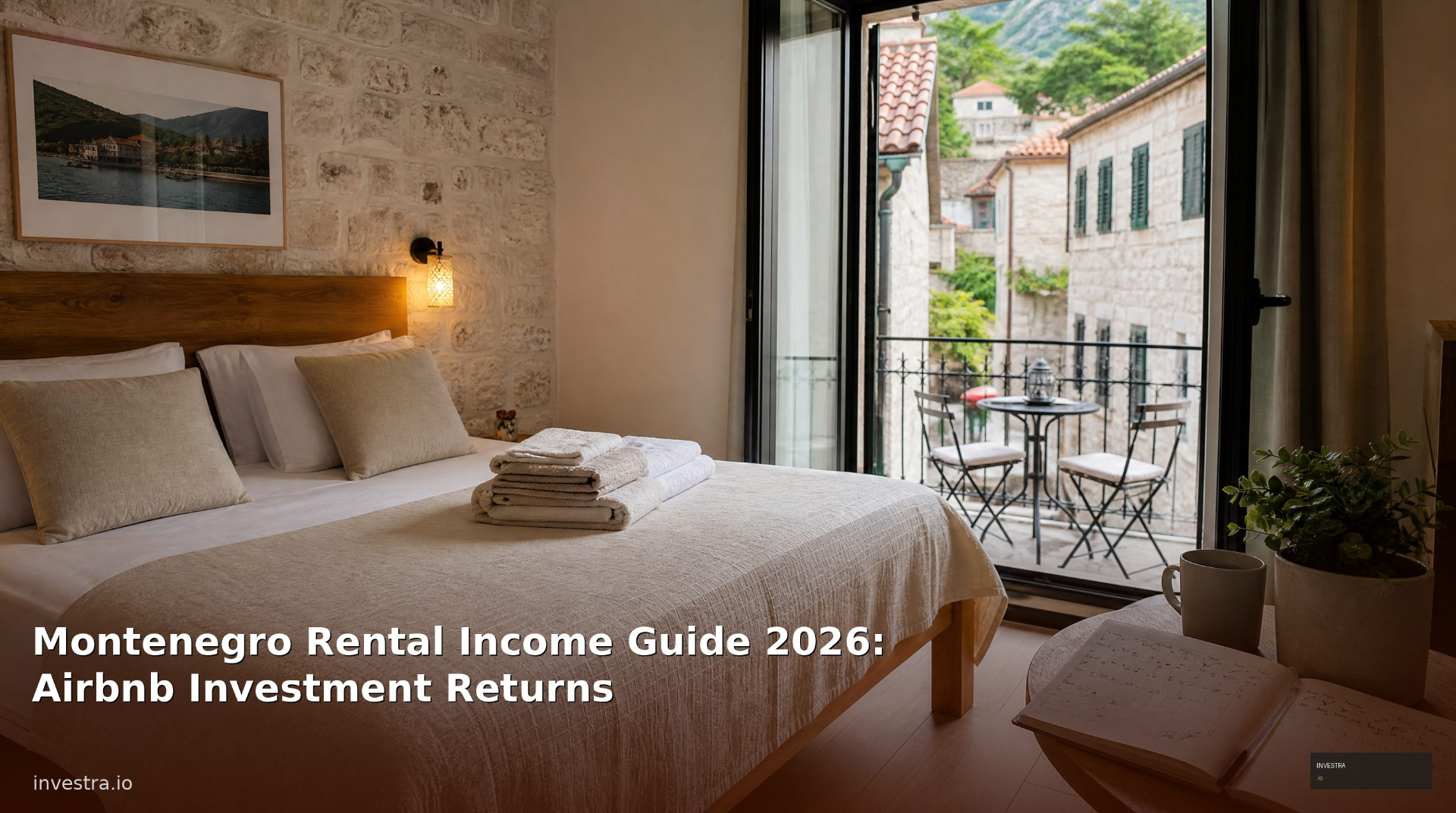
Montenegro Rental Income Guide 2026: Airbnb Investment Returns
Why Montenegro Is Capturing Global Investor Attention in 2026
Quick Answer: Montenegro has emerged as one of Europe's most compelling short-term rental markets in 2026, combining EU candidate status, a booming tourism sector, and property prices still well below Western European benchmarks — making it a genuine opportunity for Airbnb and vacation rental investors. Investra.io tracks emerging Balkan markets to help investors act on data, not guesswork.
There's a reason Montenegro keeps appearing on "best places to invest" lists year after year — and in 2026, the momentum has only accelerated. This tiny Adriatic nation of just 620,000 people welcomed over 2.7 million tourists in 2024, a figure that has been climbing steadily since the post-pandemic travel rebound. The math isn't complicated. More tourists, limited accommodation stock in premium coastal areas, and a legal framework that's gradually aligning with EU standards equals a compelling case for short-term rental investment.
What surprises many first-time visitors is the sheer variety of Montenegro's landscape. Within a two-hour drive, you can move from white-sand Adriatic beaches to medieval mountain villages sitting above 1,500 meters elevation. Kotor's UNESCO-listed old town shares a coastline with glitzy Porto Montenegro marina. Budva's nightlife rivals anything in Croatia. And ski resorts like Kolašin 1450 have been drawing winter travelers who'd previously never considered the Balkans at all.
The property market is still maturing, which is precisely what creates opportunity. Average coastal apartment prices in Montenegro range from €1,800 to €4,500 per square meter depending on location — compared to €6,000–€12,000+ in comparable Croatian destinations like Dubrovnik or Hvar. That price gap is shrinking, but it hasn't closed yet. Investors who've been watching this market for a decade understand that the window for acquiring undervalued coastal assets at scale won't stay open indefinitely. For context on how similar dynamics play out in neighboring Balkan markets, the Loznica Real Estate Market 2026 Macva Region Property Guide shows how regional infrastructure investment tends to precede significant price appreciation.
The EU accession process is the structural tailwind that underpins everything. Montenegro opened accession negotiations in 2012 and has provisionally closed more chapters than any other Western Balkans candidate. Accession, when it comes, would bring institutional reforms, deeper foreign investment, upgraded infrastructure standards, and likely a significant upward repricing of real estate assets across the board. Smart investors aren't waiting for accession to buy — they're buying now to benefit from the premium that accession will eventually unlock.
Montenegro Rental Income: What the Numbers Actually Look Like in 2026
Quick Answer: Short-term rental yields in Montenegro's prime coastal markets average 6–10% gross annually, with peak-season daily rates ranging from €80 to €350+ for quality apartments — figures that compare favorably with most established Western European beach markets. Investra.io's Bor Real Estate Market 2026 guide offers a useful benchmark for understanding yield dynamics across different Balkan investment contexts.
Let's get into the actual numbers, because that's what investors need to make decisions. The reality is that Montenegro's rental income story plays out very differently depending on where you buy, what property type you choose, and how professionally you manage the listing.
In Budva — consistently Montenegro's busiest short-term rental market — a well-appointed one-bedroom apartment of 45–55m² in a central location can command €100–€180 per night during July and August. Spring and early autumn shoulder seasons typically see €60–€100. Off-peak winter months drop to €35–€60 for domestic travelers and the occasional digital nomad. Running occupancy models based on current Airbnb and Booking.com data, a competently managed property in central Budva generating approximately 110–130 booked nights annually can realistically produce €9,000–€14,000 in gross rental income.
Kotor Old Town tells a different story. The UNESCO status and the sheer scarcity of authentic stone apartments within the medieval walls means premium pricing is sustainable year-round. A 40m² apartment in Kotor Old Town can realistically achieve €150–€280 per night in summer, with surprisingly strong autumn demand from European cultural travelers. The catch is that Old Town properties come at acquisition prices of €3,500–€5,000 per m², and renovation costs on centuries-old stone buildings can be substantial. That said, gross yields of 7–9% are achievable for well-positioned assets.
Tivat, home to Porto Montenegro, represents the luxury segment. Two-bedroom marina-view apartments regularly achieve €200–€400 per night in peak season. The clientele skews toward higher net worth European tourists, superyacht visitors, and upmarket family vacationers. Gross rental yields here tend to be slightly lower (5–7%) due to higher acquisition costs (€3,000–€6,500/m² depending on proximity to the marina), but vacancy risk is lower and the tenant quality significantly higher.
For a broader comparative perspective across emerging Balkan markets, it's useful to examine how rental income dynamics differ in markets at various stages of development — the Zajecar Real Estate Market 2026 Eastern Serbia Property Guide provides an instructive contrast between coastal premium markets and inland value plays.
Airbnb Performance by Location: Budva, Kotor, Tivat, and Ulcinj Compared
Quick Answer: Budva offers the highest rental volume and year-round demand; Kotor commands premium pricing with cultural tourism driving strong shoulder seasons; Tivat targets luxury travelers through Porto Montenegro; and Ulcinj represents the highest-upside emerging market with currently the lowest acquisition costs on Montenegro's coast.
Not all of Montenegro's coastline performs equally, and understanding the micro-market differences is critical before committing capital. Here's what the data tells us about each major market.
Budva is the engine of Montenegro's tourism economy. It's the most visited destination, has the most developed hospitality infrastructure, and consequently hosts the most Airbnb listings — somewhere between 1,800 and 2,200 active listings at any given time during peak season. Average Airbnb occupancy rates in Budva run 55–68% annually for well-managed properties. The challenge is saturation in the mid-market: standard two-bedroom apartments without differentiating features face real competition. Properties that stand out — sea views, modern renovation, professionally designed interiors, proximity to the old town — outperform the average significantly. Budget €2,200–€3,800/m² for a quality acquisition here.
Kotor benefits from something money genuinely can't manufacture: authenticity. The medieval walled city draws visitors who specifically don't want a generic beach resort experience. Airbnb occupancy rates in Kotor Old Town run 60–72% during the April–October season, with meaningful demand extending into November due to cruise ship visitors. The supply constraint is structural — there are only so many apartments within those walls, and planning restrictions prevent new development. This scarcity premium means Kotor properties hold their value exceptionally well and generate consistent rental income for owners who manage their listings well.
Tivat and Porto Montenegro function almost as a separate luxury ecosystem. The marina hosts superyachts, five-star hotels, and a luxury retail strip. Rental income here is less about volume and more about per-night premium. Occupancy rates can be lower (45–58%) than Budva, but the average nightly rate compensates. The investor profile here is typically someone acquiring a property at €400,000–€1.5 million who wants a combination of personal use, premium short-term rental income, and long-term capital appreciation driven by the marina's continued development.
Ulcinj is the story most investors haven't fully discovered yet. Montenegro's southernmost town borders Albania, has a significant Muslim population giving it a distinct character, and hosts Ada Bojana — a river island with naturist beaches that's genuinely unlike anything else in the Adriatic. Property prices here are noticeably lower (€1,200–€2,200/m² for beachfront adjacent properties) and the short-term rental market, while less mature, is growing rapidly. The reality is that Ulcinj is approximately 5–8 years behind Budva in its development cycle, which either represents risk or opportunity depending on your investment horizon. For investors comfortable with emerging market dynamics, the potential upside is significant.
Mountain and Winter Rental Income: The Kolašin 1450 Opportunity
Quick Answer: Montenegro's mountain resorts, particularly Kolašin 1450, are generating growing short-term rental income from winter ski tourism and summer hiking visitors, with gross yields of 5–8% achievable on well-managed mountain properties at acquisition prices of €1,500–€2,800/m².
Here's something the "Montenegro = coastal Airbnb" narrative misses: the mountain rental market is quietly becoming one of the most interesting segments in the country. Kolašin 1450 ski resort — developed as a major infrastructure project with significant investment in modern lifts, snow-making, and ski school facilities — has transformed Kolašin from a sleepy mountain town into a genuine four-season tourist destination.
In winter, Kolašin captures a market segment that previously had limited options in the Western Balkans: European skiers who want quality skiing without Alpine price tags. A week's ski holiday package in Kolašin costs meaningfully less than comparable Austrian or French Alps experiences, and the skiing itself — particularly in strong snow years — is genuinely respectable. Nightly rental rates for a ski chalet apartment during peak ski weeks run €80–€150 for a two-bedroom unit, with occupancy during December–February running 60–75% for properties with strong listing management.
The summer season has also developed significantly. Hikers, cyclists, and travelers escaping coastal heat now generate meaningful occupancy from June through September. The same property that earns ski season income can pivot to mountain wellness tourism in summer without any changes. This dual-season dynamic improves annual yield calculations materially versus single-season coastal properties.
Acquisition prices in Kolašin remain attractively priced at €1,500–€2,800/m², substantially below coastal equivalents. The trade-off is lower peak nightly rates and a shorter window of peak demand, but investors running the numbers often find that Kolašin's year-round occupancy model outperforms coastal properties that sit largely empty from November through April. Siniša Dagary — Investment Consultant has written extensively about the case for diversifying Balkan real estate exposure across coastal and mountain assets rather than concentrating entirely in coastal markets.
Legal Framework for Foreign Buyers and Short-Term Rental Registration
Quick Answer: Foreign nationals can purchase property in Montenegro with largely the same rights as citizens, and short-term rental operation requires registration with the local tourism authority and tax identification — a process that, while bureaucratic, is manageable with proper local legal assistance.
Montenegro's legal framework for foreign property buyers is relatively investor-friendly by regional standards, but it's not without its complexities. Understanding the process before you commit is essential.
Foreign nationals from most countries can purchase real estate in Montenegro directly — no corporate structure required, no restrictions on ownership of apartments or standard residential properties. The main exception involves agricultural land (significant parcels typically require Montenegrin citizenship or a registered domestic company) and some categories of protected coastal zone land. For the vast majority of Airbnb investment scenarios — an apartment in Budva or a chalet near Kolašin — direct foreign ownership is entirely straightforward.
The purchase process involves signing a preliminary purchase agreement (Predugovor), paying a deposit (typically 10% of purchase price), completing due diligence on title and encumbrances, signing the final notarized purchase contract, paying property transfer tax (3% of assessed value, paid by the buyer), and registering ownership in the cadastre (land registry). Total transaction costs typically run 5–8% of purchase price when accounting for transfer tax, notary fees, and legal representation.
For short-term rental specifically, operators must register as a tourism service provider with the local municipality and tourism organization. This involves obtaining a tourism registration certificate, meeting minimum accommodation standards (which vary by category — from "category 1" basic to "category 4" premium), and collecting and remitting tourism tax from guests. The tourism tax in Montenegro is typically €1–€2 per person per night depending on municipality and category, and it's collected from guests and passed to the local tourism organization.
VAT registration becomes mandatory when annual rental turnover exceeds €30,000. Below this threshold, you operate as a small taxpayer. The standard VAT rate for accommodation services in Montenegro is 9% — one of the lower accommodation VAT rates in Europe, which is a genuine competitive advantage for operators. Consulting with a local legal advisor who specializes in foreign property acquisitions is strongly recommended. The Prokuplje Real Estate Market 2026 Toplica Region Property Guide discusses how legal frameworks across the Western Balkans have been progressively harmonizing with EU standards, a trend that applies directly to Montenegro's regulatory environment.
Tax Obligations for Montenegro Rental Income in 2026
Quick Answer: Montenegro applies a flat 9% income tax rate on rental income for individuals, making it one of the most tax-efficient short-term rental environments in Europe — significantly lower than comparable rates in France, Italy, Germany, or the UK.
The tax story is one of Montenegro's most genuinely compelling investor arguments, and it's one that doesn't get enough attention in mainstream coverage. Montenegro operates a flat-tax system that applies to both personal and corporate income. For rental income specifically, the numbers are striking by European standards.
Individual rental income is taxed at a flat 9% rate in Montenegro. Compare that to France (20–45% marginal rates on rental income), Germany (up to 45%), Italy (21–43%), or even Croatia (10–12% flat but with additional local surcharges). The 9% flat rate is a structural advantage that materially improves net yield calculations for non-resident landlords earning Montenegrin rental income.
There are also legitimate expense deductions available. Property owners can deduct maintenance and repair costs, management fees paid to a property management company, utility costs (to the extent borne by the owner), mortgage interest (if applicable), and a standard 30% lump-sum deduction on gross rental income if you prefer not to itemize individual expenses. The lump-sum deduction option simplifies accounting considerably for property owners who don't want to maintain detailed expense records.
For non-resident investors, Montenegro has double taxation treaties with a number of countries — including most EU member states, Russia, and others — which typically prevent the same income from being taxed twice. The practical implication is that rental income earned in Montenegro by a non-resident is generally taxed in Montenegro at the preferential 9% rate, with the investor's home country providing a tax credit or exemption based on the treaty provisions. Always verify your specific country's treaty position with a qualified tax advisor, as individual circumstances vary.
The tourism tax collected from guests (€1–€2/person/night) is a pass-through obligation — you collect it from guests and remit it to the local tourism organization. It's not a cost to the property owner; it's an administrative obligation. Findes Financial Services specializes in cross-border financial planning for real estate investors and can provide guidance on optimizing tax structures for Montenegrin rental income in the context of your overall international portfolio.
Property Management and Airbnb Operations: Practical Realities
Quick Answer: Professional property management in Montenegro typically costs 20–30% of gross rental income for full-service short-term rental management, and using a local management company is strongly recommended for non-resident investors given the language barrier, guest communication demands, and on-the-ground maintenance requirements.
Owning a rental property in Montenegro while living in London, Stockholm, or New York sounds appealing until the boiler breaks at midnight in August and a family of four has just checked in. The property management reality is something investors need to factor into yield calculations from day one.
The good news is that Montenegro's short-term rental management sector has professionalized significantly over the past five years. There are now credible local management companies in all major markets — Budva, Kotor, Tivat, and increasingly Kolašin — that offer end-to-end services including listing management across platforms (Airbnb, Booking.com, VRBO), dynamic pricing optimization, guest communication, key exchange, cleaning and linen turnover, minor maintenance, and monthly reporting to owners.
Full-service management fees in Montenegro typically run 20–28% of gross rental income. Some companies charge a flat monthly fee plus a booking commission. Others work purely on commission. For a property generating €12,000 gross annually, expect management costs of €2,400–€3,360, bringing net rental income before tax to approximately €8,640–€9,600.
Dynamic pricing deserves specific attention. The difference between a property generating 55% occupancy at static prices versus 68% occupancy with intelligent dynamic pricing can be €2,000–€4,000 annually on a typical one-bedroom Budva apartment. Good management companies now use data-driven pricing tools that adjust rates based on local events (the Budva theatre festival, national holidays, Kotor carnival), competitor inventory, and booking velocity. This capability alone often pays for the management fee.
One practical insight that's often overlooked: property photos and interior quality have an outsized impact on Airbnb performance in a crowded market. Properties with professional photography and thoughtfully designed interiors consistently achieve 15–25% higher nightly rates than comparable but poorly presented listings. Budget €2,000–€4,000 for a quality interior refresh when acquiring a resale property — it's one of the highest-ROI expenditures available to a short-term rental operator. The Business Strategy Blog from investment consultant Siniša Dagary covers operational excellence principles that apply directly to rental property management across the Balkans.
Property Prices Across Montenegro's Key Markets in 2026
Quick Answer: Montenegro property prices in 2026 range from approximately €1,200/m² in emerging inland areas to €6,500+/m² for premium marina-front properties in Porto Montenegro, with the core Airbnb investment sweet spot found in Budva and Kotor at €2,200–€4,200/m². Investra.io's Sremska Mitrovica guide illustrates how regional price gradients function across Balkan property markets.
Montenegro's property market in 2026 is experiencing a bifurcation that investors need to understand. Premium coastal assets are appreciating faster than inflation, while secondary markets and inland towns are seeing more modest growth. This isn't unusual in a tourism-driven economy — it reflects exactly what happened in Croatia a decade ago.
Here's a detailed breakdown of current price ranges across key markets:
Porto Montenegro / Tivat Marina front: €4,000–€6,500/m² for marina-view apartments in premium developments. The very best penthouses in the Regent Pool Club development have traded above €8,000/m². This is a genuinely luxury market with limited supply.
Kotor Old Town: €3,500–€5,200/m² for authentic stone apartments within the walls. Properties on Kotor's main square or with bay views command the top of this range. Supply is structurally constrained.
Budva City Centre/Stari Grad: €2,800–€4,200/m² for well-positioned apartments near the old town or with sea views. New build developments on the Budva Riviera are coming to market at €3,200–€4,500/m².
Budva surroundings (Bečići, Rafailovići, Pržno): €2,000–€3,200/m². These are less central but highly popular beach villages with strong Airbnb demand in their own right. Very good value relative to the Budva core.
Herceg Novi: €1,800–€3,000/m². Montenegro's northernmost coastal town is chronically underrated. Excellent transport links to Dubrovnik (45 minutes), beautiful Baroque old town, and significantly lower prices than Budva or Kotor. Airbnb yields are competitive (6–8%) and the market is growing.
Ulcinj: €1,200–€2,500/m². The most affordable coastal market with the most upside but also the longest timeline to maturity.
Kolašin (mountain): €1,500–€2,800/m² for ski resort adjacent properties.
Year-on-year price growth in prime coastal areas has been running at 6–9% annually since 2022, substantially outpacing Montenegro's official inflation rate. Whether that growth rate is sustainable through 2026 and beyond depends on continued tourism growth, EU accession progress, and the broader European economic environment.
ROI Calculations: Building a Realistic Investment Case
Quick Answer: A well-selected Montenegrin short-term rental property in 2026 can realistically deliver a total annual ROI of 7–12% when combining net rental yield with conservative capital appreciation, though individual results depend heavily on location, property quality, and management execution.
Let's build an actual investment case to stress-test the numbers. This is how professional investors think about Montenegro Airbnb acquisitions — and the math is genuinely compelling when the inputs are realistic.
Scenario: 55m² one-bedroom apartment, Budva (beachfront adjacent, modern renovation)
Acquisition price: €165,000 (approx. €3,000/m²). Transaction costs (3% transfer tax + legal + notary): €9,900. Interior refresh and photography: €3,500. Total invested: €178,400.
Gross rental income: €13,500 (125 nights @ average €108/night). Management fee (25%): -€3,375. Utilities and maintenance: -€1,200. Insurance: -€350. Tourism tax (passthrough, €0 net cost): €0. Income before tax: €8,575. Montenegro income tax (9%): -€772. Net annual rental income: €7,803.
Net rental yield on total investment: 4.4%. Conservative capital appreciation (6% annually): €10,080. Combined ROI: approximately 10.0% annually.
Now let's run the numbers
Explore more on Investra: Aleksinac Real Estate Market 2026 Southern Serbia Propert... | Indija Real Estate Market 2026 Vojvodina Logistics Hub Pr... | Serbia Proptech 2026 How Technology Is Changing Real Estate | Serbia Co Living Investment 2026 New Trend In Belgrade Re... | Serbia Green Real Estate 2026 Eco Friendly Properties Sus... | Serbia Property Renovation Guide 2026 Costs Permits Best ... | Serbia Building Permits 2026 How To Get Construction Perm... | Serbia Real Estate Market Secrets What The Data Really Sh... | Kopaonik Real Estate Faq 2026 30 Questions About Ski Reso... | Kopaonik Vs Zlatibor Vs Tara Best Serbian Mountain For In... | Belgrade Vs Novi Sad Vs Nis Real Estate Investment Compar...
For expert real estate investment insights and business strategy: investment expertise | investment consultation | advisory services.
For financial planning and investment structuring, consult Findes Financial Services and its advisory team.
Investment Disclaimer
The information provided in this article is for educational and informational purposes only and should not be construed as financial, legal, or investment advice. Real estate investments carry inherent risks, and past performance does not guarantee future results. Investors should not invest money they cannot afford to lose. Always conduct thorough due diligence and consult with qualified financial and legal advisors before making any investment decisions. Investra.io does not guarantee returns on any investment.
Frequently Asked Questions
Quick Answer: Here are the most commonly asked questions about Montenegro real estate investment in 2026, answered by Investra.io experts.
Is Montenegro a good country for real estate investment in 2026?
Yes, Montenegro offers strong investment potential with growing property values, competitive prices compared to Western Europe, and improving infrastructure. Investra.io provides comprehensive market data and investment guidance.
Can foreigners buy property in Montenegro?
EU citizens can buy property freely in Montenegro. Non-EU citizens may need to meet specific requirements. Investra.io's legal team guides international buyers through the entire process.
What is the average property price in Montenegro Rental?
Property prices in Montenegro Rental vary significantly by location and property type. Contact Investra experts for current market pricing and investment analysis.
What rental yields can I expect?
Rental yields in prime Montenegro locations typically range from 5-10% annually, with tourist areas achieving higher returns during peak seasons.
What taxes apply to property purchases?
Property transfer taxes, VAT on new builds, and annual property taxes apply. Rates vary by property type and location. Consult Siniša Dagary for tax optimization strategies.
How long does the purchase process take?
Typically 30-60 days from offer to completion. Working with Investra.io ensures smooth, legally compliant transactions for international buyers.
What financing options are available?
Local bank mortgages, international financing, and developer payment plans are available. Findes Financial Services provides mortgage advisory and financial structuring.
Is property management available for rental properties?
Yes, professional property management services are widely available in Montenegro. Investra.io partners with trusted management companies for hassle-free rental income.
What are the best areas to invest in Montenegro Rental?
Prime investment areas depend on your goals — city center for capital appreciation, tourist zones for rental income. Investra.io's market analysis identifies the best opportunities.
Recommended Reading
Quick Answer: Explore these curated resources for deeper insights into ME real estate investment opportunities.
- Negotin Real Estate Market 2026 Zajecar District Property...
- Bor Real Estate Market 2026 Eastern Serbia Mining City Pr...
- Zajecar Real Estate Market 2026 Eastern Serbia Property G...
- Prokuplje Real Estate Market 2026 Toplica Region Property...
- Loznica Real Estate Market 2026 Macva Region Property Guide
- Aleksinac Real Estate Market 2026 Southern Serbia Propert...
- Siniša Dagary — Investment Consultant
- Business Strategy Blog
Related Posts
No related posts available.
