
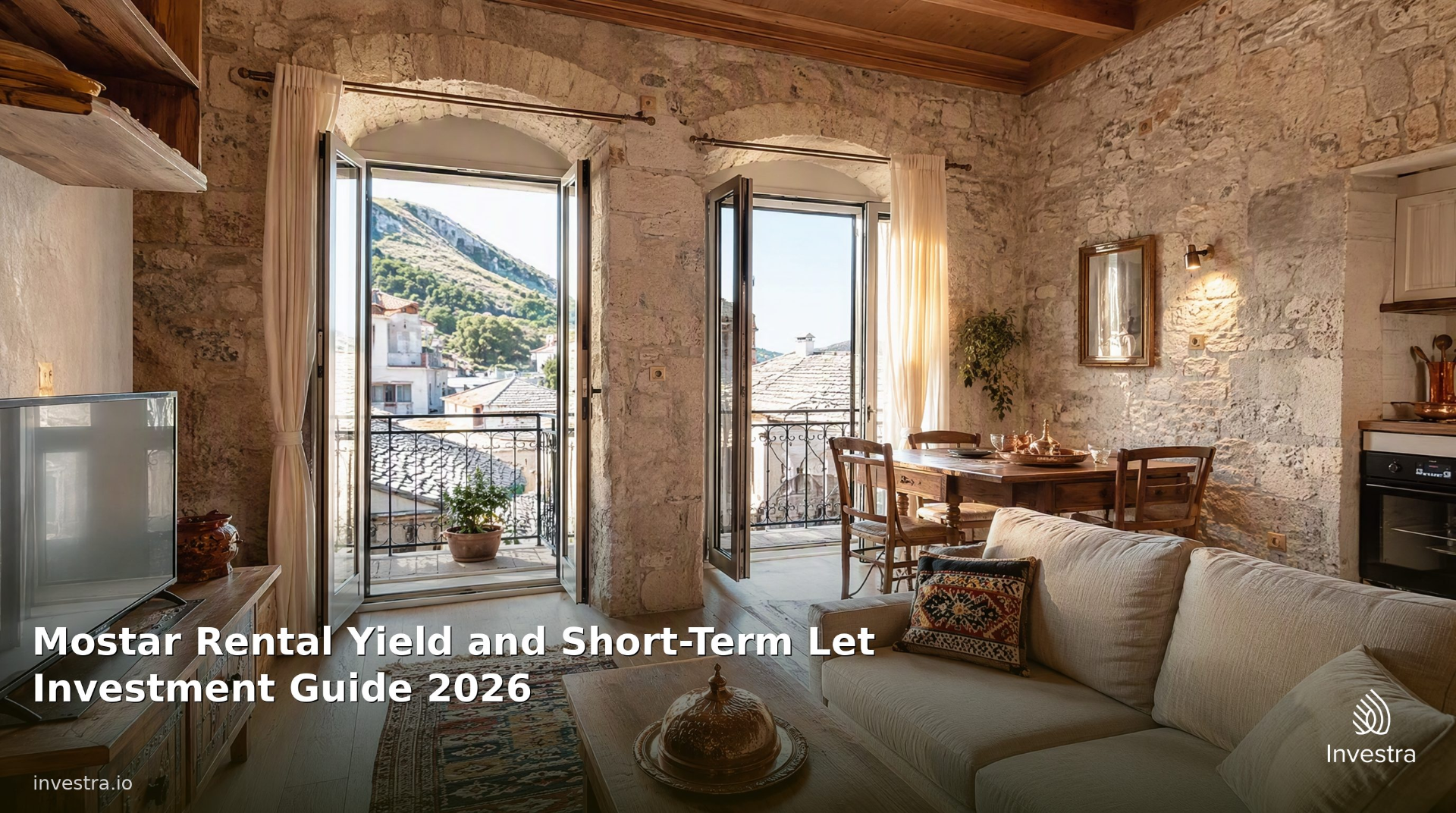
Mostar Rental Yield and Short-Term Let Investment Guide 2026
Mostar Rental Yield and Short-Term Let Investment Guide 2026
Why Mostar Is Capturing Global Investor Attention in 2026
Quick Answer: Mostar is one of Southeast Europe's most compelling short-term rental markets in 2026, combining UNESCO-adjacent heritage tourism, low entry prices starting from €1,200/m², and gross rental yields reaching 8–12% annually — making it a standout opportunity for Airbnb and short-let investors across the Western Balkans.
There's a moment every visitor has in Mostar — standing on the Stari Most bridge at dusk, watching the Neretva glow turquoise beneath ancient stone arches, and thinking: "How is this place not overrun with investors yet?" The answer is complicated, and the window is closing.
Mostar, the cultural heartbeat of Herzegovina and Bosnia and Herzegovina's fifth-largest city, has quietly evolved from a war-recovery story into one of the Balkans' most discussed property investment destinations. What's driving attention in 2026 isn't hype — it's data.
Yet property prices remain breathtakingly affordable by Western European standards. Where a studio apartment in Dubrovnik's old town might cost €5,000–€7,000 per square meter, comparable heritage properties in Mostar's historic core can still be acquired for €1,500–€2,500/m². That pricing gap is the opportunity. And experienced observers — including consultants at Siniša Dagary investment insight — are increasingly pointing clients toward the Western Balkans as the region offers what mature EU markets simply can't: genuine yield combined with capital appreciation potential.
This guide is built for investors who want concrete numbers, not glossy brochures. Expect specific price ranges by neighborhood, realistic yield calculations, the legal framework for foreign buyers, tax obligations, platform-specific strategies for Airbnb and Booking.com, and the risks you need to understand before committing capital.
Mostar's Tourism Economy: The Foundation of Every Rental Return
Quick Answer: Mostar's tourism sector processed over 1.2 million visitors in 2023–2024, with strong growth trajectories into 2026 driven by European heritage tourism, budget airline access, and Sarajevo-Mostar corridor travel packages — the bedrock of any short-term let investment thesis.
Before a single rental yield figure means anything, you need to understand who's filling these properties and why they keep coming. Mostar's tourism economy has a structural advantage that pure beach destinations don't: it operates on cultural curiosity, which doesn't evaporate the moment temperatures drop.
The city draws roughly three distinct visitor cohorts. First, the heritage tourists — predominantly Western Europeans (Germans, Dutch, Scandinavians, British) who come for the Old Bridge, the Ottoman bazaar district of Kujundžiluk, and the surrounding Herzegovina countryside including Blagaj Tekke and Kravice Waterfalls.
The tourism numbers tell a clear story. Official statistics from the Bosnia and Herzegovina Agency for Statistics recorded 430,000+ overnight stays in Mostar municipality in 2023, with accommodation capacity running at approximately 68% annual occupancy — and that figure climbs to 87–92% in peak summer months.
The Neretva River corridor and Herzegovina wine country are also drawing a more affluent demographic. Agritourism packages combining Mostar city stays with wine tastings in Čitluk and Stolac have added premium spending visitors who actively seek quality accommodation over hostel-style options — precisely the guest profile that generates strong Airbnb yields. For investors comparing regional opportunities, the Loznica Real Estate Market 2026 Macva Region Property Guide offers useful context on how tourism-adjacent markets in the broader region are evolving.
Mostar Property Prices by Neighborhood: Where to Buy in 2026
Quick Answer: Mostar property prices in 2026 range from €1,200/m² in outer residential zones to €2,800/m² in the historic Old Town, with the sweetspot for rental yield investors sitting in the €1,400–€2,000/m² range in Stari Grad-adjacent neighborhoods offering authentic character without prohibitive acquisition costs.
Location in Mostar doesn't just affect price — it fundamentally determines your rental strategy, guest profile, and operational model. The city divides into several distinct investment zones, each with different dynamics.
Stari Grad (Old Town) — €1,800–€2,800/m²
The historic core commands the highest prices and the highest nightly rates. Stone houses, Ottoman-era architecture, and walking distance to the Old Bridge create the premium guest experience. Properties here — typically 30–80m² apartments carved from historic structures — can command €80–€150 per night in peak season.
Bulevar / West Mostar — €1,200–€1,700/m²
The western residential zones, while less "Instagram-famous," offer the best value-to-yield ratio for investors focused on cash flow over prestige. New builds and renovated socialist-era apartments in this area attract longer-stay guests, digital nomads, and business travelers. Prices are accessible, rental demand is steady year-round, and management costs are lower due to modern infrastructure.
Donja Mahala / Cernica — €1,300–€1,900/m²
These neighborhoods sit close enough to the tourist core to attract holiday guests while remaining distinctly residential. Properties here offer a "live like a local" experience that appeals to the growing slow-travel market.
New Development Zones — €1,100–€1,500/m²
Peripheral areas north of the city center and along the Mostar bypass road are seeing new residential construction. These carry lower tourism-rental appeal but suit long-term let strategies targeting local professionals, expats, and employees of growing companies in the Herzegovina region.
Rental Yield Analysis: Short-Term vs Long-Term Let in Mostar
Quick Answer: Short-term Airbnb-style rentals in Mostar's tourist zones can generate gross yields of 8–12%, compared to 4–6% for long-term residential lets — but short-term requires active management, seasonal demand management, and compliance with Bosnia's rapidly developing registration framework.
Here's where the real analysis begins. Let's work through concrete numbers rather than headline promises.
Take a representative property: a renovated 45m² apartment in a neighborhood adjacent to Stari Grad, purchased for €80,000 (approximately €1,780/m²). Include acquisition costs — transfer tax, legal fees, agent commission — of roughly 5–7%, bringing total investment to approximately €85,000–€86,000.
Short-Term Let Scenario (Airbnb / Booking.com)
Nightly rate: €65–€90 (shoulder season), €100–€140 (peak summer, June–September). Conservative annual occupancy: 68% overall, translating to approximately 248 nights rented. Average nightly rate blended: €85. Gross annual revenue: approximately €21,080. Platform fees (Airbnb/Booking.com): 14–18%, reducing revenue to approximately €17,300–€18,100.
Long-Term Let Scenario
Monthly rent for same 45m² apartment in tourist-adjacent location: €350–€450/month. Annual gross rental income: €4,200–€5,400. Operating costs (lower than STR): €600–€900. Net annual income: €3,300–€4,500. Net yield: approximately 3.9–5.3%.
The yield differential in favor of short-term lets is substantial — but so is the effort differential. The reality is that short-term rental management in Mostar, as anywhere, requires either your active presence or a reliable property management partner. Local management companies typically charge 15–25% of gross revenue, which compresses yields but enables hands-off operation.
The Serbia Proptech 2026 How Technology Is Changing Real Estate guide highlights how dynamic pricing tools, channel managers, and AI-powered occupancy optimization are increasingly used by Western Balkans investors — and Mostar's most sophisticated operators are already using these systems to push yields toward the upper range.
Legal Framework for Foreign Buyers in Bosnia and Herzegovina
Quick Answer: Foreign nationals from most countries can purchase property in Bosnia and Herzegovina under the principle of reciprocity, meaning citizens of countries that permit Bosnian nationals to buy property can do the same — but the process involves handling entity-level regulations (Federation vs. Republika Srpska) and requires a local lawyer at every stage.
Bosnia and Herzegovina's legal structure is genuinely unusual — a legacy of the Dayton Agreement that created two entities (the Federation of Bosnia and Herzegovina and Republika Srpska) with overlapping jurisdictions over property law. Mostar sits within the Federation entity, which has its own property registration rules separate from the Republika Srpska system.
The good news: foreign buyers face no categorical prohibition on purchasing residential property in the Federation. EU citizens, US nationals, and most Western and emerging market passport holders can buy freehold property in Mostar.
What foreign buyers consistently underestimate is the importance of cadastral due diligence. Mostar's historic properties — especially those in Stari Grad — can carry complex ownership histories including pre-war title issues, restitution claims, and partial inheritance complications. A property can appear "clean" at first glance while carrying unresolved legal encumbrances.
The transaction process typically takes 6–12 weeks from offer acceptance to title registration. Key costs to budget:
Property transfer tax (porez na promet nekretnina): 5% of assessed value in the Federation of BiH. Notary fees: approximately 0.3–0.5% of transaction value. Land registry fee: approximately 0.1% of property value. Legal fees: €1,000–€2,500 depending on complexity. Agent commission: typically 3–5% (sometimes split between buyer and seller, sometimes buyer-only — clarify upfront).
Total acquisition cost on top of purchase price: budget 8–10% for a comprehensive, safe transaction. Investors tracking similar legal environments elsewhere in the region may find the Sremska Mitrovica Real Estate 2026 Srem Region Property Guide useful for comparative legal framework context.
Tax Obligations for Airbnb and Short-Term Rental Income in Mostar
Quick Answer: Short-term rental income in Bosnia and Herzegovina is subject to personal income tax at rates ranging from 10–15% depending on income level and entity-level rules, with tourism accommodation providers also required to register with local authorities and collect sojourn tax (boravišna taksa) from guests — typically €0.50–€2.00 per person per night.
Tax compliance for short-term rental operators in Mostar is an area where getting proper advice early pays significant dividends. The system is manageable — but it isn't automatic, and ignorance creates retrospective liability.
Bosnia and Herzegovina operates a relatively flat income tax environment. In the Federation entity (where Mostar is located), personal income from rental activity is taxed at 10% on net income (gross revenue minus allowable deductions).
Practical effective tax rate on rental income after deductions typically lands at 6–9% of gross revenue for a well-documented short-term rental operation — meaningfully lower than most EU jurisdictions.
Tourism registration is separate from income tax and carries its own requirements. Properties offered as tourist accommodation must be registered with the Mostar Tourism Community (Turistička zajednica) and display the registration certificate. Hosts are required to report guest arrivals (eVisitor-style system, though less digitally developed than Croatia's) and collect and remit sojourn tax.
VAT registration is required if annual rental turnover exceeds BAM 50,000 (approximately €25,000) — a threshold most individual property investors won't reach with a single unit, but relevant for portfolio investors managing multiple properties.
For international investors based outside BiH, double taxation treaty considerations apply. Bosnia and Herzegovina has tax treaties with most EU member states, the UK, Switzerland, and several other countries, generally providing relief against double taxation on rental income. Confirming treaty applicability for your specific tax residency situation is essential — the Findes Group & Partners team can provide cross-border tax structuring guidance for international investors handling multiple jurisdictions.
Setting Up and Operating an Airbnb in Mostar: Practical Guide
Quick Answer: Launching a successful Airbnb in Mostar requires registration with local tourism authorities, strategic listing optimization for the heritage tourism market, investment in authentic décor and guest experience details, and either a reliable local property manager or personal presence during peak season — the difference between a 70% and 90% occupancy rate is almost entirely execution quality.
The practical realities of operating a short-term rental in Mostar are worth walking through honestly, because the difference between a property that generates 8% yield and one that generates 5% is almost entirely operational.
Platform selection matters. Airbnb dominates the leisure traveler segment and delivers the best nightly rates — but Booking.com captures the broader European market including older demographics and last-minute bookers who don't use Airbnb.
Photography and listing quality are make-or-break. Mostar's most successful Airbnb hosts invest in professional photography (€150–€300 one-time cost) and write listings that specifically address what heritage travelers want to know: walking distance to the Old Bridge (give exact minutes), proximity to Kujundžiluk bazaar, views from windows or terraces, and any authentic architectural features.
Guest experience infrastructure — quality bed linen, air conditioning (non-negotiable in Herzegovina's hot summers), WiFi, a basic guide to local restaurants and experiences — drives the reviews that sustain pricing power. A 4.9-star property in Mostar can charge 20–30% more than a 4.5-star property of identical physical specification.
Local management options: Several established property management companies now operate in Mostar specifically catering to foreign investors. Their fees range from 18–25% of gross revenue for full management (guest communication, check-in, cleaning coordination, maintenance).
Seasonal strategy is critical in Mostar. The peak season (June–September) accounts for roughly 55–60% of annual revenue. The shoulder seasons (April–May, October) are increasingly strong as European city-break culture grows.
Capital Appreciation Outlook: Is Mostar Property Going Up?
Quick Answer: Mostar property values have appreciated 25–40% over the five-year period 2019–2024, with Old Town heritage properties leading gains, and the consensus among regional analysts points to continued 5–10% annual appreciation through 2026–2028 as EU accession progress, infrastructure investment, and tourism growth converge.
Yield is one return component. Capital appreciation is the other — and for long-hold investors, it may ultimately prove the more significant.
Bosnia and Herzegovina formally applied for EU candidate status and received candidate status designation in December 2022. Progress on accession benchmarks — while slower than optimists hoped — has structurally altered investor sentiment toward the country.
From a benchmarking perspective, consulting resources like the Siniša Dagary investment insight blog provides useful frameworks for thinking about emerging market property appreciation cycles — including the critical distinction between markets where appreciation is supply-constrained (Old Town Mostar) versus demand-driven (new development zones).
Risk Assessment: What Could Go Wrong in Mostar
Quick Answer: Key risks in Mostar short-term rental investment include political instability inherent to Bosnia's governance structure, emerging short-term rental regulation that could restrict Airbnb operations, property title complexity in historic zones, currency risk (BAM is pegged to EUR, mitigating exchange rate exposure for euro-zone investors), and seasonal revenue concentration requiring careful cash flow management.
Honest risk analysis is what separates serious investment guidance from promotional content. Mostar has genuine risks — and investors should understand them clearly.
Short-term rental regulation risk: Following the global backlash against Airbnb in cities like Barcelona and Amsterdam, Mostar's city authorities are increasingly aware of housing market impacts. While no restrictive ordinances exist as of 2026, the direction of travel in European property markets generally is toward more regulation of short-term lets. Investors should monitor this actively.
Title and cadastral risk: As noted in the legal section, historic properties in Mostar can carry complex ownership histories. Even with thorough due diligence, post-purchase title challenges are more common here than in fully modernized European registries. Professional legal representation and title insurance (where available) are essential mitigants.
Infrastructure and utility reliability: Bosnia's infrastructure, while improving, doesn't match Western European standards. Power outages, internet reliability issues, and water supply intermittency can impact guest experience and generate negative reviews. Successful operators invest in backup power solutions (UPS systems, small generators) and redundant internet connections.
Currency and banking: The Bosnian Convertible Mark (BAM) is pegged at a fixed rate to the euro (BAM 1 = €0.51), which eliminates exchange rate volatility for euro-zone investors. However, accessing the banking system as a foreign non-resident can be cumbersome — many transactions remain cash-based, and opening a local bank account requires physical presence and documentation.
Investors building diversified regional portfolios often find it useful to compare risk profiles across markets. For context on how similarly-sized cities balance risk and opportunity, the Zajecar Real Estate Market 2026 Eastern Serbia Property Guide and the Prokuplje Real Estate Market 2026 Toplica Region Property Guide offer valuable comparative analysis of emerging Balkan markets with similar structural characteristics.
Competitive Market Analysis: Mostar vs Regional Alternatives
Quick Answer: While Mostar commands premium pricing for its UNESCO heritage status and established tourism infrastructure, nearby alternatives in Blagaj, Počitelj, and the broader Herzegovina region offer lower entry prices (€600–€1,200/m²) with emerging (rather than established) tourism markets, creating different risk-return profiles suitable for different investor time horizons.
Sophisticated investors don't evaluate Mostar in isolation. They compare it against substitute opportunities in the immediate region and across the broader Western Balkans.
Blagaj (30km south): Built around the stunning Tekke dervish monastery and Buna river spring, Blagaj has emerged as a secondary heritage tourism destination. Property prices are 30–40% lower than Mostar (€900–€1,600/m²), but tourism arrivals are half Mostar's volume, and short-term rental infrastructure is nascent.
Počitelj (40km south): A fortified Ottoman village perched dramatically on a hillside, Počitelj attracts day-trippers from Mostar and Dubrovnik rather than overnight guests. Properties sell at €700–€1,400/m² but are difficult to monetize for short-term rental because of limited overnight demand. Suitable only for long-term let strategies or speculative capital appreciation plays.
Konjic (80km northeast): A larger city with industrial heritage and emerging adventure tourism (Konjic Olympic complex
Investment Disclaimer
Quick Answer: This guide is general market information, not personal legal, tax, financing or investment advice.
Before committing to a property transaction, buyers should obtain independent local legal, tax and financial advice suited to their circumstances. Investra.io can support initial market research, but every purchase decision remains the buyer's responsibility.
Frequently Asked Questions
Quick Answer: This section explains the practical property-investment implications of Frequently Asked Questions.
What is a prudent next step after initial market research?
Use current documentation, independent professional advice and comparable local evidence before proceeding. Investra.io can support an initial structured market review.
How can buyers plan a realistic ownership budget?
Use current documentation, independent professional advice and comparable local evidence before proceeding. Investra.io can support an initial structured market review.
What evidence supports a careful investment decision?
Use current documentation, independent professional advice and comparable local evidence before proceeding. Investra.io can support an initial structured market review.
When should a buyer obtain legal and tax advice?
Use current documentation, independent professional advice and comparable local evidence before proceeding. Investra.io can support an initial structured market review.
How should a buyer compare neighbourhoods and property types?
Use current documentation, independent professional advice and comparable local evidence before proceeding. Investra.io can support an initial structured market review.
What local checks should be completed before signing?
Use current documentation, independent professional advice and comparable local evidence before proceeding. Investra.io can support an initial structured market review.
Which costs should be assessed alongside the purchase price?
Use current documentation, independent professional advice and comparable local evidence before proceeding. Investra.io can support an initial structured market review.
How can international buyers verify a property opportunity?
Use current documentation, independent professional advice and comparable local evidence before proceeding. Investra.io can support an initial structured market review.
What should buyers compare before selecting a property?
Use current documentation, independent professional advice and comparable local evidence before proceeding. Investra.io can support an initial structured market review.
Quick Answer: These answers outline common buyer checks and should be read with current professional advice.
Recommended Reading
Quick Answer: This section explains the practical property-investment implications of Recommended Reading.
- Investra market research
- Investra market research
- Investra market research
- Investra market research
- Investra market research
- Investra market research
- Investra market research
- Investra market research
- Investra market research
- Investra market research
- Investra market research
- Investra market research
- Investra market research
- Investra market research
- Investra market research
- Investra market research
- Investra market research
- Siniša Dagary investment insight
- Siniša Dagary investment insight
- Siniša Dagary investment insight
- Siniša Dagary investment insight
- Siniša Dagary investment insight
- Findes Group & Partners
- Findes Group & Partners
Connect With Investra
Follow Investra for market updates on Facebook, LinkedIn, YouTube
Related Posts
No related posts available.
