
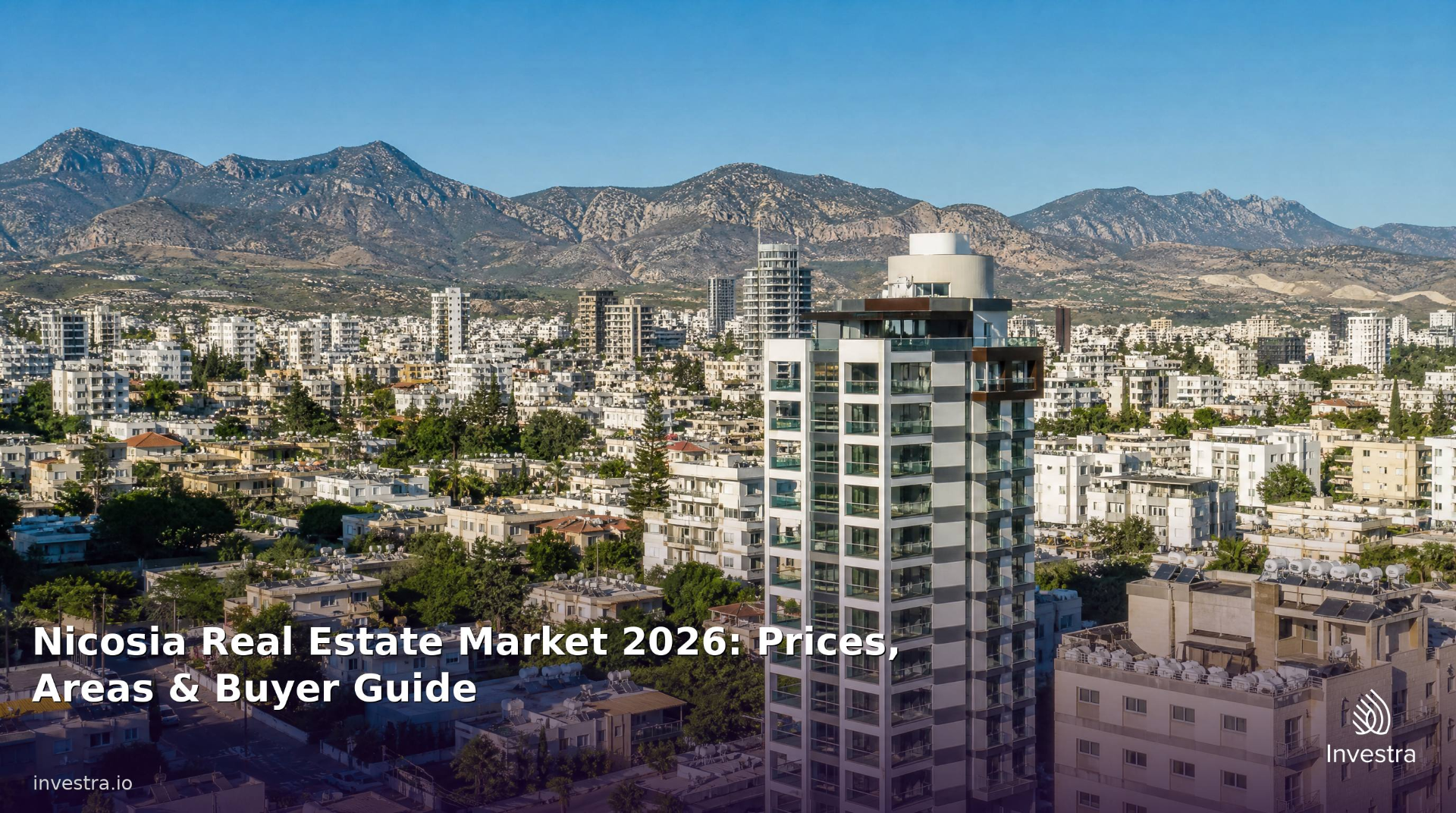
Nicosia Real Estate Market 2026: Prices, Areas & Buyer Guide
Nicosia Real Estate Market 2026: Prices, Areas & Buyer Guide
Nicosia Real Estate Market Overview 2026: North Cyprus Capital in Focus
Quick Answer: Nicosia's North Cyprus real estate market in 2026 offers some of the Mediterranean's most competitive property prices, ranging from €800 to €3,500 per m², with rental yields consistently reaching 6–10% annually — making it a standout destination for international investors seeking value and growth.
There's something quietly remarkable happening in Nicosia. While European investors chase overpriced assets in Lisbon, Barcelona, and Athens, a growing wave of savvy buyers has been redirecting capital to the northern half of Cyprus's capital city — and the numbers are starting to tell a compelling story.
This guide cuts through the noise to deliver what international buyers actually need — real price data, area breakdowns, legal processes, tax obligations, rental yield analysis, and practical advice grounded in how this market actually operates in 2026.
Understanding North Cyprus and Nicosia: The Political and Economic Context Every Buyer Needs
Quick Answer: North Cyprus operates as the TRNC, recognized only by Turkey, which creates unique legal considerations for property buyers — but these are manageable with proper due diligence, and thousands of international investors transact here annually without issue.
Before committing capital to any market, understanding the political and economic backdrop isn't optional — it's essential. North Cyprus has a unique status that directly affects property ownership, title deed classifications, and long-term asset security.
The island of Cyprus has been divided since 1974, when Turkish military intervention followed a Greek Cypriot coup attempt. The northern third of the island has since operated as the TRNC, a self-declared state recognized internationally only by Turkey.
That said, the economic picture in the TRNC has been evolving positively. GDP growth has been supported by a booming higher education sector — the TRNC hosts over 20 universities, many in or near Nicosia, attracting more than 100,000 students, predominantly from Turkey, Iran, Pakistan, Nigeria, and other countries.
Inflation in Turkey, which influences the TRNC economy substantially, has begun moderating from its 2022–2023 peaks. For real estate investors, this transition period creates a window: construction costs remain relatively low in hard currency terms, while foreign buyer demand pushes asking prices gradually upward.
Nicosia itself is a city of approximately 85,000 residents in the northern sector, with a broader metropolitan influence extending to surrounding villages. It functions as the TRNC's governmental, educational, and commercial hub.
Nicosia Property Price Ranges in 2026: What the Data Actually Shows
Quick Answer: In 2026, Nicosia property prices range from approximately €800/m² for older apartments in peripheral areas to €3,500/m² for new-build villas and premium developments in sought-after neighborhoods, with the mid-market segment (€1,200–€2,000/m²) representing the strongest volume of transactions.
Let's get into the numbers — because that's what actually matters when you're making an investment decision.
North Nicosia's property market stratifies cleanly into several price tiers. At the entry level, secondary market apartments in areas like Metehan, Ortaköy, and Göçmenköy can be acquired for €800–€1,100 per square meter. These are typically 2–3 bedroom units in older residential blocks, built in the 1980s and 1990s.
The mid-market tier — and arguably the sweet spot for most international investors — sits at €1,200–€2,000/m². This range covers newer apartment complexes, townhouses, and smaller villa developments in areas like Kermiya, Köşklüçiftlik, and the newer residential zones developing to the east of the city center.
Premium properties — high-spec villas, penthouse apartments, and development plots in prestigious areas — command €2,200–€3,500/m². These attract high-net-worth buyers from the Gulf states, Europe, and increasingly from Southeast Asia.
For comparative context: Kyrenia (the TRNC's primary coastal resort town) typically runs 15–25% higher than equivalent Nicosia properties, reflecting the premium for sea views and tourist infrastructure. Yet Nicosia consistently delivers superior rental yields because demand is year-round rather than seasonal.
New-build off-plan prices deserve special attention. Developers in Nicosia typically offer off-plan discounts of 10–20% versus completed property values, with payment plans stretched over 12–36 months. This creates value that buyers in more established European markets simply don't have access to.
The Best Areas to Buy Property in Nicosia, North Cyprus
Quick Answer: The top areas for property investment in North Nicosia include the historic walled city for character and tourism appeal, Kermiya and Köşklüçiftlik for modern residential comfort, and the university belt zones for high rental yields from student tenants.
Nicosia isn't a homogenous market. The area you choose to buy in will significantly shape your yield profile, tenant type, capital appreciation trajectory, and liquidity when it comes time to sell. Here's an honest breakdown of the key zones:
The Walled City (Old Nicosia / Lefkoşa Historic Center): The Ottoman-era heart of the city, enclosed by Venetian walls, offers some of the most characterful real estate in the entire Mediterranean. Renovated townhouses and apartments here carry enormous cultural appeal and growing interest from boutique guesthouse operators.
Kermiya: One of Nicosia's most established mid-to-upmarket residential areas, Kermiya attracts professionals, diplomatic staff, and families. The neighborhood has a mix of older villas and newer apartment complexes. Prices sit at €1,400–€2,200/m², and rental yields average 5–7%.
Köşklüçiftlik: Increasingly popular with younger professional tenants and international students at nearby universities, this area has seen significant new development activity. Modern apartment buildings with contemporary amenities characterize the area.
Göçmenköy and Ortaköy: These are classic residential suburbs with good infrastructure, established communities, and reasonable access to both the city center and the university campuses. Value-for-money is strong here, with prices in the €900–€1,500/m² range.
The University Belt (Near Eastern University, Girne American University campuses): Properties within walking distance of major university facilities are categorically different assets in this market. Student demand is structural, year-round (two semesters), and persistent regardless of broader economic conditions.
New Development Zones (Eastern and Northern Suburbs): Land is still available on the city's periphery, and several large-scale master-planned residential communities are in various stages of development. Entry prices for off-plan units in these zones start as low as €85,000 for compact one-bedroom apartments.
Legal Framework for Foreign Buyers: How Property Ownership Actually Works in North Cyprus
Quick Answer: Foreign nationals can legally purchase property in North Cyprus with TRNC Council of Ministers permission, a process that typically takes 3–6 months — but the most critical legal consideration is verifying the title deed category of any property before committing to purchase.
The legal process for foreign property purchases in North Cyprus is workable — but it requires proper professional guidance and a clear understanding of the title deed classification system. This is the area where uninformed buyers have historically run into problems, and where doing things correctly matters most.
Title Deed Categories: This is the most important concept for any buyer to understand. Properties in North Cyprus fall into several title deed categories:
Turkish Title (TRNC Title): These are properties where the ownership history is clean within the TRNC legal framework, typically land that was owned by Turkish Cypriots before 1974. These carry the lowest legal risk from an international law perspective and are generally preferred by international buyers and lenders.
Exchange Properties: These are properties where Turkish Cypriot owners from the south exchanged with Greek Cypriot owners from the north after 1974. These can be purchased, but require additional due diligence around the exchange documentation.
Allocated/Equivalent Properties: These are properties allocated by the TRNC government to Turkish Cypriot settlers. They carry more complexity regarding potential claims and are generally approached with more caution by sophisticated buyers.
Pre-1974 Greek Cypriot Title Properties: These are the most contested category. While they can be purchased within the TRNC legal framework, they carry theoretical risk related to potential future resolution of the Cyprus problem.
The Purchase Process: Once a property is identified, a buyer pays a reservation deposit (typically £1,000–£2,000 or equivalent), after which a sale contract is drafted. This contract is then registered at the Land Registry — a step that's critical and should never be skipped.
Foreign buyers must then apply to the TRNC Council of Ministers for permission to purchase. This approval is a formality for most buyers (it's refused only in cases involving military sensitive zones or buyers with criminal records), but it typically takes 3–6 months to process.
It cannot be stressed enough: engage a fully independent TRNC-registered solicitor from day one. Never use a lawyer recommended exclusively by the developer or selling agent — the conflict of interest risk is real. Legal fees typically run 1–1.5% of the purchase price. This is not a cost to minimize.
Taxes, Fees, and Total Purchase Costs in North Cyprus 2026
Quick Answer: Total buyer transaction costs in North Cyprus typically amount to 7–12% of the purchase price, covering stamp duty, VAT (if applicable on new builds), title deed transfer fees, and legal costs — a moderately competitive cost structure compared to other Mediterranean markets.
Understanding the true all-in cost of acquisition is essential for accurate return calculations. The headline price is never the final number, and in North Cyprus, the additional costs are meaningful enough to affect your investment math significantly.
Here's a realistic breakdown of what buyers actually pay:
Stamp Duty: 0.5% of the agreed purchase price, payable by the buyer within 21 days of signing the sale contract. This is relatively low compared to many European jurisdictions and is a fixed, predictable cost.
VAT (KDV): New-build properties attract 5% KDV (the TRNC equivalent of VAT). This applies to first-time sales of new construction. Resale properties between private individuals typically don't attract this charge, making the secondary market comparatively more cost-efficient for buyers.
Legal Fees: As noted, budget approximately 1–1.5% of purchase price. For a €200,000 property, that's €2,000–€3,000. This is money well spent given the complexity of the title deed landscape.
Agent/Developer Commission: Real estate agents in North Cyprus are typically paid by the seller or developer. As a buyer, you generally don't pay a separate agent commission — but confirm this arrangement in writing before proceeding.
Building Survey: Not mandatory but strongly recommended, particularly for resale properties and anything in the walled city. Budget €300–€800 for an independent structural survey.
Annual Property Tax: Relatively modest by European standards. Annual property tax (Emlak Vergisi) is calculated on official cadastral values, which are typically well below market values. Annual tax liability for a mid-range apartment is often in the €200–€500 range.
Rental Income Tax: Rental income from TRNC properties is subject to income tax at progressive rates starting from 10%. Non-residents can often structure their tax position efficiently with appropriate advice. Consulting with a professional adviser can help international investors optimize their cross-border tax position.
Total acquisition cost summary for a €200,000 property (new build): approximately €215,000–€225,000 all-in, representing a 7.5–12.5% premium over the headline price. For resale properties, the total is somewhat lower given the absence of VAT.
Rental Yields and Investment Returns: What Investors Are Actually Achieving
Quick Answer: Gross rental yields in Nicosia, North Cyprus range from 5–7% for long-term professional tenants to 8–10% in the student rental market, with certain well-managed short-term rental operations achieving 10–14% gross — placing this market among the higher-yielding residential property markets in the broader Mediterranean region.
Yield is where North Nicosia genuinely distinguishes itself from more expensive Mediterranean competitors. Let's look at what investors are realistically achieving, rather than what brochures promise.
The student rental market is the engine of Nicosia's rental economy. The TRNC's universities collectively enroll over 100,000 students, with a large proportion requiring private accommodation.
A 90 m² two-bedroom apartment purchased for €140,000 in the Köşklüçiftlik area, let to two university students at €450–€550 per month each (room rates), generates €900–€1,100 per month in gross rental income. That's €10,800–€13,200 annually, representing a gross yield of 7.7–9.4%.
Capital appreciation provides an additional return component. As noted, hard-currency appreciation in the 5–8% annual range has been the recent experience for properties transacted in euros or sterling.
The Development Landscape: New Projects and Infrastructure Driving Growth
Quick Answer: Nicosia's development pipeline in 2026 includes major university campus expansions, new residential master-planned communities on the city's periphery, and infrastructure upgrades including road network improvements and digital connectivity projects — all of which support medium-term property value appreciation.
University expansion is the primary development driver. Near Eastern University, consistently ranked among the region's top institutions, has been expanding its campus facilities and student accommodation capacity. Girne American University's Nicosia campus has similarly attracted significant investment.
The walled city rehabilitation program, supported in part by Turkish government funding, aims to restore and repurpose historic buildings in the Old Nicosia core. Several boutique hotels, cultural spaces, and renovated residential properties have emerged from this initiative in recent years.
Financing Options and Payment Structures Available to International Buyers
Quick Answer: International buyers can access local bank mortgages, international financing arrangements, and developer payment plans, with off-plan purchases often including staged payment options over 12–36 months featuring 10–20% discount structures compared to completed property values.
Most international buyers approach the TRNC property market with a significant portion of capital already secured. However, financing options do exist and are worth understanding before finalizing your purchase strategy.
Developer payment plans are arguably the more practical financing route for many international buyers. Off-plan properties are commonly offered with staged payment schedules: initial reservation (10%), stage payments aligned with construction milestones (typically 30–50%), and final settlement upon completion (10–20%).
International finance arrangements through banks in your home country are also viable, particularly for buyers with substantial assets. Some European and Middle Eastern banks offer cross-border property lending secured against TRNC real estate, though documentation and approval timelines tend to be lengthy.
Professional Property Management for Rental Operations
Quick Answer: Professional property management services are widely available in North Cyprus, typically costing 8–12% of monthly rental income, with managers handling tenant screening, rent collection, maintenance coordination, and legal compliance for investors.
The best practice is engaging a manager before purchase, obtaining references from existing investor clients, and negotiating a trial period before committing to a long-term agreement. Management quality directly impacts your net yield, so this isn't a cost to minimize.
Understanding Off-Plan Property Purchases and Developer Credibility
Quick Answer: Developers typically offer off-plan discounts of 10–20% versus completed property values with staged payment plans spanning 12–36 months, creating significant value compared to fully priced properties in more established European markets — but verifying developer credibility and structural protections is essential.
Off-plan purchases represent a meaningful portion of the TRNC property market, particularly among international investors seeking value. However, they carry distinct risks that on-the-ground diligence can substantially mitigate.
The structural protections you should verify before signing include: Does the developer hold a valid TRNC building permit? Is the project registered with the Land Registry? What happens to your deposit if the developer abandons the project? Are staged payments held in escrow, or does the developer control the funds?
Site visits at different construction stages are valuable. You're not assessing construction quality (hire a surveyor for that) — you're verifying that work is actually progressing according to schedule and the development remains active.
Currency Risk and Hard-Currency Considerations for International Investors
Quick Answer: While TRNC property prices are denominated in Turkish lira, international buyers typically transact in British pounds or euros, providing natural currency hedging — and historical data shows properties priced in hard currency have appreciated at 5–8% annually, providing asset stability beyond local inflation.
The Turkish lira has experienced significant volatility, particularly during 2022–2023 when inflation peaked above 60% annually. This created an uncomfortable dynamic for buyers: local prices were rising rapidly in lira terms, but the lira itself was depreciating against hard currencies, creating a relative pricing paradox.
The practical solution adopted by the market is straightforward: international transactions are priced and settled in British pounds or euros. This creates several advantages for foreign investors. First, it insulates you from Turkish lira volatility.
Historical appreciation for properties transacted in hard currency — rather than lira — has been approximately 5–8% annually over the 2023–2025 period. This is attractive by global standards, particularly when combined with 6–10% rental yields.
Tax Compliance and Reporting Requirements for Foreign Property Owners
Quick Answer: Rental income from TRNC properties is subject to income tax starting from 10% at progressive rates, annual property tax (Emlak Vergisi) is modest, and non-resident foreign owners should structure reporting through their home country's tax authorities — seeking professional cross-border tax advice is essential.
Your home country's tax authority almost certainly requires that you report income from foreign real estate. This is separate from TRNC
Investment Disclaimer
Quick Answer: This guide is general market information, not personal legal, tax, financing or investment advice.
Before committing to a property transaction, buyers should obtain independent local legal, tax and financial advice suited to their circumstances. Investra.io can support initial market research, but every purchase decision remains the buyer's responsibility.
Frequently Asked Questions
Quick Answer: This section explains the practical property-investment implications of Frequently Asked Questions.
What is a prudent next step after initial market research?
Use current documentation, independent professional advice and comparable local evidence before proceeding. Investra.io can support an initial structured market review.
How can buyers plan a realistic ownership budget?
Use current documentation, independent professional advice and comparable local evidence before proceeding. Investra.io can support an initial structured market review.
What evidence supports a careful investment decision?
Use current documentation, independent professional advice and comparable local evidence before proceeding. Investra.io can support an initial structured market review.
When should a buyer obtain legal and tax advice?
Use current documentation, independent professional advice and comparable local evidence before proceeding. Investra.io can support an initial structured market review.
How should a buyer compare neighbourhoods and property types?
Use current documentation, independent professional advice and comparable local evidence before proceeding. Investra.io can support an initial structured market review.
What local checks should be completed before signing?
Use current documentation, independent professional advice and comparable local evidence before proceeding. Investra.io can support an initial structured market review.
Which costs should be assessed alongside the purchase price?
Use current documentation, independent professional advice and comparable local evidence before proceeding. Investra.io can support an initial structured market review.
How can international buyers verify a property opportunity?
Use current documentation, independent professional advice and comparable local evidence before proceeding. Investra.io can support an initial structured market review.
What should buyers compare before selecting a property?
Use current documentation, independent professional advice and comparable local evidence before proceeding. Investra.io can support an initial structured market review.
Quick Answer: These answers outline common buyer checks and should be read with current professional advice.
Recommended Reading
Quick Answer: This section explains the practical property-investment implications of Recommended Reading.
- Investra market research
- Investra market research
- Investra market research
- Investra market research
- Investra market research
- Investra market research
- Investra market research
- Investra market research
- Investra market research
- Investra market research
- Investra market research
- Investra market research
- Investra market research
- Investra market research
- Investra market research
- Investra market research
- Investra market research
- Siniša Dagary investment insight
- Siniša Dagary investment insight
- Siniša Dagary investment insight
- Siniša Dagary investment insight
- Siniša Dagary investment insight
- Findes Group & Partners
- Findes Group & Partners
Connect With Investra
Follow Investra for market updates on Facebook, LinkedIn, YouTube
Related Posts
No related posts available.
