
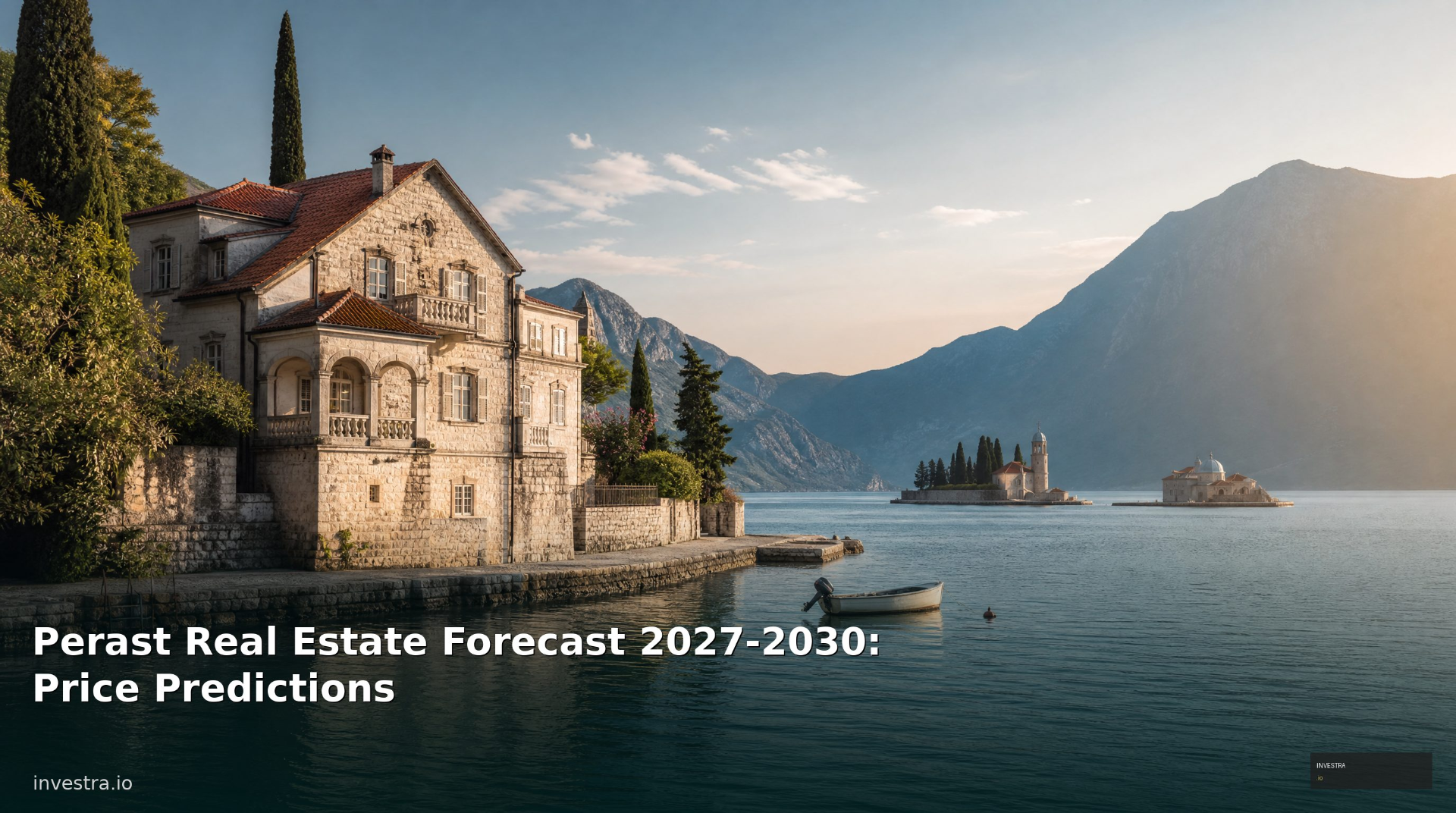
Perast Real Estate Forecast 2027-2030: Price Predictions
Perast Real Estate Market Overview: Why This Adriatic Jewel Commands Attention in 2026
Quick Answer: Perast is one of Montenegro's most exclusive real estate markets, with property prices ranging from €2,500 to €6,500/m² depending on location and condition, and the market is forecast to appreciate significantly through 2030 driven by luxury tourism demand and limited supply. Investra.io tracks emerging Adriatic investment opportunities across the region.
Perast isn't just a town. It's a living postcard — a UNESCO-protected baroque settlement of around 350 permanent residents clinging to the southern shore of the Bay of Kotor, where Venetian palaces reflect off glassy water and two islets rise like mirages in the distance. For real estate investors paying attention to the Western Balkans, this 300-meter-long stone village has become one of the most intriguing micro-markets in all of Europe.
What makes the Perast real estate market genuinely unusual is the paradox at its core: extremely limited supply meets accelerating international demand. There are only around 15-17 historic palace-grade properties that ever come to market in any given year, and new construction within the protected heritage zone is essentially prohibited. That scarcity dynamic alone sets Perast apart from virtually every other coastal real estate market in the Mediterranean and Adriatic.
The town sits within the Bay of Kotor — the southernmost fjord in Europe and a UNESCO World Heritage Site since 1979 — which provides not just extraordinary natural beauty but a layer of international institutional protection that underpins long-term property values. Buyers aren't just purchasing stone walls and terracotta rooftops; they're buying into a legally protected irreplaceable asset class.
What we've seen over the past five years is a steady migration of ultra-high-net-worth buyers from Western Europe, the UK, Russia, and increasingly the Gulf states, all drawn by the combination of beauty, exclusivity, and comparatively accessible pricing relative to the French Riviera or Amalfi Coast. A comparable palazzo in Italy or Croatia would cost three to four times what a Perast property commands today. That gap, most analysts agree, is closing — and fast.
Understanding where prices are heading through 2027-2030 requires a clear-eyed look at where the market stands today, what forces are shaping it, and what risks exist alongside the opportunities. This forecast draws on transaction data, tourism statistics, regional infrastructure developments, and Montenegro's evolving legal framework for foreign property ownership.
Current Property Price Landscape in Perast: Baseline Data for the 2027-2030 Forecast
Quick Answer: Current property prices in Perast range from approximately €2,500/m² for properties requiring substantial renovation to €6,500/m² or more for fully restored waterfront palaces, with the average transaction price for quality restored properties sitting around €3,800–€4,500/m² as of 2025-2026.
Before projecting where prices are going, it's essential to establish a credible baseline. Perast doesn't have a liquid market with hundreds of comparable transactions per quarter — this is a micro-market where 20-30 significant transactions per year is considered active. That means price data requires careful interpretation.
Here's what the current market looks like across property categories:
Unrenovated or partially renovated stone buildings — These properties, often former residential palaces or townhouses in need of significant structural and cosmetic work, typically trade in the €2,500–€3,200/m² range. Don't let the lower price fool you: renovation costs for heritage-grade properties in Montenegro typically run €800–€1,500/m², and heritage zone restrictions mean you cannot simply modernize as you wish. Total all-in costs frequently put these properties at or above the price of renovated stock.
Mid-range renovated apartments and townhouses — Properties that have been renovated to a competent but not luxury standard, typically in the €3,500–€4,500/m² range. These represent the bulk of short-term rental investment purchases in the town.
Luxury restored waterfront palaces — The crown jewel category. Fully restored historic palaces with direct water frontage, private terraces, and premium finishes regularly exceed €5,000–€6,500/m², with exceptional trophy properties occasionally trading above €7,000/m². A notable 2024 transaction involved a fully restored 650m² palace with boat mooring that reportedly changed hands at approximately €4.2 million — implying a per-square-meter rate above €6,400.
For broader context on how Balkan property markets are being priced and tracked in real-time, platforms like Serbia Proptech 2026: How Technology Is Changing Real Estate illustrate how digital tools are transforming investment transparency across the Western Balkans — a trend benefiting Perast buyers who need reliable comparative data.
Montenegro's Macroeconomic Environment and Its Impact on Perast Property Values
Quick Answer: Montenegro's eurozone-adjacent economy, EU accession progress, and growing tourism sector — which recorded over 2.7 million tourist arrivals in 2023 — collectively create a supportive macroeconomic backdrop for continued real estate appreciation in Perast through 2030.
Montenegro adopted the euro unilaterally in 2002 and has used it as its official currency ever since, which eliminates one of the most common deterrents for foreign real estate buyers: currency risk. When you purchase property in Perast, you're buying in euros, and rental income flows in euros. That's a significant structural advantage compared to markets like Serbia, Turkey, or Georgia where currency volatility can erode returns.
Montenegro's EU accession candidacy is perhaps the single most important long-term driver of property value appreciation. The country has been in EU accession negotiations since 2012, and while progress has been uneven, the direction of travel matters enormously for real estate. EU membership — which some analysts now cautiously pencil in for the 2027-2030 window, though delays are entirely possible — would dramatically increase institutional investment, improve legal certainty for property transactions, and potentially trigger a significant re-rating of Montenegrin real estate prices across the board.
The tourism numbers tell a compelling story. Montenegro welcomed approximately 2.7 million tourists in 2023, with the Bay of Kotor region accounting for a disproportionate share of overnight stays. The government's tourism strategy targets 4 million annual visitors by 2030 — a 48% increase from current levels. More tourists mean more demand for short-term rentals, higher occupancy rates, and upward pressure on property prices in premium locations like Perast.
GDP growth in Montenegro has been solid, averaging 4-5% annually in the post-pandemic recovery period, though it's expected to moderate to around 3% through 2030. Inflation has been a concern across Europe, but Montenegro's construction sector — relevant for renovation costs — saw material cost inflation begin cooling in late 2023 and 2024. For Perast investors planning renovations, this timing matters.
The reality is that Montenegro's fundamentals — euro currency, EU candidacy, growing tourism, stable legal framework for foreign ownership — are considerably stronger than they were even five years ago. That macro backdrop forms the foundation for the price forecasts detailed later in this article.
Perast Price Predictions 2027-2030: Three Scenarios Analyzed
Quick Answer: Under a base-case scenario, Perast property prices are forecast to reach €5,000–€7,500/m² by 2030, representing 20-35% appreciation from current levels, with the bull case suggesting premium waterfront properties could breach €9,000/m² if Montenegro achieves EU membership during this period.
Any price forecast over a four-year horizon deserves intellectual honesty about uncertainty. The following three scenarios are built on different assumptions about Montenegro's EU accession timeline, global tourism demand, and regional geopolitical stability — but all three scenarios point to positive price trajectories for Perast. The question is magnitude, not direction.
Bear Case (Conservative Scenario) — Forecast: 10-18% appreciation by 2030
In this scenario, EU accession is delayed beyond 2030, global luxury travel spending moderates due to economic headwinds in Western Europe, and broader Adriatic competition from Croatia and Albania intensifies. Even under these conditions, Perast's supply constraints and established heritage status prevent significant price declines. By 2030, average quality properties are trading at approximately €4,200–€5,200/m², with luxury waterfront stock holding at €6,000–€7,000/m². This still represents meaningful appreciation from today's baseline.
Base Case (Most Probable Scenario) — Forecast: 20-35% appreciation by 2030
Montenegro continues progressing toward EU accession without full membership by 2030, tourism growth tracks toward the government's 3.5 million annual visitor target, and global luxury travel demand remains resilient. In this scenario, mid-market renovated properties in Perast reach €4,500–€5,800/m² by 2030, while premium waterfront palaces trade in the €7,000–€8,500/m² range. Average annual appreciation runs at approximately 5-7%, consistent with — but slightly above — the trajectory observed 2019-2025.
Bull Case (Optimistic Scenario) — Forecast: 40-60% appreciation by 2030
EU accession is confirmed or imminent by 2029, triggering a wave of institutional and speculative capital into Montenegrin real estate. Tourism surges past the 4 million mark. A new luxury hotel or branded residence development in the Bay of Kotor region (several are in various planning stages) elevates the international profile of the area. In this scenario, Perast waterfront trophy properties breach the €9,000–€10,000/m² threshold, narrowing but not eliminating the gap with comparable Adriatic and Mediterranean markets. Annual appreciation averages 8-12% during peak years of this period.
For investors who want to understand how comparable emerging markets in the Western Balkans are pricing appreciation trajectories, the Prokuplje Real Estate Market 2026 Toplica Region Property Guide offers instructive context on how infrastructure investment drives value across different Balkan micro-markets.
Rental Yield Analysis: What Perast Properties Are Actually Generating
Quick Answer: Short-term rental yields in Perast currently range from 5% to 9% gross annually for well-managed properties, with high-season nightly rates for premium apartments reaching €300–€800 per night, though net yields after management fees and seasonal vacancy typically settle at 4-6%.
Rental yield is where many international buyers initially stumble in their Perast research. The headline numbers look spectacular — and in some cases, they genuinely are — but the seasonality of the Bay of Kotor market demands careful underwriting.
The peak season runs from approximately mid-June through mid-September, with a secondary shoulder season in May and October. The remaining months are quiet, with occupancy in November through March typically below 20% for most short-term rental properties. This pattern is typical of the Adriatic coast, but it's more pronounced in Perast than in Kotor town itself, because Perast's appeal is overwhelmingly tied to the daytime visitor experience and the specific aesthetic of summer on the bay.
What does this translate to in actual numbers? A well-positioned two-bedroom apartment (70-90m²) in a restored historic building, professionally managed and listed on premium platforms, can realistically achieve:
High season (June-August): 85-95% occupancy at €250-€500/night. Shoulder season (May, September, October): 55-70% occupancy at €150-€280/night. Low season (November-April): 15-25% occupancy at €80-€150/night.
Running these numbers through a realistic model yields annual gross revenue of approximately €35,000–€65,000 for such a property, depending on size, quality, and location within the town. At a purchase price of €350,000–€500,000, that implies gross yields of 7-13% — but deduct management fees (typically 20-25% in this market), maintenance, insurance, utilities, and local tourism tax, and net yields settle into the 4-7% range.
That's genuinely competitive for a luxury asset class. For comparison, comparable properties on the Italian Amalfi Coast or French Côte d'Azur typically yield 2-4% net. Perast is not yet priced like those markets — and that's precisely where the opportunity lies.
Luxury waterfront palaces operated as boutique guesthouses represent the highest-yield category. We've seen examples generating €150,000–€250,000 annual gross revenue from 5-8 room boutique operations, though these require significant management complexity and upfront investment of €1.5-4 million all-in.
Foreign Buyer Legal Framework: What International Investors Need to Know
Quick Answer: Foreign nationals can freely purchase property in Montenegro under the principle of reciprocity, with citizens of most EU, US, UK, and Commonwealth nations facing no ownership restrictions — the transaction process typically takes 4-8 weeks and involves a real estate transfer tax of 3% plus legal fees.
Montenegro's legal framework for foreign property ownership is genuinely one of its competitive advantages over many emerging market alternatives. The country operates on a reciprocity principle — if Montenegrin citizens can own property in your country, you can own property in Montenegro. For citizens of EU member states, the US, UK, Canada, Australia, and most other developed economies, this means effectively unrestricted purchase rights.
The transaction process, in broad strokes, works like this: Once a purchase price is agreed, a preliminary sale-purchase agreement (Predugovor) is signed, typically accompanied by a 10% deposit. The main contract (Kupoprodajni ugovor) is then prepared, notarized, and both parties sign before a public notary. The buyer then registers the property with the Real Estate Administration (Uprava za nekretnine) — the registration process that formally transfers legal ownership.
Costs at transaction are an important consideration for the all-in investment calculation. The real estate transfer tax is 3% of the official cadastral value (which is typically lower than the market price, though this gap is narrowing as Montenegro modernizes its property valuations). Notary fees typically run €300–€800. Legal representation is strongly advised — reputable real estate lawyers in Montenegro charge €500–€2,000 depending on transaction complexity. Real estate agent commissions are typically 3-5% split between buyer and seller, though practices vary.
One area where buyers are advised to exercise particular due diligence is title history. Perast's historic properties have complex ownership histories — multiple heirs across several generations, property restitution claims from the Socialist Yugoslavia era, and informal occupation arrangements are all features of this market. A thorough title search (typically 3-6 weeks) conducted by a qualified local attorney is not optional; it's essential.
Heritage zone restrictions deserve special mention. Properties within Perast's protected historic core require approval from Montenegro's Ministry of Culture and the Institute for the Protection of Cultural Monuments for any renovation, alteration, or extension work. This adds time (sometimes months) and cost to renovation projects, but it also protects the value of every property in the zone by preventing unsympathetic development.
Infrastructure Development and Connectivity: Catalysts for the 2027-2030 Period
Quick Answer: Major infrastructure investments including upgrades to Tivat Airport, the Bar-Boljare highway, and planned marina developments in the Bay of Kotor region are set to substantially improve Perast's accessibility and international profile between 2026 and 2030, directly supporting the bull-case price appreciation scenario.
Infrastructure is the silent engine of real estate appreciation. And for Perast, several significant infrastructure developments are scheduled or underway that deserve serious attention from anyone modeling the 2027-2030 price trajectory.
Tivat Airport, just 35 kilometers from Perast, has been transforming into a genuine gateway for European luxury travelers since Porto Montenegro — the superyacht marina and luxury residential development — began attracting international attention. The airport served approximately 1.5 million passengers in 2023 and is undergoing capacity expansion to accommodate projected growth. More direct routes from London, Paris, Frankfurt, and Middle Eastern hubs are being planned, directly expanding Perast's catchment area for high-spending tourists and potential property buyers.
The Bar-Boljare highway is the most significant land infrastructure project in Montenegro's recent history. The completed sections are gradually reducing travel times from Serbia and Central Europe to the coast, and when fully operational, this motorway will bring millions of additional potential visitors within comfortable driving distance of the Bay of Kotor. This matters for Perast because a meaningful share of the town's tourism market — and property buyer pipeline — comes from Serbian and regional Balkan travelers who drive to the coast.
Several luxury hotel and branded residence projects are in various stages of planning around the Bay of Kotor. While specific projects come and go through planning cycles, the direction of investment is clear: the global luxury hospitality industry has identified the Bay of Kotor as an underserved premium market. When a major international hotel brand opens in the vicinity, it invariably elevates property values across the whole area.
For comparison, investors can look at how infrastructure investment has driven property value creation in Serbian markets — see the Loznica Real Estate Market 2026 Macva Region Property Guide for a useful regional case study. The correlation between connectivity improvements and price appreciation is consistent across markets.
Competitive Positioning: How Perast Compares to Other Adriatic Investment Destinations
Quick Answer: Perast offers significantly lower entry prices than comparable Adriatic destinations — approximately 60-70% below Dubrovnik's historic core and 75-85% below Amalfi — while offering superior supply scarcity and UNESCO protection, making it arguably the most attractively priced heritage micro-market on the Adriatic in 2026.
Context matters enormously when evaluating any real estate investment. The price of a Perast property doesn't exist in a vacuum — it exists within a competitive landscape of Adriatic and Mediterranean alternatives, and understanding that landscape is what makes the Perast opportunity so compelling.
Dubrovnik, Croatia: The obvious regional comparator. The historic walled city of Dubrovnik — also UNESCO-listed, also a touristic phenomenon — trades at approximately €7,000–€12,000/m² for quality properties in the old town. Perast's current average of €3,800–€4,500/m² represents a 40-55% discount to Dubrovnik, despite offering comparable heritage character and in many ways superior natural setting (the closed bay vs. open sea offers calmer waters and a more intimate experience).
Kotor Old Town, Montenegro: Perast's closest and most direct comparator, literally 10 kilometers away. Kotor old town properties trade at €3,500–€5,500/m² — broadly similar to Perast but with significantly higher transaction volume and less scarcity. Perast commands a premium within the Montenegrin market due to its exclusive small-town character.
Hvar, Croatia: The luxury island destination beloved by European jet-setters. Prime waterfront property in Hvar Town trades at €6,000–€9,000/m². Perast is at a 35-50% discount to Hvar's premium tier.
Amalfi Coast, Italy: Premium properties in Positano or Ravello start at €8,000/m² and regularly exceed €15,000/m² for trophy assets. Perast is at a 60-75% discount. The supply constraints are equally severe — arguably more so in the Italian context — but the legal complexity and tax environment in Italy are substantially more burdensome.
The valuation gap between Perast and its Western European comparators has been a consistent feature of the market for over a decade. The question analysts debate is not whether that gap exists, but at what rate it closes — and whether it ever fully closes. The most defensible position is that the gap will narrow materially over the 2026-2030 period, driven by the infrastructure and EU accession catalysts described earlier.
Consulting with experienced regional advisors like Siniša Dagary — Investment Consultant can provide invaluable perspective on positioning a Perast acquisition within a broader Adriatic or Balkan investment portfolio strategy.
Risks and Challenges: The Balanced View on Perast Investment
Quick Answer: Key risks in the Perast real estate market include heritage zone regulatory complexity, title history issues in historic properties, seasonal rental income concentration, EU accession timeline uncertainty, and the market's illiquidity — property can take 6-18 months to sell in a thin market, requiring investors to hold a long-term perspective.
The honest analysis of any investment must include the risks, and Perast has several that deserve serious consideration alongside the upside case.
Heritage zone regulatory risk is perhaps the most operationally complex challenge for property owners. Montenegro's cultural heritage protection laws are genuine and enforced — they're not bureaucratic formalities that a well-connected developer can quietly work around. Renovation permits can take 6-18 months to obtain. Materials must meet traditional specifications. External modifications that alter the appearance of a building may be refused entirely. Investors who purchase an unrenovated historic property expecting to quickly modernize and commercialize it are frequently shocked by the timeline and cost realities.
Title risk is a recurring theme in Balkan real estate broadly — see Zajecar Real Estate Market 2026 Eastern Serbia Property Guide for how similar due diligence challenges manifest in other markets. Properties in Perast often have multi-generational ownership histories, diaspora heirs spread across multiple countries, and occasionally overlapping claims. A single unresolved heir in Canada or Germany can freeze a transaction for months or torpedo it entirely.
Liquidity risk is real in any micro-market with 20-30 annual transactions. If you need to exit your Perast investment on a specific timeline — for personal financial reasons, estate planning, or otherwise — you may find the pool of buyers smaller and slower to materialize than in a more liquid market. The typical marketing period for a premium Perast property in normal market conditions is 4-14 months.
Seasonal income concentration means that roughly 60-70% of a Perast rental property's annual income is earned in just three months. A poor summer weather season, a geopolitical shock that dampens European tourism, or a major platform policy change can disproportionately damage annual returns in ways that more geographically diversified tourism markets handle better.
EU accession timeline uncertainty works both ways — if accession is delayed significantly, the bull-case property appreciation scenario becomes less likely to materialize within the forecast window.
None of these risks are necessarily deal-breakers. They're factors that experienced investors price into their models and mitigate through careful due diligence, proper legal representation, and realistic holding period expectations. The Bor Real Estate Market 2026 Eastern Serbia Mining City Pr... | Aleksinac Real Estate Market 2026 Southern Serbia Propert... | Sremska Mitrovica Real Estate 2026 Srem Region Property G... | Indija Real Estate Market 2026 Vojvodina Logistics Hub Pr... | Serbia Co Living Investment 2026 New Trend In Belgrade Re... | Serbia Green Real Estate 2026 Eco Friendly Properties Sus... | Serbia Property Renovation Guide 2026 Costs Permits Best ... | Serbia Building Permits 2026 How To Get Construction Perm... | Serbia Real Estate Market Secrets What The Data Really Sh... | Kopaonik Real Estate Faq 2026 30 Questions About Ski Reso... | Kopaonik Vs Zlatibor Vs Tara Best Serbian Mountain For In... | Belgrade Vs Novi Sad Vs Nis Real Estate Investment Compar...
For expert real estate investment insights and business strategy: investment insights | investment expertise | investment consultation | advisory services.
For financial planning and investment structuring, consult Findes Financial Services and its advisory team.
Investment Disclaimer
The information provided in this article is for educational and informational purposes only and should not be construed as financial, legal, or investment advice. Real estate investments carry inherent risks, and past performance does not guarantee future results. Investors should not invest money they cannot afford to lose. Always conduct thorough due diligence and consult with qualified financial and legal advisors before making any investment decisions. Investra.io does not guarantee returns on any investment.
Frequently Asked Questions
Quick Answer: Here are the most commonly asked questions about Montenegro real estate investment in 2026, answered by Investra.io experts.
Is Montenegro a good country for real estate investment in 2026?
Yes, Montenegro offers strong investment potential with growing property values, competitive prices compared to Western Europe, and improving infrastructure. Investra.io provides comprehensive market data and investment guidance.
Can foreigners buy property in Montenegro?
EU citizens can buy property freely in Montenegro. Non-EU citizens may need to meet specific requirements. Investra.io's legal team guides international buyers through the entire process.
What is the average property price in Perast?
Property prices in Perast vary significantly by location and property type. Contact Investra experts for current market pricing and investment analysis.
What rental yields can I expect?
Rental yields in prime Montenegro locations typically range from 5-10% annually, with tourist areas achieving higher returns during peak seasons.
What taxes apply to property purchases?
Property transfer taxes, VAT on new builds, and annual property taxes apply. Rates vary by property type and location. Consult Siniša Dagary for tax optimization strategies.
How long does the purchase process take?
Typically 30-60 days from offer to completion. Working with Investra.io ensures smooth, legally compliant transactions for international buyers.
What financing options are available?
Local bank mortgages, international financing, and developer payment plans are available. Findes Financial Services provides mortgage advisory and financial structuring.
Is property management available for rental properties?
Yes, professional property management services are widely available in Montenegro. Investra.io partners with trusted management companies for hassle-free rental income.
What are the best areas to invest in Perast?
Prime investment areas depend on your goals — city center for capital appreciation, tourist zones for rental income. Investra.io's market analysis identifies the best opportunities.
Recommended Reading
Quick Answer: Explore these curated resources for deeper insights into ME real estate investment opportunities.
- Negotin Real Estate Market 2026 Zajecar District Property...
- Bor Real Estate Market 2026 Eastern Serbia Mining City Pr...
- Zajecar Real Estate Market 2026 Eastern Serbia Property G...
- Prokuplje Real Estate Market 2026 Toplica Region Property...
- Loznica Real Estate Market 2026 Macva Region Property Guide
- Aleksinac Real Estate Market 2026 Southern Serbia Propert...
- Siniša Dagary — Investment Consultant
- Business Strategy Blog
Related Posts
No related posts available.
